Showing posts sorted by date for query The Kingdom of the Crystal Skull. Sort by relevance Show all posts

Friday, June 30, 2023

Indiana Jones and The Dial of Destiny

Once More Without Spielberg
or
The Adventures of Old Indiana Jones
 
Released right before "Indy-pendence Day," Indiana Jones and the Dial of Destiny comes with a lot of promise and a few new wrinkles—and not just the ones on star Harrison Ford's face (although the opening sequence takes pains to "de-age" him as it takes place during World War II). This is the first of the adventures (with the exception of 28 episodes of "The Young Indiana Jones Chronicles") not to be directed by Steven Spielberg—instead it's overseen by James Mangold, who's no slouch having directed Logan and Ford vs. Ferrari. It also promises—with all the credibility that goes with the words "Farewell Tour"—to be the last of the Indiana Jones series.
 
Ford is getting "up there"—he'll be 82 on July 13th—and he's been joking since The Last Crusade that he'd prefer any next "Indy" film to be called "Indiana Jones and the Really Comfortable Bed."* Dial of Destiny doesn't prove to be that (although, he does spend some melancholic time sprawled out in a barcalounger). But age is catching up to the old whipper-snapper, and we find him in the year 1969—just after the Apollo 11 moon landing—doing more than the requisite small steps and giant leaps, certainly more than a man his age should be attempting.
Indiana—or as the world knows him Dr. Henry Walton Jones, Jr.—is spending "Moon-Day" in New York—the date of the Apollo 11 astronauts' ticker-tape parade—dreading it. He is retiring from his teaching post at Hunter College where his students are now bored by antiquities (including him!) and his teacher-prep consists of hitting the bottle rather than the books. He's alone; among the clutter of his dreary apartment are the unsigned divorce papers from Marion, one more separation in a life (and film-series) full of them. But, his class has one new auditor, Helena Shaw (
Phoebe Waller-Bridge), god-daughter to Dr. Jones and daughter of another of his allies during the second world war, Basil Shaw (Toby Jones). 
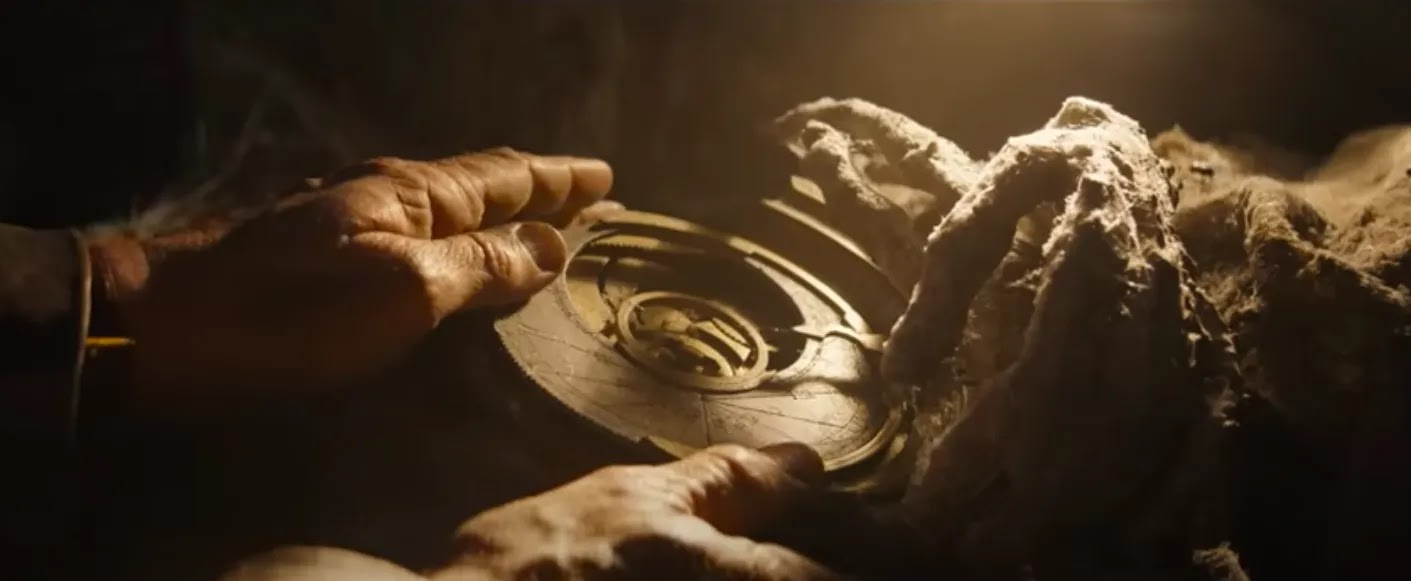
We've met Basil in the film's first sequence—a protracted chase of planes, trains, automobiles, and motorcycles to try and claim back treasures from a Nazi plunder-train to satisfy Hitler's fascination with the Occult. First, they're after the "Lance of Longinus" (which turns out to be fake), then attention is shifted to Archimedes' Dial—the Antikythera—which is of particular interest to a young Nazi physicist named Jürgen Voller (Mads Mikkelsen). The Dial was considered the first computer, constructed around 87 B.C. and was designed to calculate astronomical positions, eclipses, and the movie would have you believe it can predict geological upheavals and...time-fissures.** The trick of it is, though, that the Nazis only have half of it. They need the other half to make it work.
Anyway, Voller wants it, and Indy and "Bas'" want to keep it from him. Indy has been captured by the Nazis (of course) and they want information and he thinks all those antiquities should be in museums. While he's being threatened by the Nasties, Basil gets captured, as well, and is carted onto a train for any information about the Lance. After Indy survives an execution (several times), it becomes his mission to 1) get on that train 2) rescue Basil and 3) get all those baubles while surviving machine guns and bombing runs by the allies. All done at night, the better to hide the extensive special effects it takes to pull the sequence off, somewhat credibly.
One becomes aware, almost immediately, that Mangold is directing this entry and not Steven Spielberg (although George Lucas—who thought up the series—and Spielberg are listed as Executive Producers, they're not involved in the picture-making). It is in the DNA of Spielberg-as-director to make any sequence a playful series of complications that his shot-choices link one to the other. There's a flow that he intentionally puts into his action scenes that instantly telegraphs information to his audience. Mangold tries to do that, here, but there's a disconnect between elements that is often confusing and, at times, seems jarring to the point of obfuscation. The initial action set-piece immediately lowered my bar for expecting a superior Indiana Jones movie—as good as the other four, certainly—and those who have criticized the previous films may find themselves re-appraising their gripes (although I doubt it).
That's the set-up and the 1969-situated remainder of the movie involves the efforts to retrieve the other half of the Antikythera, which necessitates globe-trotting looking for clues to where that might be. I've always loved that element of the Indiana Jones—the tricks, the clues, the puzzles and translations unearthed from the vagaries of time and Nature. There's mounds and mounds of that, with the concomitant parallel of villains riding the research coat-tails that get in the way and delay the satisfaction of the reveals. 
In this case, its the older
Jürgen Voller, who has spent his time helping NASA with their rocket program and has gotten the co-operation of the U.S. government (specifically the C.I.A., in the form here, of Shaunette Renée Wilson doing a great "Foxy Brown" impression), and a couple of thugs (Boyd Holbrook, Olivier Richters) who have their own agenda, which is a bit more contemporary, even if they are less dramatically interesting. Throw in a kid-sidekick (Ethann Isidore) who starts out annoying and becomes gradually more entertaining.
Toss in helpers like Antonio Banderas (in too short a role) and old pal Sallah (John Rhys-Davies), and you have a nicely well-rounded cast.
Most valuable player, though, is Waller-Bridge, whose character, frankly, brings most of the energy to the whole enterprise, completing a series that seems to depend on complicated females of divided loyalties to play off Ford's adventurer-archaeologist. Sure, she probably employed just as many stunt-doubles as Ford, but her quick-witted delivery and expressions has the advantage of youth and energy. Ultimately, where Ford was previously the lynch-pin for audience identification, here, she's the character that may (eventually) engender trust to make things right, while Indy becomes something of a liability in terms of age and attitude.
The end-sequences usually are where things get a bit dicey in these things (especially where "the Wisdom of the Fan-Tribe" weigh in), where the adventurers reach the end of the road and cross over into mysticism, myth and science-fiction. And although, credulity will be snapped to the breaking-point for many, I found that sequence to be the best part of the film, worth even enough to sit through the tedious bits (although I tend to be an apologist for this series, thinking quite highly of Kingdom of the Crystal Skull).
No spoilers here, but given the rather depressed nature of the older Dr. Jones Jr. throughout the film, the fourth act makes perfect sense, story-wise and emotionally, and presents an opportunity—although one hyper-fantastically reached—to complete a series-long character arc of learning and yearning. Okay, maybe I don't "buy" how they got there, but, dramatically, the ends justify the means and presents something unique to say,
with some real resonance, about this character we've followed from youthful arrogance to wistful dotage.
And the end-sequence before the credits? (there is no post-credit scene, thank you). I'm not ashamed to say I teared up, and it made me glad I saw the two hour-twenty-minute-movie even if two hours of it I found wanting. There was no reason for a fifth Indiana Jones movie—other than the thought that maybe they shouldn't go out on the fourth one—and the whole thing is an exercise in nostalgia. The coda only emphasizes that point. But, sometimes nostalgia is pretty important. Memories of the past warm the heart, enrich the soul, and make one step into an uncertain future with the hope of finding more treasures for the memory. Nostalgia isn't "what it used to be". It can also be a beacon to face the future.
But, I can't end this without acknowledging 81 year-old Harrison Ford for making another one of these when most of us hovering around decades of his age are worried about walking the stairs of the multi-plex without using a hand-rail. That's some stamina, man, I don't call how many stunt-doubles and digital-face-replacements were used to pull it off. That should be celebrated, along with the score by 91 year old John Williams, that still manages to raise goose-bumps and make the heart soar. 
 
If this is their mutual last movie, bravo. And thank you...for the memories.

* Me, skewing towards the time-chronology of the Indiana Jones series, wanted the 1960's adventure to be titled "Indiana Jones and the Electric Kool-Aid Acid Test". Oh, well.
 
** Sure, you'll call bullshit. But, you loved the Ark of the Covenant melting Nazis, cheered when rafts were used to bail out of airplanes and sled on the Himalayas...not to mention pulling beating hearts out of chests, and were awed by the Last Surviving Knight Templar. But, you couldn't get past "nuking the fridge." The suspensions of disbelief among fans are more rickety than the bridges Indy repeatedly has to cross. How can one love the one and hate the other? I think it has to do with being a fan as a child and a jerk as an adult—you grow up but never mature. Anyway, I'm long since done trying to understand fans of the "fantasy" genre. They seem determined to destroy what distinguishes the genre from the rest—imagination and wonder. End of lecture. No, I don't have office hours and I won't meet you for a fight in the parking lot. (And...I stole your lunch).

Tuesday, June 1, 2021

The Adventures of Tintin: The Secret of the Unicorn

Written at the time of the film's release...

"The Adventures of Tintin in the Uncanny Valley"
or
"Spielberg Straight Up, No Chaser"

Everyone knows how dynamic and visceral a film-maker Steven Spielberg is. At times, he can even approach overkill, bouncing along on his little adventures, then, happily, sailing right over a cliff. Take 1941, for example, or Indiana Jones and the Kingdom of the Crystal Skull, both films of such excess that they immediately inspired ridicule. That exuberance tries the patience of many film-goers who want the director who features the Moon in his corporate logos to come back down to Earth. The term "nuking the fridge" was derisively created for the fourth Indy film (as if credulity hadn't already been crossed in the  series before...)

But, imagine (if you will...or even can) Spielberg without any constraints. I'm talking the regular constraints of film-making, the type that keep things down to the possible and even legal. Things like time, budget, light, focal-lengths, physics, natural laws (like gravity), and even the constraints for safety imposed by studio legalities and The Humane Society. Take those away—take them all away—and imagine what sort of film Steven Spielberg would make.

Scary thought, isn't it?
Now, with Peter Jackson producing, Spielberg has made his first "Avatar"-style movie, with mostly motion-capture technology, but virtually all CGI—there's no angle he can't shoot from, no perspective he can't take, no transition he can't achieve...whatever Spielberg can think, he can put on the screen, with no compromises and The Adventures of Tintin: The Secret of the Unicorn (based on three of the many Hergé books), shows what an unfettered Spielberg is capable of...and it is amazing.
And a bit headache-inducing, which I imagine would happen even without 3-D (the format I saw it in). It even approached the stage where my brain started to shut down (a phenomenon I've noticed in myself with very few movies, except for those directed by Terry Gilliam), a kind of movie-narcolepsy where I have to fight sleep, so intense and detail-filled is the movie-going experience.* Fortunately, Spielberg is so intent on making his 3-D cartoon a movie-movie, that it's quite easy to put oneself in the mode that this is happening through photographic means—only shinier, and with less dust.
So, the story of the Belgy reporter (voiced by
Jamie Bellfollowing clues and bad guys to all points of the world, trying to find the answer to the riddles of a model ship he bought at a street vendor's (and why unscrupulous people like chief villain Rackham—voiced interestingly by Daniel Craig**—might want to acquire it, by any means necessary).
And it's all done in a semi-realistic style (although tribute to Hergé's cartoony style is paid early in the film). Things are made to look real, even if the human forms are semi-cartoony. That's worked better for Pixar, whose human characters have always looked better the further they diverged from realism. Here it's a bit of a problem, especially early on in the proceedingsthere's a deadness to the eyes,*** what has been identified as "The Uncanny Valley"—the point at which, when trying to create a human simulation, the human brain (that is, a "real" human brain) rejects it, and even may be horrified by it. Examples that the film industry have taken notice of have been audiences negative reaction to the CGI baby in Pixar's first full short "Tin Toy," and the reaction of test audiences to a first-draft version of the human-looking Princess Fiona in the first ShrekThe learning curve is high in Tintin, and very quickly the issue is side-stepped with squints and off-camera looks, but it's there, initially (and, to be fair, Hergé never gave Tintin or his other characters eyes, but round pools of india ink. Imagine the horror if they did a motion-capture movie of "L'il Orphan Annie?"). But soon, events overtake our heroes, and we no longer have time to look them in the eye—it's tough enough just trying to follow them.
And that is a case of pure, undistilled Spielbergia. Enjoy.
* It's hard for me to explain what is going on (or even admit to it) when this happens. Partially, it might be because I'm not thinking much or analyzing what is happening, but just letting the images wash over me without much interpretation.  When a movie makes me think—for good or ill—I can't fall asleep.  But when there's nothing to really interpret—and there isn't much in Tintin—my mind tends to drift and be lulled.  With Gilliam and Spielberg, it might be because their movies are so full-formed and specific, there's not much for me to do.  It's like TV (which always puts me to sleep), which Marshall McLuhan labeled a "cold" medium, not asking much of its participants (if there's any participation at all), as opposed to a "hot" medium, like radio or books, where the participant's mind is active and fully functioning, filling in gaps, providing pictures and imagineering the story being fed to the brain.

** One of the really keen ideas that Spielberg brings to the table is his independence in creating the characters.  None of the voice-actors resemble their real-life counterparts—stands to reason, animators and Pixar have been doing that for years—but the recent motion-capturers, like Bob Zemeckis and James Cameron have tied their actors' likenesses to their characters, in an attempt to capture the humaness to the pixel-people.  Producer Peter Jackson, though, had no qualms about abandoning any semblance to Andy Serkis when bringing full-life to Gollum in the "Ring" trilogy.

*** One is tempted to recall Quint's soliloquy in Jaws, comparing a shark's eyes to "lifeless eyes, black eyes, like a doll's eyes. When he comes at ya, doesn't seem to be livin'."


Friday, October 18, 2019

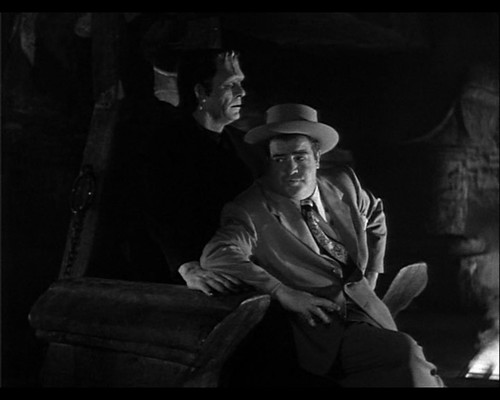
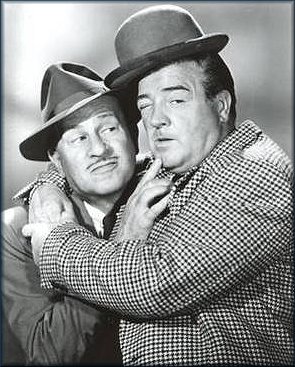
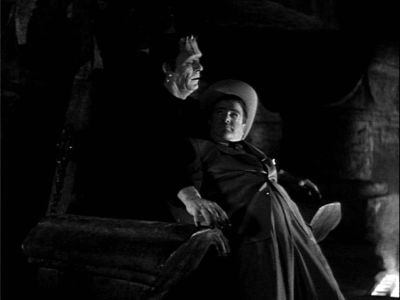
Abbott and Costello Meet Frankenstein

Abbott and Costello Meet Frankenstein (Charles Barton, 1948) The full title is Bud Abbott and Lou Costello Meet Frankenstein (as they all had the same production studio, Universal Pictures). But even that mouthful of a title leaves out two major characters in the film: Bela Lugosi re-stakes his claim as Count Dracula, the role he originated in the 1931 Universal film, and Lon Chaney, Jr. plays that poor S.O.B., Larry Talbot, aka "The Wolfman,"* who turns lycanthropic whenever the moon is full (sort of an eternal frat-boy)** 

The unholy trio of Universal met long-time companions Bud and Lou for some hi-jinks and low horror. The boys play Chick Young and Wilbur Grey, who are warehouse workers with the bad fortune to be dealing with two crates of European antiquities bound for the local museum--Dracula's coffin (with an "occupado" sign on it) and the inanimate Frankenstein Monster (victim of a dead battery). Talbot's in the neighborhood, as he's tracking the shipments for some convenient reason.
The plot revolves around Dracula's ambition to re-animate the Monster, but replace its criminal brain with a more compliant, simpler brain, and Lou's character, Wilbur Grey, is the perfect candidate. This film was a favorite of the kids in my neighborhood, and when it aired (around Hallowe'en, after "The Brakeman Bill Show"), it was the sole topic of conversation for two weeks, and endlessly recreated on the streets and playgrounds. All the Great monsters--in one movie!! Of course, it'd be great!
And it was: giddy fun with enough strangeness, horrible deeds, and the slapstick and repartee that Bud and Lou were good for. Maybe it's "Mom's Apple Pie Syndrome,"*** where the tastes of childhood circumvent our better instincts later in life, but a re-appraisal of "A + B = F" in adulthood found me admiring its competence, humor and basic story-telling construction (circuitous, though it is). It's good stuff--strictly "B" material, but when did that ever get in the way of Big "E" Entertainment?
And it had Monsters. The Bestest Monsters. The ones that represented our Id's and haunted our dreams. Given the content of my previously sex-obsessed reviews of "Frankenstein" and "Dracula," what, then, can we glean from "A + B = F?" well, despite my "longtime companion" crack, Bud and Lou were room-mates who were 'into" dames. In fact, as if to counteract the threats of homosexuality (Frankenstein) and rapacious heterosexuality (Dracula) the Monsters represent, they are SO hetero, that Lou's Wilbur has two women vying for his attentions, though "bad girl" scientist Dr. Sandra Mornay only wants him for his mind. Bud and Lou are "safe" examples of "normal" sexuality--ya know, dancing and going to parties and dressing up and nothing further than "First Base."

"Who?"

Now, don't get me started....

Wait a minute....Bud Abbott's character's name is "Chick." Hmmm.

* Chaney, son and heir-apparent to the make-up master of the Silent Era, claimed that he also stood in for Glenn Strange as The titular Monster, when the latter actor suffered an ankle injury.

** Vincent Price also makes a cameo non-appearance as "The Invisible Man!"

*** "Mom's Apple Pie" Syndrome usually rears its ugly head when dealing with "fanboy favorites," like the Star Wars films, or the Indiana Jones series, (ie. "You think the serial-mugging/teddy-bear warfare of Return of the Jedi was better than the recent Trilogy?" or "You seriously think the thuggish, racist and puppetoon Temple of Doom and slap-dash Last Crusade were "classics" compared to Kingdom of the Crystal Skull?)

Thursday, March 15, 2018

Red Sparrow

From Russia, With (JLaw)ve
or
Welcome to the Trump Nightmare

If prostitution is the world's oldest profession, "honey-trap" is probably the second. That conceit of deceit is such a useful tool of spy-craft (and entertainment about it) that one doesn't need look over the "spy" or "thriller" genre even shallowly before running into it (the first review of this month featured Dr. Mabuse, the Gambler from 1922 which had it, and in Hitchcock films, there's Notorious and North by Northwest, it's in the second of the James Bond films and the first of the novels and on and on and on). In films, the concept has always been played for romance, cheap thrills, and instilling some sense of sex and intrigue and the potential of betrayal into the thriller mix. It's a trope of the movies and thrillers, for god's sakes.

That's why it's so damn amusing to see all the "Aunt Flo's" on the internet having their hissy-fits and purple hemorrhages over Red Sparrow, the new spy thriller (based on a book—the first of ANOTHER trilogy—written by former CIA op Jason Matthews), re-teaming director Francis Lawrence (he did the Will Smith I am Legend and Water for Elephants) with his "Hunger Games" star Jennifer (no relation) Lawrence. The difference is Matthews wasn't working to amuse, but to paint a darker, colder, and more realistic "take" on the sordid business of finding an opponent's weak-spot and exploiting it, a strategy that employs all sexes and permutations. The "honey-trap" business was the first to embrace the LGBTQ community without any discrimination, whatsoever (as opposed to our military who preferred homophobia to national security after the 9-11 attacks by dismissing much-needed Farsi translators if they were gay). This is a point that Red Sparrow brings up, but does not exploit. If they had, I think there would have been less squawking about Jennifer Lawrence and the bloody violence and the sexual manipulation. Maybe. Maybe, it's because people don't like their romantic tropes and fairy-tales punctured.
Dominika Egorova (Lawrence, Jennifer Lawrence) is living the good life in Moscow. She is the prima ballerina at the Bolshoi Ballet, toasted by everyone, and feted by party officials. The position provides a good apartment downtown and medical care for her Mother, Nina (Joely Richardson), who is suffering from...we're never sure what. During her performance at the opening gala, her dancing partner, Konstantin (Sergei Polunin) lands on her leg, snapping it, effectively ending her career...and with that, will go the apartment and her Mother's care.
Dominika is approached by her Uncle Vanya (heh...oh, he's played by Matthias Schoenaerts) who is high up in Soviet Intelligence. He is (of course) sympathetic to Dominika's plight, but gives her a chance that she might be able to take care of her Mother. He has a little assignment: He wants her to seduce a Party official and replace his phone with one provided by the SRV, so they can plunder his information, but also track him and...maybe find out his voting patterns. It's sure not anything to do with Russian orphans. Just saying. He also tells her that her rival at the Bolshoi is now the prima performer, and has long been rumored to be involved with the dancer who broke Dominika's leg. It is Vanya's opinion that Dominika was "I, Tonya'd"
Dominika sneaks into the Bolshoi one night, not completely healed from her leg injury, walking on crutches. When Konstantin and her rival, Anya, are finished with their practice, she waits, and finds them in the sauna snogging. Using her cane, she attacks Anya, breaking her jaw, and beats Konstantin, effectively crippling him. Vonya notes the coincidence of the attacks, but says nothing. Dominika has a job to do.
Once she is back on her feet, a dress is provided, a room booked at a swanky hotel, and a time when the official, Ustinov, will be there. She is given the phone, but has no idea what the device will do. Her main concern is attracting the attention of Ustinov. She needn't have worried...Ustinov has left his party and is buying her a drink within two minutes of her sitting at the bar.
It is simplest of matters to convince Ustinov that she will do what he wants if he can provide medical assistance for her Mother...but she doesn't anticipate how aggressive a predator Ustinov is. Before she can even think about replacing the phones, Ustinov is attacking her. But, he is interrupted by a masked figure wrapping a wire around his throat and strangling him, his blood falling on Dominika who can only look on with horror. The masked man, an assassin named Simyonov (Sergej Onopko) tosses her some clothes, a motorcycle helmet, and an escape route past Ustinov's guards, and brought to a secure location where she is told by Vanya that the rendezvous was always going to be a "hit," that she wasn't informed to get her cooperation and, now that she's the only witness to the murder, her life will be in constant danger from intelligence officers...unless she becomes one of them. Dominika has no choice but to be sent to "Sparrow School."
Dominika has another term for it: "whore school," but for her safety and her Mother's, she goes to the remote location, where she is greeted by "Matron" (Charlotte Rampling) and she is told that her "body belongs to the state," and she and her fellow-recruits, male and female, will be taught espionage skills and the fine art of manipulating human beings to their purposes. But, first, they have to be broken down, their past lives forgotten, their attitudes erased, their inhibitions discarded—they belong to Mother Russia now, which (as Matron explains) must take the place as the supreme power of the world, given the breakdown of the West.
It's at this point, that it all clicked into place for me; Red Sparrow is merely Ian Fleming's From Russia With Love from the "honey-pot" point of view. The scenes with "Matron" have an eerie, creepy similarity and Rampling's play-book for her performance in her role is very similar to Lotte Lenya's (she played the Russian Colonel Klebb, who recruits the girl—also a former ballet dancer—to the task of seducing a spy from the other side). And, damn, if that isn't the exact-same assignment Dominika is given; a CIA agent, Nate Nash (don't laugh...he's played by Joel Edgerten) has been making regular contact with a Soviet spy named Marble (??) but after a suspicious meeting in Gorky Park that had all the appearances of some form of trap, Nash managed to escape getting caught and has fled the country. His contact has made it plain that he will only deal with Nash, who is now stationed in Budapest, and it is up to Dominika to find the agent and find out who "Marble" is, so that he can be eliminated. Just like From Russia With Love. But, without the gadgets. Or the quips. Or the train-fight. Not even an exploding helicopter.
One of the handful of times Lawrence smiles in the film.
Or the fun, for that matter. You can count on one bloody hand-print how many times Lawrence smiles in this film—her face is usually a determined inscrutability, a mask that hides what she's thinking or where her loyalties lie, which is important to the drama, and her words? She says what will gain her the most advantage, saying what everyone wants her to say.  But, it is a tough film and Dominika is ruthless, but not in an action-cartoon sort of way (like Salt or Atomic Blonde or even as "the Black Widow" is presented in the Marvel films. The fights are not balletic, the violence is...messy and bloody. There is one particularly grueling fight that seems to take as its inspiration the killing of Gromek in Hitchcock's Torn Curtain—not as stylized, though—that has its central thesis just how hard it actually is to kill someone.  
In fact, the film is brutal in ways that will make you wince...a lot. Matthews wanted to portray a more realistic spy-world where water-boarding is just a prelude for nastier ways to extract information and it is anything but glamorous. In fact, be prepared to be repulsed. There are no "nerve agents" in Red Sparrow, but the deep-rooted Soviet animus inherent in such attacks—as recent as last week's in Salisbury are very much evident. The graphic garrotings and flayings employed by the Simyonov character are merciless, and, in fact, the whole movie's tone is that way, even that of the movie's protagonist.
But it feels more "right" (or should we say "appropriate") for the movie to take this tact when morality is the farthest thing from any objective being portrayed. It's a world of blackmail and cold manipulation, and even if it does have a "kicker" that might be satisfying to an audience, one can take no pleasure in it...or the movie.
Director Lawrence makes the thing look great and he has a good cast—I haven't even mentioned that Jeremy Irons and Ciaràn Hinds are in it as high Russian functionaries—Edgerton is a bit bland, but then, he's supposed to be, and Lawrence manages to make her sparrow vulnerable when she needs to be (in the first part of the film) and deliberately opaque during the rest of the film's course, while, for the most part, keeping her Russian dialect—as tough to sell (think of Cate Blanchett in Indiana Jones and the Kingdom of the Crystal Skull) as any accent there is. She's always interesting to watch, always making tough choices, and capable of even making her state-run little monster relatable.

Saturday, November 4, 2017

Against the Wind: Indiana Jones and the Kingdom of the Crystal Skull

I was cleaning up some dead links on the blog and doing some random editing and corrections, when I noticed there were a couple of things that never made their way onto this blog, even though I mentioned them in some posts). That irritated me, probably more than the casual accidental blog-tourist who might have discovered nothing there. So, in that spirit, some corrections...and a new (semi-)feature, where I'm in a different frame of mind than the Wisdom of the Tribe. The Tribe isn't going to change it's opinion (too many of you--it'd be like herding cats), but, I'm not changing my mind, either. So, I make a case for it, and leave it to settle on its own. I'll post these on Saturday's (which is usually "Take Out the Trash" day here) under the collective title "Against the Wind."

Making Mountains Out of Mole-Hills

I've heard this film being called "critic-proof", and I'm not even sure what that means, but it implies that whatever the reviews say, people are still going to line up to see it, as if it's a critic's job to discourage people from going to see something they want to see, like it's part of the job description to trash something on your "Must-See List." And that if something truly acidic and toxic is written about it (and a Big Tall Wish is made) nobody'll see it (And they call this movie unrealistic!) Even Ford, Lucas and Spielberg were all talking (before the film's premiere at Cannes) that it was going to get savaged, and, since these guys are pros who know their stuff, it has been in some circles, mostly by mouth-breathing fan sites where "sux" dominates the descriptors.

So, despite the lowering of the bar of expectations by the film-makers, does it suck?

No. No, it doesn't.

In fact, I have to say I haven't been this delighted with a film in a long time. I will even go so far as to say that Indiana Jones and the Kingdom of the Crystal Skull fulfills the promises made by the very fine, original Raiders of the Lost Ark, something that its two sequels, however enjoyable they are in parts and particulars, never did.***

Before we go further, let us go back and recap what happened in the previous chapters...

This series (like I shouldn't have to tell you) is based on pulp serials in the B-movie tradition--episodic, cheesy, toying with History and making it up as it goes along. This one, being set in the late 50's, has to have more of a sci-fi bent than the religious-themed stories of the past set in the 30's and the 40's. It is, after all, the first adventure we've seen of Indiana Jones in a post-nuclear world. Think on that for a moment. Crystal Skull fits the period, at least cinematically, however much it messes with folks' expectations of what the film "should be" about (and let's face it, the biggest obstacle Lucas' films have are people's expectations for the "next" installment, and whether it compares to the film they already have in their head—in that case, you can't compete with what they have in mind*). Indiana Jones' timeline has finally caught up with the memories of George Lucas and Steven Spielberg.
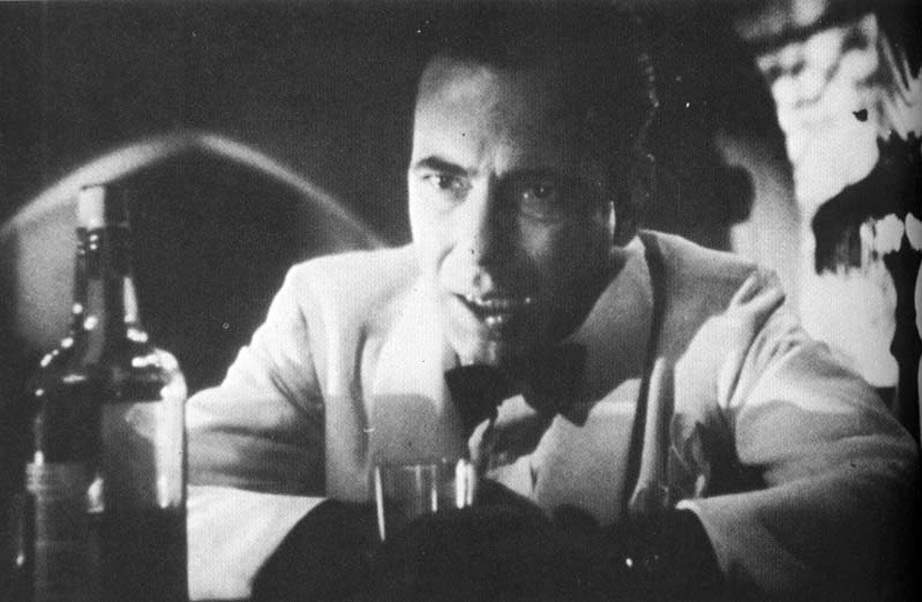
The filmmakers can't escape the fact that it's been 19 years since the last installment (and they've set it nearly twenty since the events of Last Crusade), and Harrison Ford's appearance is the nearly-constant reminder of it--he's broader, shlumpfier, more doughy in the face. But something magical happens a couple times in the film (once at a malt shop, once at a Mayan burial ground). Whether it's some CGI-gauze trick, or Ford's sense-memory playing the character kicking in, but once the dialogue turns to ancient civilizations and archaeology, the lines seem to disappear from Ford's face, and he slots back into the old/ young Indiana Jones the same way the camera "slotted" into the Bogart-drinking-his-sorrows Casablanca-shot in Raiders after Jones has seen Marion supposedly killed in a truck explosion. It's eerie, but like the occasional forays into the transcendent in the series, it's a good kind of eerie.
We've mentioned Marion, and, as the posters tell you, Marion Williams nee Ravenwood (Karen Allen) is back, and she's terrific--a breath of fresh air after Kate Capshaw's and Allison Doody's ingenues (the one too high-pitched, and the other tamped-down into irrelevance). The years have treated her far better than Ford, and she still has that incandescent smile and has been given a lot of "Dr. Jones-take-down" dialogue that suddenly snaps Ford's performance into a higher level of energy. Allen has remained well-versed in what Spielberg informed her during the first film was the "Sam Peckinpah School of Acting," something that Cate Blanchett is equally fine at--she's looser and more fun than she's been in years, and just the sight of her Commie commandant standing in a careening jeep during a bumper-cars jeep chase through the Amazon jungle is one of those things you think you'll never see.
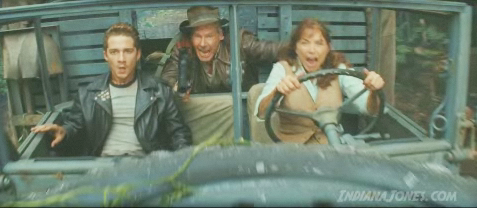
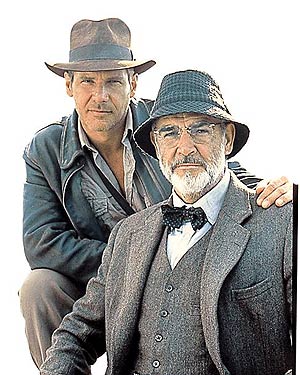
So, Shia LaBoeuf. Is he "Short-Round"-irritating, or made too much a thing of? Neither, though he has a prominent role throughout. For some reason, whether it's the magnitude of the project, or Spielberg directing, LaBoeuf's not as energetic or inventive as he's been--maybe we should call his character "Short-Leash"--but, he's a good foil for Ford and their interaction, especially in one pause in a motorcycle chase deliberately recalls the Ford-Sean Connery relationship in Last Crusade.** One is never sure if he'll be pulling out a comb or a switch-blade when he reaches into his motorcycle jacket (his aping of Marlon Brando's gear in The Wild One is a clever 50's variation of Indy's gear), and there is a great visual joke when he confronts an Amazonian resident with the same hair-cut.
As for director Spielberg, he reportedly re-studied his earlier "Indy" films to recall the way "kid-Spielberg" shot films and there are plenty of his early "headlights-into-the-camera" adrenaline shots (and even one of his Sugarland Express pans), but the takes are a bit longer-held, he's not quite so anxious to cut away, and his cinematographer Janusz Kaminski brings a new visual beauty that supplants the grit-in-the-lens of the earlier films. The elder Spielberg is also incessantly filling the film with visual ironies--grace-notes--that the younger Spielberg would save for a separate shot. There's an awful lot of stuff going on under the surface of the fire-fights, the explosions--some big ones--that betray the more mature film-maker, and man, Spielberg has become. And unlike the last two, which were short on background, and long on chase sequences, this film is over-stuffed with references, languages and the accustomed meta-recall of the past films.*** 
Not to say there isn't a lot of action. There is. That Amazon-chase between the particulars (the film is structured like a race--like Raiders and Last Crusade--with the good-guys and bad-guys all after the same thing and never too-far away from each other) is an invigorating combination of possibilities like a puzzle with every combination of inhabitant in vehicle and opponent in combat possible. It's dizzily constructed. And just when you start to think, "Wait a minute, where's..." your questions are answered.
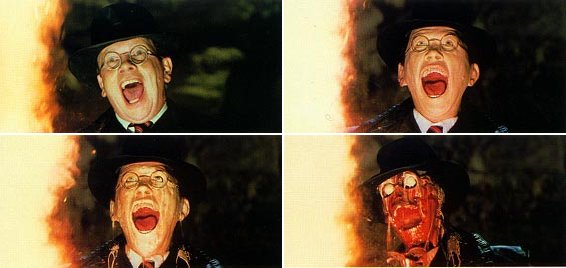
A lot of the action is outlandish, but, surprise! It always has been. How can you complain about verisimilitude when you've had melting Nazi's from the vampire-angels and God's death-ray of the Ark of the Covenant, or Thuggee priests pulling out sacrificial victim's flaming hearts, and how some victims in a lava pit burn, but the heroine-in-diaphenous pants doesn't, or 700-year old Knights Templar still guarding the Holy Grail. Get real, people. Because the movies aren't. Like Indy in The Last Crusade film-goers have to make a leap of faith, and it needs to be done with an open heart. Or at least an uncynical one. Or one open to the possibility of enjoying oneself.****
Okay now, go out there and have fun.

Wilhelm Alert: the book-carrying nerd in the library during the motorcycle chase.
-------------------------------------------------------------------------------------------------
* Somewhere along the way I've talked about "Mom's Apple Pie Syndrome"--where our memory of a cherished movie runs counter to the actual quality of the work, ie. "Nothing tastes as good as mom's apple pie," but only because that was your first run-in with the concept, and your impression of what "good" apple pie should be like may include a runny interior and scorched crust (I was blessed with a mother--God love her--who was a lousy cook, so I tend to be immune). So, too, the cherished movies of your youth may actually be crap, though we may delude ourselves otherwise, with our 'gee-whiz" innocent first impressions. The phenomenon became real for a few incredulously chagrined "Man from U.N.C.L.E." fans who, seeing the series for the first time in years on DVD last year, endearingly wondered why MGM chose to run the shows through a "crap filter" making the sets look like back-lot sound-stages with cheap "foreign" localization, lousy effects, obvious writing and some horrible performances. Ah, deluded youth. Nothing is so sweet as a young man's fancy for a film of their childhood. And nothing is so rancid as the bitterness that follows a fan-boy's crush.

But it's not the film's fault. Ever. Beauty is in the mind of the beholder.

** And if you haven't figured our the "Indiana" Jones-"Mutt" Williams relationship yet, what can I say? You're either a) five years old, b) this is your first movie or c) "denial ain't just a river in Egypt, honey." Look at their names, kids, and remember where Dr. Henry Jones, jr. came up with the name "Indiana." These films are all about clues.


*** Sometime, when Summer is over and there are no more surprises, I'm going to do a big-old analysis of this movie and why it is the natural sequel to Raiders. (Hint: It involves the clockwork-intricacies of ancient civilizations as well as the conflicts when a Man of Science is confronted with the "hard rain" of spiritual mythology) It's roots go pretty deep--which is refreshing after the previous two--and bear a full airing of the secrets buried within it. To do so now would give away far too much and contain too many spoilers of large and small varieties.
VVVVVVVVVVVVVVVVVVVVVVVVVVVVVVVVVVVVVVVVVVVVVVVVVVVVVVVVVVVVVVVVV
**** Do I have ANY complaints? Yes, the frankly extraneous character of "Mac" McHale played by Ray Winstone. McHale is designed as an untrustworthy character, but he is so untrustworthy that one wonders why he's not just shot by either party at any time during the proceedings. He's so greedy he's a bit reminiscent of Daffy Duck in a hall of treasures: "Mine, Mine, Mine!" The character is such an unnecessary plot contrivance that he might have earned the name "Aringarosa" if the name hadn't already been taken.
--------------------------------------------------------------------------------------------------------------------------

"Indiana Jones and the Terrible Age of Wonders"

Last year's fourth entry in the "Indiana Jones" saga was met with derision while it raided a diamond mine at the box-office (making it to the top of many lists of 2009's more successful films—including a conservative publication that used its Commie villains to claim that it heralded a surge by the public to right-minded films, despite the fact that the rest of the films mentioned on the list flopped...and flopped badly; Indy 4 alone raised all boats). There were complaints that it wasn't as good as the first three (a clear case of "Mom's Apple Pie" syndrome* among the fandom in fedoras—I felt it wasn't as good as the first one, but that's it): there was too much "Mutt" (Shia LaBeouf) and CGI, the familial complications too obvious, some characterizations a bit spurious,** and that it "nuked the 'fridge"—which briefly supplanted "jumped the shark" for hitting a false note in the national media (they always chortle when the fan-base eats its own) before they went back to not reporting the news. 
That last one stuck in my craw; it showed that the fan-base didn't "get" what the movies are—a post-modern, hi-tech take on the past and the low-ditch movies' past, in particular. It didn't have to adhere to "reality"—it never did. Look at Raiders of the Lost Ark, admittedly the best of the bunch—a 30's film filled with flying flap-jacks, Nazi's (Nazi's everywhere, even melting ones), Hitler myths, and tales of apocalyptic power. Nobody questioned "who" would put the rolling rock back after it crushes an intruder. Nobody asked why a tomb unopened after centuries would still have live snakes in it. One or two might have asked how Indy rode the back of a sub all the way to Nazi Island (It didn't submerge? At all? Then, why'd they take a SUB?!). Nobody questioned the ark.  It didn't have anything to do with reality, but rather with a mythic age of B-movies and wishful thinking that never existed, a cross-roads ("'X' marks the spot") between gritty, slithering reality and far-fetched fantasy, and the other films in the first trilogy followed that same map of fictional territory. 
But not as well.  Where the other two films, The Temple of Doom and The Last Crusade, failed to engage me were their wholesale abandonment of the what made the first film a Boy's Adventureland, and became a series of drawn-out chases, and half-hearted attempts at Mythos. The Temple of Doom—a favorite among some film-critics, as it challenged Indy's hero-concepts and went to darker psychological places than mere musty caves—bugged me not so much for its inaccuracies (the long fall from a plane on a life-raft, the ripping out of a sacrificial victim's flaming beating heart to the SV's—and the audience's—disbelief), but it's insistence to present a Disneyland-like "mine-shaft ride" that looked for all the world that it was populated by puppetoons. Then, there's the small detail of it being a prequel in which Jones "learns" that there's more to his mythic quests than robbing graves for fun and profit—which is intrinsic to the character, and is part of the make-up of the somewhat less-than-honorable "Indiana" Jones we first meet in the chronologically later Raiders. That lesson must not have "stuck."
But, what they do have in common—what they all do—is slap the stubbornly reality-based Jones into a sense of wonder: Raiders... confronts "Indy" with a full-on-Wrathful presentation of something that he dismissed with a casual "if you believe that sort of thing."  ...The Last Crusade makes him take a literal "leap of faith" to save both his life and his father's, and also smashes his long-held preconceptions about his Dad. "...Temple of Doom" has that previously mentioned quick-dissolving lesson of the Sankara stones and re-defines what "Fortune and Glory" can be to the doctor. "Indiana" Jones is a teacher, but in his movies, he must learn things. His character must start with a cherished "truism" and he must learn that although he may have all the answers, there are more questions that he hasn't even considered.  At one point in ...The Kingdom of the Crystal Skull, "Mutt" asks "Indiana:" "You're a teacher?"  And Spielberg weights the reply down, as it's an important one: "Part-time."

The rest of the time, he's a student himself, still learning.
In Indiana Jones and the Kingdom of the Crystal Skull, Dean Charles Stanforth (Jim Broadbent), says to Dr. Henry Jones Jr. (Harrison Ford): "We seem to have reached the age where life stops giving us things and starts taking them away." They have both aged, lost colleagues and parents, and their jobs are on the line. And "Indy" has just ridden the crest of a nuclear shock-wave in the Nevada desert, where he has seen two amazing things, off and on the Earth: the corpse of an ancient astronaut, and the limit of Man's power in the form of the mushroom cloud of a hydrogen bomb. This is the extent of our knowledge on Earth and it is a fearsome one, one that could mean our destruction at the hands of our abilities and our arrogance to use it. Behold the power of knowledge and fear.
This is the first of two images (that Spielberg deliberately composed) of "Indiana" Jones in rapt observation of an unfathomable thing that buttress Indiana Jones and the Kingdom of the Crystal Skull. In both, he is dwarfed by the event, small and helpless—all he can do is watch. In the first, he is witness to the extent of Man's knowledge.  In the second, as he watches the launch of an alien race's*** craft to inter-dimensionally travel "the spaces between spaces," something far beyond his ken and catechism. The one represents all that we know, and the other opens up another Chamber of Secrets. "Indiana" Jones can travel the four corners of the Earth, and there is still so much more territory to explore, and, indeed, more than he can know for certain. 
The personal myth that Jones must resolve is that of age and the taking away (the bomb) and the giving (the new experience). For the loner Jones, that includes new worlds to conquer...and that is celebrated here...but he also, like The Outlaw Josey Wales, finds himself, in this one, acquiring a family he didn't know he had and never wanted, flying in the face of Stanforth's gloomy assessment of their lives as being "one foot in the grave" (like "Indy" hasn't been there before). In this terrible age of wonders, there is always more to learn...more "treasure," translated by the Incas to "knowledge" and prized more than gold. Life, no matter how old we get, never stops giving.  

Not if we're observant, anyway.

For me, ...The Kingdom of the Crystal Skull represented the best, most true, antecedent to the original Raiders of the Lost Ark, fully embracing the era it is set (the 50's) and the B-movie concepts being put out at the time, and it is the strongest presentation of the concept of the "learning teacher" since Raiders...  ...The Kingdom of the Crystal Skull represented, to me, the true sequel, while the others were just regurgitating concepts. This one, like Raiders, raised the stakes.


MY only disappointment with it was, that if it's set in a 50's B-movie world, where's the giant scorpion that the hydrogen bomb creates—there were all sorts of "nukular monsters" in the films of the time, their own metaphors of the costly nature of Knowledge. But Lucas and Spielberg's intentions were to turn that metaphor inside out. Knowledge isn't destructive. It inspires creation. And new worlds to explore.
-----------------------------------------

There is talk (and only talk) of a fifth Indiana Jones movie, and while it has moved some to despair, for me it has given me fits of giggling anticipation. Imagine Indiana Jones in the B-movie drive-in 60's, with the good doctor investigating SDS students planning a lysergic acid dump in a city reservoir, while a Beatle-browed Mutt has joined a Hell's Angels sect that practices Trascendental Meditation, and only an exploration of "The Silver Chord" can save Indy from the Ultimate Bad Trip. Meantime, there are rocket-packs, video-phones, IBM computer-rooms, and ESP experts, all figments of a 1960's that briefly sparked the imaginations of the time, but never seemed to catch on. We were too busy going to the Moon, at the time.

I think it would be groovy, man.

Call it "Indiana Jones and the Electric Kool-Aid Acid Test."

* "Mom's Apple Pie" syndrome is the one where fan-boys says that the movies they liked as kids were better than anything that had come before or since (like "Mom's Apple Pie"), a clear indication that they have a narrow focus and experience.  The corrollary is that expressed when a film-maker changes a movie for whatever reason and the fan can't come to grips with it—"They raped my childhood!"—a despicable sexually ignorant comment that indicates the person hasn't known anyone who has been (or might have been) raped or attacked.

** Admittedly so, with the characters of  "Mac" (Ray Winstone) and Oxley (John Hurt)—the latter a last-minute re-write when a "retired" Sean Connery decided not to reprise his role as Indy's father. He probably decided there weren't any golf courses near filming, or his dismal experience filming The League of Extraordinary Gentlemen in Prague left such a mark it didn't compensate for his affection for Spielberg, Lucas and Ford.

*** Here's another instance of last-minute tinkering.  Lucas wanted aliens, and Spielberg with three E.T. movies under his belt didn't want to go there.  So, the ancient astronauts became "inter-dimensional" beings, rather than space-aliens.  It actually works better that way.  Aliens = space.  We know all about space.  But, other dimensions?  That's a concept that expands the mind and the territory we inhabit.  "There are more things in Heaven and Earth..."  And even, in between.