Showing posts sorted by relevance for query The Avengers. Sort by date Show all posts

Tuesday, May 5, 2015

Avengers: Age of Ultron

"Is That the Best You Can Do?"
or
Considering Sokovia's Impact on the World

The Avengers was a big deal. Two years in the teasing and planning, it was a construct of cross-character integration of the main-stays of the Marvel Movie Universe—its greatest hits of sorts—that pulled disparate elements together while celebrating the differences in its players. It found moments where those contrasts could function as story and team-building. It was a minor miracle of a movie becoming greater than its separate elements. It's writer-director, Joss Whedon, made few if any missteps in that first film and seemed to do no wrong. He became the "go-to" guy in the "Marvel Movie Universe."

And it made billions of dollars. So, anticipation was high for the inevitable second movie bringing together the team that gives their all to stop threats that have already happened—The Avengers.

That second one, Avengers: Age of Ultron, is bigger, with more characters (bringing in some of the supporting tier from the franchises to bring some color—literally—to the group—sad to say, I've been blind to the fact that all The Avengers are white, white, white) and expanding the star-factor with (roll-call!) Robert Downey Jr., Chris's Evans and HemsworthMark Ruffalo, Scarlett Johansson, Jeremy Renner, Samuel L. Jackson, Cobie Smulders, along with Don Cheadle (use this man, please!), Idris Elba (ditto!), Anthony Mackie, Stellan Skarskgård, Julie Delpy (cameo), Elizabeth Olsen and Aaron Taylor-Johnson, Paul Bettany, Hayley Atwell (cameo), Linda Cardellini, Andy Serkis (in the flesh, this time) and that's without mentioning tons of extras and floods of CGI characters—mostly doing the stunts for the leads—who briefly morph with the pixelated ones in close-ups (and some of the effects work is a bit dodgy) to let us know they showed up on stage at some point.   
There's a lot of this...
There are 21 special effects houses involved in it, two composers (Brian Tyler and Danny Elfman) for the wall-to-wall music, locations spanning the U.S. (urban and rural), South's Africa and Korea, Italy, Bangladesh and England. There are all manner of vehicles, and more action sequences that feel like free-for-all's with the occasional tag-team effort.
And a lot of this...
It's bigger, certainly. But not better. The emphasis is on action (which people like and have come to expect) and less on the character interactions (which is frankly tougher to pull off because they require imagination and not the kind that can be engineered on a drawing board), which made the first one sparkle. The villain of this one, an attempt at A.I. defense called Ultron (portrayed via motion-capture by James Spader) has little appeal—a malevolent attitude, certainly, but little wit (which made Tom Hiddleston's Loki a fun villain) and the movie suffers from the lack of anti-charm.
Far, far too much of this...
His plot is to bring peace to the world...but through extinction, and his manner of doing so is an elaborate natural disaster that will poison the planet to wipe out humanity in the same way dinosaurs were rubbed out. For an artificial intelligence, Ultron is not very bright—what good is peace if there's nothing around to enjoy it, and (by the way) no sustainable grid with which to recharge. Maybe Ultron needed more time in sleep mode to calculate his plan to the last decimal.
Not enough of this...
One nice touch is that Ultron is a mechanical version of Tony Stark (Downey) in the first Iron Man movie, trying to create a way to keep itself alive—ironic in that it is Stark whose idea to make The Avengers obsolete (and safe at home) to the world is what is the genesis of the Ultron creation. Stark's hubris cannot fathom that activating something found in the headquarters of an evil group named "Hydra" could actually not come to some good, especially empowered by the jewel in the staff that Loki (the aforementioned Hiddleston—not appearing in the movie, unfortunately) was using to blast all manner of things that displeased him in the original Avengers movie.
Way too little of this...
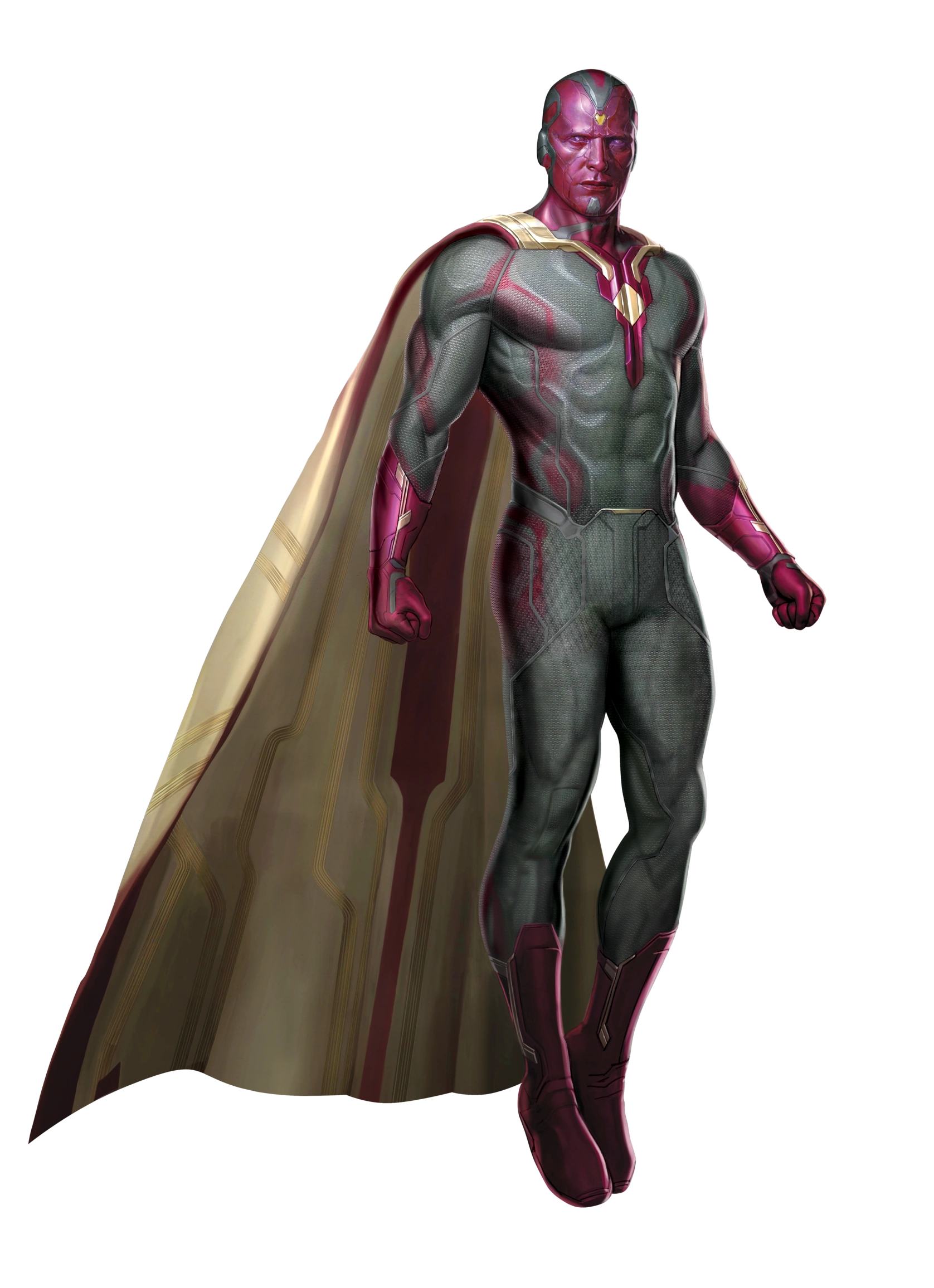
The ultimate side-effect of the combined efforts of hero and villain is "The Vision" (Bettany), a mainstay of the graphic Avengers, who, along with two others of the long-time members, Quicksilver (Taylor-Johnson) and The Scarlet Witch (Olson)—S.H.I.E.L.D. agent Maria Hill describes them as "He's fast; she's weird"—and seen in the teaser of Captain America: Winter Soldier, are introduced to the group, as well (despite the changes, this team is still as lily-white/Aryan as they come—I mean, Thor? Captain America?). They are given brief introductions, starting as unlikely allies of Ultron and then, when his clunky machinations become all too obvious, switching sides to the good guys. Olson's Witch has a brief effectiveness by invading the minds of the group's members and giving them depressing flashbacks (with cameos) that puts them in unproductive funks. The rest of the time, she has the telekinesis power of "getting the writer out of a jam." Handy.
Too much of this...
The corps is still the corps: there's the big three—Cap, Iron Man and Thor—and (as they used to sing on "Gilligan's Island") "the rest"—Hulk, Black Widow and Hawkeye—with the remnants of S.H.I.E.L.D. (Nick Fury, Hill) as support, showing up in the nick (no pun intended) of time. With the decimation of S.H.I.E.L.D HQ in CA: Winter Soldier, the Avengers now have their own New York pad—apparently the former Stark Industries—that sticks out like a sore, easily targetable thumb on the skyline—it even has the Avengers logo on it to help even the dumbest of villains know where to aim. It's no wonder that one of these complexes gets destroyed every single movie.
I'm okay with this...
"Is that all you've got?" he says, reading my mind.
Time Magazine has pointed out that, in this day of hacking, Ultron's way of doing things is not only inefficient, but hopelessly stuck in the 20th...even 19th Century. Forget the nuclear codes he has access to, Ultron should be connected enough to infect and take over anything with internet capability. But, no, Ultron, sophisticated computer-app that he is, likes to punch things. That's how this little tin god wants to take over the world. How hi-tech. The only advantage is that the superheroes have to punch back and that's what the audience wants, according to the studio. It gets so stupid that Ultron, when he could merely take over the controls of the jets the heroes are flying to make them as aerodynamic as bricks, actually gets into the cockpit of some flying machine with GPS and everything and flies around shooting things. Dumb.
This, too much...
But, let's forget about the laziness and safe writing inherent in that avoidance. The bulk of Age of Ultron couldn't accommodate anything but the broadest and simplest of problems—big set-pieces with fisticuffs and shield-tossing, and flying hammers and splintering metal. Nothing as intricate as trying to wrest control of a flying rig from an anti-auto-pilot. Not as visceral. But it might have been more interesting.
And this...
Now, that's a thought: maybe the North Koreans hacked the Disney/Marvel computers, too, and messed with the script, inserting studio notes saying "change the costumes" (to sell more toys), "need more fights," "let's see more of the white guys," and "cut the dialogue." Maybe there was an evil computer plot, after all, but behind the scenes. No such luck, I think. More likely, Marvel/Disney said, "Hey, you did such fine work last time, Whedon, we're going to interfere with it."  And it's good for the corporate sponsors to sell more cereal boxes and sippy-cups.
Maybe, it's just that first movie seemed so fresh because it was the first time seeing the "assembled" Avengers, and any follow-up was going to seem not as inspired and old-hat. Whatever the reason, this time, they're not assembling, they're dissembling—I'm not exactly sure what the point of it was, after all that, other than to make another bazillion bucks. The idea of that underwhelms me, as did the entire movie itself.

The whole film left me feeling like this: 
And this...

* Here's an asterisk without any sort of link to the main body of the text—don't strain yourself looking for it.  Also, don't stay throughout the credits expecting one last little tease.  There isn't one.  The brief appearance of Thanos (Josh Brolin) is all there is.
My favorite part...because it was unexpected.

Thursday, May 12, 2016

Captain America: Civil War

"Avengers, Dis-assemble!"
or
Marvel Presents this Captain America Movie, (Interrupted by this Avengers Movie), Interrupted by this Spider-Man Preview

Captain America: Civil War is interesting. It's very enjoyable—in fact I'd be willing to say that this completes the best superhero trilogy ever, surpassing Chris Nolan's "Dark Knight" Batman movies. But, man, some things really bug me. 

Uppermost, is the feeling I wasn't watching a movie at all, with a lot of stirring-up going on with few consequences, some conceits that seem VERY convenient for story-telling purposes, and the feeling that this was more of a demonstration film than an actual building block in the continuing story of...anybody. It is one more Marvel Universe sequel that feels like it shouldn't have been made, as, ultimately, nothing of real import happens...except for deal-making in the background—the movie-makers needed product, they front-loaded it with a lot of stars and went to a lot of trouble, but nothing in the story gets resolved. Watching a Marvel movie is beginning to feel like watching "The X-files," with the empty promise of "Yeah, but wait'll NEXT time..." 


Thanks, but where's my $10.00? ($14.00 for 3-D).

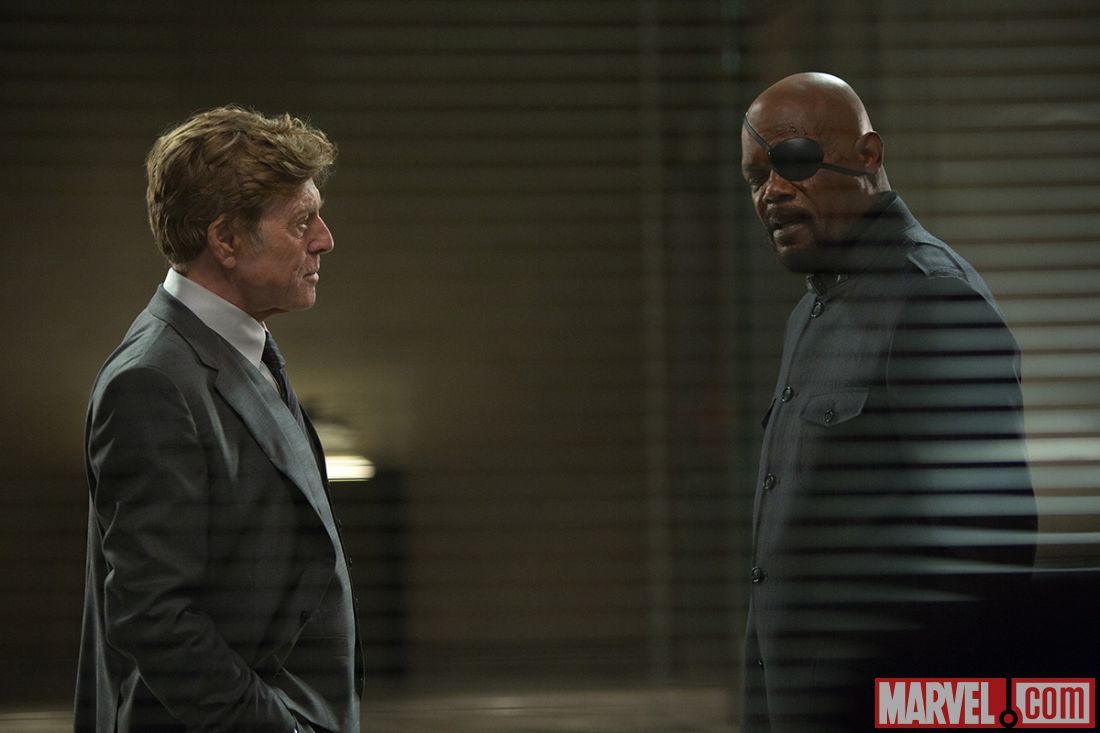
The movie does not follow the Marvel series of stories except in title and barest of essentials. After a short set-up marked "1991" (in huge numbers that crowd out anything else) set in a frozen waste that serves as Hydra Headquarters—it's either Hydra or 'SPECTRE' considering the octopus logo—in which "Bucky" Barnes' brainwashed Winter Soldier is sent on a fore-shadow mission, we find members of the Avengers (Captain America, Black Widow, Scarlet Witch and Falcon) in civvies, investigating an "Institute for Infectious Diseases" in LAGOS (in huge letters that crowd everything out), that soon comes under terrorist attack. They go into action—the first of the scheduled three action brawls that have become the norm in the Marvel Universe—and due to the actions of "Crossbones" (formerly a particularly loathsome member of SHIELD under Robert Redford's oversight), a titanic explosion occurs that causes much damage and kills quite a few civilians.

Oopsy.

"Never mind what I did, what about you guys?"
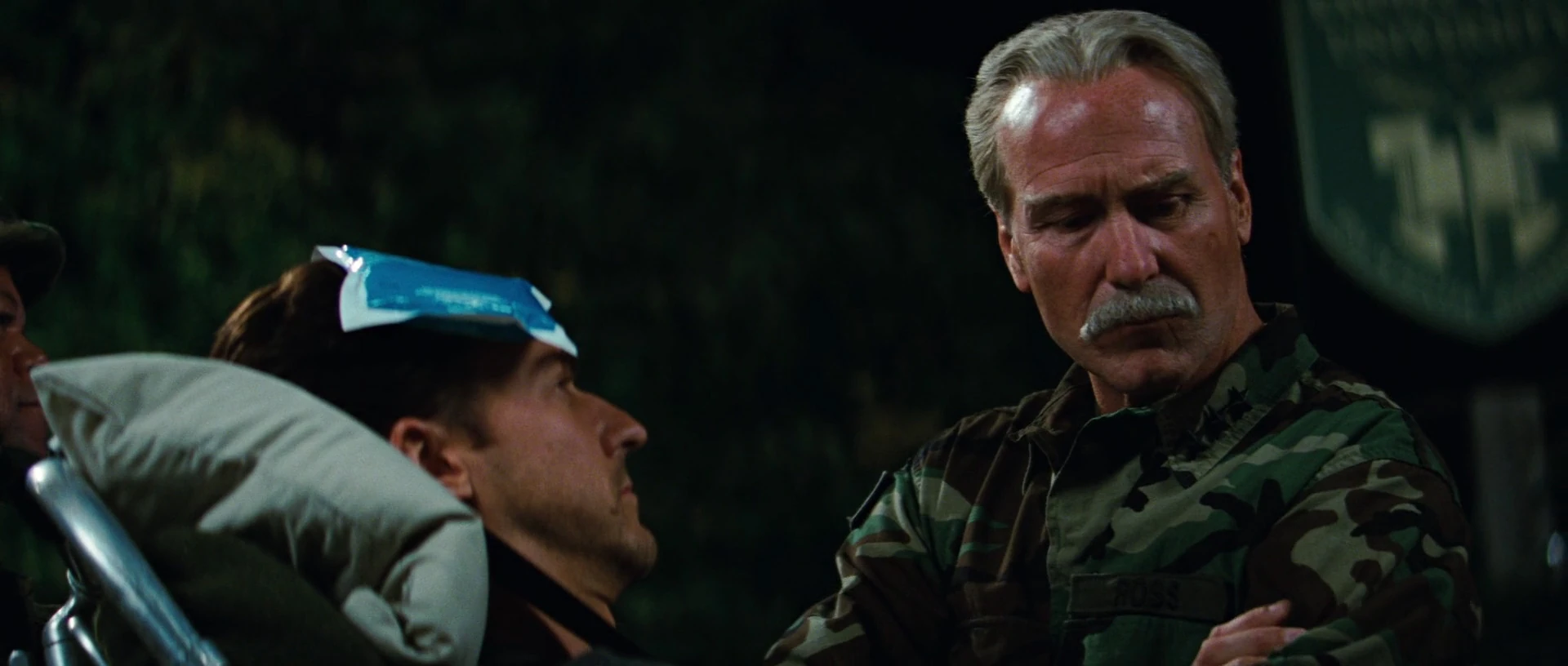
Given the fall-out of that mission, the Avengers are called to meet with the Secretary of State, the former General Thaddeus "Thunderbolt" Ross (William Hurt), not seen since the last "Hulk" movie (when Hulk was Edward Norton and not Mark Ruffalo), who castigates the group for the collateral damage caused in NEW YORK (The Avengers), WASHINGTON D.C. (Captain America: Winter Soldier) SOKOVIA (The Avengers: Age of Ultron)—but quite forgetting the damage that HE caused at Culver University and in Harlem during The Incredible Hulk (politicians LOVE to cherry-pick), and telling the team they are in desperate need of government oversight (given how well that all worked out under SHIELD—Have they rebuilt the Watergate yet?). 
The alternative to signing the United Nations' so-called Sokovia Accord is retirement (which would have been MY pick with a snide "YOU work out all the disasters from terrorists, your OWN organizations, and other dimensions, and, by the way, say "Hello" to Thanos for me, Jarhead! See ya, wouldn't wanna be ya!"). 
At the table, Rhodey, Natasha, Rogers, Wilson, Vision, and Scarlet Witch
with Stark hanging back (in case any readers are lost)
The group is divided: Steve "Captain America" Rogers is suspicious: "(The U.N.) is run by people with agendas. And agendas change" and Falcon, Scarlet Witch, and a retired Hawkeye refuse to sign. Nobody likes it, really, but, Tony Stark makes a case for it...lest The Avengers get shut down (wait a minute, wasn't HE the one trying to replace The Avengers in Age of Ultron? Can anyone keep track of Tony Stark's mood-swings? Like, maybe, the writers?). Cap won't sign despite Natasha (Black Widow), Rhodey (War Machine), Vision (the former Jarvis, Tony Stark's version of "Siri") regretfully siding with Stark. Cap walks out of the meeting, abstaining.
While Cap is attending the funeral of old girlfriend (from World War II) Peggy Carter, who has passed away, things come to a head in VIENNA (in huge letters that crowd out anything else) at the UN signing of the Sokovia Accord, when the building is attacked by a car-bomb, and evidence points to The Winter Soldier—Cap's brainwashed pal "Bucky" Barnes—as being the culprit. Why "Bucky," with his skills-set, would employ a car-bomb to do the job no one wonders, but Cap (being Cap) goes to BUCHAREST (you already know...) looking for his buddy, suspecting that he was set up. Of course, he finds him quickly, and the two hash out that the whole thing stinks, right before German counter-terrorist forces (in Bucharest?) bust in, Bucky escapes and Cap and Falcon give chase. Mixed in with the chase is another hero "The Black Panther," who is actually T'Challa (played by Chadwick Boseman, and he's terrific, as he was in 42 and Get On Up), the son of the slain King of Wakanda, killed in the VIENNA explosion.
Falcon (Sam Wilson), Cap (Steve Rogers) and the Black Panther (King T'Challa)
under arrest—are you keepin
g up?
Cap, Bucky, Falcon, and the Panther all get arrested when things come to a draw, with the Winter Soldier being trussed up in an unbreakable restraint—because those always work SO well in these movies—and shipped to BERLIN. Cap has his shield taken away and The Falcon's wings are clipped. "They are, after all, government property," says Natasha. "That's cold!" says Falcon. "Warmer than a jail-cell," shoots back Tony. Stark tries one last time to persuade Rogers to sign the Accord, rendered somewhat moot by the attack in VIENNA, but Cap isn't having any of it, especially when he finds out that Tony has the Scarlet Witch being held a virtual (heh) prisoner by The Vision back at Avengers HQ. "Sometimes I just want to punch you in those perfect teeth," persuades Tony. Somebody explain to me why HE's in charge of The Avengers?
This trick never works...
While Bucky is being interviewed by a Dr. Zemo (Daniel Brühl), the facility (which appears to be run by Martin Freeman because he's in EVERYTHING) is attacked by a pulse weapon that knocks out the power to the facility. And because the place is super-high tech to hold super-powered villains and things, there's no back-up generator that can kick in, or anti-pulse shield that can protect it. Zemo is the guy behind it all, apparently, and he has an amazing facility for finding out the secrets to the Avengers, Hydra, and every other organization's defenses (which is never explained), while our own spy agencies can't figure anything out...like putting up back-up generators in the budget.
Natasha thinks: "We have ENOUGH super-heroes. What is Sharon "Agent 13"
Carter doing here?" I wonder that myself.
While the lights are out and the security cameras down, Zemo gives Bucky the secret Russian code-words* to turn him into an unthinking killing machine, and he breaks out of his restraining cell (told ya!), Zemo makes his escape, but a freed Bucky starts smashing his way out of the place, taking out one Avenger after the other until Rogers and Wilson take him down, and find their own way of restraining him that seems to work a little better. Bucky reveals that Zemo is on his way to SIBERIA to the secret Hydra base that produced him to resurrect five other winter soldiers—just like him, but meaner. Cap determines that they need to come up with a team to get to SIBERIA, but first they have to get out of the country. That country being GERMANY.
Back in the U.S., the Scarlet Witch escapes from her attentive little android Vision with the intervention of Hawkeye (recruited by Cap), but it's the Witch that manages to overcome Vision by dropping him through several miles of the Earth's crust. She is clearly the most powerful member of The Avengers, so what is she doing as an after-thought in a Captain America movie. Along with the Scarlet Witch, Hawkeye brings along Ant-Man, reformed thief Scott Lang, at the suggestion of Wilson. Lang is eager to please and clearly has a case of Captain America hero-worship.
More incongruously, Tony shows up at the QUEENS home of Aunt May Parker (who, all of a sudden, is Marisa Tomei, who in no way shape or form, resembles the frail elderly Aunt May of the comics.) Tony's there to talk to May's nephew Peter (now Tom Holland) about a grant from his Stark Foundation (but, in reality, he has somehow heard about the "Spider-kid" flitting around New York and being Stark, tracks him down and verbally jousts with him, and offers him an "upgrade" (which considering he's Spider-man 3.0 makes things very complicated. Now, Tony can track down this "kid" but he can't track down Team Cap driving around in old Volkswagens in BERLIN. Really? With their emission problems?

Okay, enough grousing. Let's get to the good part. This sequence makes no sense unless you're a "fanboy" who "geeks" out on stuff like this. Falcon, Ant-man, Hawkeye, Scarlet Witch, Winter Soldier and Captain America are walking across a tarmac—way out in the open—to get to an Avengers jet to fly to SIBERIA to take care of Zemo and those five winter-soldiers. No flight plan. No official documents. All done undercover. 
Except they're walking out in broad daylight in the middle of a very open space—in full costume—and then, they are confronted by Iron Man, Iron Warrior, Black Widow, Vision, and the Black Panther—in full costume. This is going into Susan Sontag "camp" territory, along the lines of Adam West's Batman walking into a discotheque and telling the waiter that he doesn't want to attract attention, while he's wearing a mask and a blue satin cape. 1) Tony chooses NOW to confront them, instead of before if he's so good at tracking people, and maybe when they might be caught unawares? 2) He's doing this without the German anti-terrorist folks (who stopped them before) anywhere in the vicinity—even as a back-up? 3) He holds his ace card—Spider-man—in hiding until he can bring him in with a dramatic entrance (as "cool" as it is, it's also stupid, strategically).
Okay. Kvetching over. There then occurs, for about fifteen minutes the best part of the movie, where the two teams run at each other ("They're not stopping!" bleats Spider-man) and start fighting, and for a comics geek, this is really fun, especially with the addition of the hyper-active Spider-man, and the nearly ecstatic Ant-Man ("Everybody's got a gimmick now," grumbles Hawkeye), who both employ some surprises about dealing with the opposite combatants in moves that have not been seen before, both sides trying to stop the other, but not necessarily kill them—sort of like a WWE exhibition.
"You've got a metal arm? That's AWESOME, dude!"
(He actually says that)
For awhile, it looks like Cap's group is going to get to go to SIBERIA, with Ant-Man doing enough damage inwardly and outwardly to folks' equipment—to the point where they give Iron Man one of the best lines of the movie: "Okay, anybody on our side hiding any shocking and amazing possibilities, now's the time!"
Concern about collateral damage—which is what they're fighting about—goes out the window, as the conflict gets out of hand at the airport. But Cap and Bucky manage to get to a plane to take off, with a malfunctioning Iron Man and War Machine in hot pursuit, the Falcon running interference, and The Vision managing to fire off some blast that Falcon evades and ends up hitting War Machine, sending him plummeting to the Earth, leaving Stark pissed and determined for revenge.
"By Hrothmar's hammer, you shall be revenged..."
And yet...things come to light, too conveniently, and with the same lack of story-logic that plagues The Dark Knight and Skyfall—the villain goes to elaborate plans to create situations that he has NO idea will actually occur in the manner that he supposedly supposes. The rest of the film follows Cap and Bucky's trip to Siberia, and Iron Man's pursuit of the truth of it all, which, if he just didn't pursue it, would completely screw up the villain's plans. And it contains, a mood-change moment that is SO convenient that it desrves to be called (after the opposite, defusing attitude changer in Batman v Superman) a "Martha Moment."
And this is where Captain America: Civil War ultimately fails. There is some sharp writing going on in the microcosm, the film is full of great lines without resorting to puns and cultural humor (well, not too much, anyway). But, the picture—what the story is about, the grand arc of the movie—has no real point. One gets the sense, after all, that, for all the build-up and anticipation, the film's a bit of a let-down. It's hollow in the center like an empty Iron Man suit. Ultimately, it's about nothing, and the film ends without much changed...only intensified. Oh, Spider-man gets introduced and that's fun. But, the Avengers? Same as they ever was. The conflicts stay the same, and there's not much there to hold them together. Until another crisis comes along, which will occur, Sokovia Accords or no Sokovia Accords. Nothing, ultimately, is at stake.
"Civil War's" "Martha" Moment
The film does have Robert Downey's best acting in the entire Marvel series, and not just his penchant for ad-libbing a better line than scripted. Here he sells the many conflicting moods of Tony Stark to the point where you think the character is probably more than a little unstable, and he is, as written. The Russo's do a fine job of directing and keeping things moving...and (more importantly) keeping things clear in a very convoluted, and potentially confusing, story. The action scenes are fast, funny, and followable, with the occassional "W'oh!" moments (the opening fight, though, has that zippering stuttering quality that's starting to look like the speeded-up "undercranking" in 1940's films.
And one more fight that didn't need to happen, except the script formula demanded it
What sets Captain America: Civil War apart, though, is it's ability to have its cake and eat it, too, with that most over-used concept in this genre—the revenge story. Everything here is set up over revenge. Most of the bad guys' motives are because of revenge. "You did this to me and I'm going to make you suffer for it." Yawn. We've seen a lot of carnage in the super-hero movies, and as budgets get bigger and CGI gets better, the depictions have gotten to the point of being troubling—compare Superman II's Superman-Zod battle to the one in Man of Steel.  Age of Ultron tried to top it, while also acknowledging some bits of damage control. Both Batman v Superman and Civil War address the issue—the consequences of the previous movies influence the next ones: Bruce Wayne targets Superman over the deaths of employees at Wayne Financial in Metropolis; Zemo's actions are a direct result of the incidence in SOKOVIA.

Revenge is at the core. But CA:CW differentiates between the heroes and the villains with the issue of revenge. The bad guys want revenge. The good guys should not. And yet Stark is susceptible to it—he's merely a millionaire with weapons at his disposal, while most of the others (save Scarlet Witch, Spidey, Vision) are soldiers, they have seen the consequences of war. They know things happen. They have suffered losses (Cap's main motivation lies in the loss of Bucky Barnes during WWII). Everybody may be pointing fingers, but the blame goes to those with the wrong motivations, despite the amount of time spent trying to pin accountability. In their own fumbling way, the writers may have hit on something—the emphasis should maybe be placed more on heroics than action, on sacrifice and restraint, rather than gymnastics. Personal integrity rather than firepower. 

It may make the movies less adrenaline-pumping, but it might make them less dreary, less wearying and more inspiring. 

One should hope.
Missing in action—the two punching bags.

* Those words are:  Longing. Rusted. Seventeen. Daybreak. Furnace. Nine. Benign. Homecoming. One. Freight Car. Use then at your own risk and not around anyone with a metal arm.

Wednesday, May 1, 2019

Avengers: Endgame

It's (Marvel) Clobbering Time
or
"Get Back What We Lost—Keep What I Got (Would Be Nice)—And Not Die Trying"

Dr. Stephen Strange (Benedict Cumberbatch) said (in Avengers: Infinity War) that he had gone forward in time to see the outcome of the Avengers' battle with Thanos and that he saw 14,000,605 outcomes in which they lost and only one in which they survived.

When Marvel announced that their Avengers: Endgame would be just over 3 hours long, I thought, "Geez, do they have to show us ALL of them? Can't we just see the one?"

It turns out the one is enough to fill those 3 hours, but along with the idea of solving the problem of Thanos' grand scheme of culling 50% of the Universe's population—which takes relatively little time—it also has to reward movie-goers who have stayed through every frame of past Marvel Studios' films (starting with Iron Man in 2008) to give them what they want. 

Fan service takes a lot of time, it turns out.

There's a lot of that. "Fan service," I mean. There's a lot of call-backs, reflections, echoes, and cameo's—lots of cameo's—from past Marvel movies that they re-visit to give you that warm feeling that you're being rewarded for your recognition and thanked for your support throughout the whole, slow dissemination of the Thanos/"Infinity Stones" storyline.
And it has been a slow dissemination. My sister needed to know what movies to see in order to follow Endgame and I replied that she needed to see the Avengers series and the Captain America movies as essential (in this order: Captain America: The First Avenger, The Avengers, Captain America: The Winter Soldier, The Avengers: The Age of Ultron, Captain America: Civil War, and finally The Avengers: Infinity War), but if she wanted "electives," then the first Guardians of the Galaxy movie and Dr. Strange (maybe Captain Marvel, but not really). And that is as close to spoilers as I'm going to vault. This movie, in particular, needs a bit of background to fully appreciate it.
But, I can say the movie picks up at a singular moment for one of the Avengers after the "Finger-snap Heard 'Round the Universe." The one Avenger we didn't see in Infinity War—Hawkeye (Jeremy Renner) has his little dust-up, and it sets him on a path of retribution and vengeance that attracts the attention of the remaining Avengers, although they stay out of it and away from him for the time being. There are other issues to take care of. Nebula (Karen Gillan) and Tony Stark (Robert Downey Jr.) are marooned in space after leaving Titan following their disastrous encounter with Thanos, who is still out there...somewhere. And—lest we forget—Ant-Man (Paul Rudd) is still trapped in "the quantum realm."

And that...is all I will say about that.
I will, however say, that it goes in a completely different direction than I thought it would, thinking that Captain Marvel would play more of a role—she doesn't, but manages to be efficiently useful when the Deus' are Machina'd. Core Avengers are utilized with special emphasis on The Big Three: Downey's Iron Man, Chris Hemsworth's Thor and Chris Evans' Captain America. They are given considerably more screen-time to complete their character arcs.
And there actually are character arcs (which is why the movie ballooned to such a length). I'd groused that Infinity War was all desperate action, with little emotional resonance to it, save for the actual culling of the Universe at Thanos' left hand. Here, the emphasis is on that resonance and it gives all the actors a chance to strut their stuff rather than just furrowing their brows and assuming the position. It also separates itself from the Marvel Comic Universe by taking those characters places they just wouldn't and couldn't in the comics. I liked that.
And as good as all these performances are, I thought the acting kudo's should go to Jeremy Renner, who must serve as the audience's emotional touchstone, starting with the very first scene and to almost the very end. He is quite amazing in this.
If the movie suffers, it is from too many endings, all in the service of character, which is a worthy thing to do, especially in a superhero movie.
"Okay, how many of you have never been in space? Raise your hand."
Also, Endgame is a different Marvel movie as it is more reflective and nostalgic, looking back, rather than facing forward ("true believers") and serving as a launching point for the next one, it is a completion. For that reason, you have no need to sit through the entire end credits. There is no teaser, no preview, no dangling thread. I only wish I knew that before I sat through the entire thing.
I have quibbles—I always do. There's the "too many endings" issue, a large continuity problem, the disparate fire-power issue, a few cute lines that land with a thud (and are repeated), and Thor's hammer. I have an issue with Thor's hammer. But, that's probably just me.
"Hey, Cap, do you read me?...Cap, it's Sam, can you hear me?...On your left."
It's well-done with a lot of fine grace-notes, and a climax that is, frankly, thrilling to behold. It's quite an experience...and very, very satisfying.


Friday, April 24, 2015

Countdown to Avengers: Age of Ultron—The Avengers

The latest "Avengers" movie comes out on May first. For this month of Fridays before the premiere, we'll be re-running reviews of the movies that formed the stepping stones for this latest one. This time, we'll look at the first film went "all-in," collecting all the established Marvel heroes, whether starring in their own films or playing supporting roles, in what was hinted at in the post-credit teasers as "The Avenger Initiative." 

For this one, which was the lynch-pin of the franchise and HAD to become a success, the now-established Marvel Studios called upon a fan-favorite writer-director whose previous attempts to make a super-hero movie had been scuttled by another studio, but he was well-known attracting an audience and making a budget stretch to the point of bursting. The result was successful far beyond anyone's expectations, with the only down-sides being post-Avengers movies seemed to be a little run-of-the-mill and accusations of the "Whedonization" of the Marvel Universe.  


Whatever.  It worked like gang-busters.


"We've Got a Hulk..."
or
Playing Your "A" Game

This one is The Big Pay-Off.

Back in the day (around about Iron Man) when they started doing teasers at the end of Marvel movies for the idea of an "Avengers" event, one hoped that they could pull it off. Captain America needed to work (and it did). Iron Man II integrated other characters successfully.  They even managed to make Thor somewhat interesting. And even though two "Hulk" movies under-performed at the box-office, there was still potential there. Given the scenario of the "Ultimate Avengers" storyline (a revamp in the Marvel line that started everything over from Origin Story Square One with a decidedly more adult, realistic attitude...and a Nick Fury that looked like Samuel L. Jackson) a case could be made for a good old fashioned Marvel Jam story of the "When Titans Clash!" school.

The problem is all those heroes. It could turn into a mighty cluster, if there isn't a compelling story that slots heroes into appropriate scenarios, a problem with some of the "X-Men" films. And one also hopes that there's a compelling reason for these guys to be here, that there is some character function going on, even though they have plenty of screen-time in their own series to work on those.

Will The Avengers "assemble" into a well-functioning superhero romp, and make Joss Whedon (who excels at ensembles) an A-list director that fans have been hoping for?
"Yes" to the former and "Maybe" to the latter, although pulling off this one is not an easy feat—so many particular and persnickety stars, so many owned and exploitable characters that corporations (and opposing film studios) want to manage, and so many potential minefields that it would take a superhero (with levitating powers) to rise above and negotiate them.  But Marvel's The Avengers (what they're calling this one to avoid any confusion) manages to be fast-paced, quick-witted, and, although slightly derivative (mostly of Jack Kirby's "Fourth World" series, with hints of The Andromeda Strain in sub-text, and, let's face it, most mythology and comic book tropes), and is, as one character analogizes, "a bag full of cats," fulfills its basic tenet: to be consistently entertaining, with crises every few minutes, wonders to behold (some of the sets are simply amazing), interesting pair-ups in terms of fights (Marvel heroes are always fighting each otherthey're very turf-oriented, which is bad because they're all in New York) and dialogue. 
And it does two essential things: keep each individual hero definable in tone and action, and make those fights "followable"—this isn't a hodge-podge of pictures of punches, muzzle-flares and explosions, there is breathing room between sequences and shots, so an audience is allowed to register action and result, something missing from a lot of action movies, where there is either bad direction or a style-disconnect between various "units" filming. It feels "of a piece," despite the subject of the film being about extraordinary outcasts aligning uneasily.*
In a pithy line of dialogue between "Iron Man" Tony Stark (Robert Downey, Jr. riffing brilliantly) and villain Loki (Tom Hiddlestone, registering far more than he did in the Thor movie)—everybody gets their Loki scene, The Hulk's being the best—the entire movie is summed up in an adamantium-encased nut-shell: "Yeah, takes us a while to get any traction, I'll give you that one but, let's do a head count here. Your brother, the demi-god; a super soldier, a living legend who kind of lives up to the legend; a man with breath-taking anger management issues; a couple of master assassins, and you, big fella, you've managed to piss off every single one of them."  

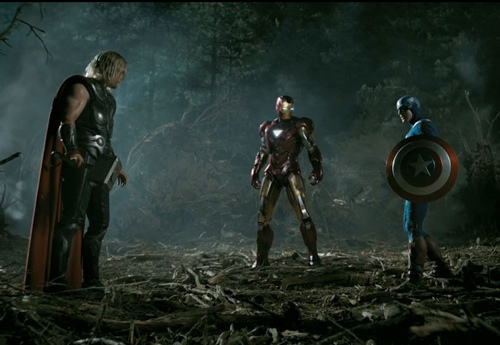
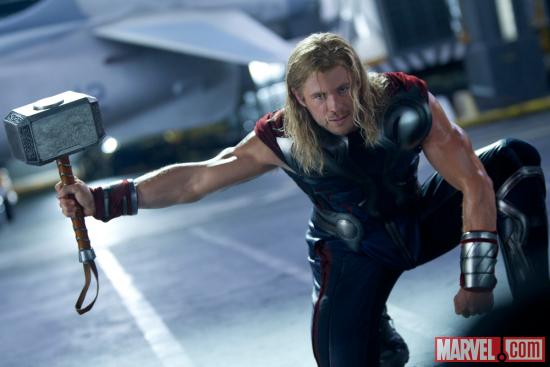
Motivation enough to form a coalition of the willing.  And the disparate styles of the players is well-evidenced-six degrees of declaration: Chris Evans is all un-ironic directness (even though he is perfectly capable of matching Downey snark-for-snark); Chris Hemsworth is all stentorian brio done with Shakespearean force (he's so much more effective here than in his own movie); Jeremy Renner is as taut as his crossbow wire, Scarlett Johnasson's blank-stared Black Widow is well-suited for her position as a lethal scam-artist, Samuel L. Jackson manages to make even original lines sound like oft-quoted cliches; and Downey, quick and mercurial, dances around the dialogue, adding his own steps. Each actor has their own way of working with Whedon's words, and Downey's pace has everyone playing their "A" game.
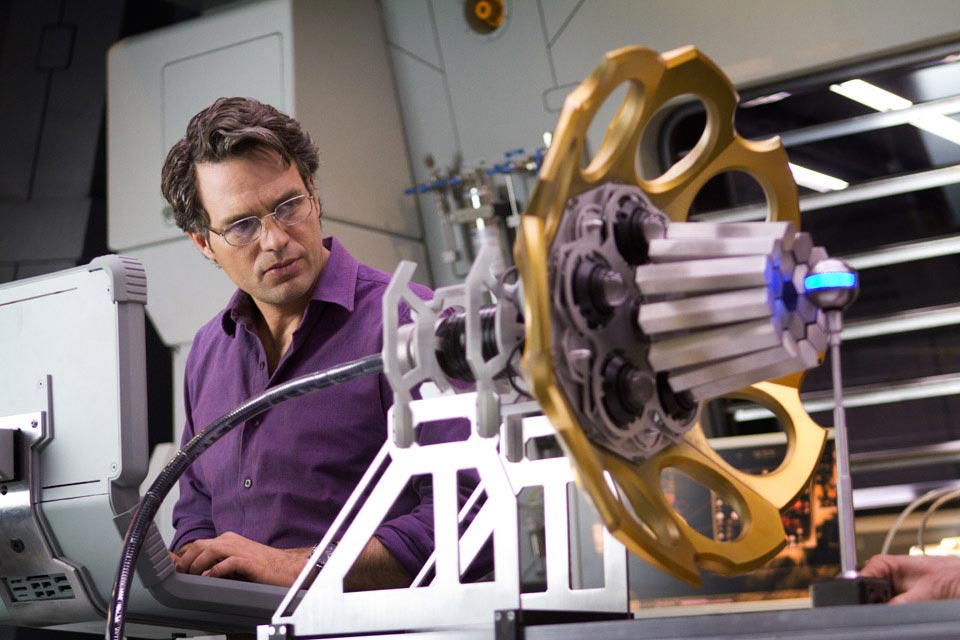
But the best here is Mark Ruffalo, playing Dr. Bruce Banner and (the first time an actor is allowed to, via motion-capture) his altered super-ego, The Hulk. Two movies and two different actors (Eric Bana and Edward Norton, no slouches) tried to do something with the limited premise and came up short. However, here, with less screen-time, Ruffalo manages to make Banner as interesting as his comically destructive "Other Guy," his physicist not guarded or fearful or weak (as has been the norm), but ironically bitter, resignedly haunted, the most mysterious of Marvel's "Mystery-Men."  "You really have got a lid on it, haven't you?" says Stark at one point, referring to the Doctor's self-control and the monstrous result of any lack of it. "What's your secret? Mellow jazz? Bongo drums? Huge bag of weed?"  Maybe The Hulk is such a one-smash pony that he's at his best as a supporting character, rather than the star of a movie series. One could argue that about all the characters here with the exception of Downey's Iron Man, who is, due to the actor's efforts, a one-man circus.
But, here it's all in the group, nobody's around long enough to drag it down, and it's the interactions that count. The plot is MacGuffin-oriented in the Marvel-style of "I-don't-know-what-it-is-but-it-sure-is-big:" the doohickey from Captain America and the whatsit from Thor are involved so that a race of advanced aliens can take over l'il old us. Not sure of the motivation, but who cares? Marvel's The Avengers is big, bold, brassy and breezy, and has the feel and crazy zeal of those Japanese monster movies that combined a lot of characters and smashed them together.

I don't know what it is, but it sure is fun.**
All the potential Avengers, assembled by George (every little detail) Perez

* Whedon shows the eventual alliance solidifying in two nicely planned shots, one—used in all the commercials—orbiting the heroes as they "circle the wagons," and a meticulously planned CGI sequence in mid-battle that is the super-hero equivalent of "going around the horn."

** There are TWO codas this time: one after the initial credits (before they get into the detail stuff) and another one that was filmed right after the Hollywood premiere that's odd...but fun.