Saturday, June 24, 2023

The Perks of Being a Wallflower

Written at the time of the film's release...

Something from Nothing
or
No Man is an Island of Misfit Toys 

Charlie (Logan Lerman) is starting his first year in High School as a freshman and he has a lot to learn. He's shy, introverted, and fragile the result of some trauma we know not what going in. He walks the corridors friendless, a punching bag for the cool kids and their posses. His parents (Dylan McDermott and Kate Walsh) are lightly caring, and his English teacher (Paul Rudd) reassures—"If you make one friend on your first day, you'll do good." "If my English professor is the only friend I make today, that'll be sorta depressing."

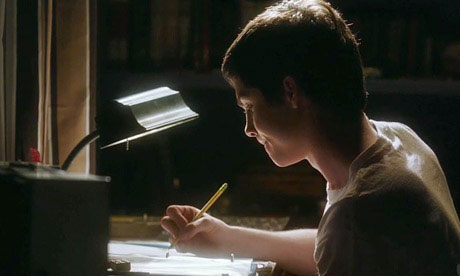
But Charlie does have one friend, writing to him about his experiences, pouring out his frustrations and observations in letter after letter about his "trying not to be a loser." The friend is anonymous, may not even exist, or once existed, but those letters keep Charlie going and serve as his avenue of expression, rather than having his day pulled out of him at the family dinner table. It's an uphill battle from some valley that isn't discussed, but Charlie is self-aware enough to know some perspective. "My life is officially an after-school special," he grouses.

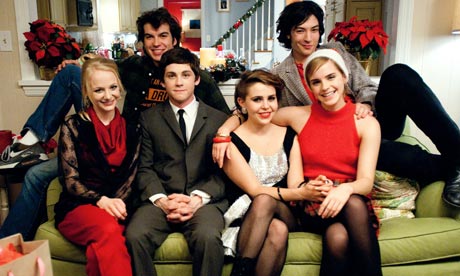
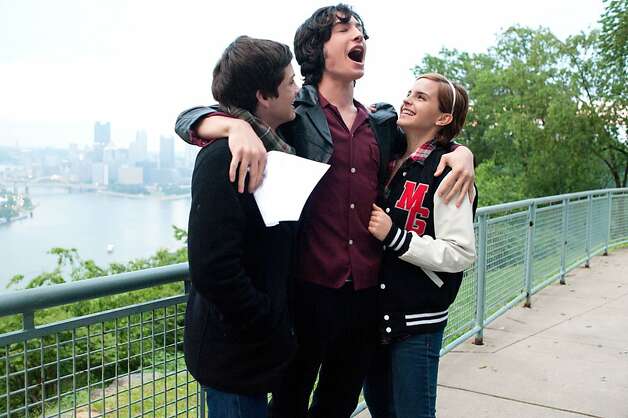
At a football game, he meets Patrick (Ezra Miller), a senior and the subject of some casual bullying, but Patrick has a wicked sense of humor that he throws out with no hesitancy as a shield. Charlie gravitates to him, and meets Patrick's step-sister Sam (Emma Watson), also a Senior, but who is coming back from "having a reputation." After the football game, the three hang out at a diner and compare notes of commonality, which involve a distinct lack of fitting in with the high school social structure, and Charlie is introduced to more of the group, who hold fast, hang out, and provide safety in numbers and a fresh perspective on the puerile benefits of normalcy.

The Perks of Being a Wallflower
(written and directed by Steven Chbosky from his own novel) is a fine quirky example of a "Coming of Age" movie, that sub-set of the teen flick where lessons are learned (his life really is an after-school special) and is not so much a film about growing up, as growing out. Growing out of the insular self-inspection, narcissism and selfishness that is comfortable and has no risk, it's dark and warm and safe in that little "black cave of the psyche." But is it? That cave only echoes one's own thoughts back to us, providing no perspective and no horizon to reach to or for.

Yeah, it's pretty safe in there...if there aren't any demons or other creatures of the nightmare lying in wait to strike when you're most vulnerable. And we all have those. And even if we don't, the echoes of our own thoughts are only phantoms and zephyrs, not sustaining, and if that's all we cling to, they become echoes of echoes, distorting, becoming less clear, and often impenetrably undecipherable—a feedback loop. 


And feedback loops, uninterrupted, can become weapons.
Charlie is scared. And ashamed. And that limits his choices, when he does make a choice. Most of the time, things are just foisted on him and he has to make a decision: like this, or don't? Comfortable or not? Aware, or comatose? And by the time, he makes a decision, it's usually too late, putting him a tail-spin, and another trap. His fellow wallflowers are in traps, too (isn't that what High School is all about?), but one thing he learns is that they're not the only ones and the traps, self-made or imposed are universal.

It's a good film, with good imagery, but a neophyte director's tendency to hit things a little too square—the shot from the communion wafer to the LSD tab, please—but the performances feel real, Emma Watson is a helluva dancer, and it's a good trip down memory lane, now that it's gone and out of our lives. "See ya, wouldn't wanna be ya"


For the truth of the matter is, we all grow out. We couldn't survive if we didn't. Yes, "we are infinite" as the movie's tag line wants to be sure we know.  

But not individually.

And not by ourselves.
Out of the black cave and into the light

Friday, June 23, 2023

The Diving Bell and the Butterfly

The Diving Bell and the Butterfly aka "Le Scaphandre et la Papillon" (Julian Schnabel, 2007)

"Still Life with Wandering 'I'"

At one point, early in Julian Schnabel's inexplicably gripping realization of Jean-Dominique Bauby's blink-by-blink account of his coping with a paralyzing stroke, the camera leaves the confines of the eye of Bauby (his paralysis is nearly total, only his left eye is capable of movement in order to scan his world, and communicate with those around him) and changes perspective to move across the room in a blur to witness his mistress putting up pictures from his past to aid in his recovery. That surrealistic freeing moment allows us (the audience) the chance to change perspective as well; instead of looking out from Bauby's fixed position, as will happen a good 60-70% of the time, we turn inward and see an approximation of his thoughts. Or are those his thoughts; could it be an hallucination; could it be an out-of-body experience; could it be his soul talking?
Bauby's condition is referred to clinically as "
Locked-In Syndrome," where the brain is active, although the body cannot move. And Schnabel's film gives a lie to the label, as Bauby's life-in-paralysis is anything but locked-in. Although he is frequently only a passenger in his life, Schnabel points out that reality and perception is only when component to a life. There is also the vast store of life inside the mind.
Throughout the film we are privy to Bauby's internal life,
* but often those thoughts become images--memories, imaginings, lusts, fantasies, body-images. Rarely are there violations of the POV rule, where we share Bauby's point of view in whatever form it takes, and turn around to see his minimal reactions--a quivering lip, a tear, a drool. But even those are edited to form a piece of the whole--to make a sum of Jean-Do's experience of a "still," but rich life.**
Variations on the one-point perspective:
The Normal: Jean-Do's point of view from his hospital bed

Extreme POV: Bauby watches his right eye-lid being sewn shut

Break-Out: Jean-Do extrapolates out from his view-point to see his mistress' face

Body-image: Jean-Do imagines himself unable to move underwater in a rigid diving suit

Fantasy: Jean-Do imagines his isolation on a family outing at the beach.

Memory: Jean-Do remembers shaving his father (Max Von Sydow)--
a time when he assisted someone who was helpless

Interpretation: Pictures hung in his hospital room, abnormally close, contrasting

Memory or Imagination: Calving glaciers--a symbol of decay?

Hallucination: Is his mistress visiting or not?

Scene-setting: Jean-Do imagining his interaction, or director convenience?

Reality
* Even though the producers are American, and the scriptwriter and director are British, the entire film is in french dialect at Schnabel's insistence. It has an added benefit--it is one more "remove" from Bauby. We can hear his thoughts, but, unless you're French and speak it, it needs to be translated, just as his internal thoughts needed to be communicated through his eye-blinks and interpreted. It is one more level of audience-sympathy with the subject.  
 
** Schnabel couldn't adhere completely to that rule--In the phone conversation with his publisher, the director cuts to the publisher's office to see her quandary about agreeing to a book by a paraplegic—something Bauby is not privy to, and his nurse cannot see.

U.S. Marshals

U.S. Marshals (Stuart Baird, 1998) A sequel to The Fugitive, but where that film's Dr. Richard Kimble had been captured and cleared of the murder of his wife, it would seem a little silly to have him go through the same situations, innocent of another horrible crime with which he's charged. 

Talk about "Double Jeopardy!"


But, Tommy Lee Jones received a much-deserved Oscar for his portrayal of U.S. Marshal Sam Gerard, so if the success of The Fugitive dictated a follow-up, best that it concentrate on Gerard and his team of dedicated if eccentric agents working with him, that made so much of an impact in the earlier film. So, along with Jones, came back Joe Pantoliano, Daniel Roebuck, Tom Wood, and LaTanya Richardson Jackson, their wise-cracking timing just as smart-alecky and operating just enough off the rails for "Big Dog" Gerard to rein them in.
But, whereas Gerard in the first film is the active member of a squad seeking to run down a fugitive from justice, here he stumbles into the assignment, accidentally becoming involved in the case in a situation not unlike how the character—with a different first name—was directly, and personally, involved in the escape of the TV "Fugitive." He's part of the deputized contingent escorting prisoners when the transport carrying them suffers a catastrophic accident.
How did he get there? A fugitive-round-up that goes a bit South leading to "excessive force" complaints puts him in dutch with his commander (Kate Nelligan), and as "punishment" he's assigned to escort his prisoners to their holding facility by plane.
Too bad that he doesn't know that the movie's been following a parallel track of following an unrelated investigation into the murder of two Diplomatic Security Service agents trying to stop an exchange of diplomatic secrets. The main suspect of that case is one Mark Roberts (Wesley Snipes), who has been posing as a truck driver but was arrested following a traffic accident. Roberts' fingerprint was found on the scene of that double-murder and now he's being transported on that same plane. Trouble is, he's been targeted for assassination, and that attempt led to the plane crashing. Roberts escapes and Gerard leads the investigation to find him.
He's not alone, though. Along with his usual squad, he's saddled with DSS agent Royce (
Robert Downey Jr.), who's a special kind of cocky that just rubs everybody the wrong way, and who's in a big "hurry-up" to apprehend Roberts, even if it means disobeying procedure and going all-cowboy, moves that turn Gerard twenty-five shades of cranky.
While Roberts is working underground to find out why he's been framed, Gerard and crew go to the source to find out about their quarry. Security footage of that double homicide shows two things—that Roberts' actions were self-defense and that he was wearing gloves, contrary to the fingerprint evidence he'd been assured of. But, Gerard being Gerard, he still pursues leads leading to Roberts, while also wanting to find out what the story is. Complications arise to make him double-down on his efforts to find Roberts—who he learns is actually a CIA operative named Mark Sheridan, suspected of trying to sell U.S. intelligence to the Chinese.
Director Stuart Baird started his career in film as an editor—and a great one, at that--editing Tommy, Die Hard 2, and several films of Richard Donner's including The Omen, Superman, and the first two Lethal Weapon films. His first film as director, the Kurt Russell starrer Executive Decision, was a Warner Bros. programmer that proved to be a trial by fire with quarreling actors—only slightly mollified by million dollar pay-checks—and he was able to deliver a fast, furious hijacking drama that had the momentum to keep plot-holes pushed to the backs of audience's minds.*
U.S.Marshals was his second stint in the director's chair** and he had big expectations to fill. The Fugitive had been a big action hit and Baird and his scripter (John Pogue) stacked the film with chases, a couple of spectacular stunts, and shifting narratives and divided loyalties. He also had a bigger canvas--Executive Decision was claustrophobically centered around the interior of a 747 Boeing passenger jet--and he took advantage of it, not only employing varying urban environments, but also Louisiana swamps, even a massive grain freighter.
But, the highlight stunt is one that parallels the "Kimble jumps the dam" sequence in The Fugitive—although appearing much later in its respective film—is Sheridan's jump from the roof-ledge of a building to catch a moving train. It is absolutely ludicrous in imaginable consequences and injuries, but Baird's set-up and editing makes it look plausible...and thrilling...even if Gerard is slow in firing his pistol.

This is the second film for much of the cast and they're all uniformly great.  The only exception being Robert Downey jr. who, frankly, "protests too much" in his role as the square peg in Gerard's posse. Downey is a miracle-worker as an actor, no one could dispute that, but, here, he works against the movie as much as he seems to work against bringing this fugitive in. Where someone in his position should be a bit more low-key, Downey's performance is a grand-stander that immediately puts him in the audience's cross-hairs as somebody "not right." And for all the tsuris his character causes Gerard, you wonder why Deputy Marshal Sam doesn't just keep him out of the way by assigning him clerical work.
U.S.Marshals is almost a very good movie, if it didn't stumble so much trying to be as good as The Fugitive, but, unfortunately, it takes a very simple formula and complicates it to no good effect. In raising the stakes, it instead just diminishes the returns.

* For example: Sheridan heals awfully fast—his auto accident at the beginning of the film breaks his arm and puts him in a neck-brace, yet that doesn't seem to slow him down any; "Mythbusters" proved that a Smith & Wesson pistol couldn't shoot out the window of an passenger plane, so a less-powerful zip-gun CERTAINLY shouldn't, which would've stopped the movie in its tracks; and although I appreciate Irène Jacob (as Sheridan's girlfriend) running around in a little black dress, it's absolutely ludicrous that Sheridan would attempt to go on the run with her in the cemetery scene—even if she was wearing sensible shoes.
 
** Baird's third--and so far last—directing effort was the fourth--and last—film featuring the "Star Trek: The Next Generation" cast, Nemesis. He has continued to edit films, most notably two James Bond films of the Daniel Craig era, Casino Royale and Skyfall.

Wednesday, June 21, 2023

Trance (2013)

Post-Modern-Femi-Noir
or
I See London, I See Trance

Danny Boyle has been on something of a tear lately. His last couple films have been popular show-cases of how diverse and direct his story-telling skills can be now, and resonant with audiences. And yet none of his recent films should have "worked:" Oscar-winning Slumdog Millionaire's combination of pop culture, Bollywood, gangsterism and classic literature; 127 Hours' brutal and claustrophobic story about a man  who cuts off his own arm, which still manages to be uplifting and even inspiring. Boyle is now a household name and an A-list director thanks to Slumdog. His previous film, the sardonic sci-fi film Sunshine did not attract an audience, nor did his kids' film Millions (despite being delightful, both for kids and adults). His new prestige made him the natural choice to become the creative director for last year's London Olympics.
It was while working on them that the opportunity came to take a break, and he rushed this film,
 Trance, into production—not that you could tell, it's full of his multi-media eclecticism that at times can run out of control. The script had already been directed (by its writer Joe Aherne) as a TV movie in 2001. It's a heist film with several twists, and, as Doyle has said in interviews, it was a dark tonic to the celebratory work he was doing for the Games.
We are introduced to the movie by Simon (James McAvoy) who gives us a brief art history lesson on particular paintings and their peculiarities. But one thing about this ersatz collection sets them apart; "You haven't seen them because they've been stolen." Simon works as an art auctioneer and walks us through a brief summary of audacious art thefts, and the precautions that auction houses take to protect their commodities. "Lesson number one," though, is "don't be a hero. No work of art is worth a human life."
"Rule No. 1: Don't Be a Hero."
It's a lesson he should take to heart. A robbery does take place, and true to instructions, Simon isn't a hero--he's in on it, the job's "inside man.' But, in the shell-game of keeping up appearances, he is given a severe head trauma, and (isn't this a pretty picture?) can't remember what he did with the painting.
This is, of course, quite upsetting to the ringleader, Franck (Vincent Cassell), who tries to extract the information in the typical gangster fashion (old fashioned threats of death, disfigurement, and the actual pulling out of  fingernails). Nothing breaks through Simon's personal pentimento.
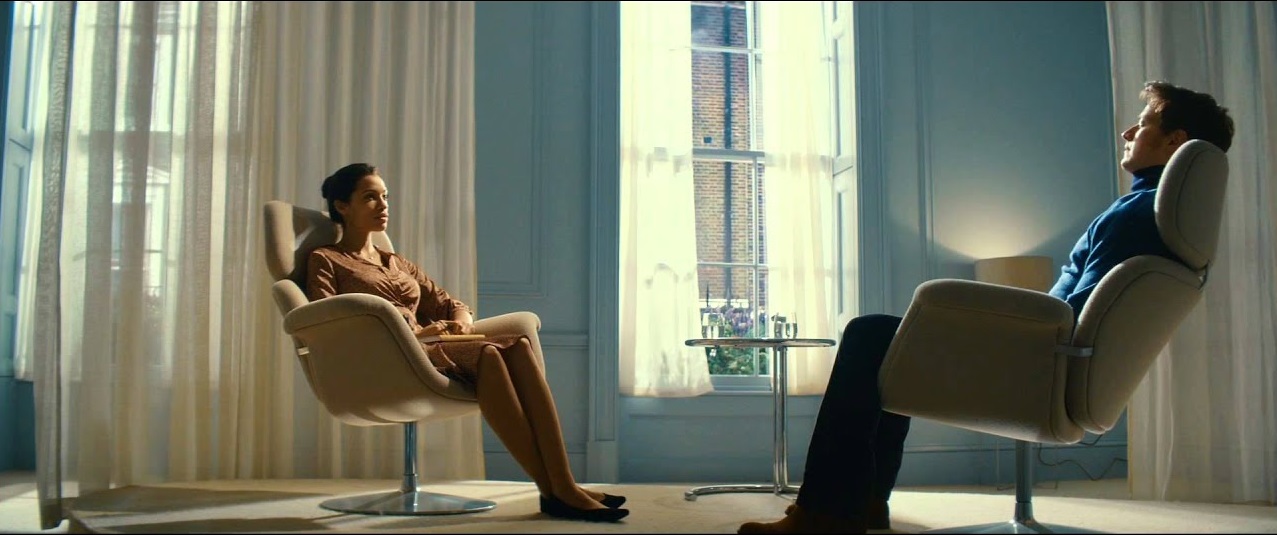
Go to Plan B. They send Simon to hypnotherapist Elizabeth Lamb (Rosario Dawson), who's had quite a success breaking addictions, changing lives and messing with heads. It's the latter skill that comes in good stead as she quickly realizes that Simon is not just a guy in need of finding his car-keys, but may be in league with the devil. Finding his memory might even make him a memory.
Doyle's good at messing with heads, as well, as Trance proves fairly quickly. 
Under his hypnotherapy, loyalties are tested (particularly the audience's), and no matter what subject matter is on screen, whether grisly or enticing, it's tough to take your eyes off it. Pretty soon you're not sure what's real, what's illusion...or (finally) what's going on. Some neat tricks are played, expectations are shattered, but all to the service of a script that isn't all that great.
One can appreciate the twists and turns and diversions, and the slightly feminist slant that the movie tilts in the traditional role of the femme fatale in film noir. But, ultimately the biggest trick that's pulled is the illusion that a better movie is happening. For all the visual pyrotechnics and the reality warping manipulation of the audience, Trance isn't that good a movie, and unconsciously or consciously, a trifle.
Goya's Witches in the Air—the "MacGuffin" of the movie