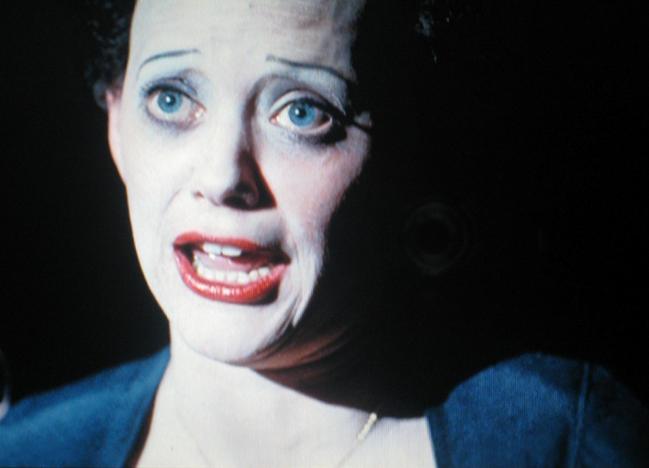
The Diving Bell and the Butterfly aka  "Le Scaphandre et la Papillon" (Julian Schnabel, 2007)
 "Le Scaphandre et la Papillon" (Julian Schnabel, 2007)
"Still Life with Wandering 'I'"
At one point, early in Julian Schnabel's inexplicably gripping realization of Jean-Dominique Bauby's blink-by-blink account of his coping with a paralyzing stroke, the camera leaves the confines of the eye of Bauby (his paralysis is nearly total, only his left eye is capable of movement in order to scan his world, and communicate with those around him) and changes perspective to move across the room in a blur to witness his mistress putting up pictures from his past to aid in his recovery. That surrealistic freeing moment allows us (the audience) the chance to change perspective as well; instead of looking out from Bauby's fixed position, as will happen a good 60-70% of the time, we turn inward and see an approximation of his thoughts. Or are those his thoughts; could it be an hallucination; could it be an out-of-body experience; could it be his soul talking? Bauby's condition is referred to clinically as "Locked-In Syndrome," where the brain is active, although the body cannot move. And Schnabel's film gives a lie to the label, as Bauby's life-in-paralysis is anything but locked-in. Although he is frequently only a passenger in his life, Schnabel points out that reality and perception is only when component to a life. There is also the vast store of life inside the mind.
 Throughout the film we are privy to Bauby's internal life,* but often those thoughts become images--memories, imaginings, lusts, fantasies, body-images. Rarely are there violations of the POV rule, where we share Bauby's point of view in whatever form it takes, and turn around to see his minimal reactions--a quivering lip, a tear, a drool. But even those are edited to form a piece of the whole--to make a sum of Jean-Do's experience of a "still," but rich life.**
 Variations on the one-point perspective:


The Normal: Jean-Do's point of view from his hospital bed
 Extreme POV: Bauby watches his right eye-lid being sewn shut
 Break-Out: Jean-Do extrapolates out from his view-point to see his mistress' face
 Body-image: Jean-Do imagines himself unable to move underwater in a rigid diving suit
 Fantasy: Jean-Do imagines his isolation on a family outing at the beach.
 Memory: Jean-Do remembers shaving his father (Max Von Sydow)--
a time when he assisted someone who was helpless
 Interpretation: Pictures hung in his hospital room, abnormally close, contrasting
 Memory or Imagination: Calving glaciers--a symbol of decay?
 Hallucination: Is his mistress visiting or not?
 Scene-setting: Jean-Do imagining his interaction, or director convenience?
 Reality
* Even though the producers are American, and the scriptwriter and director are British, the entire film is in french dialect at Schnabel's insistence. It has an added benefit--it is one more "remove" from Bauby. We can hear his thoughts, but, unless you're French and speak it, it needs to be translated, just as his internal thoughts needed to be communicated through his eye-blinks and interpreted. It is one more level of audience-sympathy with the subject.
** Schnabel couldn't adhere completely to that rule--In the phone conversation with his publisher, the director cuts to the publisher's office to see her quandary about agreeing to a book by a paraplegic—something Bauby is not privy to, and his nurse cannot see.