Saturday, September 28, 2024

Megalopolis

Marcus Unrealius
or
Utopias Turn to Dystopias
 
"Look back over the past, with its changing empires that rose and fell, and you can foresee the future too."
Marcus Aurelius, Meditations

More than a decade ago, at a second-hand book store, I picked up a tome called "The Greatest Movies Never Made,"* which detailed a lot of films that had been proposed, had gotten to the script stage or pre-production and then for whatever reason, it was never made—films like Jodorowsky's conception of Dune, Hitchcock's Kaleidoscope, Philip Kaufman's Star Trek film: Planet of the Titans...
 
 
Now, that book was written a couple decades ago, but the sound of it was intriguing, although a little vague about the details.** It sounded like Fritz Lang meets Ayn Rand in a sci-fi setting. But, Coppola was determined to get it made.
A concept drawing of Megalopolis that I remember from that book.
 
And now, using his own money, he has, at the age of 84. 
 
"A man's worth is no greater than the worth of his ambitions."
 Marcus Aurelius, Meditations
 
Based very loosely on events known as the Catilerian Conspiracy, Coppola's film tells the story of Cesar Catilina (Adam Driver), nephew of the rich and powerful Hamilton Crassus III (Jon Voight) and head of the Design Authority of New Rome in the "Third Millennia, 21st Century," a city divided between the extremely rich and the poor. Catalina has access to a wonderful substance called Megalon—another wonder-element along the lines of adamantium or unobtainium—the purpose of which is simultaneously vague and omni-versatile. With it, Catilina intends to build a "perfect school-city for the future" in the heart of New Rome, while the Mayor of New Rome, Francis Cicero (Giancarlo Esposito) would rather build a new casino, another pleasure-dome for the rich and idle. At a televised unveiling for the proposed gambling complex, Catilina interrupts by reciting Hamlet's soliloquy (almost all of it) and accusing Cicero of being nothing more than a slum-lord.
But, before one gets any further into the plot, there is one curious thing to mention: In the preliminary sequence of the film, it's shown that Cesar seems to have the ability to stop time. Walking precariously to the edge of the Chrysler Building, he leans over and stops time—the fleeting clouds halt and the traffic below comes to a standstill with nary a honk. And in that gap, Cesar rights himself, defying gravity and moves back away from the edge. That would seem to be a really big story-point, but except for another sequence where he does it and some business about losing the ability later in the script, not much is done with it. Is it a fantasy (could be)? A vision (there is evidence of such in Megalopolis)? A delusion (there, too)? As a thesis statement for a movie, it's a powerful one, but rather than hammer it home, it's a neglected conceit. 
 
The movie will have a lot of those.
"The art of living is more like wrestling than dancing, because an artful life requires being prepared to meet and withstand sudden and unexpected attacks."
 Marcus Aurelius, Meditations
 
If Cesar was just in conflict with Mayor Cicero, things would be easy, despite the considerable clout the Mayor commands (aided and abetted by characters played by Jason Schwartzman, Dustin Hoffman, and others). But, there's others including his cousin Clodio Pulcher (Shia LaBeouf), heir to the Crassus fortune, who despises Cesar and seems to live for outliving his uncle to gain his inheritance, a deep-seated attraction to debauchery and finding any means to thwart Cesar at any cost. Then there's Wow Platinum (Aubrey Plaza), a tele-"journalist" with a ravenously ambitious streak attracted to power, starting first as Cesar's mistress and then marrying Crassus with the aim of becoming a rich and powerful widow. 
All of these characters are, to say the least, self-obsessed, but, then, so is Cesar, even if his devotion is to seeing the creation of his Megalopolis and done to his precise vision of what could be possible with Megalon. Aiding him in his quest are his chauffeur/historian Fundi Romaine (
Laurence Fishburne), and a fascinated acolyte, former good-time girl Julia Cicero (Nathalie Emmanuel), daughter of the Mayor, who begins to become fascinated with Cesar after witnessing him stop time during the demolition on the Megalopolis site (how come she isn't frozen and does anybody else notice that...?...let's not quibble as you're not going to get any answers).
The film follows the burgeoning relationship between Julia and Cesar and the various machinations to discredit our hero and his ambitions, even as we're led through the decadence and the moral lassitude of the upper-crust of New Rome, living like there's no tomorrow while the vast majority of New Rome can only gawp at them through chain-link barriers. Oh...and there's one other complication—A Russian space station has become de-stabilized in orbit and will probably land square on New Rome causing mass destruction on a convenient scale.
Coppola has been working on this project since Apocalypse Now, actually starting filming it in 2000—that's where he's getting the city-spires reflecting golden hour magic on a grand scale—but financial ruin, studio cold-feet, 9-11, and his fortune-making wine business all delayed progress, while he dabbled in small films with smaller budgets to see how he could make things more economically. All the time events in the press influenced the script, concept-artists came and went, and Coppola tinkered, re-wrote and tinkered again, the idea always in the back of his mind.

"It is the responsibility of leadership to work intelligently with what is given, and not waste time fantasizing about a world of flawless people and perfect choices."
 Marcus Aurelius, Meditations

So, how is it? A bit of a mess, really. But, a glorious mess. Not unlike his movie Twixt, and not unlike the Redux cut of Apocalypse Now—with the pace-killing French plantation scene which the under-the-gun Coppola finally cut completely, making a tighter more-focused film. One should always be wary of Directors' so-called "dream projects"—sometimes they're just too close to the things to be rigorous about it and lose the sense of the audience's dispassionate perspective. It's nice to have complete control, as long as you don't Ayn Rand the thing to death with the "purity" of your vision. There are whole little bits where the actors are encouraged to improvise (I'm thinking of a scene in Cesar's office where he's supervising co-workers in forming an odd human pyramid to create a geometric shape that—although it might have been fun to do on-set at the time—seems completely nonsensical and...unnecessary to advancing the story) that might have been better left on the cutting-room floor.

Though this be madness, yet there is method in't. 
 Hamlet (Polonius, Act 2 Scene 2)
William Shakespeare
 
But...but...there are moments where the imagery is just too exquisite to ignore. Coppola has always had a great eye, whether as a consumer or as a producer of movies, and there are odes to Fritz Lang (especially his Metropolis which is a spiritual cousin to this), German expressionism in general—even an ending nabbed from The Great Dictator—and his own experiments with practical effects in Bram Stoker's Dracula, Apocalypse Now, and techniques of the silent era—so many irises, split screens, and layered images (his way of showing the satellite's destruction of New York is far more interesting than just another CGI shock-wave and he had one act of violence that propelled me out of my seat) that you can't help but be dazzled.
But maybe not seduced. For all the luxuriousness of the visuals, the story is a little threadbare, lacking some connecting tissue that might have propelled the story along, little details (something Coppola is so good at) that might have prevented some thought-stuttering that wrenches you out of the flow of  experience that a more assured story-narrative would ensure. There are just too many leaps of faith that make the watching less comfortable and more precarious.
It also might have something to do with Coppola being much more versed in the Catilerian Conspiracy than your average movie-goer. Although there's nothing wrong with aspiring to connect with the lowest common demoninating audience, I doubt that many folks will recognize his references—"Oh, yeah, that 'vestal virgin' thing!"—and be merely puzzled as they go over your head like so much satellite debris.
"Everything we hear is an opinion, not a fact. Everything we see is a perspective, not the truth."
Marcus Aurelius, Meditations
 
So, what do we have in Megalopolis?  Let's call it a tentative failure. One should always be cautious with first impressions, even though one should trust their instincts. But, the shock of the new may blind-side you—it happened with Apocalypse Now, after all—and I'm always a bit cautious with late-era directorial efforts, like the casual dismissals of Stanley Kubrick's Eyes Wide Shut or John Ford's 7 Women, both of which get better with every viewing. And one should always give extra credit to a director swinging for the fences even if they never get out of the infield. 
One might go forward by looking back. Coppola has made a wide variety of films, some of which have connected with audiences and some that haven't. With very few exceptions—I'm thinking The Conversation—they have dealt with interconnectedness, of people relating to each other despite differing perspectives, and different personal agendas.
And they're about family, whether it's a formalized family or not, nuclear or not—of the stoic and disciplined against the passionate and unprincipled. And they're about ambition and how it can inspire...or destroy. Those conflicts can exist in any person, but most obviously in artists. It's like Coppola has been making autobiographies about his own conflicting artistic instincts in the same way Howard Hawks' "teamwork" movies were inherently metaphors for making movies. A much younger Coppola would have made Megalopolis end as a cautionary tale. The older, wiser, more hopeful Coppola ends this one with positive reconciliation.
 
Perhaps reappraisals can start with that.

“The first rule is to keep an untroubled spirit. The second is to look things in the face and know them for what they are.” 
 Marcus Aurelius, Meditations
 

* Or something like that. I lent it to someone and, as I'd read it cover to cover, I didn't care if I got it back. Since it's publication, there've been a couple of other books with similar titles about the same subject. 
 
** Coppola always played things tight to the vest. I read an interview with Coppola in Andrew Sarris' "Interviews with Film Directors" where he was asked about what his next movie was (this was around the time of The Rain People) and he answered "I've written a script called "The Conversation". It's about a guy on his 50th birthday." Technically true, but he left a lot of it out.

Thursday, September 26, 2024

Super/Man: The Christopher Reeve Story

Participant to Observer
or
"And Then She Said the Words That Saved My Life: 'You're Still You and I Love You.'"
 
I assume everybody knows the story: Christopher Reeve, Broadway actor, was picked to play "Superman" in the 1978 movie of the same name—bulked up strenuously to do it—and essayed the role through four films, while also choosing to be in other projects that were farther afield to prevent type-casting. Then, a horse-riding accident left him paralyzed from the neck down—"It's what happens when the trap-door opens and the noose tightens"—unable to breathe without assistance. The doctors gave him a 50/50 chance to live through the night. His older son says that the doctors "re-attached his head to his body."
 
And then he got to work. 
 
Reeve became the best-known advocate for spinal chord injuries and despite his touch-and-go condition, he and his wife Dana, would go anywhere, meet anyone who could write a check, provide a medical path, raise awareness. He also managed to act...and direct projects...totally confined to a wheel-chair, unable to support his neck, breathing with a respirator. 10 short months after his accident, he appeared on-stage in a wheelchair at the Oscar ceremony...and cracked jokes.
 
And the prevailing wisdom became "If he wasn't Superman before, he sure is now." 
His story, with the full cooperation of the Reeve children, his former partner Gae Exton, DC Studios, Warner Brother studios, and anyone who had footage of the man has been released as a "Fathom Event"—one of those special piped-in presentations to a theater environment—and called Super/Man: The Christopher Reeve Story. It makes use of a lot of home-movie footage, contemporary interviews with friends and family, doctors, experts, and archival footage, an amazing curating job executed by directors Ian Bonhôte and Peter Ettedgui.
Reeves' tragic accident—which, when you see it, looks so flukish—raised awareness of the quadriplegic community; if you didn't know someone who was completely paralyzed, suddenly you did. Forget that Reeve was long-past the Superman role and was in lower profile projects and TV movies that were usually seen (mostly) by the devoted, but suddenly, he was uppermost in peoples' awareness.
Bonhôte and Ettedqui take you through the whole life-story, starting on New Year's Eve 1985 with a family celebration and a post-accident Reeve saying "It seemed like my life came together. And then, in an instant, everything changed."* You see home movies of him and his kids charging though sportsy activities with his kids, yelling at them "Carpe Diem!", showing him active, but more than active, downright aggressive. He was a flyer, skier, skater, yachtsman, and as far as horses..."I've always been allergic to horses"...but, loaded up on anti-histamines he learned to ride for a film and fell in love with it. He liked aggressive sports, but insisted he was careful because "I didn't want to see a headline like 'Superman Hit By a Bus.'"
 
That produces a grisly laugh. But, it shows the honesty with which the the piece is presented. Details are presented about his condition are presented to hammer home the precariousness with which he lived through the ordeal, the things left out of the papers, the raw emotions of those going through it are not held in check, and if one comes away unmoved by the honorableness of the participants, then a trip to the ER is suggested to check for a pulse.
A couple of persistent thoughts:
 
— the devotion of Robin Williams. Williams and Reeve were fellow acting students and roommates while attending Julliard and remained steadfast friends. After the accident, if there was anything the Reeves needed, Williams would provide it. On every anniversary of the accident, Williams would host a grand party at the Reeves' place to keep the actor from dwelling on the accident.
—those kids: Reeve had two children with his partner Gae Exton, Matthew and Alexandra, and one child with wife Dana, Will. Their interviews are straight-forward, honest, passionate, and you can't not admire them, individually and together, and you have to wonder at what kind of parents Reeve and both women must have been to produce such amazing people.
 
—the steeliness of Christopher Reeve: that's not some pun. The whole movie is watching Reeve push and push and push himself to improve, whether it's weight-training for Superman or grinding through re-hab. The movie explains his up-bringing—parents divorced when he was 3, and neither parent was what one would call nurturing, but obsessively judgemental. They inscribed in his DNA a restless dissatisfaction with the status quo in order, if not to please them, the potential to please them, by pushing himself. Some of that probably saved his life initially after the accident, but it sure must not have been easy.
 
It's a wonderful tribute, as painful as it sometimes is to watch. The triumphs, the tragedies, the pain. No doubt it will be streaming on some service in the near-future.

* While paralyzed, among all the other things he did, Reeve managed to dictate and get published a couple of books. And he did the audio-books for them (which is where a lot of the narration comes from). Now, think of that: He was breathing through a tube and still managed to record the narration for his two books. I've seen perfectly healthy authors for whom that was a trial. But, Reeve....? Probably gave it his all.

Wednesday, September 25, 2024

The Critic (2023)

Critic, Critique Thyself
or
The Mystery of the Missing Curtain Call
 
To read online reviews, Anthony Quinn's mystery novel "The Curtain Call" is a cracking good read, set in 1936 London with a background in the theater-world amidst it's denizens, while at the same time being something of a manifesto on giving the downtrodden some agency. It sounds like it would make a great movie.
 
The Critic is the movie based on Quinn's book...and it isn't. A great movie, that is. I don't know what happened, but whole plots, characters, whole gists of the book have gone missing in the transition from print to screen and one can only wonder who the culprit is.
 
Or the why of it. But, someone has done a great crime to the book. And somebody's responsible.*
But, one shouldn't review what isn't there, one should review what is. What we've got is a character study with a little bit of blackmail/murder thrown in. Jimmy Erskine (
Ian McKellen) is a renowned theater critic for London's Daily Chronicle, known for his bitchy reviews scratched out with a poison pen (and typed up for submission by his assistant, played by Alfred Enoch). Jimmy relishes his job and his high-handed witticisms ("I do not enjoy the theater. I am the chief drama critic of the Chronicle!") and the perks of having his reserved seats at the theater and reserved table at the club, but his publisher, the Viscount David Brooke (Mark Strong)—having taken over the paper from his late father—has reservations of his own and would like Jimmy to "tone it down. More beauty. Less beast!"
Jimmy, though, has high standards—in everything but the "rough trade" he dabbles in—and between his lack of cooperation in kinder, gentler reviews and his frequent violation of the "morals clause" in his contract, he finds himself sacked. The Viscount has had enough of the paper's "old guard" and wants to bring in fresh blood. For Jimmy, being a pensioner is not enough to keep him in the decadent lifestyle that he's become accustomed to. So he hatches a plot.
One of the actors that he's been regularly slagging in his reviews is ingenue Nina Land (
Gemma Arterton), who is pretty and game, and wants nothing more than impress the Chronicle's drama critic—she's a fan of his taste and his writing—but one more bad notice from him and she has the pluck enough to confront the man (catching him trolling in a nearby park) and she makes her case through flattery and some implied blackmail, both of which impresses Jimmy. "There is art in you, Miss Land," he confides in her. "My disappointment is in your failure to access it." He decides then and there to take her under his wing and tutelage. She could be useful.
What he doesn't know is that Land is having an affair with the publisher's son-in-law, a portrait painter of some repute, and that complication makes things a little dicey for what Jimmy has in mind for his scheme to get his old job back. Trouble is, he's a critic, and having observed enough theater in his profession, one would think he would immediately spot a weak plot, even if it's of his own devising.
The Critic
premiered at the Toronto Film Festival last year and there was less buzz than murmuring, and so some tinkering and tailoring was done with re-shoots and another ending prepared and there's just enough dissonance in the film that the seams show. One can't fault the performers, all of whom do the job with McKellan deserving the lion's share of the praise for a performance so venal done with obvious relish.
But, it isn't enough. The plot's spread awfully thin and what's there is lingered over and emphasized, like the shot that director Anand Tucker keeps coming back to—an overhead shot that zeroes in right on the performer's forehead (to what purpose, you wonder, other than to show somebody thinking). And you wonder where it started to go south.
 
Any movie adaptation of a book should make you want to go to the source to get more of what drew you to the story in the first place. The Critic makes me want to read "Curtain Call" to see what it is I'm missing.

* Yeah, it sounds weird, but then, so is the source: Plan 9 from Outer Space, Ed Wood's notorious science-fiction opus once dubbed The Worst Film Ever Made. At one point, a detective discovers a corpse in a grave-yard and says (quite seriously) "But one thing's sure. Inspector Clay is dead, murdered, and somebody's responsible." 
 
Well, technically, that's three things, but you can't quibble with Plan 9, or you'll end up wasting your life.  As a matter of fact, it occurs to me that I don't have a post for Plan 9...yet. Well, Hallowe'en month is coming up...

Tuesday, September 24, 2024

The Virgin Spring

The Virgin Spring (aka Jungfrukällan) (Ingmar Bergman, 1960) The 1961 winner for the Best Foreign Film is one of the most stark in the filmography of Ingmar Bergman. Much criticized and censored in the U.S. when it was first released, it is a surprising gut-punch of a film that takes on the themes of violence, revenge, jealousy and guilt in a way that goes against the grain of Bergman's more esoteric films, and feels more like an exploitation film...with a conscience, sitting somewhere in the storytelling territory between myth and mysticism and the grim and the fairy-tale. With a dash of religious conflict as a chaser.   

I remember it as a film being offered for a showing at my local High School and being told—in no uncertain terms by my parents—that I would no way, no how be allowed to see that film. The Seven Samurai, sure, I could see that one. But, not The Virgin Spring.

Frankly, seeing it recently, I can't blame them all that much. Bergman's film would have knocked me for a loop. As it did so many. 
Based on a legend (and subsequent ballad "Töres döttrar i Wänge
") of the building of the church in Kärna in medieval Sweden, and the reasons behind it, Bergman tells the story of Töre (Max von Sydow), a landed farmer in the 14th century. Proud, prosperous, Christian, but not so arrogant that you wouldn't find him also working with his servants in the field, he would seem to have it all: married to Märete (Birgitta Valberg), his second wife and their daughter Karin (Birgitta Pettersson) and foster daughter Ingeri (Gunnel Lindblom).
The two girls couldn't be more different ("as different as rose and thorn" 
Märete says)—Ingeri is dark and treated as a servant, and not much respected as she is quite pregnant, while the favored daughter, Karin, is blonde and pampered and indulged—perhaps too much. Great pride is taken in Karin, especially by Töre, while his wife's is measured by an adult parent's guarded judgement. It is a grand day for the Töre's; Karin is to take candles they have made to the church for the Virgin, and although Karin feigns sickness—to get out of going to church—she is only too happy to go proudly in her silken yellow shift (sewed by fifteen maidens!), Sunday skirt and blue cape (oh, and the white stocking and the blue shoes with the pearls!), like royalty.
Karin insists that Ingeri go with her (as she never gets off the farm) and the journey is a day's ride, but she doesn't know of her step-sister's animosity towards her and that Ingeri has secretly prayed to the god Odin to come to her aid—what that might entail isn't made explicit, but it's quite possible that he heard. Fording a river, they come across a mill attended by a wizened old man (
Axel Slangus), answering to no name: "I hear what I want to hear and see what I want to see." he tells Ingeri while Karin travels onward towards the church. "I hear what men whisper in secret and see what they think no one sees." He has cures for Ingeri and he professes to hearing "three dead men riding north" and invites her to hear what he hears. As he has heard her.
Already superstitious, Ingeri flees from the old man, following—against her best instincts—Karin into the dark forest. But, what she sees freezes her in her tracks. Three goat-herders have prevailed upon the kind-hearted Karin to stop and she invites them to eat the meal packed for her journey, but by the time Ingeri has reached her, they've attacked her, raping and then bludgeoning her to death, stealing her fine raiments and escaping into the forest. The rock Ingeri had planned to throw at the villains to stop them falls uselessly from her hands.
This is brutal stuff. And the film will only get more brutal as it goes along, as the film delves into the revenge for the act, but it's not one that comes from the heavens unless one believes that there are no coincidences. If that were so, it could be God or Odin or Fate that propels the film darker into an abyss of revenge and murder, but those entities seem to merely listen to the one-sided conversations of the beings that enjoin them. They are mute for all the homage paid.
But, not entirely.
 
If the pagan god of Odin makes an appearance, the Christian god is given equal time, through iconography and one apparent miracle, although not one to affect  the actions of the characters or the outcomes of things in the tale. Those are entirely the responsibility on the human figures, influenced or not by any deity.
I'm not one for revenge stories, which, given the absence of any sort of divine retribution, The Virgin Spring is. I don't find triumph or even satisfaction in them. For one thing I don't buy the math. "Eye" doesn't always equal "Eye". And I think for any retribution there is always a cost, even an invisible one. At least, there should be. But, The Virgin Spring, for all its measured coolness, boasts some of the most visceral acts of revenge ever put on the screen, no matter how much slaughter one has seen in movies. In part this is due to von Sydow's performance, which usually is noteworthy for its stillness and its internal strength. But not here. Töre seems ready to erupt at any time, whether from boastful pride or his own horror at what he finds himself capable of.
Von Sydow's performances are always imbued with spine, but in this, with all of its violent actions, he seems, ironically, more vulnerable, more capable of shame, of guilt, and penitence. The lip quivers, the hands shake, as if the revenge itself has affected him as well as his victims. But, then guilt and shame are major emotions in The Virgin Spring where everybody seems to be a victim...by their own hands or the hands of others, even if its the hands of Fate.
Later in his life and career Bergman would look back on The Virgin Spring and call it "a wretched imitation of Kurosawa." Imitation in themes and technique, maybe...but as unique and devastating as the Master would have made it half a world away.

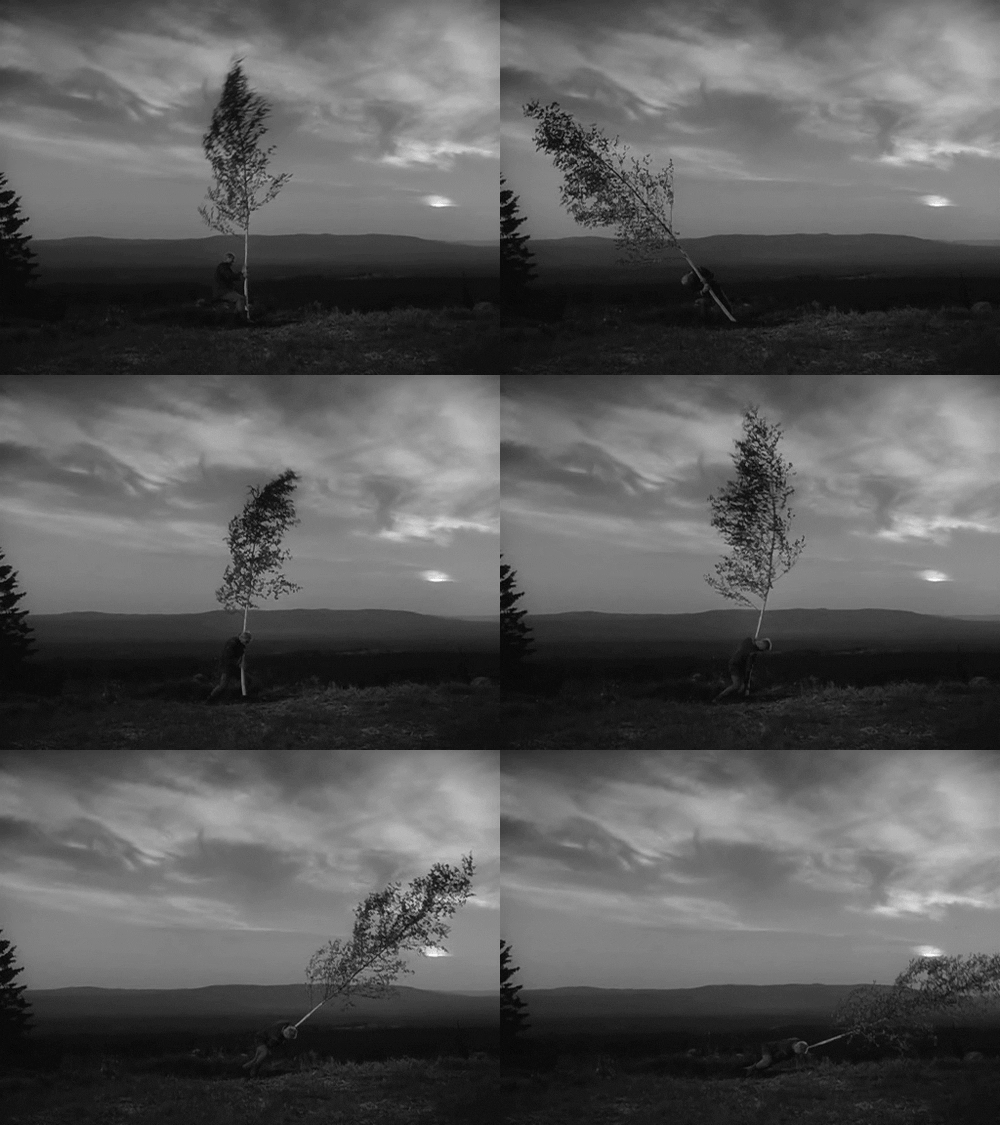
Ingmar Bergman—film fan—checking out "Bruce" the shark
on the set of Jaws.

Monday, September 23, 2024

Don't Make a Scene: The Year of Living Dangerously

The Story:
A guy walks into a bar...

This is another of those "Classic Scenes" from the late Premiere Magazinethis one taken from Peter Weir's The Year of Living Dangerously—that would take one scene  that is pivotal and script out the dialogue.

So, Billy Kwan walks into a bar and director Peter Weir photographs it from Billy's perspective—from his shoulder-height, and we're given the world from his perspective. Billy has been narrating the film and we've been made privy to his innermost thoughts. Sur,e other characters are played by actors who are top-lined, but Billy feels like the heart and soul of the movie, the character with whom the film-makers seem to want us to identify. So, when his character cracks...it's a bit of a shock. And the movie barely recovers.

But, we should have seen it coming. Billy may be the smartest guy in the room, but, he's also the least noticed. We get a sense of this at the start of the scene. Billy wanders in, still in shock from the death of the child in the family that he's been trying to help and he's looking for the usual gang of journo's that make a semi-permanent group of barflies. But, his heighth doesn't allow him to see them; he's perpetually peering through a forest of other people in his search. It shouldn't go unnoticed that he goes unnoticed as he makes his way through the crowd. He's practically invisible—which is a blessing as a photojournalist and a curse, personally.

He compensates for this internal and external world-view, by imagining himself a puppet-master—an image utilized in the film—plotting, planning, ascribing motivations gleaned from his cache of files, manipulating, becoming in his own mind his own version of Sukarno.

But, without any real-world power. When things start going South—when the relationship he's developed between Hamilton and Jill risks exposing her as an intelligence agent, and the child of the village woman he's been attempting to help dies—he becomes just another would-be tyrant clinging to the power he only thinks he has. Ironically, he's susceptible to the same disease he's been fighting against. Power corrupts. Even if it's only imagined power.

Poor Billy.
 
The Set-up: Indonesia during the final days of the Sukarno regime in 1965. A pool of journalists are covering the story, and the one who stands out is Billy Kwan (Linda Hunt), a photojournalist of Chinese-Australian heritage. Billy is short of stature, physically and professionally, but he has connections in Indonesia in high places—like Jill Bryant (Sigourney Weaver), working at the British Embassy—and low—he has great sympathy for the Indonesian people, particularly one mother and child, who are having a tough time of it and to whom he regularly provides food and aid. Billy does his research and he has file cabinets of information on them all in his bungalow. It is only when Guy Hamilton (Mel Gibson), just assigned in-a-hurry for an Australian TV network to cover the Indonesia crisis, does Billy see a way to make the most of everyone's situations and he takes Hamilton under his wing. But, when Hamilton proves to be professionally callous and the woman's child dies suddenly, Billy's machinations, like, Sukarno's hold on the nation, start to unravel. And so does Billy.
 
Action.
 
INT. WAYANG BAR - NIGHT
WALLY, CONDON, and CURTIS share a meal at a side table. They are making more noise than usual, and the other customers keep their distance.
WALLY O'SULLIVAN: Billy, come over here. Been looking everywhere for you. 
BILLY KWAN:
What is all this? 
KEVIN CONDON:
Bulgarian Independence Day. 
O'SULLIVAN:
Not a crucial day in modern history, but Sukarno's coming... 
O'SULLIVAN: in a couple of hours. 
CONDON:
We think he'll use the occasion for a speech. - 
KWAN:
I'm sure he will. - 
CONDON:
Later. Right now we're celebrating. -  
KWAN:
Oh?
What are you celebrating? - 
CONDON:
Curtis got Saigon. 
KWAN:
Curtis got Saigon. 
KWAN:
Well, we must all drink to that. 
PETE CURTIS:
C'mon, Billy. Don't give me this crap tonight, huh? 
KWAN:
Wherever human misery is at its worst, the press will be there in force.
CURTIS:
Give me a break, willya?
KWAN: To Saigon!
KWAN:
You know, p
eople are out there fighting in the streets for rice. I shot some footage.
KWAN:
Does anybody want it? 
O'SULLIVAN:
It's only a temporary shortage. 
KWAN:
Why don't you tell them the true story, gentlemen? 
KWAN:
Why don't you tell them that Sukarno makes empty speeches... and builds monuments to his vanity...
KWAN:
...
while his people starve to death. 
KWAN:
Why don't you tell them that he says, "Eat rats!" 
O'SULLIVAN:
My dear Billy. You were...
O'SULLIVAN:
...the one who told us he was a great man.
KWAN:
He was!
KWAN:
He was! That's why his betrayal is so hideous.
There is a hush. CONDON looks uneasily down the bar at ALI.
CONDON:
Steady on, Billy. 
O'SULLIVAN:
I've never really agreed with you on just... 
O'SULLIVAN:
...how much the people mean to Sukarno. The only thing he wanted to do for his people was to go to bed with them. 
O'SULLIVAN:
The female ones, that is.
CURTIS:
Ha!
KWAN:
You're right. 
KWAN:
He does use his people as objects of pleasure, but so... 
KWAN:
...do you. Only you do it...
KWAN:
...with boys!
There is a stunned silence. ALI stands behind them, smiling triumphantly at this information. CURTIS grabs KWAN by the shoulders and slams him against the bar, both feet suspended from the floor like a doll.
CURTIS:
What did you say? 
CURTIS:
You little... 
URTIS:
...bastard! - 
KWAN:
Curtis!
CURTIS:
You know what you did...
CURTIS:
...to him?! You knew what that meant...
CURTIS:
...didn't you? They'll throw him out of the country! 
KWAN:
You're no better,
CURTIS: They'll throw him out of the country!
KWAN:
...you and your girls!
HAMILTON stands at the doorway.
GUY HAMILTON:
Curtis, put him down!
KWAN runs out of the bar 
and HAMILTON follows him.
HAMILTON: Billy? 
HAMILTON:
Billy?
O'SULLIVAN:
I'll have my bags packed tonight.
HAMILTON:
Billy!
HAMILTON:
I want to talk to you! 
HAMILTON:
Billy!
HAMILTON:
Billy, stop! - 
EXT. ALLEY - NIGHT
The alley is deserted. It is little more than a fissure. its only illumination coming dully from shuttered windows two and three stories up. Garbage is scattered everywhere.
KWAN is not runner. His abbreviated legs work to no avail like a kindergarten child's. HAMILTON overtakes him a blocks his way. 
HAMILTON:
Damn it!
In the half-light, they both cast grotesque shadows on the wall as they stand facing each other, trying to regain control of their breathing. 
HAMILTON:
What's the hell's the matter with you?
KWAN:
What do you want?
HAMILTON:
What was Curtis doing?
KWAN:
You made the broadcast, didn't you? - 
HAMILTON:
Now, I didn't source... 
HAMILTON:
...that back to Jill. I got that someplace else.
KWAN:
Doesn't matter. That's not the point.
HAMILTON:
Yes, it is the point. 
HAMILTON:
And when this thing breaks, it could change the whole political shape of Southeast Asia. 
HAMILTON:
How far are my loyalties to Jill supposed to go? 
KWAN:
I would have given up the world for her. 
KWAN:
You won't give up one story. 
HAMILTON:
It's not just a story, dammit. It's the bloody story. 
HAMILTON:
Can't you understand that? 
KWAN:
Don't you understand? You've lost Jill. 
HAMILTON:
What? What have you told her? You told her something? 
KWAN:
I gave her to you. I'm taking her back. 
KWAN:
Do you understand? 
HAMILTON:
You gave her to me? 
HAMILTON:
For Christ's sake. 
HAMILTON:
You mad little bastard! 
HAMILTON:
You think you can control people's lives just 'cause you got 'em in your bloody files? 
KWAN:
No.
I believed in you. I thought you were a man of light. 
KWAN:
That's why I gave you those stories you think are so important. 
KWAN:
I made you see things. I made you feel something about what you write. 
KWAN:
I gave you my trust. So did Jill. 
KWAN:
I created you.


Pictures by Russell Boyd and Peter Weir
 
The Year of Living Dangerously is available on DVD and Blu-Ray from M-G-M Home entertainment.