Showing posts with label Keith David. Show all posts

Friday, July 29, 2022

Nope

Yep!

or
Close Encounters of the Herd Kind
 
"Nahum 3:6: I will cast abominable filth upon you, make you vile, and make you a spectacle."
 
Jordan Peele has made you a spectacle—not of you, but for you—and like any great spectacle, sublime or tragic, you can't look away.
 
Nope is about a bunch of things—about people's need for the spectacular, and to believe anything to fulfill it, it's about instinct versus learning, about how neither one can save you when you're considered merely prey, and that Nature has its own "advantage" baked in just like a casino.
 
It's also about how we're all animals, basically, and no sophistication of the cerebral cortex can erase the fact that we're all made of meat. It's like Peele has melded Steven Spielberg's first hits Jaws and Close Encounters with their separate senses of primal terror and ecstatic wonder and smooshed them together to make one over-the-top bonkers film, one that's gorgeous to look at (lensed by Hoyte Van Hoytema) has a great, itchy score, and has enough humor and suspense to make you forget you might be watching a "message" movie. It has "bite."
In Aqua Dulce, California, The Haywood Hollywood Horses training facility squats like a dry oasis. The Haywood's are descendants of the African American jockey photographed in Eadweard Muybridge's The Horse in Motion, one of the very earliest cabinet card sets, which, in turn, was used in early zoopraxiscope presentations, making it the first motion picture projection presentation, some 12 years before Edison, and eight years before the proposals of Louis LePrince in France.
Now, the Haywood ranch is run by Otis Haywood (
Keith David—you'll recognize him by his distinctive narrator's voice), who still supplies trained animals for films. One day, out with his son O.J. (Otis Jr. played by Daniel Kaluuya), Otis Sr. is killed when metal objects fall inexplicably out of the sky and he is killed by a nickel plunging through his eye and embedding in his skull. His kids, O.J. and Emerald (Keke Palmer) try to keep the ranch afloat, but it's hard going. O.J. is not the most communicative soul, dealing with horses better than people, most specifically his sister "Em" who is focusing on her own career as a writer, director, producer and less on the old horse business. 
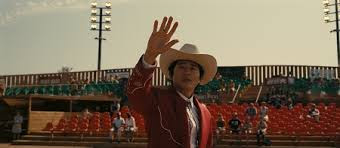
As a result, O.J. is selling off horses to a recent nearby attraction, Jupiter's Claim, a western theme park run by Ricky "Jupe" Park (
Steven Yeun), former child actor, and one of the survivors of the infamous "Gordy's Home" Incident—where, years earlier—and, for us, at the beginning of the movie—on the set of a comedy television series, a chimpanzee, startled by a popping helium balloon, viciously attacked the other performers, killing and maiming them. Ricky runs the park, but also exploits the tragedy by charging the obsessed, tours through his personal memorabilia from "The Incident".
Then, one dark and stormy night, O.J. notices that one of the horses is out of the stable, and when he investigates, sees that electricity is shutting down around the area, and a sand tornado touches ground, spooking the horse, and making it run. It's dark and all, but O.J. thinks he sees an object moving through the sky, fast, followed by an eerie sound of terror. When he comes back home, the lights are back on, but he's spooked. Something weird is going on.
Emerald hears O.J.'s story and her impulse is to get it on camera and exploit it—get "the money shot", or, better still, get "the Oprah shot"—so they head to the local Fry's (one's still open?), where their insistence on security cameras that can look UP and can operate once the grid goes down attracts the interest of one of the employees, Angel (
Brandon Perea) who helps them install their systems. A conspiracy wonk, he links in to their system on their first night to get "footage" which fails, due to natural and unnatural-to-Earth interference. Another incident brings in the interest of cinematographer Antlers Holst (Michael Wincott), obsessed with obtaining "the impossible shot."
Around about here things get less speculative and more specific, but the group's attempts to record the UFO—"They're called UAP's now"—are intertwined with each participant's specialty skills: Holst's photography skills, O.J.'s training skills, Angel's ability...to be irritating, frankly, and Emerald's inability to stick to the plan. They're disparate attitudes and personalities almost makes them akin to the Pequod's crew hunting "Moby Dick." But, their prickly desert personalities all make their stake-out a multi-layered and evolving plan.
My description of thing makes it sound simple, but Peele's approach is anything but, starting with opening with that "Gordy's Home" incident—which apparently has nothing to do with the movie, except to serve as a background motivation for one of the characters. Then, he goes to that "raining metal" sequence, and jumps forward to some time later, when the ranch is having hard times. It's disorienting and you wonder if you're missing something. You're not. Peele's just building the mystery and tightening the screws, as he builds in details to explain something unexplainable (although a couple of things will never be explained). It's like he's training us.
And it works gang-busters. I defy anyone not to be peering at all points of the screen for a tell-tale sign as you peer along with the characters for a glimpse of the mystery. And that's part of the fun. Peele has, so far, at least, included the audience as part of the drama, making them co-conspirators in his manipulation games. He directs the gaze, but he also indicts the mind. Here, he's made something mesmerizing enough that we can't take our eyes off it. And, ironically, that's just the sort of thing that could doom the characters. One can almost hear Peele cackling in the background at the joke of it all. "Fools! You'd be snapped up in a minute!"
But, Nope is a step forward. Here, he's making a movie that satisfies his need for detail, but boils it down to simple concepts that are achievable (and perceivable) as visually spectacular. His last film, Us, reached for something big, but couldn't quite achieve it because the conception of it was interesting...but not awe-inspiring. Here, he goes for the Big Moments and pulls them off extraordinarily, without overwhelming the tension of the movie. Nope is a step up for a film-maker who's just exploring his abilities, while paying homage to, but not whole-sale stealing from, the movies that inspired him. Peel had me at Get Out, but I'm looking forward to his next one with even higher expectations.

Thursday, June 16, 2016

The Nice Guys

How Awful About Amelia
or
"Kids these Days..." ("Don't Say 'and stuff.' Just say, Dad, there are whores here.")

Shane Black excels at "buddy" movies—he did, after all, create the Lethal Weapon series. That's a good thing and a bad thing: when he does something like Kiss Kiss Bang Bang, he comes up with a mystery, pushed off-kilter by the clashing personalities of his protagonists; when he does something like Iron Man 3 with a clearly dominant personality, the movie lurches out of control from its lack of counter-point. The Nice Guys has no such issues and actually improves on his formula.

I have to confess: any PI movie set in the 70's that starts out with the funk-shimmer of "Papa was a Rolling Stone" is already on my good side. When it establishes locale and detail by doing a rear-view fly-over of a decaying "Hollywood" sign to settle over a ranch-house in the valley at the base of that sign it shows someone is being careful with the atmosphere. Black follows the night-time perambulations of a child-denizen wandering the house who manages to score by finding a copy of dad's "Cavalier" magazine and then becomes distracted by a centerfold that he doesn't see a sports-car sailing off a cliff overhanging his backyard and bouncing through his house, you're seeing someone saying something about a world out of whack in the most surprising and arresting way possible.

And it keeps getting better.

Like most "buddy" movies, the two don't start as "buddies." Jackson Healy (Russell Crowe) is a lone wolf and is the muscle-arm of the detective business. People hire him to be tough and threaten. He's been at this long enough to have eliminated the tough stuff; the rules are simple: people are persuaded easier when they're hurting and it gives them to know that he is serious. Business rarely needs to be repeated. It is a bad side of the business, but he has a good side; he is recognized (when he is recognized, which is rarely) as "the diner guy" who disarmed a gun-man and beat him into unconsciousness with his own weapon. It made the news and it was good for business, if beating up people is your business. He does his work efficiently and with humor, even providing helpful medical advice to help with the future hospitalization. He's good at his job, but a bit of a troglodyte.
Holland March (Ryan Gosling) is a widower with an 11 year old daughter in tow. He's the brains end of PI work, but that is being generalized and charitable. He specializes in the bizarre cases that most detectives would dismiss as a waste of time. Holland doesn't think it's a waste as long as money is being wasted his way. He has sharp instincts, but absolutely no physical skills and his mental facilities are being impaired by his habit of drinking himself into a stupor. The death of his wife has thrown him into an incapacitating depression, and it is only his caretaker-daughter Holly (Angourie Rice), 11 going on 35, that keeps him on his flat-feet and peeping.
Holland has been making the rounds, searching for Amelia (Margaret Qualley), a girl who has disappeared in the L.A. of 1977. It is not a good place, rife with crime, prostitution, porn and drugs—in other words, not unlike the Los Angeles of today, but with more water. Amelia is a typical missing-persons case, she's a headstrong runaway, privileged, entitled, mad at her mother (Kim Basinger) and determined to get back at her, how is anybody's guess. Holland does some interviewing at local clubs and bars, but Amelia is untraceable.
She should have asked Healy. Amelia has just hired him to beat Holland up and warn him off the case, breaking an arm that March has already bandaged from a breaking-and-entering gone wrong. He also gives a nice little back injury that, considering all the running around that goes on towards the end of the picture, seems to heal itself magically—either that, or he has wonderful muscle relaxants.
It is only when Healy is attacked in his office (above The Comedy Store, which is different) by a couple of toughs (Keith David, Beau Knapp) who are also looking for Amelia, that he begins to think that there may be more to this than just a simple thump-for-hire. Maybe March is working for the same guys who are threatening him or maybe not, but whatever the reason, Amelia seems to be a popular girl and Healy wants to find her so he can find out why he is also being threatened. Time to combine resources.
Back-track to March, who, understandably, is pained to have anything to do with Healy, but their mutual self-interest not to be shot persuades them to pool their resources Amelia-tracking and maybe find out who the people are who are targeting both of them. The two look for leads at a protest rally against L.A.'s smog conditions organized by Amelia and meet an acquaintance of hers named Chet (Jack Kilmer) a self-described "projectionalist," who takes them to the former residence of Amelia's boyfriend, "former" as it has recently been destroyed in a fire. The boyfriend's former employer was a porn producer who is hosting a party at his cliff-side mansion. 
It's an eventful party: March's daughter, Holly, stows away in the trunk of March's car, Healy runs into the toughs who roughed him up earlier, and March discovers the body of the porn producer, after drunkenly falling over a balcony railing and tumbling down the cliff. Oh, and they run into Amelia, who flees with Holly after being threatened by one of the thugs.
Things bump along, as the two detectives adjust to their working styles (or lack of them), just long enough to realize that they are out of their depth, the forces they're investigating being organized and a couple steps ahead of them, so that things get resolved but messily.
The movie is a bit shaggy-dog as far as clues-continuity—there are some leaps in logic and convenient encounters that only occur to you after the movie is over, as it entertains and Crowe and Gosling work overtime with a mis-matched relationship that, at times, recalls Abbott and Costello in their extremes (Gosling's March, when sober, has a funny coward's way of reacting to moments of stress)
Yes, that is a giant bee in March's back-seat, and, no, it's not a drug joke.
But, there's a nice through-line to the thing. The kids. While the adults are preoccupied with shuffling money around and their own narcissistic amoral short-term agendas, the kids are left to their own devices and having to make their way through, wondering if they have a future. The kids are alright, but they're judging, while the adults wander through the blighted glitz-scape accepting things for what they are, which is beyond their control. They've given up on the long-term, which, for the kids, hasn't even happened yet. 
And they're pissed. They're trying to understand the world they're growing into, to become adults, but they're getting the sense that their elders have given up on being adults themselves, so, if they're going to have any hopes and dreams besides having change in their pockets, they have no examples to look to. And feeling a definite disconnect with this L.A. world, like being little aliens in the landscape. No wonder they're insecure and going off the handle—no one wants to hold the handle! It's a latch-key world with deadbeat parents who not only do not care about doing the right thing, they've lost track of what that might be. In most of these "peeper" movies, it's the detective looking for answers who provides the moral center by his reactions to his discoveries. Not this movie. It's the kids, who are also looking for answers, who are the moral compass, pointing to true.

In most instances, the "kids are smarter than adults" trope comes off as precious or stupid, but The Nice Guys manages to make a great case for it, placing it in this genre, in this city, at this time. You tend to believe it. And wonder how they survived.
March demonstrates the "bad-breath tie" to Healy
(which sure looks improvised).