
or
Waiting in the Wings ("Any Questions?")
A work of art does not answer questions, it provokes them; and its
essential meaning is in the tension between the contradictory answers.
Leonard Bernstein
I have a lot of favorite composers, but the one who always made music that brought tears to my eyes was Leonard Bernstein. There are sections of his score to On the Waterfront that does it, sections of "West Side Story", a recent viewing of Bernstein's "Mass" on PBS "Great Performances" did it to me, even though the thing was going right over my head. And it happened here, in this movie, in the end-credits without an extended segment of his "Candide."
There are moments of great sublimity in Bernstein's music that you wonder that a human being could come up with something like that, tones and phrases so heavenly that they punch you right in the heart. And that he was able to write for theater, film, and the concert house is another of those un-ponderables. Add that he was not only a gifted composer, but also an outstanding student and interpreter of other composers' music, creating some definitive (to my ears, anyway) interpretations. And along with being a great student, he was a great teacher, becoming known for "Young Peoples Concerts" and lectures on "Omnibus". He was a genius, while acknowledging that word is so devalued these days. But, the thing about geniuses is you never want to work for one. And maybe you don't want to become "involved" with them. Their work, their inspiration is an insular part of that person and sometimes it is a Rubicon you cannot cross. Bernstein was a great teacher, composer, conductor, but was also a celebrity, insatiably curious and had appetites. As Bernstein's sister (played imperiously by Sarah Silverman in the film Maestro) says: "There's a price for being in my brother's orbit..." That price is an isolation, that, although he may be a partner, he will never be a constant one (not that he couldn't be dedicated). He may be loyal, but by giving that loyalty is given permission to be disloyal. Mercurial, temperamental, capricious. Reliable, certainly to his craft and his art, but unreliable in his steadfastness and his exclusivity.


Maestro tells the story of the Bernstein-Montealegre marriage, which lasted 27 years until her death in 1978 (Bernstein died in 1990). And, interspersed with it are individual triumphs—Bernstein's star-making substitution for an ailing Bruno Walter conducting the New York Philharmonic (without any rehearsal) for a CBS Radio broadcast, his work making "On the Town," Montealegre's stage career, his work on the Mahler catalog—and disappointments, the most central of which was Bernstein's philandering with both men and women, as well as Montealegre's eventual death from cancer. It's staged as three acts (naturally), shot in different formats: the early years in academy ratio black and white; the troubled years of success—academy ratio color; Bernstein's life after Montealegre in wide-screen color. Why the marriage years are in the boxy square format and the solo years in wide-screen seems to be making a comment, but I haven't been able to come up with anything that doesn't seem to be in contradiction to the rest of the movie. The film is centered by the performances of Bradley Cooper as Bernstein and Carey Mulligan as Felicia Montealegure—everybody else in the film are background characters, no matter how well-know (Comden and Green, Jerome Robbins, Aaron Copland), and the film revolves around them, sometimes literally. One's immediate impression is that Mulligan is doing some of her strongest work in years—until you realize that she's always been doing her hardest work. Cooper directed (and co-wrote the screenplay with Josh Singer) and he's given Mulligan and himself some pretty dexterous argument scenes where they're required to talk over each other incessantly and pausing only to spark off something the other person said. There's some deft timing done at high volume and dudgeon that's very impressive.
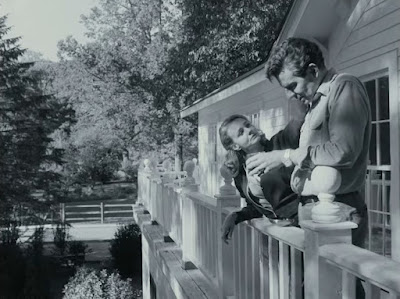 Cooper's performance is going to be the one that people will have an opinion on—as Bernstein was such a media presence that most people have an instinctive sense-memory about him—the make-up work is quite good with only moments of Cooper managing to emerge through it, and he's given Bernstein three distinctive voices for each section, products of a life-long cigarette habit and a cultivated life-style. I have the benefit of knowing someone who worked with Bernstein later in his life and they give Cooper high marks for his work citing "moments when you'd swear it was him" in postures and hand-work.* I will defer to them for any comments on his work, and will add that their impression of Bernstein—"casual" and "generous"—and that the film was far more honest than was expected.
 As far as Cooper's direction, I found it interesting. He is not a great director for the poetic artistic shot, but he is a great director of sequences. After a prologue of the older Bernstein (in wide-screen), breaking down while performing a piano piece in front of the cameras ("So to answer your question, yes, I carry her around with me quite a bit"), the film cuts to black and white box as Bernstein gets his fateful call to conduct in 1943, and Cooper has Bernstein open his drapes, fly out of his room in his shorts and robe, opens a door in the hall and (wham) he opens it onto a balcony in a vast concert hall. The camera zooms out to the stage and a waiting podium, and then back to Bernstein, who turns on a dime and goes back through the door to emerge in a tux and make his grand entrance for the performance. It's very bravura (and all done to the heavy percussive part of Bernstein's On the Waterfront score).
 And I began to worry: Is he trying to out-Spielberg Spielberg?** He's not—as the subsequent movie would show—it's just that he likes long "takes." In fact, it's amazing how long a scene will last without cutting away—those "argument" scenes are done in one shot.
 Cooper will do a couple of other "showman" sequences during the "early days" sequences, but then he stops. Did he run out of energy? No, it's more a matter of putting the energy into the performances and letting the camera settle down as an uninvolved observer with merely a slow Barry Lyndon-style approach for comment. Those exuberant camera routines merely reflect the heady days of promising youth and endless possibilities...where you think you can do anything. And significantly, as things get more serious, Cooper's camera work gets more placid. Rather clever, that.
 Oh, there's a fumble or two. A scene where a clearly cavalier Bernstein drives onto the family estate with his new lover in tow is overlaid with the sneaky opening bars of "West Side Story" and that's a little "on-the-nose." But, for the most part, the choices are good, sometimes surprising in their subtlety, and show a freshman movie-maker still learning some tricks and experimenting and seeing what the possibilities are in this train-set he gets to play with.


The film sets up a mystery with that opening Bernstein quote at the top of the page, and then, at key points, breaks a scene off with a final "Any Questions?" That's not much of a provocation, is dramatically awkward, and I'm not sure the movie fulfills its promise of demonstrating the tension between contradictory answers, so much as showing that any two human beings will have conflicts and must fight their inclination toward selfishness and ego (on both sides) in order to form a more perfect union. But, at least the movie is reaching, and exuberantly so, and Bernstein would appreciate that. He'd have hated a boring bio-pic, even if he had to look bad to get one. In other words, the movie conducts itself well. Any questions?


-GI-Gordon+Parks+1955.jpg)
* I made a remark that, unlike, say, Joaquin Phoenix in Walk the Line, Cooper's work was more imitation than performance and got the reply "Yeah, well, that's Lenny."
** Spielberg was going to direct Maestro, but an early peak at Cooper's rough cut of A Star is Born made him say "You should direct Maestro."


