Showing posts with label Federico Fellini. Show all posts

Tuesday, March 21, 2023

Juliet of the Spirits

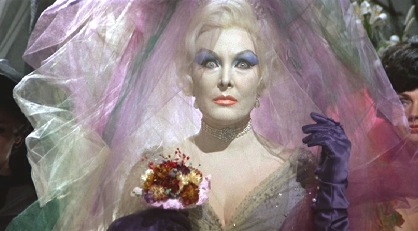
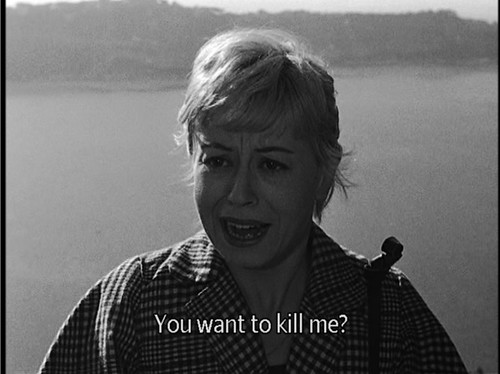
Juliet of the Spirits aka "Giulietta degli spiriti" (Federico Fellini, 1965) Any director's first forays into color from black and white are worthy of attention. John Ford filled his palette with startling reds. Stanley Kubrick set his first color film in the black and white world of space-travel and suffused interior spaces with hot red's, pale greens and cool blues. Fellini you'd expect to go somewhat crazy right off the bat.* But then, how colorful can priests and dirty beaches be? Oh, and the circuses. The circuses must be splendente with color.

But, the great Italian director starts conservatively with its dimension of other-worldliness and
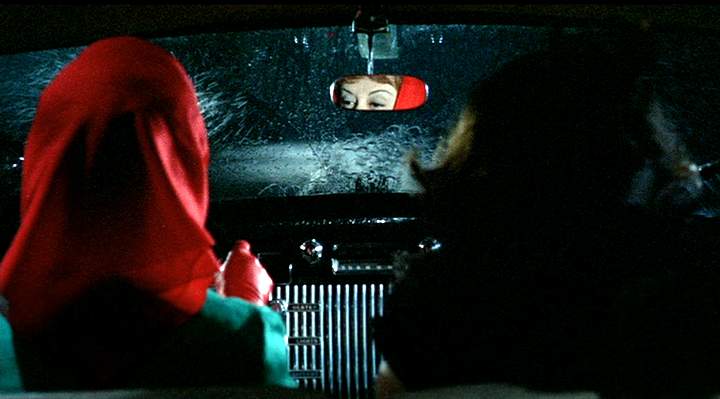
earthy matters with a natural palette and muted colors. But as the world of Giulietta (played by Fellini's wife and muse, Giulietta Masina) starts to crush inside and explode outwards, the colors within her reach become more vibrant and exotic, approaching the phantasmagorical as she explores the phantasmic.
On her fifteenth anniversary to roguish businessman Giorgio (
Mario Pisu), Giulietta has a romantic dinner planned, only to have to share it with the clutch of hangers-on and sycophants he drags home with him. She begins to suspect that she's sharing him in other ways as well, and she seeks guidance from the spirit-world and evidence from a detective agency (of priests!) to get the goods on her no-good husband. At the same time, she begins...slowly, reluctantly to move on from her past life to a new one.

Fellini has famously said "All of my movies are really about me."** Of course. He's making them and writing them—creating them—so they'd naturally reflect his thoughts and
obsessions. But the Fellini who earlier collaborated with his wife-star on empathetic films like Nights of Cabiria and La Strada was now an internationally known and renowned film-maker. His previous films—La dolce vita and —were international hits, as well as being particularly autobiographical Pilgrim's progresses through the glitterati of a new Italian dynamic. He's still working in that mode in Giulietta, but he's inserting Masina into the scenario as an outsider looking in on the decadent adventures of the journeying artist and exploiting the pain of the taken-for-granted wife in the story. One could be gossipy and say that Giorgio is Fellini and the entire movie is an invitation to Giulietta into his dream-life of passions, or a cinematic separation telling the world what a stick-in-the-mud his wife is, but given his past empathetic films with Masina, Giulietta is a bit dispassionate and curiously cold. And cruel; He's inserted his wife into his collection of grotesques and nubile concubines and finds her wanting.
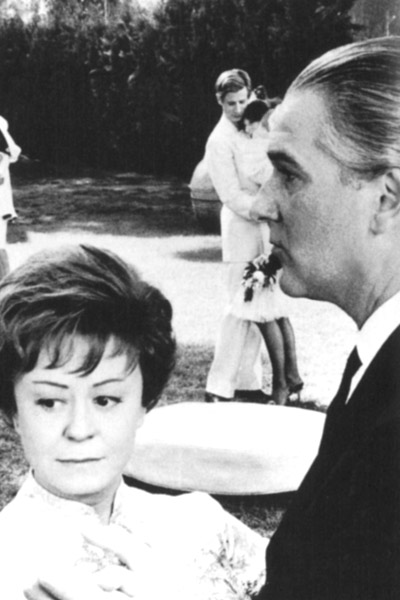
Masina, too, is a little off-put in her performance. Where, in her previous roles with Fellini, she is passionate and eccentric, even effervescent, here she is withdrawn, and 1/4 into the film, after seeing
the constant tight smile that she has on her facepensive, patient (but only so far), repeated again and again in a medium close-up, you get the impression that she's holding back her frustration. One can hardly blame her; Giulietta is caught between two worlds, neither one to her comfort or liking. As she expressed the pain and hope of her characters in the past, one feels her pain with this film.
But you can't argue with a dream.
The colors are eye-popping. The images are by turns, challenging and inviting. The film has the same fascination that a corner holds—what's coming up? What lies beyond? But somewhere, in turning the corner, the journey becomes all-important. The lead character becomes lost in the landscape; lost, or left behind.
 
* Fellini first experimented with color in his segment of the Omnibus film Boccaccio '70—one of the director's "half"-films.  
 
** I've avoided using the exact quote as it comes in two different flavors, depending on which translation you use (and which bumbling entertainment "journalist" translated it): "If I were to make a film about the life of a soul, it would end up being about me," or "Even if I set out to make a film about a fillet of sole, it would be about me." Cosa?

Wednesday, January 2, 2019

Olde Review: The Nights of Cabiria

This was part of a series of reviews of the ASUW Film series back in the '70's. Except for some punctuation, I haven't changed anything from the way it was presented, giving the snotty kid I was back in the '70's a break. Any stray thoughts and updates I've included with the inevitable asterisked post-scripts.

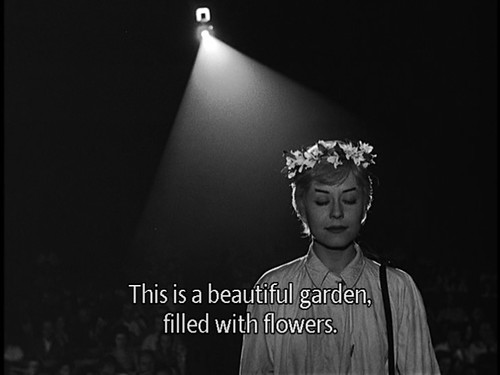
The Nights of Cabiria (aka La Notti de Cabiria) (Federico Fellini, 1956) Both times that I previously saw The Nights of Cabiria I was in the projection room showing it, and that is not the best place to try and appreciate any movie, believe me. But even filtered between dirty glass, and the change-overs,* and the re-windings, it was easy to see that it was an exceptionally fine film.

Cabiria, when we first see her, is in the process of being robbed and shoved into the river by her lover of one month, and after going down for the third time and being fished out by some nearby kids, she is pronounced "dead" (albeit by one of the kids) and then revived and indignantly stalks back to her house. "She's got nine lives, like a cat," one of Fellini's nosey neighbors says as she disappears down the road.

That first scene is symbolically representative of the entire film, for it has an episodic structure in which Cabiria, "a well-known night-bird," is continually finding herself putting herself into situations that, for a while, make her think she might improve her current state as a street-walker, only to be "shoved" and "drowned" by having those hopes dashed. She is usually rescued by something else which also provides hope and also explodes in her face, providing more humiliation. Not coincidentally, most of these hopes entail people: an actor who momentarily uses Cabiria, is momentarily charmed by her, and in a moment, drops her; a hypnotist who exposes her fantasies to a cruelly amused audience. 
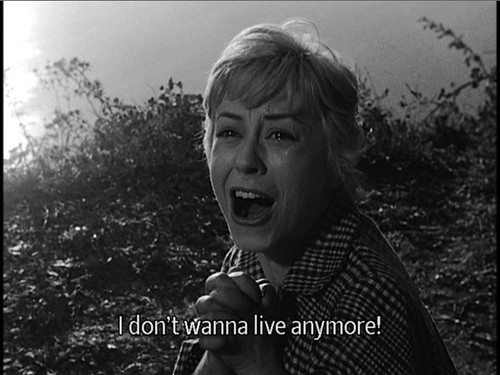
By the end of the film, Cabiria has come full circle--she is miles away from her home, which was her only previous certainty of retreat and recovery, she is without money for she has been robbed and betrayed by her fiancee, who only out of sheer cowardice refrained from pushing her off a cliff. When we last see her, she is presumably walking home in the dark, when a group of young people, revelling and celebrating, catch up with her and gradually her spirits are lifted by them. She begins to nod and smile at the revellers, and then, finally she nods at us, as if to say, "Yeah...well, it's alright" and she continues to move on.
I can just hear the feminists in the audience hiss this film** because Cabiria is prey, just asking to be taken advantage of. She smirks and sneers on the outside, but inside, she is quite susceptible to being suckered into anything. How could she constantly take such abuse? Why does she allow herself into such situations? I'm not sure I can put what I feel on that into this review, but I can safely say that that final few feet of film, when she turns to the audience and nods with a slight, battered smile--that final few feet of film is charged with a life-renewing energy, and I see it as a personal challenge, just as surely as I see The Nights of Cabiria as Fellini's finest film.

One note: The Nights of Cabiria is subtitled, so you might want to get in line early, since it's tough to read them from the top row of 130 Kane.

Broadcast on KCMU-FM , Oct. 7th and 8th, 1976


Nothing to add, really (although the line about "feminists" irks the older me. There is no reason that feminists—or anybody—should not love, as I still love The Nights of Cabiria (and, no, I'm not a big fan of "Sweet Charity" which is "based" on Fellini's screenplay). If anything it should be embraced as a telling statement of the undeclared second-class citizenship imposed on women by the weaker sex. And Cabiria is nothing if not a fighter, who will persevere, no matter what life throws at her. 

Although Fellini went many marvelous and torturous routes during his film-career, I still think it's his finest film (I also have a deep love for Toby Dammit: Or, Never Bet the Devil Your Head, one of those very marvelous and torturous routes. 

But, the worst (and I would add "unforgivable") sin of this review is that I neglected to mention the performance of Giulietta Masina, just one of the roles she played that makes me put her in the category of Chaplin as one of the great screen-faces and personas.***


*In college (when this was written), I was a film projectionist showing movies all around the UW campus. There were no DVD's back then, just massive reels of celluloid encased in metal, each feature made up of a few reels. The projectionist's job was to switch from reel to reel (and projector to projector) without missing a beat, and certainly without distracting the viewer's attention. Two film-blips, ten seconds apart at the end of reels was the signal to "switch-over" from one reel to the next. Then the projectionist would rewind the previous reel (for the next projectionist), and set up the next one, and wait for the blips. A nice job, that. And you got to see a lot of movies.

** Yeah, that's a little harsh, but I can certainly see the argument. Cabiria is a victim, led astray by her hope for something better. If that was all she was, if she was accepting of this victim-hood, and gave in to it, she might be warranting some bad attitude. But she's also a fighter, who keeps picking herself up, throwing off self-pity, and accepting the joy that life has to offer. I really love this character. I want her to "make" it.

Who wouldn't?


*** Chaplin called Masina "the actress who moved him most."

Wednesday, June 6, 2018

I vitelloni

I Vitelloni (aka The Large Calves) (Federico Fellini, 1953) So many films have come down the strada since this one (American Graffiti, Diner) that bear a resemblance to this nicely melancholy collection of stories about the wasted lives of young men that fans of those later Americanized versions will find themselves in cozily familiar (if uncomfortable) terrain. It has become a staple of film makers who have become nostalgic, but just smart enough to see their pasts with the lenses of irony and affectionate smugness.

In a provincial town, there are five men who, post-education and living with their parents, are poised on the edge of putting away childish things and becoming men—and they're doing it as slowly as possible: Alberto (Alberto Sordi) a flamboyant life-of-the-partier, which is fine for him but he's bothered by sister's dalliances with a married man; Riccardo (Riccardo Fellini, the director's brother) is a fine baritone with never-realized dreams of being an entertainer;  Leopoldo (Leopoldo Trieste), the intellectual, has the required "script-in-the-drawer," never published, never performed; the unofficial leader, Fausto (Franco Fabrizi), whom all the others look up to, is an unrepentant womanizer, good at seducing but bad at staying 'til morning; then, there's Moraldo (Franco Interlenghi), the youngest, who observes all the behavior, following in the others' footsteps if not down their paths.
See, there's a problem: Moraldo's sister (Leonora Ruffo), who's just been named "Miss Siren of 1953" at the end-of-Summer bash, is pregnant with Fausto's baby. When she faints after being crowned, the whole town becomes aware of the scandal and Fausto is forced to marry her, then take on a job as a clerk, which he despises. Already, Moraldo's loyalties are divided, between loyalty to family and friends, between fun and responsibility, and right and wrong, and it creates a new perspective from which he observes his friends as they listlessly make their way from Summer to Summer (their season to shine) free, but not care-free...and not entirely rootless. Time goes by, getting by, and all are shown lessons they don't want to learn—about compromise, about self-reliance and duty.  But there's always another party to go to, another prank to pull, another alley to duck into when the going gets uncomfortable. There's no time to lose, as time can't be wasted, only spent.
It's all set to the sad swagger of Nino Rota's perfectly-in-tune score, and it is one of those rare Fellini films that ends with a resolution, rather than a wry shrug. There is hope, and an indelible last image that hangs in the memory (and not because it's freeze-framed) that shows how brilliant Fellini could be when he kept things simple (and he had to on this film, shot over six months, with different cinematographers). The last line is also curious, as it is dubbed, not by the actor, but by Fellini himself. He would insert himself more and more into his films, until they merged, the two indistinguishable for a time, the man and his work, his dreams made real.
Sittin' on the dock of the bay...wastin' time

.

Wednesday, September 27, 2017

Il Bidone

Il Bidone (aka "The Swindle") (Federico Fellini, 1955) The Italian maestro in his hey-dey. 

This 1955 film follows a trio of grifters—Augusto (Broderick Crawford), Picasso (Richard Basehart), and Roberto (Franco Fabrizi)—who are low-level con-artists in search of the Big Score—even a Ponzi scheme will do. They drive into a small village, all pomp and circumstance, with as much respectability as a disguise or a decent suit can buy. Then, with guile and a healthy disrespect for people's own need for "easy riches" or a "too-good-to-be-true" deal, bilk the citizenry out of as much cash as they can find lying around. As priests (using the respectability of the Church), they convince simple farm-folk of "buried treasure." On a grander scale, they're developers collecting down-payments on rooms to a vapor-hotel that will never materialize ("The economy's bad and we've suffered some set-backs").  
For Picasso, there are dreams of becoming a famous painter (but in the mean-time he can forge a few masterpieces to get by, much to the chagrin of his long-suffering wife, played by the wonderful Giulietta Masina). Roberto, their chauffeur/get-away driver, is young to the game and is always looking for new angles so he can set off on his own crime-spree, free of "the losers" he thinks might be holding him back.   
But, the leader of the group, Augusto, is feeling the advance of age and getting a little desperate; he hasn't achieved any real fortune, just what can be piffled away on a falsely high lifestyle and an evening of prospecting at the clubs (he's not a high-roller, but he has to play one and that can get "spendy"). He is torn. He wants the respectability that a really big perpetual con (like the kind found in government circles and among the constabulary) can bring. In essence, what this overlarge, over-age boy in big pants wants in reality is what he only play-acts in his livelihood—a man of respect, a high roller, an adult, or his imagining of what that is. For Augusto, he hits "the brick-wall of Reality," in the presence of his very real daughter, for whom he wants most to be seen as a man of accomplishment, instead of the fraud he pretends to be.
I started out this review saying "the Italian maestro in his hey-dey" and have come to this point wondering if that is true.  I've often dismissed his latter films as inferior if more complicated and less grounded in reality to his 1950's films, which are more aspirational in nature. They're about wishing and hoping for success which eludes their protagonists—the street-performers of La Strada, the drifting men of I Vitelloni... and Cabiria. When director Federico Fellini became film-maker "Fellini," international artist, he seemed to lose that touch of "becoming," replacing it with observations of his new life "having made it," and finding it difficult to maintain as well as being empty, and finding it wanting. In a sense, Fellini was compiling an autobiography of his journey to success and beyond. Even his wife (Messina) complained that his Juliet of the Spirits wasn't about a woman's issues, but about his own. His movies about the glitzerati felt hollow and self-absorbed (appropriately).  
But, the director still aspired, although he struggled for subject matter (see ) or funding, especially in his later years, despite his international reputation. He retreated to fantasies and circuses, reality being not enough—and maybe not too sure anymore about what reality actually was, surrounded as he was by reputation, the expectations of fame, and the glare of the spotlight. Simple virtues and humble origins cannot be found on the soundstages of Cinecitta, or the boardrooms of Titanus
But, the aspirations continued. As if documenting Shakespeare's seven stages of life, Fellini's vision, aimed ever inward, began looking back, becoming nostalgic for those early times of "wanting" dreams, trying to reclaim them, make them real again. The films were not so much aspirational anymore, but seeking the times and memories of aspiration, when the world was full of possibilities, when wonder was more than kleig-lights and grease-paint, a fraud wanting to be real.

Tuesday, October 25, 2016

Toby Dammit or: Never Bet the Devil Your Head

Toby Dammit: Or Never Bet the Devil Your Head (Federico Fellini, 1968) Fellini's adaptation of the obscure Edgar Allen Poe story of a rake whose egotism gets the better of him has been making the rounds this year at the film festival circuit and receiving the attention and the acclaim it is due.

Made as part of a European Poe omnibus (and released in the U.S. by
AIP, who'd been producing their own Poe adaptations), under the title Spirits of the Dead aka Histoires Extraordinaires or Tre Passi Nel Delirio, it is Fellini's 30 minute masterwork that the film is best remembered for. The other adaptations were Roger Vadim's heavy-breathing "Metzengerstein" starring Jane and Peter Fonda as incestuous cousines, and Louis Malle's dull S & M piece "William Wilson," despite starring both Brigitte Bardot and Alain Delon.

But, the best of them—by a head—was Federico Fellini's contemporary take on Poe's story of a rake who makes one wager too many.

As the Fellini piece was the Grand Finale, I wouldn't be surprised if folks walked out of it before his segment. If they did, they missed a chilling masterpiece. 
Fellini transposes the premise to a Hellish 1960's Italy where international film-star Toby Dammit (Terence Stamp), in a perpetual state of drunkenness, is whisked off a plane to a television interview, and then feted at a party filled with high-rollers and press to celebrate the start of production of a religious-themed Western.*
Fellini spends much of the time satirizing the fawning excesses of the film industry and the predatory/co-dependent nature of the Press, and proves he certainly knows how to throw a party. Dammit keeps drinking and sinking into a deeper funk when he's seduced by an Italian "hostess" (to the accompaniment of Ray Charles' cover of "Ruby") and turns philosophical when a reporter asks him if there is a devil, which Fellini turns into a simple, unsettling Vision.** 
The evening ends when Dammit's handlers take him off-leash, giving him the disposal of a sports-car. There follows a nightmarish "Mr. Toad's Wild Ride" through the narrow Rome streets (which clearly influenced the "Durango '95" sequence of Kubrick's A Clockwork Orange).
The high-octane combinations cannot end well. But Fellini steers it back to Poe for an appropriate, ambiguously grisly finish. Clocking in at 37 minutes, Toby Dammit is a compact mini-movie, but is filled with imagination and good ideas. Were it not for Nights of Cabiria, this Fellini vision of Rome as Hell would be my fave Fellini.


* Peter O'Toole was supposed to star, and dropped out. Earlier in the decade he'd played all of the Angels in John Huston's "The Bible," produced by Dino DeLaurentiis. Perhaps it was a little too "on the nose."

** You watch things, you learn things.  Fellini's version of the Devil might have been inspired by fellow Italian Mario Bava, who in 1966, had featured a devilish little blond girl in Kill, Baby, Kill. Fellini's image is more powerful, but...