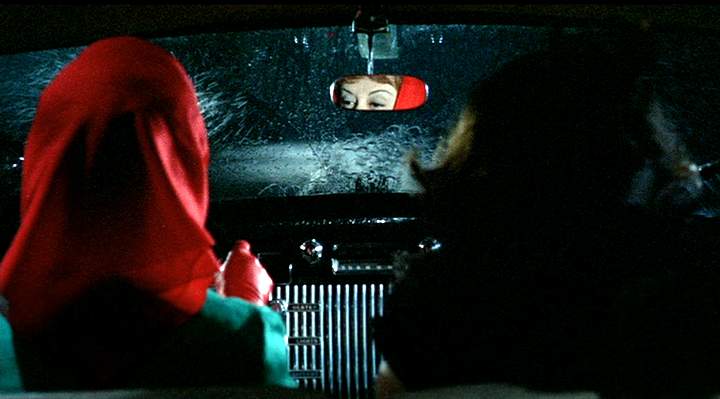
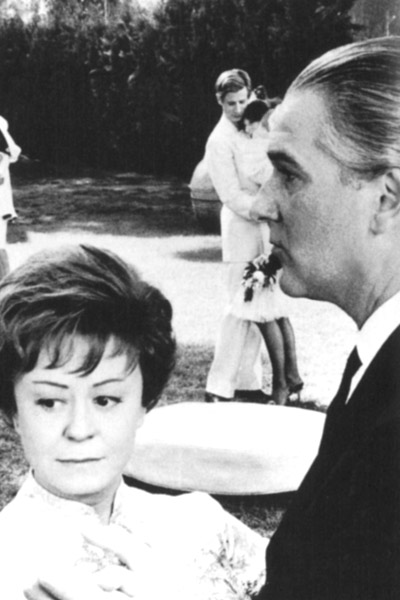
Juliet of the Spirits aka "Giulietta degli spiriti" (Federico Fellini, 1965) Any director's first forays into color from black and white are worthy of attention. John Ford filled his palette with startling reds. Stanley Kubrick set his first color film in the black and white world of space-travel and suffused interior spaces with hot red's, pale greens and cool blues. Fellini you'd expect to go somewhat crazy right off the bat.* But then, how colorful can priests and dirty beaches be? Oh, and the circuses. The circuses must be splendente with color.
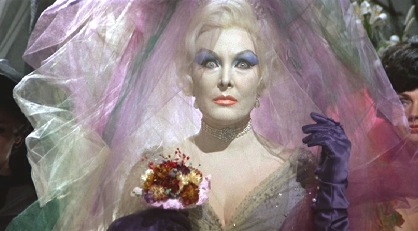
But, the great Italian director starts conservatively with its dimension of other-worldliness and earthy matters with a natural palette and muted colors. But as the world of Giulietta (played by Fellini's wife and muse, Giulietta Masina) starts to crush inside and explode outwards, the colors within her reach become more vibrant and exotic, approaching the phantasmagorical as she explores the phantasmic.
On her fifteenth anniversary to roguish businessman Giorgio (Mario Pisu), Giulietta has a romantic dinner planned, only to have to share it with the clutch of hangers-on and sycophants he drags home with him. She begins to suspect that she's sharing him in other ways as well, and she seeks guidance from the spirit-world and evidence from a detective agency (of priests!) to get the goods on her no-good husband. At the same time, she begins...slowly, reluctantly to move on from her past life to a new one.
Fellini has famously said "All of my movies are really about me."** Of course. He's making them and writing them—creating them—so they'd naturally reflect his thoughts and obsessions. But the Fellini who earlier collaborated with his wife-star on empathetic films like Nights of Cabiria and La Strada was now an internationally known and renowned film-maker. His previous films—La dolce vita and 8½ —were international hits, as well as being particularly autobiographical Pilgrim's progresses through the glitterati of a new Italian dynamic. He's still working in that mode in Giulietta, but he's inserting Masina into the scenario as an outsider looking in on the decadent adventures of the journeying artist and exploiting the pain of the taken-for-granted wife in the story. One could be gossipy and say that Giorgio is Fellini and the entire movie is an invitation to Giulietta into his dream-life of passions, or a cinematic separation telling the world what a stick-in-the-mud his wife is, but given his past empathetic films with Masina, Giulietta is a bit dispassionate and curiously cold. And cruel; He's inserted his wife into his collection of grotesques and nubile concubines and finds her wanting.Masina, too, is a little off-put in her performance. Where, in her previous roles with Fellini, she is passionate and eccentric, even effervescent, here she is withdrawn, and 1/4 into the film, after seeing the constant tight smile that she has on her face—pensive, patient (but only so far), repeated again and again in a medium close-up, you get the impression that she's holding back her frustration. One can hardly blame her; Giulietta is caught between two worlds, neither one to her comfort or liking. As she expressed the pain and hope of her characters in the past, one feels her pain with this film.But you can't argue with a dream. The colors are eye-popping. The images are by turns, challenging and inviting. The film has the same fascination that a corner holds—what's coming up? What lies beyond? But somewhere, in turning the corner, the journey becomes all-important. The lead character becomes lost in the landscape; lost, or left behind.
* Fellini first experimented with color in his segment of the Omnibus film Boccaccio '70—one of the director's "half"-films.
** I've avoided using the exact quote as it comes in two different flavors, depending on which translation you use (and which bumbling entertainment "journalist" translated it): "If I were to make a film about the life of a soul, it would end up being about me," or "Even if I set out to make a film about a fillet of sole, it would be about me." Cosa?
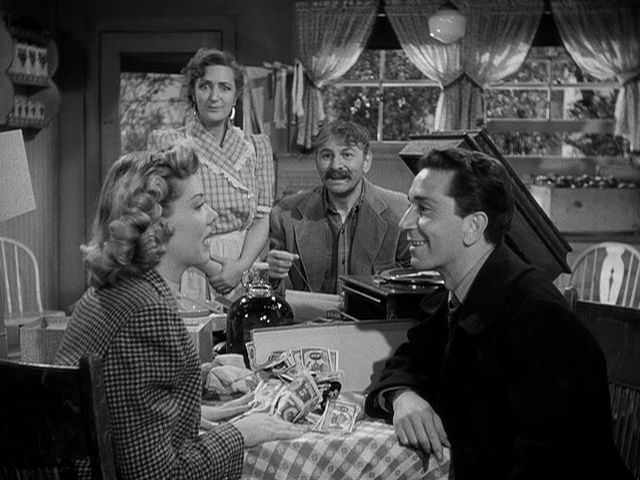
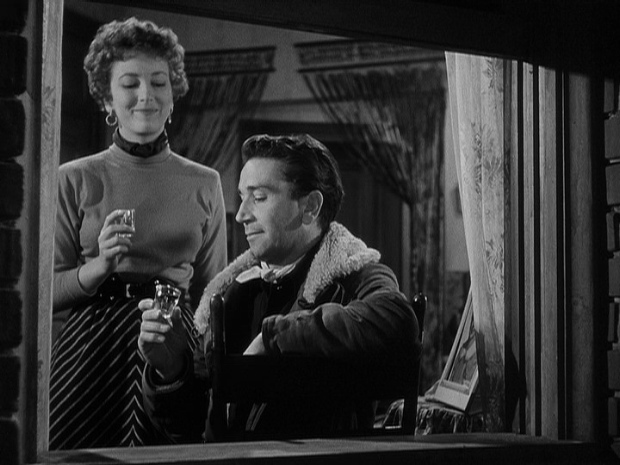
Thieves' Highway (Jules Dassin , 1949) A revenge story set in the wild and wooly world of wildcat truckers (also explored in A.I. Bezzerides' similarly themed They Drive By Night). Nick Garcos (Richard Conte) comes home after a big score and showers his family with presents. He's so full of himself that he doesn't notice the obvious: Dad's missing his legs (which makes the slippers he bought him a very poor choice). It seems while Nick was away, Dad got rooked on a vegetable run, taken for a long drunk, and had a bad crash in his dilapidated truck, crippling him.
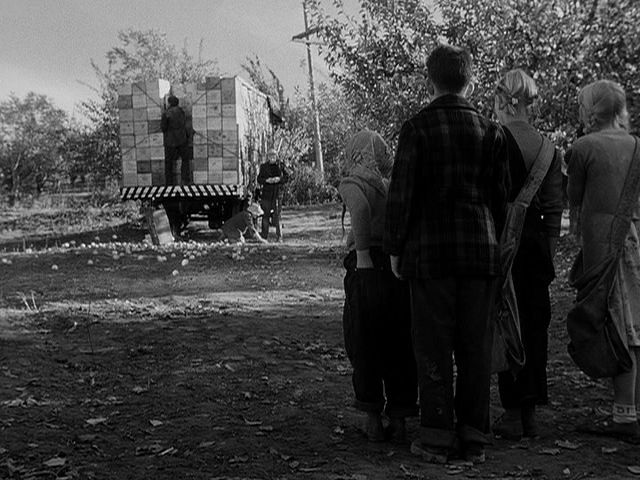
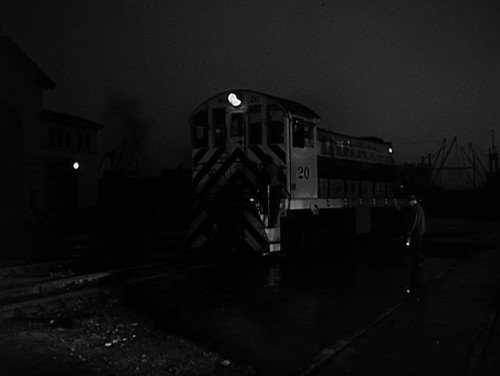
Worldly-wise and hardened in combat, Nick decides on an assault on the man who crushed his dad's dreams, one Mike Figlia (Lee J. Cobb), a bad apple who'll spoil the whole bunch right down to the bottom of the barrell. He partners with the wild-catter who bought Pop's truck (the great Millard Mitchell) to deliver two loads of golden delicious to Figlia's produce wholesaler in San Fran'...if they can get through a gauntlet that includes duplicitous rival wild-catters, a truck with a bad universal (and not much good!), 36 hours straight on the road without any sleep, and worn tires (a sequence that Dassin turns into a thrilling montage of overlapping images).

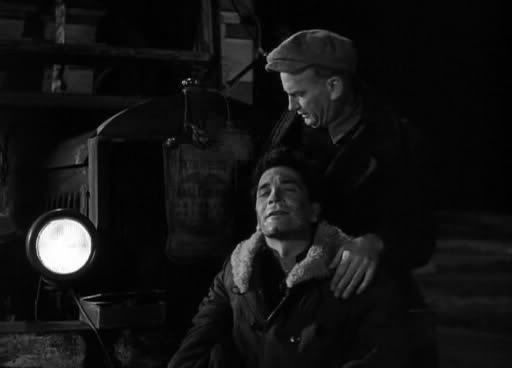
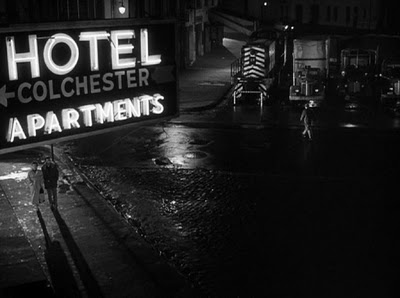
Except for the loading of apples, all this takes place at night, and no one could dredge the dark as well as Jules Dassin (as he was always proud to announce, that's pronounced "Da-ssin," from the U.S.). Dassin always had a flair for the street and the twisted culture of film noir, and Thieves Highway is gritty and street-smart: no one in this movie is naive or innocent, everybody has an agenda or an angle, and Nick has to keep his head on straight (tough to do with a neck injury received when a truck collapsed on him while changing a tire), whether negotiating with Figlia or dealing with the street-frail (Valentina Cortese) hired by Figlia to entertain Nick while he works the angles.
It's an education, one that toughens Nick up and makes him see that there's more than what he imagined in his existence before. Sure, he's earned a living and survived the war, but... It's one thing to avoid death, it's quite another to embrace life.
 Juliet of the Spirits aka "Giulietta degli spiriti" (Federico Fellini, 1965) Any director's first forays into color from black and white are worthy of attention. John Ford filled his palette with startling reds. Stanley Kubrick set his first color film in the black and white world of space-travel and suffused interior spaces with hot red's, pale greens and cool blues. Fellini you'd expect to go somewhat crazy right off the bat.* But then, how colorful can priests and dirty beaches be? Oh, and the circuses. The circuses must be splendente with color.


.jpg)
.jpg)
.jpg)
.jpg)

.jpg)