Showing posts with label Alicia Vikander. Show all posts

Tuesday, March 8, 2022

Anna Karenina (2012)

Struggling with writing a review of Cyrano, the latest from director Joe Wright. So, in the meantime, here are a couple reviews from his past work that I haven't put up yet.

Written at the time of the film's release...
 
Artificial Intelligence
or
Anna! Karenina! The! Musical!

Tolstoy's "Anna Karenina" is considered by many the greatest novel ever written, and has been adapted so many times (two of them starring Greta Garbo!), one is tempted to name any version "The Last Remake of Anna Karenina." So, the task for director Joe Wright and scripter Tom Stoppard must have seemed daunting, or as one of Zsa Zsa Gabor's later husbands stated it: "You know what you have to do, you just have to find a way of making it interesting."

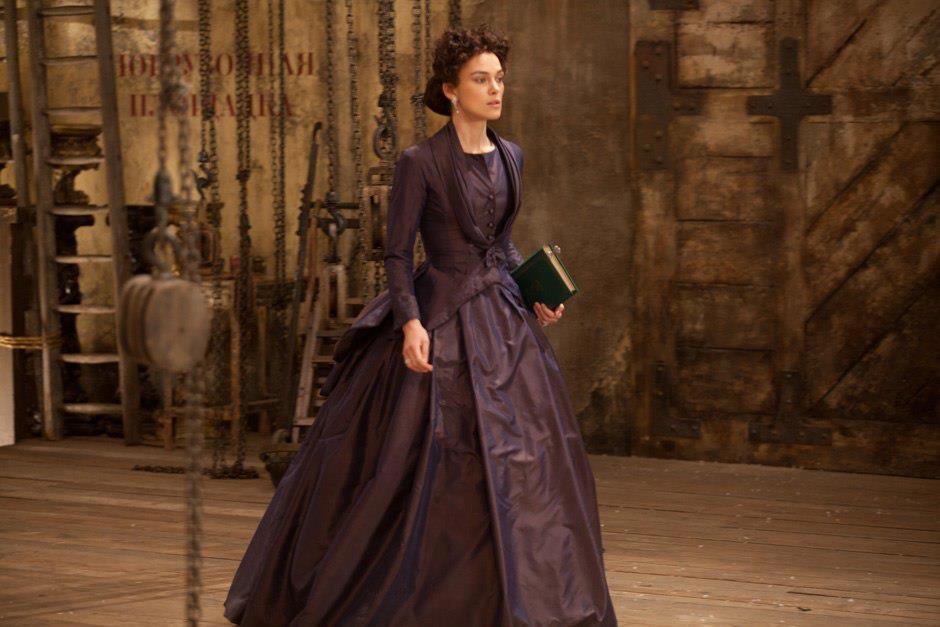
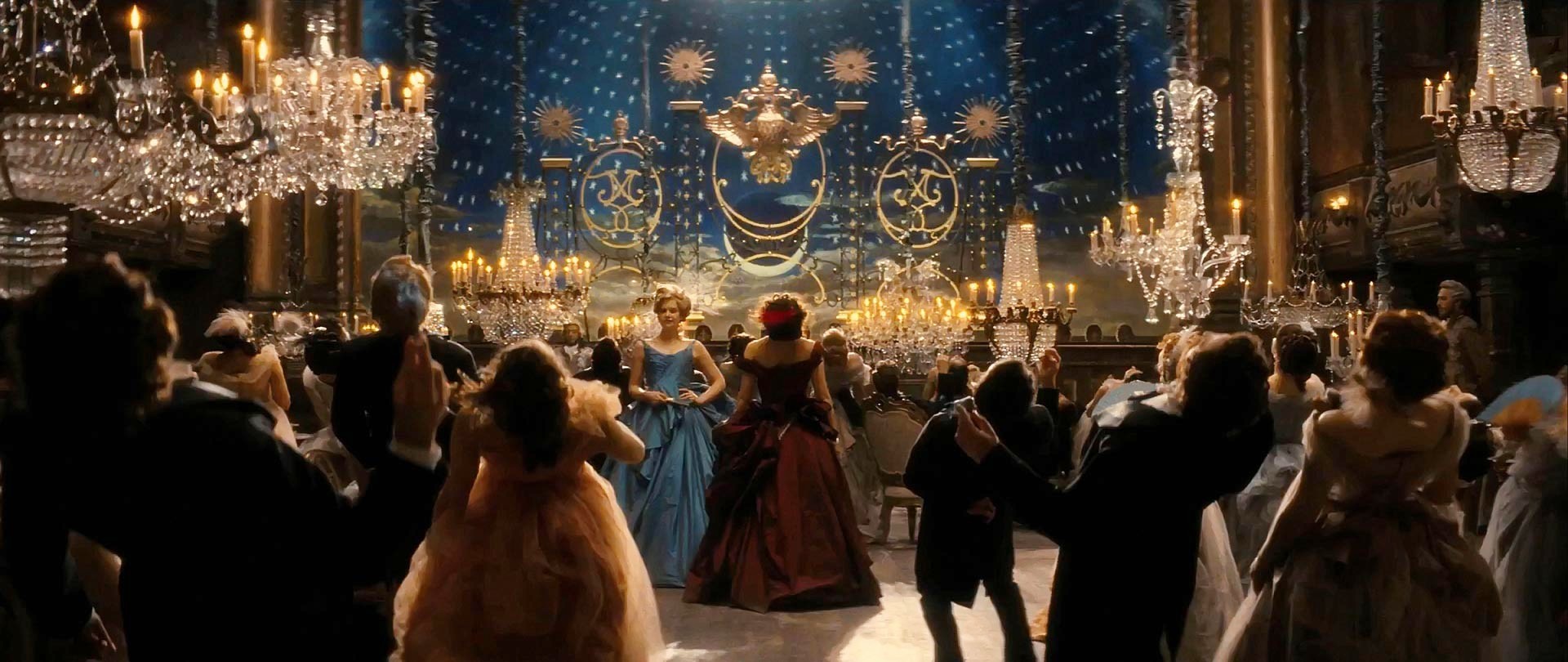
Well, this one is interesting, alright. And it hues closely to Tolstoy's novel in the way that a CliffsNotes Edition sticks close. All the plot points are there, the characters whittled down to their bare essences, or eliminated altogether, and breezily delivered in a theatrical manner, save some significant exceptions. Truth is, Wright makes this version of Anna Karenina the way Baz Luhrmann would, as a grand, operatic experience staged in an extraordinarily choreographed with the emphasis on the "arch" (as in "playfully and affectedly roguish") in Proscenium Arch.
Jim Emerson had a fascinating article* (based around Skyfall) on his "Scanners" blog on the difference between a "theatrical" film and a theatrical film and its use of space as defined by the limitations of the frame and a stage directors' tendency to reflect that frame with its own limitations resembling the dimensions of a stage. 
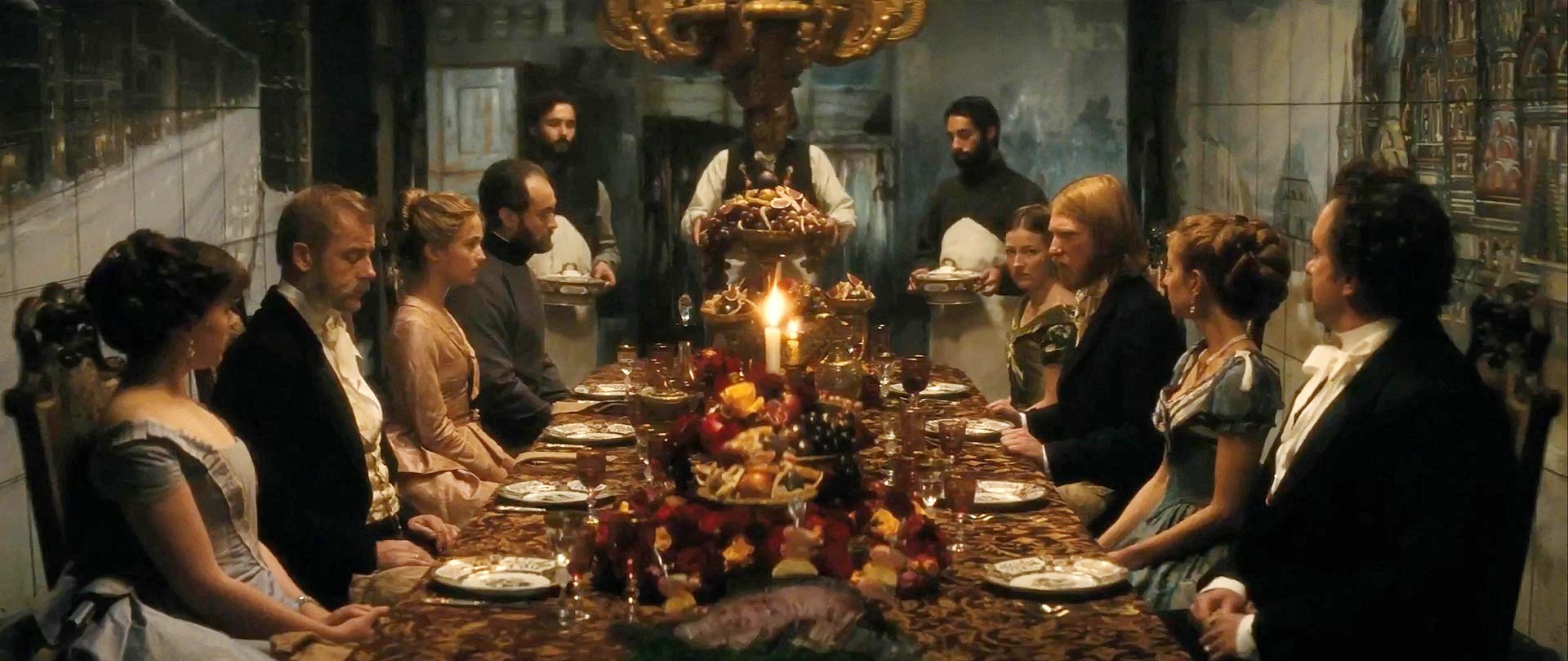
Wright fully embraces that concept and goes further; for the main story of the hoi-polloi and their social and political gamesmanship, all of the action takes place within the false spaces of a theater (at times even using the rafters as locations for traditional street-scenes): train and carriage scenes are decidedly set-bound with no effort made to reflect a "real" world outside the windows; transitions are made "in-camera" without editing, so a very stagy and choreographed bureaucratic work set-up with synchronized rubbing stamping (set to Dario Marianelli's interesting score) segues to a restaurant scene by merely having the "extras" trade in their black business suits for waiter-whites; a formal society ball is not an intricate commingling of dancers that Wright so effectively engineered in Pride and Prejudice, but is an elaborate ballet, where the participants barely touch and their hand movements are intricately swanning in nothing that approaches a traditional dance (at times, to keep track of the principals, the foreground dancers in our field of vision "freeze" to better make out the focus of our attention). Like Francis Ford Coppola's set-bound version of Bram Stoker's Dracula
, It's all very elaborate, "stagey," false, and at times clever but, a lot of the time, merely "showy," like a musical with no libretto, something to separate this "Anna" from the more realistic, even if filmed in-studio, versions. 
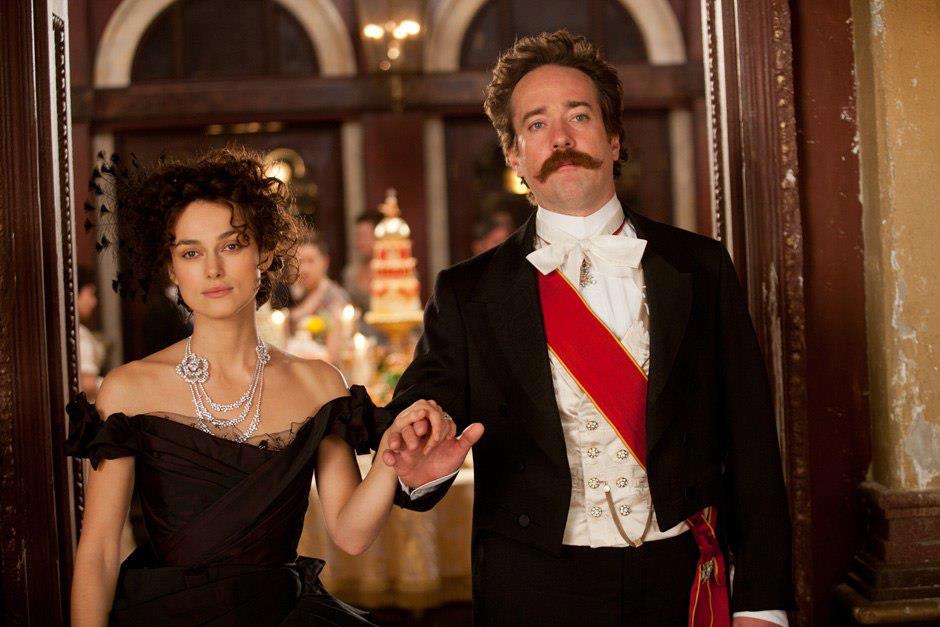
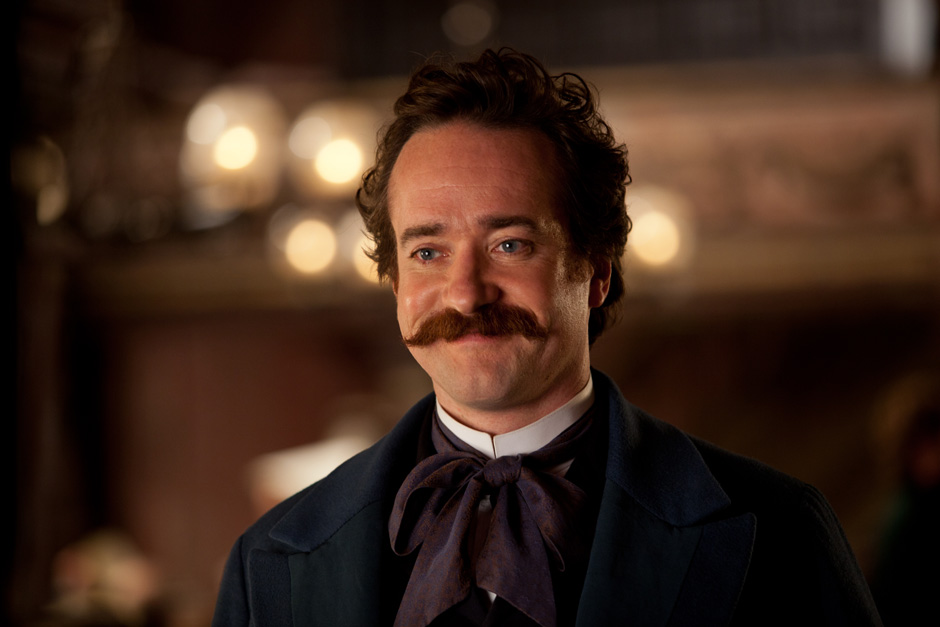
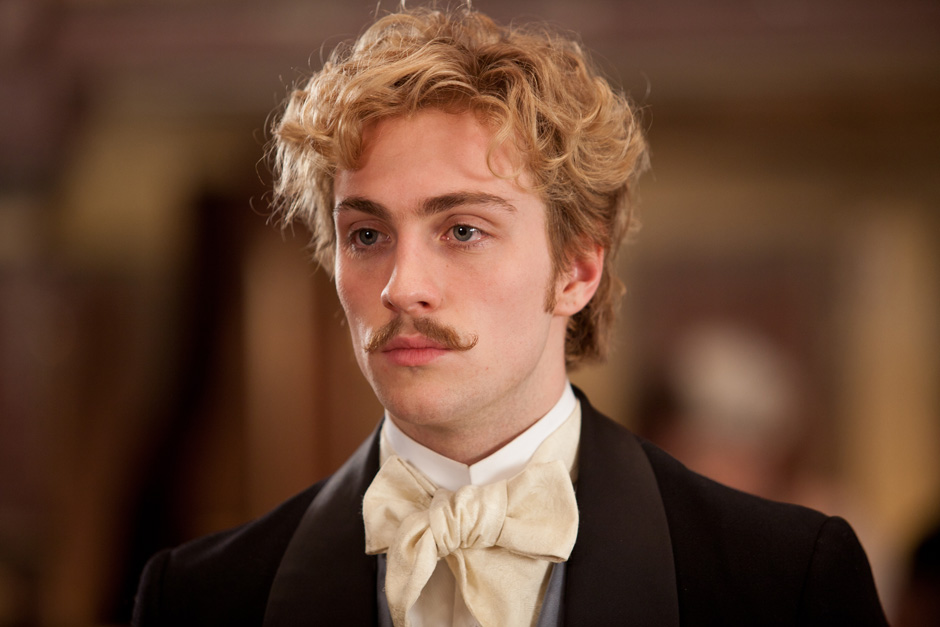
The performances run that way, too. Keira Knightley is an exasperating Anna, conflicted but fatally committed to fully expressing whatever is on the surface of her heart. Her P & P co-star, Matthew McFadyen is a burlesque cousin Oblonsky, fatuously showy in a way that reminds of Kevin Kline performing a burlesque role. Jude Law—not one of my favorite performers—here is exceptional as Anna's cuckolded husband, and is so restrained and non-theatrical, that it sets him apart from almost every other performer, isolating him, and is a good short-hand way of showing why Anna might be dissatisfied with him. Olivia Williams has a small part as the Countess Vronsky, whose son (Aaron Taylor-Johnson) is the very florid object of fascination for Anna.
Anna (Keira Knightley) runs from Vronsky at the Ball
and experiences a little fore-lightening from an approaching train.

It's dangerous in a Joe Wright theater.

But, almost the entire film is deliriously fascinated with the artificiality that it undercuts the very real passion and consequences of actions of the people in the film, reducing them to "players" as opposed to human beings.

I say "almost" because Wright does change things up to "open up" the segments featuring Levin (Domhnall Gleeson) and Kitty (Alicia Vikander), who already have their disappointing encounter with Vronsky and move on. When they reunite, their segments are set in a real world of sky, clouds and fields befitting the couple who exemplify wisdom, forbearance and patience. Wright puts them in our world, relegating the others to an artificial world that is essentially stage-managed (even at the end with a coda of Karenin and the remains of his family, it is contained in the stage-world that Wright has chosen to house his film.
It's different, even interesting in an oddly disrespectful manner, as the flightiness of the bourgeoisie and their concerns are merely shadow-play and window-dressing—it is true to an extent—but by pushing the metaphor so aggressively, it undercuts any feeling one has for the players in the majority of the film itself, and reveals itself as resembling the tut-tutting of the hypocrites who turn against Anna. I'm not sure that Tolstoy had that intention (even strained through Stoppard), and this film might have benefited  from a less facile presentation that required less stage-craft and something more resembling (I don't know) empathy?

Friday, August 13, 2021

The Green Knight (2021)

Getting Ahead for Christmas
or
Won't You Tell Me What's Gawain On...
 
I'm a big fan of the works of director David Lowery (Ain't Them Bodies Saints, Pete's Dragon, A Ghost Story, The Old Man and the Gun) which are diverse and visually strong and striking. He makes movies that respect viewers and give them something lovely to look at and something to chew on. They're not exactly "easy sells" for the studios, but with The Green Knight, we're getting as close to a super-hero movie as Lowery is ever going to get.
 
And it's a stunner.
 
It's the old Arthurian legend, "Sir Gawain and the Green Knight" written 700 years ago by an anonymous scribe, who tells the story of a young knight-lite, who accepts the challenge of a Christmas intruder at Camelot, and, in a year's time, must pay the price of retribution.
 
It's a story about honor and self-sacrifice, which is also a tough sell at the box-office these days.

But Lowery has taken the basic frame-work, done a lot of research, read the interpretations (like Tolkien's) and put a spin on it that has been there all along, but folks might not have recognized because they were concentrating on the men-folk.
At the time of the film's beginning, Gawain (Dev Patel) is hardly a noble knight, rarely spending time at the court of Camelot, although King Arthur (Sean Harris) is his Uncle, and, instead, holding his own court at the local brothel, where his regular partner is Essel (Alicia Vikander). She loves Gawain, but is quite aware of their difference in stations. Indeed, when she suggests that nothing would make her happier than being his lady, Gawain responds with silence.
Visiting his mother, Morgan le Fay (Sarita Choudhury), on Christmas, she gives him grief for not attending the King's holiday feast and he relents, only to find that the King requests him to sit by his side during the proceedings. Quite an honor, but why? Unbeknownst to Gawain or anyone else, his Mother has been performing a ritual in her tower, which may or may not have produced a guest at the gate. A gnarled, wood-veined figure, The Green Knight, rides on horseback into the hall full of royalty, knights and the famous round table, with a challenge.
Is there any knight so bold and so brave to take him on in a fight? But, before you answer, there's a catch: Should that knight survive, in a year's time, he is beholdened to travel to the Green Chapel, where whatever blow the strange figure has received will be reciprocated in kind. Gawain accepts the challenge and the King hands him Excalibur for the task. To Gawain's surprise, the Green Knight kneels and bears his neck...and Gawain chops off his head with one swift stroke.
But the Green Knight does not die. He picks up his head, reminds Gawain of his obligation and leaves...laughing. The die is cast. The challenge is clear. It is not so much besting the Green Knight as it is making good on the promise to accept the fate that awaits him and keep his appointment. With (as the film's chapter title says) a "too-quick year"'s anticipation of the event, he who undertakes the journey to the Green Chapel must truly be a brave knight...and a man of his word. But, is that Gawain? He hasn't demonstrated such nobility before.
Arthur has something to say about it: "I don't know any great man to march to death before his time...do not waste this." And so, Gawain sets out to make his way to The Green Chapel. For the journey, his mother braids a girdle that, she says, will prevent any harm to him while he wears it. That doesn't guarantee, of course, that he will be completely safe. Along the way, he is robbed of his horse, the Green Knight's battle-axe, and the girdle, and left bound and gagged while the robbers caper off.
It is here that we see a neat visual story-telling trick from Lowery cluing us in to the sort of man Gawain is—and giving us a better handle on the story he's trying to tell. The director's camera circles the woods where Gawain is helpless and once we've made the full revolution, we come across him again—a full skeleton left to rot. Circle again and Gawain is there, still alive, flesh AND bone, but now, with the vision of what could be if he does not act, he painfully crawls along the ground to his sword in order to attempt to cut his bonds.
Lowery will pull this idea again, later in the film, showing us an alternative future should Gawain falter, and that he has a choice to make if he is to succeed in his quest. He is not an instinctual knight, of pure thought, bold, brave and chivalric. He can go either way, and it is his choice that will decide his fate, to take action and do the right thing, the honorable thing, the sacrificial thing, the knightly thing.
On his journey he will meet a ghost (and do it a kindness), encounter giants and trust their counsel, meet a companionable fox, and encounter a castle that offers welcome, but also a tempting means of escape. But, he goes on, rewarded by his trials by getting back all that was taken from him.
It's a weird, fantastical tale, told with simple, startling images that are in danger of distracting from the story's point: given a choice, would we do what is right, what is noble, or would we chicken out, be weak, give in to our baser instincts, or be lazy slobs and not disciplined, principled actors. It's a question that we should put before all of us, if we have the wherewithall to listen, to admit that we might be wrong, might be weak, and that we can do better, whether it's not to cut someone off in traffic, or withhold that snarky tweet, or consider the fate of others as we would our own.
 
Gawain is put to the test. So are we all, even if we bear no armor, wield no axe, and will never have poetry written about us.

Saturday, August 22, 2015

The Man From U.N.C.L.E. (2015)

Cry U.N.C.L.E.! and Let Slip the Dogs of Summer!
or
The Better Luck Next Time Affair

Those of us "of an age" remember the 1960's (if what we did in the 70's and 80's didn't completely wipe it out) as a time burgeoning from eclectic influences in pop culture. Colors were bold, music had influences from around the world (mostly British, French, Italian, and Spanish with a smattering of Appalachian folk), literature disobeyed rules and fashion skimped on material and was mightily chromatic. Things began to go "pop" and the notion of "long-hair music" forever changed. In the era of the Beatles and Bond, things began to be taken less seriously until it fell into "camp." On TV, the transition went from black-and-white into "living color" and the shows went from filmed radio plays to bigger-budgeted escapism.  

One of those was an hour long spy-mock-drama that endeavored to bring a James Bond type of thriller to the small screen (Bond's creator, Ian Fleming, contributed the name of its hero-agent) with a touch of intercontinentalism (on a small budget) and a running nod towards Hitchcock. "The Man From U.N.C.L.E." (which stood for The United Network Command for Law and Enforcement.*) premiered on the NBC TV network in September of 1964 (a few months shy of the movie premiere of Goldfinger) and featured Robert Vaughn as American agent Napoleon Solo (Fleming's contribution) and David McCallum as Russian agent Ilya Kuryakin. Leo G. Carroll played their boss, Alexander Waverly (he played a similar head of a spy agency in Hitchcock's North By Northwest). The plots generally revolved a plot by the criminal organization T.H.R.U.S.H.** which Solo and Kuryakin would quell with the assist of an innocent civilian (usually that week's lead guest star) who would prove invaluable and then return to their ordinary lives never to be heard from again. The show ran for 4 seasons on NBC and frequently bits of episodes were joined together to form theatrical films which were most prominently shown in foreign markets. There was a spin-off: "The Girl From U.N.C.L.E." starring Stephanie Powers (as agent April Dancer—another Fleming name) and Noel Harrison, but it lasted one season.
That was then; this is now.  An "UNCLE" film has been in development for years with various enticing elements attached, but when the chips fell, Guy Ritchie was in the director chair, and re-united with his Sherlock Holmes co-screenwriter Lionel Wigram to make an updated version of the film. Just as with that film, the two tinker with expectations while trying to remain somewhat true to the spirit of the thing.
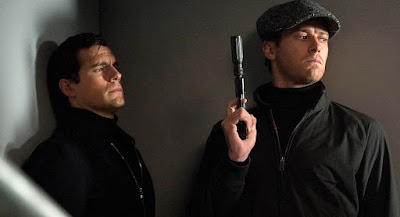
So, how is it?  Pretty luke-warm for a Cold War film.  It is an origin story of sorts, set in 1963 with a threat of such high seriousness and nuclear repercussions that the CIA and KGB must unite to try and stop it. The recruits are Napoleon Solo (Henry Cavill—who doesn't have Vaughn's lizard-like charm, but replaces it with a winsome mean streak) and Ilya Kuryakin (Armie Hammer, just fine, thank you), just like the series. But not like the series. Solo has a history of theft, smuggling and black marketeering from his days at the end of World War II (although Solo looks a bit young to have been serving at the time) and Kuryakin is humorless, abnormally strong (he yanks the boot off a car at one point in the film) and is reported to be slightly psychotic from childhood traumas. Well, that's no fun, but it does set up the sort of bitchy, bickering banter that the Holmes films are known for, some of which works and some of which feels like filler.
The collaboration does not start off well.
The matter at hand is an Italian industrialist couple, the Vinciguerras's (Luca Calvani, Elizabeth Debicki) with ties to former Nazis who—for whatever reason—are trying to develop a nuclear bomb. Not nice. The reason Solo and Kuryakin are collaborating is that both agents were trying to get their hands on one Gabby Teller (Alicia Vikander), whose father is working with the Vinciguerra's to develop the bomb. Solo manages to smuggle her out of East Berlin, much to the consternation of Kuryakin, who is trying to prevent it. This forces the two sides to cooperate, although both agents are privately advised to steal the back-ups of the bomb plans even if they have to kill the other to do so. Not the most viable of partnerships.
And if their rivalry doesn't put the kibosh on the operation, Gabby's loose cannonry certainly might. She trusts Solo a bit (he did, after all, get her out of East Berlin), Kuryakin, not at all—and he's the one tasked with posing as her fiancé in the hopes that she can contact her long-missing Daddy working for the enemy. It is the flimsiest of spy-schemes but it beats a high-stakes poker game or most of the other UNCLE strategies on the TV show. While Solo turns on the charming roguishness with the Vinciguerra's (particularly the Mrs.)...
...Kuryakin and Teller try to pose as a happy couple in love, something the Russian has to be constantly coached at by both Solo and Teller, as he is not very good at staying in character. He also has a nasty habit of losing his temper and using his martial arts training, even though he's supposed to be posing as an architect. Considering he's being watched constantly by Vinceguerrian hoods, you would think he'd have a little more control over himself. How long has Kuryakin been an undercover agent, anyway? 
The character arcs of the two agents are rather obvious—they start out as the best of enemies and after some softening up, whether by feminine charm or by Nazi-inspired torture, they become the worst of friends. Each has more than enough opportunity to irritate the other—they both manage to "bug" the other metaphorically and technologically—but stray instances of rescuing the other, even if deliberately delayed after initial second thoughts, makes them realize that they have each others' backs, even if secretly imagining a target over-layed there. It's a wonder with all the bickering they get any work done and it becomes apparent fairly early on who the prime movers of the opposite camps are.
For the best thing about The Man From U.C.L.E. is, contrarily, The Women: Vikander's Gabby Teller is presented as an innocent—the Hitchcock innocent in over their head (which was a much used trope of the original TV series)—but she quickly displays a better understanding of her role than the uptight Kuryakin does, and her adaptability and her quick judgment in rolling with changes in strategy makes her a better insurgent than Solo, who always manages to stick out like a superbly tailored sore thumb. And the actress has more fun with her role than either of the two leads, frequently being more engaging and entertaining—there's a lovely moment where she boogies to vintage rock in the background while Kuryakin tries to concentrate on a focusing chess game despite the irritation of his lively room-mate.
Then there's the villainess, played by Debicki. Tightly coiffed and haute coutured to maximum advantage, she resembles nothing so much as a blonde Audrey Hepburn morphed into a cutthroat assassin. She's gorgeous, but that's not the main reason you wouldn't want to turn your back on her, and Debicki invisibly sashays between cooing hostess and sociopathic evil without breaking stride. Her screen-time is not much, but she manages to be always one step ahead of her co-players, both in dominating a scene and the story.  The actor playing her husband barely registers—it's clear she's in charge even if she wouldn't be caught dead wearing a pant-suit.
That the women in U.N.C.L.E. are far more interesting that the titular males seems a little surprising and a bit vexing—maybe we've seen the back-biting, bitching male co-workers too much in Ritchie's "Sherlock Holmes" movies. And like those, the movie has an over-abundance of style—the period details are fun and distracting, the fashion is really well-done—if only the central roles were as nicely tailored—and the soundtrack is a bold blend of brash Italian stylings with glimmers of other pop fads from the 60's—there's even a barely discernible nod to Jerry Goldsmith's theme from the TV show. It's the one hint of subtlety to the score which is refreshingly free from being the musical paste that has become more of the norm these days and is more of an accompaniment than trying to "blend."

But, there should be more to a movie than some good elements. However fresh some things are, it can not keep the whole thing from feeling a little stale. One wishes for a little more fun, a bit more wink, which, even in its earliest days, the series managed to pull off.  

Open Channel D (or, at Best, C-)
Mr. Waverly (Hugh Grant) gets the very predictable last word.


* The series had a nice joke at the end of the weekly credits: "We wish to thank the United Network Command for Law and Enforcement without whose assistance this program would not be possible."

** It was never really established what the "THRUSH" acronym stood for but it has been widely accepted as The Technological Hierarchy for the Removal of Undesirables and the Subjugation of Humanity—a name that probably wouldn't qualify it for 501(c)(3) status.

Friday, May 1, 2015

Ex Machina

She's My Little Deus Coupe
or
"Pardon Me, Ma'am, But You Have Too Much RAM
For a Real Live Girl..."

"Deus Ex Machina" is from the Greek for "God From the Machine" and is a literary term for that point when a dramatist has boxed himself into an unsolvable issue and solves it by a sudden and inexplicable occurrence. Something, or God, intervenes to distract or unite to come to terms. Ever read "The Stand" by Stephen King? There, God literally does intervene in the polarized battle between the good and the evil among the survivors of a world plague. The black monolith of 2001 is a literal "deus ex machina" and could be said to be the movie's protagonist. Even a western like Red River has a "deus ex machina" when Tess Millay, the woman common to both Tom Dunson and Matt Garth, suddenly shoots at them to stop their inevitable father-son death-struggle over dominance.

In Ex Machina, the new movie written and directed by Alex Garland (he wrote, The Beach, 28 Days Later, and Sunshine for Danny Boyle, as well as the adapted screenplays for Never Let Me Go and Dredd), there is no "Deus" as such. Just the pretend-kind, usually associated with those grabbing for power—the "little tin" kind. Appropriate.

It's a lucky day for Caleb Smith (Domhnall Gleeson). A programming functionary at the BlueBook Corporation, which is the leading search engine on the Internet, he has won first prize in the BlueBook staff lottery; the prize is a week-long stay with the company's founder Nathan Bateman (Oscar Isaac) at his retreat who-knows-where. He is air-lifted there (he asks the chopper pilot when they're going to get to Bateman's property and gets the reply that they've been flying over it for the past two hours), and is instructed to follow the river to a relatively small structure that creates a card-key for him and lets him in. Now, this is a "smart" house.
But, looks are deceiving. The vast majority of Bateman's house is underground, with scattered areas of natural growth to maintain an edge of Nature. Caleb eventually finds "Nathan" working out after a bender decompressing from a long session of brain-storming, and it's here that Nathan tells Caleb why he's visiting (after making him sign "the mother of all NDA's"): to conduct a "Turing test" on his latest innovation, a functioning artificial intelligence. It's Caleb's "job" during the week to see just how non-machine-like Nathan's machine is, interviewing it in private (but closely monitored) sessions to see just how "human" this artificial intelligence is.
When he finally "meets" the A.I., named Ava (Alicia Vikander), it is a bit of a shock. Ava is a robot, walking around, speaking, fully functioning. Tough enough that this robot looks human (which would surely prejudice any objective conclusion to the ultimate question), but she is also wholly sympathetic. She/it is trapped in a glass enclosure, asking as many questions as she answers. Before Caleb, the only interaction it had was with Nathan, it's creator/programmer, and frankly, Nathan can be a bit tiring, after awhile, being completely narcissistic, and borderline self-destructive. But "tiring" is not really something concerning a machine. It never tires. It is always "on."  nd, given, it's 24/7 existence, it has a lot of time to think...and calculate.
A couple of things weigh on Caleb. There is his oddly inappropriate sympathy for Ava—she's (it's) trapped in her glass work-space (but what should that matter to a machine, especially a machine with no context of place other than it's station. The other thing, probably related, is that Ava is "female," at least in appearance. Why? Is that part of the test, to see how that affects Caleb's examination (in which case, who is being tested—Ava or Caleb?). Then, there's Ava's need to dress up in a wig and "girl-clothes" to appear human. She aspires. Should a machine aspire to anything? Or is she merely Pinocchio in drag, wanting to be real. But to what end? The back-and-forth between Caleb and Ava becomes personal and invasive. Then, things get very creepy.
During the Caleb/Ava interviews, there is an inevitable power-failure, the main generators of Nathan's house—actually "research facility"—shut down, the back-up batteries kick in and emergency lighting bathes the whole place in a creepy red glow. With the generators shut off, Nathan can no longer monitor the sessions and Ava throws a spanner into Caleb's works; she warns Caleb not to trust Nathan, that he's deceitful, planting a seed of conspiracy in Caleb, and setting the programmer on a quest to find out exactly what Nathan might be doing—and what his plans are for the A.I. program, and Ava in particular. One worrying aspect in this (among many) is that it is Ava who can kill the generators, something Nathan doesn't suspect and explains away by blaming the place's contractors. "I'm workin' on it," he deflects.
Nathan is focused on the project, but he's also a bit of a binger—getting drunk and being a prick to Caleb, questioning his competency and intentions. Caleb wants to know what will happen to Ava if she doesn't pass the test. The answer is simple: she'll be replaced, updated, re-programmed to fix the problems, her memory wiped and a new program, a better program installed. The answer is simple, but troubling; yes, you'd do that with any sub-standard operating system, but (as another movie put it) nobody's sure of what Ava might think about it. 
Ex Machina is very, very simple, but brilliant. It toys with the quest for intelligence—not memory, or mere problem-solving, but in wholly creative and imaginative reasoning...and what the responsibility is to that (for want of a better term) sentience. It calls upon references from The Bible, Greek myth, and, because of that, the "Frankenstein" story in its perambulations on the subject of intelligence and responsibility for it. We're pretty lousy on the record of human rights...are we going to be any better with thinking machines? What will be their function—slaves? Will we have to pay them $15 an hour, or merely the promise of a virus-free environment (does insurance cover that?). Do we tell them about Re-PC? 
The point may be moot—or may not compute. The machines may have the ultimate answer (and where are Asimov's laws of robotics when we need them?). In the meantime, even in Ex Machina's time, the humans aren't faring too well. Caleb gets so bent out of shape by the mind/mainframe games that he even begins to doubt himself, wondering if he might be a robot (good thing Ridley Scott didn't direct this) and injected into the scenario to see if maybe he's the one being tested, a case of the worm Turing. What is Nathan's motivation? For all that, what is Ava's? Can she/it even have motivations?
Ex Machina poses a lot of questions, doesn't provide easy answers and is an exquisite little cautionary tale about man, machine, and perception. How much do we want machines to be "like" us...and to what end? If anything, the idea is to evolve—do we want machines based on our thought processes, patterns and conclusion-jumping when we're doing enough damage ourselves, or do we want to improve on our failings and make something better? In the reverse, why would a machine aspire to be human (it can observe, right?) At one point, Nathan says "Someday the A.I.'s are going to look at us like would looking at fossils in the desert." Quite likely.

But it's doubtful they could make a movie as good as this one is.