Showing posts with label Tom Hardy. Show all posts

Tuesday, June 25, 2024

The Bikeriders

The "Wisdom" of the Tribe ("Whatta Ya Got?")
or
"It'd Be Funny If It Weren't So Tragic..."
 
Look. I get it.
 
I blog about movies because I love it. So, of course, I joined a movie-loving-cluster of bloggers—The Large Association of Movie Blogs (I've participated in a podcast for them about this very movie) and there is comfort there. It's a joy to commiserate with other people—of other ages, of other backgrounds, from other countries—who share a love of movies. We all have opinions. Sometimes we don't agree, and you can ignore that or you can learn from the different perspective. It's all about the process of understanding this thing you love. There's safety there, too. Sometimes you can share something in those discussions that it would be a fool's errand to try to communicate with your family and friends. For most of them, "movies" is something to do on a date-night, or when you want to just 'veg'. The last thing they want to do is to study the film and try to find out why (or why not) it communicates its message. For others, that's like assigning yourself homework. For me, it's something I "gotta" do.
 
So, here's The Bikeriders, written and directed by Jeff Nichols. It's a movie about a motorcycle club—the Vandals MC —that operated (in its hey-day) between 1965 and 1973, and was immortalized by the picture book of the same name by Danny Lyons.
It's a movie about a motorcycle gang. Haven't we seen enough movies (and bad ones) about those?

Sure. But, this is Jeff Nichols, one my favorites of the "younger" crop of directors, and his subjects are interesting, and if they're not box-office sure-things, they're at least interesting in the way he presents them. He made Mud, Take Shelter, Midnight Special, and Loving, all movies I'd recommend seeing (especially Loving) because of the way he tells stories so well. All his movies are about ostracized outsiders, and The Bikeriders is no exception.
We first meet Benny (
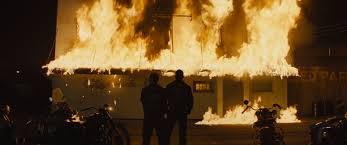
Austin Butler) quite a ways into the story, but this is like a thesis statement for the movie. He's sitting in a bar, smoking, drinking, minding his own business. Then two beefy "townies" walk into the bar and object to the fact that Benny is wearing "colors"—his motorcycle jacket—and suggest that he take it off. Benny—as in the way of movie bikers—looks from one of the guys to the others—clenches his jaw and says "You'd have to kill me to get this fuckin' jacket off." 
So, there's a fight, seeing as there's no negotiation between the parties. It starts in the bar, then goes outside. It's starts as a fistfight, then Benny pulls out a knife and slashes one of the guys' face, then the other grabs a shovel and swings it at his head.
Just before it connects—and it IS going to connect—Nichols freeze-frames and we begin the movie proper with an interview (we're still not at the beginning of the story) and Danny (Mike Faist) is talking to Kathy (Jodie Comer) about the incident and about her relationship to Benny and of how the Vandals came to be—Johnny (Tom Hardy), a blue collar worker with a wife and two kids, saw The Wild One on TV and, like so many others, liked the freedom of the lifestyle depicted (ignoring the underlying message) and formed the club. It was about how a bunch of outsiders formed a community of like-interests, ignoring the typical organizations like churches, PTAs, and Elks. The reason? They're all outsiders who wouldn't fit in those clans, so why not form their own? "What's not to like?" (which is as much of a nothing sandwich as "Whatta ya got?").
The through-line of the movie is the passage of time and how the group changes, following Johnny's lead, which has some basic things like wearing the distressed leather jacket that serves as a uniform, and some arbitrary rules about being loyal to each other, and if there are any issues that are disagreed upon, they'll have a fight—"fists or knives" is the only specifics that need to be addressed—and whoever wins, gets their way, much in the way it worked in Black Panther (which sounded like a good system in that movie, but here smacks of "rule by minority").
While these things are going on, Johnny weighs the responsibility that being leader of such a group imposes on him, and Kathy realizes that Benny will always be conflicted whether to choose her or the club, even as that club faces challengers from a couple of fronts—the incoming Vietnam vets with chips on their shoulder and a disdain for authority and the young kids who see the power in numbers and want in on it. The "outlaw" mythology starts to get the better of the Vandals and it starts changing as time gets longer and meaner. It leaves Johnny with one of the few articulate insights in the movie: "You can give all you got to a thing" he tells Kathy at one point. "And it's always gonna do what it's gonna do" and it applies for Kathy to Benny and it applies for him to the club.
But, that's about it for depth. Things happen. Things get worse. And the vague rules of the club seem to go by the way-side as its reputation swells and new members begin to dilute its purpose and turn it into a gang. The rules don't apply to anybody anymore. And any good intentions are drowned out by bad behavior.
That's the gist of it. And as good as the performances are—although the actors' recreations of their characters' voices may produce giggles, they're based on Lyons' tapes of interviews with them—and as okay as the visuals are and as strenuously Nichols tries to recreate the books' look, it doesn't amount to much. One gets left with the impression that The Bikeriders is less about the gang than it is about Kathy's observations of them, and that's an outsiders' perspective (like, frankly, the guy who made the book). We see her struggle for the soul of Benny, but we really don't get to know him—he's a James Dean wanna-be—and the audience doesn't really get to know the Vandals—do they have jobs? how do they get the money for all that beer? They own a bar, sure, but there never seems to be anybody in it—because they're a bit of a mystery—and an antagonist—to Kathy. Like Brando's challenging non-answer of "Whaddaya got?" there's no "there" there. And the story of the Vandals is just another cautionary tale of what happens when you don't apply the brakes every once in awhile. Or check the gas-tank.
If Nichols wanted to make a film of a picture book, he accomplished it. But, it's all captions with nothing between the lines and nothing between the pictures. The Bikeriders is more of a scrapbook than a fully fleshed-out movie, with a veneer of remove as he's trying to recreate what somebody already documented—"The Golden Age of motorcycle clubs"...but that age is long gone. Thomas Wolfe said you can never go home again. Apparently you can't make a movie of it, either.
 
But, Nichols is a fine director. This time he merely took a spill. And I look forward to his next one


Thursday, August 11, 2022

The Dark Knight Rises

Written at the time of the film's release.

The Bane of Our Existence

or
"Okay, What Joker Put Yeast in My Dark Knight?"


"All stories end in death, and he is no true story teller who would keep that from you"--Hemingway

"If you want a happy ending, that depends, of course, on where you stop your story"--Welles

So, Christopher Nolan's "Batman" trilogy ends in a nearly 3 hour film that neatly wraps up the story. How does it end? That would be telling. The comics went through a phase where Bruce Wayne ruminated that he was working towards a world where he wasn't needed. That's a nice little "buttoning up" of the "Dark Knight" story, but it's not complete. What of Bruce Wayne? Nolan has the opportunity in his version to really end it—he doesn't have to sell comic books next month—so, he can take it anywhere he wants to go. And one realizes (if one really wanted to end the story) that the only real happy ending that could be achieved is if Bruce Wayne became the one thing he never knew as a child—a caring, present father. Anything else makes the story a tragedy, and Bruce Wayne the last victim of the gunman's bullets that killed his parents. Given this series' downbeat tone (that of the sacrificial martyr) and of the available previews for The Dark Knight Rises, such a scenario does not seem likely. Given that, Nolan can take the tragedy of his hero in any number of directions.
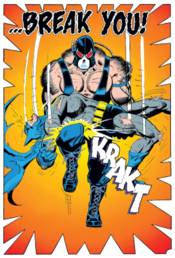
Bane (Tom Hardy here) is the perfect villain to bring into the mix. A hopped-up minor character, he is best known as the lead antagonist for the "Knightfall" storyline (that seemed to last a couple years). In "Knightfall," the drug-pumped super-villain released every criminal in Gotham's prison system for The Bat to deal with, while he hung back, biding his time. Then, when the Batman, weakened and exhausted, finally confronted him, Bane broke his back, leaving Wayne paralyzed and unable to fight on. It fell to the rest of "The Batman Family" (including the once-and-future "Robin's") to take on the mantle and continue the fight.

Nolan's canvas is a bit broader, taking into consideration the events of the two previous films to create something a bit more apocalyptic, a rumination on the fractious quality of good vs. evil and the slippery slope to Hell that ideology and good intentions can be tilted towards. Nobody's pure in this one, there's no whack-job with delusions of grandeur behind the assault on Gotham City, with avarice their sole motive. Everybody, wearing white or black, thinks they're doing the right thing. And everybody's wrong.

It's eight years since the events of The Dark Knight that resulted in the deaths of D.A. Harvey Dent, Rachel Dawes, and the subsequent disappearance of the man suspected in the killings, the Bat-man (Christian Bale). Now, Bruce Wayne is an exile in his newly-rebuilt Wayne Manor, walking stiffly with a cane due to some unknown injury (part of me wants to think it was due to him being stabbed by one of The Penguin's umbrellas). He sees no one, is a recluse, and there are rumors he's turned into a Howard Hughes-style eccentric, apparently due to a massive investment in a clean energy prototype that failed and cost Wayne Enterprises a fortune...or at least half of it.
The chief backer for the project, Miranda Tate (Marion Cotillard) tries to get past the constant guards of faithful butler Alfred (Michael Caine, putting in the most emotional performance he's done in years) and Wayne exec Lucius Fox (Morgan Freeman), who fill the functions of acting as Wayne's heart and brains (and conscience), if not as surrogate Mother and Father. A rival exec, Daggett, is trying to take over W.E., by any means necessary, in this case, employing a terrorist named Bane, who has his own bones to pick (and break) with Gotham's golden boy. At the beginning of the film, Gotham in morosely complacent (and obviously filled with exposition), having cleaned up crime by the draconian Dent Anti-Crime Act, which has incarcerated over a thousand criminals in Gotham's Blackgate Prison.

But things are percolating underground, disrupting Gotham's infrastructure.  Bane has an army of misfits and big plans that have outgrown the desires of his patron, and there's a lithe cat burglar named Selina Kyle (Anne Hathaway), who is caught with her hands in the Wayne Manor safe by the man himself ("Oops," she says, not very convincingly). Yes, she's pilfered Martha Wayne's pearl necklace, but more importantly, Bruce Wayne's fingerprints. What does she want with those?

It's only one piece in an intricate puzzle of escalating consequences that Batman must unravel if he is, once again, to save Gotham City, and he must confront his past and overcome great injury, physical and emotional, if he is to prevent a catastrophe...
one of his own devising.

That's the gist of it, but it is convoluted by elaborate set-pieces that are, frankly, jaw-dropping, and ends up with Gotham isolated from the rest of the nation, in the hands of criminals with big ideologies and little concern for how roughly they're applied. The police are paralyzed—most of them trapped in the deep infrastructure of the city (a little too conveniently) while Bane initiates a countdown to total destruction.

A countdown of five months.

To quote The Riddler:"????" Five months? How suspenseful is that? And you'd think that somebody, somewhere, would be able to unravel the plot or situation in such a time-frame. But, it's basically a set-up for what Nolan depends on to generate suspense throughout the movie—the last minute "save," that is usually explosive and comes from nowhere, because the writer-director has made motivations ambiguous enough as to be unreadable.* Everyone has got a secret that will be revealed at the most opportune moment of drama. If the mystery was revealed in a drawing room, it would feel like cheating, and the revelations almost psychic.
Speaking of unreadable, Tom Hardy's Bane is hampered by a mask of a morphine dispenser (to keep him from feeling pain), as opposed to the enhancement-juice-pumping-apparatus from the comics (This leads one to ask: if the guy can be stopped by breaking the mask, why does Our Hero employ so many body-blows?  Face-shots, man!!). He is perpetually muffled by this thing, which Hardy compensates for with an almost jolly Father Christmas speaking style, making a clever, unnerving ying-yang effect for the character. Ultimately, though, he's something of a vapor-tiger, like Darth Vader, the big bloated bloviator who's merely a "blind," a distraction for the real danger.


But...five months??**
Another thing: Nolan has come out publicly saying that he wants to make a Bond movie (and the snowbound facility infiltration in Inception is a bowler-tip to them). I would submit that he already has, this film being it. So much of it is borrowed from Bond that all one needs is a casino scene to make it complete (a costume party has to suffice
***). The opening sequence, the-villain-that-feels-no-pain, the duplicitous females, obligatory "Q" scene, the tick-tock final set-piece and other aspects can be attributable to Bond films of the past. At least someone is borrowing from the Bond series this time, instead of the other way around.
But, his world of comic-book fantasy is far more gritty and down-to-Earth than any other, and that's what makes "The Dark Knight Trilogy" good; it's relatable, it feels like it could happen, if someone had the will, the wherewithal and the wallet to do it. It also feels of our time. There's been a lot of gas about the politics in this film—uninformed, desperate gas—but the whole uprising scenario, the subjugation of the privileged with no benefit to the less fortunate, the breaking down of society and the cleaving of its people is the stuff of water-cooler vitriol and feels like the temper of the times. The Tea Party AND the Occupy Wall Streeters can both find things to point at and go:"See?"
I'm not going to speculate which side is right, and Nolan is obtuse (and politically slippery) enough to play it right down the yellow stripe of the road. But, this British director is saying something about the State of the Union with a full child-warbled rendition of The Star Spangled Banner (before a particularly horrific football game) and a shot of American flags in tatters on a city street, deep in the movie. They're there for a reason, but not for anything specific enough other than "we're a fragile alliance and we're in trouble."
And that we need heroes—selfless ones, for whom profit is not a motive—and that, "anyone can be Batman."****

* Case in point:  there's a scene where Catwoman uses a Wayne-supplied bat-bike to blow a hole in a tunnel to make an evacuation tunnel for the sealed-off city, a task initiated by the Caped Crusader.  Following it, Nolan sits on a pull-in shot of Hathaway with an enigmatic smile on her face that communicates...nothing. Except an odd complacency. It will only be resolved...if there's anything TO be resolved, later in the film. 

** There are neat touches, and a refresher of both The Dark Knight AND Batman Begins will help. One nice thing—Nolan recalls a scene from BB when a young Bruce Wayne falls down a tunnel and is subsequently rescued by his father, by having a similar scenario played out here, with the Obi-Wan presence of a dark father figure from his past. Nice touch.

*** A masked ball at which, like in Batman Returns, Bruce Wayne doesn't wear a mask.  Heh.

**** Just not Nicolas Cage, please...
What do they say at Marvel? "What a poser..."


Friday, January 5, 2018

Tinker Tailor Soldier Spy (2011)

Written at the time of the film's release.
 
Spies Like Us
or
Eyes Wide Shut* (The Fine Art of Concealment)

I love spy movies. Growing up in the 1960's, with the advent of the James Bond films—an amalgamation of Ian Fleming's novels and the films of Alfred Hitchcock (particularly North By Northwest)—and concurrent with the 60's embrace of the "anti-hero," my perceptions of movies were warped and laser-beamed with the image of duplicity, secrecy and emotional coolness.  Spies are not nice people—it doesn't matter what kind of cars they drive—they are both untrustworthy and trustworthy, they make moral judgments (sometimes snap decisions) of who is worthy of each. Keepers of secrets, cataloguers and manipulators of weakness, spies use people as weapons, ignore collateral damage and sleep the sleep of the just knowing that the ends justify the means. Fleming's secret agent was the last vestige of the romantic spy (despite the many imitations that ensued), a double-crossroads between the old and the new—a "gentleman-spy," chivalrous, but more than willing to plunder the spoils of war, and a thug...but with exquisite taste.
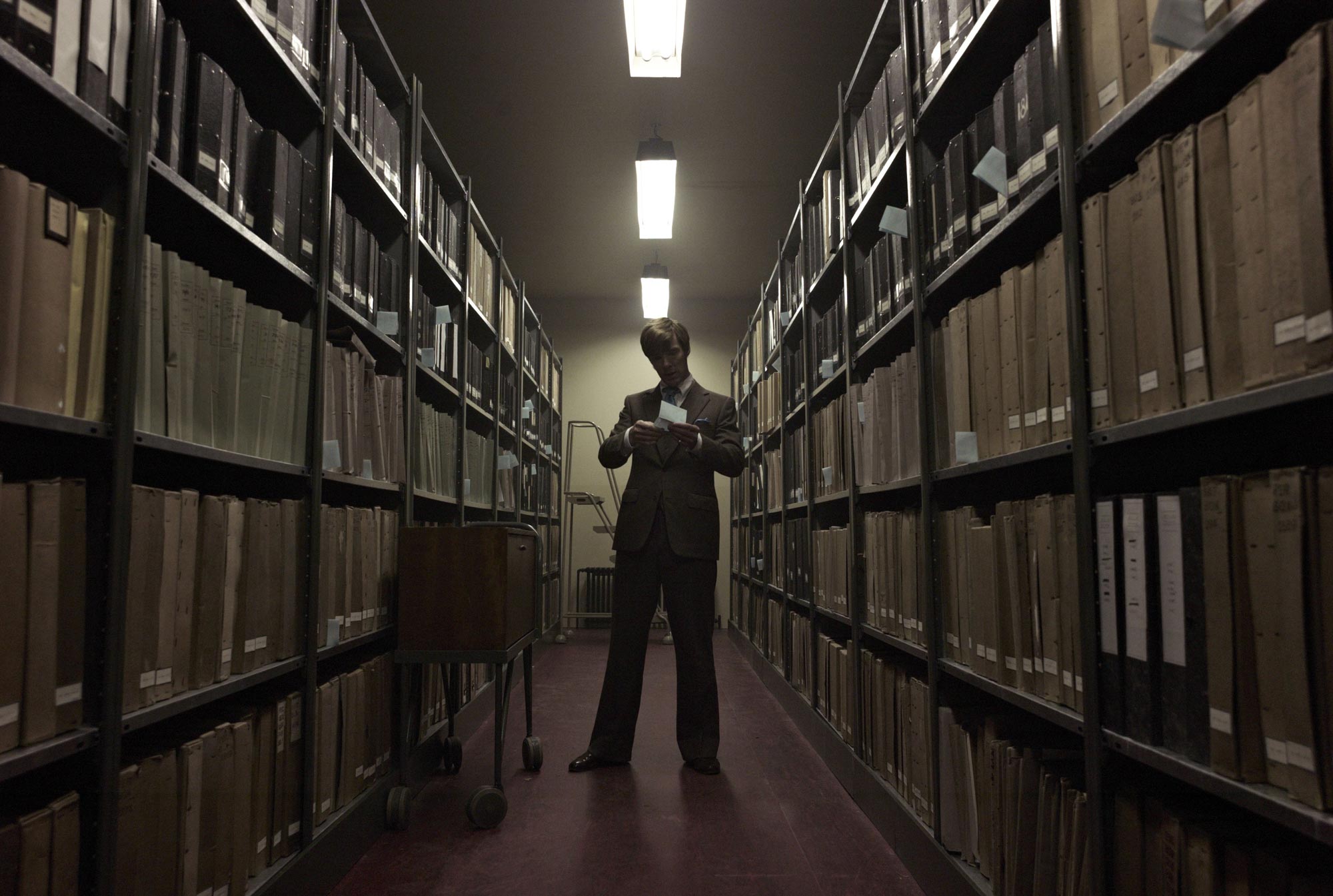
But the gold standard ("finger"-less division) for the times, which embraced the Cold War** were the novels of John le Carré (French for "The Square," which reflected the author's choice of creating novels around the moral rectitude of naive and sentimental men in an amoral world) who wrote about spies as functionaries and bureaucrats, rather than super-men with toys, and the epitome of those was "Tinker, Tailor, Soldier, Spy," the first novel in "The Karla Trilogy,*** which pitted two spymasters against each other in a fight to The Brandenburg Gate—the mysterious Russian, Karla, and George Smiley, an agent for British Intelligence (which le Carré dubbed "The Circus"). Smiley had appeared as a minor character in previous le Carré books, but with "Tinker..." he became the focal point, not only the best man in the service, but also its weakest link, intellectually smart as a whip, but emotionally dull as a stump.  In it, he is called upon to investigate his own former Intelligence agency, as there is suspicion that there is a "mole"—a double agent—very high up in the ranks.****  A thick book, filled with intricate detail and Dickensian characterizations with deep motivations, it was adapted (like the film, without commas in the title) in 1979 into a 7-part mini-series by the BBC and director John Irvin with Alec Guinness as Smiley, a version which was considered definitive.
When word that Peter Morgan had scripted a film version, it seemed inconceivable that such a compressed time-frame could do the novel justice.
And, incredibly, it does...even at times going the mini-series one or two better...by integrating sequences that le Carré never bothered with or thought of that throw in a lot of information in a very short space of time, the difference between a novelistic and cinematic experience: a Christmas party at the Circus, where knowing glances are exchanged between brother-spies and covert operations are, even there, in effect;***** the shooting of Jim Prideaux (Mark Strong, quite different from how we've seen him before in his villainous roles of late) on a secret mission from Control (John Hurt) to try to learn the identity of "the mole" in their ranks; a warning to Peter Guillam (Benedict Cumberbatch) to "get his house in order" that leads to a painful personal decision that reflects certain issues among the suspects; and an interrogation scene that adds tragic ramifications to the story of Ricki Tarr (Tom Hardy), but also illuminates the cruel humor of the Russian strategist, Karla.
And the "Cold War" scenario gets even chillier given Swedish director Tomas Alfredson's handling of the film.  The men investigating and being investigated (Ciarán Hinds, Colin Firth, Toby Jones, and David Dencik) are already cold fish, but with the script and Alfredson's direction, they're almost completely cyphers, the only glimpses of a personal life are revelatory of each man's weaknesses.  Also, Alfredson's framing schemes involve as much mis-direction as direction, shooting above, over, around and through as many obstacles and distractions, frames and panes of glass, a maze of obfuscations that confuse the path to true seeing, putting us in the same position as the story's primary Truth-Seeker, George Smiley (Gary Oldman).
Early on, Smiley visits an oculist to get a new pair of huge owl-like glasses to see more clearly before embarking on his secret mission for the government. Those glasses also provide another barrier to his eyes, the window to his soul. Oldman's performance is brilliant, deceptively simple—but that's not the point.  One is struck, perpetually, throughout the film, of how much Oldman conveys with the simplest—and smallest—of movements. It is to the actor's credit (and Alfredson's) that so much of the actor's performance is seen from behind, his face unseen, but it matters not; George Smiley is not given to overt actions, but covert ones, minor moves of chess-pieces that mark the battles in intellectual wars.  His brevity and economy in everything—that weighs so heavily on his personal life and makes him vulnerable, comes to the fore here, making this odd performance a perfect encapsulation of the role and is a further refinement and definition of the character of le Carré's greatest creation—George Smiley—betraying nothing, always betrayed.


* The origin of the phrase "Eyes Wide Shut," the title of Stanley Kubrick's last film, originates as a colorful turn of phrase in le Carré's original novel "Tinker Tailor Soldier Spy" (Kubrick and David Cornwell— le Carré's real name—were good friends, although Kubrick never enticed him to work on a script with him). It's the scene where Connie Sachs is explaining what happened to the Russian double-agent Polyakov and how he was seduced by a "honey trap" (le Carré spy-code for a female counter-agent) and how Polyakov, against his better judgement, walked in with "his eyes wide shut." That turn of phrase is not in the movie, probably BECAUSE of the association with the Kubrick film.

** When detente eased the tensions between the West and East, le Carré presciently set his rifle-sights on the next enemies of the state—capitalists and industrialists who pledged allegiance to the almighty dollar rather than to any flag or deity.  Supposedly, trade partners don't war against each other (hence, the genesis of the EU and NAFTA), but has the damage those entities wrought on the world economy really been beneficial?  Is anyone winning, when we all go down together?

*** The others in the series are "The Honourable Schoolboy" and "Smiley's People."

**** This parallels the true life upheaval MI-6 went through in the 1950's, with the Cambridge Five scandal.

***** One inspired touch is The Circus Crowd singing along with an old song that I only thought I remembered—the title tune from a long-forgotten Bond knock-off (sung by Sammy Davis, Jr.) called The Second Best Secret Agent in the Whole Wide World, which nicely plays in with British Intelligence's subordinate view of themselves as "also-ran's" to their American "Cousins" in the CIA. 

Thursday, January 21, 2016

The Revenant

In the Country of Mann
or
"This Isn't About the Hunting, Is It?"

The Revenant does in 2 1/2 hours what Anthony Mann* used to do in a trim 90 minutes...and he'd throw in a B-actress love interest to boot. The story of Hugh Glass (played in the film by Leonardo DiCaprio), who survived a bear attack while serving as a guide for a Fort Kiowa (in what would become South Dakota on the Missouri River) pelt-hunting party (which went from 100 men at the beginning to ten at the end), then endured a 200 mile trek to the fort, it is an amazing tale straight out of legend, but has been transmorgrified into a tale of revenge for the big screen. That's not the way it actually happened (the two men who were charged with staying with Glass and left him for dead ended up with no consequences at all), but it's a movie, and the current climate of cinema seems to have demanded that it turn into an obsessive tale of revenge throughout its core.

I wish I could say that the movie thrilled me, but it did not. Perhaps I've seen too much revenge-motivation in films lately (blame those evil superheroes) that I'm a little sick of it—bored by it, even. Maybe it's not just superheroes. Maybe it's the reality show-machinations we've been inundated with or the greedy-gus corporatization of America where it's not enough to make a good life for yourself until you've kept somebody else from having it that has generated this feeling of not just "keeping up with the Joneses," but "getting even" with the Joneses. Do we have to live like a soap opera or The Godfather? I reject that handily. And I object to the real triumph of Hugh Glass in the wilderness being turned into a turf war (that, after all, is what was happening with the Natives—something Iñárritu seems to want to indict them under in this scenario, as well).

The Revenant is receiving all sorts of accolades—and garnered a mail-satchel of Oscar nominations—and one has to give it kudos for being so doggone persistent in recreating the squalor of the world of the Western trapper (credit veteran production designer Jack Fisk for that)—but I think a lot of that hyperbole is for those folks who were a little left behind by the obtuseness of Birdman, and are playing catch up for how good writer-director Iñárritu can be. Here, he's just a little more obvious and on-the-nose than usual, producing great craft, but to a story that says more in the actual truth of it than it does in his dramatization.
It is 1823 and a party of animal trappers are exploring the northern reaches of the Louisiana Purchase by the Missouri River. The group is led by Captain Andrew Henry (Domhnall Gleeson, last seen auditioning for headliner at a Nuremburg rally in Star Wars, squiring Sioarise Ronan in Brooklyn, and exploring the future of dating in Ex Machina, the guy gets around), their guide is that Hugh Glass who is aided by his son Hawk (Forrest Goodluck), when they are caught by surprise during a hunting sortee away from the group by the sound of gunfire. The group is under attack by the Arikara tribe led by Elk Dog (Duane Howard) who is looking for his daughter Powaqa, whom he believes was kidnapped by the trappers. The natives decimate the trappers—the Arikara are portrayed as being VERY good shots, with some rather wicked looking arrow-hits, and the trappers have a tendency to fall down even after a single arrow hit in the leg—and a dozen of them are able to get to their keel-boat to distance themselves with what pelts they can accumulate.
They're in a very bad way. Under pursuit and under-supplied, they have barely enough wares to make the trip worth its while. Then there's "The Griper." Every platoon has to have one, and Fitzgerald (Tom Hardy) is the self-appointed nay-sayer and whiner, the guy who thinks he should be in charge. He'll pick a fight with anybody and when challenged, backs off, complaining about his treatment. Fitzgerald does a little antler-locking with Hawk and it's only Henry's and Glass' interference that keep the two from coming to blows. Hardy, who has been so good for so long, is fiercely committed to the role, creating a sand-paper-irritating character that makes you crave his demise by any means possible. I'd give him an Oscar just so he'd shut up, already.
But, it's Glass who suffers misfortune. Separated from the troop, he unfortunately gets between a mother grizzly and her two cubs and the animal savagely attacks him (the sequence, done with special effects and CGI—of course—is a wonder, horrible and savage, while having a fascinating quality of animal logic—or illogic—to it, and just when you think it's over, it goes on and on). He's found alive, but just barely, and Henry's men do their best to patch him up—Fitzgerald, sensitive soul that he is, notes that Glass' cries of pain might lead the Arikara's right to them. Travoising Glass up steep terrain doesn't make their escape any easier, so Henry charges two men to stay with Glass until they can get a rescue team from the fort to help. Glass' son Hawk won't leave his father's side, and Fitzgerald and the youngest member of the party, Jim Bridger (Will Poulter) volunteer to stay with the guide.
Captain Henry (Gleeson) and Fitzgerald (Hardy) very much alive.
I guess when you're down to ten men, you can't be too picky about volunteers. Fitzgerald is convinced that Glass is done for and is more than willing to finish him off and move on. But Glass' son will have none of it and is the only thing keeping Fitzgerald from abandoning his post and the crippled guide.

Glass didn't have a son, historically, but inserting one into the narrative up's the ante for drama and provides one more subsequent reason for the movie-Glass to swear vengeance beyond what really happened—in reality, he just wanted answers and his rifle back, actually.  
Motivated by the movie's events DiCaprio's Glass gropes out of the sloppily constructed grave Fitzgerald has prepared for him and starts the slow trek back to the fort, evading hostile Natives (still searching), crawling initially, then trudging using a stout branch as a make-shift crutch, and using all the survival skills a lifetime has taught him. This part is true. And except for Glass' radical method for fighting infection and necrosis, it's pretty much the way legend has it. The "revenge" factor is thrown in, as is a back-story that has Glass in moments of fever and dream envisioning the spirit of his Native wife (Grace Dove), killed in a raid by soldiers of a more European military costume, letting the Cavalry off the hook this time.
One of cinematographer Emmanuel Lubezki's magnificent panoramas.
"As long as you can still grab a breath, you fight" is the chief mantra of The Revenant and so there's a lot of breathing on the soundtrack (and, in fact, the film begins and ends with that sound, disembodied from image). But, mid-way through the film another comes into play: "Revenge is in the creator's hands." If, indeed, the Creator cares. The creators of The Revenant care, obviously, but that might be to tie the film into the movie-trend of revenge at all costs. But maybe it's time for there to be a moral re-alignment in films. What made the recent Spectre interesting was its denouement on Westminster Bridge where James Bond has the drop on long-time nemesis Ernst Stavro Blofeld and is emplored by the villain to "finish it." With the authorities standing nearby, Bond merely unloads his gun and says "All out of bullets. And I have better things to do." Even Christopher Nolan took that most vengeful of super-heroes, Batman, and gave him the valuable lesson he never learned in the comics—living well is the best revenge. We have better things to do.

So do we all. Perhaps, revenge should be relegated to villains and not those we consider heroes, who would have better things to do than be compulsively vindictive. Hugh Glass, Jim Bridger, John Fitzgerald, and Captain Andrew Henry all lived without it.

The Hugh Glass marker—Shadehill Lake, SD
A portrait of the real Hugh Glass
Leo in another western
(cleans up real nice, don't he?)


* The reference to director Anthony Mann comes from a series of "psychological" Westerns that director Mann, screenwriter Borden Chase (and others) and star James Stewart made in the 1950's, which showed the deterioration that Nature and Man can cause in even the most charitable of people and showed the parallel between the "civilizing" of raw country and the "civilizing" of man's baser instincts. They're all great films: Winchester '73, Bend of the River, The Naked Spur, The Far Country, and The Man from Laramie. Oh, and there's a trick at the end that's owed to a Howard Hawks subterfuge employed by Humphrey Bogart in The Big Sleep and John Wayne in Rio Bravo. Unfortunately, the person portrayed as dying in 1823 actually died in 1832. Yeah, don't let facts get in the way of enjoying the movie...just like a political campaign.