Showing posts with label Jodie Comer. Show all posts

Tuesday, June 25, 2024

The Bikeriders

The "Wisdom" of the Tribe ("Whatta Ya Got?")
or
"It'd Be Funny If It Weren't So Tragic..."
 
Look. I get it.
 
I blog about movies because I love it. So, of course, I joined a movie-loving-cluster of bloggers—The Large Association of Movie Blogs (I've participated in a podcast for them about this very movie) and there is comfort there. It's a joy to commiserate with other people—of other ages, of other backgrounds, from other countries—who share a love of movies. We all have opinions. Sometimes we don't agree, and you can ignore that or you can learn from the different perspective. It's all about the process of understanding this thing you love. There's safety there, too. Sometimes you can share something in those discussions that it would be a fool's errand to try to communicate with your family and friends. For most of them, "movies" is something to do on a date-night, or when you want to just 'veg'. The last thing they want to do is to study the film and try to find out why (or why not) it communicates its message. For others, that's like assigning yourself homework. For me, it's something I "gotta" do.
 
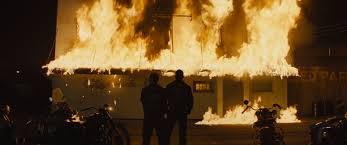
So, here's The Bikeriders, written and directed by Jeff Nichols. It's a movie about a motorcycle club—the Vandals MC —that operated (in its hey-day) between 1965 and 1973, and was immortalized by the picture book of the same name by Danny Lyons.
It's a movie about a motorcycle gang. Haven't we seen enough movies (and bad ones) about those?

Sure. But, this is Jeff Nichols, one my favorites of the "younger" crop of directors, and his subjects are interesting, and if they're not box-office sure-things, they're at least interesting in the way he presents them. He made Mud, Take Shelter, Midnight Special, and Loving, all movies I'd recommend seeing (especially Loving) because of the way he tells stories so well. All his movies are about ostracized outsiders, and The Bikeriders is no exception.
We first meet Benny (
Austin Butler) quite a ways into the story, but this is like a thesis statement for the movie. He's sitting in a bar, smoking, drinking, minding his own business. Then two beefy "townies" walk into the bar and object to the fact that Benny is wearing "colors"—his motorcycle jacket—and suggest that he take it off. Benny—as in the way of movie bikers—looks from one of the guys to the others—clenches his jaw and says "You'd have to kill me to get this fuckin' jacket off." 
So, there's a fight, seeing as there's no negotiation between the parties. It starts in the bar, then goes outside. It's starts as a fistfight, then Benny pulls out a knife and slashes one of the guys' face, then the other grabs a shovel and swings it at his head.
Just before it connects—and it IS going to connect—Nichols freeze-frames and we begin the movie proper with an interview (we're still not at the beginning of the story) and Danny (Mike Faist) is talking to Kathy (Jodie Comer) about the incident and about her relationship to Benny and of how the Vandals came to be—Johnny (Tom Hardy), a blue collar worker with a wife and two kids, saw The Wild One on TV and, like so many others, liked the freedom of the lifestyle depicted (ignoring the underlying message) and formed the club. It was about how a bunch of outsiders formed a community of like-interests, ignoring the typical organizations like churches, PTAs, and Elks. The reason? They're all outsiders who wouldn't fit in those clans, so why not form their own? "What's not to like?" (which is as much of a nothing sandwich as "Whatta ya got?").
The through-line of the movie is the passage of time and how the group changes, following Johnny's lead, which has some basic things like wearing the distressed leather jacket that serves as a uniform, and some arbitrary rules about being loyal to each other, and if there are any issues that are disagreed upon, they'll have a fight—"fists or knives" is the only specifics that need to be addressed—and whoever wins, gets their way, much in the way it worked in Black Panther (which sounded like a good system in that movie, but here smacks of "rule by minority").
While these things are going on, Johnny weighs the responsibility that being leader of such a group imposes on him, and Kathy realizes that Benny will always be conflicted whether to choose her or the club, even as that club faces challengers from a couple of fronts—the incoming Vietnam vets with chips on their shoulder and a disdain for authority and the young kids who see the power in numbers and want in on it. The "outlaw" mythology starts to get the better of the Vandals and it starts changing as time gets longer and meaner. It leaves Johnny with one of the few articulate insights in the movie: "You can give all you got to a thing" he tells Kathy at one point. "And it's always gonna do what it's gonna do" and it applies for Kathy to Benny and it applies for him to the club.
But, that's about it for depth. Things happen. Things get worse. And the vague rules of the club seem to go by the way-side as its reputation swells and new members begin to dilute its purpose and turn it into a gang. The rules don't apply to anybody anymore. And any good intentions are drowned out by bad behavior.
That's the gist of it. And as good as the performances are—although the actors' recreations of their characters' voices may produce giggles, they're based on Lyons' tapes of interviews with them—and as okay as the visuals are and as strenuously Nichols tries to recreate the books' look, it doesn't amount to much. One gets left with the impression that The Bikeriders is less about the gang than it is about Kathy's observations of them, and that's an outsiders' perspective (like, frankly, the guy who made the book). We see her struggle for the soul of Benny, but we really don't get to know him—he's a James Dean wanna-be—and the audience doesn't really get to know the Vandals—do they have jobs? how do they get the money for all that beer? They own a bar, sure, but there never seems to be anybody in it—because they're a bit of a mystery—and an antagonist—to Kathy. Like Brando's challenging non-answer of "Whaddaya got?" there's no "there" there. And the story of the Vandals is just another cautionary tale of what happens when you don't apply the brakes every once in awhile. Or check the gas-tank.
If Nichols wanted to make a film of a picture book, he accomplished it. But, it's all captions with nothing between the lines and nothing between the pictures. The Bikeriders is more of a scrapbook than a fully fleshed-out movie, with a veneer of remove as he's trying to recreate what somebody already documented—"The Golden Age of motorcycle clubs"...but that age is long gone. Thomas Wolfe said you can never go home again. Apparently you can't make a movie of it, either.
 
But, Nichols is a fine director. This time he merely took a spill. And I look forward to his next one


Thursday, May 26, 2022

Free Guy

BFD for the NPC
or
Thumb-Twitching at the Movies
 
Guy (Ryan Reynolds) wakes up every morning, feeds his fish ("Good morning, Goldie!"), pulls out his usual outfit—short-sleeved blue shirt, khakis—from a closet full of short-sleeved blue shirts and khakis, brushes his teeth, eats breakfasts, grabs a coffee (medium coffee, cream, two sugars) and goes to his job as a bank teller ("Don't have a good day. Have a great day!")...which will be robbed...every day. Without fail.
 
Oh, I didn't mention the commute.
 
Guy lives in Free City, which is a video-game. Walking to work, he is constantly witness to all sorts of disasters, natural and unnatural, none of which can kill him if he's on his normal route to the bank. He is an NPC—a non-playing character, an extra, a background figure. He's coded, but he's robotic. Unless something hits him and kills him, he's going to do the same thing, go the same route, be the same Guy, a nobody, a drone, a cog, a non-essential worker.

And I know how he feels.
Guy's a part of the landscape, but Free City is constantly invaded by the muckery inflicted by real-world players, all represented by avatars wearing sunglasses. The chaos they cause is just part of the routine, until Guy notices a woman (Jodie Comer) walking down the street, bopping to the Mariah Carey song "Fantasy" which he recognizes. Why, you may ask? Well, that would be spoilery (and, frankly, a little unbelievable—but, go with it). He's intrigued by her, wants to know who she is, and inspires him to don player sun-glasses he's acquired from one of the bank-heist perps.
What he finds is a real-player's perspective of his world—pixelated mind blown! He is made aware of an entirely new world in which he is not merely a part, but could become a participant; he has some measure of control and he knows that the woman—named "Molotovgirl"—is somehow involved. So, he must find her, and find out what he needs to know to become the master of his own fate.
Tough work. But, the cast—especially in the Free City sections—makes it enjoyable. Because that whole area is a fantasy and anything can happen (including cameos) there are surprises and Easter eggs galore, plus it has Ryan Reynolds at his most winsome. The movie is more of a slog out in the real world where the issues are creative rights over code rather than self-actualization, and despite the best efforts of these actors—
Taika Waititi tries damned hard for laughs and Comer's real-life programmer Millie has less jolt than Molotovgirl—these sections of the film must be endured, rather than enjoyed.
Of course, you've seen it before...and better. The "Simulation Hypothesis" has been around since people decided they liked their dreams better than being awake. The trope was used in a lot of "Twilight Zone's" and other sci-fi/fantasy product like
Rainer Werner Fassbinder's World on a Wire, the "Men in Black" series, The Matrix (of course) and Ready Player One. One of my favorite instances was in an episode of "Star Trek: The Next Generation"—"Ship in a Bottle"—where, after trapping a hologram of Professor Moriarty in a small cube version of a holo-suite, Captain Picard muses "Who knows? Our reality may be very much like theirs, and all this might just be an elaborate simulation, running inside a little device sitting on someone's table." 
 
Just so.
The concept is so fascinating that real-world people can abandon their limited lives to immerse themselves in the video-worlds to imagine themselves as better versions (in the things they admire—like kill-ratios) while their biological clock is ticking down, all in the quest of earning more imaginary lives. Video games are the crypto-currency in our biological banking system. But, do they value their psuedo-lives more? Than their actual lives? Results may vary.  I sense a screenplay synopsis coming on.
For me, I don't play video games anymore. I find them a waste of my dwindling time here on Earth. So, I didn't "geek" over Free Guy, a lot of the inside referenced going right over my head. But, I enjoyed enough of it that I didn't care—and the movie plays well enough without insider knowledge. I also liked the fact that I got to watch it on free HBO while staying in a hotel in Oregon, a way to pass the time where I didn't "want those two hours of my life back"—real or virtually.

Tuesday, October 19, 2021

The Last Duel

Rashomon ala Française
or
"Deny...Deny...Deny"
 
Ridley Scott's new film, The Last Duel (written by Nicole Holofcener—she wrote and directed Enough Said—and the Good Will Hunters Matt Damon and Ben Affleck) is, as they say, "based on a true story"—one of significance—that of the last judicial duel—a trial by combat to the death—held in France.
 
Now, that's a big deal—we're all familiar with duels and jousting from the movies and their romantic notions of such brutalities—but this particular episode resonates now, for very deliberate reasons, and the 2004 book by Eric Jager, from which the film is based, predates that resonance, but it has been taken, and been transformed by recent cultural and sociological events (at least the acknowledgment of such), with a new, more informed and ironic eye. More towards that after the brief synopsis.
 
The players are real people and their stories are intertwined with the politics and fealty of 14th century France:
 
Jean de Carrouges (IV) (played by Damon), a French Knight and governor of Normandy, of "rash and temperamental" manner, who after several campaigns and the death of his first wife and son, married Marguerite de Thibouville receiving as dowry several parcels of her disgraced father's land, which would lead to acrimony with Count Pierre d'Alençon.
 
Jacques Le Gris (played by Adam Driver), friend and neighbor of Carrouges, and favored member of the court of Count Pierre d'Alençon (over Carrouges). The Count gave a parcel of land to Le Gris that Carrouges assumed was part of his wife's dowry, and the subsequent suit over that land infuriated the Count and caused animosity between the two French knights. It should be noted that Le Gris had a reputation as a womaniser.
 
Count Pierre d'Aleçon (played by Affleck), Count of Allençon and Perche.
Marguerite de Carrouges (played by Jodie Comer) Second wife of Jean de Carrouges, and who accompanied her husband to a fete celebrating the birth of a friend's son. At this festivity, Carrouges and Le Gris publicly put aside their differences and Le Gris first met his friend's wife. Although the friendship was strained, it is here where things started to seriously deteriorate.
The events that led to the duel are based on an accusation by Carrouges against Le Gris—that while the former was away fighting in Scotland, Le Gris forced his way into the Carrouges castle while his wife was alone and raped her. Knowing that when the crime is presented at the court of Count Pierre it would be dismissed, Carrouges pressed his charges to the Court of France, demanding a judicial duel. Le Gris denied the charges, and his lawyers called witnesses for Le Gris' account and against Marguerite's charges—she was six months pregnant at the time of the trial. Calling on her to testify, she swore the truth of the accusations, but the lawyers argued that, as she was pregnant, and she swore she didn't "enjoy" the encounter, that she was lying, as "science said" that rape could not produce a pregnancy, but a satisfying sexual experience could. The implication being that she had an affair with Le Gris and sullied his good name rather than invite the wrath of her husband.
The duel was allowed to determine the truth of the matter, as the winner of the contest—the last man standing—was obviously, by God's hand, telling the truth. If Le Gris won the duel, then not only would Carrouges be dead, but the charges would—God says—be proved false and Marguerite would be burned at the stake for committing perjury while testifying. There's a reason the period is called "medieval."
Now, notice that the gentlemen involved all have Wikipedia pages devoted to them, but Marguerite does not. The writers have decided to rectify that by giving Marguerite her due. The film is structured in three chapters (book-ended by the events of the duel): "The Truth According to Jean de Carrouges," "The Truth According to Jacques Le Gris," and, finally, "The Truth According to Marguerite de Carrouges"—"The Truth" hanging for a just a moment longer as the rest fades. The film goes the "Rashoman" route of telling the same story from three perspectives, each one colored by the prejudices, assumptions, and—finally—the experiences of those involved. They differ wildly with the individual—in Carrouges' "Truth", he is steadfast and always in the right and in the others, he's a diffident, strident buffoon. Le Gris' sees himself doing his duty and his rape a moment of passion for a love burdened to an unhappy marriage. Marguerite sees her husband as more concerned with property than her and Le Gris as a man full of himself and not to be trusted—a "ladies' man" we'd say although the term couldn't be more opposite.
But, there is one truth hanging over it all: it's a man's world. As a cleric says at one point "rape is not a crime against a woman. It is a property matter." Women are a means to an end—the acquisition of property and brood-mares for progeny. It is no comfort at all that The Last Duel is set in the past as the arguments and attitudes have a familiar ring to them—I've heard the "rape could not produce a pregnancy" garbage come out of a U.S. representative recently discussing the abortion issue and a cleric's advice to "deny, deny, deny" the accusations against Le Gris are an all-too-familiar tactic in The Attorney's Handbook. Even the idea of burning a woman at the stake for perjury has the same base core-values of roasting her in the press. If the stakes weren't so high, one could take satisfaction in the spectacle of men chopping at each other with battle-axes just to keep them occupied and from doing more damage.
That the story is told three times must have cut down on costs a bit—just do another version of the same scene with alternate dialogue or attitude and it has the audience the ring of familiarity while giving another version of events. And one notices the differences and takes note as the narrative changes. It's a good strong effort by Scott, whose period pieces can be quite good or quite indifferent. His 14th Century France is perpetually overcast, punctuated by the traditional Scott "fluff" of chaff flying through the air, be it smoke, snow, or back-lighting shafts of light. His battle scenes seem to have settled on the quick-cutting shutter manipulation he's become fond of giving the action a jittery, desperate feel.
It's a story about men maneuvering through a man's world, but the importance of the story boils down to women and the damage done to them in the process. One may be tempted to say that this is a post MeToo movement "penance" movie (and some critics have), but the observations that women are caught up in the machinations of men no matter how petty can be observed just in reading about the six wives of Henry VIII. This is not news even if it becomes fresh in the zeitgeist, any more than racial bias started to be "noticed" by greater numbers of whites after the death of George Floyd. It's just that it was buried in the understood infrastructure rather than being discussed around the water-cooler in broad daylight. It's not "woke" (as much as some—mostly men—are wont to comment) to merely point out something that is consistently ignored just as it is consistently present. Scott's cut-away's to various women's reactions in the movie are more significant in how pervasive the problem is, than just the show-casing of this one historical incident.
"A man's home is his castle" goes the old saying (you can tell that it's old in that it ignores the existence of women). And we've gotten used to period dramas in which those fortifications are "stormed." The Last Duel is just another deliberate forward assault on the impregnable stature of male dominance and the patriarchy—as backward a notion as royal ascendancy and as heretical as the divine right of kings—and we're just as slow to topple those structures even if we rushed to disprove those latter two. But, walls are vulnerable to time, and they eventually crumble with or without human intervention.
 
Human intervention helps, though. "Man" the battering rams and catapults.