or
"Actually...Leave Them Up. Let Them Think About What They Did."
Fly Me to the Moon—which was saved from going straight to streaming by audience surveys—already has a couple strikes against it for me before I even see the movie.
1) It's a rom-com, a genre that leaves me cold for its predictability and formulaic structure: Meet Cute; Get Involved; Get Closer; Complications and Misunderstandings; Split Up and Simmer; Coming to Terms—Sacrifice; Ride Off into the Sunset. Two-step drama, with a mere distraction in the middle.
2) It floats that old chestnut of conspiracy theorists—the Apollo 11 moon landing in 1969 was faked. I hate that crap. I wasted too many hours online debunking them that I just gave up with some useful links to YouTube people using "facts" and not "feelings" against the absurdist arguments thrown up by others. The best reply is Buzz Aldrin's; he punched one of these nuts in the nose.* I won't waste time on it here, but a lot of the explanation for the origins of this vacuousness (and arguments against) are displayed here and here.
Of course, this isn't the way things should be; one should go into a movie without prejudice, without expectations. I couldn't do that. Bear that in mind.
 For the most part, Fly Me To the Moon gets its facts right ("with a lie or two"): there's the standard run-down of what set "The Space Race" up—Russia's Sputnik launch in 1957, America's fears leading to its fast ramp-up and militarization of a space program, and just as we were getting to the stage of moving out of Earth-orbit flights, there was a horrific fire on the launch-pad of Apollo 1 during a test exercise killing the astronauts and causing a significant pause to "get it right." A revamped Apollo capsule was tested, re-tested, and fire-proofed and missions were done to test it, the lunar landing craft (or LEM) and a sortee made around the Moon on Apollo 8. There was a lot of prep, a lot of testing, with the Apollo 1 fire reminding everyone that the mission was "to land a man on the moon and return him safely to Earth."


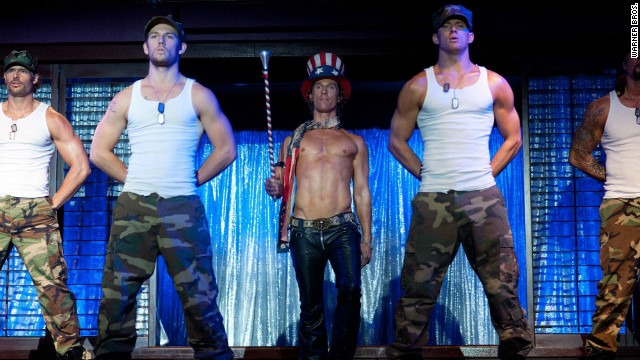
That's top of mind to Cole Davis (Channing Tatum), flight director at Kennedy Space Center—the place where they assembled the rocket and launched it—Fly Me to the Moon bases the fictional character on Deke Slayton, one of the original Mercury astronauts, who was not allowed to fly because of an atrial fibrillation—"an a-fib" they call it in the movie—a heart murmur. Slayton did not become "Flight Director of Kennedy Space Center" but managed "The Astronaut Office" until he flew on the Apollo-Soyuz joint mission. He is "gung-ho" on the Mission as he was present at the time of the Apollo fire and he takes everything, every nut, bolt, and screw, seriously. And semi-seriously as he's superstitious of the feral black cat that hangs around KSC. Then there's Kelly Jones (Scarlett Johansson), of "Kelly Jones Advertising." Her job has less to do with reality than it is does with "feelings" and the manipulation of same to win clients and thus, their customers. Like Cole, she's a problem solver, but with a different bent. Her area of expertise isn't science or engineering but psychology—Cole doesn't like weak spots; Kelly loves them. She'll use them to her advantage and if it's a little dishonest, the ends always justify the means. That's how it works in advertising and she sails through her territory friction-less and A-OK.
 But, when she's approached by a Man in Black (Woody Harrelson) from the Nixon Administration to "sell" the Moon landing to the American public, she can't resist—it's a government job! And she begins setting up interviews for the press (against NASA regulations but she hires actors to get around that little detail), selling space ad campaigns to willing clients (NASA didn't "do" ad campaigns, but a lot of their contractors were all too willing to crow about it), and doing a little influence-peddling with congressmen voting on funding bills (which certainly happened and is happening today).
 For Cole, this is like sticking corporate logos on a capsule to make it look like a NASCAR. It's disrespectful, unnecessary to the program and...just dishonest. It's only when Harrelson's MIB starts interfering that things start turning into a major head-ache—putting cameras on the spacecraft (the idea! Even though*cough* it'd really been happening since Apollo 7). In space you can't change course, but the winds of politics keep threatening to blow things off course.


"You got your notebook?"
But, it's a ROM-COM, and they never stray off track! Cole and Kelly have their differences, so, of course, they have to bend a little and if that's in each other's direction....well... How is it? Well, as I said on the recent Lambcast about it, it "didn't piss me off" (which, considering I had two strikes against it before entering the theater says a lot about the charm of the thing). Johansson and Tatum could orbit around this sort of material in their sleep, but she never misses an opportunity to display a worry-line and he makes stubborn male obstinancy attractive. Some of the writing is quite clever, the meticulousness of the art direction and the costuming is spot-on (especially for the casual-wear of the males) and Greg Berlanti has a much better eye directing movies than he does producing superhero shows for the CW.


"uhhh...how are they going to stand this thing up?"
(My plastic models of it broke apart in this configuration!!)
But, for criminy sake, one can't look at the movie and think that even the most gullible of audiences won't "buy" some of the stuff they see being shown on-screen. I'd mention some buy they'd be "spoilery" and that's one conspiracy I just won't stand for (some things should be left secret, dammit!).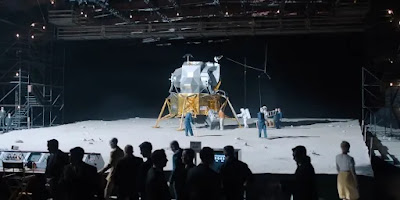 Let's just say that they got a lot of stuff wrong while maintaining just a bit of the right stuff.


It's a rom-com, so OF COURSE there's going to be a "flying scene!"
* The second best argument is the one for folks who know nothing about the space program (which I grew up watching): Okay...say you fake Apollo 11. Did they also fake Apollo's 12, 14, 15, 16, 17...all of which were larger in scope and covered terrains that couldn't be housed in the BIGGEST warehouse-studios...not to mention Apollo 10 (the dress rehearsal that got tantalizingly close—10 miles—to the lunar service)...and fake Apollo 13, which was a mission FAILURE!
If you seriously believe there was still a conspiracy you're either obstinate in the light of facts, desperate, or certifiable. You need help. Get it. Start with research.