Showing posts with label DC. Show all posts

Thursday, August 7, 2025

Superman (2025)

Truth, Justice ...and the Puerile Goofiness of the Funny Papers!
 or
"1-A!1-A!1-A!1-A! 1-A!" 
 
So, what does a Superman movie written and directed by James Gunn (The Guardians of the Galaxy, THE Suicide Squad) look like? 
 
Well, it's different. Uncomfortably so. But, that's not necessarily a bad thing. A roller-coaster ride from start to finish, Gunn manages to channel the 'Big Blue Boy Scout" aspects of the character that has always been a part of it—but, without the Hollywood temptations to mock them, contemplating "Bad Superman" or the brooding "misunderstood Christ-like alien" of the past films (complete with a lazily slavish devotion to the 1978 Christopher Reeve film—although this one does have a couple character call-backs from it...and the marchable John Williams theme)—while also dusting off some cliches, tossing others, and embracing some of the bizarre aspects that lie deep in the character-archives of the extended DC Comics Universe.
 
Gunn likes the bizarre. He cherishes it. What others might find childish and puerile, he uses with giddy delight. And Superman (2025) leaps into all that in a single bound. Well, actually, too many bounds to count. It's a dense movie that will leave many in the dust, but doesn't take itself so seriously...or iconically...that some of the details don't matter much. Not when you're dealing with sci-fi tech and concepts that verge into "woo-woo" territory almost constantly. Pocket Universes? Check. Manufactured black holes? Okay. Unexplained and unexplainable kaiju? Sure. Getting insurance for anything in the city of Metropolis? Okay, that one's a bit much, with all the mayhem that's tossed at the beleaguered city every few minutes in this film.
Gunn tosses out the destruction of Krypton—how many times have we seen it?—but keeps the red trunks because...the red trunks embarrassed other film-makers...but embraces the tendency of creating mass-destruction set-pieces. There is a scene deep in the film where Supes and Lois Lane are having a heart to heart, while in the far background, members of the "Justice Gang" are battling a "dimensional imp" with clubs and green-energy baseball bats. It's a risk that the serious conversation will be overwhelmed by the goofy action in the background. But, it's also a salve about things getting too grim 'n gritty...this time.
Who are this "Justice Gang"(not to be confused with the "Justice League")? Well, it's a little "inside baseball", but, here goes—they're Earth Green Lantern Guy Gardner (
Nathan Fillion)—in the comics, this sector of space has 3—Mr. Terrific (Edi Gathegi), a scientific genius who actually has ethics, and Hawkgirl (Isabela Merced), whose origin story has had so many complications even DC comics hasn't decided what it is. Anyway, they're a weird choice for a super-team—but, director Gunn likes weird and even preposterous. But, they're in marked contrast to Superman: these guys want action. In an earlier kaiju fight, "The Gang" want to just kill it; Superman wants to put in an Intergalactic Zoo. He's in marked contrast to the "grim n' gritty" and adrenaline-junkies that mark most superhero movies. It's a stark contrast from the Zack Snyder/Christopher Nolan films. But, then, Supes' himself is a stark contrast.
Gunn starts the movie in media res...no back-story, no explosive origin...with Superman suffering "his first defeat", falling into an Antarctic snowscape after being uppercut by "The Hammer of Moravia", a mecha-Hulk villain out of an autocratic country with a history of invading countries. Evidently, it's pay-back for Supes interfering with one of those invasions. He thought it the proverbial "right thing to do," but when interviewed by Daily Planet reporter Lois Lane (
Rachel Brosnahan—she's great!), he is flummoxed when he is accused of an illegal act, not sanctioned by the U.S. government. Politics doesn't play into the Kryptonian's thinking, nor does race, color, or creed...like it has since the character's first publishing in 1938. He has human values, raised by as rural a couple (Pruitt Taylor Vince and Neva Howell) as you can imagine, but who have the moral fiber and strength to raise a kid who could fry their entire farm with an angry look, But doesn't. More importantly, wouldn't.
Who's behind the daily slings and arrows Superman has to deflect when he could be doing something else? Why, Lex Luthor
(Nicholas Hoult, at full arrogance-mode), of course—maybe the movie people haven't read enough Superman comics...he has other enemies, but they seem to be stuck on Luthor the same way the Batman movies are stuck on The Joker—but, he's back to being a scientific genius (albeit a sloppy one) and tech-bro...not a crooked real estate developer this time...who hates the Kryptonian with a passion ("Super...'man'. He's not a man. He's an 'it'. A thing with a cocky grin and a stupid outfit, that's somehow become the focal point of the entire world's conversation."). 
Lex wants the Kryptonian's reputation...and he wants his power. If he can't have them, no one will, so he either wants to tarnish Supes' image...or kill him. Because that's how you climb that ol' megalomaniacal ladder, not by winning hearts and minds, but by making people lose theirs.
So, though it may still a very fantastical comic-book world in this one, it sure echoes our times...the way the comics version of Superman periodically does since his debut in 1938. Its a different world, where anybody could use their phones to film you changing clothes in a phone booth (if there WERE phone booths, and isn't that ironic?), where information, good, bad or indifferent, is faster than a speeding bullet. Where anybody with a grudge or a cause can, at the very least, bloviate like they're doing a TED talk. And lie through their teeth like they were telling Truth. More people have more access to the power of technology, but use it in the worst ways. 
What differentiates Gunn's Superman from all the iterations that have come before is that he's a good guy despite the "powers and abilities far beyond those of mortal men." He knows he's an alien, but when given the old Nature versus Nurture question, he lands with a thud on the latter. He assimilates, and tries to be 110% human to compensate. He doesn't mope, he doesn't question his fate, he's not tempted to abuse his power or even be snarky about it. It's the old comic-book Superman, but without Warner Brothers messing with it to make the character "more hip" for "modern" audiences. Gunn keeps the character pure, but surrounds him with the goofy, the childish, the arrogant, and the just plain bad. To mark the contrast.
Gunn leans into the humanity, but an outsider's view of it, seeing the good, the hope, the striving, and the yearning to be free and wanting to be that. I see an awful lot of internet blather about moments of "cringe" in this Superman, particularly this speech: 
That is where you've always been wrong about me, Lex. I am as human as anyone. I love, I-I get scared. I wake up every morning, and despite not knowing what to do, I put one foot in front of the other, and I try to make the best choices that I can. I screw up all the time, but that is being human, and that's my greatest strength. And someday, I hope, for the sake of the world, you understand that it's yours too.
Good Lord. Maybe it's "cringe" because he admits he makes mistakes, but we could use a lot more of that these days, but that would take character, humility, honesty, and a whole lot of other things missing in this PR-saturated spin-zone we call a world.
For a time now, I've been grousing (and boring friends) about certain notable politicians and corporate Masters of the Universe, by describing each one as an "Anti-Superman." Why? Superman (so the old TV show announced) "fights a never-ending battle for Truth, Justice, and the American Way." But, now its an every-day, non-prosecuted occurrence 180° in the other direction with these guys. There's no relationship with Truth (which has never been so degraded and discarded), Justice, which is consistently delayed and dismissed...and as for The American Way? It's the way of the thug-gangster, that icon of American pop-culture (until it affects us personally). 

And common decency is becoming more and more uncommon.
No wonder the last Superman movies were so grim, gritty and stewed in their own existential juices so much. We don't need that kind of inspiration. 

We need this Superman. A Superman who can push against a falling skyscraper, but also push against the inexorable fall of civilized behavior or civilization itself, and not break a sweat or crack with angst. And leads...by example...for the good. The common good.

We need this Superman now.

Thursday, September 26, 2024

Super/Man: The Christopher Reeve Story

Participant to Observer
or
"And Then She Said the Words That Saved My Life: 'You're Still You and I Love You.'"
 
I assume everybody knows the story: Christopher Reeve, Broadway actor, was picked to play "Superman" in the 1978 movie of the same name—bulked up strenuously to do it—and essayed the role through four films, while also choosing to be in other projects that were farther afield to prevent type-casting. Then, a horse-riding accident left him paralyzed from the neck down—"It's what happens when the trap-door opens and the noose tightens"—unable to breathe without assistance. The doctors gave him a 50/50 chance to live through the night. His older son says that the doctors "re-attached his head to his body."
 
And then he got to work. 
 
Reeve became the best-known advocate for spinal chord injuries and despite his touch-and-go condition, he and his wife Dana, would go anywhere, meet anyone who could write a check, provide a medical path, raise awareness. He also managed to act...and direct projects...totally confined to a wheel-chair, unable to support his neck, breathing with a respirator. 10 short months after his accident, he appeared on-stage in a wheelchair at the Oscar ceremony...and cracked jokes.
 
And the prevailing wisdom became "If he wasn't Superman before, he sure is now." 
His story, with the full cooperation of the Reeve children, his former partner Gae Exton, DC Studios, Warner Brother studios, and anyone who had footage of the man has been released as a "Fathom Event"—one of those special piped-in presentations to a theater environment—and called Super/Man: The Christopher Reeve Story. It makes use of a lot of home-movie footage, contemporary interviews with friends and family, doctors, experts, and archival footage, an amazing curating job executed by directors Ian Bonhôte and Peter Ettedgui.
Reeves' tragic accident—which, when you see it, looks so flukish—raised awareness of the quadriplegic community; if you didn't know someone who was completely paralyzed, suddenly you did. Forget that Reeve was long-past the Superman role and was in lower profile projects and TV movies that were usually seen (mostly) by the devoted, but suddenly, he was uppermost in peoples' awareness.
Bonhôte and Ettedqui take you through the whole life-story, starting on New Year's Eve 1985 with a family celebration and a post-accident Reeve saying "It seemed like my life came together. And then, in an instant, everything changed."* You see home movies of him and his kids charging though sportsy activities with his kids, yelling at them "Carpe Diem!", showing him active, but more than active, downright aggressive. He was a flyer, skier, skater, yachtsman, and as far as horses..."I've always been allergic to horses"...but, loaded up on anti-histamines he learned to ride for a film and fell in love with it. He liked aggressive sports, but insisted he was careful because "I didn't want to see a headline like 'Superman Hit By a Bus.'"
 
That produces a grisly laugh. But, it shows the honesty with which the the piece is presented. Details are presented about his condition are presented to hammer home the precariousness with which he lived through the ordeal, the things left out of the papers, the raw emotions of those going through it are not held in check, and if one comes away unmoved by the honorableness of the participants, then a trip to the ER is suggested to check for a pulse.
A couple of persistent thoughts:
 
— the devotion of Robin Williams. Williams and Reeve were fellow acting students and roommates while attending Julliard and remained steadfast friends. After the accident, if there was anything the Reeves needed, Williams would provide it. On every anniversary of the accident, Williams would host a grand party at the Reeves' place to keep the actor from dwelling on the accident.
—those kids: Reeve had two children with his partner Gae Exton, Matthew and Alexandra, and one child with wife Dana, Will. Their interviews are straight-forward, honest, passionate, and you can't not admire them, individually and together, and you have to wonder at what kind of parents Reeve and both women must have been to produce such amazing people.
 
—the steeliness of Christopher Reeve: that's not some pun. The whole movie is watching Reeve push and push and push himself to improve, whether it's weight-training for Superman or grinding through re-hab. The movie explains his up-bringing—parents divorced when he was 3, and neither parent was what one would call nurturing, but obsessively judgemental. They inscribed in his DNA a restless dissatisfaction with the status quo in order, if not to please them, the potential to please them, by pushing himself. Some of that probably saved his life initially after the accident, but it sure must not have been easy.
 
It's a wonderful tribute, as painful as it sometimes is to watch. The triumphs, the tragedies, the pain. No doubt it will be streaming on some service in the near-future.

* While paralyzed, among all the other things he did, Reeve managed to dictate and get published a couple of books. And he did the audio-books for them (which is where a lot of the narration comes from). Now, think of that: He was breathing through a tube and still managed to record the narration for his two books. I've seen perfectly healthy authors for whom that was a trial. But, Reeve....? Probably gave it his all.

Thursday, December 28, 2023

Aquaman and the Lost Kingdom

Put a Hook In It!
or
Basting Away Again in Peter-Jackson-ville
 
"Everybody's good at something," Arthur (Aquaman) Curry (Jason Momoa) exposits at the beginning of Aquaman and the Lost Kingdom. "Me, I talk to fish. Some people think that makes me a joke. But, I'm also good at something else. Busting heads."
 
Just what you want from the King of Atlantis. A lot has happened since the first Aquaman movie. Arthur is now the King of Atlantis and he's just managing to keep his head above water, finding that it requires more compromise with the multi-species Atlantean Council than merely busting their heads. He has now "put a ring on it" (and not one of his telekinesis rings) and is married to Mera (Amber Heard—she's in this a lot more than people were gleefully speculating, proving once again that the Internet is a very fallible, mean-spirited place), and they have a son, Arthur Jr. (too many babies to mention), who is just starting to take on Dad's traits. The couple are living at the lighthouse of Arthur's Dad (Temuera Morrison, again) and Mom Atlanna (Nicole Kidman) stops by every so often to help manage the chaos.
But, these are troubling times: Arthur's mentor Vulko (Willem Dafoe, MIA) has died in "the plague" which is glossed over more than at Kennedy for President Headquarters. Half-brother Orm (
Patrick Wilson) is in prison for his crimes while King of Atlantis (Hmph. Must be nice.) and the Black Manta (Yahya Abdul-Mateen II) has skipped a couple steps of the grieving process and is still plotting revenge against the A-man for the death of his father and given to going around the lair muttering things like "Every day I don't fix my power-suit is another day Aquaman lives." That's not exactly a good morning affirmation and hints that not only the power-suit has a screw loose. He's aided and abetted by some disposable Manta-mob and Dr. Stephen Shin (Randall Park), one of those brilliant McGyver-esque scientists who can use alien technology on the first try but just not brilliant enough to get a legitimate job.* Dude can't even get a grant!
Anyway, the plot is some nonsense about Manta being so OCD avenging his Father that he puts the entire Earth at risk, seeking out a power source to revive Kordax (
Pilou Asbæk), the frozen dead King of the Lost Kingdom of Nekrus, that was banished from the 7 Atlantean kingdoms a long time ago in a Peter Jackson-style flashback. Manta has a found a green-glowing trident (called "the Black trident") with which he can communicate with Kordax, but it's usually a one-sided conversation of Kordax telling him what to do.
So, Aquaman and Atlantis get wind (or current) of all this, and A-man decides that he needs to recruit some help, which he does by springing his brother Orm out of prison, with the help of a invisi-suit, and a stealth octopus by the name of Topo (which stands for Tactical Observation and Pursuit Operative) and, as Mom Atlanna explains he has a "genetically engineered intelligence for infiltration and espionage." "And," she explains further "he also plays a variety of musical instruments" (I only remember him playing drums in the comics, but it's been a while).
Orm and Arthur (of course) have "history" so they bicker and feud and bust each other's chops perpetually and it would get very tiresome if it weren't for Momoa's boisterousness and Wilson's acting response to him. Which (in its brilliant way) is to underplay to such a degree that one gets the impression that all of this mayhem and craziness is pretty much run-of-the-mill stuff and as real as clammy palms. I thought Wilson and his Orm character were the dullest part of the first Aquaman feature, but here, he's an absolute tonic of dead-pan stoniness and competence.**

It's needed. The surprise of him is needed because this one feels a bit rote. The first film had all the gee-whizzery of a new play-set, but this one seems to be missing a couple of necessary parts. Oh, it moves like anything, with whooshy, spinny, disorienting action sequences every ten minutes of so, but there are no great set-pieces like the first film's violent mad dash across Sicilian roof-tops. Nothing drops your jaw here.
Except for some of the special effects and not in a good way. The first film was a fun world-builder with its undersea kingdoms and giant seahorses and mounted sharks. But, you get the impression that since the first one was a hit the producers felt they could scrimp on the CGI budget and take full advantage of the murky, shimmery water overlays to hide some dodgy pixelation. There's one whole sequence where it feels like everybody's head is slightly askew of their bodies, and it's a bit of a relief when a sequence shows up with no digital effects at all. But, they're few...and far between.
It's a bit of a plunge from what the first one offered, even factoring in the "thrill of the new." This one feels clogged with recycled material--from The Lord of the Rings, Black Panther, even Iron Man. The comic book world is naturally self-reflexive and the same tidal forces apply to comic book movies. You have to do something different, risking the loyalty of fans, to reinvigorate a property, and that is something that producers are not brave and bold enough to do. It's a question of stemming the tide or just becoming back-wash. Forget about Lost Kingdoms. This should have been called Aquaman and the Lost Opportunity.
 Aquaman, Storm and Topo...together again.
* Imagine Shin's job interview with Black Manta: "Dr., what do you see as your five-year goals?" "Well, developing a more powerful energy source." "WRONG answer! It should be to KILL Aquaman!" "Uhhhh-huh! (uncomfortable pause)...Do you offer insurance?"
 
** Ya know who else is good in this movie that you'd never guess? Dolph Lundgren. He was very good in the first Aquaman, but here, he's given more to do and he's subtle and majestic. The man was born to play kings. 

Friday, June 16, 2023

The Flash

The Blade of Grass is Always Greener in the Other Meta-verse
or
Whatever Happened to The Scarlet Speedster?
 
Let's start with a bit of history: when I was a kid (and older), I loved "The Flash" comic books. The character had a lot of history, and (for some reason) was usually the lynch-pin for any big comics event. They re-invented the character (in the comics, his identity was police scientist "Barry Allen") with a more scientific basis to create what was dubbed "The Silver Age" of comics. In 1961, when "The Silver Age" Flash managed to traverse dimensions and meet "The Golden Age" Flash from the 1940's comics, it ushered in DC Comics Multiple Earths, a fictional representation of the Multiverse Theory. When sales of his comic weren't (shall we say?) "up to speed" the publisher decided to kill the character off in "Crisis on Infinite Earths" (designed to eliminate the multiple Earths and simplify the comics line for new readers. 
 
Demand for the Silver Age Flash to be resurrected led to that happening, and then soon after DC decided to "re-boot" its entire line of comics (the idea was called "The New 52"), they decided the catalyst for the change would be The Silver Age Flash, who —due to the machinations of one of his villains—finds himself in an altered reality where he has no powers, there is no Superman, there is a Batman (but he's Thomas Wayne, as it was Bruce who was shot in the alley in that reality), there is a war going on between the Atlanteans and the Amazons, where Wonder Woman assassinated Aquaman, and so on. And the Flash has to fix all of it, and get it back to his reality...which of course, would be the "New 52" revamp. That all happened in a comics "event" called "Flashpoint"
Got all that? You might think that comics are stupid, but they sure can get complicated.
So, this movie, The Flash, has its origin-bones in that "Flashpoint" story but grafts it into the DC Movie Universe sticking to the one "changing history" aspect of it and going its own way. In it, Barry Allen (Ezra Miller), on the eve of a potentially losing appeal by his father (Ron Livingston now)—in prison for being falsely convicted of killing his wife, Barry's mother (Maribel Verdú*)—discovers that he can go back in time, and, in fact, pick-and-choose many time-lines, and affect what has happened in his past. Cautioned by Batman/Bruce Wayne (Ben Affleck) that he could haphazardly "destroy...everything," Barry figures out a way that he can alter events without actually being seen or interacting with that time-line in order to prevent his mother's murder.
Yeah, well, going back in time to change things is...never easy. In fact, the only thing tougher is pleasing a rabid movie/comic fan-base with singular expectations of what would make a "good" Flash movie—is it related to the TV show? ("why not?"), Michael Keaton's Batman is in it? How about Val Kilmer's? ("why not?") What about "poor" Henry Cavill?—and for every "slight" to their expectations, the "Rotten Tomatoes" meter will drop closer and closer to a green blotch (as if that mattered). No, The Flash will not meet an awful lot of people's "wish lists." It's not world-building. Quite the opposite. It's not setting up the next chapter of a franchise (like we're used to). It is a self-contained story that could conceivably not have—or need—a sequel. It's just considering the possibilities. It's what DC used to call in the Silver Age "An Imaginary Story." Writer Alan Moore ("Watchmen," "V for Vendetta," "Batman: The Killing Joke," "From Hell") had the best rejoinder: "Aren't they all?"
So, how is it? I'll use a word that hasn't been much used since comic-movie-makers have been striving to make their super-heroes "credible"—"Let's dress them in leather!" "Let's make them bad-asses!"—it's hilarious.
And hilarious in a good way! From it's opening sequence where Barry Allen (Miller) aka "The Flash" must spend an excruciating amount of time waiting for his carb-filled PB&J order and gets interrupted by a call from the Justice League (well from Wayne butler, Alfred—Jeremy Irons) to race over to Gotham City where thieves have stolen a toxin from a local hospital. Thieves being so smart they're dumb, they've managed to undermine the foundation of the hospital where it's at the brink of collapse. While Bat-fleck goes after the thieves, Barry-Flash must save the people trapped in the hospital. What ensues is a sequence straight out of Rube Goldberg by way of Buster Keaton, as The Scarlet Speedster, must save falling babies out of maternity ward by "any means necessary." And in Barry's perceived bullet-time, all those babies each have their own individual perils that he must solve in the—to him—excruciatingly long time it takes them to fall.
Director Andy Muschietti has filled the sequence with such giddy malice that one cannot take any of it too seriously, especially when he and scenarist Christina Hodson build on the sequence, complicating it with more dangers that Flash has to solve. Sure, Batman gets to use all his toys for an extended chase, that strains credulity, dragging him along Gotham highways in the sturm-and-drangy way we've become accustomed to, but The Flash sequence sets up an atmosphere that dilutes suspense in favor of a pell-mell momentum that's rather exhilarating.
We'll stop there for a synopsis over-view because to say anything more would be like spoiling the punch-line of a joke. It's not as funny—or, at its core, surprising—if you can anticipate how it all ends. There are just too many twists and turns and laterals and feints that will be telegraphed, ruining little moments and small that are intended to take you places you had no idea were coming, or even existed. If you think you know what's coming, you're just wrong, even for all the hints and speculations that leaked out in the marketing.
Key to making this work is Ezra Miller. I've always had problems seeing him as The Flash and his presentations in both versions of Justice League (but especially Joss Whedon's) where he was a manic goof-ball and grating comic relief. But, Miller comes out of his supporting-role comfort zone and proves that he can carry a big splashy movie with amazing ease. And he's a hell of a performer, playing two versions of the same character, but with two different histories and stages of development. That's a trick in itself, but Miller makes it look easy, with a gutsy level of letting himself look stupid without losing the basic integrity of the character and making the drama and emotion of the thing work. And for all the manic energy that he throws out, he still manages to have one of the best dead-pan reactions for comedy. Say what you will about him (and everybody has!), but he's just damned good in this.
What else are people talking about? Oh...cameos! Yes, there are cameos, both voluntary and not. And, yes, Keaton is great—he always is. And the "Supergirl" we're introduced to (
Sasha Calle) is terrific.
And the special effects? There's been a lot of kvetching about that, but an early sequence in what will be called the chrono-globe (or some such—maybe we should call it "The Uncanny Valley?") sets up a non-photo-realistic quality that carries out throughout the rest of those sequences (assuming that's what everybody is talking about—I have no previous experience with what constantly shifting time-lines actually look like, so I couldn't judge!) that generally smudges perceptions of what we think we should be seeing.
I could quibble with a prolonged sequence based on Man of Steel where Michael Shannon seems less than engaged, but director Muschetti has always had an observable weakness when it comes to big set-pieces. One would have thought if he could juggle a bunch of falling babies, he could handle a super-hero slug-fest on four fronts, but it falls just shy of being super. I wasn't crazy about the "never-ending battle" in Man of Steel for that matter.
But, was I entertained? Heck, yeah. As much as when I used to close the cover of a good comic-book. So much so that I didn't mind when Muschetti pulls off a final "gotcha" that was just as amusing as its meant to be, upending people's pre-concieved notions and messing with their minds. It's a story, after all. One with limitless possibilities and a perverse willingness to "go there."
 
Aren't they all?
 
Well, no. But, they should be.

* One of the many joys of The Flash is to see Verdú again, who was in Coppola's Tetro, del Toro's Pan's Labyrinth, and Y Tu Mama Tambien.

Friday, March 24, 2023

Shazam! Fury of the Gods

It's Always 🗲Shazammy🗲 in Philadelphia
or
"It's Fam-i-ly Feud!"

"All happy families are alike, but every unhappy family is unhappy in its own way."
Leo Tolstoy, "Anna Karenina" 1878
 
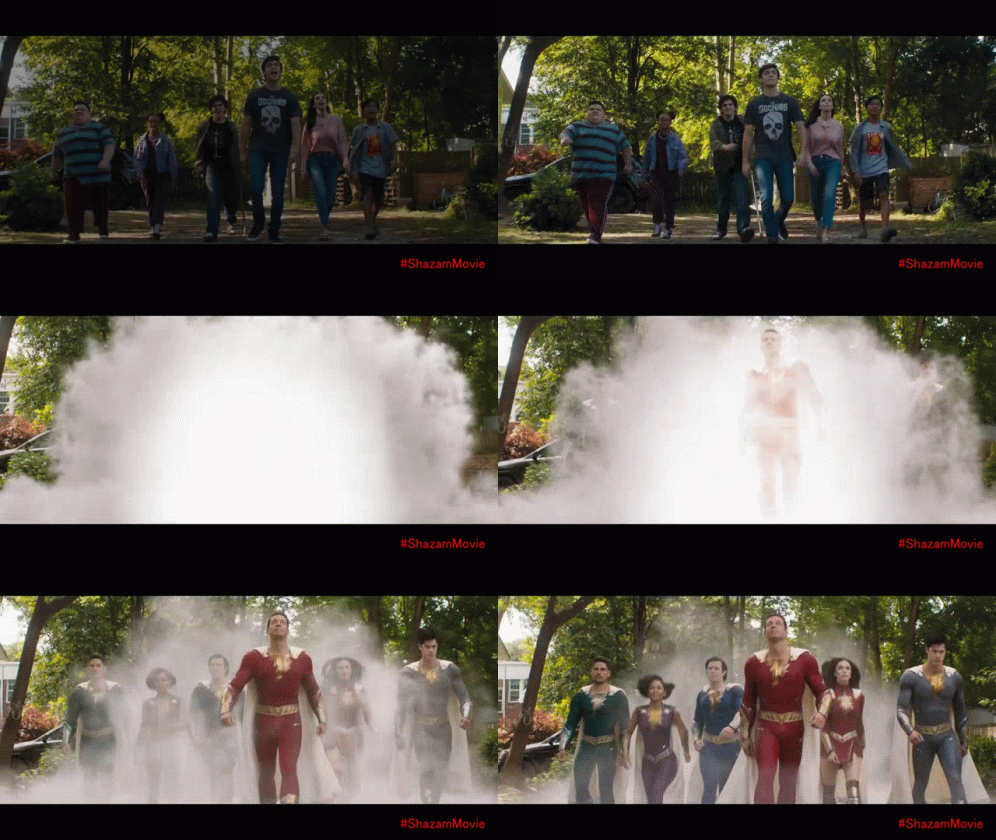
When last we left Billy Batson (Asher Angel), he'd just turned his foster-brothers and sisters into a collection of super-heroes to defeat an evil threat. By invoking the name of the wizard "Shazam"(Djimon Hounsou), they turn into the "Marvel Family" (but nobody calls them that because...lawyers), with, collectively, the wisdom of Solomon, the strength of Hercules, the stamina of Atlas, the power of Zeus, the courage of Achilles, the speed of Mercury...and the neuroses of foster teens. Strange brew.
 
Particularly shouldering these burdens is Billy, who, in his superhero guise as an adult-looking "Captain Marvel" (shhh..."lawyers"...but played by Zachary Levi), he is responsible for the safety of the city of Philadelphia and the management of his family, super-powered and not. It can weigh on a guy. But, then, he has the stamina of Atlas, so, "no big deal," right?
"Say my name!" ("'Destiny's Child' did it better")
Well, it depends on your point of view. He does have the stamina of Atlas, but as Atlas is dead and all, he's probably not using it anymore. Right? So, why not have it? Right? Possession is 9/10 of the law, right? Even if you're "possessed" by a super-hero.
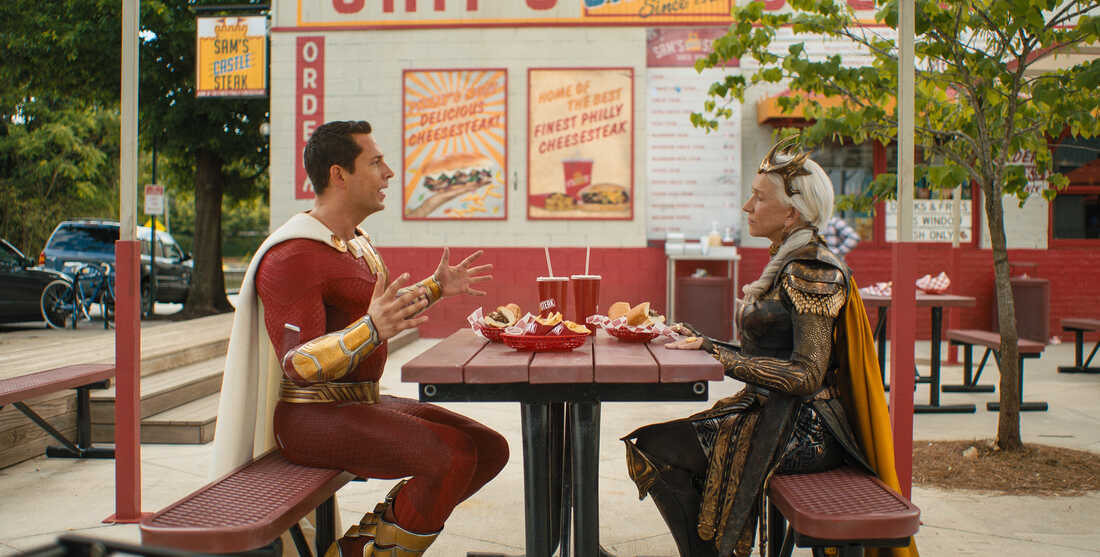
Except for one thing. Three things, really. Atlas had children, a few from different sources, but like all family fights, it usually comes down to the most outspoken ones to stir the pot, so the ones that matter are his daughters Hespera (Helen Mirren), Calypso (Lucy Liu) and Anthea (Rachel Zegler)* Notice the family resemblance? No? Well, like I said "different sources"; call them the step-daughters of Atlas.
  
Being heirs, they're not too thrilled with "family assets" being seized and given to "strangers..."—why, it's not even someone in the family, for god's sake (literally). Besides, not having Atlas' power is making living in whatever god-realm they inhabit in their pearly-gated community less than optimal. I mean, so what if you're a god, even an unfashionable god—a god that's not exactly making people hit their knees anymore—they still have a right to what's theirs!
And so, they deem to get their sandals sullied on real Earth and take back the Wizard's staff that contained all of the power of the gods that were transferred to "The Marvel Family" rather than "The Atlas Family" during the kerfluffle with Dr. Sivana in the last movie. Just putting their mitts on it is enough to generate some power out of it and they use it to smash up a museum and turn all of its patrons into stone. And before you can say "who in their right mind would put something that powerful into a museum?" the Marvels go into action.
Well, not immediately. First, Billy has to visit a doctor about his issue with "imposter syndrome"—he is a 17 year old who becomes an adult super-hero, after all!—the burdens of great power/great responsibility, that he might be a redundant in a world full of super-hero movies (he doesn't mention that, I just added it), and...that at 17, he's going to "age-out" of the foster-care system, and his parents won't be getting support for him. That's a big issue, one that occupies his thoughts even while the "Marv's" try to stop a bridge from collapsing during rush-hour.
But, the Wizard tells them of the impending threat, and the kids try to figure out how to fight mad adults who are gods, or "children of god." The humor of the film comes from the awkwardness of 'tweens trying to be adults, as well as the odd arcana of their Rock of Eternity headquarters that is as idiosyncratic as Hogwarts (heat is provided by an eternally burning violin—Nero's?—and there's an enchanted auto-pen named "Steve"). 
Meanwhile the Atlas kids are using the Wizard's staff to suck the shazam! out of the Marvel kids individually, while also trying to acquire a "golden apple" to rebuild Earth into their kingdom. Oh, and there's a dome—a big impenetrable energy dome surrounding Philadelphia that traps everybody, including our heroes inside. And creatures that look like they came out of Harryhausenland. And unicorns. And a dragon. At one point, Cap just comes out and says "I never thought I'd be saying this, but the dragon is the least of our problems now."
Sounds like it would be a mess, but, it surprisingly isn't. The humor isn't strained, as much as is going on. Levi maintains the "gee-whiz-I'm a dork" persona that makes the adult Captain Marvel such a fun character, and there's "just enough" individualism in the Marvel kids to make you give a rip about 'em when they're getting slammed around. And there are joys, little unexpected "bits" where you shake your head at the cleverness—like Helen Mirren reading a negotiating note from the Marvels—who have no filters—dictated by an enchanted pen—that has no editing skills. And the youngish cast, who are riffing, and moving things along at warp-speed.
The characters' powers have settled in, so there's none of that training awkwardness about their abilities as in the first movie, and maybe all the opportunities of kids acting like adults with super-powers isn't explored nearly enough. But, there's enough mocking earnestness that there were times when the matinee kid in me had their blood pressure up and wanted to see the bad guys get their comeuppance, just because they're very mean people...or demi-gods...or whatever. That hasn't happened to me for awhile in movies. Maybe it's because we've become used to evil that is so blatant and is constantly excused away with sanctimonious self-righteousness.
And ultimately (as Billy evokes "The Fast and the Furious" series in one scene—to Mirren, no less!) The Fury of the Gods really is about family—families that function and families that don't—compare and contrast—and the squabbling and scorched Earth that ensues—and, of course, it all takes place in Philadelphia and the villains are trashing the City of Brotherly Love (ironically). One can't help but see this as another episode of Family Feud...but without Steve Harvey to break the fourth wall to let you know he thinks it's all a little dumb, too.
 
There's a lot of entertainment value in it, a bit lighter in tone, but not lighter in content that the kids can see it and not be zombiefied. And as jokey as it is, as juvenile as it can be, a lot of it will go over kids' heads.
 
* Shazam! Fury of the Gods makes a mystery of the third one for a time, and her identity is revealed as a surprise that doesn't really "land." I mean, why did she suddenly turn up in the first place if she didn't have something crucial to do with the plot?