Showing posts with label Nicole Kidman. Show all posts

Thursday, December 28, 2023

Aquaman and the Lost Kingdom

Put a Hook In It!
or
Basting Away Again in Peter-Jackson-ville
 
"Everybody's good at something," Arthur (Aquaman) Curry (Jason Momoa) exposits at the beginning of Aquaman and the Lost Kingdom. "Me, I talk to fish. Some people think that makes me a joke. But, I'm also good at something else. Busting heads."
 
Just what you want from the King of Atlantis. A lot has happened since the first Aquaman movie. Arthur is now the King of Atlantis and he's just managing to keep his head above water, finding that it requires more compromise with the multi-species Atlantean Council than merely busting their heads. He has now "put a ring on it" (and not one of his telekinesis rings) and is married to Mera (Amber Heard—she's in this a lot more than people were gleefully speculating, proving once again that the Internet is a very fallible, mean-spirited place), and they have a son, Arthur Jr. (too many babies to mention), who is just starting to take on Dad's traits. The couple are living at the lighthouse of Arthur's Dad (Temuera Morrison, again) and Mom Atlanna (Nicole Kidman) stops by every so often to help manage the chaos.
But, these are troubling times: Arthur's mentor Vulko (Willem Dafoe, MIA) has died in "the plague" which is glossed over more than at Kennedy for President Headquarters. Half-brother Orm (
Patrick Wilson) is in prison for his crimes while King of Atlantis (Hmph. Must be nice.) and the Black Manta (Yahya Abdul-Mateen II) has skipped a couple steps of the grieving process and is still plotting revenge against the A-man for the death of his father and given to going around the lair muttering things like "Every day I don't fix my power-suit is another day Aquaman lives." That's not exactly a good morning affirmation and hints that not only the power-suit has a screw loose. He's aided and abetted by some disposable Manta-mob and Dr. Stephen Shin (Randall Park), one of those brilliant McGyver-esque scientists who can use alien technology on the first try but just not brilliant enough to get a legitimate job.* Dude can't even get a grant!
Anyway, the plot is some nonsense about Manta being so OCD avenging his Father that he puts the entire Earth at risk, seeking out a power source to revive Kordax (
Pilou Asbæk), the frozen dead King of the Lost Kingdom of Nekrus, that was banished from the 7 Atlantean kingdoms a long time ago in a Peter Jackson-style flashback. Manta has a found a green-glowing trident (called "the Black trident") with which he can communicate with Kordax, but it's usually a one-sided conversation of Kordax telling him what to do.
So, Aquaman and Atlantis get wind (or current) of all this, and A-man decides that he needs to recruit some help, which he does by springing his brother Orm out of prison, with the help of a invisi-suit, and a stealth octopus by the name of Topo (which stands for Tactical Observation and Pursuit Operative) and, as Mom Atlanna explains he has a "genetically engineered intelligence for infiltration and espionage." "And," she explains further "he also plays a variety of musical instruments" (I only remember him playing drums in the comics, but it's been a while).
Orm and Arthur (of course) have "history" so they bicker and feud and bust each other's chops perpetually and it would get very tiresome if it weren't for Momoa's boisterousness and Wilson's acting response to him. Which (in its brilliant way) is to underplay to such a degree that one gets the impression that all of this mayhem and craziness is pretty much run-of-the-mill stuff and as real as clammy palms. I thought Wilson and his Orm character were the dullest part of the first Aquaman feature, but here, he's an absolute tonic of dead-pan stoniness and competence.**

It's needed. The surprise of him is needed because this one feels a bit rote. The first film had all the gee-whizzery of a new play-set, but this one seems to be missing a couple of necessary parts. Oh, it moves like anything, with whooshy, spinny, disorienting action sequences every ten minutes of so, but there are no great set-pieces like the first film's violent mad dash across Sicilian roof-tops. Nothing drops your jaw here.
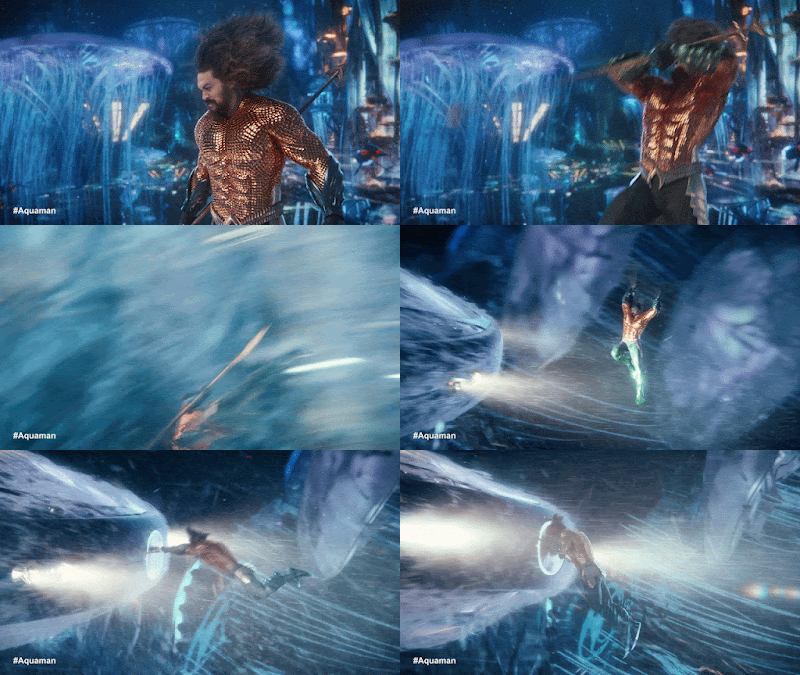
Except for some of the special effects and not in a good way. The first film was a fun world-builder with its undersea kingdoms and giant seahorses and mounted sharks. But, you get the impression that since the first one was a hit the producers felt they could scrimp on the CGI budget and take full advantage of the murky, shimmery water overlays to hide some dodgy pixelation. There's one whole sequence where it feels like everybody's head is slightly askew of their bodies, and it's a bit of a relief when a sequence shows up with no digital effects at all. But, they're few...and far between.
It's a bit of a plunge from what the first one offered, even factoring in the "thrill of the new." This one feels clogged with recycled material--from The Lord of the Rings, Black Panther, even Iron Man. The comic book world is naturally self-reflexive and the same tidal forces apply to comic book movies. You have to do something different, risking the loyalty of fans, to reinvigorate a property, and that is something that producers are not brave and bold enough to do. It's a question of stemming the tide or just becoming back-wash. Forget about Lost Kingdoms. This should have been called Aquaman and the Lost Opportunity.
 Aquaman, Storm and Topo...together again.
* Imagine Shin's job interview with Black Manta: "Dr., what do you see as your five-year goals?" "Well, developing a more powerful energy source." "WRONG answer! It should be to KILL Aquaman!" "Uhhhh-huh! (uncomfortable pause)...Do you offer insurance?"
 
** Ya know who else is good in this movie that you'd never guess? Dolph Lundgren. He was very good in the first Aquaman, but here, he's given more to do and he's subtle and majestic. The man was born to play kings. 

Tuesday, August 22, 2023

The Interpreter

The Interpreter (Sydney Pollack, 2005) A lot of "firsts" in this movie: the intriguing pairing of Sean Penn and Nicole Kidman--she, in a role tailor-made for Charlize Theron, and he, basically making money for the production of Into the Wild;* it's the first time the United Nations has allowed filming on its premises (a wise move to dispel some of the recent "Secret Society" rantings about the U.N. among the Red States), showing the inner workings and the awe-inspiring chambers inside; it's Sydney Pollack's first film designed for wide-screen since his work in the 60's**--his compositions are far more elegant and complex than the kind of attention he paid to, say, The Electric Horseman, or Tootsie, or sadly, Out of Africa. The wide-screen compositions give the impression that the film is more complex than it actually is. As it stands it follows the Pollack formula ("Person of Mystery investigated by another until all is revealed in a pro-forma setting," in this case, the general assembly of the U.N.) The Person of Mystery is Kidman's Sylvia Broome, an interpreter at the U.N. with a burning secret. The investigator is Penn's Tobin Keller with the Secret Service, charged with protecting the despotic President of an African nation--where Ms. Broome's dissident parents, sister, and most recently, brother were killed. Only he doesn't know that.
Why wouldn't he know that, you may ask? So do I, as a background check might--just might--turn up that information. But, he's distracted because 1) you know how investigations involving information from third world countries go, 2) Broome is very good at not volunteering any information, 3) she's being stalked, so now he's involved in protecting the potentate and her for what she might know, and 4) oh yeah, his wife just died.

I guess 1-3 weren't dramatic enough reasons.
There are plots, counter-plots and even bogus plots falling all over each other, one particularly nasty explosion (that violates the "Hitchcock rule"***), and some such nonsense about Truth being better than Lying. It's a lot of drama built over one of those Messages that is so Simplistic, Nobody's going to be Offended. I guess you have to do that when you film at the U.N.
Seeing the magnificent cathedrals to world peace is the best reason to see this movie. Kidman and Penn are very good, but wasted (but not as "criminally" wasted as Catherine Keener is as Penn's partner-agent), and Pollack's eye for composition has never been better. If those particulars are of interest it's a movie to see. If things like story matter, best to give it a pass.

*More and more, Penn is looking like his generation's George C. Scott, in the literal and spiritual sense.

*** Pollack stopped doing wide-screen composition for films because the only other market for films was airings on television--full-screen, which would take wide-screen films and electronically shift them to the area of the screen where the center of attention was, a process perjoratively called "pan-and-scan." So, Pollack made movies where most of the "action" was going on in the middle of the screen in a barely elongated square, like your television screen. Now, that the technology has advanced with wide-screen TV, and DVD's eclipsing TV broadcasting (the "major" networks don't show movies anymore), and the cable channels mix wide-screen with "pan-and-scan." Movie channels devoted to films (like TCM) show films wide-screen. Movie channels that only SAY they're devoted to films like AMC) pan and scan--and insert interruptions, like commercials and promos. Stanley Kubrick composed for television, as well. that's why there's such a stink about his DVD's (except for the early films through A Clockwork Orange) not being wide-screen. They supposedly weren't intended to be.

*** Before you set off a bomb, tell people there is a bomb, and where it is, and when it will go off, to build suspense. That's why a lot of movie-bombs have superfluous LED screens.

Thursday, February 24, 2022

Rabbit Hole

Written at the time of the film's release...

Ghost-busting

or
Coping Mechanisms

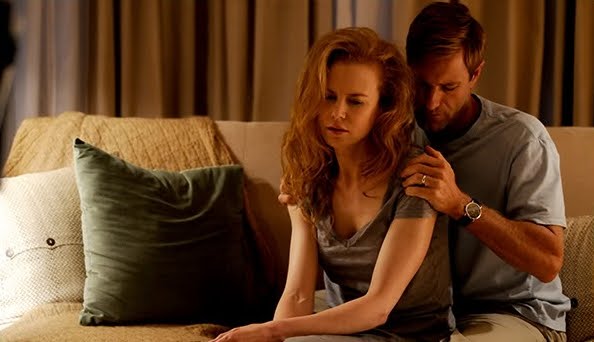
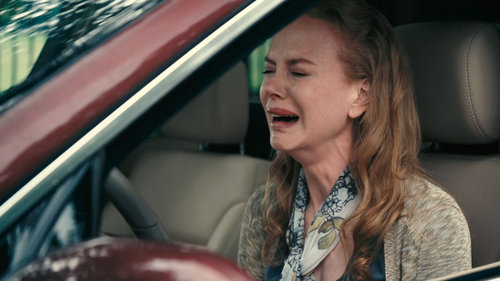
'Becca (Nicole Kidman) is going through the motions. She's doing everything expected of her and dutifully. The planting of new flowers in the garden, the making of stringent recipes of comfort food, the grief support group. All those motherly instincts and nothing to mother, and everything—absolutely everything—reminds her of the void in her life. Her child is dead, a victim of a car-pedestrian accident. Her sister (Tammy Blanchard) is pregnant, her mother (Dianne Wiest) keeps bringing up her own dead child—Becca's brother, friends with kids avoid her as if death were communicable, the flowers get crushed, the pans go empty. Life goes on, horribly.

Husband Howie (Aaron Eckhart, all clenched jaw and knotted body language) can't let go, sitting up every night endlessly watching a phone-video of little Danny  This frustrates 'Becca. So do the "professional wallowers" of the support group. She's avoiding grief, while Howie and the others are embracing it, and both sides are going too far  She starts to find ways of relieving herself of Danny's things, each one precious to Howie. They start to splinter, the pressures of the void hammering them from both sides.

Life goes on, horribly.
Audiences have been avoiding Rabbit hole like those parents avoid Becca, the subject matter presuming to be a downer. More's the pity as there is enough humor in the cracks of the angst to make it worth seeing and nod appreciatively at the simulations of life and death and the grief that comes between. Director John Cameron Mitchell stays out of the way, mostly, merely observing the struggles from sympathetic angles, while not making a big thing of the POV—making him a far subtler director than, say, Tom Hooper of The King's Speech.  The performances are pitch-perfect along the scale of emotional expression, from buried thought to screaming match, with Kidman sublimating technique for organic feeling to Wiest's haunted portrait of mother love. You pull for these people as they learn to live with death, even if they only get a "C" average.

It would be unfair to say too much of the plot other than the set-up, but
it touches briefly on comics and concepts of parallel universes and alternate realities—an alternate form of Heaven and the possibility that somehow, somewhere, things are different and that the cosmic dice might roll a different way. Possibilities erode the concept of the concrete reality, and sometimes the best way out of a trap is to imagine the way out, rather than accept that there isn't.

A downer? Maybe. But I found something heartening in a film that suggests that
the only way to fill the void of death is with larger doses of life. And that the holes those voids leave can only be healed—not so much in reality—but, in another dimension, the warrens of our soul.


Thursday, December 16, 2021

Being the Ricardos

The
Red-Headed Scare (It's All True)

or
Looo-cy, You Got Some Sorkin' To Do
 
I had a Lucy Ricardo reaction to this project first coming to mind: curling my lip to show all my teeth and going "Ewwww." Even though Being the Ricardos is helmed by Aaron Sorkin, Sorkin, as he's demonstrated, isn't the most effective when delivering comedy material—drama with humor and irony, sure. But comedy? C'mon, I watched the entire run of "Studio 60 on the Sunset Strip." I may have been the only one.
 
Lucy's been on a lot of people's minds lately: TCM had a month of Lucy movies last month in conjunction with their "highlights" podcast about her life. This movie covers a bit of what that covered, but squeezes it all in within the space of one week of production of the "I Love Lucy" show, those issues being Desi's affairs, Lucy being pregnant just ahead of shooting a season's worth of shows, and the disclosure—on Walter Winchell's radio broadcast—that Lucy (coded as "America's favorite TV comedienne") was a communist.*
 
All true. Desi was sneaking out on Lucy. Lucy did become pregnant while shooting a season and, despite resistance from CBS, sponsors Westinghouse, and Phillip Morris, and incorporated Lucy's pregnancy into the story-line—a first (one of many) that distinguished "I Love Lucy" from the stone age of television. And Lucy was a communist, but not a practicing one. She had checked "communist" on a voter registration card in 1936, at the behest of her beloved grandfather Fred Hunt, who raised Lucy and her brother in their childhood.
It's also true that Ball and Arnaz were better together than they were apart. Both were quick-witted dedicated hard-workers with gambler's instincts and business savvy. Together, they bought the old RKO studios (which years before had released Lucy from her contract), created the 3-camera technique for documenting TV shows—which made better clarity, guaranteed delivery, and allowed episodes to re-run—clobbered television taboos, Desi gave the green-light to "The Untouchables" (narrated by Winchell, ironically) and Lucy said yes to production of TV's "Mission: Impossible" and "Star Trek." At one point, the greatest assets for Westinghouse and Phillip Morris...and CBS. They had a lot of power, but it was all power that could be taken away, if they didn't deliver. the goods.
Aaron Sorkin knows his way around television—he's made three TV series ABOUT television ("Sports Night," the afore-mentioned "Studio 60" and "The Newsroom") and the backstage turmoil involved in filling up broadcast time on a regular consistent basis. It is a meat-grinder, and anybody wanting to cut corners to make it a little easier, risks the wrath of millions of viewers. Desi-Lucy knew that. And so does Sorkin. He also knows what it's like to produce a carefully scrutinized show while your life is falling apart. Even when things are going well, personalities and egos have to be considered and worked around, editing and second-guessing happen constantly, interference from outside sources need to be batted out to the foul-zone and sometimes the drama off-stage is more intricate—and better—than the one on-stage.
Sorkin segments the film into a television work-week: Monday-"Table Reading; Tuesday—"Blocking Rehearsal"; Wednesday-"Camera Blocking"; Thursday-"Dress Rehearsal"; Friday—"Show Night". Those are the steps for the actors and technical crew to take from the first reading of the script on Day 1. Things get changed, problems get discussed, it's staged, and how it's going to be recorded is worked out, then the final touches and intricacies before the final day when it's presented before an audience. A 25 minute play produced each week, and the audience has to be "warmed up" that it's going to be a good time and they're free to enjoy themselves.They see the fun parts. They don't see the work. 
They also see the parts being played. They do not see the actors. Which brings us to casting. Cate Blanchett was first cast but dropped out. Nicole Kidman got the "Lucille Ball" part and Javier Bardem the "Desi Arnaz" part. J.K. Simmons plays William Frawley, and Nina Ariadna plays Vivian Vance. And they work. Some may grouse that Kidman doesn't look like Lucille Ball, but then we didn't see Lucille Ball, we saw "Lucy Ricardo." Lucille Ball was a tough business woman, who knew that time was a commodity and shouldn't be wasted by niceties—there was work to be done. Kidman gets that. Yeah, she can do the schtick, exploding the blue eyes and pitching the voice to screech-mode to play "Lucy"—but she spends most of her time as the intense, driven actress with a cigarette-growl and is very serious about comedy...and character. "Lucy Ricardo" didn't just happen, she was created, given what Lucille knew about getting attention and laughs. And like the silent comedians, she worried about timing and earning guffaws without doing it cheaply. It's an interpretation, not an imitation and it works. The voice is phenomenal.
Bardem doesn't have the boyish good looks of Desi Arnaz, but he's all over the charm and the drive...his scenes with Kidman are played like an old movie with too-perfect lines and better timing. And he's pretty good doing the songs. J.K. Simmons is a delight as Bill Frawley, with the rasp but not the girth, full of cranky jibes, belying a worldly wisdom (Sorkin writes a lovely line when he invites Lucy to a bar for a drink during a fraught work-day. "It's 10 am!" "Well, it's always 10:15 somewhere!") and Ariadna's Vivian Vance is a frustrated actress, worried that she'll be typecast frumpily, playing a woman "married to my grandfather."
But, Sorkin pays particular attention to the writers of "I Love Lucy" with actors portraying them at the time of the show's creation and with "witness testimony" of the same people older trying to set the record straight: Executive producer Jess Oppenheimer (played by Tony Hale and John Rubenstein), Bob Carroll (played by Jake Lacey and Ronny Cox) and Madelyn Pugh (played by Alia Shawkat and Linda Lavin!). Being a writer himself, Sorkin gives them the roles of experts, the elder versions smoothing over the inevitable pecking battles we see occurring in a bull-pen during the earlier scenes.

And—like a good sit-com—it all gets resolved in the end. Well, almost resolved. And, while it's true that Desi (in his usual role warming up the audience) did talk to the waiting crowd about the communist accusations, but he did not use the gambit Sorkin employs—although it is true that Arnaz knew the person mentioned, having met him at the race-track. Instead, Cuban-American Arnaz merely reminded the crowd that they were all Americans, and that, in this country, the accused are innocent until proven guilty. He merely appealed to their better natures. I kind of like the truth better. And Lucy was greeted, when introduced, to thunderous applause. But, Sorkin leaves out what happened after the taping: she went back to the crowd—something she never did—and said "God bless you for being so kind," then went to her dressing room and broke down.
 
Tough but not invulnerable.
Instead, Sorkin leaves us with one last enigmatic image. The crises have been averted. "I Love Lucy" goes on and no is being fired or losing their job. Sorkin shows the continuity after near-disaster, and the show going on, the actors on set, and the camera slowly moves up into the stage-lights looking down on the activity, until it hovers above the beams and bracers forming a television shaped screen around the scene below. What's he saying? Are they trapped? Is this a ploy showing the
metaphoric similarity of the Arnazes to the Ricardo's?—because if it is, it doesn't work. What's the gist here? Maybe it'll come to me, but it sure doesn't communicate.
 
And it ends with television static. I only say this because it will cause confusion when it starts streaming on monitors December 21. Do not adjust your sets.   

* I love Desi's resulting line: "maybe they're talking about Imogene Coca..."

Tuesday, October 12, 2021

Stoker

Gosh, it's October 12th and I haven't started putting up the usual collection of Horror-style movies that have been moldering in the crypt...

Written at the time of the film's release...
 
"Creepy Carrie, Creepy Carrie"

or
There's Just One Hitch...

There is such an air of oppression in Chan-wook Park's Stoker ("from the acclaimed director of Oldboy") that it completely tractors over any pretensions of accomplishing what the intent is...to make a film in the style of Alfred Hitchcock.

Well, to do that you have to have an understanding of what Alfred Hitchcock did as a director...and you also have to have an understanding of what "style" is. Not the stylization of what we see here—all oblique angles  and off-kilter cutting, movie-making that "suggests" a story rather than just coming right out and saying it in movie terms. But, also you have to know that Hitchcock's "thrillers," when he made them, took the opposite tack of Stoker, presenting "normal" life invaded by aberration, rather than making it the norm. Hitchcock might have been obsessed with the creepy, but the gourmand in him knew that a steady diet of it would make it dull.


Which is what Stoker is.

On her 18th birthday, the father of India Stoker (Mia Wasikowska) is killed in an automobile accident, devastating her family, and introducing to them her father's brother "Uncle Charlie" (Matthew Goode) at the funeral. Charlie stays with the family inserting himself into every aspect of the Stoker household, still in shock over Richard Stoker's (Dermot Mulroney) death, taking a particular interest in gardening, the servants, and mother Evelyn (Nicole Kidman). Soon, the head caretaker goes missing, as does great-aunt Gwendolyn (Jacki Weaver), explained away by Charlie, who then turns his laser-like gaze on India.  As is the trait of Uncle Charlies, he sees a kindred spirit in his brother's daughter, and if the man had any sense, he'd be afraid of that, which is the only aspect of Stoker that doesn't pay homage to the Master of Suspense—this is a movie that has no redemption and no hope.

There's a child's primer of Hitchcock throughout: bad "mother" relationships, a creepy "Uncle Charlie," odd dispassionate deaths, the callow, uncomfortable-making young man, the swinging light, the "secret" basement, the masquerading gardening activities, the imposing staircase (circular), the rather irrelevant but "convenient" ability of India. It's a Hitchcock movie for those who've only seen Psycho, and are stuck in that film's deliberate pace and motivation. It's designed to shock, but not to move (and not even out of one's seat...unless of course, it's to walk out).
And there's no humor. Not even a nervous titter. Oh, sure, there is dark "irony" scattered hither and yon with all the subtlety of a hammer swing, but there is no lightness of touch anywhere, not even as an antidote to all the mock serious portent that shrouds the thing, that makes it travel the dead man's walk from too-heavy seriousness to unintended self-parody. It's as if Alan Ball had written Shadow of a Doubt, directed by a too-eager-too-please director who knows nothing about sub-text, and the fun ways that one can infuse the abnormal into normal, or what passes for it.

It's all in the trailer, kids.

Tuesday, January 19, 2021

To Die For (1995)

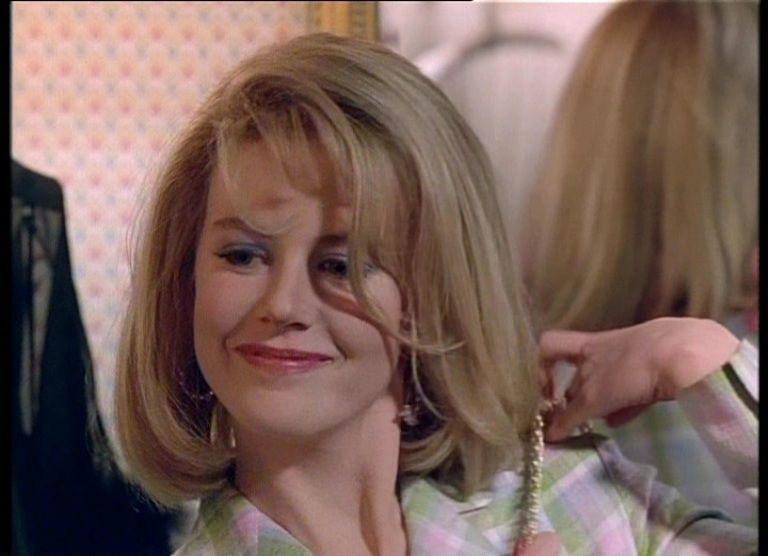
To Die For (Gus Van Sant, 1995) Nicole Kidman plays Suzanne Stone, a local tv weather-girl with a particularly aggressive addiction to celebrity. Her new-found fame conflicts with her ordinary home-life and her marriage to a mechanic, despite the financial stability it gives her. So she plots to murder her husband (Matt Dillon), as his lack of status might hold back her fortunes. She recruits three teenage misfits (Joaquin Phoenix, Casey Affleck, Alison Folland), whom she's met while doing a documentary called "Teens Speak Out", to carry out the homicide. But, when her in-law's attempt to pin the murder on her, she turns on the kids with blackmail and the local police with entrapment. Despite being found not guilty, she's only too eager to keep building her career. After all, there's no such thing as bad publicity. To Die For is a black comedy mixed with film-noir (that pairing almost never works as it tends to pile on the ironies) on the sociopathy of celebrity. It was written by Buck Henry (based on a novel by Joyce Maynard, which in turn was inspired by the Pamela Smart case) and directed by Gus Van Sant

"You're not anybody in America unless you're on TV."

Those who had seen her in BMX Bandits, "Bangkok Hilton," and Dead Calm knew that Kidman was more than "Mrs. Tom Cruise," but it wasn't until To Die For that she emerged from her superstar husband's shadow and began creating a separate career. An arch performance just shy of camp, it was the first of the actress' many forays into aberrant personalities that have subsequently dominated her career, and, for some, has proved troubling to her audience base. On the other hand, she's become one of those actors who have defied "typing"—one never knows what Kidman one is going to get.  And, as time has moved on and the bar for celebrity has sunk as low as a snake's belly, the film looks positively prescient.
It certainly was indicative of the careers of Phoenix (who had previously been billed as "Leaf" Phoenix) and Affleck, both of whom have gone to Oscar-winning careers. And Kidman—who would win her Oscar seven years after this movie—etches an indelible portrait of a femme fatale, hot-blooded in her manipulation and cold-blooded in her abandonment. Making an audition tape, Kidman's Stone looks directly into the camera with knowing seductiveness and invites the watcher in on her little dark secrets and fervent desires for TV work.
The wiliness of the actress playing the character is matched by the character's own wickedness and the two seem to fuse. Reason enough to watch the film, but
Kidman is nearly matched in ferocity by the fine Illeana Douglas, as the Dillon character's sister, who is equally capable of killing for love. It's a movie that will keep you unnerved until the final black comic cold-hearted image.

Tuesday, January 12, 2021

The Golden Compass

Written at the time of the film's release...

"Remember, man, that thou art dust, and to dust thou shalt return"
Genesis 3:19

Oh, there have been howls in the wilderness over the film The Golden Compass, and not the kind you'd expect from anything like armored polar bears

No, indeed. The Catholic Church (which's taken a few knocks lately) and the Catholic Legion of Decency have awakened like vampires and condemned this film, based of Philip Pullman's trilogy of novels (under the title "His Dark Materials" published between 1995 and 2000)--though the Legion is remarkably silent over the Church's own trespasses. 

Then there are those fans of the books who are beating their breasts with their Anniversary Editions saying that it doesn't do "justice" to them.
Well, checking my own personal Alethiometer, I can say they're both wrong, if not downright irrelevant in their arguments. The Catholics' stance won't do anything but help the movie.* If they really wanted to prove they meant business they could excommunicate Catholic Nicole Kidman, but I think that would generate so much sympathy that folks might even forgive her for Bewitched! And the "chapter-and-versers" will just have to live with the fact that "books is books" and "movies is movies", and both media have their story-telling strengths that are oftentimes incompatible with each other.**
Enough of the controversy, how's the movie? Immensely satisfying for a first chapter (and half-a-movie). There are unresolved issues galore, confused motivations, and the lurking feeling that things might have played out a bit faster than the time it takes to say "To Be Continued" three times fast. But the production design is killer, the performances are good (though Daniel Craig has little to do, or offer, as Lord Asriel), and the effects work is exemplary. The Golden Compass takes place in a world not too unlike our own, except that, instead of souls, people have "daemons," animal-like wraiths who shape-shift until maturity sets in for the host
The academics are attempting to trace the cosmic origins of "dust," a move frowned upon with great furrows by the Magisterium (headed by Derek Jacobi and...Christopher Lee, so you know they've got to be bad!) As is shown often in the film's many scenes of combat, when a person is killed their daemons go *poof* into little whisps of CGI powder with the "glimmer" program turned on "HIGH." It is this "dust," which The Church...sorry...Magisterium wants to suppress all knowledge of, despite the fact that it's right there before your very eyes. Evidently, this "dust" is a threat to the Magisterium's political power in this World. Hence, the conflict between them and the "academics." Lord Asriel has photographic evidence of this dust falling from the heavens and entering humans through the daemons--so our link to the cosmos is via "dust-bunnies" of a sort.

That's the background dust...er, stuff.
Our heroine, Lyra (Dakota Blue Richards), is a headstrong urchin of an orphan living at Oxford as the ward of Lord Asriel
, an explorer-adventurer of some note and seeker of the truth about this "dust" business, the mention of which is considered heresy by (and produce much paroxysms in) The Magisterium. Lord Asriel goes off adventuring and Lyra is entrusted with an Alethiometer, a Golden Compass, which will tell her the truth of a subject if its asked in precisely the right way--not unlike a Press Spokesman. She also comes under the slinky thumb of Mrs. Coulter (Nicole Kidman, in full "evil-squint" mode), who does "official business" for The Magisterium, whom, she explains, "tells people what to do...but in a nice way...to keep things working." 
Lyra is always being told to behave
, yet, she has, as her two mentors, two head-strong people who like to say "no one tells me what to do." So, soon Lyra is rebelling, and escapes from Mrs. Coulter (in a scene that, in all the discourse, is given dramatically short-shrift) and embarks on a series of adventures that entails the kidnapping of two of her friends, a hook-up with a band of the takens' parents, a countrified aeronaut (Sam Elliott, never more twinklingly courtly), and a displaced prince of a polar bear playing "Hamlet."
It's this section
where the film really shines. The bears are marvels of CGI animation with wonderful actors like Ians McShane and McKellan (What? Him...again? Can they make a fantasy film without this guy?) breathing life through their vocal performances. One sight that made me laugh was during the Big Fight for "Polar Bear King," when Iorek Byrnison (McKellan's bear) has his armored head-piece knocked off and the camera (computer?) follows it to the edge of the ring, where the spectator-bears stare curiously dumb at it. The film is awash with pictorial touched like that, that fill in and make this world real whenever the story-telling turns miserly.
Performances are uniformly fine--though
Craig under-performs. Perhaps he'll be given more to do later, although it's pretty apparent who of the characters you're supposed to be rooting for early on. Time will have to tell. But it's quite good for being half-a-movie. Certainly it makes you anticipate the sequels.
It has been reported in the news that the Vatican has been "consoled" by the film's less-than-golden opening receipts. But probably less than they were when "Deliver Us From Evil" or Spotlight underperformed.
HBO is doing a marvelous 3 season series of Pullman's books, with lovely detail to the material.

* Showing off my talents as a prognosticator, the film did poorly at the box office and plans for other films in the series were canceled by NewLine. The entire series of films is being done—and done quite well—for HBO, which has so much money from "Game of Thrones," they can afford to offend the Catholic Church. By the way, with my margin or error, I have the makings to be your average pollster!

** Trouble is NewLine Cinema, which was perfectly alright with 3.5 hour versions of Tolkien, but did not want this one to be 3 hours long and so they took back the film from Chris Weitz and cut a great deal of material from it, rendering it a bit hedgy in the exposition and transition department.