Showing posts with label Ian McKellen. Show all posts

Wednesday, September 25, 2024

The Critic (2023)

Critic, Critique Thyself
or
The Mystery of the Missing Curtain Call
 
To read online reviews, Anthony Quinn's mystery novel "The Curtain Call" is a cracking good read, set in 1936 London with a background in the theater-world amidst it's denizens, while at the same time being something of a manifesto on giving the downtrodden some agency. It sounds like it would make a great movie.
 
The Critic is the movie based on Quinn's book...and it isn't. A great movie, that is. I don't know what happened, but whole plots, characters, whole gists of the book have gone missing in the transition from print to screen and one can only wonder who the culprit is.
 
Or the why of it. But, someone has done a great crime to the book. And somebody's responsible.*
But, one shouldn't review what isn't there, one should review what is. What we've got is a character study with a little bit of blackmail/murder thrown in. Jimmy Erskine (
Ian McKellen) is a renowned theater critic for London's Daily Chronicle, known for his bitchy reviews scratched out with a poison pen (and typed up for submission by his assistant, played by Alfred Enoch). Jimmy relishes his job and his high-handed witticisms ("I do not enjoy the theater. I am the chief drama critic of the Chronicle!") and the perks of having his reserved seats at the theater and reserved table at the club, but his publisher, the Viscount David Brooke (Mark Strong)—having taken over the paper from his late father—has reservations of his own and would like Jimmy to "tone it down. More beauty. Less beast!"
Jimmy, though, has high standards—in everything but the "rough trade" he dabbles in—and between his lack of cooperation in kinder, gentler reviews and his frequent violation of the "morals clause" in his contract, he finds himself sacked. The Viscount has had enough of the paper's "old guard" and wants to bring in fresh blood. For Jimmy, being a pensioner is not enough to keep him in the decadent lifestyle that he's become accustomed to. So he hatches a plot.
One of the actors that he's been regularly slagging in his reviews is ingenue Nina Land (
Gemma Arterton), who is pretty and game, and wants nothing more than impress the Chronicle's drama critic—she's a fan of his taste and his writing—but one more bad notice from him and she has the pluck enough to confront the man (catching him trolling in a nearby park) and she makes her case through flattery and some implied blackmail, both of which impresses Jimmy. "There is art in you, Miss Land," he confides in her. "My disappointment is in your failure to access it." He decides then and there to take her under his wing and tutelage. She could be useful.
What he doesn't know is that Land is having an affair with the publisher's son-in-law, a portrait painter of some repute, and that complication makes things a little dicey for what Jimmy has in mind for his scheme to get his old job back. Trouble is, he's a critic, and having observed enough theater in his profession, one would think he would immediately spot a weak plot, even if it's of his own devising.
The Critic
premiered at the Toronto Film Festival last year and there was less buzz than murmuring, and so some tinkering and tailoring was done with re-shoots and another ending prepared and there's just enough dissonance in the film that the seams show. One can't fault the performers, all of whom do the job with McKellan deserving the lion's share of the praise for a performance so venal done with obvious relish.
But, it isn't enough. The plot's spread awfully thin and what's there is lingered over and emphasized, like the shot that director Anand Tucker keeps coming back to—an overhead shot that zeroes in right on the performer's forehead (to what purpose, you wonder, other than to show somebody thinking). And you wonder where it started to go south.
 
Any movie adaptation of a book should make you want to go to the source to get more of what drew you to the story in the first place. The Critic makes me want to read "Curtain Call" to see what it is I'm missing.

* Yeah, it sounds weird, but then, so is the source: Plan 9 from Outer Space, Ed Wood's notorious science-fiction opus once dubbed The Worst Film Ever Made. At one point, a detective discovers a corpse in a grave-yard and says (quite seriously) "But one thing's sure. Inspector Clay is dead, murdered, and somebody's responsible." 
 
Well, technically, that's three things, but you can't quibble with Plan 9, or you'll end up wasting your life.  As a matter of fact, it occurs to me that I don't have a post for Plan 9...yet. Well, Hallowe'en month is coming up...

Tuesday, January 12, 2021

The Golden Compass

Written at the time of the film's release...

"Remember, man, that thou art dust, and to dust thou shalt return"
Genesis 3:19

Oh, there have been howls in the wilderness over the film The Golden Compass, and not the kind you'd expect from anything like armored polar bears

No, indeed. The Catholic Church (which's taken a few knocks lately) and the Catholic Legion of Decency have awakened like vampires and condemned this film, based of Philip Pullman's trilogy of novels (under the title "His Dark Materials" published between 1995 and 2000)--though the Legion is remarkably silent over the Church's own trespasses. 

Then there are those fans of the books who are beating their breasts with their Anniversary Editions saying that it doesn't do "justice" to them.
Well, checking my own personal Alethiometer, I can say they're both wrong, if not downright irrelevant in their arguments. The Catholics' stance won't do anything but help the movie.* If they really wanted to prove they meant business they could excommunicate Catholic Nicole Kidman, but I think that would generate so much sympathy that folks might even forgive her for Bewitched! And the "chapter-and-versers" will just have to live with the fact that "books is books" and "movies is movies", and both media have their story-telling strengths that are oftentimes incompatible with each other.**
Enough of the controversy, how's the movie? Immensely satisfying for a first chapter (and half-a-movie). There are unresolved issues galore, confused motivations, and the lurking feeling that things might have played out a bit faster than the time it takes to say "To Be Continued" three times fast. But the production design is killer, the performances are good (though Daniel Craig has little to do, or offer, as Lord Asriel), and the effects work is exemplary. The Golden Compass takes place in a world not too unlike our own, except that, instead of souls, people have "daemons," animal-like wraiths who shape-shift until maturity sets in for the host
The academics are attempting to trace the cosmic origins of "dust," a move frowned upon with great furrows by the Magisterium (headed by Derek Jacobi and...Christopher Lee, so you know they've got to be bad!) As is shown often in the film's many scenes of combat, when a person is killed their daemons go *poof* into little whisps of CGI powder with the "glimmer" program turned on "HIGH." It is this "dust," which The Church...sorry...Magisterium wants to suppress all knowledge of, despite the fact that it's right there before your very eyes. Evidently, this "dust" is a threat to the Magisterium's political power in this World. Hence, the conflict between them and the "academics." Lord Asriel has photographic evidence of this dust falling from the heavens and entering humans through the daemons--so our link to the cosmos is via "dust-bunnies" of a sort.

That's the background dust...er, stuff.
Our heroine, Lyra (Dakota Blue Richards), is a headstrong urchin of an orphan living at Oxford as the ward of Lord Asriel
, an explorer-adventurer of some note and seeker of the truth about this "dust" business, the mention of which is considered heresy by (and produce much paroxysms in) The Magisterium. Lord Asriel goes off adventuring and Lyra is entrusted with an Alethiometer, a Golden Compass, which will tell her the truth of a subject if its asked in precisely the right way--not unlike a Press Spokesman. She also comes under the slinky thumb of Mrs. Coulter (Nicole Kidman, in full "evil-squint" mode), who does "official business" for The Magisterium, whom, she explains, "tells people what to do...but in a nice way...to keep things working." 
Lyra is always being told to behave
, yet, she has, as her two mentors, two head-strong people who like to say "no one tells me what to do." So, soon Lyra is rebelling, and escapes from Mrs. Coulter (in a scene that, in all the discourse, is given dramatically short-shrift) and embarks on a series of adventures that entails the kidnapping of two of her friends, a hook-up with a band of the takens' parents, a countrified aeronaut (Sam Elliott, never more twinklingly courtly), and a displaced prince of a polar bear playing "Hamlet."
It's this section
where the film really shines. The bears are marvels of CGI animation with wonderful actors like Ians McShane and McKellan (What? Him...again? Can they make a fantasy film without this guy?) breathing life through their vocal performances. One sight that made me laugh was during the Big Fight for "Polar Bear King," when Iorek Byrnison (McKellan's bear) has his armored head-piece knocked off and the camera (computer?) follows it to the edge of the ring, where the spectator-bears stare curiously dumb at it. The film is awash with pictorial touched like that, that fill in and make this world real whenever the story-telling turns miserly.
Performances are uniformly fine--though
Craig under-performs. Perhaps he'll be given more to do later, although it's pretty apparent who of the characters you're supposed to be rooting for early on. Time will have to tell. But it's quite good for being half-a-movie. Certainly it makes you anticipate the sequels.
It has been reported in the news that the Vatican has been "consoled" by the film's less-than-golden opening receipts. But probably less than they were when "Deliver Us From Evil" or Spotlight underperformed.
HBO is doing a marvelous 3 season series of Pullman's books, with lovely detail to the material.

* Showing off my talents as a prognosticator, the film did poorly at the box office and plans for other films in the series were canceled by NewLine. The entire series of films is being done—and done quite well—for HBO, which has so much money from "Game of Thrones," they can afford to offend the Catholic Church. By the way, with my margin or error, I have the makings to be your average pollster!

** Trouble is NewLine Cinema, which was perfectly alright with 3.5 hour versions of Tolkien, but did not want this one to be 3 hours long and so they took back the film from Chris Weitz and cut a great deal of material from it, rendering it a bit hedgy in the exposition and transition department.

Saturday, October 20, 2018

Gods and Monsters

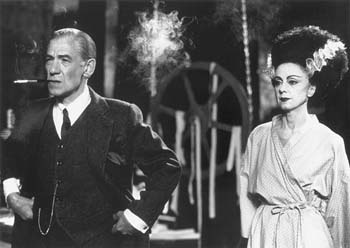
Gods and Monsters (Bill Condon, 1998) Frankenstein begot "The Monster." Mary Shelley created Frankenstein. But the Modern Prometheus who caught lightning in a bottle and made Frankenstein more than the sum of its parts was director James Whale.

James Whale's first directing gig was for Howard Hughes, directing sound and dialogue versions of silent scenes from Hell's Angels that had already been shot, taking advantage of film's new recording technology with the introduction of "talkies." He'd come from England where he'd made his name with an acclaimed stage production of "Journey's End" in 1928, supervised its move to Broadway, and then went to Hollywood, where he briefly served as a dialogue coach, then went on to Hughes WWI flying epic. A quick study and wildly imaginative, he'd completed the film version of Journey's End before his work on Hell's Angels was released from Hughes' meticulously and repeatedly washed hands. In another year, he would achieve his greatest success, overseeing a new, and what is considered the definitive, version of Mary Shelley's "Frankenstein," using the stylistics of German Expressionism and creating a monster, but also getting under its skin, evoking a strange empathy for this defiance of Nature and God. It was the first film of a five year contract with Universal Studios, and his choice of the inventoried properties to direct, evidently because the other scripts ready to be made held no interest for him.
When considering Gods and Monsters, the film purporting to be about the last days of Whale, there is always a giddy part of me that recalls the delirious segment of "Monty Python's Flying Circus" (aren't they all?) called "Farming Club,' in which a serious BBC commentator begins to discuss the composer Tchaikovsky before it deteriorates ("which is a bit of a pity as this is 'Farming Club'"), and then returns to a discussion of the composer with the lead-off: "Tchaikowsky. Was he the tortured soul who poured out his immortal longings into dignified passages of stately music, or was he just an old poof who wrote tunes?"
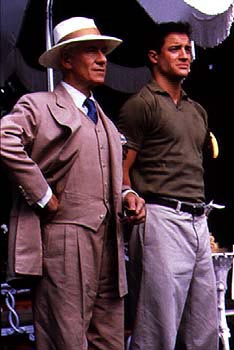
Cruel, maybe. But the film makes the mistake that a lot of us who "read" films does—it makes its assumptions out of things it already knows, and, once having made those assumptions, stops.* It does a fine job of recreating Whale's work making his "monster movies," specifically Frankenstein, the one that towers over them all. It's good that it at least brings into the light of day Whale's homosexuality and how it might have informed his work. But, just as his two "Frankenstein" movies overshadowed the rest of his career, Gods and Monsters seems to only concern itself with that aspect of Whale's life (much like the "film aficianado" that Whale grants an interview to, becomes disenchanted that his interest is in the horror films and so demands that he remove an article of clothing for every one of those questions). There's a lot more that the film either ignores or glosses over, in exchange for trumping up a story about a possible relationship that Whale (played by Ian McKellenmight have had with his gardener (Brendan Fraser), a result of which, Whale ended up drowning in his own swimming pool.  As such, it does as much a disservice to its subject as Hollywoodland does to George Reeves.
The fact of the matter is, both movies try to shoe-horn some psycho-babble and ginned-up rumor to try to explain the completely private act of suicide. We don't what what drove these two men to take their lives. We can only conjecture.  But, what was on their minds at those final moments can only be explained by the subjects themselves, and those critical thoughts are far more complicated for the sort of detective work that might easily solve "who stole Lady Penelope's diamonds?"**
There's more to Whale than Frankenstein. He was a prisoner of war during WWI, where he lived a kind of "King Rat" existence, accumulating a sizable amount of cash from his fellow prisoners in poker games. He was an "out" homosexual at a time when everything was "on the QT and very hush-hush." He lived in Hollywood very well, from some extremely good investments, and in a long-term relationship with one man, producer David Lewis. He directed for both film and stage, and among his other works are The Old Dark House, the Claude Rains version of The Invisible Man, and Show Boat, considered by many to be the best version, which one could argue simply because it contains the towering presence of Paul Robeson. But there's more, and much more. However, owing to the vagaries of box-office and the whims of fashion, not all of Whale's work is available to see. And so, it becomes no longer part of the equation in the matter of considering Whale, the artist. What we're left with is his best known, but not most typical, work. Frankenstein explains James Whale as much as "Rosebud" explains Citizen Kane. And that is, inadequately.
Gods and Monsters is, finally, dishonest. It serves up melodrama, for what is a more compelling, if depressing, truth. What this "Master of Horror" finally feared was a life out of his control, that he was no longer master of. And rather than face that fear of life unimaginable to him, he chose the fast way out. Not as compelling, maybe, as what Condon's film serves up, but, I think it would be truer to the source—and tie in better with the milieu it's obsessed with—if it was to make the point that Horror isn't cooked up in flashes of lightning and sparking laboratories.  It is far more commonplace. Horror can be Nature itself, as ordinary as illness and disease and frailty. It's a better message, I think. But try and get an audience to go see that.

* Look.  I do it, too.

** The best evidence, of course, was Whale's suicide note, which was kept secret for many years, and as Nature (and Hollywood) abhors a vacuum, that allowed for decades of speculation to become fact—or rather ill become it.  This is what Whale's final message read: 
"To ALL I LOVE,
"Do not grieve for me. My nerves are all shot and for the last year I have been in agony day and night—except when I sleep with sleeping pills—and any peace I have by day is when I am drugged by pills.
"I have had a wonderful life but it is over and my nerves get worse and I am afraid they will have to take me away. So please forgive me, all those I love and may God forgive me too, but I cannot bear the agony and it [is] best for everyone this way.
"The future is just old age and illness and pain. Goodbye and thank you for all your love. I must have peace and this is the only way.
"Jimmy"

--------------------------------------------------------------------------------------------------------------------------------

In my studio career, I've done lots of auditions. Lots and lots. We've had whole days where folks came in to read a part, or we'd ask agents to bring folks in we'd never seen before to see who was out there, and if they had some possibilities.

There was an open-call for the part of a kid for a video game company, and we were pretty shy of "young adult" voices, so we held an open casting. People would come in, take a look at the script, and then I'd record them for one or two "takes," say "Thanks! That was great!" (whether it was or not) and go on to the next one. Then, we'd take all the recordings and put them into a nice little collection and ship them out to the producer/director/writer who would do the casting. Sometimes, they'd ask for our recommendations. They'd at least inquire if there were any possibilities. This particular writer/producer/director (we'll call him "Bob") was also an actor, so we could talk about specific qualities that we were looking for in detail. In other words, we could "fine-tune" the search.

The day of the audition, actor after actor showed up to have their voice recorded so that Bob could hear what they might do with the material, and as with every audition they ran the gamut from possible to horrible. By two in the afternoon, there wasn't anybody I thought was any good. Oh, there were a couple we could "get by" with, but on the whole it was one of the worst casting sessions I'd ever had. I'd even go so far as to try and direct these people into a performance to little success. In fact, I'd just finished the worst audition of the day when a guy showed up--a late addition to the schedule. He was about six feet, carried a back-pack, it was obvious he came in right off the street. He apologized for seeming unprepared, said he'd just graduated from Cornish and his agent thought he should do some auditions. I said, "Great! Whatever!" And put him into the booth. Then I gave him the standard instructions I gave all the auditioners about the part and what the producers might be looking for. I wasn't expecting anything different than what had come before.

But, a great talent can come from anywhere.

Right off the bat, he was good, with an intensity and a commitment that nobody else gave to the role. Plus, his timing was terrific, making the most of lines that had only a bit of humor to them. And--this was amazing--he had a sense of subtext, like the character actually had a life before he started talking, and it informed what he was saying now. Very rare, and that put him head and tails above all the rest of the auditioners. In fact, when Bob asked me if there were any I'd recommend, I said "Just one." That guy. "In fact, I wouldn't consider anybody else." "He's that good?" "He's THAT good."

So, Bob hired him. He thought he might be a bit old for the part, but he said, "He knows how to make himself sound younger, so we'll see." He said he was very easy to direct, and did things in a very subtle way. He was very happy with the performance, and the project was completed.

But it was rejected by the game company.

"He's too old!" they said in their infinite wisdom. "We want someone 14 to 15. He sounds 18, youngest." So, Bob had to recast and do it again, which was too bad. But, the client is always right in these things. So, this guy who was so good ended up getting replaced in the project.

But everything turned out all right in the end. This guy, this young actor, who'd just graduated, got paid for the part, and went on to do "other things."

And the client got what they wanted, which was to get someone who skewed a little younger. I'm sure they've forgotten the incident, and that they rejected this guy. But if they tried to get him today, they couldn't touch him.

His name:
Brendan Fraser.

http://www.imdb.com/name/nm0000409/

http://www.brendanfraser.com/

http://en.wikipedia.org/wiki/Brendan_Fraser


Wednesday, August 1, 2018

The Hobbit: The Desolation of Smaug

Written at the time of the film's release...

Maintaining Good Working Hobbits
or
A Dense Overlay of Smaug

The second of Peter Jackson's three "Hobbit" films, The Hobbit: The Desolation of Smaug is, predictably, more of the same. It's a three hour ramble, a complication and a darkening of the tone of the first film—as usually happens with the second of a trilogy, so that we, the audience, can climb out of our emotional valley in time for the resolution of conflicts in the third. Standard Operating Procedure. We are given a quick recap of the first film—going back in time to when Gandalf the Gray (Ian McKellan) first put the idea into the head of Thorin Oakenshield (Richard Armitage) and getting the dwarf crusade rolling. Once the summary is done (in brief: Gold, Mountain, Dragon, Dead King, Arkenstone, New King, No Elves Allowed), they skip over An Unexpected Journey and head back to the Gandalf, Bilbo and the dwarves on the path to Lonely Mountain (Sindarin Erebor), orcs still snapping at their behinds and making their way to the entrance of Mirkwood.

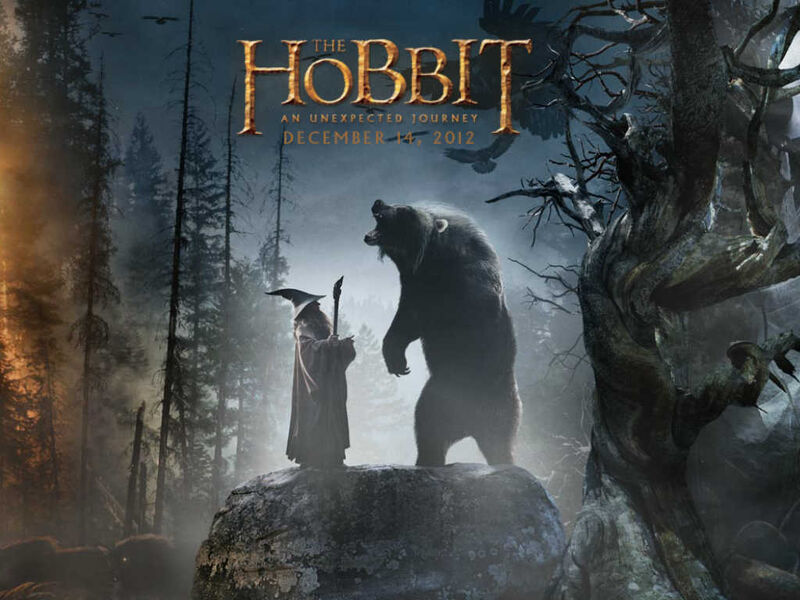
A quick visit to the skin-changer Beorn (Mikael Persbrandt), who usually appears in the form of a bear—not much is made of him, even though he got his own poster with Gandalf last time—and they get to Mirkwood (by pony), at which point Gandalf goes "walkabout"—he does this every movie and they probably split the story to accommodate a "Gandalf disappearance"—so the wee folk must enter the spooky forest alone, with a promise from the wizard that he'll meet them at "the Lookout."
"The Lookout"—he said he'd meet us; he should be easy to find...
Anyone familiar with the book knows that you don't find out where G.the G. goes until the last chapter, and that was after Tolkien had written "The Lord of the Rings" and got continuity-conscious. But, here, we do get to see where (hint: he went there LAST movie), and Jackson's The Lord of the Rings gets set up all good and proper (except Benedict Cumberbatch is voicing the character now—wonder if Jackson will Lucasize everything to make it all match up). The dwarves and hobbit are concerned with icky things and splendors that one would associate with a place called Mirkwood, and the ring that Bilbo snatched from Gollum is starting to exert its unholy influence turning the peaceful little guy into a berserker bad-ass. Travel packages with unruly companions and nasty accommodations with large pests and diffident natives will do that to anyone. But, Bilbo proves his worth on more than one occasion and eventually they do make it to the Halls of Lonely Mountain, a few shy of a full dwarve-deck and make their way to a meeting with the titular character that's been hoarding all the gold and keeping it for himself—the ultimate one percenter of Middle Earth.
Bilbo above the canopy of Mirkwood
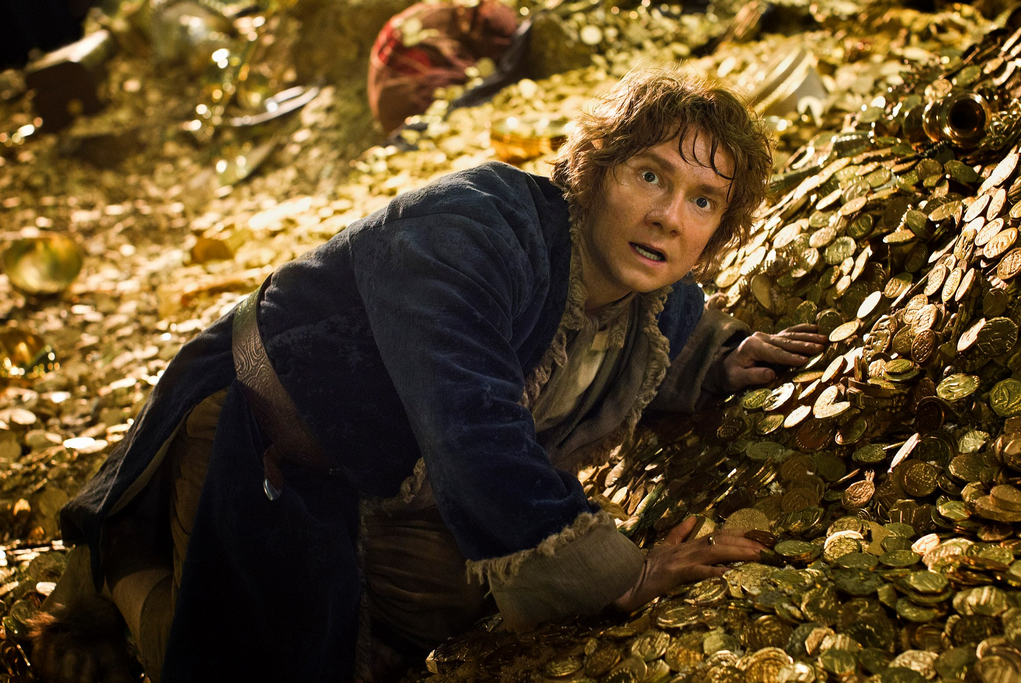
Smaug is the dragon, living in the massive storage caves of the Mountain, and he spends his time, far from desolate, sleeping among the gold and treasures of the dwarves like a big scaled, fire-breathing Scrooge McDuck. When Bilbo's attempts to find the Arkenstone awaken him, there is quite an extensive cat-and-mouse game as the small hobbit scurries around the cumbersome dragon. Or I should say Cumberbatch, as the ubiquitous actor provides a nicely arch resonant voice to Smaug, which is accompanied by a lip-curling animation to enhance it. This is where the film shines, as the territory is new, the imagineering of the dragon is fresh, and the surprises are many. After the previous two hours, that's a bit refreshing.
For if there's a problem with Peter Jackson's version of The Hobbit, it's that, by now, we are so familiar with the way he does things that nothing much really resonates anymore. The heavily belabored ripostes by the actors seem a bit too predictable—when Bilbo changes his story to Gandalf that he found his courage in the goblin caves last movie (rather than The Ring), there's a close-up of Gandalf as he says what half the audience is expecting: "You'll need it." Really, that one and "You should be" are certain candidates for Screenwriting 101 "easy irony" along with "You just don't get it, do you?" and "They're standing behind me, aren't they?"  
And the action sequences, this time assistant-directed by actor Andy Serkis. go on and on, in ever-increasing silliness. If last movie set a more rollicking, silly tone than The Lord of the Rings (in part by the influence of Guillermo del Toro), now the joke's wearing a little thin. Extended fights between orcs and elves are no longer thrilling, they're a demonstration of every possible way you can kill something with an arrow.  An extended rush down a rapids in barrels is accompanied by additional orc-elf fighting, where the barrels are used for any other purpose besides transport, as every tree-limb and branch over-hanging is used as a foot-hold. Some of this criticism isn't fair, because if this had been the first film in a trilogy of Tolkien adaptations, the marvels of the film would send people off a CGI cliff in amazement. It mustt take at least forty-five minutes to tumble down it, though.
One should, however, point out that the "we've been down this glade before" problem didn't occur with Jackson's earlier Tolkien trilogy, where there was enough material to keep things seeming fresh each film, and Jackson and his screenwriters did enough juggling of the narrative to keep things seeming new from film to film. Their attempts here amount to trying to add a romantic element between the elf warrior Tauriel (Evangeline Lily) and the dwarf Kili (Aidan Turner), much to the consternation of Legolas (Orlando Bloom, back in action). And while it provides a reprieve from tumbling and shooting and other too-frantic sequences, it does take away from the basic focus on the titular Bilbo Baggins (Martin Freeman) whose story this is. Freeman's performance is, again, terrific, bringing all sorts of fretting elements to play, and making the transformation of his hobbit into a killer more than a little disturbing.
The vistas are staggeringly rendered, but some short-changing has been done with the characters in action sequences—Orlando Bloom seems to be the chief character robbed of some pixels, here and there, and the attempt to de-age him to a younger self doesn't really work (I've never seen it done convincingly, so far). The only real surprises come in snatches of casting with Lee Pace, disappearing into the role of the elf Thronduil, Lily's elven warrior, and Stephen Fry's Master of Laketown. Be on the lookout for some Laketown spies and you might even find Stephen Colbert for a brief second. Oh, and Jackson gets his own "Hitchcock moment" out of the way very quickly.
Oh. And SPOILER ALERT there's another movie coming, so this one ends at a rather inopportune time. You only have to wait another year.
"Conversation with Smaug" drawn by J.R.R. Tolkien
"Conversation with Smaug" drawn by WETA

Wednesday, July 25, 2018

The Hobbit: An Unexpected Journey

Written at the time of the film's release.

Getting to Be a Hobbit With Me
or
There and Back Again...and Again...And A-GAIN.

Peter Jackson returns to Tolkien's Middle-Earth, the scene of his greatest triumphs as a film-maker. And it hasn't been easy for him. "The Lord of the Rings" trilogy took the film industry by storm, changing all sorts of accepted things, like "sittable" film length, production timetables (filming three films simultaneously), elaboration of production design, and whether a "fantasy" film can ever be taken seriously by the Oscar Academy for anything other than technical awards. In fact, when The Lord of the Rings: The Return of the King won Best Picture a few years back, more than one gossip-monger (or as they're known, "industry press") suggested it was for the entire series of films, rather than for the merits of the final one. I believe that. So, pressure immediately started to bring Tolkien's "The Hobbit" to the screen in as much the same way as possible, with Jackson producing and Guillermo del Toro directing, a good choice, actually (and the film benefits from his bizarre creature designs).  
But, "The Hobbit"'s past caught up with it, and the several (animated) versions of it came into play over who owned the film rights, and so The Hobbit: An Unexpected Journey has a complicated production titles sequence with Warner Brothers the (North American) distributor and New Line Cinema and M-G-M as the production facilities. M-G-M's financial troubles (now long forgotten in the wake of Skyfall's nearly billion dollar take) caused del Toro to drop out, leaving Jackson and his orc-army of New Zealanders to once again handle the short-duties for the assembled hobbitage.
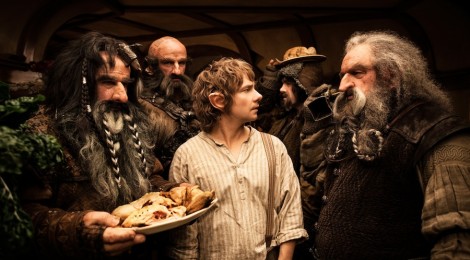
And how is it?  Much as you'd expect. It's as if they'd never stopped production on the first series, and so sure of the continuity are they, that the moments immediately preceding the start of The Fellowship of the Ring are presented, as if it was the easiest thing in the world to do. The film's been getting lukewarm reviews, and I can't can't quite fathom why. Nothing's really different. The supporting cast is uniformly the same (there's no Viggo, but Frodo is briefly there, and Martin Freeman takes over the role of the younger Bilbo Baggins in a way that seems to suggest a more spry Ian Holm with much faster and more comedic reaction-sense), but the main criticism seems to be a more leisurely pace. This, I don't mind. Jackson has always regretted not showing more of Hobbiton, which might have given "The Lord of the Rings" more of a sense of "home," and as something worth fighting for—a theme played in spades in TH:AUJ.*
Seeing as so much of it is set in the Hobbit's land, and that the cast is dominated by a baker's dozen of knock-about dwarves (see below for a guide) that have a propensity for one-liners and malapropisms, the tone is considerably lighter and larkier (and dare I say "precious") than the Doom-laden "Rings" trilogy, and it is only once the band of adventurers get going that things change to the previous series' denatured color schemes, brooding skies, ugly thuggery and general bad-assery ensuing.** The pace may be slower, but the film is considerably richer for all of that, and with so many characters in this arc, it's rather a luxury to get to know them before they are threatened in all sorts of ghastly ways.
The other issue with this Tolkien adaptation is technological. Films, since the frame-rate has been standardized, have traditionally been projected at twenty four frames per second, the estimated time that an image is retained by the eye. Now that film is mostly passé, the video standard is 30 frames per second, but it's largely an arbitrary rate to match the traditional film experience. During the late 70's, special effects wizard Douglas Trumbull offered up something he called "Showscan" which was 70mm film projected at 60 frames per second, which produced a larger, sharper image with less "streaking" of movement, due to the higher frame rate. I saw one of these "Showscans" at the Vancouver World's Fair and the effect was like watching a richer, more beautiful version of videotape. It was still film, with its photo-chemical reaction to light, but far more relatable to a "life-image" than film.
TH:AUJ is photographed digitally, but at a frame rate of 48 frames per second (what is being called HFR, or "Higher Frame Rate"), twice that of standard film, and in 3-D (to make what Jackson calls a more "immersive" film experience). The effect, once one has adjusted to it, is quite magical. Jackson doesn't try to do the 3-D tricks that Ang Lee does in Life of Pi, but the faster frame rate does improve the effect of things moving close by in 3-D; there is no longer the "stutter" effect, if something is moving by in the "near-field" at any rate of speed, which is something of a relief. And given that Jackson employs even more helicopter shots over New Zealand terrain here than in the "Rings" trilogy (as well as parallel swooping "crane" shots during the many sequences underground), that's a big help. Where it has its drawbacks are in some scenes that make the CGI characters look like toys figures, some of the impressive building constructs look like play-sets, and a slight mismatch of CGI (particularly during flying scenes) melded with terrain.
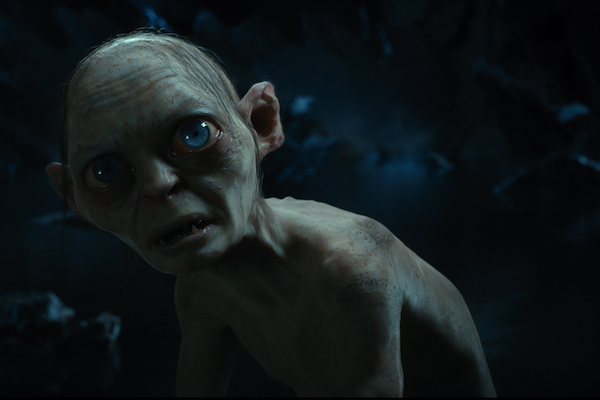
Still, it is hard to quibble when the image is so sharp, Jackson's color sense is eye-popping, and he still manages to keep a shimmering image through murky 3-D glasses. It doesn't look like videotape (as so many reviewers seem to think), as the lighting is more graded and subtle, but the movement recalls a better videotape image, and even something moving fast still has a better chance of being registered by the naked, or glasses-hampered, eye. It also allows the telling detail in even the CGI-est of images, like the moistness in Gollum's eyes, or the deep crags under Gandalf's. It is oddly transporting, and given the care that everyone has put into it, it's a very rewarding experience.

Wilhelm Scream Alert: at 02:05 and 02:35


Ya can't tell a dwarf from a halfling without a program.
* Thauj...sounds like a character name.

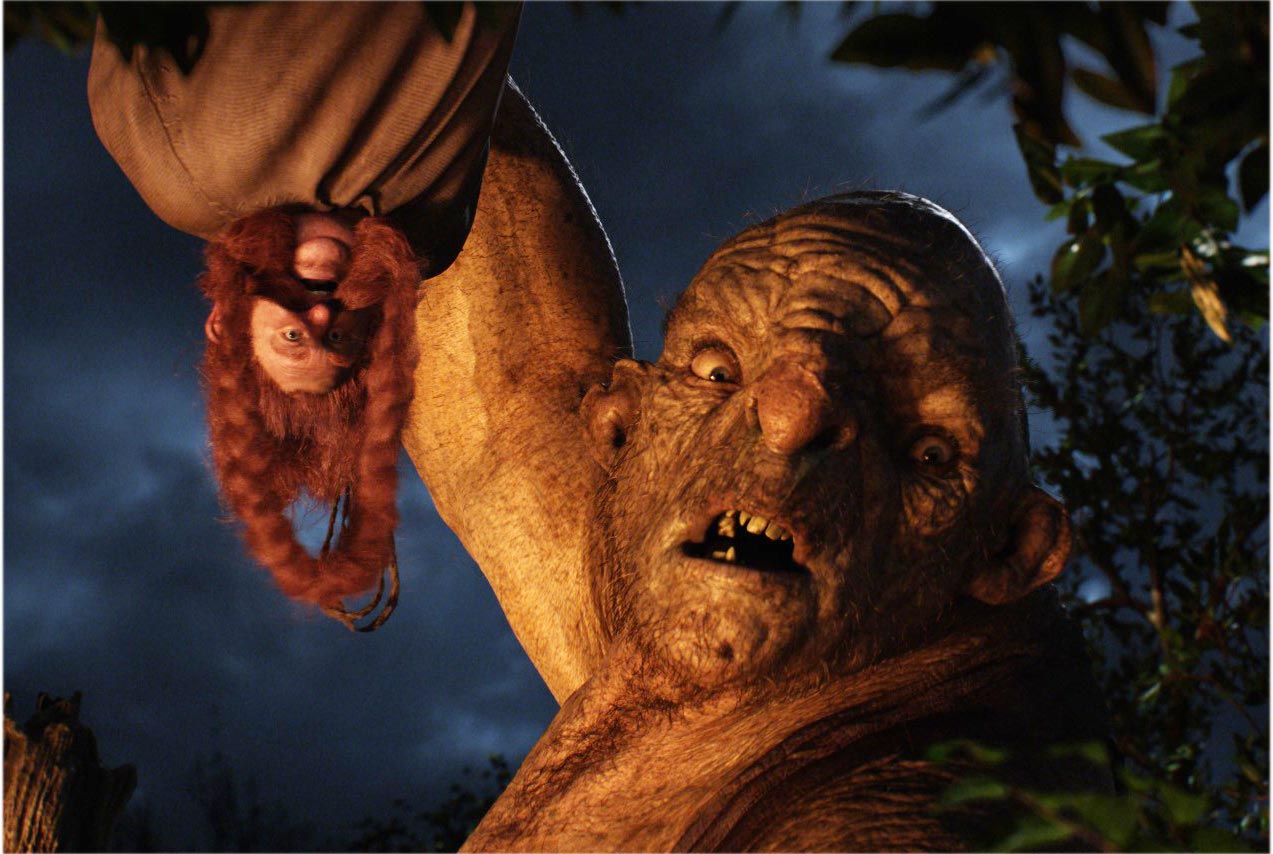
** Speaking of which, things have now approached and gone past the "Indiana Jones" threshold for physical believability here.  There's one particularly Rube Goldbergian sequence fighting trolls in an underground mine that strains credulity—but then, we're talking about a movie with dwarves, trolls, elves, ancient wizards, fire-breathing dragons, giant spiders, animated cliff-sides, and orcs riding big dogs.  That's enough to throw any griping fan-boys off their dyspepsia.  "Dude, this movie troll-kinged the bridge..."