Showing posts with label British. Show all posts

Thursday, April 24, 2025

Millions

Written, initially, when it was released on video. And recently expanded because it's so darned good and everybody needs a good movie every once in awhile...

Millions (Danny Boyle, 2004) "The French have said au revoir to the franc, the Germans have said auf wiedersehen to the mark, and the Portuguese have said...whatever to their thing."
 
"Now, it's our turn to say good-bye to sterling. This Christmas, we are going to get the euro. Good-bye, old pounds. Everyone says we're going to miss you."
 
It's 2002, and with the establishment of the European Union, the country-specific currency in the days of conflicting exchange rates was being replaced by the euro in 12 of the member states (although it's now in 20 of the 27 EU countries) as of the first of that year, all in the name of solidarity and globalization. Such a radical shift is the sort of thing to make great stories of, and this little parable (of a sorts) is a remarkable example of making a great story out of cultural change (and not just the monetary kind).
Director Danny Boyle begins Millions with a sun-dappled intro to a child's world, and a visit to the site of a new housing development, where our hero Damian (
Alex Etel) and his brother Anthony (Lewis McGibbon) imagine the building of their soon-to-be new home in fantastical stop-motion animation set to John Murphy's cooing Elfmanesque score.* One is instantly charmed, not only by the fairy-tale way in which the story is introduced, but also by the promise of what is to come. Anything is possible.
But, the sequence is interspersed with shots of impossibly propulsive trains, indicating—along with the house-building sequence that, in this child's world, things can move pretty fast.
Once, they've moved into their new home named appropriately "Serendipity" ("Surprisingly spacious with attractive views!" enthuses Anthony), it's off to school with them, where Anthony is better able to adapt than Damian who when he's asked if he has any heroes rattles off the names of saints (with whom he's obsessed) enthusiastically detailing their grisly fates to the horror of his fellow students (whose heroes are footballers).
But, their lives change when Damian imagines an audience with Clare of Assisi (1194 to 1253 and the patron saint of television...no, really) in his hermitage made of moving boxes taped together to form an ornate structure and its interrupted by the construction being crushed by a flying Nike bag filled with pound notes—£229,520 to be precise—which Damian assumes (naturally) that it came from God. His brother, Anthony, is far less deistic and thinks—maybe—it came from a passing train, but doesn't question it enough to see the opportunities implied. The kids stash the loot, vow to not tell their Dad, and Anthony begins to use it to gain friends at their new school to form a "posse."
But, Damian has other ideas (of course). Since the funds came from God, he starts to distribute it the way his idols, the saints, would. His first act is to buy a bunch of pigeons and release them, as per St. Francis (who dutifully shows up to give his approval and suggest that Damian use the money to help the poor). With aid from St. Nicholas, he leaves stuffs a lot of pound notes into the mail-slot of some neighboring Mormon missionaries (they needed a dish-washer and a microwave), the Ugandan Martyrs persuade Damian to give to a Christian charity that will provide wells to African villages (that one is so obvious and un-anonymous it gets him in trouble with his whole family and exposes the fact that he has the loot), then St. Peter comes by for a visit and tells him maybe he should slow down a little as miracles aren't always what they seem.
Damian with St. Francis (note the halo)
 
Meanwhile, there's all this money with a certifiable expiration date and two boys have to figure out how to use it while it's still valuable. Anthony starts to tour real estate "for investment opportunity." Damian comes to realize that even though giving to the poor is a really good idea "it's really hard" to do. Plus things get...complicated once Da knows there's all this money and then, there's the business of some guy nosing around the neighborhood looking like he's lost something really valuable. And Doyle maintains his penchant for keeping things visually fascinating and telling a story in unconventional ways, but still conveying what he absolutely means.
Millions is one of those ones I missed in the theater, and one I deeply regret for having missed it. It's a little gem of a movie Boyle made between his zombie-film 28 Days Later (which will be getting a sequel this year) and his sci-fi film Sunshine but sweeter than his usual fare, although—Doyle being Doyle—it does flirt with some dark material involving child jeopardy, but it ultimately has its sacred heart in the right place.
At one point St. Peter tells Damian: "Something that looks like a miracle turns out to be dead simple." Millions isn't dead simple, but it is something of a miracle.
 
It's a highly charming movie, while avoiding the usual cute kid cliches, and maintaining a quite sophisticated tone of drama and off-the-wall comedy. That was a trick even Disney found hard to pull off.** It gets a very high recommendation from me. 

* I was delighted to see that the score was performed by the Seattle Symphony Orchestra and The Northwest Boychoir and recorded at Studio X of my old stomping ground Bad Animals and recorded by old comrade Reed Ruddy. Nifty!
 
** This being what they are, and the film being originally produced by Fox Searchlight, it is now the property of The House of Mouse. 
Everybody watches "Who Wants to be a Millionaire" which is some sort of career-foreshadowing.

Thursday, March 27, 2025

The Detective (1954)

The Detective
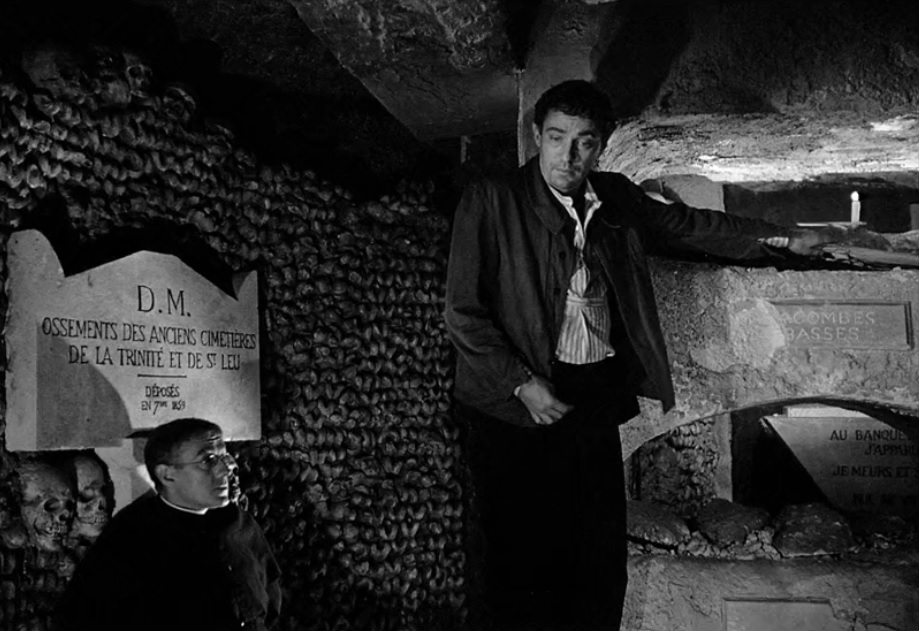
(aka Father Brown)(Robert Hamer, 1954) It's quite the scandal when Father Brown (Alec Guinness) is arrested by the local constabulary when he is caught in the act of "burglarious purposes" in front of an open safe. At police headquarters, the humble English vicker tries to explain that he was only trying to return the "swag" ("I believe that's what it's called—'swag'") for one of his parishioners (he admonishes him for being "an incompetent thief...clearly incapable of earning a dishonest living") whom he had convinced to forego a life of petty thievery and, in return, Brown would return the stolen good to the rightful place. That's when the police arrived.
 
A night in the hoosegow (which he finds "most interesting" and thanks the police for their "hospitality") and he's identified by the church authorities and sprung. So, of course, when he's hauled before the Bishop, he assumes it's for the arrest—he having a reputation in the diocese as "an odd one". But, it's of another matter entirely: it's seems that the Eucharistic Congress is soon to be held in Rome. And the Bishop has decided to send the Holy Cross of St. Augustine, which is twelve centuries old and currently resides in Father Brown's parish church. Father Brown considers the cross "not valuable...priceless," so he's alarmed when informed by a local Inspector than an "imminent criminal is intent to intercept the cross en route." The criminal's name is Gustav Flambeau* (Peter Finch) and Father Brown is only too aware of the master-thief's reputation—"a human chameleon" such an expert of disguise that no one knows what he looks like.
When Brown is informed of the precautions, the father-detective goes into a sort of distracted trance—in his mind, he's figured out three different way that the cross could be stolen. "So, if I, an amateur, can steal the cross in
three ways , one can only think what Flambeau will do!" Brown volunteers to take the cross himself—"one priest indistinguishable from hundreds carrying one cross undetectable from hundreds" But, the inspector and the Bishop are in agreement: they will have undercover men make their way to Rome in the hopes of intercepting the wiley thief. To Brown, this is "lunacy!" He makes his own arrangements to carry out his conception of a plan.
Now, as a recovering Catholic, I must confess that the closest I get to religion these days is through Father Brown, the sleuthing priest created by author G.K.Chesterton in 1910 (predating Agatha Christie's sleuths by a decade). I've watched the Mark Williams series, having seen nearly every episode, and read a few of the stories and have always found a kind of solace in the character's rock-solid faith and his unorthodox application of it when dealing with the near-occasion of sinners. He does not judge, believing not that people are good or evil, but merely people, and those that have strayed can always be moved on to the better path. He is not naive, or a cross-eyed optimist, but will argue that his faith is even more pertinent in a world where virtue is challenged. At one point in The Detective, he says: "
My son, you think that you are a man of the world and that I am not. But I assure you, my 'innocent' ears encounter every day stories of a horror that would make your sophisticated hair stand on end. Although I wear funny clothes, and have taken certain vows, I live far more in the world than you do." It's a world where his ability to pick locks, or judo-wrestle are useful tools, particularly when employed for good. He'll even pick a pocket (but only to prove a point when he returns the "swag").
When I found that there was a "Father Brown" movie, particularly to my delight that Alec Guinness played the part, I began an exhaustive search to find it. It took years, but it can now be found** And it exceeded my expectations. I've never been disappointed by a Guinness performance*** and his Brown is very much a sheep in wolfs clothing. He's as sharp as they come, if a bit idiosyncratic, and when called upon Guinness overplays the "twee" nature of Brown, his awkwardness hiding a quick-wittedness—although his humility will never allow him to admit it.
The Detective also has two of my favorite British performers: the ever-beguiling 
Joan Greenwood, (who'd starred with Guinness in a couple of his comedies) as one of Father Brown's more well-off parishioners and confidantes; and Bernard Lee (who would go on to play MI6 head "M" in the first 16 films of the Bond series) as an undercover police officer doggedly pursuing Flambeau, and who finds Brown's deft interference almost in itself criminal.
But, the surprise is Peter Finch as master-thief Flambeau. Up to this point, Finch could be rather stiff in his roles, but, here, he's light-hearted and charming, pulling off the character-work in disguise, and, when unmasked, giving off the air of a bon-vivant, quite happy in his mis-deeds. Guinness and he have a lot of dialog together and they spar winningly.
Based rather loosely on Chesterton's first Father Brown story "The Blue Cross," It's absolutely delightful and was well worth the wait.

* Interesting that they call him "Gustav" Flambeau as Chesterton gave him the christian name of "Hercule"—perhaps to not confuse him with Christie's Poirot, who debuted 10 years later—and the character is supposed to be French, and Gustav is considered a Swedish or German name.
 
** On the streaming service Tubi, but the Lord only knows how long it will remain there. 

*** Okay, there is one. It is Hitler: The Last Ten Days where I found his performance as The Führer rather dull. Time Magazine's critic said it was only useful in showing "the banality of evil." Curiously, IMDB says it's the only performance Guinness was completely happy with, having campaigned actively to play it.

Thursday, March 6, 2025

One of Our Aircraft is Missing

One of Our Aircraft is Missing
(The Archers, 1942) As dawn breaks at an RAF base, a squadron of planes comes back from a nighttime bombing run of a
Mercedes-Benz plant in Stuttgart. Apparently, the raid has been successful, except for one detail: Wellington bomber "B" for Bertie has not returned. It is presumed lost on the mission, possibly shot down, possibly the crew is lost.
 
One of Our Aircraft is Missing is a British propaganda film with a particular significance. Although it wasn't the first collaboration between director Michael Powell and producer-writer Emeric Pressburger, it is the first of their films that carries their particular partnering label: The Archers. Under that sobriquet, they would go on to produce some of the best British films in the 40's and 50's.
 
But, about that plane. About those pilots.
They were doing alright until they hit the Dutch coast. Leaflets were dropped over Cologne, then they headed to their primary target where they flew through some flak and then got hit, disabling their starboard engine. They navigate for a direct course home, get to Holland, but then the port engine kicks and they decide to bail out, the pilot, Haggard (Hugh Burden), stays with the plane as long as he can to try to guide it to the ground with doing as little damage as possible.
In the morning the crew gather together—the only one missing is Ashley (Emrys Jones) the wireless operator—and decide on their best course of action to get home without being detected by the occupying Germans. They are Haggard, his second pilot Earnshaw (Eric Portman), rear gunner Sir George Corbett (Godfrey Tearle), navigator Shelley (Hugh Williams), and front gunner Hickman (Bernard Miles).
Time being of the essence, they do their best to hide their parachutes and set off for the coast following the main rail-line; they hope that they can hook up with Ashley somewhere on the route.
As one of the crew can speak Dutch, an encounter with children (who show off their resistance pins) brings them to the nearest town where the local "schoolmarm" (who can speak English) sequesters them while she gathers the local townspeople to discuss what to do with these "drop-in's." Finally, the teacher named Else Merteens (Pamela Brown)
enters the room, suspiciously, and starts to grill them as to their identities and whether they can prove they're an English bomber crew and not some German "plants" trying to test their loyalties.
But, once they've proven their story, the village welcomes with open arms, with a sumptuous meal, offers of civilian clothes, even coordinated efforts to better hide their parachutes and smuggle them to the sea 15 km away. There then begins an elaborate ruse to "blend" the British pilots in with the townspeople to get them closer to the coast and once there, hopefully they can cross the Channel or alert their countrymen to pick them up.
It would seem like a grand spy story if it wasn't filled with quaint touches of the townspeople and their spirit of living under the shadow of the Nazis, feigning obedience with one hand and thumbing their noses with the other. One notable things, besides Powell and Pressburger's work, is the extraordinary cinematography of Ronald Neame (who, himself, would go on to direct such films as The Man Who Never Was, Tunes of Glory, The Horse's Mouth, The Prime of Miss Jean Brodie and The Poseidon Adventure), which has a good deal of verve to it, and, in latter stages of the film, turns moody and noirish. Also you should look out for the film debut of a skinny young character actor named Peter Ustinov, playing a Dutch priest. And (as if that weren't enough talent in the credits), the film is quite breezily edited by a young fellow named David Lean (who would go on to direct "some" films, himself).

Tuesday, December 17, 2024

A Canterbury Tale (1944)

A Canterbury Tale
(The Archers
, 1944) Directors Michael Powell and Emeric Pressburger (known collectively as "The Archers") begin their tale where Chaucer did in his "The Canterbury Tales" (their lines only slightly different in translation than the text):

WHEN APRIL with his showers sweet with fruit
The drought of March has pierced unto the root
And bathed each vein
  with liquor that has power
To generate therein and sire the flower;
When Zephyr also has, with his sweet breath,
Quickened again, in every holt and heath,
The tender shoots and buds, and the young sun
Into the Ram one half his course has run,
And many little birds make melody
That sleep through all the night with open eye
(So Nature pricks them on to ramp and rage)—
Then do folk long to go on pilgrimage,
And palmers to go seeking out strange strands,
To distant shrines well known in sundry lands.
And specially from every shire’s end
Of England they to Canterbury wend,
The holy blessed martyr there to seek
Who helped them when they lay so ill and weak.
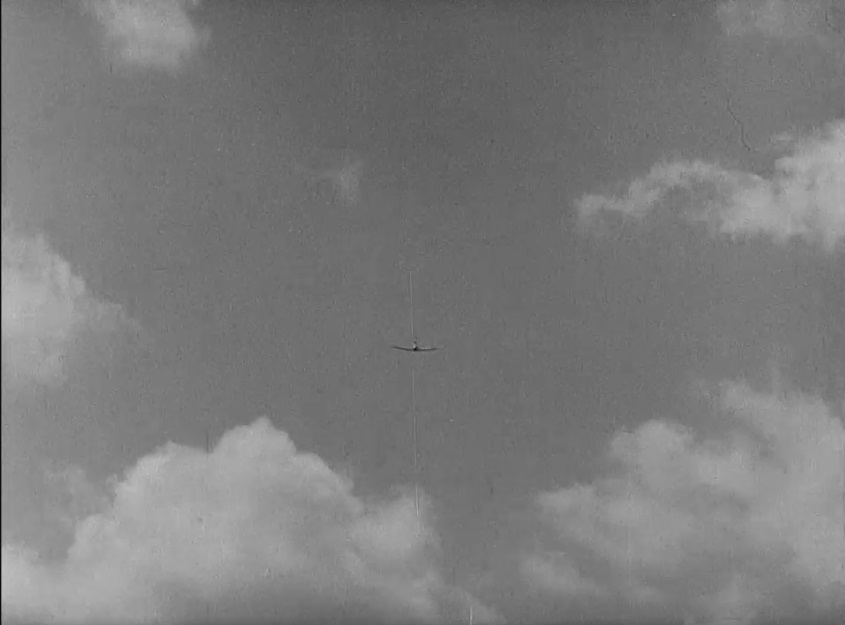
They're setting place, showing ancient maps, and then—at the appropriate verse—show us the pilgrimage as it was, with ox-carts and donkeys, and peasantry making their ways over the hills, then the close-up of a nobleman who sees a falcon high in flight. And—cut! (24 years before Kubrick did something similar)—the falcon is replaced by a fighter-plane that zooms towards us and over the head—cut!—of a British soldier circa 1944 who watches it (in the same frame composition and is probably the same actor, now in modern military dress) and the narration begins again...with another verse over landscapes not too far afield from what we saw before:


600 years have passed. What would they see, 
Dan Chaucer and his goodly company today? 
The hills and valleys are the same.
Gone are the forests since the enclosures came.
Hedgerows have sprung. The land is under plow, 
and orchards bloom with blossoms on the bow.
Sussex and Kent are like a garden fair,
but sheep still graze upon the ridges there.
The pilgrims still wends above the wield,
through wood and break and many a fertile field.
But, though so little has changed since Chaucer's day.
Another sort of pilgrim walks the way.
 
And a tank heaves into the frame and a line of those mechanized vehicles starts to wend its their own way along the pilgrim's trail on the way to Canterbury. As subtle and artistic as The Archers could be, they could also be brutal in how they juxtaposed for contrast, sometimes uncomfortably so, even for modern audiences thinking that sophistication can only be found in late-model movies. But, with A Canterbury Tale, the filmmakers linked the past and the present, while also acknowledging the omnipresence of change. For no matter whether its war or peace, or what happens to the landscape, the one constant are the pilgrims in need of hope and maybe a miracle.
Three people are in the town of Chillingbourne, Kent, a village on the train-track to Canterbury. Two are soldiers, one a Brit, one a Yank, and a "land-girl" who's taking part in helping farmers while men-folk are away to war. They are all "in-service" but beyond that they have nothing in common...except that they're stuck in Chillingbourne. They meet by happenstance when the Yank, Sgt. Bob Johnson (played by Sgt.
John Sweet, chosen for "authenticity" rather than, initially, Burgess Meredith) gets off the train too early being lurched awake by the conductor's announcement of "Next stop...Canterbury." He's a stranger in a strange land at the wrong stop in the middle of the night and he recruits help from the other two, Sgt. Peter Gibbs (Dennis Price) and Alison Smith (Sheila Sim) to find lodgings for the night.
One complication, however: while making their way through town to get their bearings, Alison is attacked from the shadows by a stranger who throws glue in her hair. Evidently, there's a lot of that going around as she's the eleventh victim of such an attack—she'll meet other such girls in her farm duties. While she goes through numerous shampooings to try to rinse out the gunk, Sgt. Johnson reports the attack to the local magistrate Thomas Colpepper (Eric Portman), who is curiously unmoved and suggests that women should not be out at night after a black-out curfew. After all, Canterbury itself has just been bombed by the Germans.
Johnson is convinced to stay the weekend and the three determine to investigate who the mysterious "glueman" in town could be. The town is full of potential suspects, clues abound, and it does help to take the minds off things like the war, one's part in it, and its consequences past and future. A little mystery can distract from things of great import, and yet, there's the countryside and its history and the current residents of that storied real estate, which managed to survive Kings, Queens, technologies and even the German war machine. Instead of being a mere stop-over, their encounters and walkabouts bring out a resonance and maybe even a communion with the past.
Bombed out buildings, but Canterbury remains untouched.

For, despite the distraction, these three are in need. Each is suffering a loss, a regret, a yearning that makes them incomplete, even as an indeterminate future threatens all of them. It may be coincidence that they are all there at that time and at that place, but without seeking it out—hell, they don't even know the history of it—for those acres and shrines to echo what they did in Chaucer's time for those who made their own pilgrimages in their time of need. It is Colpepper who clues them in to the storied land and serves as unofficial chaperone for the trio, and indirectly guides them to the path that they don't know they seek.
The Archers, of course, lean into Chaucer and the romance of the land and its past (and the value and benefit of the pastoral existence—which they would continue in the next year's I Know Where I'm Going!—Powell called these films their "anti-capitalist period"), but there's another influence, cinematically. A Canterbury Tale was made in 1944, 5 years after The Wizard of Oz and the story of strangers, bonded together, off on a heroes' quest traveling to a source for "reward or penance" is shared by both.  
Of course, Wizard is fantasy, a fairy tale. A Canterbury Tale is fanciful. But, both have rich denouements that strike the heart and do so in quite different ways. Even though all the characters in both stories realize their hearts' desires, they come to them not knowing what they do not know. Oz and Canterbury provide the realization of their dreams, but Canterbury has no definite ending (despite an American-bound re-edit by Powell that has more of a conclusion—fortunately, I saw the original British version), the last act is open-ended, with hope for the future, if an uncertain one.

A Canterbury Tale is one of the best movie experiences I've seen this year. It left me completely enchanted.

 * The story even shares the element that both sets of heroes have already possessed what they lack—they just don't know it yet.

Friday, November 8, 2024

I Know Where I'm Going!

I Know Where I'm Going!
(Michael Powell
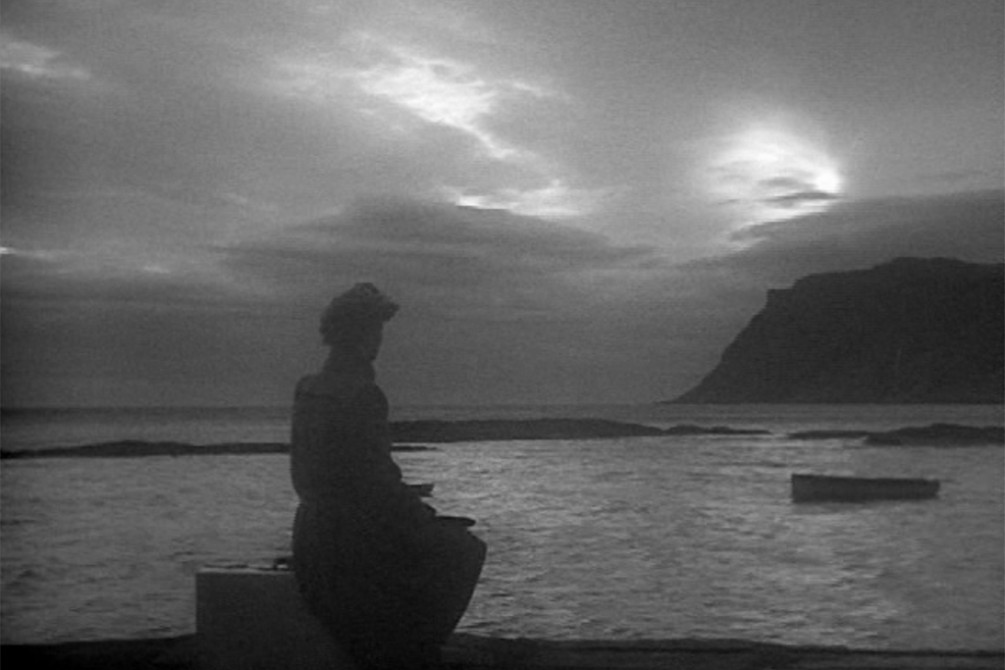
/Emeric Pressburger, 1945) Wendy Hiller stars as Joan Webster, a determined woman whose whole life has been planned out and played out according to her own well thought-out scenario. Now, she's traveling to the Scottish Highlands to marry her industrialist fianceé (head of Consolidated Chemical Industries) on the Island of Kiloran. But to get there—and become "Mrs. Consolidated Chemical Industries"—she must book boat passage from the Island of Mull. But Nature and Fate conspire to keep her Mulling and scuttle her schedule, while the cutely eccentric citizens cast a spell all their own.
 
By all accounts, it should never have been made. Powell and Pressburger were going to make A Matter of Live and Death for the Rank Organization after a request that they make a film that might help cement relationships between the British and Americans. But, the plan was to make A Matter of Life and Death partially in Technicolor (why "partially" is best explained by seeing the movie). But with all the Technicolor cameras being used by the American military for training films, The Archers (the company name of Powell and Pressburger) had to delay filming until they became available.
 
What to do in the meantime?
Pressburger knew that Powell loved spending his initial down-time after a movie by going to the Scottish islands and proposed a story about a woman who wanted to make a transit to an island but couldn't and by the time one's available she's made the decision that she no longer wants to go.
Pressburger wrote the story in a whirlwind four days, and Powell and he fine-tuned over a matter of a couple weeks. Initially to star Deborah Kerr and James Mason, The Archers had to navigate their own troubled waters as Kerr had a contract at M-G-M and couldn't get out of her commitment (either that or Powell and Pressburger didn't have the money—they certainly didn't!—to pay M-G-M to loan her out) and Mason didn't want to spend his days "camping out" with the crew in an out-of-the-way location. Wendy Hiller, whom Powell and Pressburger had wanted for The Life and Death of Colonel Blimp—her parts had been played instead by Kerr!—was signed and Roger Livesey was ultimately cast as one of the island's residents (ironically Livesey was doing a play in London and never went to the Hebrides locations, but did his part in the studio filming—Mason needn't have worried about the rough conditions).
For Powell and Pressburger, it was something of a lark, and allowed them to continue an anti-materialist theme that they'd started with their previous film, A Canterbury Tale, of the aesthetics of rural life, while also breaking their four-film streak of making war films. A whimsical love story was just what was needed. A whimsical love-story with a third-act action sequence where our heroes nearly drown in the
 Corryvreckan whirlpool, but a delightful one, nonetheless.
 
Powell and Pressburger create a film concoction with fantasy elements, surreal dream sequences and musical interludes, taking a straightforward story and applying an extremely creative approach to it. The story may seem overly familiar, but not the approach to it which keeps one watching intently to see not so much what will happen, but how. No less an expert as writer Raymond Chandler wrote of it: "I've never seen a picture which smelled of the wind and rain in quite this way nor one which so beautifully exploited the kind of scenery people actually live with, rather than the kind which is commercialised as a show place."
 
It's a lost little gem that shows what a creative force "The Archers", the team that made The Red Shoes, could be. Also, look for a short appearance by a child-actress named Petula Clark. Yup, that one.

Wednesday, September 25, 2024

The Critic (2023)

Critic, Critique Thyself
or
The Mystery of the Missing Curtain Call
 
To read online reviews, Anthony Quinn's mystery novel "The Curtain Call" is a cracking good read, set in 1936 London with a background in the theater-world amidst it's denizens, while at the same time being something of a manifesto on giving the downtrodden some agency. It sounds like it would make a great movie.
 
The Critic is the movie based on Quinn's book...and it isn't. A great movie, that is. I don't know what happened, but whole plots, characters, whole gists of the book have gone missing in the transition from print to screen and one can only wonder who the culprit is.
 
Or the why of it. But, someone has done a great crime to the book. And somebody's responsible.*
But, one shouldn't review what isn't there, one should review what is. What we've got is a character study with a little bit of blackmail/murder thrown in. Jimmy Erskine (
Ian McKellen) is a renowned theater critic for London's Daily Chronicle, known for his bitchy reviews scratched out with a poison pen (and typed up for submission by his assistant, played by Alfred Enoch). Jimmy relishes his job and his high-handed witticisms ("I do not enjoy the theater. I am the chief drama critic of the Chronicle!") and the perks of having his reserved seats at the theater and reserved table at the club, but his publisher, the Viscount David Brooke (Mark Strong)—having taken over the paper from his late father—has reservations of his own and would like Jimmy to "tone it down. More beauty. Less beast!"
Jimmy, though, has high standards—in everything but the "rough trade" he dabbles in—and between his lack of cooperation in kinder, gentler reviews and his frequent violation of the "morals clause" in his contract, he finds himself sacked. The Viscount has had enough of the paper's "old guard" and wants to bring in fresh blood. For Jimmy, being a pensioner is not enough to keep him in the decadent lifestyle that he's become accustomed to. So he hatches a plot.
One of the actors that he's been regularly slagging in his reviews is ingenue Nina Land (
Gemma Arterton), who is pretty and game, and wants nothing more than impress the Chronicle's drama critic—she's a fan of his taste and his writing—but one more bad notice from him and she has the pluck enough to confront the man (catching him trolling in a nearby park) and she makes her case through flattery and some implied blackmail, both of which impresses Jimmy. "There is art in you, Miss Land," he confides in her. "My disappointment is in your failure to access it." He decides then and there to take her under his wing and tutelage. She could be useful.
What he doesn't know is that Land is having an affair with the publisher's son-in-law, a portrait painter of some repute, and that complication makes things a little dicey for what Jimmy has in mind for his scheme to get his old job back. Trouble is, he's a critic, and having observed enough theater in his profession, one would think he would immediately spot a weak plot, even if it's of his own devising.
The Critic
premiered at the Toronto Film Festival last year and there was less buzz than murmuring, and so some tinkering and tailoring was done with re-shoots and another ending prepared and there's just enough dissonance in the film that the seams show. One can't fault the performers, all of whom do the job with McKellan deserving the lion's share of the praise for a performance so venal done with obvious relish.
But, it isn't enough. The plot's spread awfully thin and what's there is lingered over and emphasized, like the shot that director Anand Tucker keeps coming back to—an overhead shot that zeroes in right on the performer's forehead (to what purpose, you wonder, other than to show somebody thinking). And you wonder where it started to go south.
 
Any movie adaptation of a book should make you want to go to the source to get more of what drew you to the story in the first place. The Critic makes me want to read "Curtain Call" to see what it is I'm missing.

* Yeah, it sounds weird, but then, so is the source: Plan 9 from Outer Space, Ed Wood's notorious science-fiction opus once dubbed The Worst Film Ever Made. At one point, a detective discovers a corpse in a grave-yard and says (quite seriously) "But one thing's sure. Inspector Clay is dead, murdered, and somebody's responsible." 
 
Well, technically, that's three things, but you can't quibble with Plan 9, or you'll end up wasting your life.  As a matter of fact, it occurs to me that I don't have a post for Plan 9...yet. Well, Hallowe'en month is coming up...