Showing posts with label Gemma Arterton. Show all posts

Wednesday, September 25, 2024

The Critic (2023)

Critic, Critique Thyself
or
The Mystery of the Missing Curtain Call
 
To read online reviews, Anthony Quinn's mystery novel "The Curtain Call" is a cracking good read, set in 1936 London with a background in the theater-world amidst it's denizens, while at the same time being something of a manifesto on giving the downtrodden some agency. It sounds like it would make a great movie.
 
The Critic is the movie based on Quinn's book...and it isn't. A great movie, that is. I don't know what happened, but whole plots, characters, whole gists of the book have gone missing in the transition from print to screen and one can only wonder who the culprit is.
 
Or the why of it. But, someone has done a great crime to the book. And somebody's responsible.*
But, one shouldn't review what isn't there, one should review what is. What we've got is a character study with a little bit of blackmail/murder thrown in. Jimmy Erskine (
Ian McKellen) is a renowned theater critic for London's Daily Chronicle, known for his bitchy reviews scratched out with a poison pen (and typed up for submission by his assistant, played by Alfred Enoch). Jimmy relishes his job and his high-handed witticisms ("I do not enjoy the theater. I am the chief drama critic of the Chronicle!") and the perks of having his reserved seats at the theater and reserved table at the club, but his publisher, the Viscount David Brooke (Mark Strong)—having taken over the paper from his late father—has reservations of his own and would like Jimmy to "tone it down. More beauty. Less beast!"
Jimmy, though, has high standards—in everything but the "rough trade" he dabbles in—and between his lack of cooperation in kinder, gentler reviews and his frequent violation of the "morals clause" in his contract, he finds himself sacked. The Viscount has had enough of the paper's "old guard" and wants to bring in fresh blood. For Jimmy, being a pensioner is not enough to keep him in the decadent lifestyle that he's become accustomed to. So he hatches a plot.
One of the actors that he's been regularly slagging in his reviews is ingenue Nina Land (
Gemma Arterton), who is pretty and game, and wants nothing more than impress the Chronicle's drama critic—she's a fan of his taste and his writing—but one more bad notice from him and she has the pluck enough to confront the man (catching him trolling in a nearby park) and she makes her case through flattery and some implied blackmail, both of which impresses Jimmy. "There is art in you, Miss Land," he confides in her. "My disappointment is in your failure to access it." He decides then and there to take her under his wing and tutelage. She could be useful.
What he doesn't know is that Land is having an affair with the publisher's son-in-law, a portrait painter of some repute, and that complication makes things a little dicey for what Jimmy has in mind for his scheme to get his old job back. Trouble is, he's a critic, and having observed enough theater in his profession, one would think he would immediately spot a weak plot, even if it's of his own devising.
The Critic
premiered at the Toronto Film Festival last year and there was less buzz than murmuring, and so some tinkering and tailoring was done with re-shoots and another ending prepared and there's just enough dissonance in the film that the seams show. One can't fault the performers, all of whom do the job with McKellan deserving the lion's share of the praise for a performance so venal done with obvious relish.
But, it isn't enough. The plot's spread awfully thin and what's there is lingered over and emphasized, like the shot that director Anand Tucker keeps coming back to—an overhead shot that zeroes in right on the performer's forehead (to what purpose, you wonder, other than to show somebody thinking). And you wonder where it started to go south.
 
Any movie adaptation of a book should make you want to go to the source to get more of what drew you to the story in the first place. The Critic makes me want to read "Curtain Call" to see what it is I'm missing.

* Yeah, it sounds weird, but then, so is the source: Plan 9 from Outer Space, Ed Wood's notorious science-fiction opus once dubbed The Worst Film Ever Made. At one point, a detective discovers a corpse in a grave-yard and says (quite seriously) "But one thing's sure. Inspector Clay is dead, murdered, and somebody's responsible." 
 
Well, technically, that's three things, but you can't quibble with Plan 9, or you'll end up wasting your life.  As a matter of fact, it occurs to me that I don't have a post for Plan 9...yet. Well, Hallowe'en month is coming up...

Friday, December 24, 2021

The King's Man

Mannered Maketh Malarkey (Dulce et decorum est cogitare hanc pelliculam sugit)
or
The Prequel To End All Prequels
 
I wasn't a fan of Kingsman: The Secret Service, although I enjoyed most of the performances, particularly Taron Egerton's, I felt that it was pretty sloppy without much holding it together, although the satire was there and recognizable as such. It was meant to be a breezy jocular look at spy thrillers,  located somewhere in between the Bond Series and Austin Powers, hewing closer to the latter in terms of cleverness (or lack of it) and amping up the violence to the point that—despite containing the adage that "manners maketh man"—it became decidedly unmannerly.
 
One couldn't take it seriously and so any connection to a thriller goes right down the chute as the stakes are as high as they are in a "Looney Toons" cartoon. Samuel L. Jackson had it right in the first one by playing the arch-villain with a silly lisp, which has become his signature tic for showing he has no respect for the material he's playing—he certainly doesn't use it when hawking Capital One.
So outlandish actions and jolly good manners was the joke of the first two films, but director
Matthew Vaughn's latest, The King's Man—boasting original material from Vaughn and Karl Gajdusek (good villain name, that)—goes back in time to show the origins of the secretive Kingsman organization that bypasses political discussion and goes right for the jugular. Why this was thought necessary is anyone's guess, but I suspect—with another movie featuring Egerton in the works at the same time—they may be offering material that will relate to the next sequel. There are a couple of prominent names in cameo's and perhaps they'll be part of the next one.
The film concerns the exploits of Orlando Oxford (
Ralph Fiennes and bloody good, if seeming like he's in the wrong movie), the Duke of Oxford, who, at the time of the film's opening is a former war officer now working for the Red Cross and inspecting a concentration camp in South Africa in 1902. He is there to see General Herbert Kitchener (Charles Dance) about the deplorable conditions and talk strategy. In the course of the visit, the party comes under attack and Oxford's wife Emily (who encouraged Oxford's humanitarian duties) is killed before the eyes of Oxford—who has been wounded in the attack—and their young son Conrad. With her dying breath, Emily swears Oxford to "protect our son, protect him from this world, and never let him see war again."
When Conrad grows to the age of 17 (and embodied by
Harris Dickinson) is looking for a life of adventure, which his father vehemently opposes. He wants to join the Army when of age, but Oxford keeps him at home under the watchful eyes of associates Shola (Djimon Hounsou) and Polly (Gemma Arterton), who are crack spies and soldiers of fortune, but hide in plain sight as part of the Duke's staff. Presumably, it was so hard to hire good marksmen in that day. Oxford has good reason to be worried. Somewhere on an improbably high, flat and unscalable escarpment a group of terrible people are plotting to destroy the world and make money doing it. Headed by a Scottish separatist code-named The Shepherd, the group contains as members from around the globe including Grigori Rasputin (Rhys Ifans), Mata Hari (Valerie Pachner), Vladimir Lenin (August Diehl) and Gavrilo Princip (Joel Basman). 

Who? Well, I'll bet most audience-members don't know who Rasputin is, so don't feel bad. And I'm sure that a lot of them don't know the significance of Arch-Duke Ferdinand (played in the film—briefly, which is historically accurate, by Ron Cook).
Hell, ask the common man about World War I and you'll get a response like "World War II had a prequel?" or "Yeah, Wonder Woman was in it" Be that as it may, the group is trying to exacerbate the already bad relationship between three head-strong cousins, King George V (of England), Kaiser Wilhelm II (of Germany), and Tsar Nicholas II (of Russia), all played amusingly by Tom Hollander (bravo, sir!),* starting with the assassination of Arch-Duke Ferdinand, and the poisoning of Nicholas' son Alexei.
In his attempts to protect his son Oxford nearly gets him killed protecting the Arch-Duke and taking out Rasputin. But, then, this film has a habit of having people saying things and doing something that is contrary to their words. Oxford makes grand speeches about colonialism and imperialism and the exploitation of the indigenous people, but his comfort in his class and power has him being a very good example of all that. The only folks who seem to actually mean what they say are the villains, who are all so single-mindedly evil that they barely register as real characters—these were all very powerful and influential people and they're treated like puppets in this film's Grand Scheme.
But, at least they're consistent. The movie, on the other hand, careers between goofiness and sanctimony. Words are meant to be taken seriously, but the action sequences not so—deft (and unbelievable) as they are. Rasputin, Oxford, Conrad and Shola have a three-to-one duel set to Tchaikovsky's 1812 Overture, there's a weirdly impractical assault on that villain lair, and there's a World War I trench assault that, as completely unbelievable as it is, is still meant to be taken seriously if we're to have any feelings for the character.
It's a film of duplicity and two-facedness, delighting in "hilt-cams" and elaborate torpedo shots and a flash-zip of two years of World War I to see the the reduction of a hamlet town into a No Man's Land. Jeez, there's even an mustache to mustache edit in the thing. One starts to think that the film-makers are just so pleased with themselves and their own cleverness that they can do such little miracles that they don't see that the movie is clumsy and ham-fisted. So ham-fisted that the "surprise reveal" of "The Shepherd" is easily guessed just by the way shots are held unnecessarily before cutting away from them. Clever.
 
 
So clever it's stupid.
 
* Yes, it's true. Those heads of state were all related to each other (and you thought the Daniel Craig Bond movies were too in-bred!) No wonder the 20th century was so fucked up. And no wonder people wanted to do away with the Right of King's.

Thursday, November 5, 2015

The Craig's: Quantum of Solace

Cutting to the Chase
or
"Once More into the Cuisinart, Dear Friends"


When last we left James Bond, newly double-0'd agent On Her Majesty's Secret Service, he was nursing a broken heart and the betrayal by his lover, by the one way that he knew to ease the pain—shooting someone in the leg with an assault rifle.

After the success of
Casino Royale, the last complete James Bond novel not to be given an "official" film version, and the revival of the franchise with the casting of Daniel Craig, one had to wonder what the producers would do for an encore.


Or a sequel.
Quantum of Solace* takes place 30 minutes after the ending of Casino Royale, (in mid-car-chase) with Bond going "rogue" and seeking revenge.**
It's the first "true" sequel in the Bond series--all of them previously being stand-alone stories, where for budgetary or scheduling reasons, the secondary characters (like CIA agent Felix Leiter) would be played by different people from movie to movie.
Here, things are consistent: Jeffrey Wright again plays Leiter, Giancarlo Giannini returns as Rene Mathis as does Judi Dench as "M." And the mysterious Mr. White (Jesper Christensen), behind so much of Bond's troubles last film is in the rather bumpy custody of MI6, where he drops the news that there's a world-wide criminal organization that the Brits aren't even aware of, presumably the one financing the bombing of the Skyway jet, the funding of "freedom fighters," and high stakes poker games from the last film. Apparently these activities are so "under the radar" that the world's network of spies—and in this film even Bolivia has a Secret Service—hasn't noticed. But that is just a wild goose chase to Bond achieving that quantum of solace about the events of Casino Royale.
One could go on and on with the trivial aspects of QOS, but in broad strokes, one can answer the entreaties of those who couldn't wait for the next installment last time. No, it isn't as good as the last one; Casino Royale was one of the best film in the series (this is No. 22 of the "official" Bond films), even after the perspective of a couple years.

Does Bond find out the answers to the questions he's seeking? Yeah, for all the good it does us. We spend 95% going down a blind alley--at 90 miles an hour, with a shaking camera pointed aimlessly and an average edit length of half a second. More on that in a moment.

Does Daniel Craig take off his shirt? Yes, all too briefly for some, I'm sure.
The dialog is crisp and also very, very brief. The acting is uniformly good, with particular mention of Craig, Dench, and Giannini. Even the "Bond girls," traditionally where the Bond films fall down in the presentation category, can act: former model Olga Kurylenko is quite good, using a cat-walk scowl as the basis of her performance; and Gemma Arterton is pert, spunky...and sadly disposable. Mathieu Amalric--so good in The Diving Bell and the Butterfly--makes the most of his reptilian looks, as a sort of bug-eyed Roman Polanski.***
All well and good. The film feels like a less goofy version of the Roger Moore Bonds where outlandishness is the order of the day, but without the obvious winking. There are some lighter moments (and Craig makes the most of them) but most of it is played with deadly earnest. One expects to get lost in some details along the way by the orange light of the explosions. Indeed, two of the major players in this film are brought up and never mentioned again.****
But there is a major problem with Quantum... which dims the viewing experience, that being the slap-dash way that director Marc Forster and his second unit director Dan Bradley (who stunt coordinated the "Bourne" and last couple "Spiderman" movies) have staged and assembled the action sequences--and there are a lot of them--on land, sea, air, and fire, by foot and all manner of motorized vehicles. These sequences are nearly incomprehensible, with a rapid pace that does not allow the distinguishing of any participant or the context in which they're being done. A good action director allows the time to register surroundings and environment, and provides the context of relationship--who's doing what to whom and where. It's that information that provides suspense. Without that information, it's just fleeting images that don't add up—in other words, a trailer. 
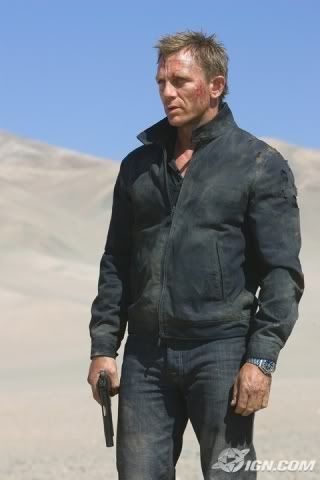
What Forster and Bradley may be trying to do is put the audience in the same dizzying, disoriented position as Bond, but even then, there are times when there isn't enough context to inspire alarm. At one point, in one of the hand to hand fights it becomes apparent that, suddenly, one of the combatants has acquired an axe. There was just enough time for me to register that perhaps the film would be better if it were edited with that. The shame is that a lot of work went into these sequences--QOS is the most expensive Bond film while simultaneously being the shortest--and a couple of marvelous shots that literally tumble along with Bond merely disorient, rather than thrill, as you're not allowed to see the original position from where these shots start. At the end of it all, you're left with a battered Bond but absolutely no idea how he got that way.
This is a major mis-step. These are suspense films, after all. But in pushing the envelope of how fast to take these action sequences, post-Bourne, the film-makers have reached the point where they are no longer telling a story, no longer communicating with the audience, at which point they've failed in their own mission.

I'm not even sure what is to be gained by seeing Quantum of Solace in a theater, even in the back row. The best way to get anything out of the action is to watch it at a slower speed on DVD.

Two of examples of the subliminal editing style of Quantum of Solace.


* The name is taken from a Fleming Bond short story in which Bond merely sits and listens to a tale of a marriage turned ruinous, and a "quantum of solace" is the smallest particle of comfort one can derive to keep it going. The only Bond titles left to be used are "Risico," "The Property of a Lady," "The Hildebrand Rarity," and "James Bond in New York," none of which is a "grabber" of a title, or would make a good song-title. But then, who thought you could do anything with Thunderball? Passing a reader-board for another theater en route to the Cinerama, it read simply "007."

** "What, he's gone 'rogue' again?" is what a friend said after seeing the trailer. Bond had already done something similar in the Timothy Dalton-starring Licence To Kill, which combined equal parts "Miami Vice," Yojimbo, and elements of the Fleming novel, "Live and Let Die."'

*** Director Marc Forster used directors Guillermo del Toro and Robert Rodriguez as voice-actors on this film, and the "director" connection applies to a henchman called "Elvis" who reminds one a bit of Quentin Tarantino. What with the "colorful" names of the villains, ala Reservoir Dogs and the producers' history with Tarantino—he famously announced to whatever ubiquitous press agency he uses that he wanted to make "Casino Royale" with Pierce Brosnan and griped about not getting the chance—it wouldn't be too far afield to think the Broccoli kids were getting annoyed with his whining enough to tweak him a bit.


**** I've since been told by one of the "Opening Night Regulars" I see the Bond's with, that a sequence resolving their stories (all one minute of it) was left on the cutting room floor, giving the producers a chance to start afresh next film, rather than continue with yet another sequel.
A still from the "lost" Quantum of Solace sequence.