Showing posts with label K. Show all posts

Wednesday, May 15, 2024

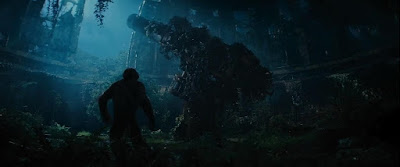
Kingdom of the Planet of the Apes

Noa's Character Arc
or
"Decency. Morality. Strength. Compassion."

"It's all in the eyes, isn't it?"
Laurence Olivier
Caesar is dead. Long live Caesar.

The new entry of the re-booted "Planet of the Apes" series continues with a fourth one, titled Kingdom of the Planet of the Apes. Taking place "many generations later" than the previous one, we're introduced to an entirely new set of characters and circumstances as Earth starts to adjust to the population upheavals of "The Simian Virus" (we've been told that only 1 in 500 humans were immune to the deadly virus, which came from developing a cure for Alzheimer's*). It has become apparent that the re-boot series has a slightly more ironic demise for mankind, choosing Good Intentions over Nuclear Stupidity. 

Another difference from the original series is that this time around (or in this Universe, if you want to get all science-fiction-y about it) the Apes filled a void left by Mankind's decimation. In the Apes series 1.0, another virus killed all dogs and cats, and apes became their replacements-and mankind being unkind-found them handy as slaves. All it took was the progeny of a time-traveling future ape couple to light the spark of revolution.**
Up to this point, the reboot series has been pretty binary...it was only apes and humans. The occasional horse, of course (of course), but the Planet of the Apes has, of late, been a poor example of bio-diversity. Kingdom changes that. Our first shot is of an eagle swooping down and snagging a fish out of a lake. And before anyone can suspect they're seeing a Planet of the Eagles movie, it swoops onto the waiting arm of an ape, just like Grub-hub. We are in the midst of the Eagle Clan, who have a neat little system of farming and hunting, while letting the eagles do the work. Not much conflict there, but it's a thriving self-sustaining community.
But, getting down to particulars, we then follow a trio of apes on a mission. Noa (
Owen Teague), Anaya (Travis Jeffery), and Soona (Lydia Peckham) are climbing their way up the sides of dilapidated skyscrapers hunting for unhatched eagle eggs. The next day is bonding day where they will be paired with their eagle hatchlings that will join them in the hunting/gathering expected of them. And it's the way of the Eagle Clan to claim an egg—leaving one in the nest for the perpetuation of the species in the wild—fighting off dizzying heights and outraged eagles to find that one egg that "sings to you."
All well and good, despite some complications. These chimpanzees are basically young adults, and they spook easily, given the stories told to them from their forefathers, particularly of creatures they call "Echoes" that (legend has it) live beyond the tunnel kilometers away from the village. Plus, they've been having trouble with "scavengers" who have been stealing crops and helping themselves to the fish in the smoke-house. Noa has a night-time confrontation with one, and in the struggle, his eagle egg gets crushed, and despite warnings from friends and his parents, he decides to make a last-minute excursion to get another egg before the ceremony starts.
And it's here that I have to stop any synopsis because the spoilers start coming pretty fast and loose 20 minutes into the movie. Things get complicated—in the way it's happened in quite a few Westerns—and Noa must go on a hero's quest that pretty much follows the Joseph Campbell playbook of the noble cause mixed with the righting of wrongs. At the same time, there are "echoes" of the past films that any history with the series, past or present, will recognize.***
How is it? Really good, in the way the previous three re-boot films have been very good (as opposed to Apes 1.0 that was a series of diminishing returns). And—as critic Glenn Kenney used the term in his review of Rise of the Planet of the Apes—it delivers a couple of genuine "Holy Shit!" moments. The art design is really impressive, showing a United States—specifically—that Nature has taken over. A couple apes will be riding horses in the foreground, and when they move enough that you can see where they've been, you goggle "Ohmigod! That's an airport!" (I had the same reaction to some of the scenes in Civil War recently). There's a nice depth to the imagining of an ape civilization done by the WETA wizards that says a lot about the society by the junk it keeps...and values. And the writers provide wonders a-plenty that you just know in your gut are going to be used as sequel fodder—they "sing to you."
And the acting in these things are always better than they have a right to be, given the obfuscation of masks or CGI face-grids, and Kingdom has a lot of talent on display despite the fact that you never see their faces and you wouldn't recognize them if you passed them on the street. There's something about their choice of how an ape will sound speaking English that's fun to experience. One of the actors (
Kevin Durand), playing a populist-leader-with-eyes-towards-dictatorship does a lovely spin that sounds remarkably like James Earl Jones. 
But, like Olivier said, "it's all in the eyes, isn't it?" Despite the overlay of CG, the expressions in the eyes always shine through, making a connection with audiences whatever the mood they're conveying. And given the encumbrances of the motion-capture suits the actors are forced to wear, that it all comes off seamlessly, and one just gets used to seeing the apes as characters, like any other biped. One becomes fascinated with the macro and the micro of the ape
It's quite extraordinary, really. And there are just enough threads for future stories that one wants to see what will evolve in future installments, keeping in mind that there is still a spaceship out there "lost in space" (that the San Francisco Chronicle paper headlined) on its way to Mars. Like the way-laid mission from the 1968 film, that ship should be coming down sometime—it was called "Icarus" after all. And one wonders what those astronauts will find when they get there.
Will ape and human be able to get along and co-exist peacefully? Will those astronauts find a better society than the one they left? The indications in Kingdom of the Planet of the Apes points to a negative answer. But the question is still intriguing.

* The development of this cure also radically increased the intelligence of our genetic first cousins...apes. Hence, their rapid rise in the food-chain.

** And talk about irony: those apes came to 1970's Earth using Charlton Heston's spaceship from the original movie, the one that took him to the future planet of the apes in the first place. You want to blame somebody for the planet going topsy turvy? Blame Heston!
 
*** At one point a character is given the name "Nova" and when asked why, the name-giver says "We always call them 'Nova.' I don't know why."

Thursday, March 21, 2024

Knox Goes Away

Schrödinger's Murderer
or
"Did You Bury This Guy?" "No. Why?" "'Cause If You Had, I'd've Dug Him Up and Killed Him Again."

Knox Goes Away is a lot better than people say it is.

Michael Keaton's second directed film—his first was the little seen The Merry Gentleman—is another pulpy film noir about a hit-man. The first (which Keaton basically took over when the original director was incapacitated) was more of a character study, contrasting its hired killer becoming something of a guardian angel to a woman in need of protection. But, as opposed to the first, this time director Keaton's fully committed and this one is more of a puzzle film, with Keaton's contract killer, John Knox, having to solve two problems simultaneously, both as them as personal as could be. 

It's not territory Knox is familiar with, as he's as cold as they come, not even wanting to know about the individuals he's hired to kill. He doesn't need a reason, as much as his partner Tom Muncie (Ray McKinnon), tries to justify the murders they've been hired to commit ("because in ten minutes, Tommy, he's not gonna be anybody"). He just does the job, cleans up the scene to avoid suspicion, then goes away. He's a bit of a ghost. The record has him ex-Army ("Deep Reconnaissance Officer") and he did a stretch for tax evasion (of all things) but, given his trade, it could have been a lot worse.
But, Knox is smart. He's extremely well-read—someone says he has 10,000 books in his house—majored in English Lit and History and he has the nickname of "Aristotle" that he got in the Army for always having a book in his hand. And he survives by his wits. His assets are all neatly tucked away, and he has few strings attached—he had a wife and kid, but they've been out of the picture since prison—except for co-workers, like Muncie, and "acquaintances" in the business. There's a hooker (
Joanna Kulig), who shows up like clockwork every week (Knox lends her books).
He survives by his wits. But, his first problem is they're starting to fail him. A visit to a neurologist and an E-ticket through an MRI gives him good news and bad news—he doesn't have Alzheimer's (as he feared), he has CJD—Creutzfeldt-Jakob Disease—which is worse. Statistically, 70% of people die within a year of diagnosis, but Knox has weeks, not months. The forgetfulness will increase, there'll be hallucinations, coordination issues, vision problems...then dementia, palsy, coma, then his brain will just stop making him breathe...The Big Erasure. "I'm sorry," the neurologist says lamely. "S'okay, Doc" says Knox. "Even if I hated you for telling me, I'd forget soon enough."
Knox keeps it quiet. He tells Muncie their upcoming job will be his last one—that he's "going away" (truer words...)— and then he'll start "putting his affairs in order" as the doctor recommended. But, that last job of his goes bad, he screws it up when he has "an episode", proving that he's not too good at this "death" business when it happens to take the lead. He makes due with the clean-up, for all the good it'll do, but it's botched and there's nothing he can do about it. The cops are gonna see through the inconsistencies and start looking around. He's losing it and he knows it. Now, he has to work fast.
Then, the other problem happens and it's one he can't ignore, as taxing as it is on his dwindling resources. In a way, it's a similar but more complicated scenario than the issues he had to just make-do with on the botch-job. But he has to get this one right. He cannot fail at this because it'll screw up everything else that he's planned in "putting his affairs in order." But, his disease will make the likelihood of screwing up that much more likely...and he has to be precise. He has to get it right.
So, he goes to an old contact in "the business," Xavier Crane (
Al Pacino, doing some of the most subtle work he's done in ages). Crane is retired (although he keeps reminding Knox "you know I'm a thief"), but Knox asks him a big solid: look at his plans, check them, make sure they're right...and, if they are, check in with Knox...daily...to make sure things are going on schedule and monitor Knox's condition. Crane becomes caretaker to Knox and his plan...and it's one the old pro doesn't take lightly.
I'm not saying anything about what Knox has to deal with—for one thing, it's really spoilery, and for another, it's a bit problematic—it's a little too convenient that it happens just at that time (one keeps expecting a twist that says the whole thing's a set-up but it doesn't), but one could, if being generous, explain it away using the "life's what happens when you're busy making other plans" trope. But, everything is so inextricably linked that it's actually far more resonant than if all Knox had to do was liquefy his assets and make sure that everything is "clean."
What Knox does in the ensuing couple of weeks will only reinforce one's confusion about his condition—what is he doing? Why is he doing that? Is he losing it? Truth be told, he is, but he's working on a scheme he came up with years ago...with an awful lot of last-minute improvisation. But, he's gotta do it without screwing up.
Meanwhile, on a parallel track, the cops—in the form of Detective Emily Ikari (Suzy Nakamura, who's so good) and her partner, Rale (John Hoogenakker)—are looking at how Knox "cleaned up" that last hit and it just isn't adding up as what Knox wanted it to look like. And they're starting to circle around Knox as the forensics start to come in, confirming their theories. It's just a matter of time, something Knox doesn't have.
Like I said, this one is better than people say it is. I don't know what the issue is—maybe it's too complicated for today's entertainment "journalists" or maybe a lot of the stuff just goes over people's heads, but it's a lovely exercise in how one deals with a "post-'Dateline'" world of micro-forensics, DNA research, cell-phones, and a security camera on every street corner. It's intricate without broad strokes and there are a lot of sly subtleties in the script, direction and acting.
Keaton's great in this, certainly as an actor, but—as he showed in setting up shots on The Merry Gentleman—he has a good eye for story-telling camera placements of a certain moody edge...without the burden of the "attention-getting" tricks that early directors fall prey to. I did have some issues with how he portrayed Knox's condition—it didn't seem like Alzheimer's to me—but then reading up on CJD with its dementia AND hallucinations, I could see what Keaton was going for. Marcia Gay Harden's in this and she's terrific as Knox's ex, James Marsden might be a tad too mercurial in his part (but he's supposed to be a hot-head) and Pacino plays his wizened mentor role with the former quiet intensity of his past. It's good to have that back.
I like it for its intricacies, its resonances, and the fatalism that should run through any good film-noir. And it is a film-noir, despite the sunshine and the surprising humor that runs through it (Nakamura's delivery, for example, is as dry as a bone). I'm thinking of one particular shot of Detective Ikari near the end that in contrast to the rest of the story shows what an uncaring Universe we inhabit, no matter our intentions and competence. That shot didn't need to be there, but Keaton kept it in, and it's heart-breaking given the rest of the film. That's noir, and this little film, slipping under the radar, manages to revive the form, staying true to its inherent world of cynicism, but seeming so triumphant.

Tuesday, November 28, 2023

The Killer (2023)

WWJWBD?
or
Skepticism is often mistaken for cynicism. (Suuuure, it is...)

Stick to your plan.
 
Anticipate. Don't improvise.
 
Trust no one.
 
Never yield an advantage.
 
Fight only the battle you're paid to fight.
 
Forbid empathy. Empathy is weakness. Weakness is vulnerability. 
 
Each and every step of the way ask yourself: what's in it for me? 
 
This is what it takes. 
 
What you must commit yourself to...if you want to succeed.

Simple.
 
It's the mantra by which the hired sniper (played by Michael Fassbender and unnamed except for some wildly amusing aliases on his I.D.'s and credit cards—he can't be accused of identity theft but might be in violation of the recent writer's strike) of David Fincher's The Killer (based on a graphic novel series by Alexis Nolent—ndp Matz—and Luc Jacamon) lives his life and dutifully repeats to himself after all the anticipation stops and he's actually required to pull a trigger—and only then, if his pulse-rate is hovering at 60.
It's the waiting that kills you. He keeps his body in shape with daily exercise, a light diet of protein—McDonald's...really?—and his mind focused with a steady stream of The Smiths and the aphorisms constantly scrolling through his head. 
 
He is in Paris, taking up temporary residence in an abandoned WeWork space across from a plush Paris penthouse that he constantly eyes for any sign of activity...or of a target. He's received an assignment, but the intended corpse is late. And this gun-man hates that. It's rude, for one thing. And if his intel is wrong about this, what else is off-track? Not that he knows anything about the target. He's not there to judge. "My process is purely logistical," he muses "narrowly focused by design. I'm not here to take sides. It's not my place to formulate any opinion. No one who can afford me, needs to waste time winning me to some cause. I serve no god, or country. I fly no flag. If I'm effective, it's because of one simple fact: I. Don't. Give. A. Fuck ."
But, he does, as far as the inefficiency goes. Cameras are everywhere. And though he purposely dresses as a German tourist to discourage any recognition...or interest...he can't help but think that his constant presence will gradually work against him, despite his M.O. of "redundancies, redundancies, and redundancies." On "Annie Oakley jobs" like this one, it's the details. "It only takes a few episodes of 'Dateline' to know there are countless ways to trip yourself up. If you can think of a dozen, you're a genius. I'm no genius." Later, he will get nostalgic: "When was my last, nice, quiet drowning?"
Maybe he should have waited until the guy got in the hotel pool. It wouldn't be a very interesting idea for a movie if everything went according to his plan. And little-by-little, that mantra becomes increasingly irrelevant and The Great Anticipator finds that he must improvise...a lot. The redundancies, redundancies, redundancies become complications, complications, complications. And, for once, he has to deal with the consequences as they hit closer to home. He finds it tough to be a target.
"I blame you...for having to bring my work home," he muses at one point. 
 
The Killer is fine, if you don't mind spend spending so much time with a conscienceless sociopath who has the advantage of never having to stick around for the aftermath—that's just something he never needs to calculate. But, when the tables turn and he actually has to give one of those fucks, there is no apparent empathy shift. He's still the coldly calculating death merchant with a penchant for pretense. And given his track record for playing sublimation and even mechanization, Fassbender is the perfect guy to play him. He's on-camera for most of the movie's running time, constantly in the sights of the view-finder and those types of marathons are tough to pull off. But, he does it with a seeming ease as the toughest thing his character can do is crack a smile.
Ultimately, it's a revenge movie—his clients don't like the outcome of the job he was hired for and so they go after him—and he has to methodically go up the chain, finding his contact, finding out his contacts, and taking them out one by one. He finds out "who", but the "why" is a bit of a mystery, unless you ascribe his own philosophy to their motivations:
"From the beginning of history, the few have always exploited the many. This is the cornerstone of civilization. The blood and mortar that binds all bricks. Whatever it takes, make sure you're one of the few, not one of the many." And so he goes about his business. Whatever it takes.
Fincher's direction is full of his feints and slights of hand—the time-transitions in a cut, the "impossible" shots (he did start out in special effects and he's in his wheel-house in a CGI-world—see the video below), all carefully controlled, composed and edited with a distinctive *snap* to them. It all looks simple, but what it takes to achieve that effect is extraordinarily complicated. That it's in service to another "revenge" plot is a bit disheartening. That it's something Fincher has wanted to make for years is more than a little depressing.
Fincher is such a craftsman, that he shouldn't be punching down. Maybe he had an extra commitment to Netflix for making Mank. Maybe he wanted to see if he could curb his instincts for budget and length and make something spare with both. Maybe the option to the graphic novel's film-rights were going to lapse. Or maybe this is his attempt to make a comedy ( although I've always considered Fincher's Fight Club more of a comedy) with its assassin who seems to have grown his habit for internal monologue watching "Dexter." Maybe it's his way of making a "John Wick" movie (why you'd want to, aside from the absurdity of it, escapes me). But, this is more This Gun For Hire than Le Samouraï.
 
If he was looking to make art, he was aiming a little low.
"Of those who like to put their faith in the inherent goodness of mankind,
 I have to ask, 'Based on what, exactly?'"


Saturday, May 20, 2023

King of Kong: A Fisful of Quarters

Saturday is traditionally "Take Out the Trash" Day...but not today. This one's actually fascinating. And I put it here because there will be posts this week that are tangentially related.

Not that anyone's keeping track.

Written at the time of the film's release...


The King of Kong: A Fistful of Quarters (Seth Gordon, 2007) Interesting little documentary about the sub-world of video-gamers and the clashing ego's of those trying to achieve high scores. It's also a bit like a real-life version of those Anthony Mann/James Stewart Westerns where a newcomer used to doing things his way comes up against an entrenched system with closely held beliefs that serve their own self-interests.

And, of course, those depend on a good villain, and they don't come better (or self-deluded) than
Billy Mitchell, the mulleted hot-sauce "king" who has everyone in his limited sphere convinced that he's a genius...when what he is...is very good at video-games. Mitchell has had the reputation since high-school, so it's about there where his maturity ended and he stopped to grow as a human being. Instead of conversation, he spouts vaguely threatening marketing bursts full of brio but without much substance to back himself up. You spend the movie wanting him to take a large fall.
Riding into town comes Steve Wiebe, an over-achiever who's had to contend with disappointment most of his life. Laid off from Boeing, he goes back to school for a Master's and passes time playing Donkey Kong, analyzing the patterns and achieving higher and higher scores. Until one day, he passes Mitchell's. You can't have a mano e mano match without a referee, and the story provides that with Walter Day,* self-styled arbiter of video-game high scores through his company, Twin Galaxies.
Wiebe submits a video-tape of his high-scoring game, but the tape is rejected as insufficient proof, amid speculation by Mitchell cronies that Wiebe's machine has been tampered with by an enemy of Mitchell's—these guys are the wimpiest of paranoiacs. So, to prove his point, Wiebe schleps all the way to the booming metropolis of
Laconia, New Hampshire to an arcade where a "live" play of the game can be witnessed and verified. Wiebe does it, but then Mitchell submits a tape (which appears to have glitches in it) of a higher-scoring game, which apparently he just had lying around in case of emergencies. That tape is accepted with no questions asked, and Wiebe becomes aware that he's not just fighting a pixelated Donkey Kong but a system rigged for the benefit of its own 800 lb gorilla.
It's fascinating to see so many "grown" men getting worked up over bragging rights of a video game, and how low they can sink in trying to get "their" way. The Mitchell drones are particularly pathetic, doing service to their dark lord so he doesn't have to make an appearance as witness, or risk anything. That one of them admits in interview (in front of Mitchell, who petulantly seethes silently) that Wiebe's a good guy and a good player is the only satisfaction one gets from the film...other than getting a chance to see this topsy-turvy little fiefdom of gaming.
After the film was released, there were protestations. Both Wiebe and Mitchell have said that they've actually competed before the doc was being filmed, and actually they get along great ("Hey, they're buds'!"), and the film was edited to make the story simpler (something the film-makers admit, and is, no doubt, absolutely true), but one comes away thinking one's seeing a lot of truth in the frame, despite not seeing all of what was recorded. You can manipulate a story with editing, certainly, but you can't make a person say anything they don't want to say on-camera.

Editing lies, but every picture tells a story.

Even though his actions belie it, even Mitchell admits to that in the film.

(And in the interest of public disclosure, I just played "Donkey Kong On-line," and scored 200, before thinking I was wasting my day—five minutes of it—and giving up.

* Day seems like a decent sort, trying to keep track of all the wimp/macho sniping, throwing himself in between the fights going on between ego-driven gamers. Guinness Book of Records recognizes him as an authority. Now, that is an accomplishment.

Wednesday, February 22, 2023

Knock at the Cabin

Tied-Up in NIMBY-land
or
What Would Jesus Do?
 
One approaches a new film by M. Night Shyamalan with a sort of dread, not the sort of dread he likes to weave in to the frame so that you have to "holster" your soda and popcorn, lest there be a jump-scare. No. It's the fear of the unknown...especially given Night's track record. Will this be one of "his" good ones? Or, will it all go (as they narrate in those TrueCrime TV shows) "horribly...horribly wrong."
 
If you haven't seen the trailers for Knock at the Cabin (they seemed omnipresent), it's pretty basic "Funny Games" kind of material, but played (I guess you could say) "straight". A gay couple, Eric (Jonathan Groff) and Andrew (Ben Aldridge) and their daughter Wen (Kristen Cui) are vacationing at an isolated cabin in the woods. Four people (Dave Bautista, Rupert Grint, Nikki Amuka-Bird, and Abby Quinn) come out of those woods, ask to be let in, and when they're refused, they break into the house, concuss one of the dads and overpower another one, tie them up, and then ask them to hear them out. They have something very important to say.
Leonard (Bautista) starts with a preamble: "If you could look inside, you'd see my heart is broken because of what I have to do."
 
Doesn't. Sound. Promising. As if tying them up was going to appeal to their sympathy.
Now, straight up, before we going into anything potentially spoilerific, let me say that Dave Bautista is the Most Valuable Player in this thing. Everybody is good in this, even—and particularly little Kristen Cui—but Bautista really sells the premise. He's done very well for himself in previous films, but his Leonard is what makes you believe in the absurdity of the whole concept. His man-mountain is in agony over the role he finds himself playing and makes you believe that he HAS to play it out or the consequences will be cataclysmic. Played any differently and Leonard would have come across as just another Q-ANON supporter shooting up a pizza parlor ("The intel on this wasn't 100%"). But, Bautista's sweating, haunted Leonard, his voice soothing and breaking has just enough weird anti-energy to make you keep watching, even as your better sense or Doubting Thomas is telling you "...wait...wait..."
"What he is about to do" is warn this family that there is an apocalypse coming.  "The cities will drown. A terrible plague will descend. The sky will fall like glass and God's fingers will scorch the Earth." 7 Billion people will perish. But, this family...this family...can prevent it. All they have to do is kill one of their family-members. And it'll stop. It will all stop. There's no "agenda" here. It's not because they're a "gay couple" with an adopted child. They're not on some "anti-woke" crusade. The four were brought to this cabin...because they all saw it in their "visions." They didn't see any people. They just saw the cabin in...their "visions."
Their "visions." And then they met on the internet. And compared stories. And realized...to their horror, mind you...that everything lined up, and they had to act to prevent Armageddon. So, if you wouldn't mind, decide which of you are going to die. Or everybody dies.
At this point, I began giggling. I knew what I would do. Question everything. I wouldn't care if they showed me the coasts flooding on CNN (which, by the way, they do), I'd think these people were total nutters and do everything in my power to overcome them before they did anything to my family.
But, I really began giggling when I started thinking "What Would Jesus Do?" and the answer was "where's the cross?" The Lamb would have a better scope on what was really happening, of course—whether it was really happening—he'd probably gotten The Memo. But, what do these two guys—who already feel a little persecuted in their daily life—do when confronted with this terrible choice? What would anybody do—if they weren't "bearing crosses" from Society—when confronted by this choice-that-would've-driven-Solomon crazy? I think they'd be very un-Christ-like. I think they'd want to see the stats on "the intel."
But, who knows, really? The oceans are rising—(which has been denied, but are YOU thinking of buying ocean-front property?)—and we just went through a plague (which has also been denied). Anybody can come up with reasons why they're so damned sure about not believing the pandemic, or not wearing masks, or saying nobody's landed on the Moon, or the Earth is flat, or Donald Trump won an election that (in reality) he didn't, and even be so potent about it, they would do things that a rational, thinking person would consider "crazy." You don't need to be a "shaman", you just need to hold a grudge. And ignore "Evidence."
So, this little movie. I wouldn't ascribe it as a "woke vs. bigot" argument (although I doubt Ron de Santis would watch it)—it's far too simplistic for that. But, I will note that the screenwriters—"Night" being one of them—changed the story (which featured something pretty grim, even for a movie about The Apocalypse) to tip the scales. Some might argue on the wrong side, but they're definitely tipped, perhaps to make it more a "Night" movie, but maybe more to put it squarely in the "ambiguous" category. Hitchcock did that once—in The Birds—and folks were ready to have him plucked for it, as audiences like to have things nice and neat and explained to them.
"The book did whaaaaaaa...?!"
 
But, I found myself leaving the theater with a grudging admiration for this movie for "going there," whatever its reasons.