Showing posts with label G. Show all posts

Thursday, February 6, 2025

Ghostlight

Ghostlight (Kelly O'Sullivan, Alex Thompson, 2024) Last Summer when Ghostlight opened I was "doing other things" but I'd heard about it from what seemed like every program on NPR doing a feature-story or interview about it. It had a compelling story and an interesting "hook"—the three actors playing a family in the film are an actual nuclear family.

That family is starting to become fissionable. A past family crisis has been buried by fiat and the after-shocks are starting to cause considerable damage. Daughter Daisy (Katherine Mallen Kupferer) is "acting up" at school and father Dan (Keith Kupferer) called from his work at a street-construction site for a parent-principal conference along with his wife Sharon (Tara Mallen), where things only escalate and Daisy gets suspended. This is just one more complication for a family that is barely holding things together, what with that previous tragedy and the pressures of a wrongful death lawsuit the family has brought against the family of their late son's girlfriend.
That, and things aren't going so well at the job; he's berated by a complete stranger (
Dolly De Leon) for all the noise that's disrupting the rehearsals of a small theater-group next to where he's jack-hammering. Holding everything in, one day he just snaps at a motorist who snaps his picture and he gets reported to his boss. He gets put on leave. That earlier complaining stranger asks if he wants to join the theater-group. "You looked like you needed the chance to be someone else for awhile" is the reason for her invitation.
Reluctantly, he does, even though it all looks a bit "woo-woo" to him. Everything is a little too "touchy-feely" and the actors are all into themselves. But, the breathing exercises are helpful, the camaraderie is pleasant, and the rehearsal room is a safe place, away from the "thousand natural shocks" that he's been contending with, outside of it. Plus, it gives him a place to go during the day without having to explain that he's been fired to his family. It never occurs to him that it's comforting because he's running away from the matters-at-hand.
But...maybe he feels he isn't. "The play's the thing", you see. It's "The Tragedy of Romeo and Juliet"—picked because that stranger from earlier, Rita, has always wanted to play Juliet...but, she's older now, and tiny...and Asian...and...she's never been given the chance. Because...all of that. This is her dream. And that dream gives all the actors a chance to think outside of the opportunities they've lost. To dream a little bit. to have the chance to grow a little bit beyond themselves.
But, Dan keeps getting stuck on the play. He fights it. He fights the idea of it...right down to its core. When pressed, he finally opens up. His son committed suicide and in a pact with his girlfriend, decided to take their own lives because she was moving...and Dan wouldn't let him move with her. He died. She lived. Hence, the lawsuit. Dan, in talking out his trouble dealing with the play, reveals things he's never revealed, lets things out that he's kept stoppered in, and the troupe in empathy and solidarity embrace him. It helps with the play. It hurts with everything else. But, the show must go on.
There's a lot to like about Ghostlight. The acting, in particular (and the film won awards for Best Actor for Kupferer and Best Director at the Seattle International Film Festival—it was nominated for Best Film and Katherine Mallen Kupferer was nominated for Best Actress—and the film was nominated for all sorts of awards throughout the festival circuit) and if there was any justice in the world Kupferer should be competing for the roles Jeff Daniels is regularly hired for now. He has the Daniels vibe with just a touch of George C. Scott's quality of a coiled fuse. He has one scene—his deposition monologue—that runs the gamut of emotions, and when he erupts in the middle of it, it sets you back on your heels. It's so good that I someday want to do a Sunday Scene of it (even though it'd be a nightmare to put together). He's that good.
I just wish it was in a better movie. And it's not that the movie is bad (it isn't), it's just that it's that most damning of words..."precious". Look, I understand the concept of theater being "therapy." I really do. But, it's a little too much for the screenplay to insist that performing in a play can solve the issues of revengeful grief. Especially as the movie suggests it can happen while ignoring the pressures (many of them psychological) of performance...even for a trained actor. It involves memorization, and concentration, and, with Shakespeare, it involves dealing with unfamiliar language and archaic references, which would be anxiety-inducing for anyone, let alone for a working-class guy off the streets, with no acting experience, on top of suppressed emotions, and who isn't even familiar with the play.
And, more importantly, "the play's the thing." Why does it have to be that play? Using "The Tragedy of Romeo and Juliet" as the vehicle for catharsis for this situation is so "on the nose", it's like hitting the nail with a sledge-hammer. It's like Lincoln being shot during a performance of "Julius Caesar." Somewhere in the process of conceiving this project, someone had to say "Oh, that's perfect."  But with, with all the concessions that were made in the fleshing out of the screenplay, nobody stopped to think that maybe it was a little too perfect. That it beggars the imagination. That even Shakespeare would have put down his quill and said (in Elizabethan terms, of course) "Well, maybe that's going a bit too far." 

Still, it's well played. And that's the thing.

Saturday, August 24, 2024

The Green Slime

Saturday is traditionally "Take Out the Trash" Day. We'll need an extra leak-proof liner for this one.

The Green Slime
(Kinji Fukasaku, 1968)  "The Green Slime ARE Coming?" Shouldn't that be "The Green Slime IS Coming?"
 
Well, believe me, the poster grammar is the least of this movie's problems. 
 
The Green Slime was an indirect follow-up to four low-budget Italian science fiction films* entailing a future Earth space station called Gamma One. The same models were used for the miniatures, but the station was re-christened Gamma Three, and the script and financing were provided by M-G-M in the U.S. The film was made in Japan, directed by Kinji Fukasaku with a Japanese crew and starring Western actors Robert Horton, Luciana Paluzzi and Richard Jaeckel, as well as control rooms full of ex-pat Western actors and U.S. military crew stationed in Japan. As the film was intended for international markets, they didn't bother doing sound recording while filming, so that everything—and I mean everything—was dubbed later on in a studio. It's just one of the things that gives the film a bizarre feeling of desperation.
Seems Earth has a problem: the asteroid Flora 80 is on a collision course with our planet and if it's allowed to hit it will create "an extinction-level" event. Ben Affleck not being born yet, and Robert Duvall unavailable trying to get James Caan on the Moon in Countdown, the Space Command sends Commander Jack Rankin (Horton) to Gamma Three to "blast the thing out of the sky" to which Rankin replies with a stalwart "thumbs up"—his go-to when he's trying to be positive.
When he gets to the station, he immediately shoves the station's in-command, Commander Vince Elliott (Jaeckel) out of rank, saying that until the asteroid's out of the way that he's in command of the station (dammit!) and anybody doesn't like it, well, there's the airlock outside over there. Vince sucks it up, this being an emergency and all...and because he's now involved with Rankin's old girlfriend, Dr. Lisa Benson (Paluzzi), who's in charge of "Medical" there on the station, so, hey Vince is "one-up" on Rankin.
Rankin, Elliott, and a team of technicians set off for the asteroid Flora, land and begin setting explosive charges to blast the thing out of the sky (as per orders), but inquisitive scientist Dr. Hans Halvorsen (
Ted Gunther) finds some green goo that he just finds fascinating and wants to take a sample to examine aboard the station ("New life" and all that...). But, Rankin, knowing full-well that they're sitting on a "ticking time-bomb" nixes any "shilly-shallying" from egg-head scientists and knocks the container out of Halvorsen's grasp. 
Yee-ahhh, about those command skills. Good instincts, but bad technique. The sample shatters and some of that glop falls on one of the crew's suits, allowing it to get onboard the station, where, because it feeds on energy (allowing it to survive on a rock in space, I suppose), the station's decontamination procedures only manages to feed it, and make it grow into big, bulbous, one eyed creatures with claw-arms (ELECTRICAL claw-arms!) that wouldn't have passed the laugh-test for the show-runner of the really early "Doctor Who" shows.
Of course, they need time to grow from their ooze-state, so much time is spent monitoring Flora blowing up, and having a celebratory soiree where the music ain't good and the dancing's even worse, but given enough of that 1960's movie staple, the gyrating posterior shot. And, it gives Rankin, Elliott and Benson a chance to spell out everything they already know about each other, and for Rankin to pull a dick-move and ask Benson for a slow-dance right in front of her current lover. Everybody's probably wondering how soon they can get this jerk off the station!
But, no such luck! Pretty soon, the lights start flickering, which can only mean one thing! The Power station! And something's wrong! They find the burned still-smoking corpse of one of the technicians and Benson displays her considerable medical knowledge by announcing "He's dead." But, no time for mourning yet, kids, because one of those bulbous Green-Slime things is just around a conduit and starts to whip those electric arms around, killing a bunch of anonymous guys with ray-guns and football helmets. The lasers can't kill it, and if the thing bleeds, it just makes more of them, so the best the station can do is try to isolate the things...except...they forget about the station's ventilating system. Pretty soon, the things are schlumpfing all over the station, even in the hospital.
Since the things eats energy, laser guns have little lasting effect, so the best alternative is right out of the Superman TV-Villain handbook: to throw something at it, like hospital beds (they use a lot of those, it seems to be the most effective weapon), or if your laser gun—which only makes them stronger, remember—jams or runs out of...laser, I suppose**...you can throw that at them, too. If it jams in their eye, it's quite effective, apparently.
I mock, of course, because there is no way one could confuse this with high art—this came out the same year, and from the same studio, as 2001: a Space Odyssey (which was intended to be "the proverbial good science-fiction movie")—and The Green Slime has all the hallmarks of the proverbial bad sci-fi flick—the antiseptic art design, the "best-we-can-do" special effects, the stentorian acting (to keep from laughing), and a sensibility that can best be described as—to use a highfalutin' word—"puerile."*** That means it would merely impress children...or the child-like. I'm way past that sell-date to be impressed.
There are some notable things about it however. It's one of the few screen credits of William Finger, who spent most of his life in obscurity writing for comic books. Obscure, except for one co-creation of great significance for which he was denied credit for decades (until recently, that is). Bill Finger, along with artist Bob Kane, co-created the character of "Batman." That Batman. He wrote a lot of the defining stories of the Batman character (as well as co-creating Robin, Alfred, and quite a few of the major villains) from its origins in 1939 through to the 1960's. At least, he got credit for The Green Slime.
The director, Kinji Fukasaku, had been directing for seven years and really wasn't a slouch and was quite highly regarded. In fact, the next year, he replaced Akira Kurosawa (!!) as the director of the Japanese sequences of Tora! Tora! Tora! (!!!) and in 2000, he would write and direct a genuine classic, Battle Royale, which, whether directly or indirectly, served as inspiration for "The Hunger Games" series.
Another amazing fact and landmark about it is this: The Green Slime was the first movie skewered on "Mystery Science Theater 3000", serving as the show's pilot episode. If, for nothing else (okay...for nothing else), it has some significance.

* The first of the series was Wild, Wild Planet...or as it's known in Italy, I Criminali Della Galassia ("Criminals of the Galaxy").

** Or..maybe...the animator who draws the laser beams runs out of ink. 
 
*** See what passes for women's fashion in these things—short skirts, tight, shimmery fabrics, nothing you'd want to wear.  
 
Yeah. No. No, really.
 

Tuesday, July 9, 2024

Pom Wonderful Presents: The Greatest Movie Ever Sold

Written at the time of the film's release.
 
Filmmaker Morgan Spurlock passed away May 23, 2024 at the age of 53.

"False Advertising"
or
 "Oh, Trailers are Commercials, too, Ya Know...and Movies are Products"
 
Is it a surprise to anyone that product placement is so prevalent in films?  With budgets bursting (the next "Batman" movie will cost 250 million dollars), movies turned to corporations to have them co-finance their films by making sure their products were featured prominently with labels out.  It's a form of advertising that is the basics of making your product known—get it in front of eyeballs. Each image of your product burned into a cornea is called an "impression"—an impression that builds familiarity and is a push to induce the buying of it. And if those eyeballs are lid-locked while watching a movie at your local cine-plex (heck, you even paid to see it!), so much the better—there's no chance you'll be going to the 'fridge to miss the "message." E.T. famously ate Reese's Pieces because M&M's passed on a movie deal. The little sugar-nodules sales soared. Every James Bond film bristles with banners—billboards are crashed into, every electronic monitor had to include the "Sony" name, and car companies supply the cars and fill them with cash—you didn't think all those disposable Aston Martins came without gratuity, did you?*
Fact is, your basic present day blockbuster couldn't be made without a recognizable label turned towards the camera. And if there was a way for historical epics to put "Budweiser" on the Mead-sacks and "Wilson" on the cross-bows they'd do that, too
.**
Even independent films do so...as Everything Must Go and its ubiquitous cans of Pabst Blue Ribbon attests. You can argue that it is for 
verisimilitude, but I doubt the studios would care how much their films resembled The Real Consumer World if there wasn't some cash passed under the table.


Morgan Spurlock has taken the approach to the logical extreme: his Pom Wonderful Presents: The Greatest Movie Ever Sold is a documentary about product placement in films that explores the process while simultaneously exploiting it to completely fund itself. It's a film of the corporate interests, by the corporate interests and (however cynically he might have gone into the thing) for the corporate interests. The entire movie about product placement in the movies is about acquiring the product placements to fund the movie.
It is a little bit brilliant. Essentially, he walks into boardrooms with a video camera recording the whole process just to say "this is what you're buying...right now.  How much are you going to give me?" Name above the title goes for a cool million. Sporadic Spurlock ads (there are three) go for 50 grand. In addition, he is able to secure helpful "aids to production"—hotel rooms, gas, even a fleet of seven cars—if he can ink a deal to make sure that they are shown in the film...and they are. Interviews are conducted in gas station cafes, drinking the advertisers products—even the shoes-leather that Spurlock burns to hit the pavement to meetings is paid for. Not only that, he makes deals for promotional cups that promote his movie and his clients.
There are so many hands washing each other that you almost expect a cameo by Howard Hughes. But who he gets to talk about movie-marketing is good enough.  Industry insiders talk about the business of branding (Spurlock turns out to be "Mindful"/"Playful"), increasing opportunities, testing the efficacy of the images (through MRI brain-scans—even the trailer is tested on Spurlock to see how his brain reacts).
Experts on societal influence (Noam Chomsky) and consumer protection (Ralph Nader...at his relaxed puckiest), advertising (Bob Garfield from NPR's "On the Media" and Advertising Age's Robert Weisberg), discuss the dangers of dealing with the devil and mixed messages. A fascinating clutch of interviews with film-makers seems to gloss over the impact and influence that corporatization has on the movie decision-making: John Wells (seen editing Company Men), J.J. Abrams, Brett Ratner, Peter Berg and Quentin Tarantino weigh in on how it affects their process—Rattner is alarmingly blase ("Artistic integrity?  Whatever..."***) while Berg is pragmatic ("GE is my boss and they don't give a fuck about Art") and Tarantino chortles over how, for years, he's pushed to shoot his restaurant scenes at a Denny's (he loves Denny's), but is constantly rebuffed (still, he's done a lot for the European McDonald's market). Even an amused Donald Trump shows up—probably a little miffed that he didn't come up with Spurlock's scam.
Pretty soon, it becomes apparent that the whole thing is a perpetual motion money-pushing machine and that money buys a lot of movie-magic. What is most disturbing is the offers Spurlock gets, unbidden, once he proves he's willing to play ball in an advertiser's field. "How do you say 'No' to that?" he painfully asks at one offer.


As I said, it's all a little bit brilliant. He delivers his message while they deliver the goods. If there is a down-side to Pom Wonderful Presents: The Greatest Movie Ever Sold, it is that there is so much to say, so many Madison Avenues to explore that the film rather breezily loses its focus. But, one should expect that when traversing a slippery slope, no matter what kind of shoes you're wearing.

I was the only one in the theater watching this (a shame, really), but as I was exiting the theater, I was flagged by the ticket-taker—a woman I've had a jocular joshing relationship with at my local art-house. She handed me a complimentary chilled bottle of Pom Wonderful pomegranate juice for watching the movie. I laughed all the way to the car.
 
I didn't drink it because I didn't take it.
 
* Yes, Bond DID drive an Aston in the novel "Goldfinger," and the movie's gadget-weighted DB5 became "the most famous car in the world," but Ford also provided their prototype Mustang for the '64 film, which made that new model a hot seller.  Sony and MGM plan to get $45 million for product placement in the next Bond—an all-time record.

** The biggest scam for blatant advertising is MTV. When it started, it was the first 24 hour TV station broadcasting only commercials—those "promotional" videos made to promote record sales.  Now, the videos are more popular than the recordings themselves.  Nothing succeeds like excess.

 *** How dare he?  Now, if you'll excuse me, I've got to go see Disney's Pirates of the Caribbean: On Stranger Tides—the fourth movie inspired by a Disneyland ride.

Friday, January 5, 2024

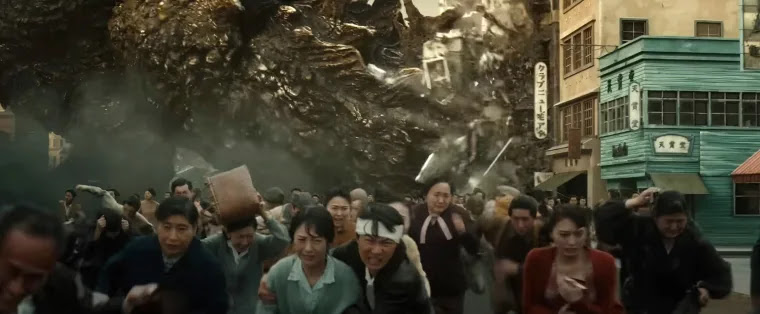
Godzilla Minus One

Banzai, Toho!
or
Kurosawa's Post-War Giant Lizard Movie
 
Kamikazi pilot Kōichi Shikishima (Ryunosuke Kamiki) does something very unusual for a pilot of his duty. He lands his bomber on Odo Island for repairs at the remote Navy Air Service base. But, there's nothing to repair. The lead mechanic Tachibana (Munetaka Aoki) diplomatically approaches the pilot, telling him that he could find nothing apparently wrong with the plane. "What are you implying?" Shikishima replies defensively. "I'm on your side," deflects Tachibana. "You landed this bucket of bolts on this swiss-cheese of a runway. We need more people like you. Why 'die honorably?'" But, Shikishima only feels shame and regret—his very existence is evidence of his cowardice and his turning back on his duty. He is in an existential nightmare.
 
But, it will only get worse. 
 
Shikishima has noticed some usually-deep-water fish dead on the surface waters surrounding Odo Island. It's an odd mystery until it gets dark. Then a roar erupts from the waves and an out-sized dinosaur creature lumbers onto the beach and quickly takes out a reconnaissance tower "Godzilla" one of the mechanics murmurs. "What is it?" Shikishima asks in terror.
 
"Nobody knows."
And, ultimately, it doesn't matter. Shikishima will sneak to his plane, but when he has the creature in his sights, he freezes, causing a panicking technician to prematurely...and ineffectually...fire his rifle, attracting the beast's attention and provoking an attack. Shikishima runs from the plane just as Godzilla stomps on it, exploding the plane and knocking Shikishima out. When he recovers, all save for Tachibana are dead, and he accuses the pilot of cowardice, blaming the deaths on him, and vindictively giving him a packet of the dead engineers' photographs as a reminder of his weakness.
Ultimately, Shikishima returns home to Tokyo after the war, only to find it in ruins from U.S. fire-bombing, his parents dead, and his reputation as a kamikazi in tatters and himself a symbol of scorn. He does not argue, he does not fight back, as he is in utter agreement with the sentiment. He has failed in what he sees as his duty twice and his survivor's guilt is near crippling. It becomes a matter of survival, and refugees are trying to scratch out a living any way they can under U.S. occupation. It's how the young pilot becomes the care-taker of a beggar-woman, Noriko Oishi (
Minami Hamabe) and the orphan-child Akiko that she has promised its dying mother to raise. But, he sees his role as merely charitable: there is no romance between Kōichi and Noriko as he does not think he deserves such happiness, nor would he disgrace Noriko by becoming her husband. For him, the war is not over. It may never be. It lives with him still.
But, he needs a job. He takes one clearing the Sea of Japan of American and Japanese mines on a "specially made" ship—which turns out to be a converted wooden fishing vessel, the Shinsei Maru—the wooden structure won't attack magnetic mines, and he finds his gunnery experience useful in detonating the cut mines. With him are the ship's captain
Yōji Akitsu (Kuranosuke Sasaki), Shirō Mizushima (Yuki Yamada), and former Naval engineer Kenji Noda (Hidetaka Yoshioka) and the crew form a bond, albeit a cynical one in their work of destroying the two nation's defenses.
Unbeknownst to them, the U.S. is doing further tests of the nuclear capabilities that brought Japan to its knees, and, with the war over, they're testing them on islands in the Pacific. The consequences will be far more than merely obliterating an island.
This is the 70th Anniversary of the first Godzilla movie, and we should all look this good at that age. In fact, when I heard scuttlebutt that
Godzilla Minus One was quite good, it went on my short-list of movies that had to be seen. Not only did it not disappoint, it is surprising how good and accomplished it is, how mature, and downright clever. It is a master-stroke that combines the kaiju tradition of Japanese monster movies with the sensibilities of the early Akiro Kurosawa post-war films filled with defeatist angst and finding the hope and courage to rise above it.

How do they do it? It's something they should have done from the beginning—move the super-imposed people at the bottom of the screen fleeing Godzilla's toes and moving them center-screen. Rather than the scientific and military perfunctories that usually do the exposition in the films, Godzilla Minus One takes to the victims of the attacks, makes their struggles real and relatable, and then "mess" with them until the audience can't take it anymore. In Godzilla Minus One, the government—such as it is—is absent, more concerned with not spreading a panic than saving lives ("Information control is Japan's specialty" says one of the heroes), and the U.S., concerned with arming the Japanese so soon after the war, and with Russia monitoring their actions in the Pacific, take no action at all. Except we send some decommissioned war-ships (we're good at that).
It's up to an already-beaten-down populace to come to the fore and save themselves from a force that—like the rest of the world—just...doesn't...care. At the same time, writer-director (and SFX supervisor)
Takashi Yamazaki removes the traditional sentimentality associated with this series of films and strips it from its titular monster, making it completely unfathomable and that much scarier, the stakes that much higher, and the tension that much more sphincter-tightening. Plus, his focus on the human scale of things makes the craning looks at the monster that much more impressive.
I don't "do" Top Ten lists—I find them limiting—but, if you'd tell me that a Godzilla movie would make it on my list of the top ten films of the year, I'd have laughed. I'm not laughing. I'm still kinda jazzed at how unequivocally good Godzilla Minus One is.
In fact, if you have any prejudices about going to see a "Godzilla" movie, get over them. Don't hesitate. Go. Go and enjoy. You'll be impressed.
 

Friday, November 17, 2023

Guys and Dolls

Guys and Dolls (Joseph L. Mankiewicz, 1955) I'm not a big fan of musicals, although there are musicals I'm quite fond of. It's the form that bothers me—the interruption of narrative flow for a serviceable song that may or may not have anything to do with what came before or after it. If it's an operetta, sure, I can go with that if everything is mostly sung, anyway. If the musical involves the musical field, breaking into song is a natural extension. I admit it's a small-minded prejudice and, despite my grumpy attitude, it isn't absolute—I admire things that are exceptions to the caveats. Hey, nobody's perfect. And when I lean away from my prejudices, it's usually because a song is so musically magical or the lyrics so damned clever that they would be sorely missed if they were taken away. Plus, there are musicals that elevate the inherent emotion with song in ways that merely dialog, however well-written, could not achieve. So, my collection of cherished musicals is sparse, with subject matter all over the map and in different formats, animated and live-action. They thrill me, rather than having me carp through a song: "Get on with it..."
"Guys and Dolls" is one of those exceptions. Based on two Damon Runyon stories—"The Idyll of Miss Sarah Brown" and "Blood Pressure", it was a Broadway "smash" when it debuted in 1950 (directed by George S. Kauffman!), with a book by screenwriter Jo Swerling, which was rewritten by Abe Burrows, with songs (composed between the two drafts) by Frank Loesser. The later script had to merge into the songs from the earlier draft, which causes a little bit of a fracas here and there, but it makes for an entertaining and charming evening. 
So, you'd think when the movie adaptation came along, after 1,200 Broadway performances and 555 in London, everything would be on the square and level. But, the movie adaptation, produced by the Samuel Goldwyn Company, compounded issues by dropping songs—some of them ("A Bushel and a Peck,""Marry the Man Today,""More I Cannot Wish You," and "My Time of Day") already made very famous by the Broadway run—and then added three new songs...to accommodate the casting, which was done with an eye toward box office returns, rather than production logic. More on that later, but first give us to introduce personae dramatis:
The story revolves illegal betting in New York City. One of the high rollers is one Nathan Detroit (played in the film by Frank Sinatra), who, through his connections, runs a necessarily "floating" crap game from many locations throughout the city. But, due to the efforts of the local police constabulary, Nathan Detroit, one particular night, cannot get one of his usual locales to provide the hosting duties for the evening's festivities. The Biltmore Garage might do it...but with the first presenting of a security deposit of one thousand clams. This, Nathan Detroit does not have.
But, he happens upon another high roller in the well-tailored form of Mr. Sky Masterson (Marlon Brando), who is a good bet to never turn down any bet. Nathan Detroit then wagers with Mr. Sky Masterson that he cannot convince any woman of his choosing to go to a romantic dinner in Havana, Cuba. To Masterson, this is a cinch of the lead-pipe variety. Until, of course, Detroit chooses Sergeant Miss Sarah Brown (Jean Simmons) of the "Save a Soul" Mission. For Masterson, this is akin to drawing a Nothing card hand, or rolling Snake Eyes.
The film then follows Masterson's efforts to win the bet, thus saving himself a thousand G's, and Detroit's efforts to secure a hospitable roost for the Big Game in the happenstance that he should be the loser of the bet. Oh...and to further put-off his fiancee of fourteen years, Adelaide (Vivian Blaine—the only hold-over lead star from Broadway*), a nightclub dancer at the Hot Box Club.
Goldwyn was thinking Gene Kelly for the role of the smooth Masterson, who is the romantic lead role and has quite a few songs to sing, but Kelly's studio—M-G-M—would not loan him out (which is ironic as they ended up distributing the movie for Goldwyn, anyway). The next choice, naturally, would be Frank Sinatra, who desperately wanted to play Masterson. But this circumstance was not to be. Goldwyn chose, in his stead, to give the role to the biggest box office bonanza at the time, which happened to be Marlon Brando. Marlon Brando, who could not sing...maybe could dance a little. It was fine with the director, Joseph Mankiewicz, who had directed Brando in Julius Caesar, a role of some considerable acclaim and status...and moolah made at the box-office. Brando got the role. 
This did not impress Mr. Sinatra, who could sing and could dance and had displayed these abilities in many a previous musical production. The Masterson role was played on Broadway by Robert Alda (father of Alan Alda), who had a rich voice and who could acquit himself well with a song. But Sinatra was stuck in the Nathan Detroit role, which was more of a character type, played by Sam Levene on the stage (and one must say that Levene was not too accomplished a crooner) and so, received simpler "talky" songs. This was a situation for which Sinatra could not be feeling gratified about. He was much aggrieved and could only wish that a stage light would fall on his co-star, so as he might be able to step into the role.
But, he was given a conciliatory song—"Adelaide" (which he sang out of character)—and sat back while the actor he called "Mr. Mumbles" was given voice lessons that he might warble the songs that Sinatra could do at the drop of a down-beat.
 
The results, however, for all the effort, were none too shabby.   
Sure, they had to splice together a usable version of the ditties from many Brando attempts, but Brando brought Method to the madness and "acted" his way through it, which was compelling enough for Mankiewicz and the paying rubes who hadn't taken in the stage version.
And, by the by, it's not a bad production. Mankiewicz doesn't try to make it realistic in any way, creating a stagey New Yawk gangster bubble-world where everything is immaculate—even the sewers!—and there is merely the suggestion of rough-house among these sharps, but nobody really gets hurt...or "offed". No "rods" are produced, and no legs get broken. Not even a nose gets bent out of shape.
And the only "singing" that is done is...well, it's a musical, no matter how many "takes"...it takes.
But, it's not the Tony Award-winning stage version. Oh, folks did get to see a version of Vivian Blaine's performance (with a couple of her songs axed). And they got to see the performance Mankiewicz was most grateful for--
Jean Simmons' turn as Sarah Brown. She was a third-choice compromise after the director had been turned down by, first, Grace Kelly, and, second, Deborah Kerr. Simmons was accomplished and well-known (and already Oscar-nominated...for playing Shakespeare, fer crying out loud) and she had the added advantage of already having worked with Brando before (in Désirée the year before). He called her "the dream...a fantastically talented and enormously underestimated girl. In terms of talent, Jean Simmons is so many heads and shoulders above most of her contemporaries, one wonders why she didn't become the great star she could have been."
And, of course, they got to see "the show-stopper" in the play's last act--"Sit Down, You're Rockin' the Boat" performed by the stage-show's 
Stubby Kaye (who played the role of Nicely-Nicely Johnson in both versions).
It was one of the "sure things" in a production that spent a lot of its time rolling the dice, hoping for the best.

* Marilyn Monroe lobbied for the part.