Showing posts with label Richard Jaeckel. Show all posts

Wednesday, January 8, 2025

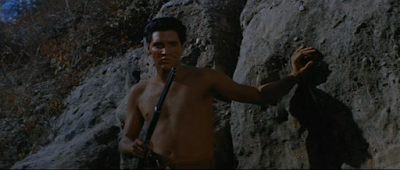
Flaming Star

Today would have been Elvis Presley's 90th birthday.

Flaming Star
(Don Siegel, 1960) So, not seeing many Elvis Presley movies—a fan of his music, and his stage performance, but not so much of the "programmers" that Col. Parker insisted he make—I've always wondered about his potential as an actor. He was a great admirer of James Dean, and there's "talk" about how good he was, but there isn't much proof of that in his movies, where he's given songs to sing every ten minutes or so and he's given a persona that comes down to "Elvis with a job," merely. Not much to work with, and certainly no room to grow beyond the parameters of what was expected, and though he kept working on them (at the Colonel's insistence), he grew tired of them—they weren't challenging and were basically fluff for fans. They still have fans to this day—those movies crop up on "Elvis festivals" all the time—but nobody (except those same fans) would consider them great films. What's great about them is Presley and frequently the only reason to see them. Him and the songs.
But, Flaming Star was a chance to break the mold. Elvis sings a couple songs at the beginning and that's it—they're disposed of quickly. This one has a story, a good "theme" backing that story, and a terrific director, Don Siegel, who was still making B-pictures, but good ones that would become classics like Invasion of the Body Snatchers, and he would make The Killers, Coogan's Bluff, Madigan, The Beguiled, Dirty Harry, Escape from Alcatraz, The Shootist. He was a quick filmmaker and "cut in his head," imagining just the camera-angles and enough footage to make the splices go by unnoticed (a skill he'd honed working for the Warner studio in the editing department—you can see his name in the credits for "montage" on Casablanca, Now, Voyager, They Drive By Night and Edge of Darkness). 
The setting is Texas in 1878 and two brothers, Clint (
Steve Forrest) and Pacer Burton (Elvis Presley) are approaching their family cabin warily as all is quiet and dark even though it is still evening. There is tension in the air as the nearby Kiowa tribe has a new chief, Buffalo Horn (Rodolfo Acosta), having replaced the old chief of the tribe, and there have been aggressive attacks to take back their traditional hunting grounds, now "settled" by whites. But, despite drawn guns and quickening pulses, they find that the lights are out for a surprise birthday party for Clint (belated though it is).
Of course, the party is hosted by Clint's father Sam (John McIntire) and his step-mother Neddy (Dolores Del Río), a Kiowa woman and mother of Pacer, but also in attendance are Clint's fancier (Barbara Eden replacing a dismissed Barbara Steele), as well as characters played by Richard Jaeckel
and L.Q. Jones (briefly).
Briefly, because after the party breaks up for the night, three of the returning party are killed by Kiowa warriors when "the Howard place" is attacked in the middle of the night. Being isolated, the Burtons don't hear of it until Clint and Pacer ride into town for supplies and are nearly set upon by the Pierces (Jaeckel and Eden) for even setting foot in their place—Pacer being half-Kiowa. They manage to get what they need, but the hatred towards Pacer by association lets them know that the entire Burton clan is not going to have an easy time of it, from the settlers in town or from the Kiowas (Buffalo Horn already having made a nighttime visit to their homestead to palaver with Pacer).
It's only emphasized when a posse hunting Buffalo Horn visit the Burtons with one question—whose side are they on? Tempers are high with the men referring to Clint as "the only white man in the family" and shots are fired when things get too heated. The next morning, Pa and Clint find that the posse has stampeded their cattle and shot them all down out of spite, prompting Clint to vent that the white are worse than the Kiowas—"An Indian will rob you blind if he can but this is all waste and meanness." The Burtons are in an extreme situation, but where Pa says they've always been, "folks in the middle."
This is an atypical Elvis vehicle (which were basic celebrity vehicles) but not an atypical Western for the time in which it was made, on the cusp of a society-changing civil rights movement, where hearts and minds were in a process of retrospection of the country and what it's ideals really meant. Considerate directors who had moved beyond the early tropes of "cowboy movies" and considered not only the challenges of the European western expansion, but also its costs...and it's crimes. History is more complex than the dictates of a popular entertainment, and Flaming Star slots perfectly well in the genre's still-early reappraisal.
But not for an Elvis vehicle. But, Presley, fresh out of his military service, rises to the challenge. In his previous movies...and future ones...he wasn't required to do much but be a version of his star persona. If anything the range only required a befuddlement over who his next dance-partner would be.
But, this role requires a stretch, far beyond the dictates of a musical format...he's embattled, hated, conflicted, and constantly challenged, all of which comes through without an audience having to compensate for his celebrity. And, although helped by a fine crew of stuntman, he's also good in the action sequences (especially in a vigorous and violent third act). It's a terrific performance, far beyond what you'd come to expect from one of his similarly mononomic contemporaries. For a similar performance, look at the best movie-work of Dean Martin, Bobby Darin, or Sinatra. It was what he aspired to, and though he may be best remembered for his rock n' rollin' higher profile films, this was him at his dramatic best.

Saturday, August 24, 2024

The Green Slime

Saturday is traditionally "Take Out the Trash" Day. We'll need an extra leak-proof liner for this one.

The Green Slime
(Kinji Fukasaku, 1968)  "The Green Slime ARE Coming?" Shouldn't that be "The Green Slime IS Coming?"
 
Well, believe me, the poster grammar is the least of this movie's problems. 
 
The Green Slime was an indirect follow-up to four low-budget Italian science fiction films* entailing a future Earth space station called Gamma One. The same models were used for the miniatures, but the station was re-christened Gamma Three, and the script and financing were provided by M-G-M in the U.S. The film was made in Japan, directed by Kinji Fukasaku with a Japanese crew and starring Western actors Robert Horton, Luciana Paluzzi and Richard Jaeckel, as well as control rooms full of ex-pat Western actors and U.S. military crew stationed in Japan. As the film was intended for international markets, they didn't bother doing sound recording while filming, so that everything—and I mean everything—was dubbed later on in a studio. It's just one of the things that gives the film a bizarre feeling of desperation.
Seems Earth has a problem: the asteroid Flora 80 is on a collision course with our planet and if it's allowed to hit it will create "an extinction-level" event. Ben Affleck not being born yet, and Robert Duvall unavailable trying to get James Caan on the Moon in Countdown, the Space Command sends Commander Jack Rankin (Horton) to Gamma Three to "blast the thing out of the sky" to which Rankin replies with a stalwart "thumbs up"—his go-to when he's trying to be positive.
When he gets to the station, he immediately shoves the station's in-command, Commander Vince Elliott (Jaeckel) out of rank, saying that until the asteroid's out of the way that he's in command of the station (dammit!) and anybody doesn't like it, well, there's the airlock outside over there. Vince sucks it up, this being an emergency and all...and because he's now involved with Rankin's old girlfriend, Dr. Lisa Benson (Paluzzi), who's in charge of "Medical" there on the station, so, hey Vince is "one-up" on Rankin.
Rankin, Elliott, and a team of technicians set off for the asteroid Flora, land and begin setting explosive charges to blast the thing out of the sky (as per orders), but inquisitive scientist Dr. Hans Halvorsen (
Ted Gunther) finds some green goo that he just finds fascinating and wants to take a sample to examine aboard the station ("New life" and all that...). But, Rankin, knowing full-well that they're sitting on a "ticking time-bomb" nixes any "shilly-shallying" from egg-head scientists and knocks the container out of Halvorsen's grasp. 
Yee-ahhh, about those command skills. Good instincts, but bad technique. The sample shatters and some of that glop falls on one of the crew's suits, allowing it to get onboard the station, where, because it feeds on energy (allowing it to survive on a rock in space, I suppose), the station's decontamination procedures only manages to feed it, and make it grow into big, bulbous, one eyed creatures with claw-arms (ELECTRICAL claw-arms!) that wouldn't have passed the laugh-test for the show-runner of the really early "Doctor Who" shows.
Of course, they need time to grow from their ooze-state, so much time is spent monitoring Flora blowing up, and having a celebratory soiree where the music ain't good and the dancing's even worse, but given enough of that 1960's movie staple, the gyrating posterior shot. And, it gives Rankin, Elliott and Benson a chance to spell out everything they already know about each other, and for Rankin to pull a dick-move and ask Benson for a slow-dance right in front of her current lover. Everybody's probably wondering how soon they can get this jerk off the station!
But, no such luck! Pretty soon, the lights start flickering, which can only mean one thing! The Power station! And something's wrong! They find the burned still-smoking corpse of one of the technicians and Benson displays her considerable medical knowledge by announcing "He's dead." But, no time for mourning yet, kids, because one of those bulbous Green-Slime things is just around a conduit and starts to whip those electric arms around, killing a bunch of anonymous guys with ray-guns and football helmets. The lasers can't kill it, and if the thing bleeds, it just makes more of them, so the best the station can do is try to isolate the things...except...they forget about the station's ventilating system. Pretty soon, the things are schlumpfing all over the station, even in the hospital.
Since the things eats energy, laser guns have little lasting effect, so the best alternative is right out of the Superman TV-Villain handbook: to throw something at it, like hospital beds (they use a lot of those, it seems to be the most effective weapon), or if your laser gun—which only makes them stronger, remember—jams or runs out of...laser, I suppose**...you can throw that at them, too. If it jams in their eye, it's quite effective, apparently.
I mock, of course, because there is no way one could confuse this with high art—this came out the same year, and from the same studio, as 2001: a Space Odyssey (which was intended to be "the proverbial good science-fiction movie")—and The Green Slime has all the hallmarks of the proverbial bad sci-fi flick—the antiseptic art design, the "best-we-can-do" special effects, the stentorian acting (to keep from laughing), and a sensibility that can best be described as—to use a highfalutin' word—"puerile."*** That means it would merely impress children...or the child-like. I'm way past that sell-date to be impressed.
There are some notable things about it however. It's one of the few screen credits of William Finger, who spent most of his life in obscurity writing for comic books. Obscure, except for one co-creation of great significance for which he was denied credit for decades (until recently, that is). Bill Finger, along with artist Bob Kane, co-created the character of "Batman." That Batman. He wrote a lot of the defining stories of the Batman character (as well as co-creating Robin, Alfred, and quite a few of the major villains) from its origins in 1939 through to the 1960's. At least, he got credit for The Green Slime.
The director, Kinji Fukasaku, had been directing for seven years and really wasn't a slouch and was quite highly regarded. In fact, the next year, he replaced Akira Kurosawa (!!) as the director of the Japanese sequences of Tora! Tora! Tora! (!!!) and in 2000, he would write and direct a genuine classic, Battle Royale, which, whether directly or indirectly, served as inspiration for "The Hunger Games" series.
Another amazing fact and landmark about it is this: The Green Slime was the first movie skewered on "Mystery Science Theater 3000", serving as the show's pilot episode. If, for nothing else (okay...for nothing else), it has some significance.

* The first of the series was Wild, Wild Planet...or as it's known in Italy, I Criminali Della Galassia ("Criminals of the Galaxy").

** Or..maybe...the animator who draws the laser beams runs out of ink. 
 
*** See what passes for women's fashion in these things—short skirts, tight, shimmery fabrics, nothing you'd want to wear.  
 
Yeah. No. No, really.
 

Tuesday, April 21, 2020

The "3:10 to Yuma" Shoot-Out

Written at the time of the remake's release.


"Thar' Ain't Room in this Genre for Both of Us"

It's a truly fascinating experience to revisit Delmer Daves' strange little 1957 "oater" 3:10 to Yuma, and look at what James Mangold (Walk The Line) has done with it 50 years later. The original was a tight little psychological western based on an Elmore Leonard ("Get Shorty," "Out of Sight," "Hombre," "The Friends of Eddie Coyle") short story, but, as with his latter urban capers, character informs action. And it provided Van Heflin and Glenn Ford two of the finest roles of their careers. Ford, never the most inspired of actors, does wonders with the role of rogue-bandit Ben Wade, who's just as handy with his words as a gun, and is just as dangerous hand-cuffed and guarded as he is on the loose. No one is safe in his sphere and he rules a band of outlaws on sheer force of personality. 
Ford ekes out every subtlety, every nuance of his clever dialog and makes it look easy as taking a nap. His is a villain that never admits he's not in control of the situation. He's evenly matched by Van Heflin, looking haggard and down-trodden as a desert-farmer, who takes on a prisoner-transfer to save his farm, and maybe a touch of glory. Such a man is constantly in threat of temptation from the devil, and it's only his cussed stubbornness that makes him see through a job when other men give up. Heflin has the less fun role, but gives it his all, and is rewarded by a Divine Intervention that is announced by a choir of angels (who are backing Frankie Laine singing the inevitable Title Song).
So, 50 years on, what can Mangold bring to the material? Well, not much really. It's puffed up with some more action and the dialogue is retained (at least in spirit) a surprising amount of the time (original screenplay writer Hallstead Welles gets the lead screenplay credit). What new things are added are informed by earlier instances in the original and made explicit, some times thuddingly, and everything is tamped down in a nihilistic amoral rasp as is expected of a western post-Leone/Eastwood (but with none of the wit or stylism). 
More explosions (Two, instead of the none in the first), one in an unnecessary story-detour through a railroad camp. The one opportunity the modern makers had--that of fleshing out the denouement in terms of character, they manage to make even more false, by pumping up the action and circumstances, straining credibility to the snapping point. Russell Crowe's Ben Wade has the same dialogue, but none of the swagger, and enough skills that one wonders just what he's doing staying around the whole movie. Christian Bale's Dan Evans has the same motivations as the original, but his circumstances are worse, and to make his family connection explicit and situations more dire, his son sneaks along on the expedition. Still, its pretty obvious how much Mangold loves the original, seeing how much is retained, but the expansion of the story works against it, and we are left with what's good in the new one...being the old one.
But there are things missing, too. Besides the more colorful straight-ahead performances of Ford and Heflin, there is a marvelous one by the fine character-actor Richard Jaeckel, who makes Wade's lieutenant, Charlie Prince, a craftily-goofy rooster of a character. Ben Foster's performance has some of the characteristics, but is a stone-cold psycho (no doubt written that way) and pales by comparison.

And then there's that Frankie Laine song...

It's the 1957 version. The 2007 version goes to Boot Hill.


Wednesday, January 4, 2017

The Lineup

The Lineup (Don Siegel, 1958) Don Siegel directed this film version of the television show he directed the pilot for—itself the TV version of a radio drama police procedural in the same milieu as "Dragnet" only set in San Francisco (the series was syndicated as "San Francisco Beat").* 

You can tell that Siegel could care less about the police in this one because, except for a frenetic action sequence at the top of the film that leaves two men dead, the movie doesn't take on any life until the arrival of the two Miami "business-men," Dancer (Eli Wallach) and his mentor, Julian (Robert Keith), who come to town to do a job for a drug-ring with an anonymous leader ("The Man") with the plan to get out of town fast once the job is done. One gets a whiff of The Killers (which Siegel was on the line to direct in its 1946 version and that he would eventually do another version of the story in 1964) with most of the film's attention-span being with the hoods.
Warner Anderson and Marshall Reed are the only hold-overs from the series. But, their scenes are so minimal, they may as well not even be in the movie, but just part of the guys in cars who've got guns and are tailing the bad-guys, waiting for the eventual shoot-out. We meet Dancer and Julian on the plane to the Bay City, where Dancer is reading a book on how to improve his vocabulary. Julian thinks that Dancer has a big future in their line of business—he just has to learn to control his temper and his violent instincts. What he only sees occasionally is the paranoia that constantly dogs Dancer (Julian thinks he's just being thorough, looking for traps that will stand in their way), a product of an inferiority complex and not wanting to admit the fact that he's a bit dim.
Dancer and Julian make it to the shabby little motel outside San Francisco where they're soon met by their driver for the job, Sandy McLain (Richard Jaeckel), who's a little too eager to be of help, asking too many questions and getting on Dancer's bad side. It doesn't help that the kid's a bit reckless and doesn't think anything of drawing from a flask while on the job. 
At police headquarters, Inspectors Guthrie and Quine (Emile Meyer) do a little digging and find out a bit more about the incident at the airport that got two officers killed: questioning the owner of the valise that one of the getaway drivers had stolen, they find it belongs to Philip Dressler (Raymond Bailey) a well-to-do collector of antiques, just returned from Asia. But, an inspection of the pieces he bought from a street-vendor shows he got more than he bargained for: the statue is filled with heroin. They confiscate the drugs and return the statue (now filled with powdered sugar) to Dressler and start an investigation of innocent others who may have just returned from Asia, not suspecting that they are mules for the drug-trade.
They're a couple steps behind Dancer and Julien, who find that getting the heroin is not an easy thing to do without collateral damage...at least, when Dancer is the point-man. One grab results in a shoot-out at the pier, another provokes a murder in a steam-room, and the other, turns into a hostage situation when Dancer and Julien take a mother and child hostage after finding out that the heroin has been destroyed...in a rather unique manner. Their failure to produce the last bag of heroin demands an explanation...and a hitherto unheard-of meeting with the usually anonymous "The Man" (Vaughn Taylor), whose air of superiority and disdain can't be a good mix with Dancer's own insecurities.
The kidnapping puts the SFPD on an APB and it allows director Siegel to do what he does best—a chase scene through San Francisco. It will be a treat for appreciators of these types of scenes and those with a sense of history to see it played out on the under-construction Embarcadero, with Siegel's efficiency and surgeon-like editing ramping up the tension until the last bullet is fired.
The result is a top-notch noir...in sunny daylight. Eli Wallach was not fond of the film during shooting, as he thought he'd taken a step down after making his film debut working with Elia Kazan on Baby Doll, where filming was more measured, slower, and had more concentration on acting as if it were a stage feature, as opposed to Siegel's quick set-ups and emphasis on pace. You had to be quick on your feet with Siegel, and although there was less "prestige" to this feature, it holds up as a nifty thriller with an edge, something that never goes out of style.

* Yes, it's not just current times where they make movie versions of TV-shows: they'd made movies of "Dragnet" and "Batman" ("The Man from U.N.C.L.E." had a neat trick where they'd edit episodes together to distribute to foreign markets). The Line-up could increase the filming budget somewhat to bring more value to screen (but not much).

Wednesday, March 18, 2015

The Gunfighter

The Gunfighter (Henry King, 1950) Westerns started to take a slight bend in the trail with this one, an original story by Andre de Toth and William Bower* (it was offered to John Wayne, who wanted to play it, but was offered too little salary for it to accept, so the screenwriters shopped it to Darryl F. Zanuck, who snapped it up for 20th Century Fox). Instead of big skies and empty plains and Indian fights, The Gunfighter explored the concept of being the storied "fastest gun in the West." Being quick on the draw is good and all, but the downside is you have to keep proving it. That's the problem with being king of the hill—there's nowhere to go but down.

For gunfighter Jimmy Ringo (Gregory Peck), every shot that kills has to be justified, witnesses verified, and, unfortunately, every town has the opportunity for killing, as his reputation unfailingly precedes him through any swinging saloon door, and inside, there's some punk full of himself and whatever swill the barman serves who thinks he's tough because he can shoot a bottle off a fence. Every town has one...until Ringo comes to town. 
Jimmy Ringo has a way of ridding the town of morons. Whatever benefit to the town's gene pool Ringo provides doesn't settle with him, though. He has to remember the faces of the idiots he kills. He carries the stigma of being a man to avoid, as he does the reputation of being "the fastest gun..."

So he keeps riding, because if he stays in place too long, trouble will catch up to him, or challenge him, only to wind up dead on the floor. To the onlookers, it's self-defense and that's how Ringo has to play it, but it happens with such regularity, he knows even if he had no choice, he's the one to blame.
Any lawman doesn't like him in their town, even the ones like Marshall Mark Strett (Millard Mitchell, a favorite character actor) who have history with him, may even like him, but know that his very presence will invite trouble and upset the peaceful status quo they're trying to maintain. So, Ringo is just as likely to be greeted with "When ya leavin'?" as a "Hello," or a hand going for its holster, opposed to a handshake.
Ringo arrives at Strett's town of Cayenne, fresh from killing another dumb kid (Richard Jaeckel) who wouldn't let it be, and several lengths ahead of the kid's three brothers who want revenge for the idiot's death. Ringo disarms them and sends their horses fleeing, in the hopes they might be discouraged from following him the rest of the way, but they're so hell-bent, they follow him on foot, and he arrives at the Cayenne saloon, thirsty, hungry and bone-tired, while the bar-keep (Karl Malden) goes out of his way to make the celebrity comfortable, while a regular goes to get the Marshall. Their meeting is cordial but serious and Strett discourages Ringo from setting in place too long. But, Ringo won't leave until he takes one more chance that might end the running—he wants to see the town's teacher, Peggy Walsh (Helen Westcott), who's gone into hiding and changed her name to avoid being found out by the man from her past—him. And, most of all, she doesn't want Ringo to meet her son—his son—who has skipped school with the other boys to hang around downtown for a glimpse of the fastest gun in the west.
The Gunfighter is probably more influential than some might think—in two short years, High Noon would be released, another Western involving the enclosed fishbowl of a small Western town and the pressure of time. There were no cattle stampedes or Indian attacks or runaway stagecoaches, just a man at war with himself by being at war with others. It might be a great thing to be "the fastest gun" but that accomplishment has a quick shelf-life before things turn sour and the acclaim rings hollow, especially as time progresses—as far as one knows there's only one way to not be "the fastest gun" and that's by being the second fastest.  

And those men are usually dead.

But, if Ringo can convince his wife and kid that he's changed his ways and that he's ready to settle now...well, that just might be a way out of it, too. But, she's reluctant...and those three brothers are on the way.

It's not the wide open spaces that set the stage for The Gunfighter, it's the closed interiors of the psyche and the self. Instead of focusing on the spectacle of building a Nation, it's about the painful process of deconstructing, not about the road ahead, but the one already traveled. It ushered in a decade of films re-appraising the Western and how changing a country can change the ones doing the changing.
* Once it got to Fox and Zanuck, three other writers worked on the screenplay—William Sellers, Nunnally Johnson, and...Roger Corman (yeah, that Roger Corman).