Showing posts with label Millard Mitchell. Show all posts

Saturday, January 6, 2018

Thieves Highway

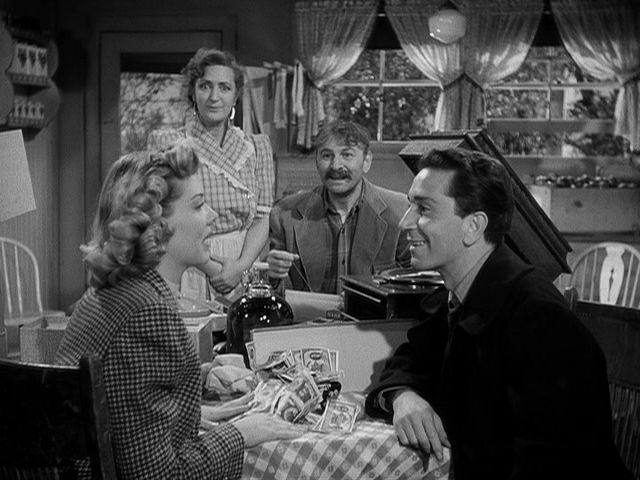
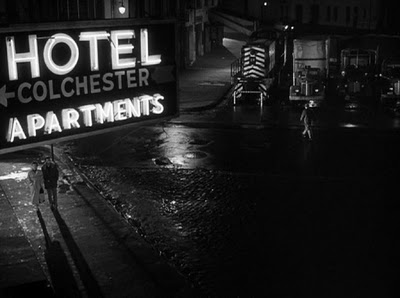
Thieves' Highway (Jules Dassin, 1949) A revenge story set in the wild and wooly world of wildcat truckers (also explored in A.I. Bezzerides' similarly themed They Drive By Night). Nick Garcos (Richard Conte) comes home after a big score and showers his family with presents. He's so full of himself that he doesn't notice the obvious: Dad's missing his legs (which makes the slippers he bought him a very poor choice). It seems while Nick was away, Dad got rooked on a vegetable run, taken for a long drunk, and had a bad crash in his dilapidated truck, crippling him. 

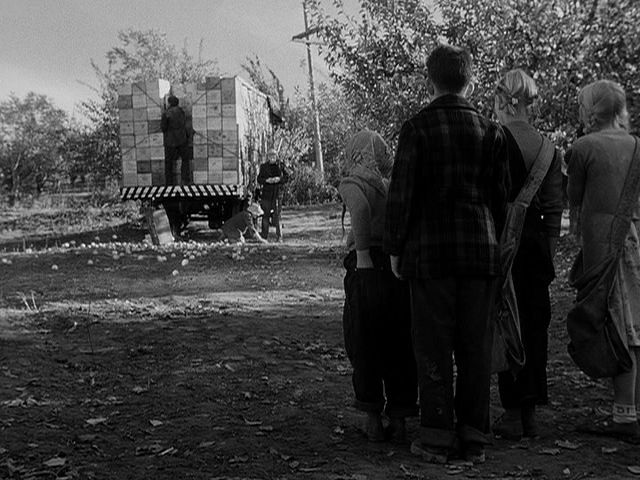
Worldly-wise and hardened in combat, Nick decides on an assault on the man who crushed his dad's dreams, one Mike Figlia (Lee J. Cobb), a bad apple who'll spoil the whole bunch right down to the bottom of the barrell.  He partners with the wild-catter who bought Pop's truck (the great Millard Mitchell) to deliver two loads of golden delicious to Figlia's produce wholesaler in San Fran'...if they can get through a gauntlet that includes duplicitous rival wild-catters, a truck with a bad universal (and not much good!), 36 hours straight on the road without any sleep, and worn tires (a sequence that Dassin turns into a thrilling montage of overlapping images).  
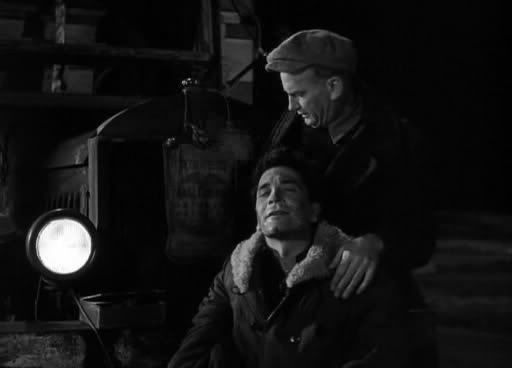
Except for the loading of apples, all this takes place at night, and no one could dredge the dark as well as Jules Dassin (as he was always proud to announce, that's pronounced "Da-ssin," from the U.S.). Dassin always had a flair for the street and the twisted culture of film noir, and Thieves Highway is gritty and street-smart: no one in this movie is naive or innocent, everybody has an agenda or an angle, and Nick has to keep his head on straight (tough to do with a neck injury received when a truck collapsed on him while changing a tire), whether negotiating with Figlia or dealing with the street-frail (Valentina Cortese) hired by Figlia to entertain Nick while he works the angles.
It's an education, one that toughens Nick up and makes him see that there's more than what he imagined in his existence before.  Sure, he's earned a living and survived the war, but...  It's one thing to avoid death, it's quite another to embrace life.


Saturday, June 17, 2017

The Naked Spur

The Naked Spur (Anthony Mann, 1953) Five desperate people in the Rocky Mountains. That's what Anthony Mann's The Naked Spur sears down to. Each one is flawed, if not down-right evil, and the twisted dynamics of their connections with each other are complicated and web-like. Isolated in the mountains, there is no Society or Civilization to get in their separate but intertwined ways or to pass judgement...or provide judgement. It's as if they're the last people on Earth, and (as the saying goes) it's not big enough for all of them.

Howard Kemp (James Stewart) is stalking prey in the mountains of Colorado. He runs into an old prospector, Jesse Tate (Millard Mitchell, one of my favorite character actors) and tells him he's tracking a man, Ben Vandergroat (Robert Ryan), for the murder of a sheriff in Abilene. He offers Tate $20 to help find Vandergroat and Tate takes him up on it, thinking that he's a sheriff, himself. I mean, he has the "wanted" poster.


Kemp and Tate find Vandergroat "treed" (as it were) on the high peak of a cliff. Attempts to get up there are met with sudden and dangerous man-made rock-slides. Tate is too old to make the attempt, and although Kemp is desperate to get up there, he gets injured in the attempt, the first of many injuries he will sustain in the film. The two back-track to see if they can find a back-route to surprise Vandergroat.


Aid comes in the form of former Union Lieutenant of the 6th Cavalry Roy Anderson (Ralph Meeker) who is heading east after serving. Anderson is taking the more precarious route to avoid entanglements with the Blackfeet tribe, as it seems they're tracking him after he compromised the virtue of the chief's daughter. Naturally suspicious, Kemp grills him about his service and when he demands to see Anderson's release papers sees he's been dishonorably discharged for being "morally unstable." 

In this movie, he'll fit right in.

Anderson scales the cliff and gets the drop on Vandergroat (Ryan is creepily brilliant in the role, a standout among great performances). But, Vandergroat is not alone. Anderson is attacked by Lina Patch (Janet Leigh, all of 26 at the time of filming, it was already her 19th film), daughter of Vandergroat's bank-robbing buddy and the desperado takes advantage of the distraction to attack Anderson—one of Ryan's effective little touches is to laugh while he's engaged in a death-struggle with his opponent, which is unique and unnerving. Tate and Kemp manage to show up on time to keep Anderson from being killed, but once Kemp has Vandergroat captured, he begins to lose control of the situation.


"Now, ain't that the way? A man gets set-up for trouble head-on
and it sneaks up behind him every time!"
For one thing, Vandergroat makes it known that he's known Kemp a long time and has no respect for him, calling him "Howie." He also lets Tate and Anderson know that Kemp is no sheriff, he's just a bounty-hunter who wants the $5,000 reward for his capture so he can buy his land back, which he lost during his time in the Civil War. For Tate and Donovan, this immediately changes their view of Kemp and they start making noises about splitting the $5000 reward, something Kemp wants no part of, wanting the entire reward for himself.

Kemp's duplicity, Tate's greed, Anderson's "unstable" morality are all fertile ground for Vandergroat to work: he uses Lina as a pawn for the affections of both Anderson and Kemp, fills Tate's head with tales of striking it rich prospecting, and preys on Lina's loyalty for being the only man who's ever treated her right. By playing on each person's weak spots, he knows that eventually he'll get himself freed from capture and away from the hangman's noose.

And for Kemp, he's fighting other demons besides Vandergroat.  Before the War, he was just a farmer, but the War made him lose everything—his farm, his girl, his trust, his money...he's a desperate man whose only a few belt-notches away from being a gang-lander just like his quarry. He's just trying to get back to the place he was before the war, and if hunting a murderer for reward will get him that much closer, then hunt he will.

But, Vandergroat is as conniving as Kemp is distrustful and not so easily played as Tate and Donovan. It will come down to a battle of wits between the two men and any advantage Vandergroat can use against him is played—Lina's affections, Anderson's jealousy, Tate's pliable loyalty. There's also a psychological advantage; Vandergroat's extremely confident and Kemp is doubting, it's not a case of good winning out over evil, but of strength versus weakness, and Vandergroat takes advantage of every injury, accidental or deliberate to try and kill Kemp...by any means...or any ally...necessary.

The Naked Spur was the third of the five westerns Mann and Stewart would collaborate on during the 1950's, that period when Stewart was experimenting with material and directors like Hitchcock and Mann who would use his Americana persona as a counter-point to stories of obsession and neurosis that show that decency is just a raw nerve away from being exposed as fragile and undependable.

The isolation is key here. In previous Mann-Stewart westerns, there was a back-drop of civilization early on, rough-hewn and hard-scrabble as it may be. Here, in the mountains, there's nothing but the law that is made up on the spot. And it's jungle law. Survival of the fittest. Nature plays a hand in who will survive—both Nature in the wild and the nature of man. The terrain may be wild, but it follows rules of moderation and any excess is dealt with.  By the end of The Naked Spur, the environment is back in balance, with no chance of spinning out of control. Fires are tempered, and the Earth is replenished.

Anthony Mann had a lot of experience dealing with the nature of humans. He started his career in the dark and stormy nights of film-noir, where the worst instinct of people are on display and desperation is just a symptom. But, as this presents, darkness can be found in the light of the sun and the clean, unpolluted vistas of mountaintops. Light doesn't penetrate the darkness than can be found in souls.

For folks newer to film who might not relate, The Naked Spur is sort of like The Hateful Eight...only created by folks who are actually artistically creative...some 62 years earlier. 

The Naked Spur
was added to the National Film Registry in 1997.


Wednesday, May 10, 2017

Winchester '73

Winchester '73 (Anthony Mann, 1950) One in a thousand. That's how many perfect Winchester rifles were produced. One in a thousand so perfect of bore and rifling that a man using it need not compensate for anything except that thrown at him by God. Men would fight for one. Men would kill for one. And the Winchester '73 that Lin McAdam (James Stewart) wins in a marksman's contest probably ends up a little less than perfect as it goes from hand to hand, and is even used as a shield and a club in the long circuitous route of the movie. But, as the repeating rifle has become the difference between life and death in the heady days after Little Big-Horn, the Winchester is the weapon of advantage in skirmishes on the plains.

The first of five westerns Stewart made with Anthony Mann in the 1950's that deepened and darkened the Stewart persona from the "aw, shucks" townie to a complex, psychologically challenged character who could be pushed to undisciplined anarchy, Winchester '73 has more going on in it than most of the other Stewart-Mann films, which had more straight-forward story-telling through lines. This one is practically episodic, as McAdam and fellow-traveler "High-Spade" (the terrific Millard Mitchell*) start in Dodge City with run-ins with Wyatt Earp (Will Geer, before the blacklist got him), Bat Masterson and a stranger-in-town named Dutch Henry Brown (Stephen McNally) before winning the perfect Winchester in a shooting match.

He doesn't have it for long as the stranger beats McAdam up and steals it from him. From there, it falls into the hands of an unscrupulous Indian trader (John McIntire), a Sioux warrior (Rock Hudson--you read that right), briefly in the hands of horse-soldiers Jay C. Flippen and Anthony—soon to be Tony—Curtis), then to an untrustworthy homesteader (Charles Drake) and finally, the possession of desperado Dan Duryea. Quite the cast (where's Harry Morgan?), and add in Shelley Winters as the saloon-girl trying to make good, and even if you didn't have Mann's steady hand with action, you'd have a movie full of good character parts.
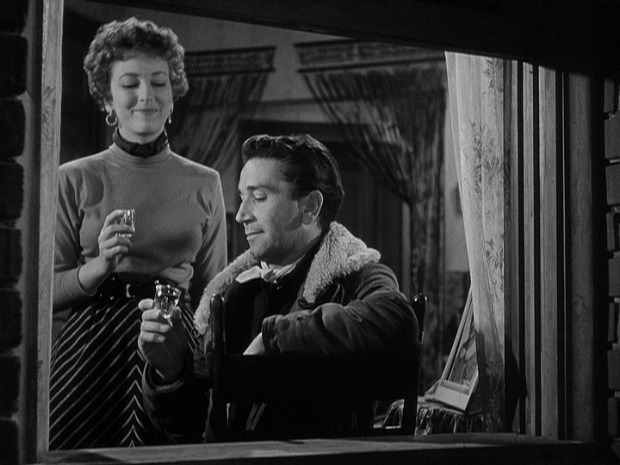
Duryea is at his hipster best, playing an outlaw determined to out-laugh all of his opponents, McIntire is nicely droll as the Indian giver/trader, and Shelley Winters gives off an "I'll deal" vibe that endears you to her immediately. In one of the little authentic touches Mann inserts to show how rough the West really was, Winters nearly bounces off a buck-board dangerously careening through the desert, and when McAdam hesitates when giving her a gun to defend herself during a Native attack, she gives him a toothy grin and says, "I understand what the last one's for..." I want that girl on my side.
It is capped with a mountain shoot-out between old-antagonists-with-a-past McAdam and Brown that is a primer for any action director to clue an audience to the strategies and complications that a fight for advantage in the mountains can entail. Add to that Mann's experiments with light in landscape that were far outside and past the urban noir settings he had bathed in shadow and slivers of light in the post-war 40's.
But in the same year as Stewart and Delmer Daves dared make a western that showed the First Peoples' side of things (Broken Arrow), Mann and Stewart** (and Stewart and other directors) began a decade-long exploration of the cracks in Western civilization's veneer that showed the fragility of the individual—how, in a so-called "decent" society, there's only an angel's breath of morality distinguishing a maverick and a psychopath. Everyone can be pushed over the edge. And the only advantage is how many rounds you can fire off before the other guy feels the first one. The repeating fire-arm was the great leveler when it came to fighting. But it was also what prevented letting cooler heads prevail. Cooler heads don't have a chance against hot lead fired by a cold heart. It's how the West was taken...and still is. The chances of surviving it to build something decent?

Probably one in a thousand.


* Mitchell has a great stoved-in character face and a likable self-deprecating manner that are also on display in one of his other prominent movie roles-in Singin' in the Rain. He died in 1952.

** One of the joys of the current DVD version of Winchester '73 is a rare commentary track by the elderly Stewart who goes into detail about the filming and his working relationship with Mann and the other actors. It's done without the "Stewart persona"--he's just watching the film and answering questions--but at the end, you can't help but smile when he blurts "Ya know, I'm just really impressed with this laser-thing."

Wednesday, March 18, 2015

The Gunfighter

The Gunfighter (Henry King, 1950) Westerns started to take a slight bend in the trail with this one, an original story by Andre de Toth and William Bower* (it was offered to John Wayne, who wanted to play it, but was offered too little salary for it to accept, so the screenwriters shopped it to Darryl F. Zanuck, who snapped it up for 20th Century Fox). Instead of big skies and empty plains and Indian fights, The Gunfighter explored the concept of being the storied "fastest gun in the West." Being quick on the draw is good and all, but the downside is you have to keep proving it. That's the problem with being king of the hill—there's nowhere to go but down.

For gunfighter Jimmy Ringo (Gregory Peck), every shot that kills has to be justified, witnesses verified, and, unfortunately, every town has the opportunity for killing, as his reputation unfailingly precedes him through any swinging saloon door, and inside, there's some punk full of himself and whatever swill the barman serves who thinks he's tough because he can shoot a bottle off a fence. Every town has one...until Ringo comes to town. 
Jimmy Ringo has a way of ridding the town of morons. Whatever benefit to the town's gene pool Ringo provides doesn't settle with him, though. He has to remember the faces of the idiots he kills. He carries the stigma of being a man to avoid, as he does the reputation of being "the fastest gun..."

So he keeps riding, because if he stays in place too long, trouble will catch up to him, or challenge him, only to wind up dead on the floor. To the onlookers, it's self-defense and that's how Ringo has to play it, but it happens with such regularity, he knows even if he had no choice, he's the one to blame.
Any lawman doesn't like him in their town, even the ones like Marshall Mark Strett (Millard Mitchell, a favorite character actor) who have history with him, may even like him, but know that his very presence will invite trouble and upset the peaceful status quo they're trying to maintain. So, Ringo is just as likely to be greeted with "When ya leavin'?" as a "Hello," or a hand going for its holster, opposed to a handshake.
Ringo arrives at Strett's town of Cayenne, fresh from killing another dumb kid (Richard Jaeckel) who wouldn't let it be, and several lengths ahead of the kid's three brothers who want revenge for the idiot's death. Ringo disarms them and sends their horses fleeing, in the hopes they might be discouraged from following him the rest of the way, but they're so hell-bent, they follow him on foot, and he arrives at the Cayenne saloon, thirsty, hungry and bone-tired, while the bar-keep (Karl Malden) goes out of his way to make the celebrity comfortable, while a regular goes to get the Marshall. Their meeting is cordial but serious and Strett discourages Ringo from setting in place too long. But, Ringo won't leave until he takes one more chance that might end the running—he wants to see the town's teacher, Peggy Walsh (Helen Westcott), who's gone into hiding and changed her name to avoid being found out by the man from her past—him. And, most of all, she doesn't want Ringo to meet her son—his son—who has skipped school with the other boys to hang around downtown for a glimpse of the fastest gun in the west.
The Gunfighter is probably more influential than some might think—in two short years, High Noon would be released, another Western involving the enclosed fishbowl of a small Western town and the pressure of time. There were no cattle stampedes or Indian attacks or runaway stagecoaches, just a man at war with himself by being at war with others. It might be a great thing to be "the fastest gun" but that accomplishment has a quick shelf-life before things turn sour and the acclaim rings hollow, especially as time progresses—as far as one knows there's only one way to not be "the fastest gun" and that's by being the second fastest.  

And those men are usually dead.

But, if Ringo can convince his wife and kid that he's changed his ways and that he's ready to settle now...well, that just might be a way out of it, too. But, she's reluctant...and those three brothers are on the way.

It's not the wide open spaces that set the stage for The Gunfighter, it's the closed interiors of the psyche and the self. Instead of focusing on the spectacle of building a Nation, it's about the painful process of deconstructing, not about the road ahead, but the one already traveled. It ushered in a decade of films re-appraising the Western and how changing a country can change the ones doing the changing.
* Once it got to Fox and Zanuck, three other writers worked on the screenplay—William Sellers, Nunnally Johnson, and...Roger Corman (yeah, that Roger Corman).