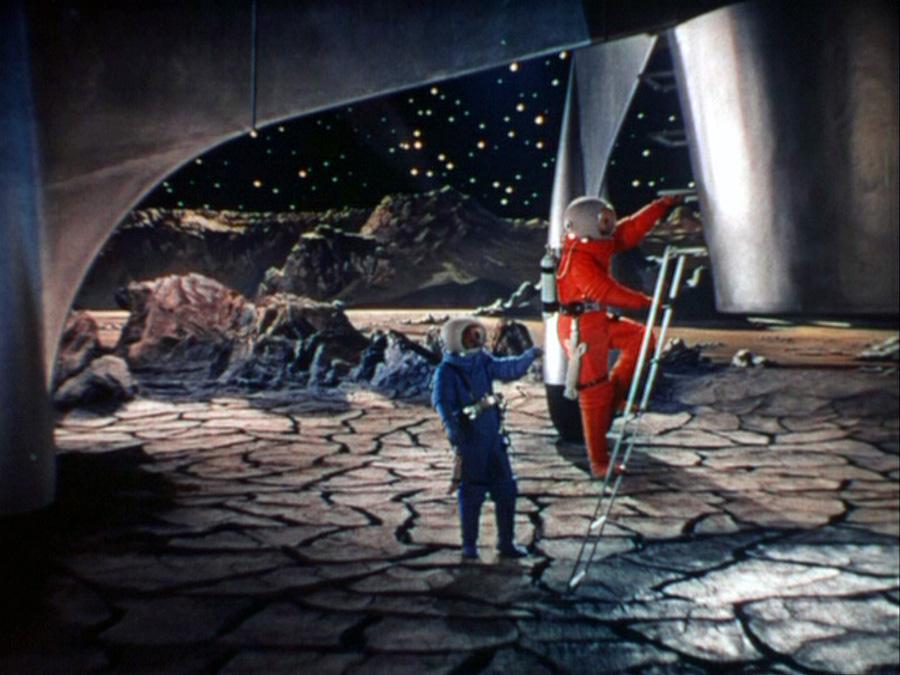
Destination Moon(Irving Pichel, 1950) As it's the 55th Anniversary of the "Yes, It Really Happened" First Moon Landing with a new movie (however fanciful) and all, it's a good time to look at a past movie about a first trip to the moon—we've done reviews of First Man and Fritz Lang's Die Frau in Mond—like this 1950 George Pal production that had considerable input (co-scenarist based on his novel, technical advisor) from "Mr. Grok" himself, science fiction author Robert A. Heinlein.
It's a fascinating little curiosity, by turns both sophisticated and puerile—something you could say about most Pal movies—that can take into account such things as G-forces, orbital mechanics, and weight playing a part in fuel consumption and maintain a strict adherence to science (no sound in space—not even for dramatic purposes—and the advantages and disadvantages of micro-gravity and the ritual of pressurizing air-locks) while having some of the more advanced concepts being explained in a Woody Woodpecker cartoon.*
Bear in mind that Destination Moon was made seven years before Sputnik put the fear of dumbness into Americans**and kicked our fledgling rocket program into "trust" mode. In the movie's opening minutes, researchers and private corporations are on the cusp of launching the first man-made satellite into orbit only to have the rocket launch off the pad and then slam itself into the desert, disastrously. And just a couple of months later, they're talking about sending a manned rocket to the Moon. Baby...steps, guys....
The Woody Woodpecker cartoon attracts investors (it's called "science fiction" for a reason...) and pretty soon construction begins on a Moon rocket using atomic energy to create enough steam thrusters to power it out of Earth's gravity and to the Moon. The entrepreneurial heads of the program are going to be the ones on-board for the flight, not test pilots, and they are Jim Barnes (John Archer) the aerospace magnate whose company built it, famed rocket scientist Dr. Charles Hargraves (Warner Anderson) who designed it, retired General Thayer (Tom Powers) who wants America's presence in space to be used for deterrence and technician Browne (Ted Warde) who supervised the technical aspects of the good ship, Luna.
But, there are complications—political ones. The Atomic Energy Commission (referred to as just "the Commission" here) denies permission to test Hargraves' atomic engine at its launch-site in the desert given protests by local citizens. Barnes suspects foul play by one of our nation's enemies (after all, how could American citizens complain about atomic testing ten miles away from their homes?) and to avoid any legal action...like a pending court order...the crew determines that, instead of further testing and other technical details, they'll launch this brand-new untested space ship in just 17 hours time.
But, that causes another complication: Browne comes down with appendicitis and has to go in for emergency surgery, his place to be taken by Brooklynite technician Joe Sweeney (Dick Wesson, who suggestsnothing so much as Humphrey Bogart's younger, goofier brother) who would rather not, thank you, as not only because he thinks the thing won't get off the ground (he's the technician??) but also he has "a date with a chick" the next day. See what I mean by the movie being a bit puerile?
But, complications aside, the ship launches just moments ahead of a court order, and, for 1950, the sequence isn't bad, suggesting G-forces pressing the astronauts into their couches and distorting their forces from the strain. An unscheduled EVA has to happen to set up radio communications as Sweeney had "greased" the aerial to make sure it deployed, not realizing that the gunk would freeze in the vacuum of space (again...he's the technician?).
About the moon sequences: it's eerie that a movie about Americans reaching the moon should reflect so much of what the actual Moon landing was like with its talk of "for all mankind" and the description of the Moon as "barren and desolate" and a formal phone-call from Earth as the astronauts are standing on the lunar surface—as if they have nothing better to do. Science Fiction illustrator Chesley Bonestell, credited as "technical advisor of astronomical art", provides the vast vistas of the lunar surface as well as shots of earth and the Moon's sphere.
At the time, the gee-wizardry made the film very popular while today it feels like a silly relic with all the risky behavior that goes on in order to get the ship off the ground without so much as a safety check. But, this was made at a time when test-pilots were flying by the seat-of-their-pants and years before the first artificial satellites started educating us about the formalities of near-Earth space travel. It was science fiction for the audiences of 1950.
The ironic thing is that, after the efforts, the chances taken, and the lives lost, and the mission accomplished, a hefty percentage of Americans still think its fiction.
Who could have predicted that in 1950? Probably nobody. Some concepts are just too strange to grasp.
* But then, Steven Spielberg did the somewhat the same thing in Jurassic Park, didn't he?
** I wish we had that NOW!
Dinah Washington's "Destination Moon" which was the End-title song for the recent Fly Me to the Moon
The Lineup (Don Siegel, 1958) Don Siegel directed this film version of the television show he directed the pilot for—itself the TV version of a radio drama police procedural in the same milieu as "Dragnet" only set in San Francisco (the series was syndicated as "San Francisco Beat").*
You can tell that Siegel could care less about the police in this one because, except for a frenetic action sequence at the top of the film that leaves two men dead, the movie doesn't take on any life until the arrival of the two Miami "business-men," Dancer (Eli Wallach) and his mentor, Julian (Robert Keith), who come to town to do a job for a drug-ring with an anonymous leader ("The Man") with the plan to get out of town fast once the job is done. One gets a whiff of The Killers (which Siegel was on the line to direct in its 1946 version and that he would eventually do another version of the story in 1964) with most of the film's attention-span being with the hoods.
Warner Anderson and Marshall Reed are the only hold-overs from the series. But, their scenes are so minimal, they may as well not even be in the movie, but just part of the guys in cars who've got guns and are tailing the bad-guys, waiting for the eventual shoot-out. We meet Dancer and Julian on the plane to the Bay City, where Dancer is reading a book on how to improve his vocabulary. Julian thinks that Dancer has a big future in their line of business—he just has to learn to control his temper and his violent instincts. What he only sees occasionally is the paranoia that constantly dogs Dancer (Julian thinks he's just being thorough, looking for traps that will stand in their way), a product of an inferiority complex and not wanting to admit the fact that he's a bit dim.
Dancer and Julian make it to the shabby little motel outside San Francisco where they're soon met by their driver for the job, Sandy McLain (Richard Jaeckel), who's a little too eager to be of help, asking too many questions and getting on Dancer's bad side. It doesn't help that the kid's a bit reckless and doesn't think anything of drawing from a flask while on the job.
At police headquarters, Inspectors Guthrie and Quine (Emile Meyer) do a little digging and find out a bit more about the incident at the airport that got two officers killed: questioning the owner of the valise that one of the getaway drivers had stolen, they find it belongs to Philip Dressler (Raymond Bailey) a well-to-do collector of antiques, just returned from Asia. But, an inspection of the pieces he bought from a street-vendor shows he got more than he bargained for: the statue is filled with heroin. They confiscate the drugs and return the statue (now filled with powdered sugar) to Dressler and start an investigation of innocent others who may have just returned from Asia, not suspecting that they are mules for the drug-trade.
They're a couple steps behind Dancer and Julien, who find that getting the heroin is not an easy thing to do without collateral damage...at least, when Dancer is the point-man. One grab results in a shoot-out at the pier, another provokes a murder in a steam-room, and the other, turns into a hostage situation when Dancer and Julien take a mother and child hostage after finding out that the heroin has been destroyed...in a rather unique manner. Their failure to produce the last bag of heroin demands an explanation...and a hitherto unheard-of meeting with the usually anonymous "The Man" (Vaughn Taylor), whose air of superiority and disdain can't be a good mix with Dancer's own insecurities.
The kidnapping puts the SFPD on an APB and it allows director Siegel to do what he does best—a chase scene through San Francisco. It will be a treat for appreciators of these types of scenes and those with a sense of history to see it played out on the under-construction Embarcadero, with Siegel's efficiency and surgeon-like editing ramping up the tension until the last bullet is fired.
The result is a top-notch noir...in sunny daylight. Eli Wallach was not fond of the film during shooting, as he thought he'd taken a step down after making his film debut working with Elia Kazan on Baby Doll, where filming was more measured, slower, and had more concentration on acting as if it were a stage feature, as opposed to Siegel's quick set-ups and emphasis on pace. You had to be quick on your feet with Siegel, and although there was less "prestige" to this feature, it holds up as a nifty thriller with an edge, something that never goes out of style.
* Yes, it's not just current times where they make movie versions of TV-shows: they'd made movies of "Dragnet" and "Batman" ("The Man from U.N.C.L.E." had a neat trick where they'd edit episodes together to distribute to foreign markets). The Line-up could increase the filming budget somewhat to bring more value to screen (but not much).

 Bear in mind that Destination Moon was made seven years before Sputnik put the fear of dumbness into Americans** and kicked our fledgling rocket program into "trust" mode. In the movie's opening minutes, researchers and private corporations are on the cusp of launching the first man-made satellite into orbit only to have the rocket launch off the pad and then slam itself into the desert, disastrously. And just a couple of months later, they're talking about sending a manned rocket to the Moon. Baby...steps, guys....
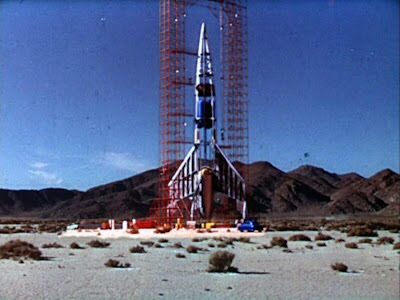 The Woody Woodpecker cartoon attracts investors (it's called "science fiction" for a reason...) and pretty soon construction begins on a Moon rocket using atomic energy to create enough steam thrusters to power it out of Earth's gravity and to the Moon. The entrepreneurial heads of the program are going to be the ones on-board for the flight, not test pilots, and they are Jim Barnes (John Archer) the aerospace magnate whose company built it, famed rocket scientist Dr. Charles Hargraves (Warner Anderson) who designed it, retired General Thayer (Tom Powers) who wants America's presence in space to be used for deterrence and technician Browne (Ted Warde) who supervised the technical aspects of the good ship, Luna.