Showing posts with label Cate Blanchett. Show all posts

Thursday, March 20, 2025

Black Bag (2025)

"You Are Cordially Invited to a Night of Fun and Games at George and Kathryn's"
or
"Will There Be a Mess to Clean up?" "Only if We Do it Right"
 
Something is brewing at the NCSC ("Making the UK the safest place to live and work online"), a division of the GCHQ, which is a branch of British Intelligence. Even before the titles come up, George Woodhouse (Michael Fassbender) is called to an off-site meeting with his boss, Philip Meacham (Gustaf Skarsgård—another one! A month of movie releases can't go by without one with a Skarsgård in it) who informs him "we have a traitor in our midst" regarding a very hush-hush program called "Severus" and Meacham wants him to find the "mole" and "ferret" them out. "Give me two weeks" says George. Meacham replies "If Severus is deployed as intended, thousands of people will die."
 
"Okay," says George. "One week."
 
It will be that kind of movie.
 
George, you see, is a highly-regarded agent at intelligence. And so is his wife, Kathryn St. Jean (Cate Blanchett) and he is absolutely devoted to her, as she is to him. But, we've seen enough movies with husband/wife teams in the same professions where vows and oaths clash enough that they can hasten the expiration date of "'til death do you part." And in the spy game, trust is everything, depending on verifiable proof. In the marriage game, trust is usually handled in another department and hemisphere of the brain.
And George has been informed by Meacham that his wife is one of the suspects. Oh, bother. That can tests one's concepts of loyalty, what? But, being a punctilious sort he begins his investigation by inviting the suspects over for dinner, prepared by him, and with the added ingredient being a drug to lower everyone's inhibitions—he has a reputation of being able to catch anyone in a lie—and that gets an amused admonition from his wife ("Darling, you must not dose our guests."), but, as we know, he only has a week.
The dinner guests include the agency's psychiatric analyst Zoe Vaughan (
Naomie Harris), her boyfriend and agent, Col. James Stokes (Regé-Jean Page), his counterpart Freddie Smalls (Tom Burke) and his girlfriend, satellite imagery specialist Clarissa Dubose (Marisa Abela). All work together for the agency for the head of the department Arthur Steiglitz (Pierce Brosnan), but all that really gets revealed at dinner is that Freddie, as is his way, is cheating on Clarissa, which results in her stabbing him in the hand with a steak knife. It is only one of three violent acts in the film, but it gets George no closer to the truth.
And he hasn't begun to investigate his wife, yet. As she was preparing for dinner, she happened to mention that she liked it when he watched her, but, she has no way of knowing how far that will go. He finds out her schedule—she's traveling to Zurich on business—and persuades Clarissa to temporarily way-lay a satellite and discovers that Katheryn is meeting a Soviet operative there. James informs him that she's got access to a Swiss bank account with £7 million in it and that a highly-placed colleague of the fellow she there has gone missing. Perhaps most alarmingly, Meacham—his boss who gave him the assignment of "finding the rat"—has unexpectedly died of a coronary. Things are happening pretty fast.
But, then it's a 
Steven Soderbergh movie. Black Bag is the second 
film he's directed film to be released in three months (the earlier one was Presence, also written by David Koepp), and it is more in the style of Soderbergh's caper movies (the "Ocean's" films, Logan Lucky, or Out of Sight), although slicker and with more of a professional veneer given the spy/thriller setting. It's stylish, witty, but with an underlying smartness that might leave some watchers in the cold. Things get complicated, red herrings abound, and if you're not paying attention, you could get lost. But, the spy vs. spy bubble the movie moves in gives it a certain edge where you're not sure whose side anybody's on at any given moment.
Call it Tinker Tailor Soldier Spy-lite, with a little bit more tech with spy-satellites and AI-enhancers and the like, plus a bit of sleuthing, psychological games, a big "MacGuffin", and even an Agatha Christie "it's-someone-in-this-room" reveal, checking off a lot of film-fan favorites. And the structure of the thing is a nice little touch. It's a clever little game, if not much of a thriller, although Soderbergh keeps it moving at a fast clip, and the badinage witty even if no one smiles. 

Thursday, May 2, 2024

Blue Jasmine

Depending on the Kindness (Enabling) of Strangers
or
Being Entitled to Your Opinion

Blue Moon/You saw me standing alone/
Without a dream in my heart/Without a love of my own/
Blue Moon/You know just what I was there for/
You heard me saying a prayer for/Someone I really could care for/
And then there suddenly appeared before me/

The only one my arms will hold/
I heard somebody whisper please adore me/
And when I looked to the Moon it turned to gold
Blue Moon/Now I'm no longer alone
Without a dream in my heart/Without a love of my own


Woody Allen's 21st century version of Tennessee Williams' "A Streetcar Named Desire," Blue Jasmine, is a contemporary version of the play's tragedy in an unsympathetic post-Bernie Madoff/Wall Street Bail-Out world, turning it into a moralistic comedy. It may seem a little misogynistic to be so mocking to someone as Williams' Blanche DuBois who has suffered a cataclysm, but when the someone is as cluelessly entitled and myopic as Allen's Jasmine (nee Jeanette) Francis (Cate Blanchett), there is a very real glee to see them get their, as the term is used in The Magnificent Ambersons, "comeuppance."
It's a brilliant conceit, combining Allen's love for classic literature and forms, tossing his own hang-dog spin onto it, while, for once, being refreshingly contemporary—something Allen hasn't really done of late, as he's had a depressive's obsession with the past for the past couple of decades (no matter how fresh the cast may be).

Allen starts his film (after the standard black background with white credits backed this time by '30's depression era rhythm and blues) with an (unusual for him) CGI shot of a jet approaching the camera, sailing by and moving away. Jasmine Francis ("I fell in love with the 'Jasmine.' 'Jeanette' has no panache") is on that jet flying from New York to San Francisco to move in with her sister Ginger (Sally Hawkins—her second film for Allen) for a fresh start after losing everything in her life. They're both adopted and couldn't be more different (As Sally says "She got the good genes."); Jeanette is all high cheek-bones and au couture, while Sally is low class and all teeth, surrounded by Guido's and roughnecks. Jasmine has suffered a reversal of fortune as her husband Hal (Alec Baldwin) has been caught wheeling and dealing in real estate schemes, ending up in prison, and committing suicide. Her extended visit delays Ginger's boyfriend Chili (Bobby Cannavale) moving in with her and her two kids by Augie (Andrew Dice Clay), her ex-husband. There's a bit of a sandpaper quality to Ginger and Jasmine's relationship; when Ginger and Augie were married, they lost a lottery nest-egg investing in one of Hal's "get-rich-quick" investment schemes, something Jasmine forgets when she drama-queens over her own plight, and dismisses entirely when confronted with it.

Jasmine (Blanchett) and Ginger (Hawkins)
So it rankles when Jasmine pulls a Mrs. Madoff and claims victim-hood about the money she's lost. Jasmine has no plans, no prospects, and there are hints of a nervous breakdown after she was found wandering the streets talking to herself. Now, she's popping Xanax with a vodka chaser and barely keeping ahead of anxiety attacks and comatose fugue states as she barrels through the lower echelons of San Francisco, trying to latch onto opportunities.
She decides to go back to school, learning computers so she can go "into" interior design, taking a job at a dentist's (Michael Stuhlbarg)—for which she is totally ill-suited (anything with the words "customer" and "service" in any combination would be)—to fund the courses. In the meantime, from her lowly status, she lords it over the family and friends she finds beneath her. That meaning everyone.

The flip-side to this is that people still find her attractive, as she puts up a great, if shallow, front, speaking of her glory days—which segue into flashbacks of her privileged happy life, only to find that once the flashback has ended, that she's still carrying on the conversation inside the flashback, and whoever she was talking through previously has left.
* It's a clever use of flashback as psychosis, a clever, nearly invisible off-shoot of the film-star (played by Jeff Daniels) stepping out of the film in The Purple Rose of Cairo. Where Allen has been living in the past the last few films, Jasmine is doing the same thing, to her detriment, as, whether in flashback or real life, it comes back to haunt her and take her away from the present and any future she might aspire to.

It's a return to near perfect form without the tricks and conceits that Allen used (during his "earlier, funny" films) and nicely merges the bi-polar extremes of comedy and tragedy that the more mature filmmaker in Allen has aspired to.  It also feels less fussy and musty than the after-taste some of the lesser Allen films have left of late. After a lifetime of making good films, some classic and some merely pedantic, and eschewing his earlier stylistic tricks, one wonders if, at the age of 78, Allen's best films might still be ahead of him and that's an exciting prospect.

Jasmine in her "fugue" state

* It's a bit like the Larry David monologues-to-the-camera in Whatever Works, only there's no child around to ask "Who's that man talking to, Mommy?"

Wednesday, April 3, 2024

Notes on a Scandal

Written at the time of the film's release...

Notes on a Scandal (Richard Eyre, 2006) There's a sub-category of movies that always sends K. and I into fits of giggles. It started when we saw (take a breath) Kenneth Branagh's film of Francis Ford Coppola's production of Mary Shelley's 'Frankenstein.' (whew!) We'd enjoyed Coppola's Bram Stoker's 'Dracula', and liked Branagh's earlier films. But something about this "Frankenstein" went seriously off-the-rails. It seemed like every performance was delivered at fever-pitch (except for John Cleese, who drastically underplayed to avoid Python-esque associations), Branagh's direction was a combination of Brian DePalma swoop-and-carousel moves and Michael Bay "shudder-shots," and Brian Doyle's score was dialed up "to 11." After awhile, she and I turned to each other with our eyes wide, and I said "I think everybody in this movie needs a good night's sleep!" and from then on, we couldn't take the movie seriously anymore.
Everybody in
Notes on a Scandal needs a good night's sleep. It's a bit like Snow White done as an urban British drama. Except "Snow" isn't quite as pure. Here's the gist: Judi Dench plays Barbara, an embittered veteran school teacher, who develops a fixation on Bathsheba (Cate Blanchett), a new art-teacher in school. Sheba, as she's know, begins an affair with one of her young students, which becomes known to Barbara quite early on. Barbara then devises a scheme to blackmail a relationship with Sheba and drive a wedge between her and her family, with the aim of having Sheba for herself. 
It's a joy (and a scary thing) to see Judi Dench turn on the after-burners and go into full "battle-axe" mode. Her Barbara is the creepiest creation since
Anthony Hopkins' Hannibal Lecter, with the added element of a pathetic (calculated?) vulnerability, and she's matched by Blanchett's distracted portrayal of the flibbertigibbet Sheba. There's one scene where both women go into an acting fever-pitch and its a bit like watching the performances fuse into one that's fascinating to watch, but makes you want to pull the "Emergency Stop" cord. And the hysteria is pushed at every hint of motion by Philip Glass' galloping score, even when it seems entirely gratuitous. It makes you want to back away slowly, get behind a locked door...and get a good night's sleep.

Tuesday, March 26, 2024

The Good German

Written at the time of the film's release...

The Good German (Steve Soderbergh, 2006)

"Berlin July 1945. Harry Truman, Winston Churchill, and Joseph Stalin are scheduled to meet outside the city, in Potsdam, to draw the post-war map. Only Japan continues to fight..."
 
This was the second of Cate Blanchett's (erk!) "Christmas" movies.* And it's a fascinating little experiment, but not a satisfying movie. 
 
In it, Steve Soderbergh attempted to do a film in the old "Warner Brothers" style. It's in black and white, done on back-lots with incandescent lights, and tube microphones and back-projection. Stylistically, it looks a lot like Michael Curtiz's staging of Casablanca, while in the many instances of conflict it resembles Orson Welles' in-your-face direction. The story, which takes place in a divided post-war Berlin is a bit like the cynical The Third Man crossed with the more romantic Casablanca. But it has the modern sensibility of more natural acting, language, nudity and hyper-cynicism. 
And it's like the two don't go together, there's such a cultural disconnect between the "silver-screen presentation" and the story that ultimately they're working at cross-purposes. It's tough to care about the machinations of the script when you're admiring the technique, and playing "identify that shot." 
Plus, the stars are ill-served by the conceits. Clooney is forced to be a bit more broad, which has never been his strength, and poor Tobey McGuire just can't cope—it doesn't help that he's playing drastically against type. The character actors fare better with more theatrical performances, and Cate Blanchett channels the languid sensibilities of Dietrich and Bergman to get by. 
Still, it's not an incompetent film—it's very accomplished. But the directorial decisions undercut the story, and one wonders why Soderbergh decided to pull off these stunts (which couldn't have been easy and certainly flew in the face of what studios think generate box-office) when a more straight-forward presentation might have served the story better.
** Whatever joys the old techniques generate (one of which is hearing Thomas Newman score a movie in the style of his father, Alfred) aren't worth torpedoing the film.

* The "other" was Notes on a Scandal, which also starred Judi Dench.
 
** Why did he shoot it this way? Probably a bit of nostalgia for the Warner style and the style of Michael Curtiz in particular. Curtiz was known to only use five lenses for filming, and Soderbergh restricted himself to just those types of lenses. Plus, the rigors forced him to shoot only what he needed for the film without re-shooting scenes for "coverage." As he told New York Times writer Dave Kehr for an article dated Nov. 26, 2006: "That kind of staging is a lost art, which is too bad. The reason they no longer work that way is because it means making choices, real choices, and sticking to them ... That's not what people do now. They want all the options they can get in the editing room."

Wednesday, March 6, 2024

Babel

or
"The Crash Heard 'Round the World"

A nice little movie that no one has ever heard of is
John Sayles' City of Hope made in 1991—it presents a limited space in time in the life of Philadelphia where the decisions of every character over the disposition of a single city block affects every other character in a way that negates any sense that lives can escape the self-imposed limits inflicted by others (and placed on themselves). Everyone is trapped and without any hope. 
 
Paul Haggis, when he copied the form in Crash offered the same bleakness but leavened it with individual rays of hope. One can look at these movies and quibble about coincidences and manipulation, but speaking as someone who's lived in one city and worked, basically, in one field for most of his life, those aspects of rubbing too many shoulders has never seemed like much of a stretch. It's pretty amazing how a large city can become a "small town" fairly quickly and without irony.
Babel
, though (named after the
tower
in the bible-story that created so many ESL programs), takes it one planet further. From its opening image of a Moroccan hunter trudging the desert to its last shot of a man holding a naked woman on a Japanese balcony, every single life is intertwined in a way that makes one wince, and actually creates dread over the next revelation of inter-connectedness (there's one character, whose absence sets in motion an unfortunate series of events, that we never see—supposedly she'll be in Babel II). It's a bit of a stretch, lessened somewhat by the global investigation of a mistaken act of terrorism. Nothing brings the world together like Homeland Security.
Still, if one can overlook The Big Skein that hangs over the movie like a shroud, the individual segments are involving, dramatically impeccable and present worlds that are never less than intriguingly realized. One wonders throughout where the stories will lead, even if the answer on an occasion or two is nowhere.
To reveal too much would be robbing the movie of any freshness it possesses, but suffice it to say that lack of communication is a key in all of them and that they are resolved (when they're resolved) by a recommitment to family (except when they're not). It's a bit messy in that regard. But, then, what world isn't?

Saturday, December 17, 2022

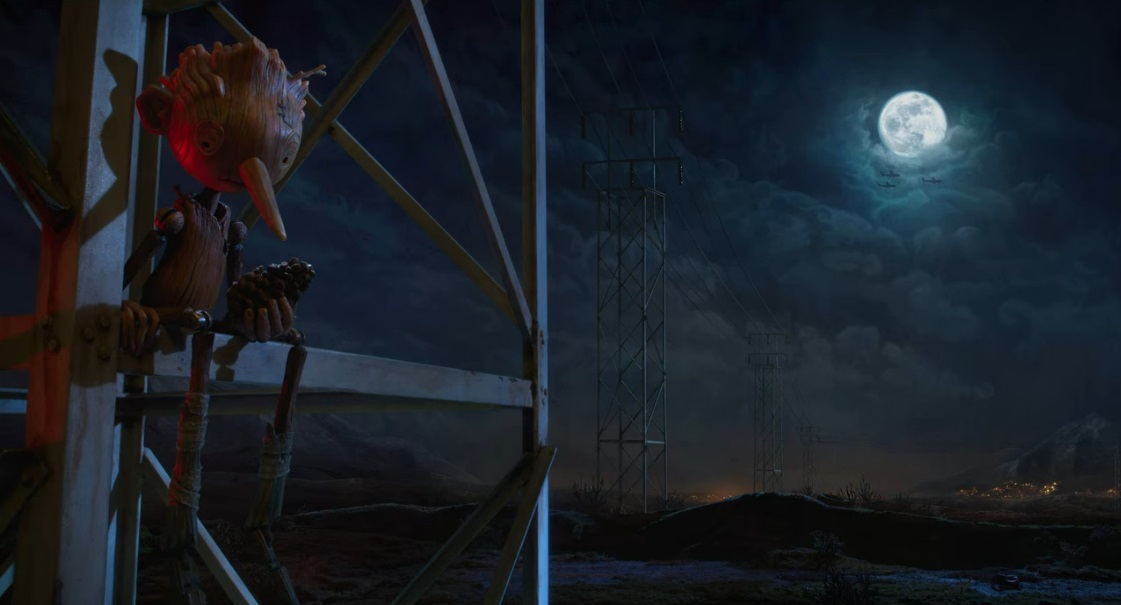
Guillermo del Toro's Pinocchio

Re-Tooling Pinocchio
or
"All Good Things Require Patience"

Good Lord, we're certainly in a nostalgia craze right now, but then self-isolation will do that to you. Spielberg did Fabelmans, Mendes does Empire of Light, and now del Toro makes a film that was inspired by an early childhood movie memory of his youth, his own version of Pinocchio. I can't fault him; I loved that movie as a child—and was obsessed with it, too. But, that was Disney's Pinocchio made in 1940. It's of a different time and a different sensibility.
 
Guillermo Del Toro's Pinocchio is quite another creature entirely. For one thing, it's set in the fascist Italy of the 1930's. And the puppet is a puppet, never losing his bark (as it were) and without the embedded wish of being a real boy. He's real enough and high on, if not life, anthropomorphism. But, he's a block of wood, cut from a tree, without the benefit of paint or clothes as per the Disney version (and the recent Robert Zemeckis adaptation on Disney+). 

And this version isn't 2D animation or CGI as with those. This is stop-motion animation, that pain-staking movie-making done (as with most animation) frame by frame. I've always had a soft spot for this type of work, be it from its earliest days of King Kong, through the mesmerizing work of Ray Harryhausen to the improvements of "go-motion" developed by the wizards like Phil Tippett for the Star Wars films. To think of these guys, with their little play-sets, moving their figures inch by perceptible inch, bearing in mind the incremental differences in perceptible motion and speed!) to create the illusion of life on film reveals not only the imagination but the science and mechanics of making moving pictures. We won't even talking about the commitment of walking to a studio knowing you'll probably only get a minute of film done (if you're lucky) every day.
So, hats off to
Mark Gustafson, who co-directed this—while del Toro was off directing live features, promoting them, winning Oscars, getting married and supervising his vision of what "his" Pinocchio story should be. Gustafson's work is incredible...and convincing. You get lost in this world and its creatures, all with their individual quirks and personalities (they move differently—by design, Gustafson's design). Those are determined by del Toro, they are brought to life by Gustafson's steadfast and steady work.
You know the story. Simplified, the story goes like this; Gepetto is a wood-carver/toy-maker who makes a humanoid marionette with the wish that it might be a real boy. Supernatural powers animate the puppet and, after the usual chaos that an energized blunt instrument can inflict, Gepetto insists that the thing go to school to be socialized, forgetting that society sees Pinocchio as a puppet walking around without strings and thus, something exploitable. Pinocchio gets gathered like kindling and tied up in a traveling show. Much searching occurs until getting swallowed by a whale, at which point, Pinoke proves his worth saving everybody and is rewarded.
But, it's the details. Disney's version leaned on the "wants to be a 'real' boy" wish, starlet-pretty fairies, anthropomorphized animals, and an emphasis on good behavior (while, curiously, demonstrating smoking, drinking, gambling, and vandalism) tent-poled with a lot of classic songs that perpetually show up in modern culture as well as hawking trips to Disneyland. The lesson to it all is "Always Let Your Conscience Be Your Guide," which implies that the conscience leads to good behavior that is accepted by society, the church, and the family. And that "being a real boy" is the sine qua non of life.
 
As they say at "CinemaSins": "That's speciest!"
Del Toro tells a different story, while keeping the nuts and bolts holding the thing together. It's set in the 1930's during fascist Italy (as we've said), and Gepetto (
David Bradley) makes his figure after his beloved son, Carlo, is killed in a bombing. Despairing (and drinking) he builds it from the tree that has grown out of his son's grave. Wood spirits (in the form of a slightly angelic figure—voiced by Tilda Swinton) show up and grant life to the figure and appoint resident cricket Sebastian J. Cricket (Ewan McGregor playing Obi-Wan for Disney a-gain!) as his guide and tutor.
The sight of Pinocchio (Gregory Mann) gallivanting cluelessly and curiously around his work-shop filled with sharp objects understandably freaks out the hung-over Gepetto. And his instincts are to curb his enthusiasms or, failing that, lock him in the closet to minimize the damage he causes. It's easiest to do the latter, ironically when he's going to church) But, Pinocchio cannot be contained and he follows his "Papa" to the humble chapel adorned with a crucifix built by Gepetto.
But, the parishioners are aghast! What unholy thing has desecrated this House of God? It's an abomination and (not only that, says the town's fascist leader, Podesta-voiced by "del Toro regular" Ron Perlman) he's a "dissident. An independent thinker, I'd say." All because Pinocchio looks at the wooden Christ on the cross (also built by his "Papa") and wonder "How come they like him and not me?" Poor Pinocchio. He's a beginning student asking post-grad questions.
Time to send him to school, but he's easily distracted by an offer from the unscrupulous Count Volpe (
Christoph Waltz) to join his circus and become a performer in his traveling puppet act. Soon, Pinocchio is quite the attraction, attracting the attention of a desperate Gepetto and the fascist Podesta—who wants to gain favor with Il Duce, Benito Mussolino (Tom Kenny), who fancies puppets as much as he fancies being the ultimate puppeteer. Dictators always have that fantasy, whether they rule a puppet government or not.
This is all delightful, even if its satire is heavy-handed (fascists deserve no less) at times, and its humor is periodically ghastly (it is del Toro, after all), but it caroms along at a brisk pace, occasionally interrupted by songs (composed by the always inventive
Alexandre Desplat, with lyrics by del Toro and Roeban Katz) that are sometimes interrupted themselves by some boisterous activity that ends them in mid-note.
And it adheres to the "Always Let Your Conscience Be Your Guide" maxim in a way that works in a complicated way where Society may not always be in the right. I like that. Like the movie itself, its heart is is exactly the right place where it should be, even if there is no heart in evidence.
 
This is a Pinocchio I can admire, no strings attached.

Friday, November 4, 2022

Tár

Kavanah (Conductor Unbecoming)
or
SNR (One Man's Ceiling is Another Man's Noise Floor)
 
Lydia Tár (Cate Blanchett) is a world-class conductor, having conducted "the five great orchestras" and is the first female conductor of the Berlin Philharmonic, she is an EGOT winner, composing for both film and stage, and with a teady contract with Deutsche Grammaphon, has her duties with many fellowships and programs around the world, teaches at Julliard, and is out doing press for her new book coming out called "Tár on Tár."
 
As the joke goes, she has a hard time keeping a consistent job.
 
She could tell that joke in several different languages, is world renowned, is a virtuoso concert pianist (even being able to imitate other virtuosos' playing styles) and does interviews with a breezy combination of expertise and modest self-deprecation, describing herself as a "U-Haul lesbian" married to her concertmaster Sharon (Nina Hoss), with whom she parents Petra (Mila Bogojevic), the six year old daughter. She was mentored by "Lenny" and, being an ethno-musicologist, is well-versed on music of all variations and cultures. She even makes Jerry Goldsmith jokes (how arcane!).
In her lectures, she is passionate and esoteric (but makes sure that she couches it with the common touch for the masses) and encourages her students to be fully involved, and embrace music free of strictures of time-period and cultural origin...or comfort. She really does deserve that "acute" accent in her surname vowel as she is, per the definition (Oxford—only Oxford): "having or showing a perceptive understanding or insight; shrewd." 
Well, maybe leave that last part out. Because she also fits the other definition: "
(of a bad, difficult, or unwelcome situation or phenomenon) present or experienced to a severe or intense degree." Intense, certainly. Severe, but muffled in the language of the polite, business-like and the erudite. Still, having a well-considered background can't always save you from being ground in the gears. People can be dazzled by the highbrow, but they get defensive when only one of those eyebrows is raised.
The film starts with Tár being photographed on a cell-phone while snarky comments are posted back and forth. We then hear her encouraging a native singer while the technical credits play out over the screen. This is unusual; the long credits are usually saved for the back-page of a movie (here the cast is saved for last). It's an acknowledgment of just how many souls are involved in a "singular vision," which, despite Tár's fame (or the director's) and their image as ring-master, rely on the hired hands to bring it to reality.
We get an interview with her as part of a media blitz which provides a lot of background, then we see her talking to a smitten fan while her assistant Francesca (Noémie Merlant) checks her watch for the next "go-to" moment. We see her in lunches with associates, mentors, and patrons. We see her teach a conducting class where she instructs, informs, lectures, cajoles and condescends to her students until one of them just walks out in disgust. Meanwhile, there are the details—one of Tár's protégés has been trying to make contact her only to be ignored and spurned until the young woman commits suicide. Lydia instructs Francesca to delete all of her e-mails. Her daughter is being bullied at school, so Lydia drives her to school, singles out that child and threatens her (in German!) that if she does it again, she will "get" her, and if she tries to tell somebody in authority about it, no one will believe her. Then, there are suspicions that Tár is grooming a Russian cellist (Sophie Kauer); it's happened before and the consequences were dire. Tar's orchestras are in lock-step and sound harmonious. Her staff and associates and lawyers are starting to rebel.
Todd Field—this is his first film since 2006's Little Children—is closely associated—too closely, I think—with Stanley Kubrick. He appeared in Kubrick's Eyes Wide Shut and, while on-set, was subjected to the Kubrickian "grilling" of why he wanted to make a film of In the Bedroom (which he directed in 2001). Too much is made of the connection between the two as their "styles" are very different. But, Tár does share a certain thematic kinship with a thread running through Kubrick's films, that of people being too smart for their own good. Of brilliant people (and systems) being undone by character flaws or unanticipated consequences, or by the mere vagaries of Fate.
There is also the stringent way that Field refuses to "stack the deck" in his screenplay: you see the good in Tár as well as the bad and you see the good intentions and the bad consequences of the forces that undermine her. There's no judgment here. It's simply the environment in which the character operates, one that she has exploited to her gain and utilized to her detriment. One can rail against "cancel culture"—and those on the receiving end of it always do—but, there's always some hurt feelings and wounded pride mixed in when those in power come to the realization they don't have power over people's money or people's time (and how they spend both) and that, however high their intentions, they're just another stall in the marketplace of ideas.
Any artist must consider their audience—just as writers do—even as they bring their own ideas to the fore because nothing exists in a vacuum. If one is going to present music, one must consider the acoustics of where it will be played. And, as is made clear throughout the film, Tár never considers her acoustics, her surroundings. Little sounds annoy her—and the sound design of the movie is brilliant. In the majesty of her work, her interpretation, one wonders what she'd do to the person in the audience who coughs.
 
The film makes no judgment; it just tells a story. It's up to the viewer to draw their own conclusions on what's what. There will be arguments and counter-arguments. Everyone will have their own singular interpretation and reaction. There's no "right" answer, no matter how learned and studied yours might be. Or how prejudiced. For me, it brings up several uncomfortable ironies: how the cultured can be very uncultured when dealing with things that scratch people's sensitivities and how the liberal arts can piss off the disenfranchised and how the fringe can be very parochial.

Saturday, December 25, 2021

Don't Look Up (2021)

Deep Impact on a Shallow Planet
or
The Dinosaurs Couldn't Say 'Told Ya So..."
 
A recent article in The Atlantic says that there are 21 million Americans who have no relationship to reality, wanting to re-instate Donald Trump as President of the United States, citing sheisters, Alzheimic Air Force Generals, and bad math to support their contentions. There's a bunch of Gen Z's who think birds are fake (they should get together with the folks who worry about chem-trails—there must be a connection because they're both in the AIR!) And we've always had Flat-Earthers because they've never been in a plane and figured out why the shortest distance to get to anywhere is not over the pole.
 
But, ask a farmer about global warming and they get serious.  Or a gardener. They've seen the time-shifts. They've seen annuals sprout too early. Crops lose their "window" and you compensate by shifting the planting earlier, risking the prospect of freezing. They know. You can't count on the Earth anymore. You can't count on anything...except maybe on one hand the number of friends you have that actually might be sane.
 
It used to be "If You Don't Stand For Something, You'll Fall for Anything." Now, with the internet the harder you stand, you'll fall even harder.
So, with that little sanctimony out of the way...what's the scoop on Don't Look Up, Adam McKay's look at "problem-solving" in a modern "connected" world?
 
McKay's conceit is to look at the "climate change" debate in a metaphorical way—what if we knew an "extinction-level" sized body was going to hit the Earth and we couldn't depend on our leaders, political or business, to save us for any reason?
Michigan State doctoral candidate Kate Dibiasky (Jennifer Lawrence) is spending a quiet night at an observatory studying trace gasses in dead galaxies for Astronomy Professor Dr. Randall Mindy (Leonardo DiCaprio) when she sees something weird on the screen. It's a comet...and it's moving. Mindy is called and he and his grad students celebrate what will be the Dibiasky Comet, and start working the orbital path...when Mindy starts to get nervous and tells all the other students to go home. Except for Kate. She sees what he saw: that the comet is heading for Earth. It's 5-6 km long and it will hit Earth in 6 months and 14 days. Call it 26 weeks.
They call NASA, who conference calls them in with Dr. Teddy Oglethorpe (
Rob Morgan) of the Planetary Defense Coordination Office. The link says it's real. And shit just got real; Oglethorpe mutters "that's a big boy" and then goes quiet when he realizes it signals "an extinction-level event." And while NASA advises caution, Oglethorpe orders a plane to bring Mindy and Dibiasky to the White House to tell the President. Dibiasky sees the Oval Office through an open door and grabs Mindy: "Are we really about to tell the President of the United States that we have just over six months until humankind—basically every species—is completely extinct?" Getting a shaky affirmative, she promptly throws up in an executive waste-basket. 
They're kept waiting for seven hours because the Executive Branch is in crisis mode: their nominee for Supreme Court justice has been revealed to be a pervert. Coming back the next day, they're given 20 minutes to explain what's going on and it doesn't go well: Mindy is nervously hyperventilating and that's off-putting to the coke-head Chief of Staff (
Jonah Hill), who got the job because he's the President's son. The President (Meryl Streep) is a hot mess, unable to focus on the potential disaster for need of a smoke, and saying that the timing of this "is atrocious" (mid-terms). She cuts to the chase: "What's the 'ask' here?" "Save us" is the reply. The decision is made to have "her people" look into it and "Sit tight and assess."
The three scientists can't believe it—they only have six months—so, they decide to take it to the press, the Washington Herald, who sets up a segment on it at the end of "The Daily Rip" (hosted by shiny anchors played by
Tyler Perry and Cate Blanchett) after a segment on the disasterous Supreme Court pick and then on the break-up of two "important" pop stars (Ariana Grande and Scott Mescudi). Warned that they don't have "media training" Dibiasky and Mindy have trouble negotiating the happy banter of the hosts until Dibiasky cracks and melts down on-camera: "Are we not being clear? Maybe the destruction of the entire planet isn't supposed to be FUN! Maybe it's supposed to be terrifying." The hosts are affronted. That's just bad form. And bad television. Dibiasky becomes a snarky meme, and interest in the Herald's story on the internet drops like a comet from the sky. So, they stop covering it.
But, because they've gone on national TV with national secrets Dibiasky and Mindy are arrested by the FBI, and the White House has to scramble. President Orlean goes on television in an elaborately staged event on a naval vessel to announce an emergency spending bill to launch a space mission to try and blow up the comet—a space mission that is manned by a single astronaut (
Ron Perlman) because "Washington needs a hero." All well and good until a cell-phone/tech pioneer, Peter Isherwell (Mark Rylance), is told by his team that the comet is a source of Earth-depleted minerals that are critical for making cell-phones. The mission is scrubbed—he's a big donor to the President's campaign—and another mission is planned to break up the comet and have it's pieces fall into the Pacific so they can be recovered and resourced.
One sees the point: nobody is going to do anything about it while there's time enough for people to figure out a way to make money from it, because that's the only "killing" they're concerned about. If there was a way to take carbon out of the atmosphere that wasn't deemed fiscally expensive and would make a fortune, we'd be worrying, instead, that there was too much ice at the poles, rather than selling our waterfront property. Don't Look Up merely converts that to the disaster scenario of Armageddon—at times the movie looks like Michael Bay's "this would look great in a car commercial" style of film-making—or Deep Impact.
The satire veers all over the place, sometimes sharp (of course people wouldn't believe it until they saw it with their own eyes, and, of course, a television chat show would cock up such news and, of course, a screaming fit on-air is going to be dismissed and the stuff of internet jokes) and heavy-handed (the political stuff is baldly aimed at the last administration, with the difference being that the Orlean team look a bit more competent and decisive). It falls somewhere between Hitchhiker's Guide to the Galaxy smart and Tropic Thunder dumb without ever achieving Dr. Strangelove brilliance. One grimly concedes McKay's aiming for the fences but he sometimes gets distracted by his own gee-wizardry and sarcastic weltschmerz to score a home-run.
Some of it is performance issues: Perry and Blanchett are rather one-note, but that seems appropriate for chat hosts. Hill's performance is as obnoxious as it's supposed to be, but Streep wears her tweet-hurt a bit too far, although it is reminiscent of Sarah Palin-subtlety. DiCaprio tries to achieve his Wolf of Wall Street comedic heights at times and falls short, but impresses in his dramatic scenes. Lawrence is terrific as the audience stand-in for expressing incomprehension and Rob Morgan stays out of comedy territory completely and frequently becomes a life-raft of reason. Best of all is Mark Rylance, who makes his tech entrepreneur suggestive but not an imitation, with just the right touch of Asperger's, child-like wonder, and child-like malice.
The reviews for Don't Look Up have been horrible, accusing McKay of condescension and being supercilious—social critics usually are—and there's a whiff of that here. But, there's also an earnestness that his heart is in the right place, if slightly broken, railing like a mad prophet to an ignoring, apathetic crowd. Despite the brickbats, I found myself enjoying it much more than I suspected I would, recognizing its weaknesses but appreciating the strengths.  
Now, about the message. Maybe by clothing "climate change" in a more direct disaster scenario is too subtle. There is a scene in the last season of "The Newsroom" ("Main Justice" Season 3 Episode 3) where there's an interview with a scientist from the EPA who has been prevented from issuing an alarming report about the environment (involving CO2 levels measured in Hawaii), and when asked to sum up the findings replies "a person has already been born who will die due to catastrophic failure of the planet" The anchor is taken aback and tries to walk it back to a less alarming conclusion, "Let's see if we can find a better spin...people are starting their weekends."
 
There isn't one. The only counter-argument is denial and that's just deflection and a stall to action. And we're doomed anyway. It's funny and it's a gut-punch. A sick joke that punches right in the nose.
 
On the much grander scale of things—pale blue dot-wise—cosmic catastrophes happen all the time—we just haven't heard about it since we haven't gotten television from there (yet)...because it's a messy Universe, despite all the space. We postulate the supernovas, the gravity collisions, but cannot grasp the implications, like imagining what happens to an ant colony when developing condo's. But, think of it in the "if Helen Keller fell down in a forest, would she make a sound" kind of way: "What if there was a cataclysmic event, and nobody did anything about it?"
 
The cosmic punch-line is "They deserved their fate."