Showing posts with label Brad Pitt. Show all posts

Wednesday, March 6, 2024

Babel

or
"The Crash Heard 'Round the World"

A nice little movie that no one has ever heard of is
John Sayles' City of Hope made in 1991—it presents a limited space in time in the life of Philadelphia where the decisions of every character over the disposition of a single city block affects every other character in a way that negates any sense that lives can escape the self-imposed limits inflicted by others (and placed on themselves). Everyone is trapped and without any hope. 
 
Paul Haggis, when he copied the form in Crash offered the same bleakness but leavened it with individual rays of hope. One can look at these movies and quibble about coincidences and manipulation, but speaking as someone who's lived in one city and worked, basically, in one field for most of his life, those aspects of rubbing too many shoulders has never seemed like much of a stretch. It's pretty amazing how a large city can become a "small town" fairly quickly and without irony.
Babel
, though (named after the
tower
in the bible-story that created so many ESL programs), takes it one planet further. From its opening image of a Moroccan hunter trudging the desert to its last shot of a man holding a naked woman on a Japanese balcony, every single life is intertwined in a way that makes one wince, and actually creates dread over the next revelation of inter-connectedness (there's one character, whose absence sets in motion an unfortunate series of events, that we never see—supposedly she'll be in Babel II). It's a bit of a stretch, lessened somewhat by the global investigation of a mistaken act of terrorism. Nothing brings the world together like Homeland Security.
Still, if one can overlook The Big Skein that hangs over the movie like a shroud, the individual segments are involving, dramatically impeccable and present worlds that are never less than intriguingly realized. One wonders throughout where the stories will lead, even if the answer on an occasion or two is nowhere.
To reveal too much would be robbing the movie of any freshness it possesses, but suffice it to say that lack of communication is a key in all of them and that they are resolved (when they're resolved) by a recommitment to family (except when they're not). It's a bit messy in that regard. But, then, what world isn't?

Saturday, January 21, 2023

Babylon (2022)

I admire writer-director Damian Chazelle's work, so it pains me to say that Saturday is traditionally "Take Out the Trash" Day.
 
Angels and Ghosts of Toxic Nostalgia
or
Make Hollywood a Cesspool Again 
 
Yeah, well, nostalgia isn't what it used to be. 
 
Damien Chazelle's Babylon tries to be many things in its break-neck, inarticulate way: a love-sonnet to "Cinema", an hysterical screed about ambition (the uphill) and the Fickle Finger of Fate—and Fashion (the downside), an impotent rage about the inevitability of Change, and an excremental wallow in excess "just because we can."
 
It's also a bit of a litmus test on how you feel about Hollywood: starry-eyed dreamy or worm-at-the-bottom-of-a-tequila-bottle cynical. You can love the taste of sausage, but you don't want to see how it's made. 
 
Movies about movie-making rarely make a lot of coin at the box-office, but the industry does love to bestow them with Oscars. Babylon has failed at the former, and, because it's not properly rose-Technicolored besotted with The Art, it won't win any bling, either.
It's 1926, and Kinoscope studio head Don Wallach (Jeff Garlin) is throwing a wild party—security is loose, morals are looser, and everybody is either tight or flaccid—at his palatial Bel Air estate high atop a graded mountain with nothing around it but steppe and orange groves. The house looks like it fell out of the sky to the most desolate place on Earth. Thus, it's quite a task to transport anything to the place. We meet Manuel Torres (Diego Calva)—"Manny" to just about everybody who can give him a job—who has convinced one of Wallach's assistants (Flea) that he can deliver an elephant to the party. An elephant. This proves problematic and particularly perilous as the pachyderm's poundage prevents purchase. The solution? Roughage. The subsequent eruption of elephant diarrhea—which Chazelle stages like a famous silent film clip (thanks, Damien! This won't influence my review at all!)—blows enough ballast to allow everyone to get all the way up the hill.
That serves as a warning shot for the next 30 minutes as Chazelle presents his version of the "Godfather wedding", where he introduces all of the principal characters attending this orgiastic party of excess. But, where Coppola stages his sequence with snapshots of telling detail, Chazelle glides his camera in, up and around the frontal and backal nudity bumping and grinding to obfuscate the- something-to-offend-everyone anything goes-ery of his bacchanal.
We meet: Manny (of course), Mexican immigrant, who is the ultimate volunteer ("I'll do it!") to get ahead; the gossip columnist Elinor St. John (Jean Smart), who's seen a lot ("I knew Proust, you know..."), but only divulges the choice bits when it's to her highest advantage; star Jack Conrad (Brad Pitt), a reigning light at M-G-M, slumming it at the party which he attends on his wife (Olivia Wilde) just announcing that she's divorcing him as the capper to their latest spat, Lady Faye Zhu (Li Jun Li), the most capable one of the bunch—she does a rich Dietrich routine to a song that's hard to believe was of the period—but is a minor player at Kinoscope because 1) she is bi-sexual (which she can hide) and 2) she is Asian (which she can't). 
There's bandleader Sidney Palmer (Jovan Adepo), who is professional amidst all the madness, but still keeps the energy of the party lively through his work. Late to the party (and not invited) is Nellie LaRoy (Margot Robbie), a New Jersey native who just knows she's going to make it in Hollywood ("Ya either a stah or ya ain't! And I'm a stah!"), and whom Manny instantly crushes on.
After a cocaine-binge with Manny, Nellie's go-for-broke dancing at the party attracts the attention of Kinoscope brass, who are in need of an actress on-set the next day—it seems the one they hired has just died upstairs after a drug-fueled micturating display for star Orville Pickwick. By the morning, Nellie's on her way to the Kinoscope set out in the desert, and a drunken Conrad has been driven home by Manny, whom the star immediately makes his assistant ("He can do anything!").
Conrad tells Mannie the movie set is "the most wonderful place in the world," but when Nellie gets there it's anything but. The "studio" is a large field, fenced off to keep the "Hire me" crowd at bay, and there are 10 sets running simultaneously (there's no sound to interfere with silent movies), orchestras playing to provide "mood music" and a sense of chaos going on everywhere. Nellie is shuffled off to make-up, brought back, made up again and then thrown into the shoot, where she acts and dances with abandon, overshadowing the film's star (
Samara Weaving). Meanwhile, a hung-over Jack takes Manny to the space where they're making his costume epic with 10 cameras filming a battle scene where the knights are played by skid-row bums off the street. One of them gets killed by running into his own spear.
It's anarchy, but, despite that, sometimes magic happens. When Nellie is asked to cry for a scene, the director (
Olivia Hamilton) is amazed that she can produce them on cue. "You think you can cry a little less?" "How many drops and which eye?" Nellie asks, and, as promised, delivers that many drops from that eye. "How do you DO that?" her director asks. "I just think of home." Nellie says matter-of-factly.
You see where this is going: Chazelle the director is in love with "the timeless" image and Chazelle the writer is showing the work, patience, pain, suffering, and craziness employed to achieve it. Even if it kills you. Throughout the time-frame of the movie—1926 through (significantly) 1952—the stars will have their ups and downs, the first become last, the insignificant achieve power, and they all can lose it with a bad headline or a stupid choice...in a land and profession rife with the possibilities of both. Lives and relationships are fragile and are erased and forgotten in the quest for the indelible image made by artifice. 
The advent of talking pictures will be a life and game-changer for the industry. Technicians will be under more pressure, and the performers will have to be all-around actors, not emoters, not just-pretty-faces...and if their voices destroy the illusion the audience has of them, it's a career crusher. We've seen the story before. What Price Hollywood? (or its progeny, the various versions of A Star is Born) The Artist. Truffaut's Day for Night. Bogdanovich's Nickolodeon. Directors get nostalgic for the simpler times of film-making and return to it once they have success. It's as if they have to re-torch the pilot light to remember why they loved making movies in the first place. As the bandleader Sidney Powell says of making movies "I think they got the cameras pointed in the wrong, direction. That's what I think." Directors can't resist the urge of turning the camera.

And there's one more most appropriate example:
 
Singin' in the Rain.
Made in 1952. About the struggles of performers to adjust to "The Talkies." It is no coincidence that Chazelle references it twice in Babylon, and does so directly when Manny goes to see the movie and breaks down in tears. It's a story he lived. But, instead of death and ruin, it's in Technicolor with music and songs and laughs, even in the face of humiliation and tragedy. No one thinks of Clara Bow or John Gilbert or Anna May Wong or "Fatty" Arbuckle while they watch Singin' in the Rain. The film-makers are too good at their jobs. They're having too good a time. If you laugh, the world laughs with you...
Chazelle shopped Babylon around town after Whiplash caused a stir and he was advised it was too big a project too soon. Someone suggested a musical and so he made La La Land, instead—the modern era's version of Singin' in the Rain with music and dancing and aspirations and baked-in nostalgia. But, it's the antithesis of Babylon, just as one could say that, with Babylon, Chazelle made the "anti-Singin' in the Rain," telling the same story, but without the Technicolor-tinted filters, the practiced and fluid choreography, the charm or the illusion. Oh, it's got production value and good performances and period detail and moves like a bat outta hell. It just doesn't leave you with any feelings other than wanting to take a shower.
Babylon tells the story of what happens when you lose success, but, in an unintentionally meta-way, it also tells the story of what can happen if you have too much. You make a bad movie that you think is wonderful and important.
In the pre-showing "vamp", Margot Robbie says she's grateful that Babylon can be seen "as it should be...with an enthused audience." Well, keep wishing, sister.


Saturday, October 22, 2022

Interview With the Vampire: The Vampire Chronicles

Interview with the Vampire: The Vampire Chronicles
(Neil Jordan, 1994) I remember reading Anne Rice's novel of "Interview with a Vampire" many, many years ago and found it a dispiriting read. In fact, by the time I got around to watching the film, everything about the story had evaporated into the ether, like one of her vampires sun-bathing. I do remember the controversy of
Tom Cruise being cast as vampire-manipulator Lestat and that there was much consternation about it. My viewing of it made me think that Cruise was the best thing about it, one of his very few performances where he stretched as an actor and a personality. The rest of it, if you'll pardon the pun, sucked.

Certainly, director Neil Jordan isn't to blame. His direction and general look for the film is exemplary, giving the film an elegant if decaying look—after all, vampires are immortal, so why would they be concerned with daily chores (plus vampirism is 180° from Godliness). Casting is fine (even if some of the acting isn't), and Jordan even throws in a couple of touches of the surreal, if only for the sheer creepiness the effect has.
Daniel Molloy (
Christian Slater) is in a nondescript San Francisco apartment, waiting for his interview subject to arrive. Surely it will be an evening interview, as he is Louis de Pointe Du Lac (Brad Pitt), who is supposedly a vampire. Skeptical, Molloy quizzes him about the various vampire tropes, which he dismisses, the legends he says coming from "a demented Irishman". But, the coffins, yes.
Then, he tells his story—of how, in 1791, despite wealth and property in Louisiana, he falls into self-destructive depression when his wife dies during childbirth. During a drunken night, he is followed by the vampire Lestat de Lioncourt (Cruise) and after being attacked by him, is offered to be killed and turned into a vampire, "giving you the choice that I never had." The two become constant companions of the night-world, never again seeing the sun (in a neat little bit, Louis becomes obsessed with the sun, even going to see Sunrise: A Tale of Two Humans directed by F.W. Murnau, who, more famously, also directed Nosferatu, the first vampire movie).
But, the two have decidedly different ideologies of life...or after-life. Lestat is a libertine with no moral code, taking his victims at his pleasure, perhaps in vengeful bitterness for the way that he was turned without having any choice in the matter. Louis is appalled by this and regrets the taking of human life and would rather feed on animals, which is something that Lestat constantly mocks. He does make one exception. When a plague decimates the country-side, Louis finds a child (
Kirsten Dunst) whose mother has died of the disease and turns her, giving her immortal life. For him, this creates a sort of ersatz family. For the child, Claudia, it gives her immortality, but traps her forever in the body of a child. She may mature, growing older and wiser in her mind, but will remain at the age in which she is killed.
The novel and film have become favorites in the LGBTQ community for its metaphorical take on hidden societies and non-traditional families, and one can see that point of view. One rebels, though, that the metaphor is ensconced in such an anti-life trapping. These vampires are murderers, and even Louis, squeamish as he may be at homicide, loses his moral ambiguities when it suits his purposes. They seem more like a cult to me than a healthy representational metaphor. Your moral mileage may vary.
And, these vampires are also incredible narcissists. Everyone is selfish to a degree, but these nether-folk would be death at a party, fixating on themselves, bloviating their philosophies and negatively-lighted world-view and looking upon the lighted world as merely a buffet to exploit. Given the era in which it's set, one would half-expect them to become imperialist and invade other countries.
But, what leaves me as cold as a corpse about Interview with a Vampire is Brad Pitt's performance as Louis. Granted, that he was only a couple of years from his true break-out roles and was still finding his way to matter as more than a pretty face. But, his Louis is such an opaque presence that he seems at sea most of the time, not able to make depression, self-destruction, or even drunkenness very interesting. He internalizes so much as to make any emotion he's trying to convey invisible to the naked eye. He's turned into a phenomenal talent as actor. But, at this point, he wasn't.
And while I'm no fan of Tom Cruise, one has to give kudos to his Lestat, as grandiose and theatrical a performance as he's ever given. Sure, he can go too far in movies, but, his Lestat is such an unmitigated purveyor of debauchery (and loving it) that Cruise could never really go too far "out there" and not have it seem uncharacteristic. His Lestat simply wouldn't care, and it makes it one of Cruise's best works, horrific as it is.

Tuesday, May 11, 2021

Ocean's Thirteen

The Plot Thickens.... 

Oceans Eleven was an enjoyable, breezy updating of a not-very-good "Rat Pack" movie with a nicely eclectic cast from many walks of the entertainment industry. It was a lark, with no real sense of any danger or risk. It just seemed like director Steve Soderbergh and star George Clooney (partners in the production company, Section 8)were getting free rein of Vegas and dragging along a bunch of pals along with them.
Oceans Twelve, however, showed signs of fatigue. Instead of Vegas, it was filmed in Europe. The large majority of the cast was arranged to "rot in jail" for most of its running time, while Matt Damon and Julia Roberts carried the weight of the plot, storyline and ad-libbed dialogue to sometimes excruciating effect (Okay, so Roberts played Tess Ocean, the wife of George Clooney's character, and when he gets way-laid, she flies to Europe where she's recruited to pass herself off as...Julia Roberts, and hilarity ensues when *gasp* Bruce Willis "cameos in" to complicate matters!!) Not much worthwhile there, but Clooney got to write off his Lake Como estate, so I guess that's something.
So, now it's the third go-'round, the unlucky Thirteen and to "play it safe" and "cover all bets," the crew goes back to Vegas to avenge another hoodwinking of deep-pockets gang member Reuben (Elliott Gould) by another puffed-ego Vegas properties owner, one Willie Bank, played by Al Pacino on cruise control. Once again, it's a con of "Mission: Impossible" proportions involving false identities and accoutrements, loaded dice, coins and roulette balls and the use of not one, but two large tunnellers (that were used to dig the Chunnel we're told) to carry out the various schemes. While it's true you have to spend money to make money this movie takes it to new extremes. 
Along the way there are pleasant cameos by
Julian Sands and Eddie Izzard (Roberts and Catherine Zeta-Jones' absences are explained away quickly--"it's not their fight"), Vincent Cassel (from 12) and even Exec. Producer Jerry Weintraub. Everything's in place--everybody's a wise-acre, Clooney makers a tuxedo look like casual wear, Pitt's wardrobe is still horrendous, and they even manage to work in Andy Garcia's rival casino owner in on the plot--though fortunately, they don't turn him into a suddenly reformed "good guy." 
Ellen Barkin and Matt Damon
(with the nose he wasn't allowed to wear in The Brothers Grimm)

Because Pacino's on board, there's a couple sneaky Godfather references in the dialog--one to Pacino's face, but like most of the in-jokes (right down to the last lines) they're so "inside" that they'll probably go over a large portion of heads. But despite these minute differences, it's the first movie all over again--like Return of the Jedi, the third in the "Star Wars" series and Last Crusade, in the "Indiana Jones" cycle--but as with those films, the ingredients making up Ocean's Thirteen have been left out to curdle a bit. It's fun and all, with a couple of laugh-out-loud moments involving Oprah Winfrey, and Soderbergh directed, shot and edited the thing himself, but is it too much to ask for something a bit more original? One gets the impression that if not for the perks to cast and crew, they would have done well to have left the table and cashed out a little earlier.

Thursday, May 6, 2021

Burn After Reading

Advanced apologies for the about-to-happen "Cloonification" on this blog—actually it won't be so bad, maybe three in the next week—but, I'm trying to post as much Clooney performances as I have for The Large Association of Movie Blog's "Acting School 101" featuring George Clooney. I've been missing a bunch of those postings with various actors and I've just done a podcast—which won't air until November, it's kind of a Big Deal—with MovieRob (who runs those things on the site) and I promised him I'd participate (Really, Rob, I will!)

Incidentally, as I mentioned so many of their films in this post, the Coen Brothers entire movie output can be found on this site, split between Part 1 and Part 2. Check them out.

This was written at the time of the film's release.

"Joel, you wanna know something? Every now and then say, 'What the fuck.' 'What the fuck' gives you freedom. Freedom brings opportunity. Opportunity makes your future."
Miles from "Risky Business" (1983) written by Paul Brickman

Then there's the corollary to those hopeful words, the Coen Brothers' new film Burn After Reading. It's a comedy, so that means folks who swoon when they're making serious films, like Miller's Crossing, or No Country for Old Men will look at it like it's a red-headed step-child, along the lines of Raising Arizona, The Big Lebowski, or Intolerable Cruelty. Thing is, they're all products of the same sensibility; the perverse sense of the world that informed Blood Simple, and Barton Fink, Fargo, and O Brother, Where Art Thou? informs Burn After Reading, especially in this time of national dependence on the Intelligence Community.

But back to "WTF."** A lot of people say "What the Fuck?" in Burn After Reading. In fact, I'd have to see it again (not an unpleasant thought), but I got the impression that every single major character in the story says it at least once. And not in the good way of the opening quote that supposedly produces opportunity (though it might for those wearying "Up With People" souls who see every problem as an opportunity, and every half-empty glass as half-full).
No, it's usually uttered in shocked disbelief at the events that transpire. It's because Burn After Reading belongs to that sub-category of comedy (and tragedy) "The Incredible Mess." It's where the hopes and dreams of a dedicated few turn into a nightmare that no matter how hard they try, their efforts to extricate themselves only make matters worse. Fighting it is a losing strategy. "Yeah, sure, it looks like quick-sand; what's your hurry?"
CIA analyst Osborne Cox (John Malkovich) has been fired from his job and he's pissed enough to write a tell-all book blowing the doors open on the Agency. One thing he won't put into the book-as he's ignorant of the fact--is that his wife, Dr. Katie (Tilda Swinton) is having an affair with friend Harry Pfarrer (George Clooney)--he's in the P.P. business (personal protection), and he's also cruising the Internet as one of Washington D.C.'s serial daters.

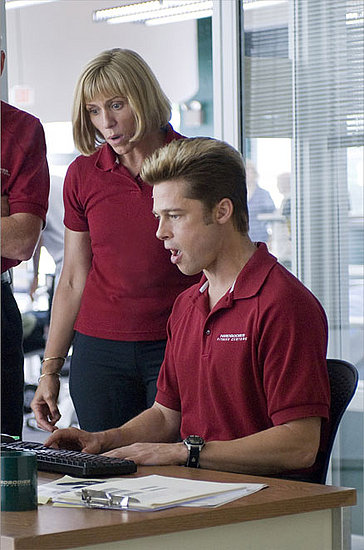
So does Linda Litzke (Frances McDormand), who works at the nearby "Hardbodies" fitness center and who is now turning to plastic surgery because she's taken her body "as far as it will go." She doesn't have the money for it, but hope comes along in the form of a disk of Cox's financial information that falls into the hands of fellow "Hardbodies" employee Chad Feldheimer (Brad Pitt), who thinks he might be getting some sort of federal reward for turning it in, and hey, wouldn't that help pay for those operations? 
The fuse gets lit, as loyalties shift, panic arises, priorities change and worst instincts lead to "worser" consequences. That reward turns to a sense of entitlement and then resentment, then to ransom. The events are somewhat monitored in disbelief by the CIA (in the form of the incomparable David Rasche and J.K. Simmons), as things spin out of control.
Everybody's great, besides Rasche and Simmons. 

Clooney seems to excel with the Coen's—this is his third film with them, playing "idiots" as he calls them, McDormand amps up the energy of her previous Coen-work, Swinton seems less self-contained and goes for the comedy like never before, and Malkovich swings between coiled fury and exploding fury. But the stand-out is Brad Pitt's selfless performance as Chad, the personal trainer who could very well be "the stupidest person on face of the earth."*
His hair piled high and high-lighted, an i-pod constantly filling the empty space in his head, his body moving spasmodically with its energy, he can be counted on to think he's doing the right thing, when he couldn't be more wrong--he is everyman, trapped in a life that resembles a first home improvement project--quite oblivious to the fact that sometimes you only get one chance to get things right without the benefit of "rep's." There's a sub-text running obviously through the thing of "the self," with the main players obsessed with their bodies and their own interests. 

Washington D.C. makes the perfect back-drop for it. "Burn After Reading" is rated "R" for pervasive...you know.

* After Bill Pullman's character, Earl Mott, in Ruthless People (1986)

** Sorry about the "pervasive language," but, really--you see this movie, and you know that was the working title of this movie (a move that, if it was carried through, would have crippled the movie at the box-office by restricting advertising and such). I briefly considered not spelling out "the f-bomb" with the comic-standard "f@<#," but I figured...no, I'm not saying it again...but as the word appeared in a When Harry Met Sally Scene, I figured "if I use it there, I might as well use it here," pervasively.

Thursday, August 27, 2020

The Curious Case of Benjamin Button

Written at the time of the film's release.

"Ah, But I Was So Much Older Then/ I'm Younger Than That Now"

Roger Ebert once wrote that "No good movie is depressing; all bad movies are depressing."

The Curious Case of Benjamin Button is such a fine film, it's painful to watch. Part of that has to do with the central conceit (and this is a conceit, as opposed to a premise) from the original F. Scott Fitzgerald short story of a man who is born old and dies as an infant. One suspects that Fitzgerald was reaching to show the arc of a life in stark contrast to the norm, and how similar to the norm that extreme is ("We all end up in diapers," says his life-partner Daisy...another Fitzgerald Daisy). But Button's life, if anything, is even more tragic for it. When he shows up late in the film, after an extended leave-taking he's told "You're so young." "Only on the outside" is his quiet reply. It's the perfect riposte to that old saw "Youth is wasted on the young."

One worried when approaching this movie that it would be a Forrest Gump situation, where the technology would call attention to itself, and the story would be another collection of paint-by-numbers history awash in the easy sentimentality of the simple-profound. I wasn't a big fan of Forrest Gump, and watched its clumsy march to a Best Picture Oscar with a certain bemusement.The Curious Case of Benjamin Button is nothing like that (even though it shares a screenwriter, Eric Roth). 
While director David Fincher came from the special effects area of film-making, he has now long moved past the days when he would pass the camera through the handle of a coffee pot, and uses the technology at his disposal to create invisible wonders throughout the film. It may come as a shock that during the first 30 minutes of Benjamin Button the character is a seamless merger of Brad Pitt's heavily-made up head and another actor's body. Another thing they say is that a good movie takes some kind of a miracle. This film brings about miracles every few minutes. And Fincher's rigorous direction is assured and formal, juggling the demands of the effects work with the very real human drama of lives that pass in the night. This film has been in development for a long time. Usually that means trouble. For this one, it must have been logistics.
Fincher's moments of magic include a dead-on recreation of old-film look* that has a amazing pay-off for a running joke that wouldn't be nearly as hilarious if it wasn't done as a series of silent movies. I've already talked about the invisible technology behind Button's early/elderly years, but that same CG magic puts Cate Blanchett's face on a prima ballerina and ages or de-ages the principles. It was Red Barber who said that God doesn't count the toys accumulated at the end of a life, He counts the scars. No movie has been so careful as to keep a running track of the lines in a face...or the scars. And when that "only on the outside" moment happens, the face we see is that of Brad Pitt circa A River Runs Through It. I don't know how they did it. It's amazing. As it must be for the people in the movie.
Let's talk about the actors now. Cate Blanchett is a given. She weaves through the movie note-perfect, putting the stages of a life out there to be remembered—the naivete, the coltish confidence, the iron strength necessary for healing. Tilda Swinton is there, though her part isn't as rich as Blanchett's, but she makes an impression. Julia Ormond is there, as Daisy's daughter, perfectly American with just a twinge of her French accent creeping in, as her character hails from Louisiana. And Brad Pitt, who's always seemed to me to be a slightly limited actor, proves himself as adept as Blanchett in showing the arc of a life--but in reverse: playing an innocent in old age make-up, but as he gets younger--the eyes get older and wiser. This and his hilarious work in Burn After Reading shows that Pitt has moved beyond depending on a slightly ethereal quality to suggest depth. There is a scene where Button is informed by Daisy that she's pregnant and the response from Pitt is a wordless mixture of love and pity.
But, my favorite performer is someone who delights me every time she's on-screen. I've talked about her before. The moment Taraji P. Henson** turns up, The Curious Case of Benjamin Button turns into a different movie. She does the same thing as Pitt and Blanchett, but you see her less, and she creates more of an impression than either of them. Her Queenie is a force of Nature, and Henson gives you the impression she's making it all up as she goes. In a film of fine performances, her's stands out.
Finally, The Curious Case of Benjamin Button, finds its place as one of those rare films that takes a middling book by a writer of some note, and turns it into a classic film, far surpassing the meager accomplishments of its source.


* Towards the end of the film, I noticed a scratch running down the left quadrant of the film and wondered if Fincher was doing that deliberately!

** It is also one of the first big-screen appearances of the now essential Mahershala Ali.