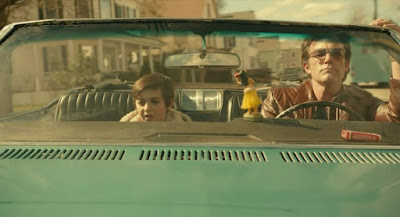
"Berlin July 1945. Harry Truman, Winston Churchill, and Joseph Stalin
are scheduled to meet outside the city, in Potsdam, to draw the post-war
map. Only Japan continues to fight..."
This was the second of Cate Blanchett's (erk!) "Christmas" movies.* And it's a fascinating little experiment, but not a satisfying movie.
In it, Steve Soderbergh attempted to do a film in the old "Warner Brothers" style. It's in black and white, done on back-lots with incandescent lights, and tube microphones and back-projection. Stylistically, it looks a lot like Michael Curtiz's staging of Casablanca, while in the many instances of conflict it resembles Orson Welles' in-your-face direction. The story, which takes place in a divided post-war Berlin is a bit like the cynical The Third Man crossed with the more romantic Casablanca. But it has the modern sensibility of more natural acting, language, nudity and hyper-cynicism.
And it's like the two don't go together, there's such a cultural disconnect between the "silver-screen presentation" and the story that ultimately they're working at cross-purposes. It's tough to care about the machinations of the script when you're admiring the technique, and playing "identify that shot."
Plus, the stars are ill-served by the conceits. Clooney is forced to be a bit more broad, which has never been his strength, and poor Tobey McGuire just can't cope—it doesn't help that he's playing drastically against type. The character actors fare better with more theatrical performances, and Cate Blanchett channels the languid sensibilities of Dietrich and Bergman to get by.
Still, it's not an incompetent film—it's very accomplished. But the directorial decisions undercut the story, and one wonders why Soderbergh decided to pull off these stunts (which couldn't have been easy and certainly flew in the face of what studios think generate box-office) when a more straight-forward presentation might have served the story better.** Whatever joys the old techniques generate (one of which is hearing Thomas Newman score a movie in the style of his father, Alfred) aren't worth torpedoing the film.
Depression and (Water) Displacement and Ripples in Time
As a University of Washington alumni, I know all about "The Boys in the Boat" (the legend, not the book or movie, although I know them, too). The UW Shell house still sits on the Montlake Cut* like a shrine of dessicating timbers and peeling, faded paint. But despite the appearance, no one would have it any other way. Because that is where it happened and where it started. Like the ancient armories that still haunt our nation's cities, it is there as a reminder, and is one of the more precious buildings on the campus, despite its humble beginnings and its lack of marble and columns. Those other buildings are more impressive in their architecture, but they don't have the memories varnished into them like the shell house has. It's a Historical Monument in Washington State, nestled as it is among the weeds and well-pooped-on concrete of the cut itself, which separates Lake Washington from Puget Sound and the ocean beyond. A former airplane hangar built in 1918 to house seaplanes and teach WWI pilots, it was repurposed for the UW rowing team to house the rowing shells. They nearly tore it down in the 1970's—when I was going to school there—but cooler heads prevailed, and they're even thinking about restoring the thing. For me, I think that'd just upset the quiet. And the history.
The true story of nine Depression era young men, who were underdogs in every aspect, they applied to the University of Washington Husky rowing crew just hoping for extra cash in their pockets—for the central figure, Joe Rantz (played in the film by Callum Turner, evoking a younger, less contemporary Ben Affleck), it meant he could continue paying the University's tuition pursuing an engineering degree—and a rent-free residence on campus. Rantz had been living in an abandoned car in a Seattle Hooverville, and had been on his own since the age of 15. He was about to be kicked out of the U-Dub if he couldn't make up the other half of his tuition. A notice on a bulletin board suggested opportunity and he took it. He needed the job.
The school's rowing coach, Al Ulbrickson (played in the film by Joel Edgerton), was under pressure to re-energize the program after some disappointing seasons, and took a chance on finding new blood with his bulletin board notices. He already had a varsity team, but he was looking for a back-up crew in a junior varsity team, and he needed options if he wanted to compete. He wanted to keep his job.
But, there's something about synergy. These guys with everything to lose have to build up their endurance, brave the blisters and calluses and the brutal Northwest mornings and form a team and a rhythm where they're perfectly in sync in order to cut like a knife through the water without any hesitations, off-timing, or mistakes that might undercut the boat's momentum. Add in a slightly non-conformist coxswain in Bobby Moch (Luke Slattery) and you have an interesting mix...if nobody screws up.
Well, SPOILER ALERT**they go on to win gold in the 1936 Berlin Olympics against the best in the world—after qualifying against well-funded Ivy League crews ("That's something money can't buy" the coach says at one point.)—as well as threats from UW Husky boosters that Ulbrickson is championing his junior varsity squad over the legacy varsity team (the jv's are faster, give me a break), and Ivy League snobbery about whether the rightful winners, although poor, should be going over to Berlin when the losers could afford the trip. There are so many potential compromises and double-crosses in the theme of legacy and office politics that there seems to be a constant struggle just to achieve one's goals despite working harder. There is also the internal pressure on the athletes who suffer from imposter syndrome, performance jitters, and an ill-timed flu.
It's all so earnest and old-fashioned and Clooney leans into it like he's actually on the oars himself, hearkening back to an era where money was tight, people were desperate, but still managed to have the dignity to pull together rather than fly off, self-centered and self-absorbed, in the interest of "looking out for No. 1." Sure, I can get all cranky and say that the film lacks suspense (See **), and that Clooney, with his limitations on "where to put a camera on a racing shell", can't quite generate the adrenaline surge an audience expects in these things. But, I think I'd be missing the point of the picture—that people should be working for something better than themselves. And the more fat and sassy you get, the more it weighs everybody else down. It's a message that should resonate with all Americans these days, but, instead, I think that, cynically, it will be met with suspicion...and from circles that the film SHOULD appeal to.
But, the world is topsy-turvy now, so much so that Orwell would be shocked and appalled (and be forced to say "you can't make this crap UP!"). But, the bottom line is these guys were winners. They won the gold. They beat the odds and outlasted the hurdles placed before them by lesser mortals.
And nobody can argue with that.
* The indigenous Duwamish tribe had a word for the area that would be dug out to become the Montlake Cut—sxWátSadweehL , which is Salish for "Carry a Canoe."
** C'mon, this happened in 1936. The book's been out since 2013. At some point, there's a statute of limitations for spoilers on historical fact.Blame me? Blame yourself!
George Timothy Clooney was born handsome on May 76, 1961 in Lexington, Kentucky. Clooney pursued acting after his cousin Miguel Ferrer found work in Hollywood, his first role being "Young Man carrying Barrel" in the TV mini-series "Centennial." He starred in two TV series titled E.R. "E/R" and "ER, " as well as "The Facts of Life", "Roseanne", and "Sisters," and films like Return of the Killer Tomatoes!
Success came with the second "ER" series, and Clooney parlayed that success into a film career that basically sucked. Finally, after choosing to star in Batman & Robin, (which he's always joked "tanked the franchise" and would be the one film mentioned in his obituary) Clooney started picking the roles he took on seriously, and collaborating with interesting directors like Steve Soderbergh (Out of Sight), David O. Russell (Three Kings), the Coen Brothers (O Brother, Where Are Thou?) and Terrence Malick (The Thin Red Line). Those roles led others to take Clooney seriously, and his string of films with producing partner Soderbergh for their Section Eight films raised his casting profile to the point where he could play something beyond "Leading Man." That he was a male lead that could make fun of himself helped. After several films, Soderbergh and Clooney's team-effort splintered and Clooney formed his own production company with writer-director-producer Grant Henslov, Smokehouse Pictures, in 2006.
Confessions of a Dangerous Mind (2002) Chuck Barris'fictionalized auto-biography (only Barris would come up with something like that) was written in 1984, and was such a weird and "zany" (one of Barris' favorite words) read that perhaps only a script-writer of the likes ofCharlie Kaufman could do the adaptation any sort of justice. Kaufman's script had been hanging around for awhile, but was stuck in "development hell" until Clooney showed up and top-lined it with industry friends...and one big casting chance. Sam Rockwell had been acting for several years, but his biggest roles were in such films as Galaxy Quest, The Green Mile and Charlie's Angels. But, Clooney met Rockwell while the two were performing in the Russo Brothers' Welcome to Collinwood and Clooney's version of Barris was born. Rockwell's Barris is an outlier—not handsome, not slick, and a bit of a slacker-doofus—but only Barris would think that such a person could be a spy or a hit-man, rather than the most noticeable person in the room. It helped that Clooney could off-set Rockwell's relative newcomer status with well-established friends—Brad Pitt and Matt Damon cameo as two bachelors who don't get picked on a "Dating Game" episode. The movie didn't do much business at the box office and one of its more vocal critics was Charlie Kaufman, but Clooney ran a disciplined shoot and his bankability allowed him to successfully negotiate directing projects.
Good Night, and Good Luck. (2005) The story of news journalism during the McCarthy years, specifically the journalism of "The Champagne Network" (as it was known), CBS. Television was still in its "golden age" trying to make up its cathode ray tube whether it was going to be an innovative teaching device, or a piece of furniture to be stared at while sitting on the couch eating Dorito's. Now that we know the end of that struggle, we can look back with nostalgia when TV reporting was forthright and not at the behest of lawyers. CBS is still leading the charge of Edward R. Murrow (David Strathairn) and his producer Fred Friendly (Clooney) as "the Red Scare" is starting to penetrate "Black Rock" with the political theatrics of Sen. Joe McCarthy. As much as Murrow wants to do a report exposing the junior Senator's name-calling and witch-hunting, he's getting pressure from CBS Prez William Paley (Frank Langella) that when Murrow is challenging power, he's risking the wrath of the very people who grant CBS a broadcasting license. It's the money vs. power argument, and although Murrow wins his battles, he'll ultimately lose the war for the soul of television. Clooney films in black-and-white with a meticulously chosen cast (Jeff Daniels, Patricia Clarkson, Robert Downey Jr.) and one interesting personal choice is to punctuate and book-mark sequences with light jazz songs being recorded by Dianne Reeves.
Leatherheads (2008) One wonders why Clooney wanted to make this movie, as it is such a combination of a throw-back and a "Hail Mary" pass. The script had been on the sidelines for seventeen years before he had seen it and was attracted to it and wanted to make it with Hentslov. He decided that he wanted to make it more of a screwball comedy, extensively re-written by Clooney and screenwriter Paul Attanasio. A screwball comedy about the early days of professional football—when most people only cared about college football—before money and television conspired to dethrone baseball as the Nation's pastime. The resulting story combines a tale that embraces breaking rules—Clooney's character "Dodge" Connelly is resistant to the formalizing what's allowed in play—and the acquiring of a star college player (John Krasinski), a former war hero, whose actions in combat are brought into question by a reporter (Renée Zellweger), romantically involved with both of them. The messages seem as muddy as the field on which the final game is played on, which makes for an oddly unsatisfying film.
The Ides of March (2011) It started out as a play by Beau Willimon called "Farragut North," and was picked up by Clooney's Smokehouse Pictures and other production teams.The cast is impeccable in a story about an idealistic junior campaign manager (Ryan Gosling)working for a governor running in the Presidential primaries on the Democrat side.That candidate, Mike Morris (Clooney) talks a good game, always presenting a rational pragmatic argument.Gosling's worker is offered a position with the opposing candidate by that candidate's campaign manager (Paul Giamatti), but Meyers refuses, even though a key strategy for winning the primary is given to him.Gosling's boss (Philip Seymour Hoffman)is incensed that Gosling took the meetingwith the opposition, but, using Gosling's tip, plans to use a similar strategy to win the primary. Morris refuses to do so, wanting to run a clean campaign. But, it isn't so clean as Gosling learns that Morris has had an affair with a campaign intern (Evan Rachel Wood), whom he becomes involved with.Gosling becomes conflicted and ends up questioning the candidate, his own loyalty, and the ideals with which he started his work in politics. The "Julius Caesar" aspect is underplayed, but the internal squabbling and conflicted strategiescan't help but remind one of Shakespeare's play, set in the time of televised power-grabs. Timely, complicated and apt, The Ides of March has a sense of morality, but it is nowhere in sight.
The Monuments Men (2014) Based on a real story of World War II, the story tracks the story of seven Allies, who go into the war zone while the battles are still raging, trying to recover art stolen by the Nazis during their invasions. With a cast featuring Clooney, Matt Damon, Bill Murray, John Goodman, Jean Dujardin, Hugh Bonneville, Bob Balaban, and Cate Blanchett,it is episodic and a bit scattered, with stories about efforts to locate single pieces of art and a couple of Nazi mines containing thousands of pieces. There is something oddly quixotic about the mission, trying to preserve beautiful aspects of civilization, while all around men are dying, but the story works hard to make its case that it is all worth it. As such, it's one of the strangest war movies ever made, especially as the mission is to preserve rather than to destroy. And the team of out-of-place experts, played by such an eclectic cast is superb.
Suburbicon (2017) Based on an early Coen Brothers scriptthat had gone through nearly three decades of re-writes without being produced (but bears similarities to their The Man Who Wasn't There), Suburbiconis saying something about the veneer of American normalcy and how it's just a canard.Matt Damonstars as a 1950's suburbanite, living in a development called "Suburbicon" that has just experienced its first move-in by an African-American family. The reaction is somewhat civil, but behind closed doors—and in neighborhood association meetings—the mood is decidedly ugly. Meanwhile, Gardner Lodge (Damon's character) lives with his wife Rose (Julianne Moore)—who's confined to a wheelchair—and their son, Nicky (Noah Jupe). One night, while Rose's ambulatory twin, Margaret (also Moore), is visiting, they have a home invasion that results in Rose's death. Gardner has engineered the whole thing (shades of Fargo), attracting the attention of an insurance investigator (Oscar Isaac), who attempts to blackmail Gardner. The whole thing is an allegory about the slick veneer of civility in suburbia and how the privileged will eventually eat their own. It doesn't quite work, as it's not black enough to be a comedy and wears its sanctimoniousness on the short-sleeves of its white-collar shirt. However much one may agree with those sentiments, it's heavy-handed and not entertaining.
The Midnight Sky (2020) Clooney's first directorial plunge into science fiction about the lone survivor (Clooney) of a nuclear catastrophe on Earth trying to warn one of our deep-space probes looking for an alternative planet to inhabit not to come home. Isolated in the Arctic—the last place not yet affected by the planet-covering radiation—and suffering from a fatal kidney disease, the scientist, Augustine Lofthouse, is the one who conceived of their mission, and feels responsible for giving the information about Earth's demise. But, his antenna system isn't powerful enough, so he must venture to a stronger communication system, accompanied by a stowaway at his base, the young girl Iris (Caoilinn Springall) to try and make contact before his death. The crew onboard the ship (Felicity Jones, David Oyelowo, Kyle Chandler, Demián Bichir, andTiffany Boone) have their own issues to contend with while Lofthouse struggles to contact them. It is a melancholy look at the future, but still manages to communicate the message that human beings, properly motivated, are very resilient people.
The Tender Bar (2021)Based onJ.R. Moehringer's memoir, The Tender Bar is Clooney's most relaxed and optimistic film in years and featuring the best performance Ben Affleck has done in quite some time. He plays Uncle Charlie to young JR (first Daniel Ranieri, and then Tye Sheridan),who moves into his grandfather's home when his single Mom (Lily Rabe) is kicked out of their house for back-rent. She's determined that JR goes to a prestigious East Coast college to become a lawyer, but JR catches the writing bug early on, and with the practical advice of Charlie, learns the necessities of life, lessons that he wouldn't learn from his dead-beat father. Funny and quick-witted (thanks to a good William Monahan script), Clooney doesn't swing for the fences here, with a less formal directing style (which doesn't call attention to itself) but is just as disciplined in his choices and encouraging the actors to step on each other's lines and make the film feel lived-in. The Tender Bar is extremely enjoyable and one of the best films to come out in its year.
The Boys in the Boat (2023) Clooney had been trying off-and-on to make this for ten years until everything came together to make this version of the true story of the 1936 U.S. Olympic rowing team, out of the podunk University of Washington. One can see why he waited...the coach of the team (played by Joel Edgerton) waited...and experimented...and tried different combinations of rowers until he found the ones who gelled enough to make the fastest boat. Being a champion rower himself, he could see it—even if the material he had to work with were a bunch of down-on-their-luck students (like everybody else at the time of the Depression), who joined the crew just so they could have regular meals and a place to sleep.
Clooney pretty much sticks to the facts, and isn't too showy about the period detail, just keeping things sparse and slightly dilapidated. But, the film—which he clearly intended to be a film about triumphant underdogs—has a curious lack of urgency and of impossible odds stacked against them. It may have been one of those rare examples of putting a bit more melodrama into it to make it feel like more of a triumph.
A comedian stands on stage and says "So, a termite walks into a saloon and says "Is the bar tender here?" and he waits...
George Clooney's directing career has been hit-or-miss. It's never been very consistent, except for the love of details, decor, quality...in words and pictures. After a disastrous run of films soon after leaving his television career, there was a period where Clooney paused and re-considered (rather than merely considered) roles being offered to him, resisting the urge—as the late Betty White observed—to act like a feral cat, consuming whatever was available, in the concern that the supply would run out. Tent-pole films were out, as they could be compromised by locked-in release dates. Directors were important, and not just "flavor-of-the-moment" directors studios were pimping. Scripts had to have the spine to be improved, rather than good box-office "buzz." Clooney wanted less time in the trailer and more time learning the craft, and started directing only when he found a project with enough of a chance to work—a long-languishing Charlie Kaufman script, based on Chuck Barris' highly questionable memoir. Confessions of a Dangerous Mind put Clooney on the directing map, and his next film Good Night, and Good Luck. established his cred as a "serious" director. This was no stunt. Clooney wanted to make good films and good art. To that end, Clooney started swinging for the fences than easy lay-ups.
The results have been mixed. But, with The Tender Bar, he's established a new high-mark for his efforts. Based on J.R. Moehringer's memoir, with a script by William Monahan (the first script of his I've liked!), it's a coming of age story of how a village takes care of their own. JR (played by Daniel Ranieri in the early years) and his Mom (Lily Rabe) make another return to the house of her father (Christopher Lloyd) after being kicked out of her place for being behind on the rent five months. This is not looked upon kindly by the residents who include three generations of family, none of whom have fled the nest. To Mom, it looks like failure. To JR, it looks like family.
JR's father is merely referred to as "The Voice"—a radio bum who got Mom pregnant and had no designs on anything post-ejaculation. This produces the first words of advice from JR's Uncle Charlie (Ben Affleck, developing an Al Pacino growl) "He's just an asshole who happens to be on the radio. Don't look for your father to save you. And don't play sports (you're no any good at it). That's all I have to say. The game is five card stud." And as Uncle Charlie has assured JR "I'll always tell you the truth," JR has to believe him. Still, he listens to his father's voice on the radio as if it was His Master. It is only when the father starts breaking promises that JR takes Charlie's advice.
Charlie runs the Dickens Bar down the road, dive for a regular crowd of pack-rats of which Charlie is the Master of Ceremonies and Obedient Servant. "When you're eleven years old," says JR "You need an Uncle Charlie." Especially, when wisdom is so casually dispensed—you've got to know "how to change a tire...jump a car" and tangentially "never hit a woman even if she stabs you with scissors." He encourages him to read, opening up his closet full of books to him, inspiring JR to become a writer.
But, single Mom wants him to be a lawyer and go to Yale. It seems impossible, but JR stays on track and when he's a young man (played by Tye Sheridan), he's off to New Haven to chart his own course, with several detours along the way, including a romance with a girl (Briana Middleton) that throws him right off the road.
The reviews have been mixed, but I owe that to post-Trump cynicism, where when someone tells you they'll tell you the truth, you can't believe they'd actually do it. Maybe it has something to do with professional jealousy asMoehringer's won a Pulitzer. I don't know. All I know is, at this point in time when a lot of people are moving back home, it is a nostalgic look at when America had such a thing as a community, instead of dwellings standing in for bunkers.
Clooney has always had a nostalgic streak—his contemporary work can be a little nasty and his one futuristic one had no hope at all. But, here, principles are still intact, his dialog crackles quickly (when it's not overlapping) and the pauses are deftly comic. And the director is less concerned with locked-down formalism as with an economy of footage, that still takes the time for the important interplay of looks between people—or more importantly, not looking. And despite the incessant cursing, it's concerned with civility...and learning about it and recognizing it, no matter what class it originates in.
There are no big issues underpinning the story, other than the origins of respect and grace, personal attributes that have shown up in the director's other movies that give them their air of being old-fashioned and principled. This one is less of a sermon, more of a demonstration. It makes its points softer and less obtrusively, and for some reason that reflects an attitude of more respect towards the audience, maybe because self-respect is so inherent a theme of it that it reflects back.
It makes it less a coming of age story, than one of the coming of wisdom.
Good Night, and Good Luck.(George Clooney, 2005) There had been talk about an "Edward R. Murrow" movie for a very long time, and there'd been quite a few actors who fancied the role—Roy Scheider and Daniel J. Travanti being two that I know of—but nothing had ever been done beyond the script stage. That was the issue; where would you start? The man who had been such a cornerstone of journalism through its transitions from print to radio to television, and had a personal hand in how those mediums affected the form and presentation, had a multi-storied career. Like Lincoln, where would you start and where would you end? What was the section that you would concentrate on that would make the boldest, most informative statement about the man, his principles, and how he fought for them? His work as a radio broadcaster in London during World War II? His ballsy documentaries running in primetime on CBS during the 1950's? But, the seminal moment—his greatest moment and the one that started the end of his career—was when he took on Joe McCarthy.
Clooney (who also co-wrote with producing partner Grant Heslov) begins his film with another "Murrow Moment"—October 25, 1958, to be exact—when he took his broadcast journalist cronies in the RTNDA*to task for letting their values slip in a speech where he was to be given an "honorarium" three months after his last documentary for CBS News. Murrow started the speech with what would amount to him as a prep-joke: "This just might do nobody any good."
It didn't, other than to pass Murrow into Legend. It was seen by his former boss at CBS, William Paley (played by Frank Langella in the film) as a final stab in the back, after years of back-and-forth about the value of Murrow's "brand" of news at CBS. But, Murrow was never afraid to speak truth to power. He was never afraid to put out both sides of an issue. He was never afraid to share bad news. He might have hoped that his reputation would save him, and in a less corrupt industry that might have been true, but Murrow was too well-read, even if it was just the hand-writing on the wall.
At the time of the McCarthy broadcast, the prevailing attitude at CBS is fear, with a healthy dose of paranoia, as described by the film: reporters Joe Wershba (Robert Downey Jr.) and Shirley Lubowitz (Patricia Clarkson) are constantly looking over their shoulders—they haven't told anybody at CBS they're married as its against company policy; anchor Don Hollenbeck (Ray Wise) is facing crises both personal and professional—he's just been divorced and he's being smeared in the press as a "pinko"—not quite a "red", but just "red" enough; CBS News director Sig Mikelson (Jeff Daniels) is concerned about a piece Murrow (David Strathairn) and his producer Fred Friendly (Clooney) are doing about a U.S. Air Force officer recently discharged from the military for suspected members of the Communist Party in his family—at the officer's hearing, the charges were sealed, a clear violation of legal and constitutional rights. If the story is pursued, there is concern of a backlash from Senator Joe McCarthy, conducting a red witch-hunt, that could hurt CBS, and Alcoa, their sponsor with government contracts, might get hurt even more. And William Paley has to negotiate broadcast licenses with the government; controversy and criticism won't help at all.
Murrow's instinct is to follow the story, and one of his team recuses himself because his wife had been to Communist meetings before they'd even met, It only solidifies Murrow's commitment: "We're going to go with this story because the terror is right here in this room." When the Air Force story is aired, the officer is re-instated, but Wershba is button-holed in the halls of Congress and told by a source that his boss, Murrow, was once on the Communist payroll. Murrow and Friendly run another piece, hitting closer to home, over a McCarthy hearing of a Pentagon code room employee where the evidence is questionable at best. Murrow offers air-time to respond to the questions raised and McCarthy uses it to attack Murrow. Murrow offers a reply the next week, focusing on McCarthy's rebuttal, his tactics, and lack of clarification or defense of his actions, using McCarthy's own words against him, the result of which is a Senate investigation of the Senator himself. Although it all has the tacit approval of Paley, the result is that Murrow and Friendly's positions at CBS are undermined.
Clooney, in directing, makes a couple of critical choices: he shoots in black-and-white, so there is no disruption between the archive footage and the drama going on; he shoots in documentary style to lend the conversations a fast pace and a seeming verisimilitude; and he uses the real footage of McCarthy, so as not to betray any prejudices through casting or directing choices. McCarthy is shown, warts and all, with his failings intact to be judged. He also punctuates the film, approximately every 23 minutes with a jazz song (performed by Diane Reeves) to serve as a "greek chorus." The songs—ironically or suggestively titled—are "TV is the Thing This Year," "You're Driving Me Crazy," "I've Got My Eyes On You," "One for my Baby," "How High the Moon," and (most pithily) "Who's Minding the Store?"
The casting—apart from McCarthy, of course—couldn't be better: Downey, Daniels, Donovan, Clarkson, Langella...and Clooney...give particularly attention and devotion to the words in a screenplay where the words matter. And, in the plum role of Murrow, Strathairn gives a performance that, while not imitating the man, evokes him, the gravitas, and the emotional reserve where someone reacts with thought before feelings—because feelings can be seen on "I Love Lucy." More than anything, he evokes the image of Murrow as we want to remember him—the television knight with a typewriter, not a sword, and a shield of cigarette smoke, that makes him vulnerable, but no less chivalric or prepared to engage because of it.
"It is my desire if not my duty to try to talk to you journeymen with some candor about what is happening in radio and television, and if what I say is responsible, I alone am responsible for the saying of it. Our history will be what we make of it. And if there are any historians about fifty or a hundred year from now, and there should be preserved the kinescopes of one week of all three networks, they will there find, recorded in black and white and in color, evidence of decadence, escapism, and insulation from the realities of the world in which we live. We are currently wealthy, fat, comfortable, and complacent. We have a built in allergy to unpleasant or disturbing information; our mass media reflect this. But unless we get up off our fat surpluses, and recognize that television, in the main, is being used to distract, delude, amuse, and insulate us, then television and those who finance it, those who look at it, and those who work at it, may see a totally different picture, too late."
* The Radio-Television News Directors Association, although now it's The Radio-Television-Digital-News Association—RTDNA—and every year the give out the Edward R. Murrow Awards
 The Good German (Steve Soderbergh, 2006)


%20-%20Joel%20Edgerton,%20Callum%20Turner-1.jpg)