Showing posts with label Patricia Clarkson. Show all posts

Wednesday, August 28, 2024

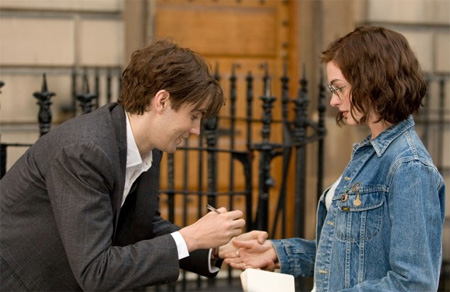
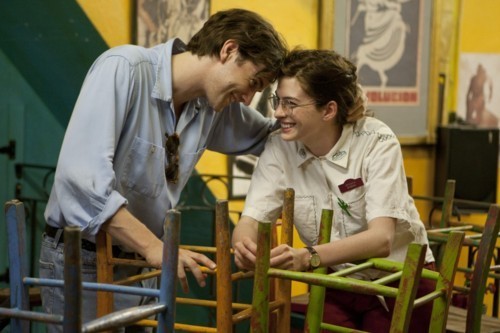
One Day (2011)

Supposedly, there's a mini-series of this on Netflix released this year. I saw the movie version  in 2011, and I wrote about it at the time of the film's release.

"July 15ths with Emma and Dex"
or
"Same Time Next Year"

Can a man and woman "just" be friends? (the question posed by When Harry Met Sally)  I've gone 'round and 'round with this one. I've said "Yes" for many years, and then that became "No," then back to "Yes," and now, it's something of a toss-up. "It's possible," I say noncommittally (which is the basis for many of the male-female problems, friendship or no).

But anything is possible.
 
"One Day" was a nifty best-seller by David Nicholls, smart, tight and funny, a romance told in snap-shots of one day that was realistic about the vagaries of life and love and the "yin" and "yang" of both. What makes the novel special gets distilled somewhat in celluloid form, making One Day feel a bit less exceptional, the humor muted somewhat, and given the twenty year time-span of the movie, some of the anniversaries celebrated are given short shrift, skipping to the more complicated "good parts," as opposed to those years when nothing much happens...you know, like "life."*
Dexter (Jim Sturgess) and Emma (Anne Hathaway) have "just met" at their graduation as they string along with their mutual friends, a couple. Emma is bookish, unstylish, a bit of a character—has a "nice personality"—Dexter is boyishly handsome and knows it, and Emma is "crushing." An awkward "overnight" happens, where it is unclear what transpired, but it's important enough that Dexter is helping Emma move when the next 15th of July occurs, but not important enough that Dexter isn't moving to Paris to teach.
July's come and July's go, as
Emma suffers through waitressing at a London Tex-Mex restaurant and Dexter jumps from job to job, eventually becoming  the smarmy host for a late-night dance teen program. Where Emma is a busy bee, droning through know-where jobs until she catches her big break, Dex is a moth attracted to the brightest (or blondest) thing in the room. They're devoted to each other, but only so far. As her star rises, his sets—first Mom (the ever-reliable Patricia Clarkson) dies of cancer, then his fortunes go South, followed by years of over-indulgence. Before you can say "This is Mrs. Norman Maine," he is seeking her out, where she has nearly given up. As traditional as this is, what is nice about One Day is that Emma does just fine without him, she makes her way in the world without a man's help (and frequently, they're a hindrance), whereas in most films of the romantic genre, everything can be solved by anything in pants.

The director,
Lone Scherfig, previously made An Education, which, while well-acted and elegantly directed, suffered from a distinct lack of heat and a little too much posh. The former problem still applies here. The film is decidedly chilly in tone, and while this is a welcome change from the day-glo color, syrupy music rom-coms that chirp incessantly about Moon, June, (premarital) Honeymoon," poking you in the heart-area that "Love is Great, right? RIGHT?" One Day makes it hard to feel anything beyond "Gee...that sucks."

Maybe it's the skipping around from year to year, but there's a distinct lack of focus in the story, as it spreads itself around a bit too thin, the ancillary characters populating the movie to make life difficult for Emma and Dexter, necessary irritants and bothers that will drive them into each other's arms every year. Plus, the story arcs of the two main characters run precipitously up and down, without any jolts of happiness amidst the gloom, or hurdles to happiness on the ascent.
**
Things settle down as people "settle" and, although One Day manages to avoid many of the cliches of the romantic genre, it also hasn't found anything as compelling to replace them. Plus, with the mutual reversals of fortune, there seems to be a dramatically required "leveling of the playing field" in order for things to resolve "the way they should".
One should be grateful that one is asking these questions about a romance movie (haven't done that in a while), so it's nice to see somebody making the attempt. But, one gets the idea that the same old "Love Potion No.9" is being hawked. All they've done is change the shape of the bottle.

* One of my favorite quotes is by Anton Chekhov: Any idiot can survive a crisis; it's the day-to-day living that wears you down.

**  Well, that's not entirely true, but we don't want to give anything away. 

Friday, April 19, 2024

Whatever Works

Written at the time of the film's release...

"And Sometimes, Finally, a Cliche is the Best Way to Make a Point"
or
"Mommy, That Man is Talking to Himself" ("Come Along, Justin")


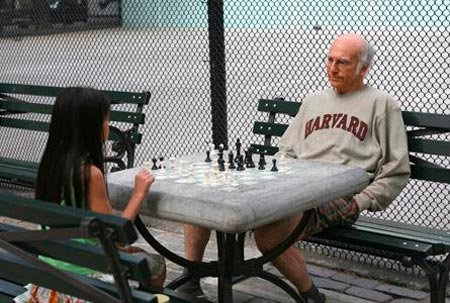
Boris Yellnikov (Larry David) is a genius. A misanthropic genius, to be sure, but a genius; he's only too happy to tell you that he almost won a Nobel Prize for his work in quantum mechanics, specializing in string theory. He's also only too happy to tell you that you're sub-normal, a microbe!, an inchworm!, a potzer!, a troglodyte!, a mouth-breather!—and in fact, at a couple points during the film he turns to the audience and turns on them...us...to tell us what he thinks of us. A lot of movies choose to insult its audience these days (sometimes directly, sometimes by what the makers think they can get away with), but Yellnikov has the courtesy of treating anyone who chooses to listen to him the same disparaging way. >He has a lot of views about quantum theory, the Heisenberg Principle, but never mentions the Konigsbergian Bubble Theory, in which the world is essentially a sub-set of forty individuals restricted to a single geographical point, 15 of whom have speaking parts.
Whatever Works is a return to Woody Allen's World, and its story of a young girl turning the heart of a beast is familiar ground, coming across as a "Woody's Greatest Hits" film—you'll find bits of Annie Hall, Manhattan, and particularly Hannah and Her Sisters—with its scenes of turmoil in the marriage between intellectual Frederick (Max von Sydow) and sensitive former-student Lee (Barbara Hershey). And Whatever...'s Melodie St. Ann Celestine (Evan Rachel Wood) is the latest in a long string of naive young waifs portrayed by Diane Keaton, Mariel Hemingway, Mia Farrow, Mira Sorvino, Samantha Morton, Juliette Lewis, and Scarlett Johansson. One could make some excuse about Allen returning to themes he explored earlier in order to form a more perfect coalescence of his ethos and it would be as pretentious as it sounds. Allen says that Whatever Works is an early screenplay he wrote in the 70's with the intention of it starring Zero Mostel. When Mostel died, Allen shelved it. So, the truth is Allen has been cherry-picking from this script for years to make some of his earlier, better pictures.
Although this is one stretch of New York City pavement worn a bit thin, there is something unique about it. One thing you can count on in Allen's movies is his autobiographical characters,
the passive aggressive smart-asses played by Allen or a surrogate (past stand-in Woody's have been Mia Farrow, Mary Beth Hurt, Kenneth Branagh, John Cusack and Edward Norton). But Yelnikoff isn't passive at all, and David plays him as he does much of his work...at 110%. This should get tiring, but it doesn't, and that's a very tricky thing to pull off. Mostel could do it, with his razor's edge timing and comic flailing, but David doesn't have his gifts as an actor. David merely sends off "vibes" that he could actually be this self-absorbed (he did co-create "Seinfeld," after all), and as with George Costanza, the entertainment value is in watching the train wreck. He's the reason to see Whatever Works (and his character is of the opinion that's the main motivation of the audience).
So, if you're going to go, go already, but understand that you'll see a lot of the same themes that have come before: of the chameleon nature of personality due to environment, of universal impermanence and the embracing of it, that it's a long, long way from May to December, and that it's not such a stretch for a physicist to move on from string theory, and pursue post-doctorate work on the ties that bind.

Thursday, August 3, 2023

Suspensions of Disbelief —"Like, yeah-Huh!"

On my earlier film blog, I would sometimes pair up movies I'd seen recently if they had some slight connection. This is one of those. 

Juno became a smash hit, despite my reservations and Diablo Cody—and Jason Reitman—went on to do some stellar work. Both are working on things. Ellen Page is now Elliott Page, and is now identifying as a male. One thing that hasn't changed is his amazing talent. I don't change things when I move these posts from the old blog to the new blog, unless I find mistakes, so I've kept Elliott's name as it was at the time of the writing, which was at the time of the film's release. 

Director Craig Gillespie, who made Lars and the Real Girl, made I, Tonya, Cruella, and the min-series "Pam and Tommy", as well as directing Diablo Cody's mini-series "The United States of Tara."
 
--Sacred Vessels in the Land of Addictionary.org

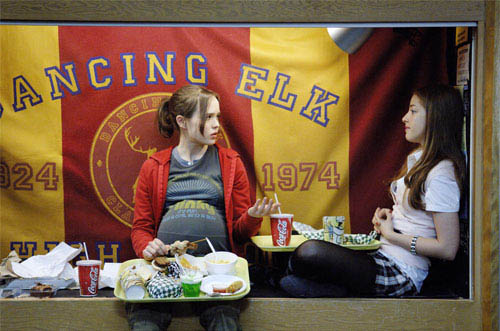
Juno is a film so dominated by its script (by Diablo Cody*) and its actors (they're all television veterans with countless man-hours before the camera) that all director Jason Reitman has to do is get out of the way-though in the transitions he routinely cuts on the 1's of the pervasively twee-rock soundtrack to maintain the air of perkiness. The kids that dominate this film about lower-middle-class families making the most of a bad situation—well, bad in the timing—are so pervasively cute and clever in their articulation and word-play that one wonders if they hail from some part of the country where the main sport is Scrabble, and instead of MySpace they all hover around "Addictionary.org." 
Ultimately one has to ascribe to it the same rule that one applies to Bette Davis movies where everyone always has the perfect come-back: "They have better writers than we do."
But the same troubles. Juno MacGuff (Ellen Page) starts the movie pregnant and pissed. And pissing. She's buying the home-pregnancy tests out of the box one at a time from the convenience store and using their facilities to test it. "You better pay for that pee-stick when you're done with it," says the clerk (played by "The Office's Rainn Wilson). "Don't think it's yours just because you marked it with your urine!" She gets the unholy pink "x" and starts to puzzle out how to proceed: telling parents, telling sperm-donor, what to do with said spawn, yadda yadda yadda.
Juno skips along dealing with all these crises and quite a few more, and never slides into bathos, preaching or "after-school special" earnestness. The characters are all people for whom regrets are a waste-of-time, and are too busy doing their best to do too much navel-gazing. Well, almost all. One walks away charmed, and admiring the cleverness and the near-occasion of bravery the movie displays. And there are no bad performances. Anywhere. No actor lets this material touch the ground, whether its the stunningly decent work by vet-thesps like Alison Janney and J.K. Simmons, but also wise work by Michael Cera, Jason Bateman, and, yes, Jennifer Garner. But the big bouquet goes to Ellen Page who carries the movie on her slim shoulders and always finds a way to make the dialog sound like she's just saying it off the cuff. That's a tough trick to pull for an entire movie--an entire comic movie--this entire comic movie. Frankly, it would've been easier giving birth.
------------------------------------------------------------------ 
It Takes a Sex Toy to Raise a Village
 
 
 Everybody likes Lars (Ryan Gosling). Lars is 27, lives in the carriage-house of the family home. Keeps to himself. He goes to work, eats, attends church, chops wood.

And that's about it.

Lars is socially retarded to an alarming degree, so much so that he feels it hurts to be touched. His family worries about him. They feel guilty. They don't know what to do.

But Lars does. He's surrounded by people with relationships, so he decides to get one. But that touching thing...that's a problem.

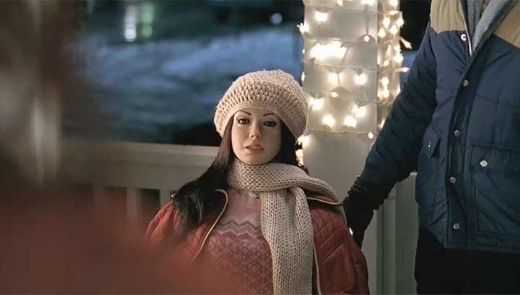
Then one day, Bianca shows up, a mail-order girlfriend. Lars tells his brother and sister-in-law that he has a girl-friend and he'll bring her over for dinner. They're elated. Then they find they didn't need the extra setting. Bianca's a sex-doll. Fairly realistic looking, but she doesn't move. At all. Lars has to carry her, until he gets her a wheelchair. He cuts her food for her. Eats it, too.
In a case of intervention, all four go to the doctor (Patricia Clarkson, being warm but acting cold), who takes one look at Bianca and worries out loud that she needs weekly treatments for her alarmingly low blood pressure, and uses the opportunity to find out exactly what is going on with Lars. She advises that they should play along--"Bianca's in town for a reason," she says. "But, people will laugh at him!" says his harried brother, played by a note-perfect Paul Schneider. "You, too," says the doc.
Lars and the Real Girl
could be perverse, and if Lars actually had relations with Bianca, people wouldn't be enjoying this movie nearly so much. Nor would it be as enjoyable if the entire town didn't, for the sake of Lars, go along with the story and accept Bianca. And that acceptance happens almost immediately. Sister-in-law Karin informs her coffee klatsch friends that Bianca is anatomically correct, and one of them says, "Soooo...she's just one of the girls, then..." The pastor of the church goes along with it. Everybody does. Ev-e-ry-bo-dy. Which set off some reality alarms for me. There aren't any disaffected youth, or jerks or morons in this town? Hell, if any of the kids from Juno lived there, Lars would be getting the "stink-eye," at least. And in a land where every inflatable Christmas lawn ornament is at risk, Bianca has it REALLY easy.
Still, it's an enjoyable film, full of heart in the right place, and offers lots of enjoyable surprises in screenplay, performance (it's hard to believe this is the same
Ryan Gosling from Fracture) and overall tone. One wishes there was a second there where one could believe in it.
---------------------------------------------------------------------------------

* Diablo Cody has such a fresh, smart way with dialog that one hasn't been as excited by a screen author's work since Zach Helm, who wrote Stranger Than Fiction. Since Helm went on to create the lead balloon Mr. Magorium's Wonder Emporium, one doesn't want to be too effusive in one's praise, lest one set oneself up for disappointment.

Wednesday, April 5, 2023

All the King's Men (2006)

Written at the time of the film's release. Recent events have compelled an update.

All The King's Men (Steven Zaillian, 2006) The story goes that Robert Rossen, the director of the 1949 version of All the King's Men was not happy with his film. Too long, too talky, and too boring, Rossen was unsure of what to cut to get it down to length. A plan was drawn up: he told his editor to take 30 seconds from the beginnings of scenes and 30 seconds from the end. What was left came in under two hours of running time and moved at a jarring pace, but it won Oscars for its star Broderick Crawford, Best Supporting Actress Mercedes McCambridge...and as Best Picture.

All the King's Men was already a great film, but there were too many compromises to the Hays Code to get it to the screen. Steve Zaillian (a fine screenwriter, who directed a favorite film of mine Searching for Bobby Fischer) decided to make a new film of Robert Penn Warren's Pulitzer Prize winning book, and sadly, wasted the opportunity in a film convinced of its own importance.
*
From the crack of thunder that appears before the opening credits, to the thudding
James Horner score that telegraphs (with hammers) each imminent plot-point (Horner uses one dirge-like theme which, by its third appearance, I had assigned lyrics "This-is-a-sad-sto-ry/A-bout Lou-i-si-an-na"), to the subdued lighting and the art design in shades of "Godfather" mordant, everything about this movie promises great portent, but merely meanders through its story of how nothing born of corruption can come to any good, be it man, ideals or building materials.
It's a frustrating film to sit through, because the pieces are there given a less respectful (as in funeral-respect) presentation. The cast is impressive.
Kate Winslet and Mark Ruffalo and Anthony Hopkins play the well-to-do Stanton clan. Kathy Baker and Jude Law are the blighted Burden clan, and Sean Penn, looking more and more like a young George C. Scott, plays the fictional surrogate of Huey Long, Willie Stark. As his flaks and flunkies, James Gandolfini, Patricia Clarkson and Jackie Earle Haley.
Good cast. But there are problems.
Penn, as he is wont to do, goes over-the-top in his speechifying, his arms waiving wildly in the air, his fingers doing filigreed dances. Where Penn got the inspiration to play it this way is a mystery, as footage of Long in speech-mode (below) shows him much more in control. Not even Adolph Hitler emotes this much. Jude Law, never the strongest of actors, falls into the dreariness of the film, staring at the other actors or nothing-in-particular with sad doe-like eyes.
** One suspects editing problems with this film—Zaillian did spend an inordinate amount of time in post-production on it. Subjects are brought up and dropped, like Stark's football-playing son, who figures prominently in the '48 film, is mentioned here and then never heard from again.*** We never do find out how Burden's mother acquires facts to make an accusation against him. Mark Ruffalo's character is left as a dissatisfying enigma.
What we do get is ponderous, and pretentious. Zaillian spends a lot of screen-time trying to show (visually) that the only thing that could unite the "hicks" and gentry of Louisiana is death. Again, that same lesson has been told in better films.

2023 Update: At the time the film came out, there was speculation that it was a "dig" at then-President George W. Bush. If so, it was bound to disappoint both sides, no matter where you came down on that particular president.

But, a re-watch today would make folks blanch—"well, that-tha-that's Donald Trump!"

Nope. Trump just borrowed from the same play-book that politicians have been using since politics became the world's "second oldest profession:" "Get elected by any means necessary. Cease power. Never let it go." That's the genius of Robert Penn Warren's book; he found inherent truths in the process and they continue no matter what generation after reads it. Sure, it seems like Trump—except for the details, the milieu, the accent. But, the autocracy is there. The crowd-whipping. The scandals. Warren could be accused of writing cliches. But, cliches are there because they're unerringly true and happen enough to become cliches.

For the truth is, politicians lie. And people look for a Messiah and want to be lied to. They eat it up. And the ultimate cliche. Absolute Power Corrupts Absolutely.

Just because it's a cliche doesn't make it not true.

* Given the awards-history of the cast and screenwriter it was assumed that this version of All The King's Men would be a top contender come Oscar-season, but its poor box-office reception scuttled those hopes.
** K (who likes Law) kept yelling out "accent-drop!" whenever his "Lawsiana" draw-el moved to Market Street. Anthony Hopkins, the sly old dog, doesn't even try.

*** Sadly, Zaillian, in an attempt to simplify his film, gutted some crucial scenes from it including the sub-plot about Stark's son, and an extended ending that provides the best scenes for Jude Law and Jackie Earle Haley.

Tuesday, December 13, 2022

She Said

Paying the Piper: The Last Harvey Weinstein Picture Show
or
"I Think Everyone and Everything Has a Secret"
 
"I feel equipped to protect you against the Roses of the world, because I have represented so many of them...You should be the hero of this story. Not the villain. This is very doable."
Attorney Lisa Bloom in a memo to Harvey Weinstein
Who knew?
 
That's the dispiriting question that lingers as one watches She Said, the film made of expose by the two New York Times reporters, Megan Twohey and Jodi Kantor, who "broke" the Harvey Weinstein sex-abuse scandal. Weinstein had been using his power as head of the Miramax film studio since the 1990's to harass, proposition, and even rape employees or potential hirees, and then used his lawyers to sign up NDA's, hired spies to follow and intimidate his accusers, and then, had his board of directors approve the hush money that was paid out. That's a lot of personnel. There are allegations that the story was spiked years previously by NBC—or should we say NBCUniversal (Universal being the distributor of this film*) owned by Comcast. Even one of the producers of this film—who was intimate with two of Weinstein's victims, and supposedly threatened him after one of his episodes—still had dealings with Weinstein afterwards even though he knew what kind of a slime-ball he was. Hard not to be cynical when there are as many suspects as an Agatha Christie drawing room can hold.
 
A lot of people knew. They just weren't talking. Or others kept them from talking. And as long as no one talked, the assaults continued.
Look, not to be too naive about all this—because Hollywood people have been sleeping around even while making remakes of "Polyanna"—but why was anyone surprised this was going on...and why wasn't anyone talking about it? With all the conspiracy theories running rampant these days, why are so many staying silent about all the hush-ups about sexual assault? Because most of the "professional" services are at the behest of men? And men perpetrate the vast majority of sexual assaults? Duh! And one may crow about more women lawyers, but judging by the quote above from a so-called harassment victim "advocate" it seems like membership in any "sisterhood" can be bought out by a sizable check.
Sex in Hollywood was just another coin of the realm. It was a quick way to get ahead or get head, all part of the bartering system of tit for tat, with the guys who had the power to make or break careers and approve budgets taking advantage of their perceived power for their own selfish appetites.
But, to the story at hand. At the New York Times, Twohey (
Carey Mulligan) and Kantor (Zoe Kazan) are both working on sexual harassment stories but in different beats—Twohey is following up on a charge against presidential candidate Trump, while Kantor gets a lead that actress Rose McGowan is saying that she's been raped by Harvey Weinstein, the head of Miramax and The Weinstein Company; Kantor has already done work-place harassment pieces about Amazon, Starbucks and the Harvard Business School. She calls up McGowan but the actress won't talk about it—why should she, as she's taken it other places and it has been shelved. Kantor tries to reassure her but McGowan won't commit. It would be career suicide, but she gives the reporter enough information that Kantor can follow up with another source.
While Kantor runs down leads, Twohey takes maternity leave and after suffering through some post-partum depression comes back to the Times and is assigned by editor Rebecca Corbett (
Patricia Clarkson) to run down parallel leads for the Weinstein story. Doors get slammed in faces. The same "nobody did anything before" deflection is heard time and again. And editor Dean Baquet (Andre Braugher) starts to become involved: "Harvey...he's...difficult" is his reply when asked if he'd dealt with Weinstein before (Braugher's tough even-handedness is a wonder to behold).
In many ways, one may feel that they've seen this movie before—All the President's Men and Spotlight—the dogged knocking on doors, the "just-in-case" giving of business cards, the leg-work, how the interviews always end with the rejection of the "Always Be Closing" line ("Will you go on the record?"), the assuredness that there is a story there and the frustration that no one will corroborate it. The ghosts of stories that never make it to press because the source won't commit, on or off the record, because...consequences. Who can blame them? For some, it's a matter of life or death.
But not for the perpetrators. The ones with power, whether Presidents or priests or producers.
 
It comes down to a biological dynamic: women and men are different. Women have to deal with the consequences of sex—pregnancy, child-bearing, child-birth, child-rearing**—and men, because of that difference, can ultimately choose to ignore that responsibility. To the point where they have the attitude that they are immune from responsibility. Does this sound familiar? The active response of men "getting caught" is to delay the inevitable, to avoid the consequences, to kick the can down the road where they have to own up to the consequences of their actions...and pay for them. It leads to an attitude of privilege, and (as I love to point out to people who fight the notion) "to the privileged, equality feels like oppression" so they fight it every step of the way. Every. Step.
Court, to the majority of us, is something to avoid. For the powerful it's just a delaying tactic. So, the "we'll sue" card is always played first as a bluff, actual suits tie things up for a bit but involve money (which the powerful can afford). It's a delaying tactic...but it's "doable." Consequences aren't.
Meanwhile, the press have consequences they're trying to avoid, as well. Those pesky lawsuits, of course, but the shame of "getting it wrong" is tied in with that. Get the story, but verify. Verify as often as possible. From sources with evidence. Get the story, sure. But get it right. Get it dead to rights. One of my favorite shots from the film is the entire team of editors, writers, proof-readers, researchers, huddled around a single computer terminal, reading, re-reading, checking every word, every punctuation, before daring to push "publish." The stakes are high, sure, but I wonder how many reporters suppress a laugh during that scene. I'd like to think very few. But I can't verify.

Still, the film does what it's supposed to do, which is provide food for thought, tell its story with the intended underlying tension, and generate a modicum of righteous indignation.

And the powerful will continue to stalk for anything...or anyone..."doable."

* Penance? I don't know. Idle speculation will make me as bad as any other foil-hat wearing conspiracy wack-o. But, Weinstein got Lisa Bloom on his team by buying the film rights of one of her books. But, NBC did spike those stories.
 
** A point is made of showing Twohey and Kantor with supportive, stepping-up partners who'll, without whining, attend the kids. Because it's what they do. And who they are.

Thursday, May 13, 2021

Good Night, and Good Luck.

Good Night, and Good Luck. (George Clooney, 2005) There had been talk about an "Edward R. Murrow" movie for a very long time, and there'd been quite a few actors who fancied the role—Roy Scheider and Daniel J. Travanti being two that I know of—but nothing had ever been done beyond the script stage. That was the issue; where would you start? The man who had been such a cornerstone of journalism through its transitions from print to radio to television, and had a personal hand in how those mediums affected the form and presentation, had a multi-storied career. Like Lincoln, where would you start and where would you end? What was the section that you would concentrate on that would make the boldest, most informative statement about the man, his principles, and how he fought for them? His work as a radio broadcaster in London during World War II? His ballsy documentaries running in primetime on CBS during the 1950's? But, the seminal moment—his greatest moment and the one that started the end of his career—was when he took on Joe McCarthy.
Clooney (who also co-wrote with producing partner Grant Heslov) begins his film with another "Murrow Moment"—October 25, 1958, to be exact—when he took his broadcast journalist cronies in the RTNDA* to task for letting their values slip in a speech where he was to be given an "honorarium" three months after his last documentary for CBS News. Murrow started the speech with what would amount to him as a prep-joke: "This just might do nobody any good."
It didn't, other than to pass Murrow into Legend. It was seen by his former boss at CBS, William Paley (played by Frank Langella in the film) as a final stab in the back, after years of back-and-forth about the value of Murrow's "brand" of news at CBS. But, Murrow was never afraid to speak truth to power. He was never afraid to put out both sides of an issue. He was never afraid to share bad news. He might have hoped that his reputation would save him, and in a less corrupt industry that might have been true, but Murrow was too well-read, even if it was just the hand-writing on the wall.
At the time of the McCarthy broadcast, the prevailing attitude at CBS is fear, with a healthy dose of paranoia, as described by the film: reporters Joe Wershba (Robert Downey Jr.) and Shirley Lubowitz (Patricia Clarkson) are constantly looking over their shoulders—they haven't told anybody at CBS they're married as its against company policy; anchor Don Hollenbeck (Ray Wise) is facing crises both personal and professional—he's just been divorced and he's being smeared in the press as a "pinko"—not quite a "red", but just "red" enough; CBS News director Sig Mikelson (Jeff Daniels) is concerned about a piece Murrow (David Strathairn) and his producer Fred Friendly (Clooney) are doing about a U.S. Air Force officer recently discharged from the military for suspected members of the Communist Party in his family—at the officer's hearing, the charges were sealed, a clear violation of legal and constitutional rights. If the story is pursued, there is concern of a backlash from Senator Joe McCarthy, conducting a red witch-hunt, that could hurt CBS, and Alcoa, their sponsor with government contracts, might get hurt even more. And William Paley has to negotiate broadcast licenses with the government; controversy and criticism won't help at all.
Murrow's instinct is to follow the story, and one of his team recuses himself because his wife had been to Communist meetings before they'd even met, It only solidifies Murrow's commitment: "We're going to go with this story because the terror is right here in this room." When the Air Force story is aired, the officer is re-instated, but Wershba is button-holed in the halls of Congress and told by a source that his boss, Murrow, was once on the Communist payroll. Murrow and Friendly run another piece, hitting closer to home, over a McCarthy hearing of a Pentagon code room employee where the evidence is questionable at best. Murrow offers air-time to respond to the questions raised and McCarthy uses it to attack Murrow. Murrow offers a reply the next week, focusing on McCarthy's rebuttal, his tactics, and lack of clarification or defense of his actions, using McCarthy's own words against him, the result of which is a Senate investigation of the Senator himself. Although it all has the tacit approval of Paley, the result is that Murrow and Friendly's positions at CBS are undermined.
Clooney, in directing, makes a couple of critical choices: he shoots in black-and-white, so there is no disruption between the archive footage and the drama going on; he shoots in documentary style to lend the conversations a fast pace and a seeming verisimilitude; and he uses the real footage of McCarthy, so as not to betray any prejudices through casting or directing choices. McCarthy is shown, warts and all, with his failings intact to be judged. He also punctuates the film, approximately every 23 minutes with a jazz song (performed by Diane Reeves) to serve as a "greek chorus." The songs—ironically or suggestively titled—are "TV is the Thing This Year," "You're Driving Me Crazy," "I've Got My Eyes On You," "One for my Baby," "How High the Moon," and (most pithily) "Who's Minding the Store?"
The casting—apart from McCarthy, of course—couldn't be better: Downey, Daniels, Donovan, Clarkson, Langella...and Clooney...give particularly attention and devotion to the words in a screenplay where the words matter. And, in the plum role of Murrow, Strathairn gives a performance that, while not imitating the man, evokes him, the gravitas, and the emotional reserve where someone reacts with thought before feelings—because feelings can be seen on "I Love Lucy." More than anything, he evokes the image of Murrow as we want to remember him—the television knight with a typewriter, not a sword, and a shield of cigarette smoke, that makes him vulnerable, but no less chivalric or prepared to engage because of it.
 "It is my desire if not my duty to try to talk to you journeymen with some candor about what is happening in radio and television, and if what I say is responsible, I alone am responsible for the saying of it. Our history will be what we make of it. And if there are any historians about fifty or a hundred year from now, and there should be preserved the kinescopes of one week of all three networks, they will there find, recorded in black and white and in color, evidence of decadence, escapism, and insulation from the realities of the world in which we live. We are currently wealthy, fat, comfortable, and complacent. We have a built in allergy to unpleasant or disturbing information; our mass media reflect this. But unless we get up off our fat surpluses, and recognize that television, in the main, is being used to distract, delude, amuse, and insulate us, then television and those who finance it, those who look at it, and those who work at it, may see a totally different picture, too late."

* The Radio-Television News Directors Association, although now it's The Radio-Television-Digital-News Association—RTDNA—and every year the give out the Edward R. Murrow Awards