Showing posts with label Allison Janney. Show all posts

Thursday, August 3, 2023

Suspensions of Disbelief —"Like, yeah-Huh!"

On my earlier film blog, I would sometimes pair up movies I'd seen recently if they had some slight connection. This is one of those. 

Juno became a smash hit, despite my reservations and Diablo Cody—and Jason Reitman—went on to do some stellar work. Both are working on things. Ellen Page is now Elliott Page, and is now identifying as a male. One thing that hasn't changed is his amazing talent. I don't change things when I move these posts from the old blog to the new blog, unless I find mistakes, so I've kept Elliott's name as it was at the time of the writing, which was at the time of the film's release. 

Director Craig Gillespie, who made Lars and the Real Girl, made I, Tonya, Cruella, and the min-series "Pam and Tommy", as well as directing Diablo Cody's mini-series "The United States of Tara."
 
--Sacred Vessels in the Land of Addictionary.org

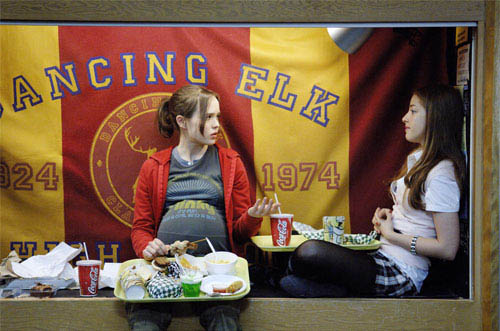
Juno is a film so dominated by its script (by Diablo Cody*) and its actors (they're all television veterans with countless man-hours before the camera) that all director Jason Reitman has to do is get out of the way-though in the transitions he routinely cuts on the 1's of the pervasively twee-rock soundtrack to maintain the air of perkiness. The kids that dominate this film about lower-middle-class families making the most of a bad situation—well, bad in the timing—are so pervasively cute and clever in their articulation and word-play that one wonders if they hail from some part of the country where the main sport is Scrabble, and instead of MySpace they all hover around "Addictionary.org." 
Ultimately one has to ascribe to it the same rule that one applies to Bette Davis movies where everyone always has the perfect come-back: "They have better writers than we do."
But the same troubles. Juno MacGuff (Ellen Page) starts the movie pregnant and pissed. And pissing. She's buying the home-pregnancy tests out of the box one at a time from the convenience store and using their facilities to test it. "You better pay for that pee-stick when you're done with it," says the clerk (played by "The Office's Rainn Wilson). "Don't think it's yours just because you marked it with your urine!" She gets the unholy pink "x" and starts to puzzle out how to proceed: telling parents, telling sperm-donor, what to do with said spawn, yadda yadda yadda.
Juno skips along dealing with all these crises and quite a few more, and never slides into bathos, preaching or "after-school special" earnestness. The characters are all people for whom regrets are a waste-of-time, and are too busy doing their best to do too much navel-gazing. Well, almost all. One walks away charmed, and admiring the cleverness and the near-occasion of bravery the movie displays. And there are no bad performances. Anywhere. No actor lets this material touch the ground, whether its the stunningly decent work by vet-thesps like Alison Janney and J.K. Simmons, but also wise work by Michael Cera, Jason Bateman, and, yes, Jennifer Garner. But the big bouquet goes to Ellen Page who carries the movie on her slim shoulders and always finds a way to make the dialog sound like she's just saying it off the cuff. That's a tough trick to pull for an entire movie--an entire comic movie--this entire comic movie. Frankly, it would've been easier giving birth.
------------------------------------------------------------------ 
It Takes a Sex Toy to Raise a Village
 
 
 Everybody likes Lars (Ryan Gosling). Lars is 27, lives in the carriage-house of the family home. Keeps to himself. He goes to work, eats, attends church, chops wood.

And that's about it.

Lars is socially retarded to an alarming degree, so much so that he feels it hurts to be touched. His family worries about him. They feel guilty. They don't know what to do.

But Lars does. He's surrounded by people with relationships, so he decides to get one. But that touching thing...that's a problem.

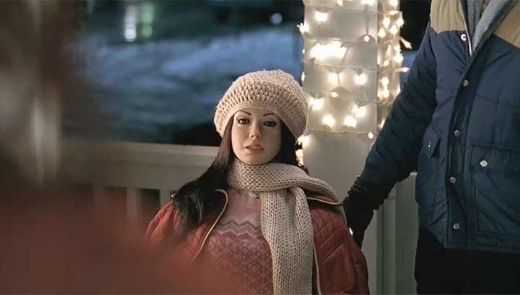
Then one day, Bianca shows up, a mail-order girlfriend. Lars tells his brother and sister-in-law that he has a girl-friend and he'll bring her over for dinner. They're elated. Then they find they didn't need the extra setting. Bianca's a sex-doll. Fairly realistic looking, but she doesn't move. At all. Lars has to carry her, until he gets her a wheelchair. He cuts her food for her. Eats it, too.
In a case of intervention, all four go to the doctor (Patricia Clarkson, being warm but acting cold), who takes one look at Bianca and worries out loud that she needs weekly treatments for her alarmingly low blood pressure, and uses the opportunity to find out exactly what is going on with Lars. She advises that they should play along--"Bianca's in town for a reason," she says. "But, people will laugh at him!" says his harried brother, played by a note-perfect Paul Schneider. "You, too," says the doc.
Lars and the Real Girl
could be perverse, and if Lars actually had relations with Bianca, people wouldn't be enjoying this movie nearly so much. Nor would it be as enjoyable if the entire town didn't, for the sake of Lars, go along with the story and accept Bianca. And that acceptance happens almost immediately. Sister-in-law Karin informs her coffee klatsch friends that Bianca is anatomically correct, and one of them says, "Soooo...she's just one of the girls, then..." The pastor of the church goes along with it. Everybody does. Ev-e-ry-bo-dy. Which set off some reality alarms for me. There aren't any disaffected youth, or jerks or morons in this town? Hell, if any of the kids from Juno lived there, Lars would be getting the "stink-eye," at least. And in a land where every inflatable Christmas lawn ornament is at risk, Bianca has it REALLY easy.
Still, it's an enjoyable film, full of heart in the right place, and offers lots of enjoyable surprises in screenplay, performance (it's hard to believe this is the same
Ryan Gosling from Fracture) and overall tone. One wishes there was a second there where one could believe in it.
---------------------------------------------------------------------------------

* Diablo Cody has such a fresh, smart way with dialog that one hasn't been as excited by a screen author's work since Zach Helm, who wrote Stranger Than Fiction. Since Helm went on to create the lead balloon Mr. Magorium's Wonder Emporium, one doesn't want to be too effusive in one's praise, lest one set oneself up for disappointment.

Friday, March 6, 2020

Bombshell

FOX in the Hen-House (The Cure For What Ailes You)
or
"A Babe With No Geezer? This Can't Be a FOX Affiliate!"

"The first thing you should know about me..." says Bombshell's version of Megyn Kelly (Charlize Theron) right off the bat "...is I have a big mouth."

Well, for good or ill, that's the FOX news paradigm, and it has nothing to do with sexism or the sex of the on-air talent. Everybody on FOX News has a big mouth, an overly-aggressive personality, and a slightly off-lobe brain that considers opportunity over content. I've never had an illusion of any of the FOX News staff being thoughtful or contemplative. 

Not even while looking in a mirror.


It is always "Hot Talk" on FOX NEWS, that most empty of formats that sheds heat but never any light. Sure, it's entertaining if you're of that frame of mind, but you have to have the naivete of a tither to a TV evangelist to buy it. Caveat Empty-Head.

END of personal FOX screed: onto the movie.

Bombshell is written by Charles Randolph, who did such things as The Life of David Gale, Love and Other Drugs, and The Big Short (in ascending order of quality) and there's not a fourth wall he's not afraid to kick at to get to the audience. If something gets too tough to communicate (as in The Big Short), he will stop the proceedings to explain it to the Nth degree. In the case of Bombshell, we get the whole story by way of Megyn Kelly's Greek chorus, who explains what goes on at FOX news, the work environment, the philosophy, and her role in that environment, which she sees as somewhat loftier than others do. She is about to be a contributor to the Republican debates and it is her intention to hit candidate Donald Trump with his history of boorishness towards women. She is understandably nervous, but determined to make an impact. 
Meanwhile. Gretchen Carlson (Nicole Kidman), who was on the popular morning show "Fox and Friends," has moved to be an afternoon show host and she's in the middle of contract negotiations with the Corp. But, she has higher aspirations. She's tired of being treated like a bimbo, both on and off-screen, and wants to do something more with her show, to the point where she starts to veer a little off-point from the standard fare. And she wants there to be a little more respect given her. At least, knock off the crass jokes. Her current contract prevents her from suing FOX. But, there's nothing in her contract from personally suing the Chairman of FOX NEWS, Roger Ailes (portrayed by John Lithgow and half a ton of make-up).
Ailes is all about loyalty...all about loyalty. He runs FOX with an iron fist on the tiller (because, as he says, if he doesn't, news will always veer left). So, he runs a tight ship, emphasizes that loyalty—and if you're loyal, you'll be rewarded, maybe. It's frankly not that different a psychological threat as a CEO expounds these days, drawing comparisons to businesses as family, with, of course BIG Daddy calling the shots. There is no question, or even acknowledgment, that there might be another way to do things other than a patriarchy.
Carlson's strategem is closely observed by Kelly, who is slightly distracted by the fall-out from her debate question, finding out, much to her distress, that she has become the focus of coverage rather than the issues she was trying to bring up. She, however, remains silent when, all of a sudden, investigators for Carlson start looking for women at FOX who can confirm harassment allegations against Ailes.
Into the mix comes Kayla Popisil (Margot Robbie), young, blond, conservative, raised in a mid-west religious household, who wants to make it big at FOX NEWS, which is her dream. She starts to work her way up from basement producer and then gets her "big meeting" with Ailes, who gives her the loyalty speech and a test of her loyalty...that she'll be willing to cooperate.
Bombshell is tough (in the screenplay department, anyway), not only on the corporate environment that allows such indiscretions for the aggrandizement of its "Master of the Universe" CEO's...or anyone capable of using sexual blackmail just because they can, but also for the lack of sisterhood that would allow such stuff to be contained as "company secrets." This isn't the stuff of—as companies like to advertise—"a name you can trust," but is more in keeping with the thuggery of a jail-yard, where everybody's in it for themselves. Most companies are inherently predatory—it is their bottom line to take your money, after all—it isn't a stretch for them sweep dirt under the rug, hide things you might like in small-printed terms and conditions, and circle the wagons in Escher-like PR boiler-plate. FOX NEWS is merely the loudest, most blathering (in protesting its innocence) example of such predatory practices and the default follow-up of denial.
There's the added inherent sexism that's employed whenever the victims are women...the same sort of doubling-down on that only adds insult to injury in a rape trial. Nobody ever questions that events happen because the perpetrators are men—why?—or that the ruthlessness displayed in business (and praised, admired and emulated) might be the same alligator-brained synapse that makes power-brokers think they can use it against their own employees. Why does loyalty only work from the bottom up and not the top down? As long as there's that disparity, loyalty must continue to be lateral among peers to create strength in numbers and create a din that drowns out corporate whispers.

I just wish there was a better director in charge of it. Jay Roach has been reaching for issue-cred after starting out making comedies of "indeterminate humor" (the "Austin Powers" series, the "Meet the Parents" series, Dinner for Schmucks) and his approach is still uninspiring and rarely moves beyond an ability to "get the shot." In other hands, Bombshell might have been a more powerful movie, even a galvanizing one.

Instead, it's less a "Me, Too" movie and more of a "Meh, Too" movie.

Wednesday, October 16, 2019

The Addams Family (2019)

Altogether Ooky (And I Don't Even Know What That MEANS!!)
or
"Are You Unhappy, Darling?" "Oh, Yes, Yes! Completely"*

I've written about how much I loved "The Addams Family" (both as a 1960's TV show and as a concept from Charles Addams' series of macabre  New Yorker cartoons from 1932 to his apparent death in 1988), and the rather "iffy" attempts to continue the perverse charm in Barry Sonenfeld's feature films and TV spin-off's. There's been a Broadway musical (that I know nothing about) and there were rumors a few years ago that Tim Burton was working on a stop-motion version—which might have been interesting. Burton might not have been entirely faithful to it, but he would have captured the spirit and the schtick that made the old series so enjoyable (as opposed to the watered-down "Munsters" that appeared on CBS at roughly (very roughly) the same time.

Well, that would have been interesting. And probably far more enjoyable than the latest re-boot of The Addams Family, written by Conrad Vernon, Pamela Pettler, Matt Lieberman, Erica Rivinoja and directed by Vernon and Greg Tiernan.
Kudo's to them for designing it closer to Addams' original conceptions (although they don't always make compelling characters—their version of Addams daughter Wednesday is particularly bland) and there are some rare body-snatches of Addams original material—like the line (*) in this post's title. But, the whole thing is barely enjoyable, particularly because some of the voice-casting is underwhelming, with the exception of Oscar Isaac's "Gomez" and Nick Kroll's "Uncle Fester."
But, there's also less emphasis on the family dynamics and more on their "otherness" from somewhat ordinary citizenry. That tactic has always been dull—unless the "normals" were weirder than the Addamses—and usually the least intriguing part of any "Addams" story. How many gawping reactions can you get before it gets old and starts decaying before your eyes? And this version of "The Addams Family" has an awful lot of that.
The film begins with the wedding of Gomez (Isaac) and Morticia (Charlize Theron—she tries, although the role would be better suited to another cast-member, Allison Janney) attended by the Addams Extended Family, but it gets interrupted by locals with torches and pitchforks—ordinary people are turned murderously monstrous by what they fear (now where have we seen that before?)** Escaping with Fester (Kroll) and "Thing" (their literal hand-servant), the joyously gloomy newly-weds head for their honeymoon in New Jersey (State Motto: "What Are YOU Looking At?), where they run down an escapee from an asylum for the criminally insane, who turns out to be Lurch (muttered by director Vernon), who will become their beloved man...er...creature-servant. Trying to return him to the asylum, they find the facility closed (by police tape), abandoned, and haunted. But, for them, it's merely a lovely fixer-upper dream-home to raise a family—but not from the dead—and put down gnarled roots.
Morticia is mortified that Wednesday starts to show interest in bling
"But, darling, pink is a gateway color!"
Cut to thirteen years later. The Addamses have an older daughter Wednesday (Chloe Grace Moretz) and son Pugsley (Finn Wolfhard, busy young man). Wednesday, full of woe, has grown rebellious ("But, darling, you have all the horrors of home right here!") and Pugsley is approaching an Addams right of passage. No, it's not a Bat Mitzvah (but thanks for going there), it's a Mazurka, in which he must demonstrate his prowess as a warrior with the Addams Scimitar. That's not Pugsley's style—he's more of an expert in explosives—and Gomez fears that, despite his worst efforts, Pugsley will be an embarrassment to the Family coming to witness the momentous event. This sentiment seems un-Addamsish.
Meanwhile, gentrification also challenges The Addams Family. At the base of their escarpment their mausoleum is perched on, a development has cropped up, sponsored by the Home, Art, and Garden Network (HAG-TV) and its principal make-over star, Margaux Needler (Janney). As if to push the point a little too far, the name of the town is "Assimilation," and the movie is consumed with her efforts to get rid of the eye-sore that sits in the cross-hairs of Assimilation's picture-windows.
Margaux stops by to give the Addams House a make-over.
The hair may be a political point.
Oh, there are good lines—at one point Wednesday runs away from home, insisting on going to public school (rather than "cage-schooling") and she's asked if she wants to go to the Mall to which she replies "Sure, I haven't seen a good mauling in ages"—but, it's relatively simple to get laughs out of Addams contrariness. The very fact that they're a morbid bunch makes them a natural anathema to normalcy and rife with satirical possibilities aimed at white picket fences. But, this version is a little too desperate to find them. And bludgeons them like a wooden stake.
There's an awful lot of music humor—too much of it—Lurch plays "Green Onions" on the organ and, at one point, "Everybody Hurts." It's a little weak. And it has the annoying habit of going back to the well of the TV-show for dread-cred, rather than stake out new territory. The film-makers make too much of a big deal of the pet lion (in the TV series, did we see that twice?) Did we really need an animated version of the TV-show's theme song that matches the live version to the last detail? Can't this be its own "thing" (so to speak?) without cleaving so close to the source? Are we to reduce the Addams Family to being a horrid cliche, with the very first movie in a re-boot series?
I know it's a children's movie and all, but the group who made the "Hotel Transylvania" films had a better coffin-handle on the material than this weak effort has. 

Maybe I'm a little too close to the source, but, after watching this, I had a normal urge to go down to Lowe's and get a cart full of torches and pitch-forks.


*
** Short Answer: "Everywhere"
"That's 'It', Folks!"

Saturday, June 22, 2019

The Help (2011)

Written at the time of the film's release...

"The Other Side of the Bridge Club (Insuring Domestic Tranquility)"
or
"You Ought Not to Joke About the Colored Situation"

You go into The Help with a certain amount of trepidation.  Will it be so politically correct as to have no bite? Will it be a "TWGSTD" movie, where the true story of the oppresssed is supplanted by "the drama" of a privileged person's conscience to help? Will it be a Neapolitan "Chick-Flick," all sugary ice cream of different flavors and colors? We've seen plenty of those, and one would hope that we've evolved out of our tribalism enough that film-makers—even commercial film-makers—hedge their story by surrounding the center with white-washing vanilla.**

Stanley Kramer, after all, has been dead for ten years.
With The Help, it's a hesitant answer of "Yes" and "No." "Yes," the story has elements of "White Guilt" saves the day, but only in the short term, and said Guilty Party, Eugenia "Skeeter" Phelan (known as "Long-Haul" to her high school friends for actually attending and graduating college and pursuing a journalism "job," rather than settling for domestic tranquility) may have a sense of accomplishment, but it costs her. And the issue of "You think you're gonna help us?" is very pointedly brought up by the character of Minny Jackson (played by her real-life inspiration, Octavia Spencer, in an excellent performance).  Say it, sister.. Nice touch of dignity, that. 
Young Miss "Skeeter" (Emma Stone), is ambitious, as are all the white women in the segregated community of Jackson, Mississippi; her ambitions don't center around who throws the nicest bridge club setting (or has it thrown for them), or making a name for herself preserving the traditions of The South. She wants to be a journalist, which, given the times, relegates her to ghosting a "best-bleach-for-the-sheets" column for the local newspaper. 
But, gnawing at her no. 2 pencil is what happened to the woman who raised her as a child. No, not mother Charlotte (Allison Janney, who tends to periodically rise above her material), but the house-servant, Constantine Jefferson (the always wonderful Cicely Tyson—I've missed her), who accepted and applauded her graceless duckling ways in a city of debu-taunting swans, and who disappeared while she was away at college, never to return. The vacancy of Constantine and her story inspires her to talk to the "help" about their stories, and how they maintain during their domestic servitude. Fearing a backlash from amongst the womens' society, she initially only gets to talk to a reluctant Aibileen Clark (Viola Davis, whose movie this is**), who tells her of her early days and of her family's molasses-like progress from house-"slaves" to house-"servants."
It involves the telling of tales on the pastel and flower-printed white woman she works for, a friend of "Skeeter's" (Anna Camp) and of the Red Queen of the Bridge set, Miss Hilly Holbrook (Bryce Dallas Howard, a subtle, ethereal actress, allowed to go "broadly comic," which, as when Meryl Streep does it, is not pretty).*** 
Set about the time of the Medgar Evers murder, where any sort of racial consciousness-raising was cracked down upon by Jackson police and strict curfews enforced, The Help has a tendency to overlook the more serious event in the timeline of its narrative, veering more towards comedy in Tate Taylor's adaptation (Taylor is a lifelong friend of novelist Kathryn Stockett's and acquired the rights to her novel before publication), but there is enough genuine tension in scenes of servants trying to get home by curfew, that the plight of the women in the serving class, and the genuine danger they faced in up-braiding their employers, and the structure imposed on them, simmers under the surface.  
Even in the face of somewhat trivially humiliating comeuppance, any sense of triumphant table-turning seems negligible against the long road to some sense of justice, however piddling (though entertainingly apt to provide a shit-eating grin) those small victories might be. 

As such, The Help, like those small victories, is a measured success.

(And I appreciated the handy list of uses for Crisco).

* "The White Guy Saves The Day," ala "Robinson Crusoe," Dances with Wolves, Glory, Guess Who's Coming to Dinner, Mississippi Burning, The Last Samurai, Avatar, heck, even "Transformers"...

** The closest it comes to teetering over the edge is in a sub-plot of an ostracized Southern belle from the other side of the tracks (played by Jessica Chastain), who embodies a white version of Southern social stigma, and, in a reverse of the normal Hollywood strategy of "white moves first," is shown "the ropes" by one of "the help," an act that becomes mutually beneficial.

*** Octavia Spencer is a real "find" here and a shoo-in to get a Best Supporting Actress nomination come Oscar season, but I hope that Academy voters will also give a Best Actress nod to Davis, whose tremulous fire in her role would make it her second nomination in three years—her first being Doubt, in which her one-speech scene managed to outshine Meryl Streep, Amy Adams and Philip Seymour Hoffman.

**** As if this embarrassment of acting riches wasn't enough, Miss Hilly's mother is played by Sissy Spacek, who continues to play ordinary roles in a most extraordinary way.


*+

Tuesday, July 31, 2018

The Way, Way Back

Written at the time of the film's release....

The Summer of Our Discontent
or
"Little Mr. Sunshine"

The summer "coming of age" movie is such a staple that it might be worthy of its own genre label, rather than merely being relegated to a sub-category. It's a natural, really. The timing seems right and appropriate for the subject of change. Summer always seems to be a time of transitions: from one school year to the next; from bring a graduate to a freshman, walking out of one door and into (and hopefully through) another one. And while the rest of the year is taken up by schooling, the ample three months of idle time gives one plenty of opportunity for other extracurricular learning—life-lessons from the school of hard knocks.

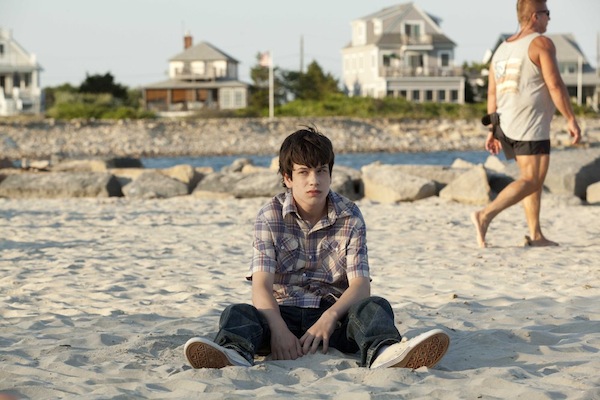
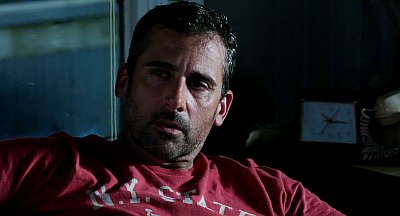
Take Duncan (Liam James), for instance (please, someone has to...) in the new film by Jim Rash and Nat Faxon (they won an Oscar for their superb script for The Descendants).  Fourteen, a 'tweener, his parents are divorced and Mom (Toni Collette) has taken up with another man. Trent (Steve Carrell), who has a daughter Steph (Zoe Levin). It is clear as this pint-sized Brady Bunch goes to an ocean beach house that it is not going to be anything resembling a beach-home. Duncan doesn't want to be there; he'd rather be with his Dad this Summer. Whether that preference has driven a previous wedge between Trent and Duncan is not know. What is known is that Trent is something of a jerk to Duncan. "One a scale of 1 to 10, what do you think you are?" he asks Duncan sequestered to the back of the station wagon on the ride to. "Six," says Duncan, noncommittally.

Duncan (Liam James) has a "thousand mile stare"
"I think you're a 3," says Trent imperiously.  "I just don't see you putting yourself out there..."

If Trent wanted to see Duncan put out, that remark was a good start.
Duncan settles into the teen routine of being a hot-house plant in a dark room, grunting monosyllabically at anyone over 30.  He can't relate to Trent's friends and neighbors, like the barely-together Betty (Allison Janney)—she has two kids, Susanna (AnnaSophia Robb) and Peter (River Alexander) and Kip (Rob Cordrry) and Joan (Amanda Peet).  And Mom, trying to heal after a divorce, is there for Trent. Duncan tries to be invisible and stay out of the way, and is emotionally unavailable.
It isn't until he finds Steph's abandoned pink bike (with tassles on the handlebars) that things begin to pick up speed and he feels like less of a trapped and pacing animal.  The bike gives him some mobility, some freedom, and it only has one seat, which is fine by him.  He starts to explore the beach-town and runs into Owen (Sam Rockwell at his loose best) who runs the local water-slide park, Water Wizz. Duncan gravitates there and that's when his Summer starts to get fun.  Owen takes him under his crooked wing, adding Duncan as park-help, and introducing him to what will be his new family, including Caitlin (Maya Rudolph), the responsible to Owen's irresponsible, and concessioners Roddy (Faxon) and Lewis (Rash). Pretty soon he's in a routine, interacting with sort-of adults and fitting in.
But, it causes conflicts within families; his long hours at the park causes concerns at home and puts him in further conflict with Trent, who has his own disappearing act issues.
It is no great shakes as a film, but it is a good movie, a movie you might enjoy. It is merely competent, well-written, extraordinarily cast and acted (the standouts being Rockwell and Steve Carell who works against type and proves himself capable of playing a deliberate jerk, instead of just a clueless one. And Rash and Faxon prove themselves as adept at directing as they are at screenwriting. In a disappointing Summer, this counts for a lot. And like Duncan's situation at Water Wizz, this little wayward breath of fresh air from the usual carnage perpetrated on screens is a welcome relief
The only explosion in The Way, Way Back

Friday, January 26, 2018

I, Tonya

The Bull in the China Shop
or
Tonya Harding Accepts Your Damn Apology

"I hear they're making a sequel to I ,Tonya called I, Nancy: it's about a nice lady who gets her knee bashed in by some trailer-park assassin and then 25 years later has to see a great award-winning movie about how she's NOT the victim..."
John Mullaney

I, Tonya (like The Post) was on the 2016 Annual "Black List" of interesting un-produced film scripts. But, it's the description—also used in the film's introduction—that grabs you: "Based on the irony free, wildly contradictory, totally true interviews with Tonya Harding and Jeff Gillooly." 

And thereby hangs the tale. The way the movie sets itself up is as a series of filmed interviews—with Harding (Margot Robbie), Gillooly (Sebastian Stan), Harding's mother Levon Golden (Allison Janney), Harding's "bodyguard" and Gillooly friend Shawn Eckhardt (Paul Walter Hauser), and an anonymous producer from "Hard Copy" the tabloid news syndicated show ("that everybody else has become," the guy snarks) that gives "the bigger picture" on the story—soon settles into a wide-screen narrative of Harding's ascent as an athletic tom-boy in the pristine princess world of figure skating. It quickly establishes that Tonya, growing up (played by Maizie Smith at 3 1/2 and the amazing McKenna Grace at 8) in Portland, Oregon, is a "daddy's girl" who wants nothing more than to ice-skate and do the things she sees the girls on TV do. Her mother strong-arms a skating coach (Julianne Nicholson) to take on the kid—but she has to take on the mother (now divorced again), too, who will not back down from any instinct to correct.
That relationship is abusive, too. But, Tonya ends up, at 9, winning skating competitions over older and more practiced skaters. This is explained by Tonya's tenaciousness (and the occasional bribe by Mom to a heckler—who, in the "totally true interviews," admitted that?). By age 16, Tonya is dating Gillooly (whom she meets—with Eckhardt at his side—at the rink), then after a particularly sticky argument with her mother, she's moving in with him, but after a certain period of adjustment, that relationship turns abusive, too...abusive enough that they get married.  
In the mean time, Tonya wins competition after competition. She is just so doggedly determined that she easily blows everybody off the ice. But, when it comes to national competitions, she can be as good as she can get, but the scores will not reflect it...because Tonya is an athlete rather than a performer, a fighter not a dancer, and compromise does not come easily to her. She plays the game, but harbors a deep suspicion that she will lose to any pixie with no muscles and a cute costume. This might be paranoid if it weren't absolutely true.
But, she still has the talent that pushes her beyond complacency and she begins to push through the prejudices with more and more ambitious programs, culminating in her doing a triple axle in competition (only six women in the world have done it and it's such a tough move that no one even attempted it for the movie—it's accomplished by special effects and some judicial editing). Once Harding is on the map, the pressures of fame and her antic private life combine to lead to what everybody in the movie calls "The Incident."
"The Incident" ("the part you really want to know") is well known on a surface level, but the devil of these things is always in the details and that's where the repetition of half-truths and a tsunami of comedy wash-back has conspired to make it seem as if Tonya took a bat and beat up Nancy Kerrigan herself, instead of the confederacy of dunces that pulled off the attack (clumsily but effectively). All of a sudden, that isolating field of ice started to get very crowded with the weight of coverage, overshadowing any competition being conducted, and turning it into a carnival atmosphere—how could it be anything else with an unprovoked attack making news. Instead of increasing security at these events, it became a circus that the media controlled.
At this point, it's more blood-sport than sport, as anything "sporting" becomes suffused with tabloid trash. It's an industry now, even football games are given a "fairy story" for the viewing public to consume along with their beer and nacho's but it has as much to do with the game as it does with popularity contests at High School. But, the industry will tell you, it "pegs the ol' meter." Blame ABC Sports Producer Roone Arledge's "Up Close and Personal" approach to sports coverage, so that now we can't have a singing contest on TV without the little "personal" film filled with the longings and desires and epiphanies of every single contestant on the show, whether it's pertinent or not. You gotta build the fairy tale...and in competitive figure-skating that applies to every tinker-bell gliding across the frosted ice arena and the starry-eyed judges who don't see it as a competition, but an art...a show, complete with music, costumes, and choreography—thank God, sprinters don't have to be concerned with such nonsense; their only judge is the clock not the prejudiced eye of the beholder. Or the audience.
As entertaining as I, Tonya—in its "irony-free" cloaking—may be, it is not unjudgmental. In fact, it seems to wallow in a cruelty to the subjects that reminded me of the nasty tinge with which Midnight Cowboy presented its characters (and bear in mind, these are human beings who are, for the most part, still alive). The movie likes to point fingers and accuse us, the audience, of continuing the cycle of abuse that Tonya Harding grew up in, and stepped in, her entire life. But, the movie is complicit, too, escalating the carnage and being clever in its choice of music to underscore scenes for the sake of "entertainment" and, yes, irony. It is its own "hit-piece" with the cooperation of of the very people it is undermining. There is something very sick and twisted going on there.
But, it didn't actually make me mad until the end-narration where the movie Tonya Harding sums it all up:

I was the second most known person behind Bill Clinton in the world. That meant something. People still wanted to see me. So I became a lady boxer. I mean, why not? Violence was always what I knew anyway.
America, you know. They want someone to love but they want someone to hate. And they want it easy.

But what’s easy? The haters always say, Tonya just tell the truth. But there’s no such thing as truth. It’s bullshit.

Everyone has their own truth. And life just does whatever the fuck it wants.

No. People who don't face facts say that "everyone has their own truth." Because, there is truth; anything else is just perception. And that's not truth, it's opinion. Now, opinion is always easier than truth because truth is complicated with details and timing and motivation, and so it's not something covered in 5 minute segments in a 24/7 news cycle. Truth comes with perspective and objectivity. And it doesn't come easy, so it's often overlooked by the Wisdom of the Tribe, which is easier and comfortable and often 180 degrees wrong in the details. And, whatever, everybody's too busy to really care about the truth...and, whenever a contradiction to their opinion of truth comes along, they'll just forget it. Or deny it. Or discount it. And stick with their own truth.

Which isn't truth. It's opinion. 
So I, Tonya—my opinion (or "my truth" by the twisted parameters of the movie). It's well-done. It's entertaining. I didn't like it, but I am willing to concede that it is the perfect movie for what America stands for right now.

God help us.


Pure Tonya Harding, without controversy, without irony...just talent