Showing posts with label Viola Davis. Show all posts

Saturday, April 8, 2023

Air

If the Icon Fits (Based on a True Shoe)
or
Crossing That Ol' River Jordan

"Who wants to see a movie about a shoe?" cracked the guy taking his kids to see Super Mario Bros.
 
Parenting kills irony.

Air does seem to have an odd subject for a movie—the efforts by "footwear manufacturing company" Nike to obtain the endorsement of up-and-coming rookie Michael Jordan for their struggling basketball division ("We're a jogging company! Black people don't jog!") doesn't seem to be movie material. A documentary on ESPN, maybe.
 
But, the script for the film had shown up on that gold-mine of movie ideas, "The Black List"*, and its author Alex Convery** did, indeed, craft a smart, ironic, compelling film about something "that changed everything." And not just Nike's fortunes, but also a long-standing deficiency in how athletes were compensated for their exploitation. Maybe you don't give a rip about the fortunes of millionaires (I hear you), but it's something that is making its way down to amateur sports and the inequality of parity in women's sports. It is a big deal. And it started here, with the unlikeliest company—who were just the ones to think outside of the foot-print.
Meet Sonny Vaccaro (a rather doughy
Matt Damon), an executive at Nike's basketball division (which, unfortunately is having a tough "go" at it, losing money, and there's been a lay-off of its employees recently). He's a go-getter, a gambler, and a pal of Nike's idiosyncratic CEO Phil Knight (Air director Ben Affleck), whose zen-Buddhist way of running things is often contradictory and sometimes unfathomable. But, there's something about Sonny that Knight finds valuable, even if he finds him frequently frustrating in how he gets along with his fellow employees.
Like now, for instance. The basketball sneaker division has a budget of $25k to sign a scrimmage of the new drafted NBA players to endorse their product—which is running third in reputation and sales to Adidas and Converse. At a board meeting, Nike marketing director Rob Strasser (Jason Bateman) chairs a meeting to determine who of the "rooks" they'll approach, and the pickings are slim. They're, at least, uninspiring. They're certainly uninspiring to Vaccaro, who does not mince words that the choices are not ones that will inspire sales and product loyalty. He has one guy in mind—this new kid, Michael Jordan. But, he's told to forget it, they can't get him. He's too expensive and he wears Adidas on the court. Don't go chasing a dream. And, especially, don't put all the budgeted eggs in one basketball player.
But, Sonny Vaccaro doesn't listen. He tells anybody in ear-shot of his harangues (even if they're rolling their eyes) that "Jordan" is the one they should get—for the whole budget—despite all the hurdles: Jordan's agent—played brilliantly by
Chris Messina; Jordan's own hesitance, overseen by the protective Jordan family, mother Deloris (Viola Davis) and father James (Julius Tennon—for those people sensitive to "nepo-babies," he's Viola Davis' husband/business partner); the corporate mind-set of Nike in general and Knight, in particular—when times are tough is not the best time to go for broke; and the general consensus that it can't be done (so why try?)
All of which just makes Vaccaro work harder for it. He's not an athlete, but he's dogged, like one. He does his due diligence, talks to people who coached Michael, talks to his agent (for all the good it does), then starts breaking industry "rules" knowing full well that if he fails and Jordan doesn't sign it's business for Nike as usual...which is not good, and his job is probably on the line. But, he's of the mindset that if he can't sign Jordan, he probably shouldn't be there, anyway. It's a three-point shot at the buzzer.
First things first: go see it. It's brilliant (despite being "a movie about a shoe"). And you don't need to be a sports fan to appreciate it (although it might help). Like the brilliant Moneyball, it is a story steeped in the arcana of the sport, which is all throw-away stuff in the end, because it's about something else...something more primal and more important. And it's a movie that you can appreciate for the sheer mastery of the craft of good story-telling.
The script—by Convery***—has crackling dialog that bears repeating outside the theater, and it's smart about showing people, warts and and all, but not caring one jot. It already assumes that the people of the story have feet of clay and doesn't try to portray them as anything but ordinary people in an extraordinary moment in time.
And Affleck's direction is his most assured. His strength as a film-maker is montage and he begins Air with a deep-dive into 1980's culture, combining archive footage with his establishing shots (also steeped in 1980's culture, just to keep the through-line) of life at Nike, Inc. Plus, he's a disciplined editor, who uses the "cut" as an accelerant for scenes that are already delivered at Hawksian speed.
He's helped by the legendary photographer
Robert Richardson (Criminy, he even made Portland look beautiful!), who is less eclectic than he has been in the past, but offers work that could earn him a "co-director" credit. In one scene where Vaccaro talks to coach George Raveling (Marlon Wayans) in a dimly-lit bar, it's done in a couple of long-held "takes" with the camera constantly snapping focus between the two participants, directing your attention. That it's done with such brio, without trying to disguise it, tickled me.
And in another little creative touch, the movie isn't scored, but its soundtrack is  scavenged from 80's scores by Tangerine Dream and Harold Faltermeyer, when there isn't an period rock tune under-laying the action.
It is a great show. One quibble that I know people have been talking about is that the film doesn't really show Michael Jordan (and, in fact, goes out of its way NOT to show him)—there is one line spoken by "him" (and that's over the phone) in the entire movie—but, that conceit is in the Convery script. Leave "the man" out of it. We're talking about potential. And Affleck and Damon's rewrites push the concept of not portraying him all the way.
**** They might have extended it to the title, as well. Convery titled his script "Air Jordan". For months in development, it was known as "The Untitled Matt Damon-Ben Affleck Project." It hits theaters as Air. Simply Air. No Jordan. Not even in the title.
 
But, he's there...in archive footage.The "real" Michael Jordan. All the while, they're making a movie looking at a Master from the vantage point of the future. We know what he did. We know the story. All of it. And they show it in flashes in the best part of the movie. But, we're talking about portraying a time before all that happened, when they're talking about potential...and betting on a future. A future they can't even conceive of.
A future nobody could conceive of in their wildest dreams. 
 
Except, maybe, for Michael Jordan's.
* It was picked "the best un-produced screenplay of 2021".
 
**  It should be noted—even if the WGA doesn't—that Matt Damon and Ben Affleck did an extensive re-write. But, what makes the Convery script so good is still in there. And the good lines, too.
 
*** Convery's script is there, but Damon and Affleck did an extensive re-write, adding one person—Howard White (played brilliantly by Chris Tucker), who heads Jordan Brand now. His character seems essential to the story now. Dam-fleck also eliminated the character of the brilliant Tinker Hatfield, giving the dialog to Creative Director Peter Moore (Matthew Maher, who is terrific). Too many designers, I guess, would have confused people.
 
**** I amuse myself with the idea that it's along the same lines as not portraying Mohammad...or the way clerics worried about the "sacrilegious" idea of showing The God-head" on movie screens. Here, they're respectfully not showing The GOAT. 

Tuesday, November 1, 2022

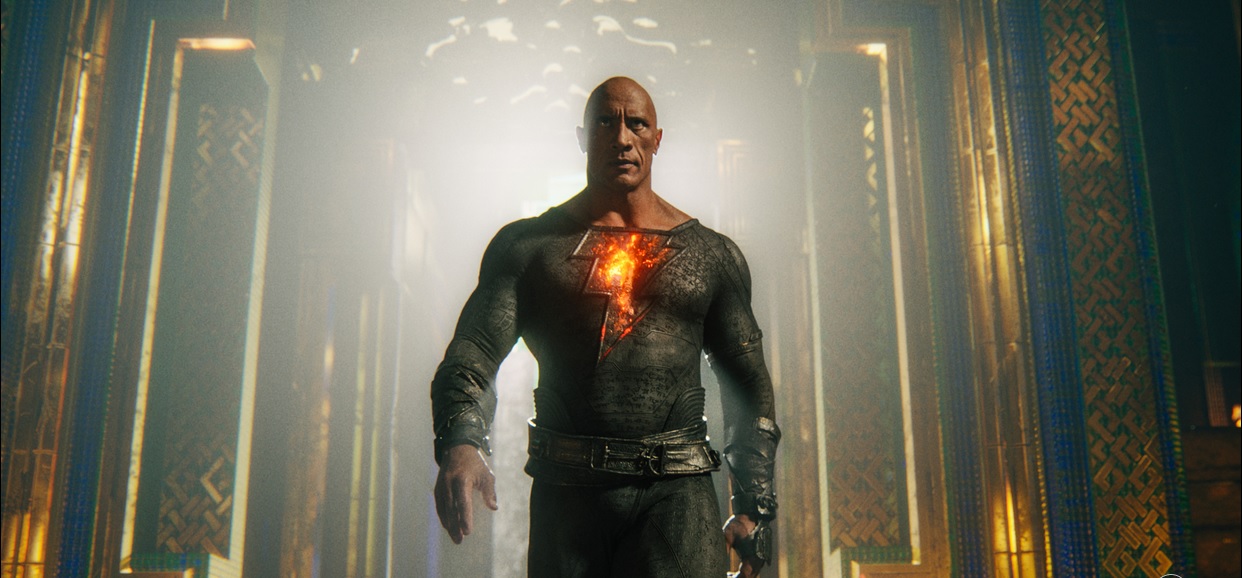
Black Adam

Deja-Zam!
or
"You Want to Split the World in Two"
 
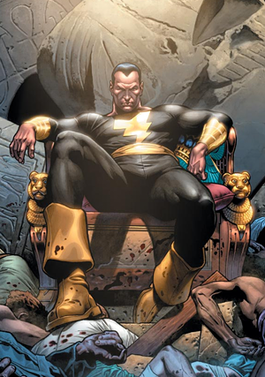
It seems an odd choice—outside of Dwayne Johnson's wish to make it so—to make a movie centered around a relatively lower-tier character as Black Adamknown primarily as a villain in DC's "Shazam!" comics (so-named due to copyright restrictions imposed by DC's main funny-book competitor Marvel comics, despite their "Captain Marvel"-named character appearing later). It's rather like the pivot the MCU made when they started a series based on "Guardians of the Galaxy" (Why them? Why at that time?"). But, then, the Warner Brothers Studio has made a lot of odd choices in their perpetual game of "catch-up" with Marvel Studios—the sudden rush to make a "Justice League" movie despite one being in development for a decade, an "Aquaman" movie before making a movie of "The Flash" or a decent "Green Lantern" movie or even making another, less than morose "Superman" film (but then, Marvel can't seem to make a good "Fantastic Four" film and is only getting around to making a "Namor, the Submariner" feature—created in the 1940's—by introducing him in Black Panther: Wakanda Forever, apparently).
 
Maybe it has something to do with toy sales. I don't know. It's as good a reason as any. Certainly, it has nothing to do with "art."
But, as these things go, the resulting movie isn't bad (but, it's not good, either). In fact, for much of its 2 hours+ length, it's a murderously efficient action film that purposely (rather than accidentally) questions the moral ambiguity of vigilantism in the guise of "doing good." It just matters who thinks what is good. That keeps shifting and changing throughout the course of the movie, where heroes do bad things and villains might be useful to a greater good. It's a long way from "white hats" and "black hats." But, don't confuse that with any sort of sophistication of thought.
The movie starts...with some verrry long exposition...in ancient times. Of a king named Ahk-Ton who ruled the middle-Eastern kingdom of Khandaq with impunity and, seeking the powers of a god, enslaved his people to look for a powerful mineral called Eternium, with which he would form "the crown of Sabbac". With this, he would be able to summon the power of the gods from the Rock of Eternity, granting him the stamina of Shu, speed of Horus, strength of Amon, wisdom of Zehuti, power of Aten, and the courage of Mehen* just by saying the magic word "Shazam!" (The Breath of Sekhmet is only needed if you having to do a lot of heavy expositioning.)
Anyway, the slave-boy Hurut, who finds the Eternium, learns a valuable lesson that life in Khandaq is cheap and grown-ups are not to be trusted. Ahk-Ton learns a valuable lesson when the ancient Egyptian gods double-cross him for his hubris and give the power of Shazam to wised-up Hurut.
Then, "something bad" happens powerful enough to send us into 21st Century Khandaq, where government has broken down and the place is run by the International Crime syndicate, Intergang. A resistance movement/archaeological team (they have those?) led by Adrianna Tomaz (Sarah Shahi) is searching for the crown of Sabbac, because, you know, power and all. They get ambushed by Intergang shock-troops and only when Adrianna finds a way to resurrect Teth-Adam (or Black Adam)(Johnson) from his imprisonment in the Khandaqian version of The Rock of Eternity do they manage to escape with their lives. Intergang, however, gets cooked, poached, crushed, and blown apart by Adam's powers.
Enough damage is done that it gets on the radar of Amanda Waller (Viola Davis via zoom-call) who calls on The Justice Society of America to intervene.

Wait. Wait. Wait. 
Excuse me, your Honor. Side-bar?

Nobody may "get" this or even think it's important if they don't read a lot of DC comic-books. I have. So, what in the multi-verse is Amanda Waller doing being in charge of The Justice Society (they're the old heroes from the 1940's "Golden Age" of comics as well as...to keep things simple...younger heroes who have accepted "the mantle"). Amanda Waller (it has been established) is in charge of Task Force X—ya know, "The Suicide Squad" (whether it has the "The" or not)—the criminal sacrificial lambs who go on missions nobody else wants to do or are so illegal they have to be hush-hush. What's she doing in charge of anybody possessing or professing any sort of moral compass?
Well, that's troubling. Not just because the "good guys" are being run by "bad guys" but because the mission they're being sent on is to corral the "new threat" while absolutely ignoring the "old threat" that has been plaguing the populace—out in the open—for years. Huh, some heroes—those being Dr. Fate (Pierce Brosnan), Hawkman (Aldis Hodge), Atom-Smasher (Noah Centineo) and Cyclone (Quintessa Swindell). Trust me, you don't want to dig too deep into these heroes and their origins, because a couple of them are either confused (Hawkman) or ridiculous (Cyclone).** 
It is nice to see Dr. Fate and Hawkman put in the movies, though—Brosnan does a fine, fine job in the role and it's good that they gave Hawkman a look that isn't completely stupid (he's appeared in the CW Arrowverse shows and in "Smallville"). It is not nice that they're basically little tin soldiers heroically doing things that aren't heroic. In fact, for much of the movie, the JSA can be seen as being "the bad guys" as they hector among themselves before considering what it is they are actually doing (rather than the requisite property damage while single-mindedly doing "the job" they were ordered to do).
In fact, Johnson's performance here is so "johnny-one-glower" that the movie naturally gravitates towards these new heroes (that the average movie-goer knows nothing about) for any sort of sense of what it is going on. They banter and bicker until Teth-Adam miraculously learns English from his ancient Khandaqian and joins in the snark. Well-paced and edited snark, but snark—and relentless snark—nonetheless. Everybody learns to play nice while kicking the crap out of everybody so they can defeat their common enemy—a villain that nobody and, indeed, Amanda Waller, have ever heard of. There is one super-hero death (which actually affected me—"Awww, they were pretty good!"), a switch-out on the principal origin story, and one scene of conflicted conscience that is dismissed with a quip and then forgotten about like one more tossed-to-the-horizon bad guy.
I'd like to say I enjoyed it, but all I can do is give it some tight-lipped respect for its pace for most of its length, and wonder at how the dark tone of this one—they had to go through four edits before it was dropped from an "R" to a "PG-13" rating—is going to merge with the inevitable mash-up between the larky "Shazam!" movies and this franchise off-shoot. It'll be like mixing ice cream with jalapeños.***
Or like mixing super-heroes with real-life problems. That trick never works. Since the time that cars started to be thrown around city-streets, nobody has ever paused to discuss the insurance implications. No super-hero has ever tried to stop poverty, homelessness, or severe drought or mass-starvation (Hell, it doesn't even happen in the real world, where Super-Democrats throws several tons of cash at it and Super-Republicans use their "Ignore-it-it doesn't exist" vision). It doesn't even work in super-hero satire. Superheroes are fantasy-land, a panacea to distract us from real world problems in a constant loop of goofy star-fish shaped alien threats and killer clowns that we see again and again.
Black Adam is no different. It is the same sort of feint that implores us to "look up in the sky" so we don't see the problems on the ground.
 
And not even a "last minute" cavalry appearance by Superman can save the day.

* Confused? Yeah, sure, if you've read Captain Marvel Comics. All this Khandaq stuff happened way, way before the Greco-Roman gods that Captain Marvel/Billy Batson siphons off every time he yells "Shazam!": that would be the wisdom of Solomon, the strength of Hercules, the stamina of Atlas, the power of Zeus, the courage of Achilles, and the speed of Mercury. What I want to know is: where did the Khandaq gods go when the Greco-Roman gods showed up and were looking for accommodations in Mount Olympus or Valhalla or wherever. Evidently,all these gods didn't die—despite what Wonder Woman says—because their batteries are still fully charged to torch the pilot lights of Captain Marvel, the Marvel Family, and Black Adam! They must have gone somewhere...and we're not even mentioning Rock n' Roll Heaven (where you know they have a helluva band!) 
 
** When I saw the Justice Society line-up before seeing the movie, I thought "Huh! That's interesting! They're putting in two super-heroes (Fate and Hawkman) who have origins in Egyptian lore! Maybe they'll do something interesting with that!" No such luck. They might have at some point, but nothing is made of it in the movie. At all.  As for the confusion surrounding Hawkman's origin (or origins), you couldn't figure it out even if you put on an Absorbascon.
 
*** What the hell! Someone's actually done this! Okay, bring on The Apocalypse, the world has finally gone absolutely mad!!

Tuesday, October 11, 2022

The Woman King

Amazon-Prime
or
Sisters Are Doing It For Themselves
 
Warriors of the Oyo Empire are having their evening meal. Prisoners from the Dahomey and other territories to be sold to the slave trade are kept in huts and don't dare go up against these fearsome soldiers or they'll be killed and they can't run because they use horses. But, it's a quiet night and not even the animals are stirring in the tall grass. A burst of bird-flight spooks one of the younger soldiers and the others enjoy a good laugh at his expense.
 
It will be their last laugh.
 
Out of the grass, silently, rises many women, suited for battle and with battleaxes resting on their shoulders. On point is Nanisca (Viola Davis), with a look so fierce and baleful that if the warriors knew ice-water it would be running in their veins. She raises her axe and with a ululating cry storms forward with the rest of her warriors, all women. They are the Agojie, the specialist unit of women-warriors from Dahomey, who expect and demand the respect of their citizens, and who run out of the brush like a wave, axes flashing. They won't flash for very long as Oyo blood will dull them.
One may gripe about the super-hero glut of movies, even though they have abated somewhat as studios find their footing with them. But they have paved a way for people to accept the "adventure" movie as a good evening's entertainment even if not populated with people in spandex. The Woman King, directed by Gina Prince-Blythewood, owes quite a bit to that trend, seeing as it shepherded a precedent for studios to consider financing a film about woman-warriors (Wonder Woman) and African locales and story-lines (Black Panther). Those were fantasies, however. The Woman King purports to tell history.
It is 1823 and the kingdom of Dahomey, under King Ghezo (John Boyega) is approaching the time when they must pay tribute to the Oyo and its leader, General Oba Ade (Jimmy Odukoya), despite that the leader is known for raids and for interfering in Dahomey's own trade with Europeans for slaves and other resources. It is the Oyo plan to absorb Dahomey and eliminate its influence; why accept tribute when they can have it all? The raids are merely prelude for an inevitable attack, and Ghezo seeks to forestall the inevitable by accepting the Oyo demands.
But, Nanisca, leader of the Agojie warriors, knows that the Dahomey are merely being bled slowly before an inevitable take-over bid, and suggests the training of new recruits to fend off any new raids. The rescued women are brought into the Agojie training facility, as well as other women who volunteer or who are too rebellious to become slaves or wives. In that latter category is Nawi (Thuso Mbedu), who has some rough edges that need to be disciplined and "smoothed over" before she earn her place among the warriors, or risk being sold for failing.
She comes under the tutelage of the trainer Izogie (Lashana Lynch), who recognizes the girl's defiance but also potential. The film follows Nawi's training, but also her relationship with a half-Portugese/half-Dahomey trader (Jordan Bolger) who is not unsympathetic to his kingsmen, but also has to live in another world, too.
This is great adventure movie material, but the distinction is that it is told from the native's point of view, not from the colonialists'. And, despite the inclusion of that trader, there is no "outsider savior" to intermingle and "help" or even explain the situation. Which is as refreshing as it is long overdue. The basic storyline is as old as Kurosawa, but how they play it is as old as Spartacus.
There has been some yelping about history and inaccuracies (and I'm usually the first "yelper"), about how the kingdom of Dahomey was just as culpable in the slave trade (and it very much was), but The Woman King does not shy away from that fact, instead concentrating on the Agojie and their efforts to stop the influence of the Oyo Empire over their affairs. And there is the acknowledgment that the rulers of Africa were just as complicit in trading human beings as the Europeans—just less efficient and far-reaching. There have always been slaves, just the definition of civilization has changed.
That's an important statement to make. And it features in the story by actor Maria Bello and Dana Stevens' script. The slave trade has always been a sensitive subject and a more complicated one than the safe narrative (if it is allowed to be spoken about at all!) that has been agreed upon, and is part of the larger story of power and oppression than the narrative of any one race. The story of agency and a people's ability to achieve it is the ultimate story of the ascent of human-kind.
And that is a story vigorously told in The Woman King. That the story is fascinating without white-washing in the broader points is an example of just how bold the artisans making the film are. And that goes to the actors as well. Viola Davis has long been a national treasure and her performance as Nanisca is traditional in its depiction of scowling generals who fight the periphery of what is lost to achieve what is to be gained. And watching her walk in this film is one of the subtle joys I had in this movie. Lashana Lynch wins the Toshiro Mifune Award for making the most of a role that could be cliched but instead seems fresh and more than just what appears on the page—she has a habit of doing that.
 
It's a great cast in a great movie. Highly recommended.

Saturday, September 11, 2021

Extremely Loud and Incredibly Close

Written at the time of the film's release...

The Schell Game
or
An Irrational Fear of the Irrational

Not sure what the problem with young Oskar Schell (Thomas Horn) is: it could be borderline autism, or as is brought up, Asperger Syndrome ("the tests were inconclusive," he deadpans). It could be "mean world syndrome" or "fusion paranoia," or something as simple as shock or grief, maybe even survivor's guilt. But, coached by his father (Tom Hanks) who died in the Twin Towers on 9/11, he is on a mission to find answers by the same empirical methods Dad used to create scavengers' hunts throughout the city of New York.

To the young Schell, the events that took his father, literally before his eyes, yet in an abstract undefinable way (he literally vanishes, but there is no body to bury), it is all horrifyingly absurd, and the only way to wrap his mind around it is a quest, in the same way that his father distracted him from his fears, which are plentiful (closed spaces, crowded places, tubes and tunnels, things that fly, things that are loud, bridges that could collapse) all things that keep his logical, compartmentalized fact-file of a mind focused on the task at hand, to the rhythm of the tambourine that he shakes to keep his own mind from being rattled by anything else.
One day, after visiting the shrine he's constructed for his father, he confronts for the first time his father's room and closet kept undisturbed since the Al Qaida attacks, smelling his clothes, trying to recall the sense-memory of him, when by happenstance, he finds an envelope (marked "Black") containing a single key.  Thinking it to be the ultimate of one of his father's challenges, he embarks to find the one lock in all of New York mated to that key.
It's a tortured, torturing metaphor. What he's really looking for is something...anything...that might give him solace for his loss, an answer to why his beloved,
obliquely protecting father might vanish so completely, without even the cold reality of a corpse to ground him to reality.  In the process, he neglects his mother (Sandra Bullock), his schooling, his life...for the ultimate answer of purpose, and thereby complete the education cut short by the death of his father.  It's a risky premise, one that, ultimately, can have no real resolution, but only absolve him of any complicity in the events of his father's death. 


What Oskar is actually looking for is his own penance.
Movies come in cycles, not only because of the economic consequences of box-office (nothing in Hollywood succeeds like excess), but also with the nation's zeitgeist.  Is it any coincidence that
Extremely Loud and Incredibly Close is a modern day version of New York film-maker Martin Scorsese's Hugo...about another boy's father-quest involving a key and finding something else more than himself?  Hard to say...anymore than that Hugo and The Artist are both explorations and celebrations of the era of visual story-telling displayed by the dawn of moving pictures. 
But, EL&IC has the disadvantage of being a little too close to the theme without the benefit of artistic distance, while being a little too obvious about what it's trying to say...which, as it turns out, isn't much...other than "what are you worried about, kid, when you might be hit by a bus tomorrow." Or dharma works, when runaway karma runs over your dogma. Thanks, but I'd rather have
Méliès be a cure for my malaise.

But, what a cast
...Hanks, Bullock (basically in the background for most of the movie but allowed to shine at the film's resolution), John Goodman, Viola Davis, Jeffrey Wright and a steady stream of fine character actors as Oskar's many encounters and tough-stones on his journey.  But, the finest of the bunch is Max von Sydow as the Campbellian "helper by the side of the road" that he plays mutely without a word of dialog.  Again, the part is a little obvious and a little tortured, but von Sydow once again provides an actor's master class in taking a role of lightness and making it breathe with life and truth.

Thursday, August 12, 2021

The Suicide Squad

Task Force "Ecch!"
or
"Here's Hoping I See You in 3 Hours"
 
David Ayer's Suicide Squad was a sad affair. The trailers looked great, and the fan response was so positive to them that the Warner Brothers team took the movie away from Ayer and tapped the trailer team to re-cut it. There may have been two cuts and some "genius" mixed and matched, but the sum total was not as lively as it should have been, and a lot less anarchic as it was called out to be. It was glum with the sole high point being the introduction to Margot Robbie's version of Harley Quinn.
 
So, now, here's the 2.0 version, with a "The" adjective inserted to tell them apart (the next "Batman" film is "The" Batman), and the Warner Bro's do what they usually do when they think one of their tent-poles is in trouble—hire a director with ties to Marvel to re-do it (because that's worked so well in the past!). In this case, it's Troma director James Gunn, who directed the "Guardians of the Galaxy" films for Marvel, and got fired by Disney for some "bad tweets" he'd made in the past. While Disney got their mouse-knickers in a bunch, Warner grabbed him for the next "Suicide Squad" before Disney/Marvel turned tail and asked him to come back.

It was Warner's gain. Gunn's "take" on "Task Force X" "works".
There isn't a lot of set-up. We're are introduced to the super-villain Savant (Gunn crony Michael Rooker), sent to Belle Reve prison for blackmail. He has been made a deal by Amanda Waller (Viola Davis, national treasure and who is put to good use here) to become part of "Task Force X"—The Suicide Squad. An explosive charge is put in his neck (amusingly, played by the comics' creator James Ostrander) and is told that if he deviates from his mission that the device will be detonated, killing him instantly, but if the mission is accomplished and he survives, ten years will be taken off his sentence.
 
He is put on a plane to the South American Island of Corto Maltese, which has just had it's American-friendly government toppled by a new regime of cut-throats. The team consists of Savant, Rick Flagg (Joel Kinnaman from the original film), Harley Quinn (Margot Robbie, ditto), Captain Boomerang (Jai Courtney, ditto-ditto) as well as new members Blackguard (Peter Davidson), Javelin (Flula Borg), an alien warlord called Mongal (Mayling Ng), TDK ("don't ask" and played by Nathan Fillion) and Weasel (Sean Gunn). Things do not go well once they make land-fall as their landing has been leaked to military on the island. As some of the posters say "Don't get too attached." More on this section later.
That assault was just a diversion; another team, comprising of Bloodsport (Idris Elba—he's great in this!), Peacemaker (Jon Cena), Ratcatcher 2 (Daniela Melchior), King Shark (Steve Agee and voiced by Sylvester Stallone), and The Polka-Dot Man (David Dastmalchion) land elsewhere and have a considerably easier time of it. How these guys got mixed up in this is done with a flashback as their mission is to infiltrate the capital and destroy all vestiges of what is called "Operation: Starfish," a super-secret project that has been under wraps for years and is in danger of being misused by the current junta. Oh, and their mission gets revised to also rescue Flag and Harley, who have gone missing.
Sounds simple enough, but there's still quite a few characters to juggle, and unlike Ayer, who gave back-stories to Quinn and Deadshot—and that's about it—Gunn manages to weave back-story in without having to build a whole new sequence around it, interrupting the story-flow. Oh, he jumps around in time a bit, but in the service of planning a surprise with a well-timed "gotcha" at moments of extreme duress for the team. "How will they get out of this one?" Well, just wait, we've got some 'splainin' to do.
Now, those who've seen the Marvel "Guardians" movies will be surprised at the difference between a "PG-13" James Gunn movie and a Hard-"R" James Gunn movie. Those who remember his unrated comics spoof, Super, will be more prepared. In the battle sequences, faces get blown off, people are ripped to shreds, blood spurts copiously, bodies set aflame, and limbs come off—intentionally and unintentionally—in a way that feels more like a visit to a triage unit than it does a comic-book fight. At one point (when Harley Quinn is single-handedly making an escape from the island El Presidente's stronghold) the blood-splatter is replaced by flower-petals and chirping birds, which can be explained away that she's crazy, but more probably it's to avoid an "X"-rating. 
And it's persistent. Parents should be warned: "It's a super-hero movie" is not an excuse and taking your kids to this is like taking them to Taxi Driver.

That being said, the movie also goes out of its way to be goofy. Gunn has picked comic-book characters whose power ratings are very low in the D&D deck—"Polka-Dot Man?" "The Disconnected Kid?" "Ratcatcher 2?" "Weasel?"—but very high in the disposability category. That also includes two characters we meet later: "The Thinker" (played by an emaciated—but no less sharp—Peter Capaldi), and the movie's "Big Bad," one of the original villains of DC's "silver age"—appearing in the first appearance of The Justice League—"Starro, the Conqueror."
Yes, folks, he's a giant starfish. But, an intergalactic giant starfish. (Okay, that's still not impressive...) An intergalactic giant star-fish, who can squirt little starfish that will latch onto your face and take over your mind (except in the movie, they kill people dead and re-animate them as zombies). Well, yeah, it's still silly as all Hell, but...ya know...canon, copyrighted, merchandisable DC property...all of that.
A starfish throws a shark into a building. Yeah, tell me you've seen that before...
 
Okay, it's still silly as all Hell—especially when Gunn has stuck a google-eye rolling around in the middle of it—but, for me, it's a little bit of the charm. I liked the Pacific Rim movies, even though my rational brain told me that giant killer robots are a really ungainly system of defense (like the AT-AT's in the "Star Wars" movies, "just go for the legs and let gravity sort it out"), but it's still something of a hoot to see. And look, you can go as grim and gritty as you want to in the quest to make your movie "bad-ass," but in the end it's still a comic book movie. Real junta's flood countries with cocaine or hack computer clouds, they don't launch giant starfish (although I bet they would if they could).
What I'm saying is the goofiness off-sets the carnage, crossing that bridge between tension and comedy, which, although I say it's a bridge it is actually more of a tightrope. The greater the tension, the greater the release, whether it be shock or laughter. Gunn has always had that sensibility, but the allowance to go "R" just gives him permission to push the boundaries, not unlike the original Deadpool (but without the fourth-wall breaking "meta" quality that quickly wears out its welcome). It's fast, it's funny, and it's more than competent. Recently, I've been decrying the loose/lame action scenes these movies have been sporting, but Gunn lets you know where people are, how they got there, and what the big picture perspective of those sequences are. With so many characters that takes some doing.
Casting helps that process a lot. Fortunately, the film is chock-full of good actors who can do the drama and the comedy. Davis, Robbie and, surprisingly, Kinnaman pull this off amazingly well. But, Idris Elba comes off with one of the best star-turns he's ever done, Cena shows a flair for straight-faced comedy, Melchior becomes the heart and soul of the movie, and Dastmalchion takes a lame part and turns it to an advantage. You care if these guys make it through the movie, and, as it lives up to the title and original concept, that is never a sure-thing.
 
It's a savage/silly romp, not afraid of making fun of and celebrating the silliness of the four-color world.