Showing posts with label Peter Capaldi. Show all posts

Thursday, March 13, 2025

Local Hero

Local Hero (Bill Forsyth, 1983) The head of Knox Oil and Gas Company, Felix Happer (Burt Lancaster) decides that the site for the new Knox oil refinery must be in the Scottish town of Ferness, and so he sends "Mac" MacIntyre (Peter Riegert)—because his name sounds Scottish ("they're your people" even though his family is Hungarian)—to impress on the locals the need to sell the town to Knox Oil, which already has a team in Aberdeen doing research on what it'll take to get the facility up and running.

What it will take is the entire town of Ferness to approve of the venture. But, will they go for it? MacIntyre would rather do the whole operation at Knox Oil in Houston ("I'm more of a telex man"), but Happer insists "Mac" travel to Ferness and scout the location for himself and to "watch the sky" for anything interesting as (as he tells him) "The constellation of Virgo is very prominent in the sky right now, in Scotland. I want you to keep an eye on Virgo for me. Will you do that?" Happer happens to be an amateur, but very enthusiastic, astronomer.
So, Mac flies to Scotland, specifically Aberdeen where Knox has a research facility and hooks up with a rep, Danny Oldsen (Peter Capaldi in his first movie) and discuss the refinery plans before heading to Ferness, where he plans to woo the locals. Everything's a little bit primitive in that "living-off-the-land" kind of way and Mac makes the rounds of the residents, who, once they find out there's American money involved, are all-too-eager to hear what the pay-out will be. While negotiations are going on, Mac becomes less the "go-getter" and adjusts to "island-time" and the quirky life-styles of the locals. At night, he goes to the town's one phone-booth to keep Happer apprised of the situation. "Watch the skies," he keeps exhorting.
His one hitch of the locals is old-timer Ben Knox (Fulton Mackay) who lives in a shack on the beach, but he owns the land and has no intention of selling, no matter the price, a human sea-wall to the development. Although the Fernessians might be "quirky" it's a mercenary kind of quirky and Knox's recalcitrance takes a bit of "twee" out of their quaintness. And a row looks to be a-brewing in the small town.
In the meantime, people get known and Mac becomes more and more like an islander. His closest contact is Gordon Urquhart (Denis Lawson), the innkeeper and town accountant, whose way of doing business is singular, as well as one of his clients, the captain of a Russian fishing boat, who regularly stops in Ferness to check his stock portfolio. Danny becomes infatuated with a dedicated marine biologist, Marina (Jenny Seagrove), who is convinced that Happer's company is going to be building a marine research facility and who has the distinction of being so dedicated that she has webbed feet.
Meanwhile, Mac keeps watching the skies and starts to become fascinated with the meteor showers and the northern lights, phenomenon that he breathlessly relates to Happer on his phone calls, prompting the boss to come see things for himself.
The film has all the charm of a fish-out-of-water story—director Bill Forsyth both wrote and directed—while maintaining sympathy for its hapless lead character falling under the island's spell while also making the case that small-town life has its advantages, despite (and maybe even because of) its remoteness. Forsyth was adept at bringing out character details that charmed even if they could also risk an audience's sympathies, and Local Hero manages to walk the tightrope of dry humor and odd-duckness.
If it had been made three or four decades before, one would swear it was a product of The Archers, and, in fact, it bears a lot of tonal resemblance to I Know Where I'm Going! without leaning so much into Scottish culture. But, it has a way of making you yearn for community and towny closeness. And it's beautiful as all get-out.
In the next few weeks, I'm going to be doing more reviews of Forsyth's work, as in my obsessive movie days, he was always a particular favorite of mine to watch.

Thursday, August 12, 2021

The Suicide Squad

Task Force "Ecch!"
or
"Here's Hoping I See You in 3 Hours"
 
David Ayer's Suicide Squad was a sad affair. The trailers looked great, and the fan response was so positive to them that the Warner Brothers team took the movie away from Ayer and tapped the trailer team to re-cut it. There may have been two cuts and some "genius" mixed and matched, but the sum total was not as lively as it should have been, and a lot less anarchic as it was called out to be. It was glum with the sole high point being the introduction to Margot Robbie's version of Harley Quinn.
 
So, now, here's the 2.0 version, with a "The" adjective inserted to tell them apart (the next "Batman" film is "The" Batman), and the Warner Bro's do what they usually do when they think one of their tent-poles is in trouble—hire a director with ties to Marvel to re-do it (because that's worked so well in the past!). In this case, it's Troma director James Gunn, who directed the "Guardians of the Galaxy" films for Marvel, and got fired by Disney for some "bad tweets" he'd made in the past. While Disney got their mouse-knickers in a bunch, Warner grabbed him for the next "Suicide Squad" before Disney/Marvel turned tail and asked him to come back.

It was Warner's gain. Gunn's "take" on "Task Force X" "works".
There isn't a lot of set-up. We're are introduced to the super-villain Savant (Gunn crony Michael Rooker), sent to Belle Reve prison for blackmail. He has been made a deal by Amanda Waller (Viola Davis, national treasure and who is put to good use here) to become part of "Task Force X"—The Suicide Squad. An explosive charge is put in his neck (amusingly, played by the comics' creator James Ostrander) and is told that if he deviates from his mission that the device will be detonated, killing him instantly, but if the mission is accomplished and he survives, ten years will be taken off his sentence.
 
He is put on a plane to the South American Island of Corto Maltese, which has just had it's American-friendly government toppled by a new regime of cut-throats. The team consists of Savant, Rick Flagg (Joel Kinnaman from the original film), Harley Quinn (Margot Robbie, ditto), Captain Boomerang (Jai Courtney, ditto-ditto) as well as new members Blackguard (Peter Davidson), Javelin (Flula Borg), an alien warlord called Mongal (Mayling Ng), TDK ("don't ask" and played by Nathan Fillion) and Weasel (Sean Gunn). Things do not go well once they make land-fall as their landing has been leaked to military on the island. As some of the posters say "Don't get too attached." More on this section later.
That assault was just a diversion; another team, comprising of Bloodsport (Idris Elba—he's great in this!), Peacemaker (Jon Cena), Ratcatcher 2 (Daniela Melchior), King Shark (Steve Agee and voiced by Sylvester Stallone), and The Polka-Dot Man (David Dastmalchion) land elsewhere and have a considerably easier time of it. How these guys got mixed up in this is done with a flashback as their mission is to infiltrate the capital and destroy all vestiges of what is called "Operation: Starfish," a super-secret project that has been under wraps for years and is in danger of being misused by the current junta. Oh, and their mission gets revised to also rescue Flag and Harley, who have gone missing.
Sounds simple enough, but there's still quite a few characters to juggle, and unlike Ayer, who gave back-stories to Quinn and Deadshot—and that's about it—Gunn manages to weave back-story in without having to build a whole new sequence around it, interrupting the story-flow. Oh, he jumps around in time a bit, but in the service of planning a surprise with a well-timed "gotcha" at moments of extreme duress for the team. "How will they get out of this one?" Well, just wait, we've got some 'splainin' to do.
Now, those who've seen the Marvel "Guardians" movies will be surprised at the difference between a "PG-13" James Gunn movie and a Hard-"R" James Gunn movie. Those who remember his unrated comics spoof, Super, will be more prepared. In the battle sequences, faces get blown off, people are ripped to shreds, blood spurts copiously, bodies set aflame, and limbs come off—intentionally and unintentionally—in a way that feels more like a visit to a triage unit than it does a comic-book fight. At one point (when Harley Quinn is single-handedly making an escape from the island El Presidente's stronghold) the blood-splatter is replaced by flower-petals and chirping birds, which can be explained away that she's crazy, but more probably it's to avoid an "X"-rating. 
And it's persistent. Parents should be warned: "It's a super-hero movie" is not an excuse and taking your kids to this is like taking them to Taxi Driver.

That being said, the movie also goes out of its way to be goofy. Gunn has picked comic-book characters whose power ratings are very low in the D&D deck—"Polka-Dot Man?" "The Disconnected Kid?" "Ratcatcher 2?" "Weasel?"—but very high in the disposability category. That also includes two characters we meet later: "The Thinker" (played by an emaciated—but no less sharp—Peter Capaldi), and the movie's "Big Bad," one of the original villains of DC's "silver age"—appearing in the first appearance of The Justice League—"Starro, the Conqueror."
Yes, folks, he's a giant starfish. But, an intergalactic giant starfish. (Okay, that's still not impressive...) An intergalactic giant star-fish, who can squirt little starfish that will latch onto your face and take over your mind (except in the movie, they kill people dead and re-animate them as zombies). Well, yeah, it's still silly as all Hell, but...ya know...canon, copyrighted, merchandisable DC property...all of that.
A starfish throws a shark into a building. Yeah, tell me you've seen that before...
 
Okay, it's still silly as all Hell—especially when Gunn has stuck a google-eye rolling around in the middle of it—but, for me, it's a little bit of the charm. I liked the Pacific Rim movies, even though my rational brain told me that giant killer robots are a really ungainly system of defense (like the AT-AT's in the "Star Wars" movies, "just go for the legs and let gravity sort it out"), but it's still something of a hoot to see. And look, you can go as grim and gritty as you want to in the quest to make your movie "bad-ass," but in the end it's still a comic book movie. Real junta's flood countries with cocaine or hack computer clouds, they don't launch giant starfish (although I bet they would if they could).
What I'm saying is the goofiness off-sets the carnage, crossing that bridge between tension and comedy, which, although I say it's a bridge it is actually more of a tightrope. The greater the tension, the greater the release, whether it be shock or laughter. Gunn has always had that sensibility, but the allowance to go "R" just gives him permission to push the boundaries, not unlike the original Deadpool (but without the fourth-wall breaking "meta" quality that quickly wears out its welcome). It's fast, it's funny, and it's more than competent. Recently, I've been decrying the loose/lame action scenes these movies have been sporting, but Gunn lets you know where people are, how they got there, and what the big picture perspective of those sequences are. With so many characters that takes some doing.
Casting helps that process a lot. Fortunately, the film is chock-full of good actors who can do the drama and the comedy. Davis, Robbie and, surprisingly, Kinnaman pull this off amazingly well. But, Idris Elba comes off with one of the best star-turns he's ever done, Cena shows a flair for straight-faced comedy, Melchior becomes the heart and soul of the movie, and Dastmalchion takes a lame part and turns it to an advantage. You care if these guys make it through the movie, and, as it lives up to the title and original concept, that is never a sure-thing.
 
It's a savage/silly romp, not afraid of making fun of and celebrating the silliness of the four-color world.

Saturday, June 25, 2016

In the Loop

Written at the time of the film's release.

"You Might Have Heard Him Say it, But He Didn't Say it, and That's a Fact!"
or
Oh, Tell me "Who are YOU?"

They say you don't want to see government at work just as much as you don't want to see sausage being made. The implication is that both involve grinders and a certain amount of evisceration. And the dropping of blood, metaphorically, and in some cases, literally.

In the Loop, the smart, funny movie version of the British comedy "In the Thick of It" manages to bludgeon home that point, but also draw parallels with the most drop-dead dysfunctional of office settings. In the Loop employs the same "caught on the fly" filming and editing techniques of "The Office" and they're played out by a cracker-jack group of actors who give the impression that they're ad-libbing the whole thing (led by a startlingly brilliant performance by Scotts actor Peter Capaldi*). Only it's "The Office" with a vindictive murderous glee and what, if it had gone through the Ratings Board,** would be described as "pervasive language."

It is also an episode of "Yes, Minister" on meth-amphetamines set in an abatoir, where the civil servants—the guys who never get voted out of office—run the show, and the show is the pantomime of a representative government working on the people's behalf. The lobbying people. The people in power. Those people. You know. There's enough invective in this movie to launch a thousand Uni-bombers, and most of it is hilarious—the kind of hilarity you feel guilty about laughing at. Especially if you didn't vote (not that it would do you much good, ultimately).
In this expansion of the series, the British Secretary of State for International Development Simon Foster (Tom Hollander) burbles through an innocuous press interview that an anticipated war conducted jointly by the U.S. and Britain is "unforseeable" and the Prime Minister's Director of Communications Malcolm Tucker (Capaldi) begins running interference ("I'm sweating spinal fluid here!") for Foster, the PM, and American functionaries creating damage control by causing as much destruction as possible (not too unlikely a scenario). That he does it by some of the most creative uses of the Anglo-Saxon tongue makes it hilarious, cruising through the labyrinths of power filled with ass-covering lackeys like a shark through a school of puffer-guppiesbattering through so many non-functionaries "on defense" by being as offensive as possible.
This is not your father's Mr. Smith Goes to Washington, or even "The West Wing"—both those political dramas assume that civil servants are servants, rather than being self-serving, doing their jobs for the public good, not seeing it as a public nuisance. Those films assume the core of public service as "Love Thy Neighbor," rather than the reality of all-knowing governments—but only in the biblical sense.

* Capaldi may not be familiar to American audiences, but you've seen him before—deny it all you want, but you have—maybe in Local Hero (at the time of the writing Capaldi has appeared in a "Doctor Who" episode but he hadn't yet become "the twelth and existing Doctor" in that long-running series). In fact, he won an Oscar for writing and directing the very odd and very funny Franz Kafka's It's a Wonderful Life. Also in the cast are James Gandolfini—as good as you'd expect him to be—Mimi Kennedy, the always entertaining David Rasche, and...anybody remember Anna Chlumsky..."My Girl?"

** It didn't, and so it arrives at theaters with the "NR" rating, the "nolo contendre" of the MPAA system.

Wednesday, April 6, 2016

The Fifth Estate

Assuaging Assange
or
Jury Tampering in the Court of Public Opinion

Julian Assange is not a happy camper...camping in the Ecuadorian embassy ("behind Harrod's" as his portrayer Benedict Cumberbatch describes it) in London. He has let it be known in his own little publicity campaign that he does not like The Fifth Estate, and that it is entirely propaganda from unreliable and untrustworthy sources.  I'll take his word for it, as that's been his business model for Wikileaks for quite a few years. 

The problem is that Assange would not be happy with ANY movie of the story unless HE wrote, produced and directed it, so that he could control the information flow to fit his view of events.* Anyone would, really, in the best of all possible worlds. The difference between anyone and Assange is that he actually thinks he could, and not only that, that he should.

The trouble is, "Mendak", it may be your story, but it's not your money financing it, and you're kind of a bad risk, if you know what I mean.  

And, if he would do it, he would insist on doing it himself, even though film is a collaborative medium.  Collaboration, however, might dilute the message, and so, really the only person who could be trusted with it is Assange.  Wait for his version in a couple of decades.  That's the trouble with hubris and megalomania, you always get your message out last and console yourself that you got The Last Word.

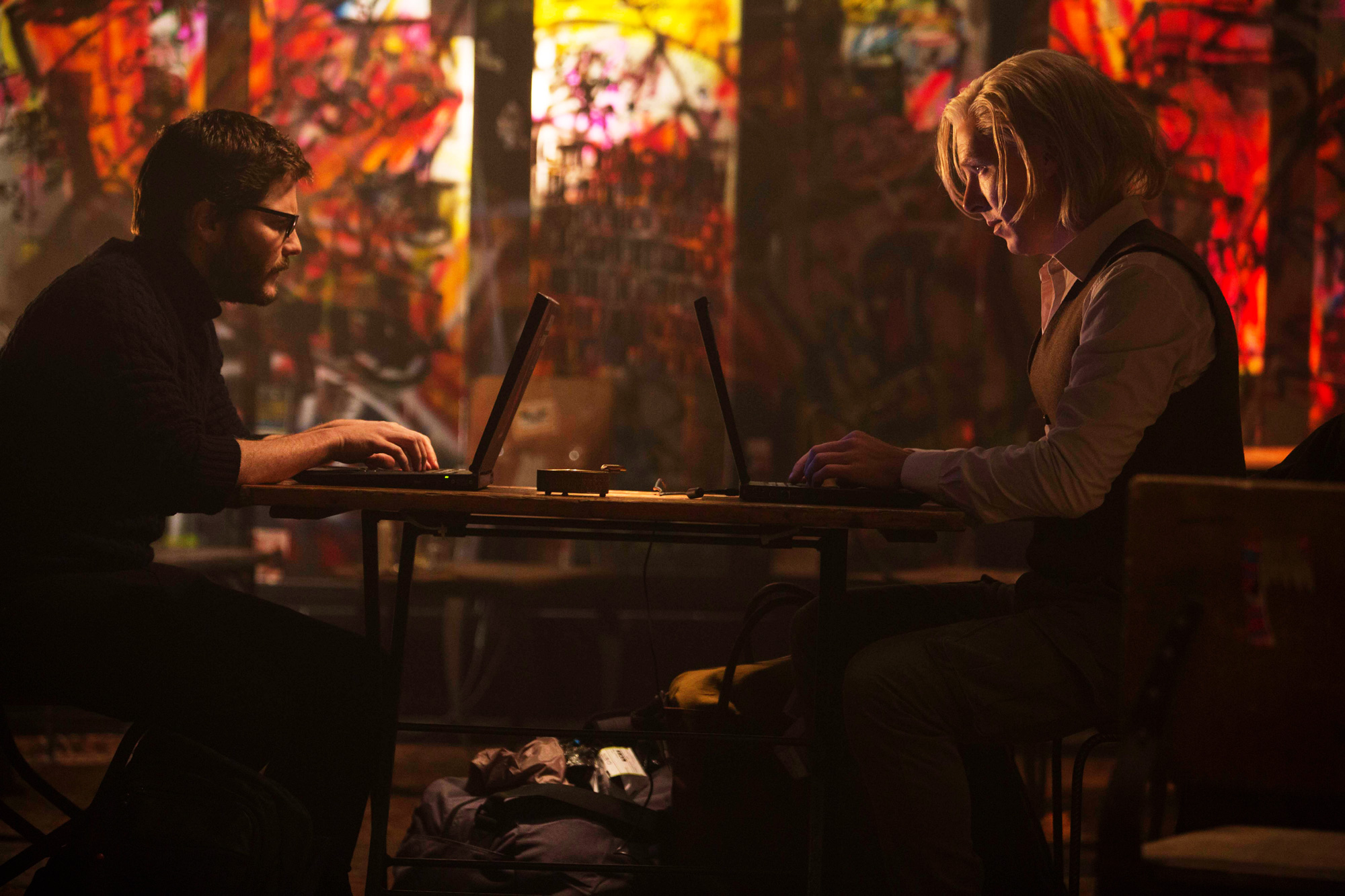
(Well, now that I've revealed my prejudices that I think Assange is a creep and something of a deluded creep...) Bill Condon's The Fifth Estate is a return to form on the controversial biographical films he's done in the past (Kinsey, Gods and Monsters), and after mucking about in the very black and white"Twilight" series, here struggles to have any sort of perspective, controversial or otherwise, for a story that is still in process. It also sweats to make something dramatic out of typing away at laptops, which is intrinsically dull, and about as engrossing as watching a movie about a writer who's writing—good in book form, maybe, but unless you go off into some sort of fantasy-land, it's a completely no-thrills scenario.  
For anyone who's been following the Assange story—which was several headline-making revelations ago—The Fifth Estate does less with the recent Iraq War revelations (some of which—like the "Collateral Murder" video weren't even revelations, having already been published in other sources) than it does with the early ground-breaking days of WikiLeaks, Assange's recruiting of Daniel Domscheit-Berg (Daniel Brühl)—whose book "Inside WikiLeaks" is one of the sources on which Josh Singer (former writer for "The West Wing" —during the non-Sorkin years—and "Fringe") based his screenplay—and the heady days when it exposed corruption in Kenyan elections and dummy-accounting in the Caymans at Julius-Baer. The worst-kept secret of all was who was running WikiLeaks. Although Assange was the very public face of the site, he would state that there were hundreds of people behind the site, doing due diligence, checking sources, and vetting information that would see the light of scrutiny.
Truth was, there were no "hundreds of people;" it was Assange and Berg and whatever server cluster the two could configure, cobble and co-habit. Vetting was cursory phone calls, or maybe a clandestine meeting beforehand. As far as redacting anything that might threaten lives,** that was nearly impossible (and logistically impossible with the release of diplomatic communications that numbered 400,000 in 2010). As WikiLeaks' revelations become bigger and broader in cope and size, the tiny staff is overwhelmed, keeping an Oz-like public face (Assange's), but not even willing to acknowledge that they might be overwhelmed and out of their depth. Thus, the "open" source hides the biggest secret of all—there's no infrastructure to the web-site other than Assange and Berg.
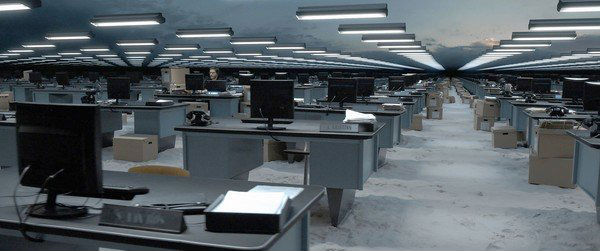
The "reveal" of this information is done in a "cutesy" illustrative manner. At one stage, Berg wants to talk to the other WikiLeaks members that he's been trading communiques with about sources and information, something Assange is initially reluctant to do. Then, when it becomes a "make or break" request, he gives in, showing Berg his "hold card"—that the other people Berg has been instant-messaging and e-mailing have merely been alternate Assange accounts.  He's only been talking to Julian, which Berg imagines as a scene out of Being John Malkovich crossed with The Apartment of an infinite number of desks in an office, all with Julian Assange sitting behind them. It's a little too literal and maybe just a little condescending to spell it out so baldly to the audience, but ultimately that visual metaphor is stretched as, at critical junctures, that infinite number of Assange's keeps coming back to make fantasy-narrative points that seem unnecessary (other than to conjure up that all those Assange's are going to write the complete works of Shakespeare someday).  
The acting is, across the line, superb: Cumberbatch does a fascinating Assange, adroit, and self-contained, like a chess-player, usually thinking about something else than the topic of conversation, and his final bit—an in-character dismissal of "the two films" coming about WikiLeaks (presumably this film and Alex Gibney's documentary) is a cautionary warning; Brühl, seems to be the go-to guy to play Germanic naifs after Good bye Lenin!, Inglourious Basterdsand Rush, and here plays Berg as an all-too-willing apprentice looking for a mentor; Laura Linney, Stanley Tucci, and Anthony Mackie play American diplomats trying to deal with the fall-out, while David Thewliss and Peter Capaldi play two reporters for The Guardian with suspicious hesitance about their "source."

It's a good dramatization, filling in character holes which Gibney's documentary left unexplored.  The two together make a good summary of events that, as yet, have no ending, but have managed to rock the world, making the cyber-world look frighteningly like a glass-house sitting in a field filled with stones.


* The same attack came from Assange about this year's Alex Gibney documentary We Steal Secrets: The Story of WikiLeaks, which tells the same story, but through interviews and through Gibney's journalistic sensibilities (which produced Enron: The Smartest Guys in the Room, Taxi to the Dark Side, Gonzo: The Life and Work of Hunter S. Thompson, Casino Jack and the United States of Money, and Park Avenue: Money, Power and the American Dream).  Critics have been far harsher on The Fifth Estate than We Steal Secrets, either because 1) the documentary is considered more "legitimate" than the dramatic version; 2) Assange's attacks seem to "stick" better to a dramatic recreation than a documentary, or 3) they actually (at a rate of 95% to 37%—which is quite a swing) prefer the techniques of the documentary to The Fifth Estate . But, then, according to Rotten Tomatoes, they've been harsher on The Fifth Estate than the Stallone-Schwarzenegger yarn Escape Plan, which is just inconceivable, and brings Rotten Tomatoes' validity as an indicator of quality and worth as a taste aggregator into suspicion.

** Assange has said that no "outed" operative has been killed, due to the leaks (although The Fifth Estate fictionalizes one such source (Alexander Siddig) being forced to evacuate with his wife and children (in the same way that Patton fictionalizes what might have happened in WWII if, because of Eisenhower's decision to send gasoline to British tanks instead of American ones, if a tank company all of a sudden ran out of fuel behind enemy lines).  1) Assange is probably not a good source for that kind of information as he'd only get it from "whistle-blowers" who might not want to take claim for any deaths (nor would Assange).  2) It's not going to come from American sources who might not want to further risk others (ie "known associates") of anyone affected by it, despite making the case that there WAS some "collateral murder" (to coin a phrase) and making assange and WikiLeaks look bad.  As someone far more Machiavellian once said "The absence of evidence does not mean the evidence of absence."