Hola!
or
You're a Wonder, Wonder Woman
There is quite a bit of irony in that the one movie that DC Comics has been delaying and delaying, re-starting and re-stopping may be the best movie they have produced since the halcyon days of The Dark Knight.
Suffering Sappho, it's Wonder Woman. And after 75 years, it's about frickin' time!
No, there's never been a Wonder Woman movie, even though she's one of "The Big Three" in DC comic's super-hero line-up. She has long been a merchandising bonanza for DC, had her own television series (which lasted quite awhile...on two networks). Hell, she was even the first cover person on Ms. Magazine.*
But, DC has been pussy-footing around with the character (just as they have been with the comics character for years), trying to figure out how to handle a Wonder Woman.
The answer came pretty definitively when she was introduced in Batman v. Superman: Dawn of Justice; whatever one thinks of that movie, the one thing everybody agreed on was that the character's appearance was a highlight. How could she not be when the titular males are such moody, squabbling neurotics?
I knew I liked what they were doing with the character when, after several smarting-offs to Bruce "Batman" Wayne in her civilian identity, she joins in the fight against the Kryptonian monster and is delivered a hay-maker that sends her flying...and she smiles, with a relish that there's no need to hold anything back.** That was different, and that Gal Gadot could hold her own and dominate Henry Cavill and Ben Affleck in their roles was more than apparent.
In the new solo movie, how great Gadot is in the role is readily apparent. In Batman v Superman, she has been in man's world for pretty much a century and Gadot plays her with a cynical, knowing charm that can cut someone down with just a withering gaze. In this new film, she is a stranger in a strange land, and Gadot's portrayal with wide-eyed forthrightness is a stark contrast, but no less assured.
There is a book-ending prologue in modern times when Diana Prince (Gadot) goes to her job as an antiquities curator at the Louvre and is brought a gift of sorts from Wayne Enterprises, an antiquity of its own—an original of the photograph of her and soldiers in Belgium during World War I found in the Luthor archives of meta-humans alluded to in Batman v. Superman. There begins her narration: "I used to want to save the world, this beautiful place. And mankind (chuckles). But the closer you get, the more you see the great darkness within. I learned this the hard way, a long, long time ago."

Cut to the island of Themyscira, out of time and out of place; dimensionally separated from the modern world, it is a product of the Greek gods,** inhabited by the Amazons, a race of women warriors charged to oversee the safety of the world from the god of war, Ares, banished to Earth for his part in the decimation of the other gods. The Amazons are immortal, except for the child, Diana, precocious princess, daughter of Queen Hippolyta (Connie Nielsen). Little Diana is a handful. While Hippolyta goes through tutors trying to teach her to be a princess, Diana only wants to hang out watching her Amazon sisters go through battle drills led by Antiope (Robin Wright) who puts them through their paces. Diana wants to be a warrior, but her mother is protective, forbidding her to be trained in the Amazonian battle arts (which combines weapons-work with Cirque du Soleil).


But, the kid is head-strong and sneaky and Antiope trains her in secret, telling her that if she takes this path, she has to be ten times better than their most-skilled warrior to prove her worth. Hippolyta has other plans for Diana—and it's not battle. She wants Diana to be Queen and tells her stories of their people's past—of gods and monsters and conflict—of how Ares killed the gods and crashed to Earth, and how Zeus charged them with protecting the planet should Ares arise again. Reluctantly, she shows her Hestia's lasso of truth and a sword of great import. Only the "God-Killer" can defeat Ares, she says.
This is a great sequence, done with a lot of visual flair—Hippolyta's history stories are like 3-D paintings, and the amazonian practice sessions are amazingly choreographed. Plus, the actresses do great work here—they all speak with Gadot's untraceable Mediterranean accent—and Wright is especially good as the nail-hard Antiope.
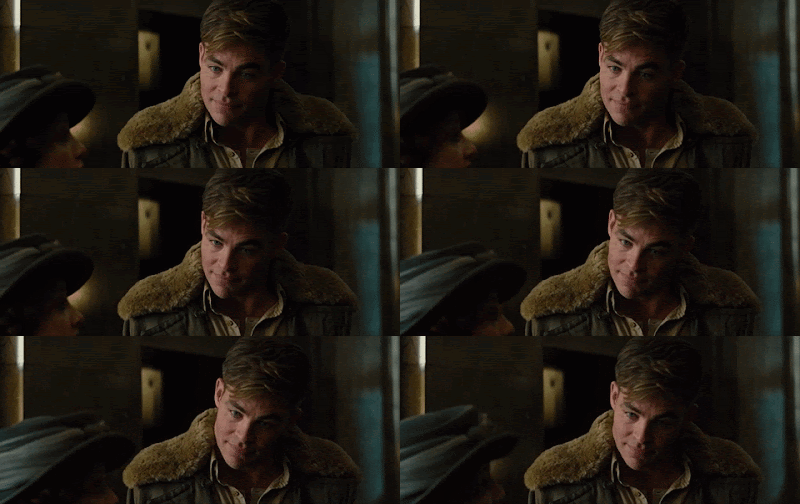
But, as Diana achieves a certain level of stature, her world is shattered. Not so much shattered as invaded; a biplane smashes through the energy barrier separating the island from the world at large and crashes into the sea. Diana rescues the lone pilot, American Steve Trevor (Chris Pine), who just has enough time to burble out the expected "Garsh! Yer bee-YOO-ti-ful!" before German U-boats also crash through the barrier—ladies, you need to fix that thing—and storm the beaches.
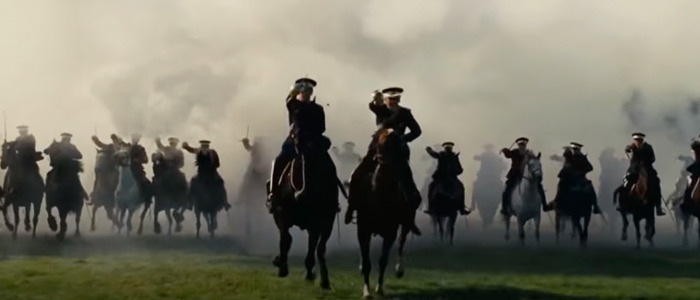
This is a great sequence and director Patty Jenkins (whose previous feature directing was the extraordinarily good 2003 drama Monster that garnered Charlize Theron her Best Actress Oscar) pulls out all the stops. The Germans only have one position—they're storming the beachhead. The Amazons, however, come from all sides, swinging down off the Themyscira cliffs from ropes and on horse-back in a flying wedge formation.
The Germans are caught flat-footed, but they have one tactical advantage; they have rifles, which have been previously unseen by the Amazons who are using swords, bows and arrows and knives. The Germans have an advantage at a distance, but if the Amazons get in close, they don't have a chance. It is a fascinating dance of death between the disorganized Germans and the highly synchronized Amazons. It is a battle of differing strengths and there are significant losses on both sides.
Despite the casualties, the Amazons are victorious, but the double-whammy of Trevor's appearance and the German attack leaves them with a serious case of culture shock if not clash. Trevor is rushed before the Amazons, where, under questioning, he only gives his name rank and serial number. Bureaucracy means bupkiss to the Amazons and they bind him with the lasso of truth to find out his real story.
With a little comic resistance, Trevor can't help but burble out the truth; turns out he's a spy, infiltrating the German air command on a mission to secure information about secret German weapons. The world (he tells them) is at war. "What war?" asks Diana. "The war to end all wars..." confesses Trevor and this causes a stir among the Amazons, but mostly with Diana who takes the news with only one conclusion—the god Ares is behind it all, and to fulfill the duty of the Amazons, she takes it upon herself to go to Man's World and do battle.

I'll stop there with the synopsis. The film still has 90 minutes to go, but the good will generated by the first 30 of it carries through the movie. Not that the rest of it isn't good (it's fantastic, frankly), but those exotic opening sequences overshadow the rest of the movie taking place in Man's World, despite the efforts to recreate WWI-era London and Belgium. There will always be a little drop in atmosphere with the transition, but, fortunately, Gadot's performance as Diana (she's never called "Wonder Woman") aided by the loose and effective Pine (who seems to be capable of doing terrific work in every film—and genre—he's in) keep the inventiveness up and provide the audience a very real investment in the characters, their goals, and their relationship to each other. Other superhero movies feel like they're just going through the motions and that's been a little wearying of late, but Wonder Woman takes a different tack; it's not another "revenge" story. This is about people who are out to do good (like super-heroes are supposed to do, not relentlessly seeking revenge or creating property damage).
Zack Snyder did the story (it all ties in to that photograph from his Batman v Superman), but Alan Heinberg's script (his first for the movies) and Jenkins' extraordinary direction (this is her first action film and her first in the 3-D format and it feels like she's been perfecting this for a whole career—why can't everybody be this good?). DC has been taking a drubbing for their superhero films that have been dark and brooding and destructive, as if they're trying too hard to be taken seriously, while the films out of the Marvel camp have had the reputation of being consistent crowd-pleasers (but only if the crowd is easily pleased). But, even the best of the Marvel creators have stubbed their toes when they had to do their second films, as if the veneer of uniqueness was impossible to maintain. They have a good "formula" but I've never been moved by a Marvel film or any of the recent flood of this genre of film.

This one, I was. And it came at the oddest place. At one point during the WWI sequence, Diana and Trevor and his odd clutch of mercenaries (played by Said Taghmaoui, Ewen Bremner, and Eugene Brave Rock) are in the trenches of "No Man's Land" where there has been no advancement for weeks, just the stasis of trench warfare and Trevor is perfectly content to keep it that way. But Diana isn't. She shucks off her cloak, and it's the first time we see her in her "Wonder Woman" garb, which has always been the weak point of the character. The spandex costumes are always the least realistic part of the superheroes in the transition from comics to film depiction and various film-makers have taken pains to make them more "bad-ass" or complicated to get around it. These film-makers are no exception, making Diana's costume more armor-like and less-swim-suited than it is in the comics.

But, still...there's a lot of exposed flesh to that costume and one can't get around the cheesiness and impracticality of it, but bringing it out at this moment when the surroundings are so blasted and the threat is so dire, that one is taken aback by the brio of it.
And then the attack begins...
...starting with a shot that echoes one in that Themyscira battle sequence that had deadly consequences before, but this time...
And, then the bullets start flying, bombs are lobbed...
...and she keeps advancing, getting deeper into the destruction and closer to the German trenches...
This has never happened to me seeing a superhero movie—but I had tears in my eyes. I don't know what it was about this sequence—the build-up, the music, the audaciousness and go-for-broke aspect of it (whether on the part of the film-makers or the character—either one, I'd wager) but this sequence made me cry. I don't get gut-punched too often going to movies, as I'm usually a bit cynical about being manipulated by them, so entrenched is that aspect in film-making to the form, but this...this clobbered me.
My reaction totally surprised me. That happens rarely these days—that something happens in a movie that I react so viscerally to it, but when it happens, one can't dismiss it, and you have to pay a certain amount of homage to the film-makers for evoking such a result. When that happens, I need to applaud the artists who did it by admitting that, yeah, they got me, alright.
And in that silliest of forms, a super-hero movie, to boot.
It's not all perfect—the villains, though respectable, aren't all that exciting, but it's a refreshing change when the heroes are more interesting than the villains—and the final confrontation seems a bit genre-conventional for this good a film. But, that doesn't mar the overall superb-ness of the experience. Anytime Gadot, Pine or their mercenaries are on-screen, the film is clicking on all cylinders, and Jenkins' direction is so assured and sometimes delightfully inventive that you forget how tough this stuff is to do. It's a breath of fresh air in a genre that has been getting very musty, lately.

And it comes down to one thing—super-heroes are supposed to inspire. They're supposed to be the best of us, myths to show us "the way," even in these cynical times. Our film super-heroes have become too narcissistic, too brooding, too self-involved and self-important to truly inspire—in fact, they've probably inured us to think that may be honorable, when it isn't. Superheroes need to show us how to make lemonade out of life's lemons, in the event our DNA changes, or we get bitten by a radioactive spider, or splashed with chemicals during a lightning storm, or...the planet blows up (that one's not unreasonable).
We need to know that we can get through it, not hunker down in a cave and collect conspiracy theories. We need to be the best we can be, with whatever gifts, whatever detriments life hands us.
Given what I've seen in the past, I don't want to live in Superman's world, or Iron Man's, and especially not Batman's. But, I'd like to live in Wonder Woman's...if only because Wonder Woman is in it.
A super hero.
*

Superman used to take center-stage in the Justice League.
These days, it's a different story.
** Director Zack Snyder says that wasn't directed, that it was Gadot's choice in one of the takes of the scene: "Did you mean to do that?" he asked her after filming. Yeah, she had. She had a better bead on the character than the writer-director.
*** Despite those Greek origins, there's nothing Greek about Themyscira, eliminating the traditional marble columns of the comics, but making it look like a wholly organic society living off the land. A nice touch.
 "The Lives That Pass Through a Horse"