Showing posts with label Max von Sydow. Show all posts

Tuesday, September 24, 2024

The Virgin Spring

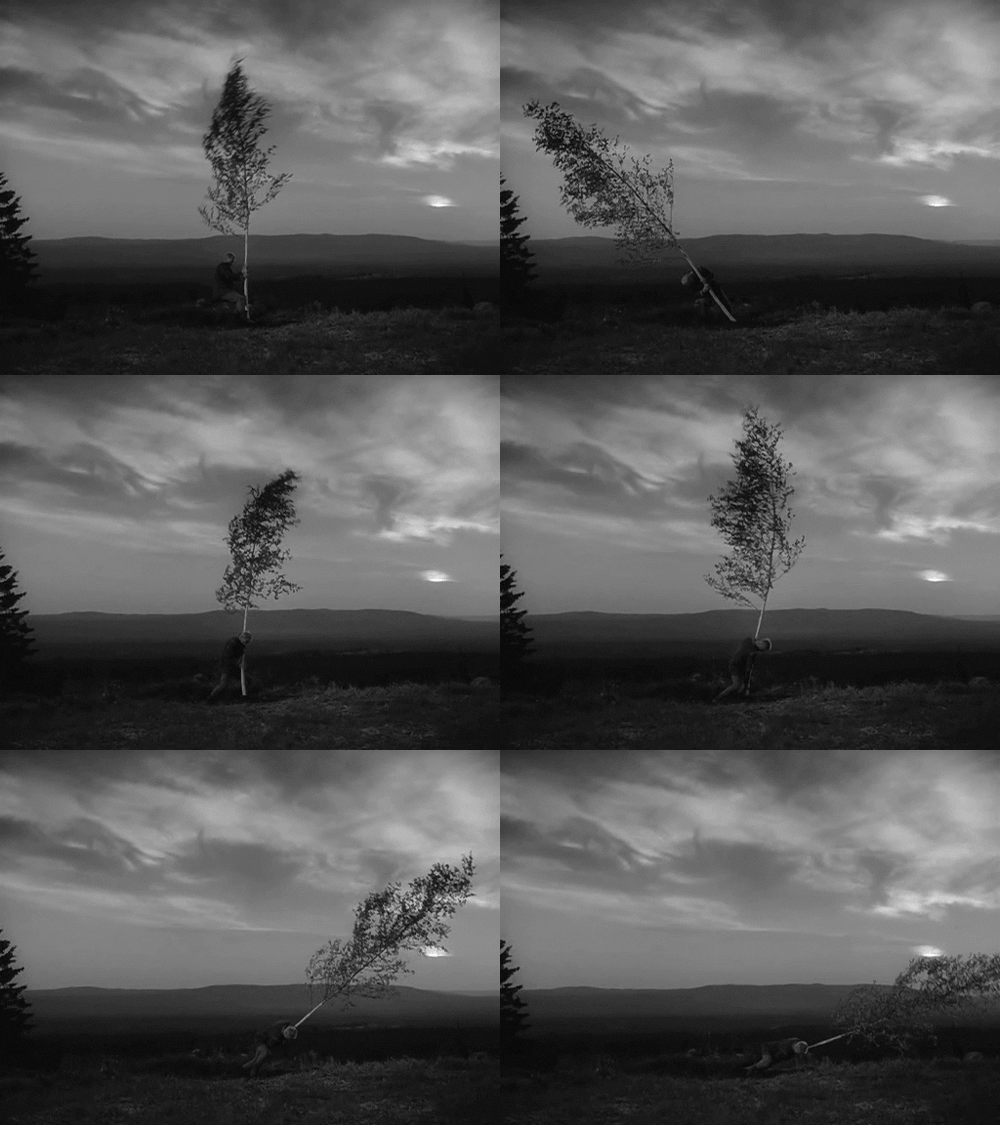
The Virgin Spring (aka Jungfrukällan) (Ingmar Bergman, 1960) The 1961 winner for the Best Foreign Film is one of the most stark in the filmography of Ingmar Bergman. Much criticized and censored in the U.S. when it was first released, it is a surprising gut-punch of a film that takes on the themes of violence, revenge, jealousy and guilt in a way that goes against the grain of Bergman's more esoteric films, and feels more like an exploitation film...with a conscience, sitting somewhere in the storytelling territory between myth and mysticism and the grim and the fairy-tale. With a dash of religious conflict as a chaser.   

I remember it as a film being offered for a showing at my local High School and being told—in no uncertain terms by my parents—that I would no way, no how be allowed to see that film. The Seven Samurai, sure, I could see that one. But, not The Virgin Spring.

Frankly, seeing it recently, I can't blame them all that much. Bergman's film would have knocked me for a loop. As it did so many. 
Based on a legend (and subsequent ballad "Töres döttrar i Wänge
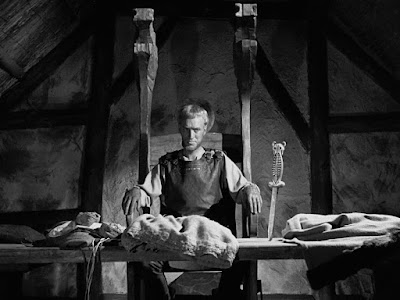
") of the building of the church in Kärna in medieval Sweden, and the reasons behind it, Bergman tells the story of Töre (Max von Sydow), a landed farmer in the 14th century. Proud, prosperous, Christian, but not so arrogant that you wouldn't find him also working with his servants in the field, he would seem to have it all: married to Märete (Birgitta Valberg), his second wife and their daughter Karin (Birgitta Pettersson) and foster daughter Ingeri (Gunnel Lindblom).
The two girls couldn't be more different ("as different as rose and thorn" 
Märete says)—Ingeri is dark and treated as a servant, and not much respected as she is quite pregnant, while the favored daughter, Karin, is blonde and pampered and indulged—perhaps too much. Great pride is taken in Karin, especially by Töre, while his wife's is measured by an adult parent's guarded judgement. It is a grand day for the Töre's; Karin is to take candles they have made to the church for the Virgin, and although Karin feigns sickness—to get out of going to church—she is only too happy to go proudly in her silken yellow shift (sewed by fifteen maidens!), Sunday skirt and blue cape (oh, and the white stocking and the blue shoes with the pearls!), like royalty.
Karin insists that Ingeri go with her (as she never gets off the farm) and the journey is a day's ride, but she doesn't know of her step-sister's animosity towards her and that Ingeri has secretly prayed to the god Odin to come to her aid—what that might entail isn't made explicit, but it's quite possible that he heard. Fording a river, they come across a mill attended by a wizened old man (
Axel Slangus), answering to no name: "I hear what I want to hear and see what I want to see." he tells Ingeri while Karin travels onward towards the church. "I hear what men whisper in secret and see what they think no one sees." He has cures for Ingeri and he professes to hearing "three dead men riding north" and invites her to hear what he hears. As he has heard her.
Already superstitious, Ingeri flees from the old man, following—against her best instincts—Karin into the dark forest. But, what she sees freezes her in her tracks. Three goat-herders have prevailed upon the kind-hearted Karin to stop and she invites them to eat the meal packed for her journey, but by the time Ingeri has reached her, they've attacked her, raping and then bludgeoning her to death, stealing her fine raiments and escaping into the forest. The rock Ingeri had planned to throw at the villains to stop them falls uselessly from her hands.
This is brutal stuff. And the film will only get more brutal as it goes along, as the film delves into the revenge for the act, but it's not one that comes from the heavens unless one believes that there are no coincidences. If that were so, it could be God or Odin or Fate that propels the film darker into an abyss of revenge and murder, but those entities seem to merely listen to the one-sided conversations of the beings that enjoin them. They are mute for all the homage paid.
But, not entirely.
 
If the pagan god of Odin makes an appearance, the Christian god is given equal time, through iconography and one apparent miracle, although not one to affect  the actions of the characters or the outcomes of things in the tale. Those are entirely the responsibility on the human figures, influenced or not by any deity.
I'm not one for revenge stories, which, given the absence of any sort of divine retribution, The Virgin Spring is. I don't find triumph or even satisfaction in them. For one thing I don't buy the math. "Eye" doesn't always equal "Eye". And I think for any retribution there is always a cost, even an invisible one. At least, there should be. But, The Virgin Spring, for all its measured coolness, boasts some of the most visceral acts of revenge ever put on the screen, no matter how much slaughter one has seen in movies. In part this is due to von Sydow's performance, which usually is noteworthy for its stillness and its internal strength. But not here. Töre seems ready to erupt at any time, whether from boastful pride or his own horror at what he finds himself capable of.
Von Sydow's performances are always imbued with spine, but in this, with all of its violent actions, he seems, ironically, more vulnerable, more capable of shame, of guilt, and penitence. The lip quivers, the hands shake, as if the revenge itself has affected him as well as his victims. But, then guilt and shame are major emotions in The Virgin Spring where everybody seems to be a victim...by their own hands or the hands of others, even if its the hands of Fate.
Later in his life and career Bergman would look back on The Virgin Spring and call it "a wretched imitation of Kurosawa." Imitation in themes and technique, maybe...but as unique and devastating as the Master would have made it half a world away.

Ingmar Bergman—film fan—checking out "Bruce" the shark
on the set of Jaws.

Saturday, December 2, 2023

Brass Target

Saturday is, primarily in these parts, "Take Out the Trash" Day.

Brass Target
(
John Hough, 1978) General George Patton was a rather colorful part of the Second World War, but, like many generals of that conflict, he was consigned to the realm of obscurity, despite his considerable efforts to the war effort.
 
That was until 1970 and the release of Patton, which went on to win the Oscar for Best Picture of its year, thanks in no small part to a (pardon the pun) commanding performance by George C. Scott. Patton—and Scott's performance—went beyond merely reviving the story of the man and his accomplishments but also catapulted the general (as well as his foibles and eccentricities) to the echelons of Myth. Those who see newsreel footage of the real Patton are often surprised at his high-pitched voice, his thick Virginia accent, and his rather tentative way of speaking, none of which Scott chose to portray in his characterization. The cult of Patton-worship after the film's release—especially among conservatives—can be construed as a response to Scott's strong portrayal, rather than to the man himself.
 
Another thing that Patton didn't portray was the matter of Patton's death, choosing instead to fade to black as the general walks his dog near to a quixotically-resonant wind-mill, keeping the spirit alive. Patton, who seemed most comfortable in the role of warrior, ironically died soon after the fall of Berlin, eight months into the peace, the result of injuries sustained in an auto accident—his limousine was going too fast across a railroad line and smashed into a truck, and the 60 year old General was the only injury. He'd broken his neck; two crushed vertebrae. He lay in traction for 12 days before succumbing to a blood clot in his heart on December 21st, 1945.
But, the cult of personality, post-Patton, wouldn't let it go at that. For quite a few years—but most notably after the movie's release—there has been idle speculation that Patton's death wasn't be accident, but was planned. No one offers proof, no one can point to a specific reason—they're "just asking questions"—but it's more to the point that some logic circuits just can't handle the fact that Patton who'd served in two world wars would end up dying from the result of something so mundane as a car crash (just as so many couldn't fathom that President Kennedy could be killed by one lone gunman). Imagination is a wonderful, but often faulty, thing. Imagination, though, doesn't make things true.
But, it can make money. The Patton death controversy didn't pop up until the 1974 publication of "The Algonquin Project" (or "The Oshawa Project," internationally) by Frederick W. Nolan, who cooked up a plot to assassinate a Patton-like commander (re-named George R. Campion) in order to keep him from investigating the theft of 250 million in Reichsbank gold being shipped to Frankfurt, a inside-job robbery that claims 59 American lives.
But, when the film-rights were sold and the project made, the commander's name was changed back to its source, George Patton, and the film followed the rest of the fantasy-land speculation, completely ignoring that Patton wasn't killed in the car-crash, but only injured. His surviving and subsequent 12 days of traction are completely ignored.
Instead, we get a sub-par plot of Army Intelligence officers (round up the usual suspects: 
Patrick McGoohan, Robert Vaughn, and Edward Herrmann) who pulled off the gold heist—in an elaborate plan that could have gone wrong in many ways, not least of which is that gold is heavy and difficult to transport. Once the theft is discovered, Patton is determined to find out whodunnit—he's livid over the loss of life—and it is arranged that before he can get very far into the investigation that he be killed by a hired assassin, Peter Shelley (Max von Sydow).
It is up to OSS Major Joe De Lucca (John Cassavetes) to determine who was behind the robbery, a task complicated by the plan's similarity to a mission De Lucca himself had masterminded against the Nazis some time earlier. That puts him in the sights of Patton's investigation, but for De Lucca, it merely means that whoever's behind it knows of him, his tactics and has enough security clearance to know what's what in the particularly-secretive-because-it-is-so-new OSS.
There are complications—enough to distract De Lucca from the obvious—and bodies begin piling up, only verifying to him that he's on the right track. And then, there's some romantic entanglements which serve no dramatic purpose other than to put Sophia Loren in the picture.
It's a lousy movie, but I can see why people wanted to do it—money. Cassavettes took less film roles later in his career as he was concentrating on film-making, and this one probably paid for a couple of his. Points to the movie for that. And he also might have also wanted a chance to play with von Sydow (playing another inscrutable assassin—he seemed to be doing that a lot in the paranoid '70's), whose character plays two roles, one in very plain sight as a diplomat and one in the shadows as a very undiplomatic hit-man (the two careers seem to be mutually exclusive in attitude and temperament and either job could impair, if not jeopardize, the other—different color contact lenses notwithstanding).
Great disguise there, Max. 
Superman, at least, puts on a pair of glasses.
But, one shouldn't quibble about details, especially sophisticated ones, as the whole plot is built on the substantial lie of Patton being assassinated. It's a wonder they didn't do it in modern dress, as focused as they are on "accuracy". 
It's taken me a long time to actually sit down and watch this movie, as I knew the Patton history, and knew that the central focus was a canard, so why bother? But, 45 years of blissful ignorance of the inanities of the thing I can chalk up to a "win". I'm just glad I didn't waste any of my money on it. As its failure at the box office helped lead M-G-M to shut down its film-making division—in 1979 M-G-M honcho Kirk Kerkorian announced that they were a hotel company—the studio probably wished the same thing. Ironically, I watched it on Turner Classic Movies (Ted Turner having bought the studio's assets in March, 1986, primarily for its film library), so I guess there's something of a happy ending, after all. 


Thursday, October 26, 2023

The Magician (1958)

The Magician
(aka Ansiktet or "The Face", 
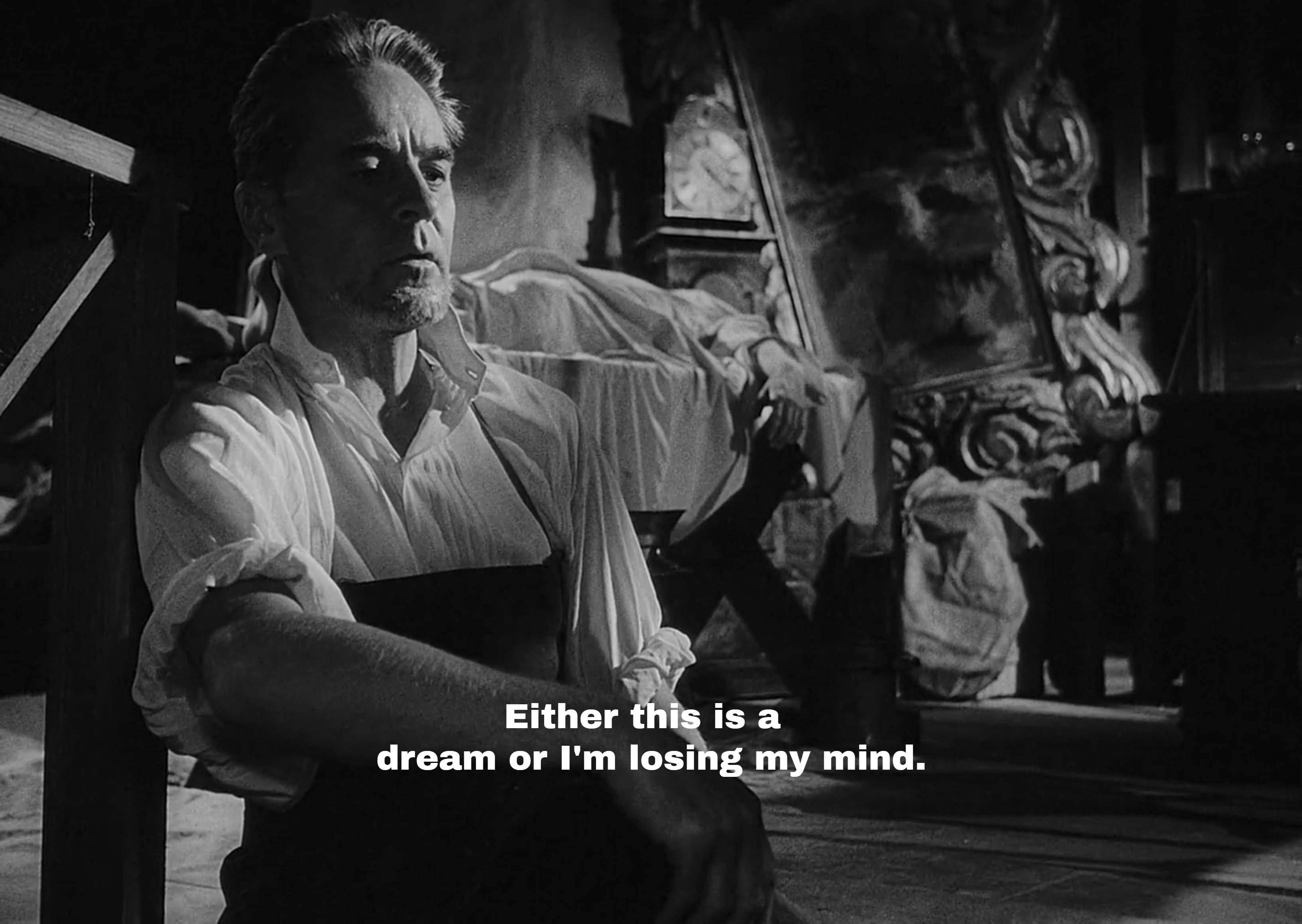
Ingmar Bergman, 1958) It is a rough day of travel for Vogler's Magnetic Health Theater, a gypsy band of performers just out of Copenhagen and carriaging to Sweden. Their reputation precedes them, having been accused of fraud and blasphemy at various stages of Europe, and some time incarcerated, but still they have a following and luckily it doesn't involve torches and pitch-forks. The troupe moves purposely on demonstrating the awesome powers of animal magnetism and selling potions for the sick and the wantonly healthy. "Sensational marvels never seen before. Magical acts derived from the philosophies of the Orient. Health-giving magnets, and spine-tingling thrills for the senses." That's what the flyers say, anyway. Whether it is true or not, the head of the troupe, Albert Vogler (Max von Sydow) will neither confirm or deny; Mr. Vogler, you see, is mute. Better to neither confirm or deny, the less said the better, and nothing is best of all.
In their travel, they come across a sickly actor, Johan Spegel (
Bengt Ekerot), who asks for some brandy as he's sure today will be the last day of his life. He is offered that and a ride, and he joins the troupe consisting of Vogler, the severes"Mr. Aman" (portrayed by Vogler's wife, Manda—portrayed by Ingrid Thulin), their assistant and spokes-person Tubal (Åke Fridell), the carriage driver Simson (Lars Ekborg) and "Granny" Vogler (Naima Wifstrand), who "may" be a witch but is skilled at potions.
The actor having a mute audience as benefactor, talks and talks, his health gradually declining, his life ebbing away with every word, knowing that Vogler will be fascinated to hear his account with death, but...just as he's about to reveal what death is like...he dies.
Against that backdrop, the troupe continues on to the first village on their way, and are invited by Counsel Egerman (
Erland Josephson) and his wife (Gertrud Fridh), both of whom are believers in the supernatural and are fascinated by the claims of the visitors, to join a party held in their behalf. Also attending—with a bit more "official" interest in the theater troupe—are Police Superintendent Starbeck (Toivo Pawlo) and the Minister of Health, Dr. Vergerus (Gunnar Björnstrand). The officials decide to have an informal bet on whether Vogler's group and abilities are frauds.
Are they frauds? There's room for interpretation: Egerson and his wife—especially the wife—lean towards belief, but Vergerus is a man of science and is disinclined to buy into any sort of mumbo-jumbo, and Starbeck's fall-back is to believe the band—given their reputation—are fraudsters, looking to separate the populace from their Krona. And given the artifice displayed by the players of the theater—Albert and his wife are both heavily made up and not what they appear to be—there's more than enough reason to think that it's all an act, mere illusion and trickery than any sort of mystic power.
One is inclined to say that there's a battle of wits between the troupe and their hosts, but it's no battle, really, merely the troupe being true to their nature as imaginative outsiders and the officials being stuck in their ways of thinking. Even if members of the troupe protest that everything is smoke and mirrors, there will always be that little suspicion with evidence to the contrary that they might not be. The evidence will be equal parts what they see with their eyes and what they feel with their hearts, and even the most pessimistic of the lot can be made to doubt, especially if their beliefs are merely a way to prop up a reputation of confidence.
One line haunts, and feels more true these days than at the time of the film's creation: At one point, the ailing actor makes a point:
Ouch. That hits you right in your superstitions. Or is it maybe the one who tells the truth needs to be put down by all the deceivers, lest they be exposed as such. But, in a world of deceivers what difference would being exposed make, especially if it's status quo?
Bergman offers no answers, just possibilities. The troupe could be fraudsters, but that fallen actor at the beginning comes back to haunt Vogler, something that only he is privy to. That must be evidence, no? But, evidence of what? Who would it convince but only another believer?
 
The Magician leaves the stage making you want more. And its questions haunt long after that point.

Friday, June 23, 2023

The Diving Bell and the Butterfly

The Diving Bell and the Butterfly aka "Le Scaphandre et la Papillon" (Julian Schnabel, 2007)

"Still Life with Wandering 'I'"

At one point, early in Julian Schnabel's inexplicably gripping realization of Jean-Dominique Bauby's blink-by-blink account of his coping with a paralyzing stroke, the camera leaves the confines of the eye of Bauby (his paralysis is nearly total, only his left eye is capable of movement in order to scan his world, and communicate with those around him) and changes perspective to move across the room in a blur to witness his mistress putting up pictures from his past to aid in his recovery. That surrealistic freeing moment allows us (the audience) the chance to change perspective as well; instead of looking out from Bauby's fixed position, as will happen a good 60-70% of the time, we turn inward and see an approximation of his thoughts. Or are those his thoughts; could it be an hallucination; could it be an out-of-body experience; could it be his soul talking?
Bauby's condition is referred to clinically as "
Locked-In Syndrome," where the brain is active, although the body cannot move. And Schnabel's film gives a lie to the label, as Bauby's life-in-paralysis is anything but locked-in. Although he is frequently only a passenger in his life, Schnabel points out that reality and perception is only when component to a life. There is also the vast store of life inside the mind.
Throughout the film we are privy to Bauby's internal life,
* but often those thoughts become images--memories, imaginings, lusts, fantasies, body-images. Rarely are there violations of the POV rule, where we share Bauby's point of view in whatever form it takes, and turn around to see his minimal reactions--a quivering lip, a tear, a drool. But even those are edited to form a piece of the whole--to make a sum of Jean-Do's experience of a "still," but rich life.**
Variations on the one-point perspective:
The Normal: Jean-Do's point of view from his hospital bed

Extreme POV: Bauby watches his right eye-lid being sewn shut

Break-Out: Jean-Do extrapolates out from his view-point to see his mistress' face

Body-image: Jean-Do imagines himself unable to move underwater in a rigid diving suit

Fantasy: Jean-Do imagines his isolation on a family outing at the beach.

Memory: Jean-Do remembers shaving his father (Max Von Sydow)--
a time when he assisted someone who was helpless

Interpretation: Pictures hung in his hospital room, abnormally close, contrasting

Memory or Imagination: Calving glaciers--a symbol of decay?

Hallucination: Is his mistress visiting or not?

Scene-setting: Jean-Do imagining his interaction, or director convenience?

Reality
* Even though the producers are American, and the scriptwriter and director are British, the entire film is in french dialect at Schnabel's insistence. It has an added benefit--it is one more "remove" from Bauby. We can hear his thoughts, but, unless you're French and speak it, it needs to be translated, just as his internal thoughts needed to be communicated through his eye-blinks and interpreted. It is one more level of audience-sympathy with the subject.  
 
** Schnabel couldn't adhere completely to that rule--In the phone conversation with his publisher, the director cuts to the publisher's office to see her quandary about agreeing to a book by a paraplegic—something Bauby is not privy to, and his nurse cannot see.