Showing posts with label Patrick McGoohan. Show all posts

Saturday, December 2, 2023

Brass Target

Saturday is, primarily in these parts, "Take Out the Trash" Day.

Brass Target
(
John Hough, 1978) General George Patton was a rather colorful part of the Second World War, but, like many generals of that conflict, he was consigned to the realm of obscurity, despite his considerable efforts to the war effort.
 
That was until 1970 and the release of Patton, which went on to win the Oscar for Best Picture of its year, thanks in no small part to a (pardon the pun) commanding performance by George C. Scott. Patton—and Scott's performance—went beyond merely reviving the story of the man and his accomplishments but also catapulted the general (as well as his foibles and eccentricities) to the echelons of Myth. Those who see newsreel footage of the real Patton are often surprised at his high-pitched voice, his thick Virginia accent, and his rather tentative way of speaking, none of which Scott chose to portray in his characterization. The cult of Patton-worship after the film's release—especially among conservatives—can be construed as a response to Scott's strong portrayal, rather than to the man himself.
 
Another thing that Patton didn't portray was the matter of Patton's death, choosing instead to fade to black as the general walks his dog near to a quixotically-resonant wind-mill, keeping the spirit alive. Patton, who seemed most comfortable in the role of warrior, ironically died soon after the fall of Berlin, eight months into the peace, the result of injuries sustained in an auto accident—his limousine was going too fast across a railroad line and smashed into a truck, and the 60 year old General was the only injury. He'd broken his neck; two crushed vertebrae. He lay in traction for 12 days before succumbing to a blood clot in his heart on December 21st, 1945.
But, the cult of personality, post-Patton, wouldn't let it go at that. For quite a few years—but most notably after the movie's release—there has been idle speculation that Patton's death wasn't be accident, but was planned. No one offers proof, no one can point to a specific reason—they're "just asking questions"—but it's more to the point that some logic circuits just can't handle the fact that Patton who'd served in two world wars would end up dying from the result of something so mundane as a car crash (just as so many couldn't fathom that President Kennedy could be killed by one lone gunman). Imagination is a wonderful, but often faulty, thing. Imagination, though, doesn't make things true.
But, it can make money. The Patton death controversy didn't pop up until the 1974 publication of "The Algonquin Project" (or "The Oshawa Project," internationally) by Frederick W. Nolan, who cooked up a plot to assassinate a Patton-like commander (re-named George R. Campion) in order to keep him from investigating the theft of 250 million in Reichsbank gold being shipped to Frankfurt, a inside-job robbery that claims 59 American lives.
But, when the film-rights were sold and the project made, the commander's name was changed back to its source, George Patton, and the film followed the rest of the fantasy-land speculation, completely ignoring that Patton wasn't killed in the car-crash, but only injured. His surviving and subsequent 12 days of traction are completely ignored.
Instead, we get a sub-par plot of Army Intelligence officers (round up the usual suspects: 
Patrick McGoohanRobert Vaughn, and Edward Herrmann) who pulled off the gold heist—in an elaborate plan that could have gone wrong in many ways, not least of which is that gold is heavy and difficult to transport. Once the theft is discovered, Patton is determined to find out whodunnit—he's livid over the loss of life—and it is arranged that before he can get very far into the investigation that he be killed by a hired assassin, Peter Shelley (Max von Sydow).
It is up to OSS Major Joe De Lucca (John Cassavetes) to determine who was behind the robbery, a task complicated by the plan's similarity to a mission De Lucca himself had masterminded against the Nazis some time earlier. That puts him in the sights of Patton's investigation, but for De Lucca, it merely means that whoever's behind it knows of him, his tactics and has enough security clearance to know what's what in the particularly-secretive-because-it-is-so-new OSS.
There are complications—enough to distract De Lucca from the obvious—and bodies begin piling up, only verifying to him that he's on the right track. And then, there's some romantic entanglements which serve no dramatic purpose other than to put Sophia Loren in the picture.
It's a lousy movie, but I can see why people wanted to do it—money. Cassavettes took less film roles later in his career as he was concentrating on film-making, and this one probably paid for a couple of his. Points to the movie for that. And he also might have also wanted a chance to play with von Sydow (playing another inscrutable assassin—he seemed to be doing that a lot in the paranoid '70's), whose character plays two roles, one in very plain sight as a diplomat and one in the shadows as a very undiplomatic hit-man (the two careers seem to be mutually exclusive in attitude and temperament and either job could impair, if not jeopardize, the other—different color contact lenses notwithstanding).
Great disguise there, Max. 
Superman, at least, puts on a pair of glasses.
But, one shouldn't quibble about details, especially sophisticated ones, as the whole plot is built on the substantial lie of Patton being assassinated. It's a wonder they didn't do it in modern dress, as focused as they are on "accuracy". 
It's taken me a long time to actually sit down and watch this movie, as I knew the Patton history, and knew that the central focus was a canard, so why bother? But, 45 years of blissful ignorance of the inanities of the thing I can chalk up to a "win". I'm just glad I didn't waste any of my money on it. As its failure at the box office helped lead M-G-M to shut down its film-making division—in 1979 M-G-M honcho Kirk Kerkorian announced that they were a hotel company—the studio probably wished the same thing. Ironically, I watched it on Turner Classic Movies (Ted Turner having bought the studio's assets in March, 1986, primarily for its film library), so I guess there's something of a happy ending, after all. 


Thursday, July 9, 2020

All Night Long (1962)

All Night Long (Basil Dearden, 1962) I've been watching a lot of Basil Dearden movies lately—the only ones already on the site, reviewed, are Khartoum and a horror anthology he'd participated early on in his career, Dead of Night—and they're pulpy but intelligently produced with an underlying social concern, interestingly framed, and with a sometimes perverse energy designed to take the audience slightly to the edge of their seats. They're at least designed to produce a nervous tick in the leg.

All Night Long, though, is more designed to keep a steady beat of foot-tapping, based as it is in the jazz idiom. In fact, for aficionado's, it's a bit of a must-see for performances by some "legends" (a much used word, but actually appropriate here), such as Charles Mingus (he gets lines to say!—"Hi, thanks for inviting me!"), Dave Brubeck, John Scott, John Dankworth, Tubby Hayes, Bert Courtley and Keith Christie. That's a great joy to the film, but I imagine it's frustrating for the very people who would want to see this for that purpose because it has a story and actors who distract from the performances and from the music for whole minutes at a time (I imagine that the first frenetic Beatles fans were frustrated with A Hard Day's Night for that same reason). On the other hand, for those folks into narrative in their films, they might be stymied by the story being stopped dead by performance drops. These people have never heard of or seen musicals.
The story is basically the story of Othello brought up to a jazz-beat (a bit uncomfortably) and a jazz-idiom. Entrepreneur and impresario Rod Hamilton (Richard Attenborough) goes to his club where he has prepared a very special night—a party celebrating the first anniversary of jazz King and Queen Aurelius Rex (Paul Harris) and wife Delia Lane (Marti Stevens), jazz pianist and songstress (retired), respectively. Guests are band-mates, acquaintances, and some notables in the industry and Hamilton has designed it to be a night of celebration and song for the happy couple. He should have checked the guest-list.
Brubeck and Scott and Dankworth are fine, of course—they're providing music. But along with Aurelius' inner-circle of Cass Michaels (Keith Michell) and his girl Benny (Maria Velasco), there is also drummer Johnny Cousin (Patrick McGoohan) and his wife, Emily (Betsy Blair). Cass is Aurelius' manager and completely loyal to him and a confidante to Delia. That relationship will become critical to the machinations of Cousin, who has been promised a side-deal for his own band by another manager, but only if he can persuade Delia to come out of retirement and join his band as vocalist. If he is to have any chance at success, he must drive a wedge into the happy marriage between Aurelius and Delia before she could even entertain fronting his group. And for that, he works on Cass.
He needs in-for-ma-tion. So, he invites Aurelius' manager to a private meeting on an outside landing and cozies up to Cass (who's been clean and on the straight and narrow for years and a dependable business partner) and plies him with some reefer, relaxing Cass enough to give Johnny inside intel on any weaknesses in the Rex-Lane marriage, which is (for him) disappointingly stable. But, he knows that Cass and Delia are close, so he devises a plan to make Aurelius suspect that the two are actually closer than her husband suspects. So, Johnny does a solo performance with everybody at the party, sewing doubts and intrigues and creating tensions where there are none.
It becomes apparent that Johnny Cousin is Shakespeare's Iago (and Cass is Cassio, which is not much of a name-stretch). But, where the bard's version goes through the play without any rationalization or motive for his actions (other than "I hate the Moor"), Johnny is totally and completely about getting his "gig" and, if a little chicanery and a marriage-split will advance it, then so be it. Suspicions are communicated between parties (at the party), but that can only go so far. And Johnny has a technological ally for fabricating proof.
Hamilton is a huge jazz fan, and part of his plans are to record a couple of sessions using a tape recorder (an EMI TR90 for you gear-heads), which Johnny uses to make recordings of some conversation. With that, he can take desired bits of conversation, and record his own voice for insinuating connections between the juicy bits to make it all seem like there's an affair going on between Delia and Cass to inflame Aurelius' jealousy. Anybody who's tinkered with tape will know that such an operation takes split-second timing (lest you erase the original) and you've got to have a stop-watch handy to be able to do it without editing—and in those days, you'd need a razor blade and tape, which is pretty obvious evidence of tampering. But, Johnny must be very good because his evidence doesn't even contain any electronic evidence that a tape has been started or stopped.
Technical quibbles aside, his gambit works—at least for a little while—and there is a real danger that he might get away with it, but not with the results he might want (this is based on "Othello," after all). There will be distrust and dust-up's, enough to ruin any high-class party, and certainly enough to interrupt any of the jazz interludes that pop up for the aficionado's. 
It is a thrill to watch Mingus and Brubeck jam in one of the pieces, particularly to watch the effortless fingering on strings and keyboard. That comes early on in the film, but there's enough good material throughout to keep folks who just came for the music to enjoy. And stick around: McGoohan learned to play drums for the film and he has a frenetic solo towards the end that looks damned convincing, even if—as I suspect—he's just playing to a tracked music piece. He's an intense actor—around this time, he was right in the middle of doing the "Danger Man" series (it played in the U.S. as "Secret Agent" with a Johnny Rivers title song)—and the same intensity is born out in that solo.
This came out in 1962—1963 in America—and at that time, what was called "mixed marriages" were illegal in one-third of the States. It was an issue here and might have had a hand in the film's limited distribution and it's somewhat rare availability. It is refreshingly not an issue in this British-based film where nothing—absolutely nothing—is made of it. It's not even mentioned, other than the marriage is one for celebration...and strong enough not to be rent asunder by the conniving of an ambitious narcissist. 
Another aspect that might have been controversial in the States is the on-camera portrayal of marijuana use. Even though the Hayes Code was dying of purposeful neglect during this period of film-making, drug use and distribution was prohibited under its strictures. Come to think of it, so was "mixed race" relationships. Something to consider while you're "bogarting" and considering the ash-bin of History and how time inevitably leaves prejudice there.
For whatever reason you come to it, for the music, or for the Shakespeare link, or you're a McGoohan fan/completist (or Attenborough...or Betsy Blair...or whoever), or if you're looking at the films when Dearden was telegraphing social messages and conspicuously pushing the barriers of what got on film—as Preminger was trying to do in the States—you come away with respect for this little doorway in the alleyway of film-noir sticking its neck out that although the world can be a nasty place, it's lit by the idea that the important things are devotion. And trust. 

And all that jazz.


Saturday, February 22, 2020

Hell Drivers

Saturdays are "Take out the Trash" Day

Hell Drivers (Cy Endfield, 1957) British feature directed by blacklisted American director Endfield—and the first to carry his actual name and not a pseudonym*—about the rough and tumble day-to-day of short-haul truckers, battling deadlines and each other to try and meet quota and be top-driver hauling ballast (gravel) on sub-standard equipment at speeds that are break-neck, even under the best of conditions. Each driver has to make at least twelve loads a day; if they don't, they're fired. Competition is so fierce that the other drivers aren't above sabotaging each other's rigs. Work-place harassment is just part of the job and a way of life.

Into this demolition derby come Joe Yately (Stanley Baker)—call him "Tom"—who's just served a year stretch in prison and is trying to make a new honest life for himself. A position is open at Hawlett's Trucking after a driver has gone through a bad accident and although the manager, Cartley (William Hartnell) is reluctant, his secretary Lucy (Peggy Cummins of Gun Crazy) intercedes on his behalf. Tom is taken on a training run and does okay, despite near-collisions with a couple of other drivers.
The other drivers are a motley crew: there's Scottie (Gordon Jackson), Ed (Wilfrid Lawson), Dusty (Sidney James), Tinker (Alfie Bass), and Johnny (Sean Connery), all rough types who aren't above intimidating Tom—it's all in fun, after all. More receptive is Gino (Herbert Lom), an Italian (Herbert Lom?) who's in love with Lucy and wants to give the new driver a chance.
Less friendly is Red (Patrick McGoohan), the driver foreman, who always sits at the head of the table—as a rib, the drivers let Tom sit at the head and Red knocks him off his chair when he enters the room. Red is the most reckless of the drivers, does eighteen runs a day winning him a gold cigarette case, and lets it be known that no—no one—will take that case away from him, even if he has to cripple the driver to do it.
The first thing you notice, given hindsight, is the cast, early in their careers, and before they achieved their biggest success in the 1960's. Sure, there's Connery and McGoohan (who'll ride the 1960's spy-craze), but there's also Jackson from "Upstairs, Downstairs," Lom and Alfie Bass, Sidney James from the "Carry On" films, and Hartnell would become the first "Doctor Who."
But, that's not all. Playing the waitress at the driver's mess is Jill Ireland. And when Tom goes home to try to make amends, David MacCallum plays his younger brother. That's an amazing group of young actors, briefly doing washing duties in the "kitchen-sink" era of British film-making. As a result, the most subtle of the actors is star Baker, while the rest of the cast do their best to garner attention to themselves.
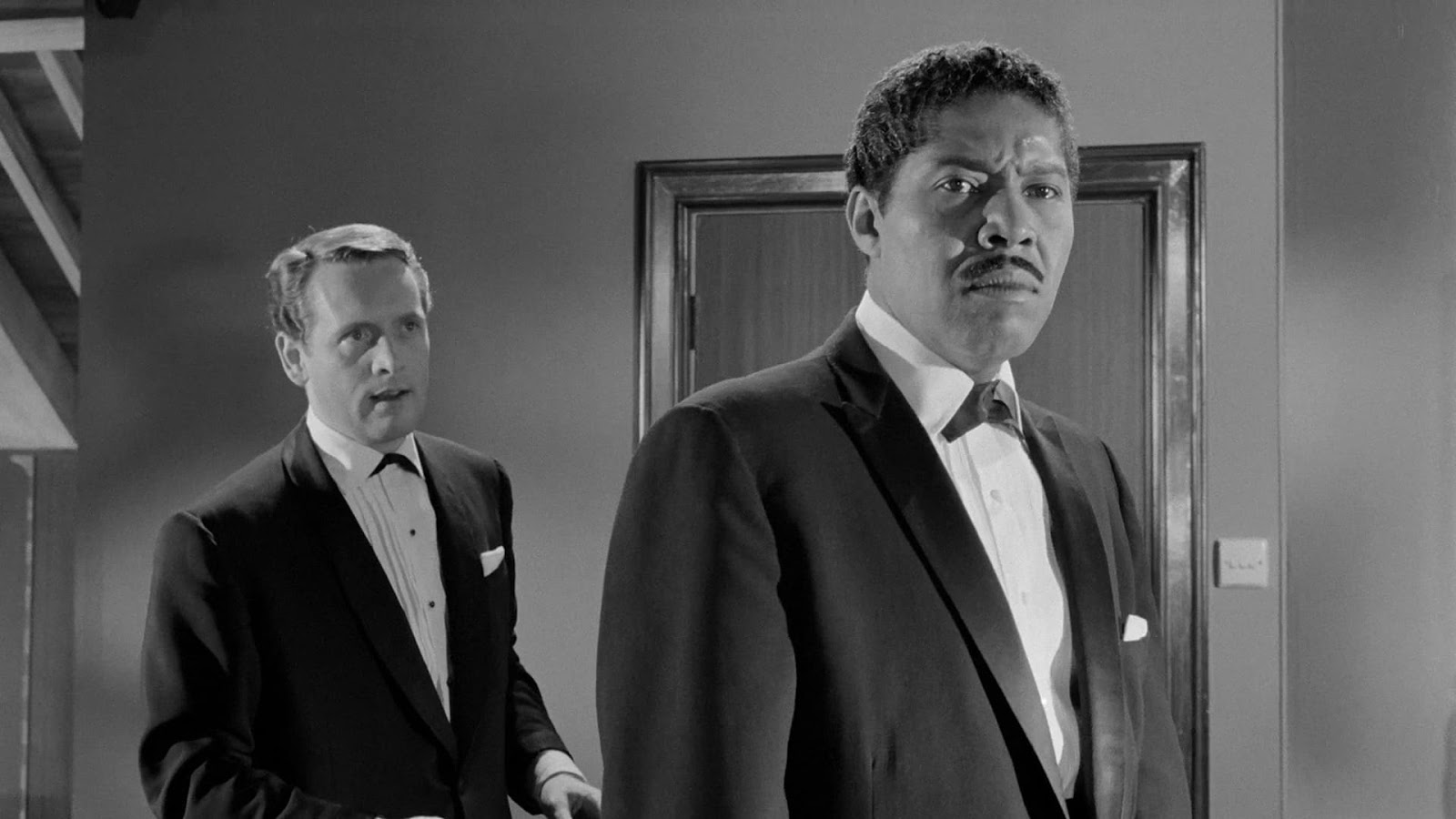
Lom's accent might be a little thick, but the actor who does the most egregious over-acting is a surprising one—McGoohan. He'd be known for merely quietly smoldering with a less-is-more kind of acting during his starring days, but here he's at full villainous boil, manking about like he was Richard III, hunch-shouldered and bull-headed. You hope for him to get his comeuppance early, as its a little painful to watch. When throws away a cigarette, you expect it to explode off-screen.
That aside, Endfield keeps the action going almost constantly, making it a visceral movie. Sometimes too much so. The driving scenes are viciously under-cranked, giving it an almost comic effect, rather than causing white knuckles. By the way, the cinematographer is the storied Geoffrey Unsworth, who would move on to far greater things.
Still, it's interesting to see if only for the young turks who would burn up the screen in the next decade.

* Well, it's listed as C. Raker Endfield, a slight obfuscation from how he was listed on his American films.

Tuesday, October 23, 2018

Scanners

It's October..."so maybe I should pay attention to horror films." How cliché.

I have some planned and in the hopper, but I noticed "The Large Association of Movie Blogs" is showcasing director David Cronenberg, so I'm also going to be throwing in a bunch of Cronenberg reviews from the past and the retrospective present. After all, you can't have a Cronenberg movie without a little bit of horror...somewhere.

Scanners (David Cronenberg, 1981) You can weaponize anything. But, I wonder if David Cronenberg knew when he was writing and directing Scanners that the United States military was (seriously) investigating the use of psychic abilities for intelligence and warfare at Forts Mead and Bragg. The programs, dubbed "The Stargate Project" were documented by Jon Ronson in the book "The Men Who Stare at Goats," which was made into a film in 2009. No one that I've read has made the connection, and evidently Cronenberg's initial concept was far afield from what was finally put on-screen; so the film could be used as a tax write-off, it was rushed into production forcing last-minute scripting while filming. And, it isn't the military that is doing the experimentation, it's a corporate interest specializing in private security—a sort of pre-Blackwater in the world of the Military-Industrial Complex. Meet the new boss. Same as the old boss. And trust Cronenberg to be ahead of the curve in terms of paranoia and conspiracies.
There is an "issue" at ConSec: at a conference in which they were announcing the use of "scanners"—agents with psychic and telekinetic abilities, a demonstration was called for and a volunteer from the audience came to the stage. Rather than providing a number from 1 to 100 for the scanner to predict, the volunteer, a scanner named Revok (Michael Ironside) psychically assaulted the Consec agent causing his head to explode, resulting, as the ConSec chairman says "in six corpses and substantial loss in credibility for our organization." And all without a bone-saw. ConSec security chief Braeden Keller (Lawrence Dane) suggests, for the good of the company, that the "scanner" program be halted, but he is overruled by Dr. Paul Ruth (Patrick MacGoohan), who has identified Revok from CCTV footage; Revok has acquired defector scanners from ConSec and has started his own band of rival scanning rogues. 

But Dr. Ruth has a plan: he has picked up a drifter named Cameron Vale (Stephen Lack) who has been arrested for stealing food and giving a woman who gives him the stink-eye a seizure. Ruth wants to work with Vale to oppose Revok and possibly infiltrate his network. Vale has been unhinged by his abilities, but Ruth injects him with a drug he's developed called "ephemerol" (heh) that negates Vale's powers and keeps him sedate.
Vale has been homeless because his scanning abilities has made him anti-social, not knowing where they came from, but once Vale explains his gifts and shows him others with his abilities, he is able to recruit Vale for his efforts. He also helps him to channel his abilities, and is astonished by the power that Vale demonstrates when he drastically increases the heart-beat of a yoga master who has trained himself to keep it low. Ruth sets Vale a task—to find other scanners and his link to them might be through sculptor Benjamin Pierce, himself a scanner.
"I'm thinking of a number between 1 and 100..." "Uuhh...No. 6?"
But, Revok has hired assassins to follow Lark to Pierce, and while Pierce is very angrily reluctant to help Lark, they are interrupted by Revok's killers who shoot Pierce—Lark uses his abilities to kill the shooters and reads from Pierce's dying mind a name: "Kim Obrist."*
Obrist (Jennifer O'Neill) is a scanner herself—there seem to be a lot of these folks (where do they come from?) and she has her own band of unaffiliated scanners. Vale attends a meeting of her group and—wouldn't you know it (especially if you have ESP!)—more of Revok's killers show up and take out Obrist's group, but Obrist is able to use her mind to kill the assassins, making them burst into flame. Lark compels the one surviving assassin to lead him to Revok and he is given a vial with the name "Biocarbon Amalgamate." Lark takes it upon himself to keep Obrist safe, but tracks down the BioCarbon facility, where he discovers it is run by Revok and they are controlling shipments of ephemerol through a ConSec program called "RIPE" and Vale contacts Ruth of what he's found out. On Ruth's instructions, Lark brings Obrist to Consec, where she is injected with ephemerol and taken by Keller to be interrogated.
So, as things gets increasingly more complicated, they also get more contained and insular, and this is where Scanners has its big drawbacks. I'm sure that the concentration of scanners in one city has more to do with budgetary considerations than any sort of story logic, but, be that as it may, it doesn't explain why it takes so darned long for Vale (or Ruth) to realize that there is probably a traitor in their midst as Revok's infiltration of the ConSec systems are so complete. You would think that folks with such enhanced brains and abilities might figure any of this out before it turns into such a murderous problem, but Cronenberg, given the constraints of time and budget is more concerned with stunning visuals than story logic.
Those "stunning visuals" (most created by make-up legend Dick Smith—he of The Godfather, Taxi Driver, Little Big Man, and The Exorcist) create the sense that anything is possible with the abilities of the Scanners—except for figuring anything out and having to rely on sleuthing like a normal person. The abilities are convenient when the script calls for them to be, but pretty useless in the main. And that's a major flaw. It's enough to make a critic's head explode.
The performances are all over the map: Lack is okay, but largely unsympathetic in an opaque kind of way—he was probably hired because he looks like he could be a derelict but also clean up real nice. O'Neill is one of those actresses that relies more on looks than personality, and she is mostly required to look earnest, like she is covering up a deep, dark secret (SPOILER ALERT: she isn't). MacGoohan, as usual, in inscrutable, an actor who's always had the ability to portray smarter even if the character doesn't call for it, merely by an ironic half-smile. On the other end of the spectrum is  Ironside. He's the master of excess, for whom subtlety seems to be a waste of time—one would say he'd be better suited for silent pictures, but even there he'd be over-the-top. His Revok is both malevolent and insane, so much so that one wonders if he could be capable of being in charge of anything if he didn't have the ability of mind control. 
Scanners is rather dumb, despite its considerable displays of brain-power. And it is giddily gruesome—as Cronenberg gleefully can be. I mean, a guy's head explodes within the first 15 minutes—and it gets worse from there. I've called Cronenberg the Enemy to the Squeamish and it is never more evident than it is in Scanners. One should hold onto one's head...or, at least, their lunch.


* Kim Obrist is listed as an assistant to producer Claude Heroux in the credits.

Thursday, April 6, 2017

Ice Station Zebra

Ice Station Zebra (John Sturges, 1968) The movie that was (supposedly) the favorite movie of billionaire-aviation pioneer Howard Hughes—one that he would watch obsessively.

One can only wonder why. It is not exactly inspired entertainment, although somewhat competently directed by John Sturges (who was at his best with genuine location work, rather than with effects-heavy set-bound shows, such as this and Marooned).


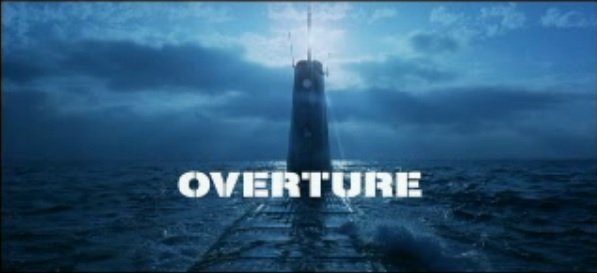
It was also one of the last of the prestigious "roadshow" presentations, shot in "Super-Panavison-70" and featuring "Overture" music and an Intermission at the theater. After this one, the "roadshow" concept was abandoned, in order to squeeze in extra showings per night, sounding the death-knell-by-chopping-block for such ambitious projects as Billy Wilder's The Private Life of Sherlock Holmes and Richard Lester's originally conceived three-hour version of The Three Musketeers. But, beyond that, the film may be one of the dullest thrillers ever filmed. 
Ice Station Zebra has the same stolid air of other adaptations of Alistair MacLean adventure yarns (The Guns of Navarone, Where Eagles Dare). It's just not as adventurous, and the locations—studio-created—are claustrophobic and closed-in, as opposed to having any dramatic vistas or the intriguing foreign locales of other MacLean stories. Here, it's meeting rooms, a submarine and a burned out polar station on a floating ice flow. People don't get out much, and the whole film feels close and boxed-in (quite a trick in "Super-Panavision-70). 
Oh, there are intrigues—it wouldn't be a MacLean story if there wasn't one or two double-crosses thrown in—but they're fairly typical. The sub' has to have a debilitating leak, and as befitting a Cold War drama (the coldest!), there are dueling loyalties and the to-be-expected double-agent (but who?). It never rises from the slightly edgy to the exciting and is mostly cliché-ridden, especially when it comes to the "whodunnit" aspects.
It's a fairly good cast with not much to do except glower at each other, and top-liner Rock Hudson isn't at his best at that, and is ham-strung by the script (by MacLean, Douglas Hayes—he wrote Kitten with a Whip, after all—Harry Julian Fink, and W.R. Burnett, no slouches, any of them) from doing anything interesting, like humor. Patrick McGoohan has one interesting scene where he loses it, but mostly he's clipped and acerbic in hyper-"Danger-Man" mode.  Jim Brown matches him frown for frown—twin performances by actors playing characters hating each other—and Ernest Borgnine does a risible Russian accent. A lot of testosterone, mostly going to waste, in material which is stretched to the ice-breaking point.
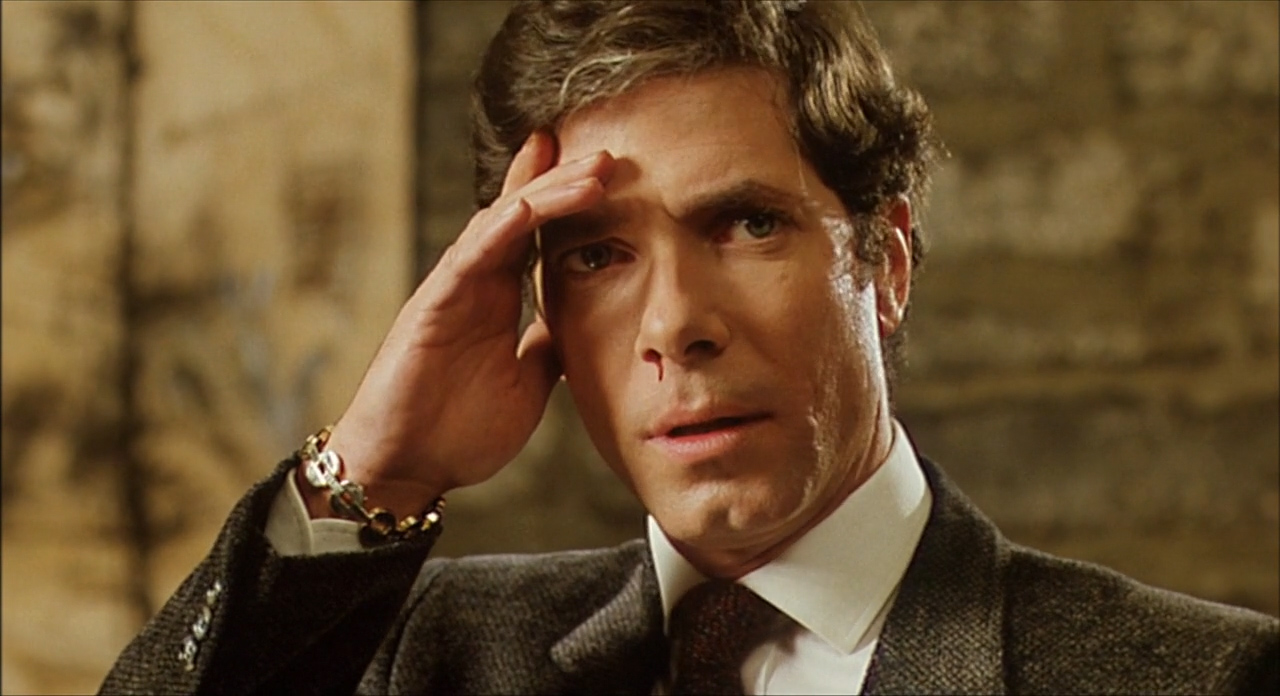
Patrick McGoohan recreates my expression watching this movie.
Supposedly there's going to be a remake, so there's a lot of room for improvement.
Given that it's a submarine movie, shouldn't it be called an "Underture?"