Showing posts with label William Shakespeare. Show all posts

Sunday, December 17, 2023

Don't Make a Scene: Chimes at Midnight

The Story: I've wanted to do this one for some time, but why I was drawn to it has eluded me.

There are those that will argue that The Chimes at Midnight (or Falstaff, as it was released in some circles) is Orson Welles' finest work, surpassing the "Wisdom of the Tribe" consensus that Citizen Kane is his best film. Made during his long period of limited budgets and maximum ingenuity, it is his most personal work and certainly contains his best performance, combining his penchant for theatricality with his most emotionally vulnerable acting. Welles' bombastic veneer is stripped away, presenting a frail strength that is, frankly, a bit breath-taking.
 
Welles' characters were always larger than life, but, here, that effusiveness is exposed as a facade, a role to be played and then dropped in moments of privacy. It's heart-breaking, even though the character of Sir John Falstaff is considered a comic character in the Shakespeare plays in which he appears. Welles amalgamated those snippets and appearances to form this one film about one of the Bard's most fully-formed background characters.
 
And it's a tragedy. A dressing-down of a boisterous, profligate windbag who's the life of the party...when there is a party to be had, or made. Without one, well, let's just say that he doesn't do well in an empty hall, and will always be the last one to leave, but resists the clean-up and the putting up of chairs. When the revels have ended, he dies in a way.
 
It's a great role for an actor, and for Welles, in particular, who seemed to wear an entourage like a cape.
 
The Criterion Collection put out a lovely presentation of Chimes at Midnight, but one particular Bonus Feature haunts, a talking-head rumination by Simon Callow, who has probably spent more time thinking about Welles than anyone in history. He has written three massive biographies of Welles since 1997, with the fourth...well, he's still working on it. In it, he postulates that Welles saw a lot of his own father in the character of Falstaff; he describes Richard Head Welles as a "Champaign Charlie", who spent his considerable wealth as an inventor on wine, women, and song-halls. Good times. New inventions that went unused, minor successes, but mostly failures, all stewed in an alcoholic haze. When young Orson was enrolled at the Todd School and starting his prolific stage career, his father would show up at the performances, drunk and causing disturbances. Welles was advised to inform his father that he wouldn't see him again until the man stopped drinking.

Of course, that was the last time Welles ever saw his father. There is absolutely no way in which Welles couldn't see the rejection of Falstaff by the newly-crowned King Henry, his former rowdy conspirator, as an echo of the shame of that act. And his Falstaff, rejected, but still brimming with pride at the ascension of the younger man achieving his full potential, is a heart-breaking, bittersweet moment of humiliation.

One other thing about this scene: the character of Shallow—who also appeared in a couple of the Shakespeare plays—is something of a fool, repetitive in speech, and constantly nostalgic for his glory days, which probably never existed in the first place. Falstaff, however, is self-aware enough to know this. But, he lets the older man have his nostalgia...as an act of generosity and empathy. And recognition.
 
And grace.
 
The Set-Up: The film is just beginning, although the story has already happened.
 
Action.
 
1. ELS: two figures silhouetted against a snowy field cross the frame from left to right.
An outcropping of rock in the left foreground and the trunk of a large tree frame the figures. An unaccompanied recorder provides background music. They pass behind the tree.
2. LS: the two figures, one behind the other, approach the camera on the right. The tree now is at the left, and the other trees form a background. The black-clothed figures and the dark trees and rocks are set off against the snow and the light sky. As they approach, the second figure, much larger than the first, can be seen to be walking with the aid of a cane.
JUSTICE SHALLOW:
  Jesus, the days that we have seen.
FALSTAFF: He, he.
SHALLOW: He, he. Do you remember, since we lay all night in the Windmill, in St. George's Field?
(Shallow moves out of the shot frame right)
FALSTAFF:
No more of that, Master Shallow.
(Falstaff follows Shallow out of the shot).
3. LS: Falstaff and Shallow enter a low-roofed building, supported by wooden posts. A brazier with a wood fire is in the right foreground.
SHALLOW:
Ha, ha, ha, ha. 'Twas a merry night. 
(A bell begins to toll in the background and continues intermittently through the scene).
SHALLOW
Is Jane Nightwork alive?
FALSTAFF:
She lives, Master Shallow.
4. ELS: Falstaff and Shallow enter at the far end of a large barnlike room. Its timbered beams and roof are visible.
SHALLOW:
Does she hold her own well?
FALSTAFF:
Old, old, Master Shallow.
(The camera tracks back slowly as Falstaff and Shallow advance toward it diagonally from right to left, crossing the center of the room).
SHALLOW:
Oh, no, she must be old. She cannot choose but be old.
(Falstaff and Shallow are now in MS, having just passed under one of the large beams. Shallow, behind Falstaff, motions him forward.

SHALLOW:
Certain she's old, 
SHALLOW:
and had Robin Nightwork...
5. Falstaff's back is silhouetted in MLS at the left, against the light from a blazing fireplace, 
as he bends under a low beam and prepares to seat himself in front of the fire.
He sits down on a bench, back to the camera, and Shallow, following, prepares to sit down next to him.
SHALLOW: ...by old Nightwork before I came to Clement's Inn.
6. Falstaff at the left in ECU, Shallow at the right in CU, their faces reflecting strong light from the fire.
SHALLOW:
Jesus, the days we have seen. // 
SHALLOW:
Ha, Sir John? Said I well?
FALSTAFF:
We have heard the chimes at midnight, Master Robert Shallow.
SHALLOW:
That we have, that we have, that we have. 
SHALLOW:
In faith, Sir John, we have.// 
SHALLOW:
Jesus, the days that we have seen.
Fade Out.

The Chimes at Midnight (aka Falstaff)

Words by William Shakespeare, Raphael Holinshead, and Orson Welles (Continuity script edited by Bridget Geller Lyons)


The Chimes at Midnight is available on DVD and Blu-Ray from The Criterion Collection.

Thursday, January 6, 2022

The Tragedy of Macbeth

A Murder of Crows
or
"...Black, Deep Desires"
 
Joel Coen steps away from "The Coen Brothers" partnership to present his own version of Shakespeare's The Tragedy of Macbeth (or "The Scottish Play" if you expect a sandbag to fall from the rafters). There's nothing to fear here: brother Ethan usually writes their stuff and Joel directs with some intersection of duties between the two. But, here, brother Joel already has a collaborator and the material has been proven time and time again (and tomorrow and tomorrow and tomorrow), despite the superstitions that have hovered like crows over every stage production.
 
There have been so many filmed presentations of "Macbeth" and re-imagined scenarios in which it takes place that one wonders what Coen, taking the text, would do with it. He doesn't try to anachronise the story, moving it to Haiti or setting it in Nazi Germany, but keeps it in 16th century Inverness. Presentation of that historical "Macbeth" recalls the way Orson Welles did it in 1948—stage-bound, Academy ratio, black and white, with an eye towards German Expressionism.
It begins with a shot straight up into the sky, the wind blowing, smoke and clouds combining and birds gyrating into the sky. Nature is on alert and moving because man is up to something unnatural—a battle has just been fought. Meanwhile a lone figure (
Kathryn Hunter) scuttles—there is no other word for it—across a dirt path in the fog, muttering to itself and to others. This is Coen's interpretation of Shakespeare's witches, one being, recalling Andy Serkis' Gollum from The Lord of the Rings, but not a CGI creation, but one of theatricality, with twisted limbs like a bird's and a hoarse croak of a voice that feels like nails on a file. The performance is weird without being traditionally spooky and sets you on edge for what is to come.
What is to come is a professional interpretation without too much weirdness. Hunter is a tough act to follow, and she is the highlight in a film that should be full of them. I say that, but it needs to be said with some context. "Macbeth" is a much performed play, both in theater and the cinema (every decade has one film of it, it seems), and, like a symphony—or other piece of music—it can be played in differing manners even if maintaining the ascribed tempo. I might have a "perfect" rendition of the piece (and other listeners another idea of what that might entail) and notice the change of "attack" or emphasis in certain sections. It comes down to interpretation, and "Macbeth" is just as susceptible to those variations.
Like the 1948 Welles version, this one depends on less being more (although Coen cites Carl Theodor Dreyer more than Welles), the backdrops shadowed or cloaked in mist and blocks of perfectly proportioned masonry with less emphasis on grit—as, say, Polanski's version—and the figures walking through them are like mice in a maze. Predestination has created their paths and their choice is to simply follow through or not. It's a curiously unpopulated world, the only crowds being the line of soldiers set to attack Macbeth's castle, hemmed in by the "Birnam wood" of the witches' prophecy, the rest being stark spaces shadowed by the blackest blacks.
Through these spaces, the characters pace, for the most part sheltered from the wild outside that knows no geometry of straight lines, but intrudes—once the Macbeths screw their courage to the sticking place by regicide—not only by physical presences, but by the sound of that nature booming (not just knocking) to be let in, like consciences made tactile.
The acting is great throughout, with Brendan Gleeson, Alex Hassell, Stephen Root (!!), Moses Ingram, and Frances McDormand all breathing new life into the texts, bridging that Elizabethan gap of Shakespearean prose by the sheer force of performance. Denzel Washington does well (as well), bringing a maturity to the role rather than—as in some versions—as a walking personification of overweening ambition. It is only in his interpretation of the "Out, brief candle" speech that leaves a little something to be desired at that critical junction of the play. 
Up until then, Washington's Macbeth is a pragmatist, slightly world-weary and seems beaten down—he has just come from a war, after all. What is most interesting is that both Macbeths in this iteration are older, childless (so no chances of succession), and obviously have seen chances for advancement taken away from them in the past, and that, now, with this hope given thought by a supernatural origin, are almost desperate to take advantage of it, lest it pass from them one last time. Once he is king, and things start to fall apart, one would think there would be more shock, more realization that he might have been duped by the very forces that emboldened him. But, that's not there. Instead, it seems he's returned to the world-weariness at the beginning of the film—which is inconvenient as he still has much to fight. It feels false, and is missing a sense of bitter desperation that will carry him through the inevitable end.
Still, it's a beautiful, often mystical film to watch and listen to. And it's always a welcome break to just take in Shakespeare to relieve oneself of the mundane nature of everyday-speak, and glory in the poetry and precision of his story-telling.


Thursday, July 9, 2020

All Night Long (1962)

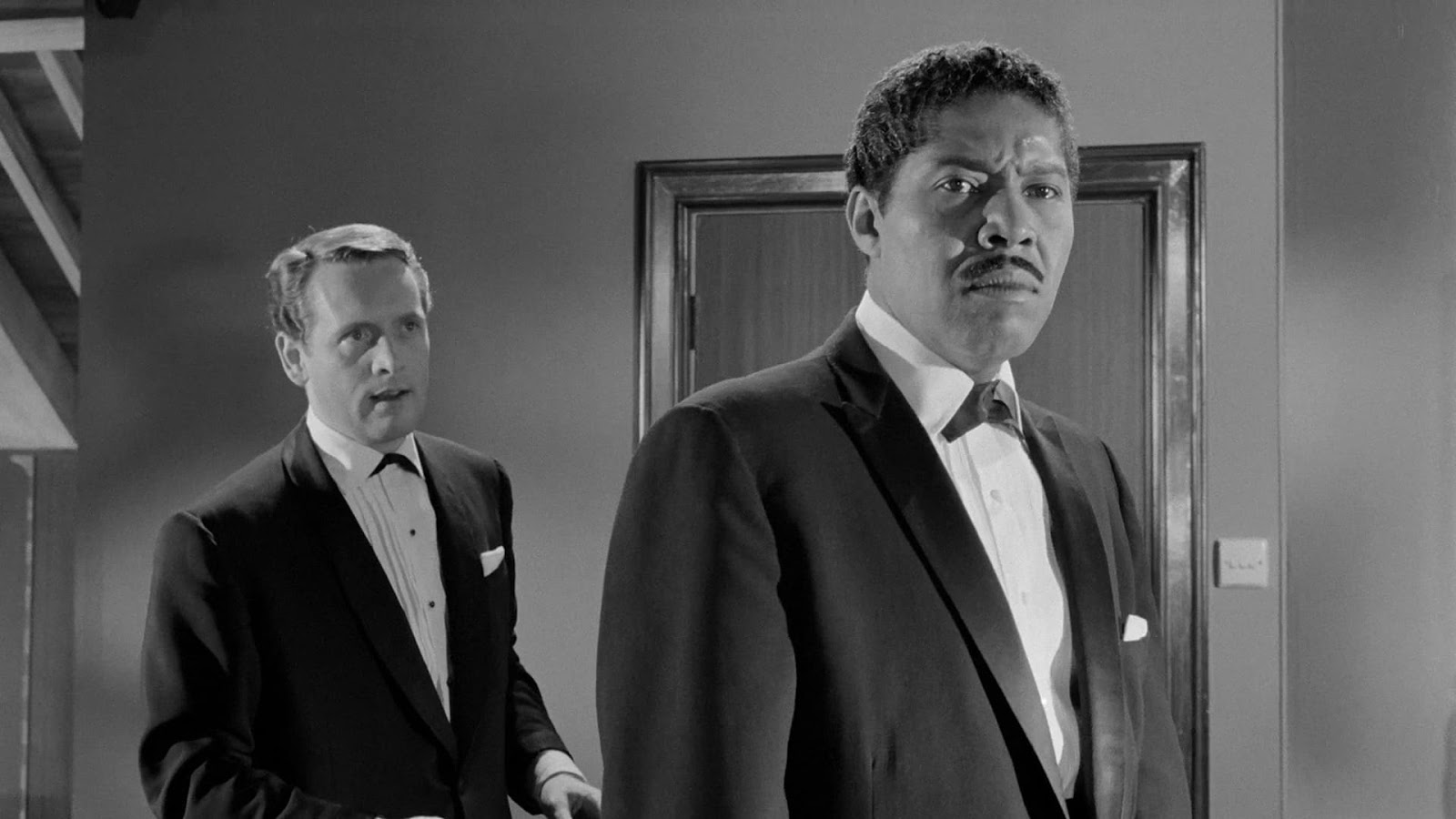
All Night Long (Basil Dearden, 1962) I've been watching a lot of Basil Dearden movies lately—the only ones already on the site, reviewed, are Khartoum and a horror anthology he'd participated early on in his career, Dead of Night—and they're pulpy but intelligently produced with an underlying social concern, interestingly framed, and with a sometimes perverse energy designed to take the audience slightly to the edge of their seats. They're at least designed to produce a nervous tick in the leg.

All Night Long, though, is more designed to keep a steady beat of foot-tapping, based as it is in the jazz idiom. In fact, for aficionado's, it's a bit of a must-see for performances by some "legends" (a much used word, but actually appropriate here), such as Charles Mingus (he gets lines to say!—"Hi, thanks for inviting me!"), Dave Brubeck, John Scott, John Dankworth, Tubby Hayes, Bert Courtley and Keith Christie. That's a great joy to the film, but I imagine it's frustrating for the very people who would want to see this for that purpose because it has a story and actors who distract from the performances and from the music for whole minutes at a time (I imagine that the first frenetic Beatles fans were frustrated with A Hard Day's Night for that same reason). On the other hand, for those folks into narrative in their films, they might be stymied by the story being stopped dead by performance drops. These people have never heard of or seen musicals.
The story is basically the story of Othello brought up to a jazz-beat (a bit uncomfortably) and a jazz-idiom. Entrepreneur and impresario Rod Hamilton (Richard Attenborough) goes to his club where he has prepared a very special night—a party celebrating the first anniversary of jazz King and Queen Aurelius Rex (Paul Harris) and wife Delia Lane (Marti Stevens), jazz pianist and songstress (retired), respectively. Guests are band-mates, acquaintances, and some notables in the industry and Hamilton has designed it to be a night of celebration and song for the happy couple. He should have checked the guest-list.
Brubeck and Scott and Dankworth are fine, of course—they're providing music. But along with Aurelius' inner-circle of Cass Michaels (Keith Michell) and his girl Benny (Maria Velasco), there is also drummer Johnny Cousin (Patrick McGoohan) and his wife, Emily (Betsy Blair). Cass is Aurelius' manager and completely loyal to him and a confidante to Delia. That relationship will become critical to the machinations of Cousin, who has been promised a side-deal for his own band by another manager, but only if he can persuade Delia to come out of retirement and join his band as vocalist. If he is to have any chance at success, he must drive a wedge into the happy marriage between Aurelius and Delia before she could even entertain fronting his group. And for that, he works on Cass.
He needs in-for-ma-tion. So, he invites Aurelius' manager to a private meeting on an outside landing and cozies up to Cass (who's been clean and on the straight and narrow for years and a dependable business partner) and plies him with some reefer, relaxing Cass enough to give Johnny inside intel on any weaknesses in the Rex-Lane marriage, which is (for him) disappointingly stable. But, he knows that Cass and Delia are close, so he devises a plan to make Aurelius suspect that the two are actually closer than her husband suspects. So, Johnny does a solo performance with everybody at the party, sewing doubts and intrigues and creating tensions where there are none.
It becomes apparent that Johnny Cousin is Shakespeare's Iago (and Cass is Cassio, which is not much of a name-stretch). But, where the bard's version goes through the play without any rationalization or motive for his actions (other than "I hate the Moor"), Johnny is totally and completely about getting his "gig" and, if a little chicanery and a marriage-split will advance it, then so be it. Suspicions are communicated between parties (at the party), but that can only go so far. And Johnny has a technological ally for fabricating proof.
Hamilton is a huge jazz fan, and part of his plans are to record a couple of sessions using a tape recorder (an EMI TR90 for you gear-heads), which Johnny uses to make recordings of some conversation. With that, he can take desired bits of conversation, and record his own voice for insinuating connections between the juicy bits to make it all seem like there's an affair going on between Delia and Cass to inflame Aurelius' jealousy. Anybody who's tinkered with tape will know that such an operation takes split-second timing (lest you erase the original) and you've got to have a stop-watch handy to be able to do it without editing—and in those days, you'd need a razor blade and tape, which is pretty obvious evidence of tampering. But, Johnny must be very good because his evidence doesn't even contain any electronic evidence that a tape has been started or stopped.
Technical quibbles aside, his gambit works—at least for a little while—and there is a real danger that he might get away with it, but not with the results he might want (this is based on "Othello," after all). There will be distrust and dust-up's, enough to ruin any high-class party, and certainly enough to interrupt any of the jazz interludes that pop up for the aficionado's. 
It is a thrill to watch Mingus and Brubeck jam in one of the pieces, particularly to watch the effortless fingering on strings and keyboard. That comes early on in the film, but there's enough good material throughout to keep folks who just came for the music to enjoy. And stick around: McGoohan learned to play drums for the film and he has a frenetic solo towards the end that looks damned convincing, even if—as I suspect—he's just playing to a tracked music piece. He's an intense actor—around this time, he was right in the middle of doing the "Danger Man" series (it played in the U.S. as "Secret Agent" with a Johnny Rivers title song)—and the same intensity is born out in that solo.
This came out in 1962—1963 in America—and at that time, what was called "mixed marriages" were illegal in one-third of the States. It was an issue here and might have had a hand in the film's limited distribution and it's somewhat rare availability. It is refreshingly not an issue in this British-based film where nothing—absolutely nothing—is made of it. It's not even mentioned, other than the marriage is one for celebration...and strong enough not to be rent asunder by the conniving of an ambitious narcissist. 
Another aspect that might have been controversial in the States is the on-camera portrayal of marijuana use. Even though the Hayes Code was dying of purposeful neglect during this period of film-making, drug use and distribution was prohibited under its strictures. Come to think of it, so was "mixed race" relationships. Something to consider while you're "bogarting" and considering the ash-bin of History and how time inevitably leaves prejudice there.
For whatever reason you come to it, for the music, or for the Shakespeare link, or you're a McGoohan fan/completist (or Attenborough...or Betsy Blair...or whoever), or if you're looking at the films when Dearden was telegraphing social messages and conspicuously pushing the barriers of what got on film—as Preminger was trying to do in the States—you come away with respect for this little doorway in the alleyway of film-noir sticking its neck out that although the world can be a nasty place, it's lit by the idea that the important things are devotion. And trust. 

And all that jazz.


Friday, September 6, 2019

Julius Caesar (1953)

Julius Caesar (Joseph L. Mankiewicz, 1953)

Lend me your eyes.


Joe Mankiewicz's first film at his new home at M-G-M was for producer John Houseman, who had produced Orson Welles' acclaimed 1937 stage version of Shakespeare's "The Tragedy of Julius Caesar", staged as if it was a tribal war in Haiti. Welles and Houseman had a venomous falling-out once they both established their film careers, and when Welles started making films of Shakespeare plays (starting with 1948's MacBeth), something might have gotten under Houseman's skin. Perhaps to show him up, Houseman made plans for his own production of "Julius Caesar", with a cast that comprised some of the best film-actors in the world. Mankiewicz adapted the screenplay and then casting began, combining stars from the M-G-M stable and some of the most notable Shakespearean actors of the time.

As well as Marlon Brando.
Now, Brando had made his impression on-stage and on film with "A Streetcar Named Desire," and was the much-ballyhooed klieg-light of "The Method" form of acting, which stood in sharp contrast with the more formal acting of the rest of the troupe, so his casting raised some eyebrows and more than a little skepticism, given his more natural—the term used was "mumbling"—style of acting, especially given his co-stars. After all, co-star John Gielgud was considered a preeminent interpreter of Shakespeare. Brando, knowing what an opportunity he had, prevailed on Gielgud to give him some pointers on negotiating Shakespeare. The rest is pure Brando cunning.

You know the story: "the lean and hungry look;" "It's all greek to me;" Caesar, beware the ides of March;" "Et tu, Brute." Roman emperor Julius Caesar (Louis Calhern) enjoys a popular reign among everyone except some members of the Roman Senate who see the monarch as having too much power and holding onto it for too long, negating any advancement for them, and approaching one of two of Caesar's confidantes—not his military leader Marc Antony (Brando), but the conscientious Senator Marcus Brutus (James Mason)—that the only way they can depose Caesar is to assassinate him.
Several senators confront Caesar and when they can't persuade him to see their way on a specific petition, stab him to death, the previously loyal Brutus being the last to attack and delivering the final, fatal blow.
With Caesar dead, the "liberators" consider the matter of the power vacuum his murder has created (as well as the fear of the populace's reaction to it). To ensure that there is a united front, the conspirators get the stated agreement of Antony to not condemn them when he requests to speak on Caesar's death, assuring that they can make the case for their actions first. It allows a they said/he said with the balance of power at the tipping point.
It's the pivot point on which Shakespeare's play (which is more concerned with the character of Brutus than Caesar) hangs and it is a story of contrasts. Fortunately, Mankiewicz has the right actors to make it play. Mason is all practicality and ideology, making the case for the senators and against Caesar. He lays out his arguments and swings the people to his reasons. But, once Brutus and the conspirators take their leave, Antony brings out Caesar's bloody body and speaks the "Friends, Romans and countrymen" speech, casting himself as the disadvantaged speaker and playing on the crowd's emotions, rather than their reason.
It's a masterful piece of writing and under Brando's fiery delivery (in his formal British-accented "Jor-el" voice), a fine example of mass-manipulation. Capitulating to the assassins' demands that he not speak against them, Antony slyly and repeatedly reminds the gathered throng that the murderers are all honorable men, but makes it clear to the crowd that he does so under duress, and then picks apart their arguments against Caesar. He then hammers his purpose home while appealing to the crowd's self-interest, by providing Caesar's will and reading off (or making up) that Caesar made the people of Rome his beneficiaries.
Brando starts out stern and placating, then seemingly breaks down with emotion, building to a feverish pitch and finally screaming the last line, as the crowd starts to rebel against the conspirators (and many of the set's furnishings) and he stands above all and watches the fruits of his handiwork.
With a wedge formed between the conspirators and the people, Antony is free to wage war against them, and, at that point, director Mankiewicz opens up the play out of the studio—Rome is portrayed as bound blocks of marble that have before dominated the film—its own version of a stage's proscenium arch that traditionally frame the Bard's works, to ever so briefly expand the scope by moving out into the real world way from columns and polished surfaces and to Nature's disarray, as the conspirators squabble with each other and their union begins to fray.
It's the best version that I've seen of the play, with strong performances from the entire cast (which also includes Edmond O' Brien, Greer Garson, and Deborah Kerr) and particularly strong performances from Mason and Gielgud, which is where other versions I've seen have fallen a little flat. The roles of Cassius and Brutus are particularly central to the play as it centers on the turning of Brutus to perform an act of betrayal in what he is convinced is a good cause, only to find that it is all for naught and must come to terms with his conscience over it—a sort of "Hamlet" in reverse.
It's an odd combination of star power and acting prowess, and is one of the best presentations of Shakespeare put on the screen.