Showing posts with label 1962. Show all posts

Sunday, April 21, 2024

Don't Make a Scene (Redux): Lawrence of Arabia

I've got a couple scenes in the works—well, one's done but I'm not ready to publish it yet—so here's a scene from Lawrence of Arabia, one of those movies that has to be seen on the big screen. The TCM Film Festival is doing that this weekend. I've seen it that way in 70mm at the Cinerama (it's now called the SIFF Cinema Downtown) and, really, it's the only way to really SEE it. 

"The film academic" I mentioned here is David Bordwell, who, sadly, passed away February 29 this year. Despite my dismissing his point about There Will Be Blood, his writing was always entertaining and enlightening.

The Set-Up: I recently read an article from a film academic extolling a scene from There Will Be Blood, in which its playing-out in one shot, or camera set-up, is praised to the skies as a master-stroke of direction.

Tosh.

While it is true that far too many directors these days are seemingly relying on the craft of montage (editing) as opposed to mise en scene (camera placement),* I would submit that it is not that special an achievement, but, rather "Directing 101." Any director worth his view-finder knows the importance of "blocking," or the arranging of actors in a scene. It establishes relationships, points-of-view, all sorts of sub-conscious signals to the audience about the participants of a scene. And it allows the actors to do what is their natural inclination to do: act in an unbroken line with their fellow-actors, playing off of each other, without the technical interruptions of setting-up for another angle.

A competent director knows when to get out of the way of his actors (just as a competent studio should know when to get out of the way of the director). But to praise a director for letting a scene play out in one shot without cutting? Only understandable from someone who's never been exposed to the process, I guess. Or someone who's just griping on the over-reliance of editing in today's movies (given the dependence on editing to create "energy," especially the false kind as pioneered by the hackers at MTV) and is doing it in a back-handed kind of way.

Anyway, the point is—a director who pathologically doesn't let a scene play out without editing, "couldn't direct traffic if given white gloves and a whistle" (in the words of one disgruntled writer I've met).

Or...are directing for the limited band-width of television. Or...are insecure in the material to keep interest. Or...are being told what to do, as in someone's directing the director (so what does that make him? An employee, not an auteur).

Here's one of many scenes I've found lately, that, with the exception of the opening three establishing POV shots, is done in one shot/one take, and it's one of my favorites. It's the "introduction" to the titular hero of Lawrence of Arabia, and it contains two of my favorite lines in this movie, full of great ones.

The Story: Aside from a sequence dramatising T.E. Lawrence's*** (Peter O'Toole) death in a motorcycle accident, and the subsequent funeral at which we hear many opinions of the man, this is the first sequence in the long flash-back of the tumultuous events of his life presented in the film. The first image shows him as we will soon come to know him: dissatisfied with his station, and re-drawing the map of the Middle East. 

Action!

T.E. Lawrence: Michael George Hartley, this is a nasty, dark. little room.
M.G. Hartley: That's right.

Lawrence: We are not happy in it.
Hartley: I am. It's better than a nasty, dark little trench.
Lawrence: Then you're an ignoble fellow.
Hartley: That's right.
Lawrence: Ah! Here is William Potter with my newspaper.

W.Potter: Here you are, Tosh.
Lawrence: Thanks. (Potter waits)
Lawrence: Would you care for one of Cpl. Hartley's cigarettes?
Potter: Ah! (Potter grandly takes one)

Hartley: Is it there?
Lawrence: Of course. Headlines. But I bet it isn't mentioned in The Times. "Bedouin tribes attack Turkish stronghold."
Lawrence: And I'll bet no one in this whole headquarters even knows it happened. Or would care if it did.
Lawrence: Allow me to ignite your cigarette.
Potter: Sir...

Adjutant: Mr. Lawrence?
Lawrence: Yes?
Adjutant: Flimsy, sir.
Lawrence: Thank you.

(Lawrence takes the burning match and working his fingers up it, extinguishing it while the others watch)
Hartley: You'll do that once too often! It's only flesh and blood.
Lawrence: Michael George Hartley, you're a philosopher.

Potter: And you're balmy!
(Adjutant leaves. Lawrence reads. Potter lights a match tries to put it out with his fingers while Lawrence watches.)

Potter: OH! It hurts!
Lawrence: Certainly, it hurts.
Potter: Well, what's the trick, then?
Lawrence: The trick, William Potter, is not minding that it hurts.
Lawrence: Oh! By the way, should Col. Gibbon enquire for me, tell him I've gone for a chat with the General.
Potter: He's balmy!
Hartley (laughs): He's alright.


Lawrence of Arabia

Words by Robert Bolt and Michael Wilson

Pictures by Freddie Young and David Lean

Lawrence of Arabia is available on DVD from Sony Home Video.**


* I attribute this to studio insistence on "coverage"--over-shooting a scene from different angles to ensure that the film will "cut" (edit in a way that isn't "jarring" to the viewer), and, by the way, gives the studio enough material to work with in case they want to fire the director if he isn't amenable enough to cut it the way the studio insists. It's why having the "final cut" in a director's contract is so cherished a clause (Would you like a list of the names of great directors who've had their movies re-cut against their wishes? We don't have time, but I can make a rough estimate---almost all of them!)

** Movie theater advocate Roger Ebert has written that "Lawrence of Arabia" on video "crouches inside its box like a tall man in a low room." That's a wonderful description. He continues "You can view it on video and get an idea of its story and a hint of its majesty, but to get the feeling of Lean's masterpiece you need to somehow, somewhere, see it in 70mm on a big screen. This experience is on the short list of things that must be done during the lifetime of every lover of film." In Seattle, it happens infrequently at the Cinerama. Next time you see it mentioned, go.

*** That link leads to the general Wikipedia entry, for a better site on the man who's the subject of the movie, go here.

Friday, December 1, 2023

The Music Man

The Music Man (Morton DaCosta
, 1962) DaCosta had directed "The Music Man" on stage, and parlayed that to direct the film version of "Auntie Mame" in 1958. When it came time for a film version of Meredith Wilson's Iowa-based musical, even the usually-interfering Jack Warner wanted DaCosta to do the film.
 
But, Warner wanted someone else besides Robert Preston—who had played the role magnificently on Broadway—to play the traveling con-man, Harold Hill. James Cagney, Bing Crosby, and Cary Grant were all approached to star and all refused, Grant adding that not only would he not star in it, but if Preston wasn't cast, he wouldn't even go to see it! Warner was about to sign Frank Sinatra, when show creator Wilson reminded Warner that he had final approval of casting written into his contract, and he wanted Preston and no one but Preston.
 
Robert Preston was cast. And performed quite magnificently.
The role played to his strengths...and weaknesses. Preston languished in the outskirts of in-demand stars. He was a good actor, but a wily character actor, not exactly star-material. Handsome, sure, but of a face-type that better suited antagonists than protagonists. He could be comfortable twirling a mustache, but whether sporting one or clean-shaven, he was an aggressive charmer of indeterminate virtue.

This quality made him a perfect match for the role of Harold Hill, a grifter in salesman's clothing, who travels city to city like a circus caravan, bamboozling the local rubes into buying musical instruments for their restless youth to form "boy's bands". Once he's pocketed the cash, he splits town before the instruments arrive, as he couldn't provide any instruction in how to use them, anyway. He SAYS he does, but what grifter can actually do what he says he can?
So, Harold Hill brings his brassy blue-sky ideas to River City, Iowa, where he and a former crony, Marcellus Washburn (Buddy Hackett) start spreading the word of what a wonderful opportunity a boys' band would be to the city's rambunctious and temptation-susceptible youth. There is, being Iowa, skepticism, from the school board, the River City Mayor (played by the inimitable prevaricating Paul Ford) and, in particular for the story's purposes, the city's librarian and music tutor, Miss Marian Paroo (Shirley Jones), but it isn't long before he starts making in-roads with the populace. Not an easy thing to do, for (as the song says) they're "so by God stubborn" they "can stand touching noses for a week at a time and never see eye to eye."
To maximize profits, and still be ahead of the law, he plots a good defense against the offense—he deflects the school board by playing on their voice-characteristics to turn them into a singing quartet, and then decides to seduce the "old maid" (sorry) "sadder but wiser" librarian to short-circuit her logic systems.
It is rather difficult to think of the 27 year young (at the time of the filming) Jones as "an old maid"—she was the same age as ingenue 
Susan Luckey, who played the Mayor's teen daughter—but, The Music Man is one of those stories where one has to suspend disbelief (after all, the movie hinges on the mulish River City dwellers suspending theirs).
One also has to suspend time and movie momentum, as well. In its 2 hour 31 minute length, there are 22 songs, meaning that the story comes to a full-stop every 5 minutes and change. It would be frustrating if Meredith Wilson's material wasn't so darned good...or so syncopative, a quality that seems to act as a natural buggy-whip to make the festivities move along at a good clip. There is one speed-bump, at the extended "'Til There Was You" sequence where one can actually feel one's pocket-watch tut-tutting. But, the song is so good—Heck, The Beatles even "covered" it!
Future director Ron Howard scopes out an overhead shot
And that's the main draw here. As good—and enthusiastic—as Preston, Jones and Company are, it is the treasure chest of songs that keep the movie percolating from scam to scam, subterfuge to subterfuge, before reaching some genuine feeling with agendas no longer hidden and ending with pure fantasy. That's quite a story arc.
Sure, it's corn. Pure-bred American corn. But, there's nothing as sweet as corn plucked right from the stalk. The Music Man, for all its brass, is just as sweet.

Sunday, August 20, 2023

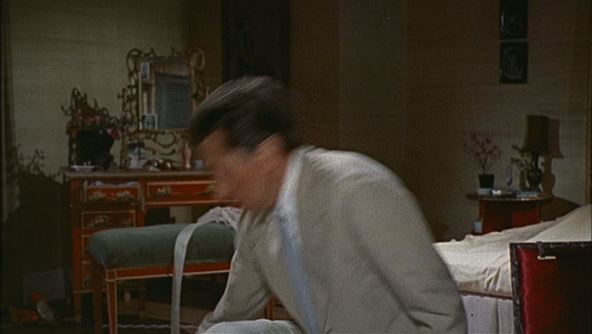
Don't Make a Scene: Dr. No

 
I've been in "a mood" lately. So, I thought, how about another one? Like one of the few instances when James Bond killed in cold blood in the first film in the series, Dr. No? He can do that; he has a licence. It's not a nice thing to do, but when dealing with international intrigues of a suspicious nature, sometimes one has to be a bit blunt.

Bond knows he has a target on his back—someone has already tried to kill him once (death by tarantulation), and he doesn't intend that there's a second time. He knows he's been lured to a trap—a honey trap—but, now he intends to end the evening by turning the tables on the man trying to kill him. 

He won't be stood up.

The cold-bloodedness in the kill is less that he shoots the "bad" Professor when he knows he's basically unarmed...or that he shoots him in the back when he's down...for good measure. After all, Professor Dent went to the place to kill him and fired six shots to make sure the job was done. Dent was the aggressor here.

It's the way he sets the trap. He sets up the scene of an assignation (complete with whiskeys and casual clothing removal), moves the pillows to make a credible shape in the bed—an easy, drunken, drowsy target—then once Dent has emptied his magazine clip, reveals his presence, and gathers information, all the while keeping his gun ready for use.

Then...he lures him in. Preoccupying himself with getting rid of the lamp-switch, getting a cigarette and lighting it—he knows Dent will make a desperate play, but he also knows he has an empty weapon. And once he gets a confession, he lets down his guard enough for Dent to make his impotent play...tells him he's stupid (basically) and shoots him dead with two shots. Then, fires a third.

That is just cold.

He lets the guy hang himself and pulls the trap.

Cold.
 
The Set-Up: Station "J"-Jamaica has gone silent. The British Secret Service has dispatched one of it's licenced-to-kill agents James Bond (Sean Connery) to investigate. The agent, Strangways, was investigating the "toppling" of American missile launches from Cape Canaveral and disappeared. Bond will pick up the investigation, but with the added agenda of finding whoever killed Strangways and...dealing with him. Bond has been lured to the apartment of the secretary of one Professor Dent (Anthony Dawson*), whom he is deeply suspicious of. Bond keeps his date, but, after dispatching the secretary to the local authorities, decides to relax at her apartment...in case of any unexpected guests.
 
Action.
 
131. INT. MISS TAROS APARTMENT. NIGHT. 
BOND reenters, still humming, closes door,
fetches two glasses,
pours a little whiskey into each,
places them beside two chairs,
moves towards bedroom after taking off coat
and hanging it careful! on back of one of the chairs.
Switches off lights.
Coat is in light from windows. 
132. INT. MISS TAROS BEDROOM. NIGHT. 
BOND enters, carefully leaving door just off catch. He switches on record-player
around switches off lights so that this room, also, is in semidarkness, loosens gun in holster, checks time on luminous watch,
goes over to already rumpled bed, pulls back sheet. 
133. EXT. MISS TAROS HOUSE. NIGHT. 
We see a dark figure hurrying inside. 
134. INT. OUSIDE MISS TAROS DOOR. NIGHT. 
CAMERA picks up figure from angle at which we do not see his face, just as his hand switches off light in passage. FIGURE goes to door of MISS TARO's. 
Listens, Carefully takes out key - opens door with infinite precaution.
When door is open,
takes out gun (silencer)
looks inside,
sees overcoat and glasses. Hears music from the bedroom, he enters. 
135. INT. MISS TAROS. NIGHT. 
FIGURE glances round - see bedroom door ajar - creeps over, listens -
pushes door gently open - peers round door - sees barely visible dark forms under sheet. 
KICKS DOOR OPEN - raises gun
and fires into forms
(silenced "coughing" shots- which, done properly, can sound horrible.) 
135. Continued. 
BOND
(out of darkness) Drop it, Professor. Hands behind you.
The room springs to life as the light comes on. 
BOND is seated in chair, one leg over the arm - left hand on table light switch...Walther in right. 
BOND
(nonchalantly) Good evening..It's funny...I thought you'd be along show up sooner or later.
BOND
Sit down.
DENT
The girl talked?
BOND
But of course.
BOND
No. You gave yourself away. I was suspicious at the Queen's Club anyhow 
BOND - when it turned out you were the only one...
BOND
...
who'd seen Strangways' new secretary
BOND
and then later at the lab...
BOND
you made no reference 
BOND
to the fact 
BOND
that Strangways' samples
BOND
were radio-active. radio- active samples were worthless ... well 
DENT
Very clever, Mr. Bond...
DENT
but you're up against more than you know...
BOND
you shoot me, and you'll end up like Strangways . . 
BOND
So it was you who killed him. Then, you killed him?
DENT
He was killed...never mind how. 
71. As he talks, we see DENT edging imperceptible nearer to his gun on the floor. 
BOND goes on talking, seemingly oblivious of DENT's manoeuvering. 
BOND
Who are you working for, Professor? 
DENT
(we get the impression he is talking to distract BOND's attention as he moves towards his gun) I may as well tell you...You may as well know as you won't live to use the information...
DENT
I'm working for...
135. Continued. 
He makes a sudden swift movement towards his gun,
picks it up and levels it at BOND. As his finger tightens on the trigger. 
DENT (contd. ) (triumphantly) ... Dr. No! · 
His finger tightens on the trigger, but the hammer clicks down on an empty chamber. 
BOND
Only six bullets in a Smith and Wesson, Professor ... and I counted them ... That's a Smith and Wesson...
BOND
And you've had your six.
72. He raises his own gun deliberately, 
squeezes the trigger. 
DENT spins backwards as if somebody has kicked him, slamming up against a flimsy Chinese table
and crushing it as he collapses.
He rolls right over onto his back...brings his legs up under his chin and an agonised convulsion...
shoots them straight out
...and then lies still. 
BOND raises and crosses to him. 
He doesn't need to examine him closely,
knowing exactly where he's hit him. 
He blows the fumes away from his gun, and goes to the bed, where we see two interlaced "forms" made from the bolster and pillow.
They are ripped by shots, charred round the edges of the holes, and feathers are scattered.
BOND Picks up the phone and dials.
His eyes are hard.

Dr. No

Words by Richard Maibaum, Johanna Harwood, and Berkley Mather

Pictures by Ted Moore and Terence Young

Dr. No is available on DVD and Blu-Ray from Fox Home Video.


* Dawson was one of those character actors who "got around"—he was the hired strangler of Grace Kelly in Dial 'M' For Murder, and in the Bond series, he played the obscured form of SPECTRE #1, Ernst Stavro Blofeld, in both From Russia With Love and Thunderball.