Julius Caesar(Joseph L. Mankiewicz, 1953) Lend me your eyes. Joe Mankiewicz's first film at his new home at M-G-M was for producer John Houseman, who had produced Orson Welles' acclaimed 1937 stage version of Shakespeare's "The Tragedy of Julius Caesar", staged as if it was a tribal war in Haiti. Welles and Houseman had a venomous falling-out once they both established their film careers, and when Welles started making films of Shakespeare plays (starting with 1948's MacBeth), something might have gotten under Houseman's skin. Perhaps to show him up, Houseman made plans for his own production of "Julius Caesar", with a cast that comprised some of the best film-actors in the world. Mankiewicz adapted the screenplay and then casting began, combining stars from the M-G-M stable and some of the most notable Shakespearean actors of the time. As well as Marlon Brando.
Now, Brando had made his impression on-stage and on film with "A Streetcar Named Desire," and was the much-ballyhooed klieg-light of "The Method" form of acting, which stood in sharp contrast with the more formal acting of the rest of the troupe, so his casting raised some eyebrows and more than a little skepticism, given his more natural—the term used was "mumbling"—style of acting, especially given his co-stars. After all, co-star John Gielgud was considered a preeminent interpreter of Shakespeare. Brando, knowing what an opportunity he had, prevailed on Gielgud to give him some pointers on negotiating Shakespeare. The rest is pure Brando cunning.
You know the story: "the lean and hungry look;" "It's all greek to me;" Caesar, beware the ides of March;" "Et tu, Brute." Roman emperor Julius Caesar (Louis Calhern) enjoys a popular reign among everyone except some members of the Roman Senate who see the monarch as having too much power and holding onto it for too long, negating any advancement for them, and approaching one of two of Caesar's confidantes—not his military leader Marc Antony (Brando), but the conscientious Senator Marcus Brutus (James Mason)—that the only way they can depose Caesar is to assassinate him.
Several senators confront Caesar and when they can't persuade him to see their way on a specific petition, stab him to death, the previously loyal Brutus being the last to attack and delivering the final, fatal blow.
With Caesar dead, the "liberators" consider the matter of the power vacuum his murder has created (as well as the fear of the populace's reaction to it). To ensure that there is a united front, the conspirators get the stated agreement of Antony to not condemn them when he requests to speak on Caesar's death, assuring that they can make the case for their actions first. It allows a they said/he said with the balance of power at the tipping point.
It's the pivot point on which Shakespeare's play (which is more concerned with the character of Brutus than Caesar) hangs and it is a story of contrasts. Fortunately, Mankiewicz has the right actors to make it play. Mason is all practicality and ideology, making the case for the senators and against Caesar. He lays out his arguments and swings the people to his reasons. But, once Brutus and the conspirators take their leave, Antony brings out Caesar's bloody body and speaks the "Friends, Romans and countrymen" speech, casting himself as the disadvantaged speaker and playing on the crowd's emotions, rather than their reason.
It's a masterful piece of writing and under Brando's fiery delivery (in his formal British-accented "Jor-el" voice), a fine example of mass-manipulation. Capitulating to the assassins' demands that he not speak against them, Antony slyly and repeatedly reminds the gathered throng that the murderers are all honorable men, but makes it clear to the crowd that he does so under duress, and then picks apart their arguments against Caesar. He then hammers his purpose home while appealing to the crowd's self-interest, by providing Caesar's will and reading off (or making up) that Caesar made the people of Rome his beneficiaries.
Brando starts out stern and placating, then seemingly breaks down with emotion, building to a feverish pitch and finally screaming the last line, as the crowd starts to rebel against the conspirators (and many of the set's furnishings) and he stands above all and watches the fruits of his handiwork.
With a wedge formed between the conspirators and the people, Antony is free to wage war against them, and, at that point, director Mankiewicz opens up the play out of the studio—Rome is portrayed as bound blocks of marble that have before dominated the film—its own version of a stage's proscenium arch that traditionally frame the Bard's works, to ever so briefly expand the scope by moving out into the real world way from columns and polished surfaces and to Nature's disarray, as the conspirators squabble with each other and their union begins to fray.
It's the best version that I've seen of the play, with strong performances from the entire cast (which also includes Edmond O' Brien, Greer Garson, and Deborah Kerr) and particularly strong performances from Mason and Gielgud, which is where other versions I've seen have fallen a little flat. The roles of Cassius and Brutus are particularly central to the play as it centers on the turning of Brutus to perform an act of betrayal in what he is convinced is a good cause, only to find that it is all for naught and must come to terms with his conscience over it—a sort of "Hamlet" in reverse.
It's an odd combination of star power and acting prowess, and is one of the best presentations of Shakespeare put on the screen.
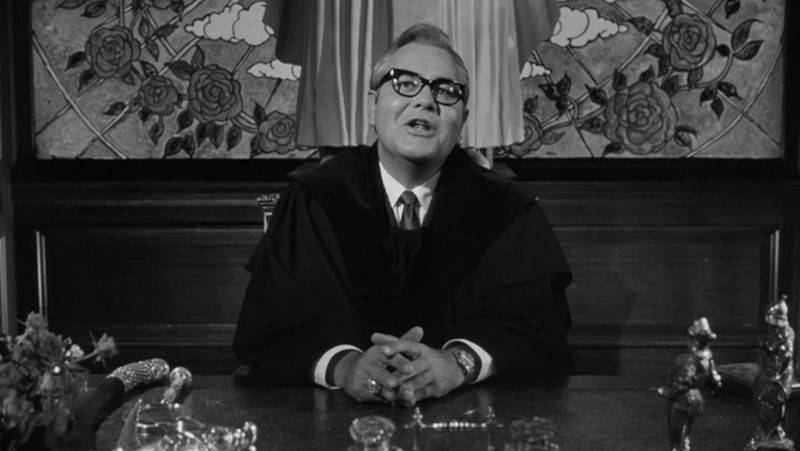
The Loved One(Tony Richardson, 1965) Director Tony Richardson "does" Hollywood, and it ain't pretty. There are lots of Tinsel Town screeds out there, mostly about personal mania (Sunset Boulevard, What Makes Sammy Run?), but few—like Day of the Locust—where the craziness seems endemic to the region and its excesses. The Loved One has an air of pretense with sanctimonious chortling while it shoots its fish in a barrel, casting the film with "types"—Liberace as a coffin salesman, Milton Berle as a crass businessman—that might be a little too leaden in its intent. Flush from his success with the multi-Oscar-winning Tom Jones, after toiling away over in the British "kitchen-sink" industry, Richardson returned to black and white cinematography (by Haskell Wexler) in an adaptation of Evelyn Waugh's novel adapted by Terry Southern and Christopher Isherwood. Waugh's book was inspired by a disappointing trip to Hollywood on the pretense of making a film of "Brideshead Revisited," and his twining of the film industry with the funeral business has a natural feel to it, as both have a lot to do with presentation, and the construction of artifice, all in the name of comfort (while robbing money blind).
But that was in the 40's. The film was made in the early 60's on the cusp of "mod" and in the nuclear shadow of Dr. Strangelove. Both films have that Southern exposure in common, but where Kubrick made his film with a gargoylishly straight face, Richardson can't help gilding the mourning lily.
Poet Dennis Barlow (Robert Morse, post-dubbed with a wavering British accent) wins a literary competition, the first prize being a trip to Hollywood, where he stays with his uncle, Sir Francis Hinsley (John Gielgud) who works at a film studio. Hinsley is soon fired by the studio's boss DJ, jr. (Roddy McDowell) and commits suicide. The British community (led by Robert Morley) insists that Hinsley's funeral be as grand as possible, bankrupting the old man's estate, and forcing Barlow to stay in Hollywood and taking a job at a pet cemetery run by Henry Glenworthy (Jonathan Winters), whose brother, the Reverend Wilbur Glenworthy (also Jonathan Winters) runs the Whispering Glades cemetery and mortuary, the establishment handling Hinsley's solemnities. There, Barlow meets Aimee Thanatogenous (Anjanette Comer), a corpse beautician and Mr. Joyboy (Rod Steiger), the Whispering Glades embalmer, who competes with Barlow for her affections.
There is a lot of brilliant stuff here: a sequence at another chapel has a wedding (ministered by Ed—the original "You're in good hands with Allstate" announcer—Reimers) that is run like a television production, so that everyone can be ushered out, and the next scheduled funeral ushered in; the "keeping up appearances" haranguing of the British enclave in Hollywood; Jonathan Winters, not really given free rein to his inner demons in the roles, but showing how he might have been our Peter Sellers; and (okay) Liberace as a coffin salesman, there's something utterly apropos about that; a visit to Ms. Thanatagenous' under-construction cliff-house that is constantly rumbling with the threat of sliding to the highway below (a nice visual representation of her fragile doe-eyed innocence); Lionel Stander as newspaper advice columnist Guru Brahmin—a study in contrasts; the creepily loving reverence of the Whispering Glades workers for "the loved ones," as opposed to how the stiff pets at the pet cemetery are tossed into a freezer.
It's all very ghoulish and naughty (even flirting with pornography towards the end, discretely edited by Hal Ashby) but something of a misfire in its presentation. Morse is energetic and fun (and he has the teeth to play British), but in the same way The Wrong Box has the timing wrong to evoke humor, The Loved One never quite convinces you that you're supposed to be laughing, even guiltily. Instead, it has the air of stuffy indignation even as it's trying to regale. One can sympathize with the sentiments, but one wishes it was done better, less fire and more mockery. What's the quote? "There's nothing I like less than bad arguments for a view I hold dear."
Looking for Richard(Al Pacino, 1996) Early on, actor Al Pacino is waiting in the wings, waiting to go on-stage in a small theater. He peeks through the curtain, only to see William Shakespeare sitting (alone) in the middle of the theater, waiting to see his performance. He lets loose one long crudity of indeterminate origin (Anglo Saxon? Flemish? Germanic?) that the Bard never used in one his plays, comedy or tragedy (although he did skirt around it quite a bit). It's as good a view as any of actor intimidation, looking at a text and being confronted with the mystery of what the author might have meant and of that same author's passing judgment on any possible misunderstanding. Plus, Shakespeare was a director...and actor. And his voice (being dead and all) is silent. Except for what is there on the page. The actor is left, very much alone on-stage.
Looking for Richard is a unique film. A documentary (and barely that—a docu-drama? docu-tragedy? vanity project?), not a staged play, of Al Pacino "finding his way" through Shakespeare's "Richard III," which, as Pacino's friend and co-conspirator Frederick Kimball describes it, is "Shakespeare's most popular play" (as it's the most often produced).
The movie is, at once, enormously ego-driven—it's all about Al and how cutely eccentric he is—but it is also just as much a display of humility and quite generous in its company-feel. For as much as Pacino is ever-present in the film, he is rarely alone and almost never in the position of authority—he's always the inquisitor. One rarely sees actors seeking, rehearsing "in the raw" (usually it's staged to make the process seem seamless), but Looking for Richard frequently has impassioned table-reads in which subtext is debated, and that is interesting. Pacino is enthusiastic about exploring the complexities of the play, especially in regards to the other characters involved in this supposedly "one-man play", and he gives a lot of screen-time to not only the actors picked for his own iteration (like Alec Baldwin, Kevin Conway, Winona Ryder, Penelope Allen, Estelle Parsons and especially Kevin Spacey), but also interviews with other actors, in interviews, renowned for their mastery of the Bard: John Gielgud, Vanessa Redgrave, Derek Jacobi, James Earl Jones, Rosemary Harris, Viveca Lindfors, Kenneth Branagh and Kevin Kline.
That's a cast bigger than most Shakespeare plays—with maybe the exception of "Julius Caesar"—and corralling them is a tough endeavor for the movie's stated task, which is to make Shakespeare accessible to the man on the street (and the "man on the street" interviews are fascinating, veering between the extraordinarily articulate to the kid who might like it if it were a first-person shooter). But, the way to make Shakespeare accessible is for it to be performed well. And so the fallback becomes the thespian exploration of character and relationships, breaking it down, getting inside the skin of the character through their expressed words. 'Twas ever thus.
With all the advice and words of wisdom, the one who comes off the worst is Pacino. He's excellent in most scenes playing Richard, but once he ascends the throne, he drops the measured wiliness too far, affecting a smirking blitheness while giving orders of "head-offing," that seems to indicate he has forgotten all the history that has gotten him to where he's sitting, and with little regard to the impression that would leave with any Lancaster that might want to snuff out that son of York. Bad playing on both the actor's and the character's part. One should be leavening the other...if it is to be true with what has gone before. Especially with the exceptional way Pacino has played the part up to that point.
But, overall, despite that hump, the interpretations are a success, lending understanding to the feud between the Yorks and Lancasters, an empire-defining feud that has long since past in its importance, other than in providing lessons on the dangers of acquisitiveness. Shakespeare still speaks to us 400 years past his passing, bringing us cautionary tales that still resonate and are given new breath by whatever voice utters those words. It doesn't matter what voice, in what era—the plays the thing wherein they capture our conscience.
This is the story of a man who could not make up his mind" intones Laurence Olivier at the beginning of his Production of Hamlet (In a case of over-reach, the man who would be Lord Olivier gets the opening card over Wm. Shakespeare).
Well, yes, that's an easy way to look at it. And while it's essentially true, it negates the fact that Hamlet is struggling with the moral implications of killing, especially since the object of all the daggers he's throwing out with his eyes is, himself, a murderer, traitor, and is sleeping with his mother.* Hamlet tries every trick in the book to expose the treachery, even takes a stab at killing him himself (with collateral damage**) Hamlet is wrestling with his conscience the whole way--while depressed, grieving--and with not good reason: his quest is based on the flimsiest of evidence--the word of a ghost. A ghost that even his Spock-like friend Horatio saw, to be sure (or not to be), but a ghost nonetheless. Such evidence would never stand up in the Court of Elsinore. The Dark Prince must also wrestle with the consequences of his actions--from his father he knows of the existence of Hell and the damnation murderous actions would lead to.
"Couldn't make up his mind." He wanted to slit the King's throat, not his own.
Every production of "Hamlet" must wrestle with the text***that ballooned with many versions, asides, and blind alleys. Olivier stripped it bare: No Rosencrantz, no Guildenstern, no Fortinbras, no battle on the plain in Denmark and so, no "Let my thoughts be bloody" speech. In this version, Hamlet does not compare his plight with the futility of war, and in 1948, considering Olivier's "rally-the-troops" version of Henry V, an anti-war statement must have seemed in bad taste, after surviving the blitzkrieg.
And just as every Hamlet must pick and choose what sections to explore, every actor playing Hamlet must contend with ghosts;****not the play's, but the players of the past. Like baseball veterans chasing old records, each Hamlet is a reflection of the past, and a portent to other Princes. The current crop of actors taking on the role must have considered Olivier's take, or Richard Burton's, or Nicol Williamson's, just as Olivier must have thought about John's Gielgud and Barrymore. Olivier does take chances given the film medium. His "Frailty, the name is woman" speech is done in voice-over with some choice epithets that burst out of him on-set. That's a good choice for the scene, where Hamlet is in a public space following a celebration and could conceivably be overheard by some hanger's-on. He is much more verbal in his further monologues when he is thought to be crazy, or alone. The "To Be or Not To Be" speech is performed on a parapet overlooking the sea, with dagger in hand. It's a good concept to have the prince "on-edge" at that juncture.
The unique staging of that speech is one of those elements that absolutely separate the filmed Hamlets from each other.***** To me, there are three others: the presentation of the Ghost of the murdered Old Hamlet, the use of Polonius, and the approach to Ophelia. Here's how Olivier treats them.The Ghost: Olivier wraps him in vapors of the real and optical variety, dressed in his battle armor, looking sepulchral, and emaciated, like a classic death figure, with a low-whispered voice--supplied by Olivier (although Gielgud is rumored to be speaking the lines) and played back slowly. Polonius: As played by Felix Aylmer, and directed by Olivier, Polonius is a comic figure, whose verbosity is played for laughs, and most treat him with a feigned patience, and wish he'd get to the point. Ophelia: As played by the 18-year old Jean Simmons, Ophelia is very much the traditional Ophelia as delicate flower. She goes crazy with the loss of Hamlet, the death of her father, and no Laertes to bolster her. She is an Ophelia too frail to stand on her own and crushed by the whirl of events, and her cracked sanity is portrayed by a far-away gaze and "fairy-princess" demeanor. How influenced she is by Hamlet's shifting moods is hard to say. But she is "ingenue-as-victim" in the Hollywood tradition.
The other thing I hear about Olivier's Hamlet is that it is somehow a "film noir" interpretation of the play. Except for some fine deep-focus black and white photography, I don't see it. No play of shadows--in fact, everyone is extremely well-lit. And the movie's very set-bound; nobody's walking down the "mean streets" of Elsinore.
Laurence Olivier's Hamlet won the Best Picture Oscar in 1948, with Olivier winning Best Performance by an Actor. He was the first person to ever direct himself to an Oscar-winning performance. Only one other actor has done it: Roberto Benigni.
* Gertrude. One of the interesting things to note about the various "Hamlet's" is the varying ages between mothers and sons. They're starting to get it right, but it wasn't always thus: In the 1990 Hamlet, Gertrude (Glenn Close) is only nine years older than Hamlet (Mel Gibson). In this one, Gertrude (Eileen Herlie) is fourteen years younger than Hamlet (Olivier)! I guess it's an improvement when your realize in the original stagings Gertrude was probably played by a man! And incidentally, Herlie also played Gertrude to Richard Burton's Hamlet--he was five years younger. ** I've always called "Polonius," the verbose father of Laertes and Ophelia, "Collateralous."
***Unless you're Kenneth Branagh, whose 1996 all-star "Hamlet" used the second Quatro version (1604) (with additions from the First Folio version), clocked in at 4 hrs., 2 mins., was filmed in 70mm, with 6 track Dolby sound, but at least had Rosencrantz, Guildensterm, Fortinbras, the "Let my thoughts be bloody" speech, and had a Gertrude who could have conceivably (heh) been Hamlet's mother! **** There are other ghosts at Elsinore if one is to believe Olivier's camera-work. Elsinore is an enclosed castle with labyrinthine corridors and vast open emoting spaces. Between acts, we flit down corridors and up spiraling staircases as if the audition is, itself, an apparition, seeing everything in turn with an omniscient view-point. And in a reversal of stage tradition, we go to the actors, rather than them coming to us.
***** Most actors address the audience on-stage. Mel Gibson's Hamlet performs it in a burial catacombs, Kenneth Branagh, while looking in a mirror, and Ethan Hawke...at the video store.