Showing posts with label Anthony Quayle. Show all posts

Saturday, June 20, 2020

Tarzan's Greatest Adventure

Saturday is "Take Out the Trash" Day.

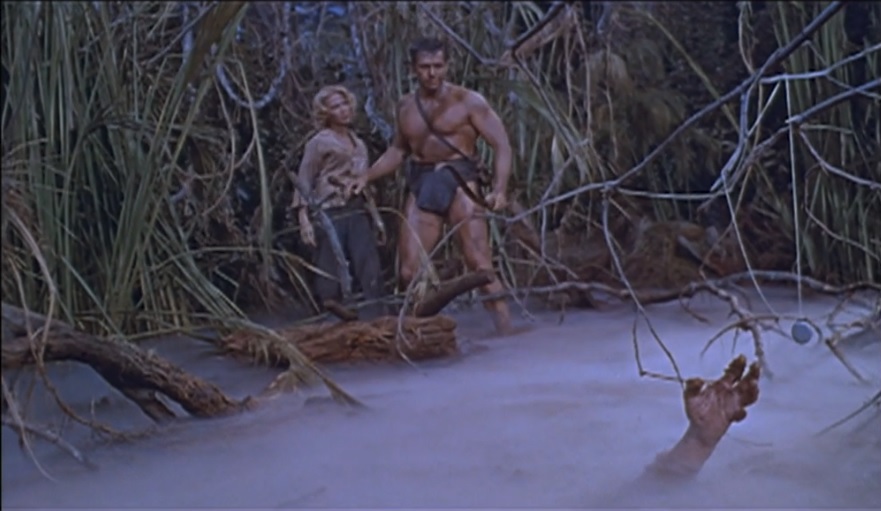
Tarzan's Greatest Adventure (John Guillermin, 1958) A rather ludicrous film that still has its fascinations as a Saturday afternoon programmer, and for its cast (which includes a couple of future Knights of the Realm), its place in the film timeline, and its rather straight-forward take on Edgar Rice Burroughs' John Clayton II, the Viscount Greystoke (a.k.a.): there's no "me Tarzan, you Jane" (there's no "Jane!") pidgining as in earlier Hollywood-based films and he speaks an American-accented English; there's precious little time spent with "Cheeta"—an invention of the films; and there's hardly any mysticism and tribalism to the film to the point where one might question one was in Africa, at all.

Basically, it's about a guy who lives near the jungle, who is renowned by the authorities for his native skills and regard for the normal state of affairs—a sort of glorified park ranger who can swing through trees.

The film begins with a bit of racial effrontery: three white men, posing as black, perform a night-raid on the small village of Mantu, stealing dynamite and leaving the village doctor and a radio operator dead. Before he dies, the radio operator has time to transmit one word: "Slade." The signal must be good, because it alerts the authorities and is heard over the radio by a passing plane piloted by the female lead, Angie (Sara Shane), a pilot and model (naturally).
Tarzan (Gordon Scott) is awakened by jungle drums alerting him that something is wrong in Mantu. Leaving room-mate Cheeta to keep watch on his place, he canoes over to Mantu as the funeral for the slain is taking place. The right proper Colonel Sundley tells him of the night's raid by suspected tribesmen and the presence of root-dye found on the premises. Tarzan "sherlocks" that the raiders were whites disguising themselves as black, and is informed by Angie—model-pilot—that she had heard the name "Slade" over her radio in the night, which clicks with Tarzan—there was a ruthless hunter named Slade who had passed through some time back and, after some snippy badinage with Angie (where he concludes she's just an annoying icky girl), he sets off to look for this "Slade."
"Slade" (Anthony Quayle) is up the river with his gang of uni-named ne'er-do-well's: O'Bannion (Sean Connery), a drunken griper; Dino (Al Mulock), a mulish thug, Kruger (Niall MacGinnis), a German who has all the information for their larcenous quest; and Toni (Scilla Gabel) because a trip up a stifling African river with a bunch of sweating mobsters is such an attractive adventure. Their quest is to find an abandoned diamond mine and the initial raid on Mantu was to get the dynamite necessary to blow the diamonds out of the mine. Sounds stable. It may be the only thing stable on the entire boat—everybody bitches and bickers and they may do themselves in before Tarzan can find them.
Tarzan has his own issues making his way paddling a canoe in pursuit. It seems this "Angie" is also in pursuit in her small plane and manages to crash it before she can get far enough to give away Tarzan's position to the thieves. But, she's not exactly "jungle-ready"—barely avoiding a crocodile exiting her craft—so besides taking on a gang of cut-throats, he has to have the woman as an albatross along the way. Being a "one-ape-man" kind of job, this leaves Tarzan a little miffed.
But, if Angie can't cope with the jungle, neither can the thieves; before Tarzan can even get close to them, the conditions start making life worse for the crooks—the boat develops trouble, and crooks start losing their numbers one by one by the many dangers in the brush. By the time Tarzan can form an assault—by bow and arrow—the odds are increasingly in his favor.
The thing is as pulpy as they come, appropriate given the author. Most of the animals are stock-footage and rarely share a frame of film with the actors. The dialog is the kind that is sledgehammer-subtle, and the male chauvinism is very prominent as the males couldn't be more condescending in their attitude. Scott's Tarzan is serviceable in an American Hero kind of way, and one wonders where he gets his hair-cut out there in the wild, not to mention how smooth-shaven he is. Of course, the acting honors go to the crooks—specifically, Connery doing the loutish acting he was specializing in the 1950's and Quayle, whose Slade is such a psycho snake that you actually think that he might be a challenge for the King of the Jungle.
There's just enough violence to be "that" side of creepy—even though everyone dies in a nicely secure studio setting, and most of the mutilation is suggestively out-of-frame. Guillermin manages to make the movie move quickly and sometimes interestingly, but is never in any danger of being more than a jungle adventure designed for not quite discriminating adolescent caucasian males.

And for fans of Quayle and Connery. Guilty as charged. 
It's also, no doubt, the "whitest" movie ever centered around Africa.

Friday, April 29, 2016

Hamlet (1948)

Hamlet (Laurence Olivier, 1948)

This is the story of a man who could not make up his mind" intones
Laurence Olivier at the beginning of his Production of Hamlet (In a case of over-reach, the man who would be Lord Olivier gets the opening card over Wm. Shakespeare).

Well, yes, that's an easy way to look at it. And while it's essentially true, it negates the fact that Hamlet is struggling with the moral implications of killing, especially since the object of all the daggers he's throwing out with his eyes is, himself, a murderer, traitor, and is sleeping with his mother.* Hamlet tries every trick in the book to expose the treachery, even takes a stab at killing him himself (with collateral damage**) Hamlet is wrestling with his conscience the whole way--while depressed, grieving--and with not good reason: his quest is based on the flimsiest of evidence--the word of a ghost. A ghost that even his
Spock-like friend Horatio saw, to be sure (or not to be), but a ghost nonetheless. Such evidence would never stand up in the Court of Elsinore. The Dark Prince must also wrestle with the consequences of his actions--from his father he knows of the existence of Hell and the damnation murderous actions would lead to.

"Couldn't make up his mind." He wanted to slit the King's throat, not his own.

Every production of "Hamlet" must wrestle with the text *** that ballooned with many versions, asides, and blind alleys. Olivier stripped it bare: No Rosencrantz, no Guildenstern, no Fortinbras, no battle on the plain in Denmark and so, no "Let my thoughts be bloody" speech. In this version, Hamlet does not compare his plight with the futility of war, and in 1948, considering Olivier's "rally-the-troops" version of Henry V, an anti-war statement must have seemed in bad taste, after surviving the blitzkrieg.

And just as every Hamlet must pick and choose what sections to explore, every actor playing Hamlet must contend with ghosts;
**** not the play's, but the players of the past. Like baseball veterans chasing old records, each Hamlet is a reflection of the past, and a portent to other Princes. The current crop of actors taking on the role must have considered Olivier's take, or Richard Burton's, or Nicol Williamson's, just as Olivier must have thought about John's Gielgud and Barrymore. Olivier does take chances given the film medium. His "Frailty, the name is woman" speech is done in voice-over with some choice epithets that burst out of him on-set. That's a good choice for the scene, where Hamlet is in a public space following a celebration and could conceivably be overheard by some hanger's-on. He is much more verbal in his further monologues when he is thought to be crazy, or alone. The "To Be or Not To Be" speech is performed on a parapet overlooking the sea, with dagger in hand. It's a good concept to have the prince "on-edge" at that juncture.

The unique staging of that speech is one of those elements that absolutely separate the filmed Hamlets from each other.***** To me, there are three others: the presentation of the Ghost of the murdered Old Hamlet, the use of Polonius, and the approach to Ophelia. Here's how Olivier treats them.The Ghost: Olivier wraps him in vapors of the real and optical variety, dressed in his battle armor, looking sepulchral, and emaciated, like a classic death figure, with a low-whispered voice--supplied by Olivier (although Gielgud is rumored to be speaking the lines) and played back slowly.
Polonius: As played by Felix Aylmer, and directed by Olivier, Polonius is a comic figure, whose verbosity is played for laughs, and most treat him with a feigned patience, and wish he'd get to the point.
Ophelia: As played by the 18-year old Jean Simmons, Ophelia is very much the traditional Ophelia as delicate flower. She goes crazy with the loss of Hamlet, the death of her father, and no Laertes to bolster her. She is an Ophelia too frail to stand on her own and crushed by the whirl of events, and her cracked sanity is portrayed by a far-away gaze and "fairy-princess" demeanor. How influenced she is by Hamlet's shifting moods is hard to say. But she is "ingenue-as-victim" in the Hollywood tradition.

The other thing I hear about Olivier's Hamlet is that it is somehow a "film noir" interpretation of the play. Except for some fine deep-focus black and white photography, I don't see it. No play of shadows--in fact, everyone is extremely well-lit. And the movie's very set-bound; nobody's walking down the "mean streets" of Elsinore.

Laurence Olivier's Hamlet won the Best Picture Oscar in 1948, with Olivier winning Best Performance by an Actor. He was the first person to ever direct himself to an Oscar-winning performance. Only one other actor has done it: Roberto Benigni.


* Gertrude. One of the interesting things to note about the various "Hamlet's" is the varying ages between mothers and sons. They're starting to get it right, but it wasn't always thus: In the 1990 Hamlet, Gertrude (Glenn Close) is only nine years older than Hamlet (Mel Gibson). In this one, Gertrude (Eileen Herlie) is fourteen years younger than Hamlet (Olivier)! I guess it's an improvement when your realize in the original stagings Gertrude was probably played by a man! And incidentally, Herlie also played Gertrude to Richard Burton's Hamlet--he was five years younger.

** I've always called "Polonius," the verbose father of Laertes and Ophelia, "Collateralous."

***Unless you're Kenneth Branagh, whose 1996 all-star "Hamlet" used the second Quatro version (1604) (with additions from the First Folio version), clocked in at 4 hrs., 2 mins., was filmed in 70mm, with 6 track Dolby sound, but at least had Rosencrantz, Guildensterm, Fortinbras, the "Let my thoughts be bloody" speech, and had a Gertrude who could have conceivably (heh) been Hamlet's mother!


**** There are other ghosts at Elsinore if one is to believe Olivier's camera-work. Elsinore is an enclosed castle with labyrinthine corridors and vast open emoting spaces. Between acts, we flit down corridors and up spiraling staircases as if the audition is, itself, an apparition, seeing everything in turn with an omniscient view-point. And in a reversal of stage tradition, we go to the actors, rather than them coming to us.

***** Most actors address the audience on-stage. Mel Gibson's Hamlet performs it in a burial catacombs, Kenneth Branagh, while looking in a mirror, and Ethan Hawke...at the video store.

Tuesday, September 23, 2014

Operation Crossbow (aka The Great Spy Mission)

Operation Crossbow (Michael Anderson, 1965) There actually was an "Operation Crossbow" during the second World War of the 20th Century, designed to stop the next generation of weapons the Nazi's were dabbling in, after the costly Battle of Britain and before an anticipated amphibious landing on the shores of Great Britain—the V-1 (or "buzzbombs") and the V-2 rockets (predecessor to both the American and Russian space programs, but designed to deliver explosives and blind destruction). The reality was a bit more mundane than here, which is staged like The Guns of Navarone (the script was initially drafted by Emeric Pressburger of "The Archers") with a team of experts charged with infiltrating the German development complex with a plan to destroy it from without and within.

As with so many of these "true stories" of the war, it's only partially true:  the threat was real; dealing with it was another matter. The film is comprised of two sections: the administrators of the mission (Richard Johnson, Trevor Howard, John Mills) coming up with various strategies to deal with the pilotless weapons and the recruits (George Peppard, Tom Courtney, and Jeremy Kemp) whose job it is to drop behind enemy lines, pose as dead or missing German engineers and infiltrate the Peenemünde rocket-works, gather information and/or sabotage the facility.
Bunker windows are letter-boxed!
Watching a V-1 test—actually the most interesting part of the film.
From the beginning, the mission is sabotaged by a lack of complete intelligence and by infiltrators in the process: one of the missing Germans is missing for a reason—he's wanted for murder and sticks out like a sore thumb to the authorities when he suddenly shows up in plain sight; one of the specialists volunteering to break into the rocket plant is a German spy (Anthony Quayle) who goes back to Germany and runs interference throughout the rest of the film.
"You want us to...what?"  Courtney, Kemp and Peppard
Operation Crossbow
Then there's Peppard's alias—seems his German has a wife (Sophia Loren) who comes looking for him when she learns that he's suddenly turned up in a German hotel. Well, that complicates things when she discovers the man with her husband's name and identity is a total stranger. She's kept under wraps by a resistance couple (Lili Palmer, Philo Hauser) until the trio can escape the scrutiny of the German authorities.
"Uh...what's she doing here?"
Loren's role is completely unnecessary—and very brief—as there are enough complications with the purloined identities to make things rough going. No, she's there to be confused, wistful, play slightly drunk, and exit, and not too quietly. Oh...and get top billing to bring in the crowds, and to provide the unnecessary (and frankly irrelevant and mislabeled) "love interest"—although it hardly qualifies—for a film that is essentially all-male in character and scope.* 
While the historically valid "Crossbow" occurs in the skies over London with the various anti-aircraft measures designed to blow the missiles out of the skies or at least knock them off-course, the trio of infiltrators (minus one) get recruited at the vast underground missile complex and begin the process of finding the weaknesses of the weapons (while ironically working to fix them to maintain their cover) and the complex (which they, unironically, intend to destroy).
Peppard and Kemp compare notes on missiles—Peppard has appeared to be
beaten up, although that sequence was cut from the film.
The film did not do well at the American box-office, prompting the studio to re-name the film The Great Spy Mission (check out the poster paste-over to the right) upon re-release as they thought the "Crossbow" reference might have confused audiences into thinking it was involving knights and archery (and as the movie-going public was in the midst of being bombarded with everything James Bond...hey, it couldn't hurt). The film, whatever its title, has more in common with The Guns of Navarone than with Bond, although the next year the Bond producers would begin work on You Only Live Twice, which, itself, more resembled Navarone and this film than anything from Fleming's source-novel. Certainly, Crossbow's imagining of Peenemünde has as much basis in reality as a hollowed-out volcano space-command does. And the writers-producers have upped the ante by introducing a new weapon that has come online—the "New York" bomb, that city presumably being the target because, hey, bombing London just isn't enough, especially if you're trying to sell a film to an American audience.
Peenemünde looks like a very big place...
As dumb as that idea is, and the whole puffery of the thing, you do have to give some sort of pointage to a film that had the balls (Spoiler Alert) to kill off two its major stars before the half-way point of the film and eliminate all of its heroes by the film's end. For all the fantasy that the film imparted to the war, it dared to not reward courage but show the indiscriminate horror of war, despite all efforts and good intentions. America was in the midst of the Vietnam war at the time, and despite its trappings of fantasy amidst the threads of the true story, it dared to show the true nihilism of war—in the generation of deliberate destruction, no one gets out alive. Operation Crossbow has real problems as a film, but it dared to not cave in to a happy ending with garlands and celebration, or even of satisfaction with a mission accomplished. It leaves the viewer with a realization of cost towards the noble in the most ignoble of times.

*Not entirely true, that: some of the best scenes involve a German aviatrix, Hannah Reitsch—yes, she did exist—who worked on the project investigating why early test pilots of the V-1 in its planning stages were being killed trying to land the thing.  She discovered the V-1's had a tendency to stall and lose all guidance capabilities—not good if you're targeting something.

Tuesday, September 16, 2014

The Guns of Navarone

The Guns of Navarone (J. Lee Thompson, 1961) Maybe I should do a series—"The Ones That Got Away." Somehow I managed to miss this one, an essential "action" film that "everybody" saw when it first came out, AND during umpteen playings on television. Not me. I managed to sit down and watch it straight through only recently. I do remember it from one particular Dick Van Dyke Show episode (Season 5, Episode 139-"You're Under Arrest") where Dick and Laura had a fight and Dick stomped out and went to a drive-in and fell asleep in the car and no one believed him because the movie playing was The Guns of Navarone. "YOU SLEPT THROUGH THE GUNS OF NAVARONE??!!" 

Such a thing was apparently unthinkable, as the line was used a few times during the episode with a cascading laugh ascension each time. It was, after all, at the time, the action movie to end all action movies.

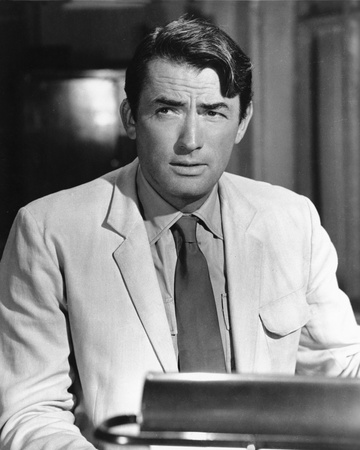
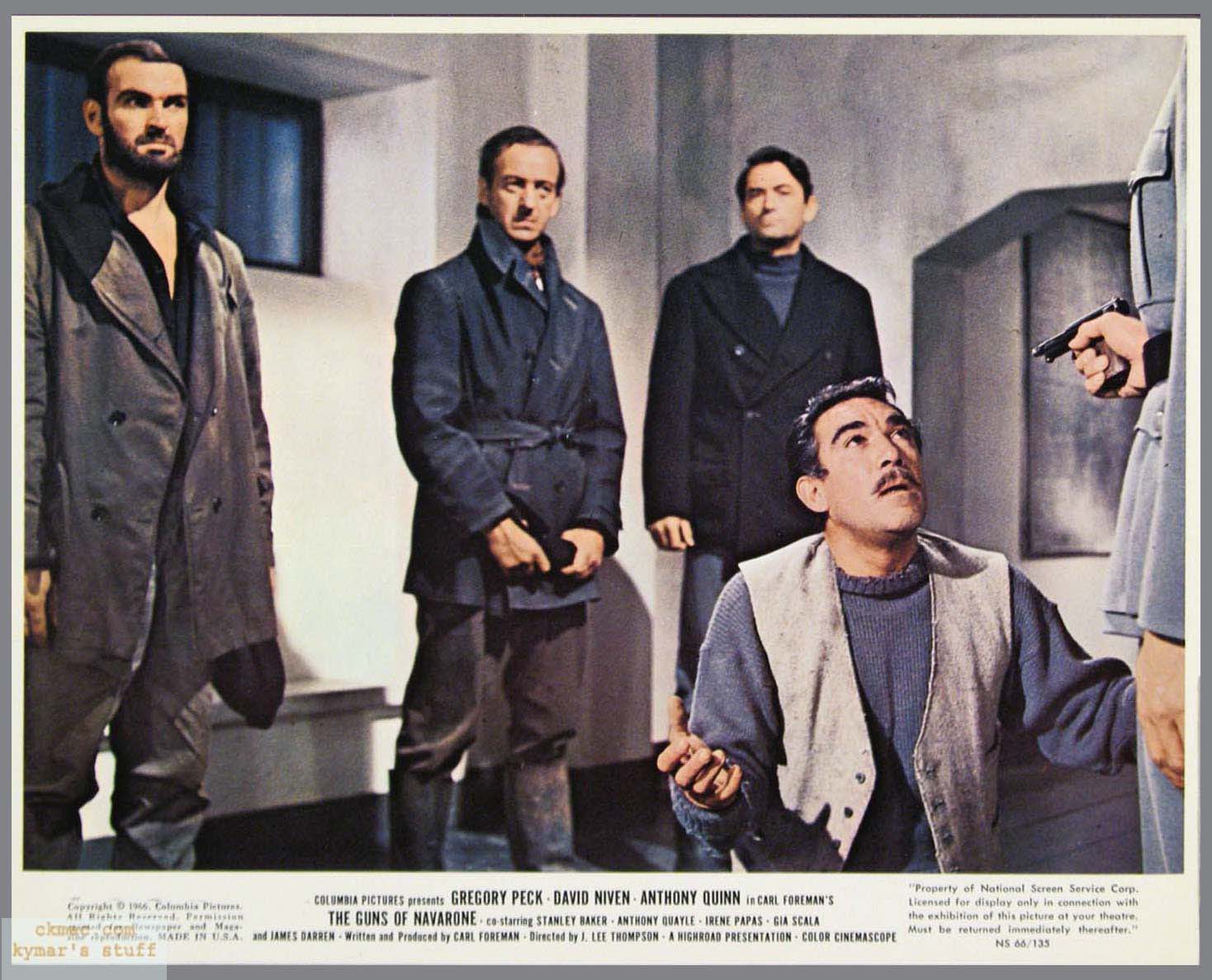
"With so many geniuses," says Team Captain Keith Mallory (Gregory Peck), "how can we fail?"

Ask a silly question...get a two and a half hour answer. Particularly when the answer involves material supplied by Alistair McLean, from whose books nothing ever goes as planned and improvisation, no matter how well provisioned for, rules the day.
"With so many geniuses, how can we fail?"
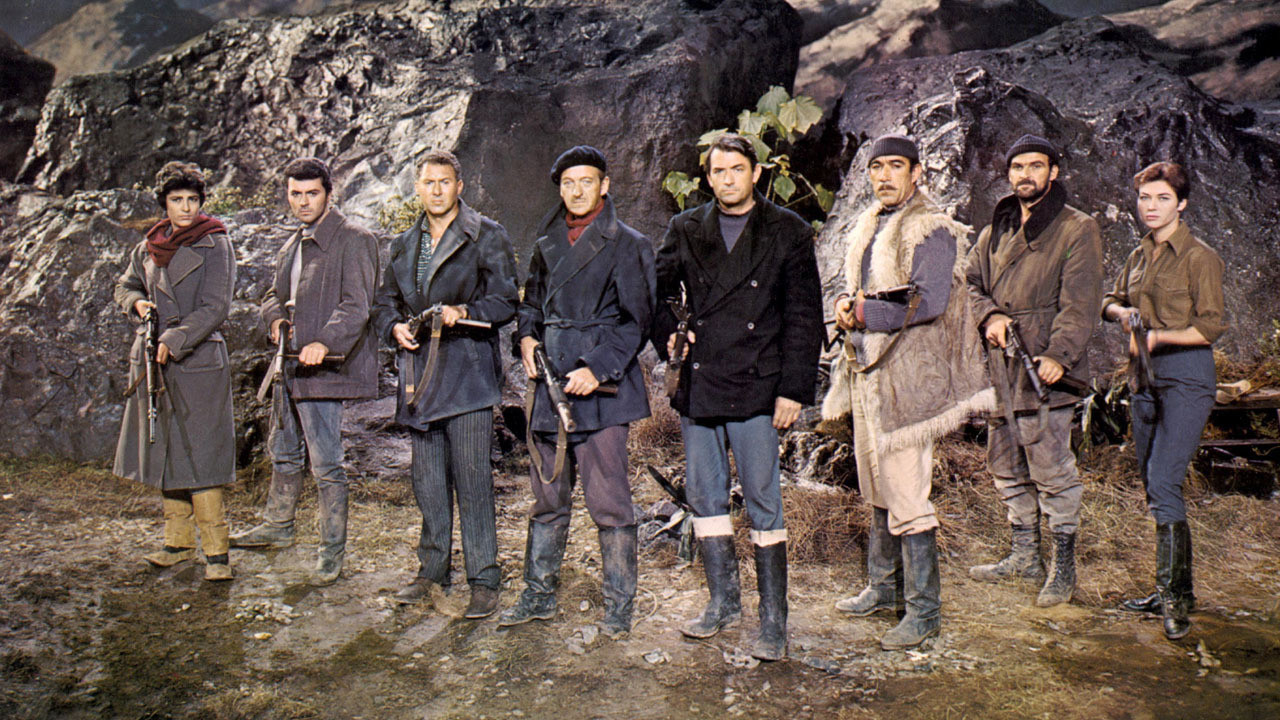
There are these cannons, see?* They're caved into vertical cliff faces that have been daunting to regular forces.**  So, a team of specialists, cut-throats, and patriots form a surly group of cynics to make land-fall—extraordinarily uneasily—go up-country and meet up with resistance forces infiltrating a hummocky terrain populated by locals (who seem to be having a wedding every hour of the day) and an endless supply of Nazis, who seem to fall like ten-pins.

There's always a weak link in these groups. In this case, it's Major Roy "Lucky" Franklin (Anthony Quayle), who has brittle bones and seems to have the ability to attract shrapnel. The initial cliff-assault proves to be his undoing, although the rest of the team manage to make the climb without falling into the rear-projection. And while not quite The Dirty Dozen, conflicts pop up pretty quickly—Corporal Miller (David Niven) is the griper, constantly needling Mallory and protective of Franklin. Mallory has issues with Col. Andrea Stavros (Anthony Quinn) who holds a grudge for what happened to his family previously in the war. Then there's Brown (Stanley Baker), "the Butcher of Barcelona," who seems to be having trouble negotiating wish-bones and his own conscience.***
Director J. Lee Thompson (a good yeoman-like director, who only gets "arty" on inanimate objects) keeps things moving fast and the frame centered—despite being a "widescreen" Cinemascope roadshow—managing to make everything capable of fitting into a square TV-frame.
The hero of the story, though, is Carl Foreman, black-listed writer-producer, who migrated to Europe to make films. Despite the gung-heavery on display, his script still squeezes in enough anti-war sentiment and issues of conscience without slowing down the action any, even impressing crusty old John Wayne, one of the anti-communists who pressured him to leave the States. His "Guns" fits into the same cynical fox-hole as the earlier Awards magnet The Bridge on the River Kwai, which he had once worked on. 

Curiously, even though I missed the original, I still managed to see its sequel Force 10 from Navarone (which recycled quite a lot of the first film's climax) a couple of times.  That one came out a full 16 years after the first, just in time to catch such up-and-coming stars as Harrison Ford, Barbara Bach and Richard Kiel, and replacing Peck and Niven with Robert Shaw and Edward Fox, two (count 'em, two) British actors who seemed to fit the characters a little bit better.  
* Them bloody "Navaronian" guns


*** Peck had an amusing homo-erotic spin on the story:  "David Niven really loves Anthony Quayle and Gregory Peck loves Anthony Quinn. Tony Quayle breaks a leg and is sent off to hospital. Tony Quinn falls in love with Irene Papas, and Niven and Peck catch each other on the rebound and live happily ever after."