Showing posts with label 1961. Show all posts

Sunday, February 23, 2025

Underworld U.S.A.

Saturday is traditionally "Take Out the Trash" Day, even when the trash is pretty damn good, like this pulpy one by maverick director Sam Fuller.

Underworld U.S.A.
(Samuel Fuller
, 1961) A Saturday Evening Post serial about organized crime during the 1930's was the source material for this pot-boiler that had gotten Humphrey Bogart's interest as a project. But Bogart died of cancer in 1957, and Columbia still had the property on their hands.
 
By this time, the Hays Code was dying a deserved death and the mobsters and racketeers, that had been pretty much hush-hushed by the movies since they'd caused hissy-fits among the pearl-clutchers in the 1930's, were making their way back to the screens. Billy Wilder even used them in his comedy Some Like It Hot in 1959! So, with the Hays hand-cuffs taken off, Columbia looked to see if they could toss out their own mob movie, and they latched onto one of the movie's most exploitative fire-brands, Samuel Fuller, who took one look at the material and tossed out the time-frame. There were mobsters making a lot of coin NOW! And some of them gave off the stink of legitimacy, so why treat it as something as quaint and antiquated as a buggy-whip? Fuller was proposing a tale of the Mafia violently opposing a prostitute's union, but Columbia rejected the idea. The Hays Code may have been crippled and toothless, but you still couldn't go too far in pushing the plain-brown envelope.
Fuller's next idea was of a kid making his way through the ranks of organized crime to avenge the murder of his father which he witnessed when he was a punk kid of 14. He swears revenge, and growing older, he moves from rolling drunks to break-in and robbery. Oh. And the kid, named Tolly Devlin, goes from being played by
David Kent to Cliff Robertson.
And with his meager lone-wolf means, he gets wind that one of the guys—the guy whose name he knows—Vic Farrar (Peter Brocco) is dying in prison. Tolly wants to help the old guy along, but how to get to a guy in in the joint? Never one to think too elaborately, Tolly decides to be just a little sloppy on a safe-job, gets caught in the act and winds up in the same prison with Farrar. He becomes a good enough trustee that he talks his way into being an assistant to the prison saw-bones and before long it's curtains for Vic Farrar, but not before he gets the names of the other guys who killed his father. Being a safe-cracker, the one thing Tolly has is patience.
One down. Three to go. Tolly's good behavior (despite his secret extra-curricular activities) gets him parole and, with a new suit, and new set of targets, he goes to the only home he has, the one owned by Sandy (
Beatrice Kay), who used to run a gin-mill until she was bought out by a thug named Gela (Paul Dubov), who, under the guise of cleaning up the town of booze-halls has turned them into "coffee shops" serving java in the front...and heroin in the back. Sandy tells Tolly the whole sad story, and he recognizes the names Farrar mentioned of all the thugs who murdered his Dad: Gela, the dope king; Gunther (Gerald Milton) the crooked labor leader, and Smith (Allan Gruener), who runs prostitution. Now, he's got faces to the names—they all have respectable business fronts—and Sandy warns him that they're better protected than the President of the United States.
 Gela, Gunther, and Smith
Well, if you can't beat up, join 'em—that way you can mingle with the muscle protecting the mob. He breaks into Gela's main "coffee shop," "The Elite Espresso"—the one Sandy used to own—and cracks the combination of the safe he used to practice on when he was a kid. He's interrupted by one of Gela's gun-men, Gus (Richard Rust), who's using one of Smith's girls to make a heroin delivery. Her name's "Cuddles" (Dolores Dorn) and before the gunsel can follow orders and kill her for welching, Tolly clocks him over the head and he and the girl make a clean getaway with the key to the stash.
"Cuddles"
Tolly tells her he's a narcotics cop and gets her to show him where the "junk" is—so he'll "go easy" on her—then steals it so he can use it to get to Gela and takes her back to Sandy's place for safe-keeping. Despite Sandy's misgivings, he sets up a meeting with this Gus hoodlum to extort 50k from Gela to get his own drugs back. It's a meeting that doesn't start well at first, with Tolly getting a gun put to his temple, but it does get him in the same room with Gela, where he tells the dope king that he was trying to find the killers of his father, but spins a story that Farrar told him all those hoods died. Them he makes a big show of giving the heroin back for nothing...because Gela and his Dad were such good pals. Gela hires him as a bag man—supervised, of course—because Gela ruefully admits he's a sentimental slob.
So, Tolly's inside, trying to worm his way through the organization to find the weak spots. Cuddles tells him how she saw Smith kill a girl once and he decides to make a fast move to get one of his Dad's killers out of the way. He calls John Driscoll
(Larry Gates) Chief Counsel for the Federal Crime Commission that is trying to take down the mob troika and their big boss Earl Connors (Robert Emhardt), who runs his own front with the generic name of National Projects. Driscoll gets a promise from Cuddles to testify against the guy, and suddenly there are two out of the way.
Newspaperman Fuller's way of disposing of the mob—banner headlines!!
What's going on here is writer-director Fuller's version of Yojimbo, Akira Kurosawa's samurai transfiguration of Dashiell Hammett's story "Red Harvest"—just as Yojimbo would be transported to the Western genre as A Fistful of Dollars—where a lone operative finagles his way into the confidences of rival gangs, and, in so doing, pits them against each other. Here he turns the mobsters into setting onto themselves because "there's no honor among thieves" but with the added wrinkle that he's also working for Driscoll—unbeknownst to the Mob—with a clandestine way of lighting fuses, playing everybody against each other...but leaving himself untouched. He's his own man, does things "my own way" and he's just manipulating both groups to get his revenge faster and more completely. It's a lovely distillation of Hammett, while coming out the same year as Kurosawa's version.
"Suckers..." he says
He'd done something like it with his Pickup on South Street, a movie so cynical about ideals that it even hacked off J. Edgar Hoover. Fuller who both wrote and directed Underworld U.S.A. always was a firebrand—he started his career as a newspaperman on a crime beat—and loved speaking truth to power and he has a cackling good time with "the Fed", Driscoll, in an exposition-dump scene that compares the mob to as respected an American institution as the U.S. Armed Forces with its ranks and divisions and chiefs of staff—"Top Brass" he calls them—doing The Godfather one better painting Organized Crime as American as Big Business Apple Pie and doing it ten years earlier.* 
But, Fuller isn't so radical that he can't choose sides among the riff-raff. His mobsters can lay no claim to being colorfully romantic as in The Godfather series and they're 180° from heroes. They're out trolling schools and using their recreational programs for getting kids addicted and girls into prostitution. At one point, the head-boss Connors, instead of addressing a recent screw-up, berates his heads that their numbers are down and he gives a pep-talk out of a nightmare: "There's 13 million kids between the ages of 10 and 15. Don't tell me the end of a needle has a conscience. Put more field men to work around the schools. We'll always be strong as long as we're tough."
It's over the top drama (Fuller is not a subtle man—the score's major motif is based on "Aud Lang Syne" as in "should auld acquaintance be forgot"), but also a little heart-pumping how much energy the film enjoys on a miniscule budget. And, although Fuller may cut-away from the violence, he does spare you the gory details, setting up mob-hits on the young daughters of snitches, setting a live guy on fire in his car, and a constant trail of broken people being exploited for money by guys in good suits. Fuller takes his outrage and takes it out on us, not holding back because he was never one for sugar-coating. But giving it to you straight and no chaser, except to make it entertaining and not a lecture.
I'm getting to the end of seeing everything in Fuller's lengthy career. And I gotta tell you, I'm going to miss the shocks and surprises.

* Funny enough, Fuller auditioned for the part of Hyman Roth in The Godfather Part II for Coppola before securing Lee Strasberg for the role.

Saturday, October 19, 2024

The Pit and the Pendulum (1961)

The Pit and the Pendulum
(
Roger Corman, 1961) The year 1547. Francis Barnard (John Kerr) arrives at the Medina stronghold on the coast of Spain from England to inquire into his sister Elizabeth's recent demise. Not so recent to Barnard's shock—she has been dead for three months and he's only recently been informed. "Something in the blood" is the vague cause and that makes him even more suspicious. Perhaps if Catherine Medina (Luana Anders) wasn't so circumspect, and Elizabeth's husband Don Nicholas Medina (Vincent Price) wasn't so...peculiarly and demonstrably aggrieved. No matter. Barnard vows not to leave the place until he "knows exactly what has happened here." Despite Medina's overwrought emotions, Barnard cannot be convinced that something suspicious hasn't happened to his sister.

A post-dinner visit by Dr. Leon (Antony Carbone) reveals to Barnard that it wasn't some blood disease, but that Elizabeth "died of fright"—a shock to her heart. Nicholas Medina, you see, is the son of Don Sebastian Medina, "one of the Inquisition's most infamous, degraded..." torturers, it seems. And the Medina castle is just as he left it, with a basement torture chamber reeking of the evil "malignant atmosphere of the castle...the barbaric miasma that permeates these walls." Elizabeth was drawn to it, fascinated by it.
In blue-tinted flashbacks, Nicholas tells of the initial happy weeks of marriage between himself and Elizabeth (Barbara Steele), until her moods began to change and he would find her periodically wandering through the basement torture chamber, until one day she was found inside an "iron maiden", quite dead. But, Nicholas may not be entirely trusted, as he himself suffers from a wracked guilt, having witnessed the death of his uncle and mother at the hands of his father, accusing them of infidelity. Dr. Leon adds that although Nicholas' mother may have been tortured, there was speculation that she was entombed alive by his wicked father. That idea has become an obsession with Nicholas, only now it seems to repeat itself as everyone in the castle starts to hear nocturnal harpsichord playing—as Elizabeth once had—possessing the Don to think his late wife's spirit haunts the castle. And him.
Something, indeed, strange is going on, as everyone has heard the playing with Elizabeth's ruby ring found near the keys and Barnard's presence and truculent insistence to get to the truth only inspires more tragedy. He can't leave well enough alone, going so far as to insist that Elizabeth herself may have been prematurely buried—which seems to be born out when they break through her walled-in sarcophagus and find the moldering skeleton of Elizabeth seemingly trying to scratch through her coffin-lid. This drives Nicholas right over the babbling edge.
Although ostensibly the hero of the story, Barnard is, for the story's purposes, more of a useful idiot. It is only appropriate, then, that he should be the potential victim for the setting and device of the title. With Nicholas' mind snapped by Elizabeth's presence, he seems possessed of his torturer-father's mad spirit and straps his nosy antagonist to a slab in the deepest reaches of the castle and starts the elaborate process of lowering a razor-sharp pendulum ever lower to eviscerate his unwanted guest.
However convoluted the way is to get him down there, the sequence in the pit is a genuine nail-biter, with the heavy blade moving alarmingly fast in its swings looking to nearly slam into the camera as it passes near along with a vicious cross-cut editing employed that seems to build with every oscillation of the stroke until the thing threatens to shred Barnard's shirt as it relentlessly moves on its path to disembowel him. In fact, Barnard is such an unsympathetic character that one wouldn't be surprised if he actually does get sliced in two before the end credits.
The script is far more elaborate than the previous effort, House of Usher, had been with less psychic imaginings and more genuine evil informing its plot, with healthy doses of the previous film's curses and cracked psyches and obsession with premature burial. Yes, the cast is still limited...to six major players this time (up from Usher's four) with Price and "Britain's first lady of horror," 
Barbara Steele, at the start of her film career fresh from Mario Bava's Black Sunday, as the leads (even though Steele has barely six minutes of screen-time, her presence rather haunts the film). Price is allowed to go fully over the top of this one as he fairly jabbers his way into madness thinking himself the reincarnation of his dead father.
But, the movie has less to do with any supernatural evil than it does with the malignancies of evil perpetrated by real flesh-and-blood human beings who just happen to have a mean streak and no compunction to curtail it. In a way, people get the comeuppance they deserve not by spirits but by their own actions There's a genuine plot being perpetrated and those actions only unleash a monster rather than the planned consequences intended. And the final cruelty Matheson has devised is one even Poe might have blanched at—complete and utter uncaring apathy—with a surprise twist in the final shot.
Oh, it's entertaining, alright. And although Price may be going a bit overboard thespianing his way into lip-curling madness, he's fun to watch. But, the skill-level has gained a few notches with much more moody cinematography than the previous Poe film and a third act that's a corker including a line that has seared into my movie-memory forever: "Maximillian, we must break into the torture chamber! Quickly!"
 
You can say that again.

The Pit and the Pendulum was the first AIP Poe film to use 
(and re-use!) these groovy psychedelic graphics

Sunday, October 13, 2024

Don't Make a Scene: The Misfits (1961)

The Story: Three actors from the Actor's Studios watch as The King of Hollywood does some of the best acting of his life.

That would be Montgomery Clift, Marilyn Monroe and Eli Wallach watching Clark Gable in The Misfits.
 
Robert Forster liked to tell the story of his first day acting in John Huston's Reflections of a Golden Eye, when Forster, new to movies and looking a little lost—he'd only done stage work and he was hired by 20th Century Fox after some time as a construction worker and teaching substitute—when Huston told him to prep for his first shot. "What do I do?" Forster asked the maverick director. Huston led him to the back of the camera and made him look through the view-finder. "You see that?" Huston grinned at the actor. "Fill it up!"
 
The Misfits is one of those movies where the actors do "fill it up."
 
The script for The Misfits is by Arthur Miller, who gave it to his wife, Monroe, as a present, but while filming was going on, the marriage was in its last throes. And the script, by that time, had undergone a bit of a transformation. Huston, who made his initial reputation in Hollywood as a scriptwriter, may have had a hand in that.
 
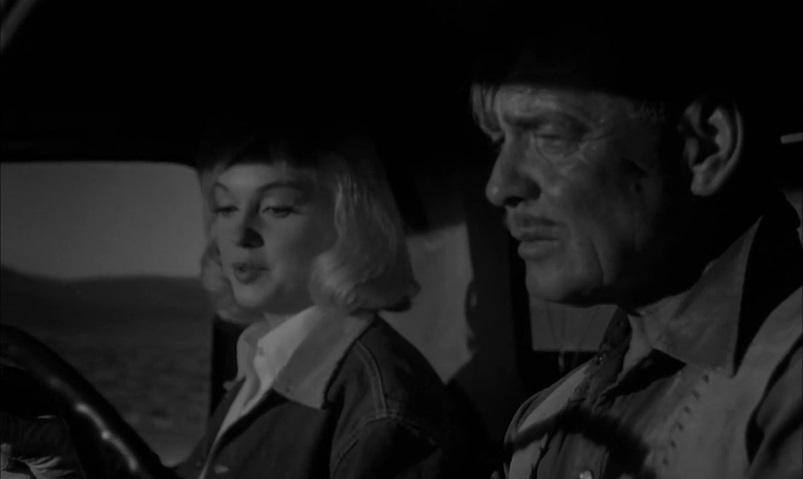
You read Miller's script and it's wordy and stagy. Gable's character of old cowboy Gay Rowland is in such bad shape from roping the horses that it's the character of Pence who drives Roslyn and Gay home. For whatever reasons, Huston ended up with just Gable and Monroe on the drive and, dramatically, that seems right. And the dialogue is whittled down to as spare as can be—most of the drama is in the actor's faces. Clift's wry farewell to Roslyn (after she tells him not to get hurt in the rodeos so damn much). Gable's shifting pains, both physical and mental, as he drives on not much sure of the future, but sure of the way. And Monroe's mercurial choices that play in her eyes and brows, unsure moment by moment of what she's gotten herself into in Reno, Nevada.
 
And it's not in the dialogue...it's in the faces...young and old alike. Miller wrote for the stage...film's another story...things are communicative and effective if they're seen but not necessarily heard.
 
And Huston doesn't put an "The End" credit at the tail of the film. Just the fabled star that Gay says will take them home...with an odd closing coda from composer Alex North that is...in a word..."spooky." 
 
It would be the last time audiences saw Gable...or Monroe...acting on the big screen.
 
The Set-Up: From Premiere Magazine "Classic Scene" April, 1998:  "To stay free, aging cowboy Gay Langland (Clark Gable) rounds up wild horses, even though, in the new West, the mustangs are led to slaughter and turned into pet food. "Everything else is just wages," he tells the horrified Roslyn (Marilyn Monroe), with whom he's fallen in love, but who remains distant. Here, in the film's final scene, this group of misfits—his friend Guido (Eli Wallach), battered rodeo cowboy Perce Howland (Montgomery Clift), and Roslyn—has gone to the desert highlands for a last roundup. Roslyn begs Gay to free the horses, but he goes on until, in a fierce battle, he ropes off the last stallion. Filming The Misfits was arduous. The production was plagued by delays and 130-degree heat. In an effort to combat boredom, the 59-year old Gable insisted on doing many of his own stunts, which put a strain on his weak heart. Shortly after filming was completed, Hollywood's quintessential leading man suffered a massive heart attack. He died days later.
 
Action.
 
[After Gay has singlehandedly roped off the last horse in the twilight]
GUIDO:
You held him. I'm proud of ya, boy. You held him. We'll get them all back tomorrow. 
GUIDO:
Just get your wind back now. Get your wind back. Don't worry, we're not through here. 
GUIDO:
We're only gettin' started. 
[Bloody and exhausted, Gay looks harshly at Guido]
GUIDO:
We don't need anybody in the world. You know that now, don't you? 
[Gay pulls out a knife and pushes Guido aside]
GUIDO:
What are you doin'? 
[Gay cuts the rope, freeing the mustang...]
[...and sits on his truck's sideboard, breathing heavily.]
GUIDO:
What in the hell you catch him for? 
GAYLORD LANGLAND:
Don't want nobody makin' up my mind for me, that's all.
GAY:
Damn 'em all! 
GAY:
They changed it. Changed it all around. Smeared it all over with blood. 
GAY:
Well, I'm finished with it. 
GAY:
It's... It's like ropin' a dream now. 
GAY:
Just gotta find another way to be alive, that's all. If there is one any more. 
GAY:
Perce, 
GAY:
cut that mare loose for me, will you?  
PERCE HOWLAND:
Sure. 
[Roslyn walks tentatively toward Gay]
GAY:
Drive you back, if you want. 
[Gay and Roslyn get in the truck.]
[Perce walks up to Roslyn]
PERCE:
Um, 
PERCE:
I'm pleased to have met you, Roslyn. 
ROSLYN TABER:
Don't get hurt any more, will you, Perce? - 
GAY:
See you around, Guido. -  
GUIDO:
Where'll you be? Some gas station...Polishin' windshields? 
GUIDO:
Makin' change in a supermarket? 
GUIDO:
Try the Laundromat! They need a fella there to load the machines! 
GUIDO:
Gay! 
ROSLYN:
I'll leave tomorrow. 
ROSLYN:
OK? 
[They stop the truck and she gets out, untying Gay's dog.]
GAY: I bless you, girl.
ROSLYN:
Gay, if there could be one person in the world...
ROSLYN:
...a child who could be brave from the beginning... 
ROSLYN:
I was scared to when you asked me. 
ROSLYN:
But I'm not so much now. Are you? 
GAY:
No. 
ROSLYN:
How do you find your way back in the dark? 
GAY:
Just head for that big star straight on. 
GAY:
The highway's under it. 
GAY:
It'll take us right home.


Words by Arthur Miller
 
Pictures by Russell Metty and John Huston
 
The Misfits is available on DVD from M-G-M Home Entertainment.