Showing posts with label Herbert Lom. Show all posts

Saturday, April 26, 2025

The Man with Bogart's Face

Saturday is traditionally "Take Out the Trash" Day...

The Man with Bogart's Face
(Robert Day
, 1980) With some television series ("The Rebel" and "Branded"), a couple movies (like Chisum) and a long association with director Irvin Kershner on his resume, writer-actor-producer Andrew J. Fenady began work on his first book, "The Man with Bogart's Face" which was first published in 1977. 

I read it not long after that--the title caught my attention-- but it didn't leave much of an impression on me, other than the guy had done his research and that he had an obvious love for the detective films of the 1940's and '50's. It tells the story of a man so obsessed with Humphrey Bogart, he has plastic surgery done on his face and changes his name to Sam Marlow, all the better to become what he's always dreamed of being—a private detective. 

Fenady had an eye to making a movie of the book, wrote a screenplay, got financing from Melvin Simon—Fenady wrote it to be low-budget—and started the process of getting the movie on the screen.
But, who would play Sam Marlow, the man with Bogart's face? Supposedly, an actor had been cast* when in walked a little known thesp' named Robert Sacchi. Saachi had his own one-man Bogart-tribute touring show which he took around the country and from most angles, he was a dead ringer for Bogart (who'd passed away in 1958), and did an impeccable mimicry of him, if slightly limited in range. Put him in a trench-coat and a fedora and he fit the bill like a slightly rumpled suit. 
George Raft (in his last role) confronts Sam Marlow
But for an entire feature film? Maybe that's going a bridge too far. The plot follows the outline of The Maltese Falcon: after unveiling his new plastically-surgeoned face (in a sequence that resembles a similar sequence in Dark Passage), a valuable "whatsit" is coveted by a variety of outlandish characters and newly-chiseled Sam Marlow (Sacchi), with a newly installed ditsy secretary he calls "Duchess" (Misty Rowe), is employed by almost all of them for the prized "McGuffin." That they all vaguely resemble characters from Dashiell Hammett's original only proves that the falcon doesn't fall far from the tree.
 
But, it's The Maltese Falcon-light.
Light, but not so nimble. His first case is with his sizable landlady whose husband is missing. Then he gets a call from Elsa Borscht (
Olivia Hussey), who tells him that her father, Horst, a former prop-man for the pictures, has been getting threatening phone-calls. She tells him this right before they get attacked by two masked gun-men at the Hollywood Bowl. It's enough action to almost make you forget that a character's name is Horst Borscht. It's going to be that kind of picture.
It seems everybody is looking for "The Eyes of Alexander" two perfect blue sapphires once a part of a statue of Alexander the Great. Among the many coveters is Commodore Anastas (
Victor Buono)—whose daughter Gena (Michelle Phillips) Marlow thinks looks just like Gene Tierney in Laura (he even has "the portrait" hanging in his office)—the fey-caricatured Mr. Zebra (Herbert Lom), the slimy club-owner Hakim (Franco Nero), and the former Nazi general (with a wooden arm) Wolf Zinderneuf (Jay Robinson, considerably toned down from his performance as Caligula in The Robe). All have eyes on the Eyes and are ready to resort to any sort of skullduggery to get them. And Marlow is forced to dodge bullets and search for the sapphires in some of the seedier, less photogenic sides of Los Angeles.
It starts to get formulaic very quickly: everybody who meets Marlow has to ask: "Has anyone ever told you you look like..." before he cuts them off with a pivot, Marlow's dialogue is always a little too clever by half and sometimes downright irritating at any quarter. Then, there's an omnipresent narration where he waxes philosophic and usually has to include an old movie reference ("Hollywood Boulevard isn't what it used to be, but then it never was" huh?).
 
After awhile, it gets to be a drag, the kind of movie Bogie would say "only phonies like it."
It gets so bad that Sacchi's performance starts to wear a little thin and you start to notice the differences instead of getting comfortable with them. For examples, the forehead is too high, the nose a little pudgy and the chin weak. Plus, every chance he gets, Sacchi runs a finger across his lip "just like Bogie did" but, he never did it this much and although imitation is the sincerest form of flattery, too much of it is the sincerest form of boredom.

Things get really ugly when things get deadly serious and the most sympathetic (although sadly also the most dull) character gets killed. And the movie begins to drag and Sacchi's impression starts going stale. The real Bogie would risk looking ugly or tortured or something at this stage of the mystery, but Sacchi doesn't dare lest the Bogie-illusion suffers for it. And one realizes then that the performance is relentlessly one-note and the whole enterprise starts to slide downhill.
The movie is of its time and you can't change that—the direction and cinematography looks like that of every run-of-the-mill detective television series of the 1970's—But one would think this thing might have played better during the "Bogie renaissance" when he started being a cult-figure on college campuses during the 1960's.

The Man with Bogart's Face just goes to show that unique can't be imitated and that Bogart was and remains inimitable.

* I'm guessing Jerry Lacy, the most obvious choice. Lacy did commercials as a Bogart look-alike and starred as the phantom-Bogart in Woody Allen's "Play it Again, Sam" both on-stage and film. If he was considered, the loss shouldn't have been too upsetting, as The Man with Bogart's Face died a quick death at the box-office. Sacchi died in 2021, outliving Bogart by over 30 years. Lacy is still quite alive at the age of 89.

Saturday, February 22, 2020

Hell Drivers

Saturdays are "Take out the Trash" Day

Hell Drivers (Cy Endfield, 1957) British feature directed by blacklisted American director Endfield—and the first to carry his actual name and not a pseudonym*—about the rough and tumble day-to-day of short-haul truckers, battling deadlines and each other to try and meet quota and be top-driver hauling ballast (gravel) on sub-standard equipment at speeds that are break-neck, even under the best of conditions. Each driver has to make at least twelve loads a day; if they don't, they're fired. Competition is so fierce that the other drivers aren't above sabotaging each other's rigs. Work-place harassment is just part of the job and a way of life.
Into this demolition derby come Joe Yately (Stanley Baker)—call him "Tom"—who's just served a year stretch in prison and is trying to make a new honest life for himself. A position is open at Hawlett's Trucking after a driver has gone through a bad accident and although the manager, Cartley (William Hartnell) is reluctant, his secretary Lucy (Peggy Cummins of Gun Crazy) intercedes on his behalf. Tom is taken on a training run and does okay, despite near-collisions with a couple of other drivers.
The other drivers are a motley crew: there's Scottie (Gordon Jackson), Ed (Wilfrid Lawson), Dusty (Sidney James), Tinker (Alfie Bass), and Johnny (Sean Connery), all rough types who aren't above intimidating Tom—it's all in fun, after all. More receptive is Gino (Herbert Lom), an Italian (Herbert Lom?) who's in love with Lucy and wants to give the new driver a chance.
Less friendly is Red (Patrick McGoohan), the driver foreman, who always sits at the head of the table—as a rib, the drivers let Tom sit at the head and Red knocks him off his chair when he enters the room. Red is the most reckless of the drivers, does eighteen runs a day winning him a gold cigarette case, and lets it be known that no—no one—will take that case away from him, even if he has to cripple the driver to do it.
The first thing you notice, given hindsight, is the cast, early in their careers, and before they achieved their biggest success in the 1960's. Sure, there's Connery and McGoohan (who'll ride the 1960's spy-craze), but there's also Jackson from "Upstairs, Downstairs," Lom and Alfie Bass, Sidney James from the "Carry On" films, and Hartnell would become the first "Doctor Who."
But, that's not all. Playing the waitress at the driver's mess is Jill Ireland. And when Tom goes home to try to make amends, David MacCallum plays his younger brother. That's an amazing group of young actors, briefly doing washing duties in the "kitchen-sink" era of British film-making. As a result, the most subtle of the actors is star Baker, while the rest of the cast do their best to garner attention to themselves.
Lom's accent might be a little thick, but the actor who does the most egregious over-acting is a surprising one—McGoohan. He'd be known for merely quietly smoldering with a less-is-more kind of acting during his starring days, but here he's at full villainous boil, manking about like he was Richard III, hunch-shouldered and bull-headed. You hope for him to get his comeuppance early, as its a little painful to watch. When throws away a cigarette, you expect it to explode off-screen.
That aside, Endfield keeps the action going almost constantly, making it a visceral movie. Sometimes too much so. The driving scenes are viciously under-cranked, giving it an almost comic effect, rather than causing white knuckles. By the way, the cinematographer is the storied Geoffrey Unsworth, who would move on to far greater things.
Still, it's interesting to see if only for the young turks who would burn up the screen in the next decade.

* Well, it's listed as C. Raker Endfield, a slight obfuscation from how he was listed on his American films.

Friday, May 18, 2018

The Ladykillers (1955)

The Ladykillers (Alexander Mackendrick, 1955) Those who know Alec Guinness mostly for his Jedi mastery in the "Star Wars" series may have missed his amazing string of English comedies showcasing his talents, sometimes in multiple roles in the same film. A complex "interior" performer, Guinness had enormous range whether playing drama or comedy. But of the latter, the most interesting might be his ghoulish turn in Alexander Mackendrick's The Ladykillers,* the dark comedy of a motley group of robbers planning an armored car job under the nose of a little old lady who has rented them rooms in her flat.

It is a murky day when Professor Marcus (Guinness) answers an advertisement placed by neighborhood busybody and widow Mrs. Wilberforce (Katie Johnson) of rooms to let in her slightly dilapidated house. The house might be old and musty, settling, and filled with screaming parrots,** but for Marcus, it's "location, location, location." And he is willing to negotiate with Mrs. Wilberforce in order to secure rooms for himself and his band-mates, a string quartet. As he explains, his orchestra needs rooms for practicing, but that is merely a ruse for a much darker purpose: his rather suspicious looking orchestra is actually less musically inclined as criminally disposed.
Besides Marcus, there is former pugilist "One-Round" Lawson (Danny Green) tough but a bit punch-drunk, spiv Harry Robinson (Peter Sellers), con-man Major Claude Courtney (Cecil Parker) and the murderous gangster Louis Harvey (Herbert Lom). They would never pass for a quartet if anyone had discriminating eyes, but Mrs. Wilberforce, who usually eyes things suspiciously, is quite myopic when it comes to the Professor's players. Maybe it's their repertoire of Boccherini's Minuet in E that evokes fond memories for her and makes her look past their bizarre looks. 
What they have eyes for is the reason they took the rooms in the first place—the modest house is but a stone's throw from the King's Cross railway station that is the destination for a regular armored car delivery, it's cargo of cash being what they covet and the Professor's plans being how they will carry it off.
The humor of the film is how these wolves must pretend they're sheep for the benefit of the innocent Mr.s Wilberforce. The crooks so their best (or worst) to be on their most innocent—or least suspicious behavior—around Mrs. Wilberforce and her friends, and the usually suspicious landlady is unaware that she has a bunch of thugs under her roof, despite sticking out like snapdragons in a rose garden. There is the constant state of danger that could become...very uncordial.
Then once the heist has been carried off without immediate consequence, there is the tense situation that the money might be detected. The ill-gotten gains are then at risk of being discovered by the kindly, if "Kravitzy" little old landlady. All of the main cast of characters, innocent or guilty as sin, are strangers in a strange land, potentially clashing with their own natures, due to the circumstances.
Now, because it is a crime film, albeit a comedic one, from the 1950's, some comeuppance—some moral balance—must be imposed in the way the story shakes out, one that has been played out with a similarly accidental twist in later movies of the type, but takes on a decidedly macabre version of "there's no honor among thieves". That there is still some ambiguity in that resolution is what makes the film quirky, ironic and mischievous. And jolly bad fun.
 
* The Coen brothers (Joel and Ethan) remade the film, set in the South (Louisianna, actually) with Tom Hanks playing the Professor character, but their film, though different in particulars, is not an improvement over the original. Perhaps the decision to re-locate the film in the States is a reaction to the fact that this very British film was actually written by American William Rose, who wrote such other films as It's a Mad, Mad, Mad, Mad World, The Russians are Coming! The Russians are Coming!, and Guess Who's Coming to Dinner. 

** The parrots, amusingly, are voiced by Peter Sellers.

*** Guinness, when he was offered the script, remarked "but this is for Alastair Sim, surely" (yes, it was, but he'd turned down the part) and Guinness' character make-up design does bear a slight toothy resemblance to the actor. Sim—if you think he looks very familiar—played what many think of as the definitive Ebeneezer Scrooge in 1951's Scrooge—directed by Brian Desmond-Hurst.

Thursday, December 7, 2017

Night and the City (1950)

Night and the City (Jules Dassin, 1950) Frenetic film noir directed by Jules Dassin two steps ahead of the HUAC that was trying to get him to name names. Dassin fled to London under the auspices of Darryl F. Zanuck to direct this turgid Film-Noir-in-London about a Charlie Hustle tout, Harry Fabian (Richard Widmark), exploiting people's passions trying to make a big score any way he can, this time through wrestling tournaments, encroaching on the turf of Kristo (Herbert Lom), who'll do anything to stop him. Everything that is, except cross his father, who just happens to be Fabian's new business partner.

The first time we see Fabian, he's running. He spends a lot of time running in the film, trying to out-pace his creditors, or the next guy who wants to kill him, or dashing after The Next Big Thing, but the line between him running to something or from is a bit blurred now. And there's not much difference between the patter he spins his long-suffering girlfriend (
Gene Tierney, whose small role belies her second billing placement) or any of the marks he's trying to hustle. Fabian's sincerity is veneer-thick, just enough to make you think he's on somebody's side besides his own. When he stands helplessly on the sidelines while his meal-ticket fights for his life (a brutal sequence amazingly staged by Dassin and the two wrestlers involved), you get the sense that he's distraught because his future could go up in smoke.

The thing is, Fabian's a rat in a trap, which is visually communicated by Dassin's many shots of him stuck in place, or running the maze-like side-streets and ruins of London, as well as the cages that substitute for offices in the sleazy back-world the denizens inhabit. Despite the squalor, the film is beautiful to look at, with Dassin and his cinematographer Mutz Greenbaum bending the shadows into Gothic patterns that rival those of Citizen Kane.
Night and the City is a fascinating film, with an animated (perhaps too animated) Widmark performance-probably to make his character a bit more sympathetic; the British actors have their emotions checked in reserve and come off best, while Tierney's performance is all Fox-ingenue. And the desperate, frantic sense feels like it was made by a man on the run. Dassin stayed in Europe, continuing his career, which hit an international career-peak with Never On Sunday in 1960. He died March 31st this year in his adopted home of Greece.
Night and the City was remade in 1992, starring Robert DeNiro and Jessica Lange. It was not improved on.

Tuesday, November 1, 2016

The Dead Zone (1983)

The Dead Zone (David Cronenberg, 1983)  Stephen King's "The Dead Zone" was written as a defense of assassination as a preventive measure for disaster (No, really...what if you could go back in time and kill Hitler as a child?*). What if you had the power of foreknowledge and did nothing to prevent something catastrophic?

It may be, indeed, a sin to kill, but
the Catholic Curch also warns of sins of omission—NOT doing something that might prevent the suffering of others (and for a historical example that hits you right in the Vatican, hello there, Pope Pius XII!!).

The extraordinary circumstances of a psychic being able to see the future and acting to prevent it is the stuff of philosophy, morality and science-fiction.
** But King, who took horror tropes and turned them on their pointed ears wasn't writing science-fiction. His brand of personal horror turned this cautionary tale into one of tragedy.

Up to that time, David Cronenberg was known for viscerally-filmed Grade-Z horror films with an emphasis on the squishy, but his film of The Dead Zone (one of the early King adaptations after De Palma's Carrie, Kubrick's version of The Shining, and the Tobe Hooper-directed TV version of 'Salem's Lot) was one of the strongest of the bunch. Cronenberg (and screenwriter Jeffrey Boam) took the larky good-nature out of the initial character of Johnny Smith (played in the film by Christopher Walken, but King thought it better suited for Bill Murray) and boiled the story down to essentials. Smith (as anonymous a name as you'd want) goes on a date with Sarah Bracknell (Brooke Adams) and things are going alright—he's fallen in love, in fact—when Fate raises its Huge Hand in the form of a near-fatal traffic accident that puts Johnny into a coma for five years (Cronenberg, perversely, has the collision occur with a milk tanker—as in "no use crying over..."***). Waking up, he finds that life is completely different—Mom's become unhinged, Sarah's up-and-married, he's semi-crippled, even after severe rehabilitation, and he can't find a job as a teacher of English Lit anywhere.
Oh, yes. Then there's "the power." By merely touching another human being, Johnny can see into that person's future, seeing their possible destiny and maybe death. He wants to live a "normal" life, a life of obscurity and happiness, but this "gift" is more of a curse, throwing him into the limelight, giving him responsibilities that he can't want or need. But, a man of conscience, Johnny can't keep his visions to himself—he has to warn people. He can't merely witness, as an innocent by-channeller, he has to act to prevent the tragedies he sees and insert himself between those he touches and their Fates.
A social man, his gift makes him increasingly isolated, trying to hide his abilities, and avoiding people and touching them to keep from seeing those visions. But, as much as he tries to quash his ability to see the future, he is always confronted by it and must come out of his obscurity to prevent them from occurring.

Sounds like classic tragedy to me. With biblical, even apocalyptic echoes.
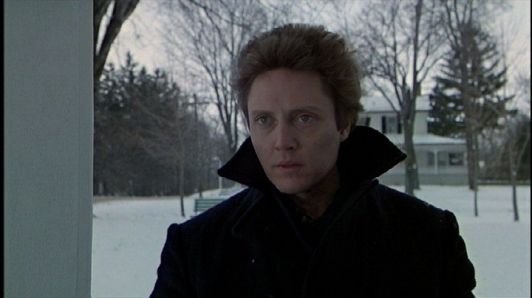
Cronenberg keeps the tone of the film oppressively heavy (Michael Kamen's score is particularly down-beat) and the Canadian locations have a dull, overcast, obliquely lit feel to them, like every moment is a late afternoon threatening to snow. Smith is a particularly sepulchral figure, Walken's tall frame shrouded by a long black overcoat, hobbling stiff-leggedly with a cane, like a harbinger of doom, his eyes haunted, but Walken's hooded eyes grow wide, when he touches someone or an object they possess, as if grabbing a live electrical wire as he goes into his vision.  Before long, he is perpetually wearing black gloves.
But, on one of his rare excursions out he manages to take the hand of one Gregg Stillson (Martin Sheen), a Senator with eyes towards the presidency, and what he sees is Stillson launching a nuclear attack, ensuring Mutually Assured Destruction, and he becomes obsessed with stopping it. 
Screenwriter Jeffrey Boam does some compression and simplification of the novel that emphasizes coincidence for the sake of a romantically resonant ending, but all in all, it is one of the best of the King screen adaptations (you've got to be careful with King—if you boil down his stories too much and take out too many of his incidents, you can sometimes see that the skeleton of his writing is calcium-deficient). The cast is amazing—Walken, Adams, Lom, but also Tom Skerritt, Anthony Zerbe (playing a strong character for once), Colleen Dewhurst, and the wonderful Jackie Burroughs—and they keep things playing out naturally, with only Sheen veering into a kind of caricature. 
It's one of Cronenberg's tamer, more straightforward early films (relatively, although there's some gut-churning violence), but it's one of his great ones.
Cronenberg gives Smith's visions a perverse power.


Pre-election post-script: early on in the "Trump-How-Low-Can-You-Go-Limbo-to-Electoral-Humiliation," an image showed up on the wires that truly startled me as it was almost a perfect match of the scene where, to prevent himself from being shot by Johnny, Martin Sheen's Stillson shields himself with an infant, the photos of which destroy his campaign and he eventually commits suicide, his ego-driven, rambling, vague-generalities-with-no-substance ambitions having collapsed.

I've been having a private little chuckle about that ever since. Life DOES imitate art.


* It's been years since I've read the book or seen the movie, and I'd forgotten that very question is asked by Smith in both: in the novel to a WWI veteran, and in the movie to his neurologist Dr. Weizack (Herbert Lom). After some serious discussion, Weizack concludes "Yeah, I'd kill the sunovabitch."

** King's next book "11-22-63" is about a man who travels back in time to prevent the Kennedy assassination.  I'm going to write one called "The Well" about an author who goes back to it one too many times.  (Note: There was a "The Twilight Zone" episode called "Back There"—great score by Jerry Goldsmith, btw—about a man who goes back in time and—unsuccessfully—tries to prevent Lincoln's assassination. It starred Russell Johnson, who, whenever he came into the studio I worked at, I'd make sure that his reading copy had nice big bold type on it as his vision was declining. He appreciated it, and I had a standard exit line for his thanks: "Well, after all, you went back in time to save Lincoln...")

*** In the novel, the accident Johnny is in is caused by drag-racers.