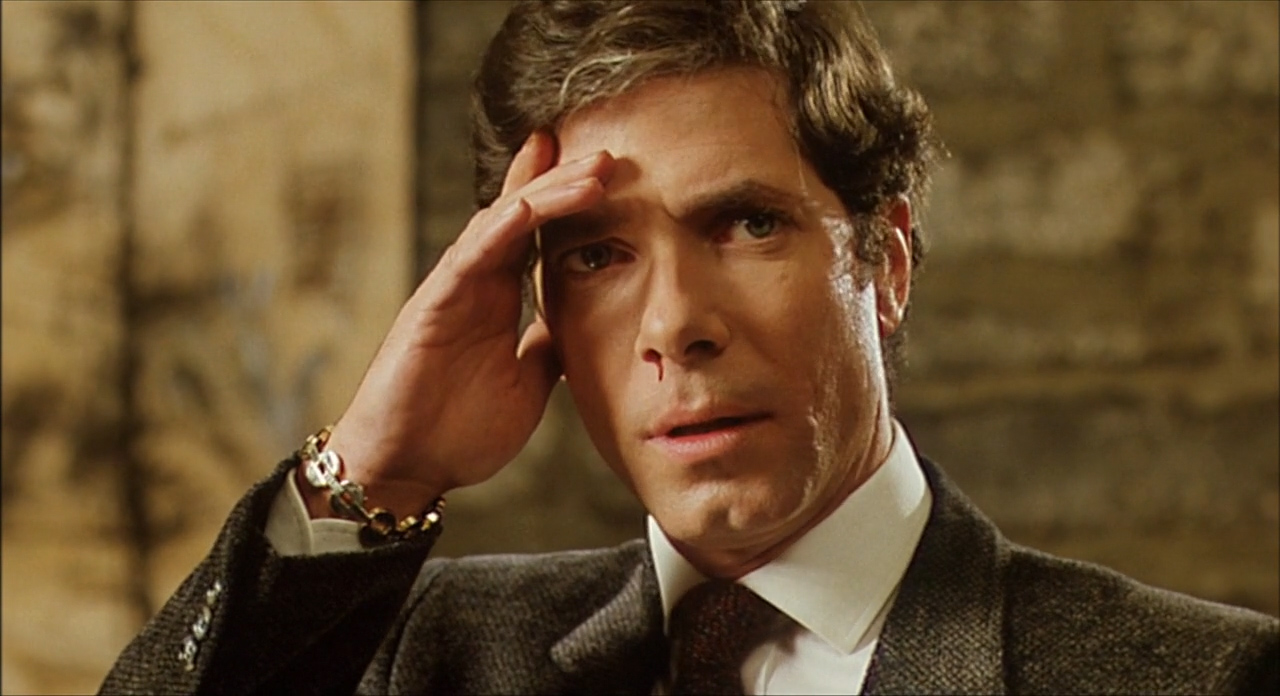
Herman Raucher's remembrance of growing up an adolescent (the word "teenager" wasn't in common usage yet) in the early days of America's involvement in WWII and being lost between the worlds of youngsters and adulthood was a huge hit when it was released to theaters (despite little promotional fanfare). But, strong word of mouth made it popular*, and as the Warner Brothers had no confidence in it at all—director Robert Mulligan (who also provided the narration) barely eked a million dollar budget out of them—it made an inordinate amount of profit. 
 While the boys are conspiring and having deep discussions about acquiring "rubbers" and timing "feels" and poring over medical books for details, Hermie's
interest in the sex education is to appear more mature and less a boy in
the eyes of Dorothy, and given his propensity to "hover" nearby, the two
start crossing orbits—it's a small island and, as I said, he's usually in her vicinity—and he begins being helpful, helping her with "man" stuff, like carrying her groceries...or anything...just to be near her.
While the boys are conspiring and having deep discussions about acquiring "rubbers" and timing "feels" and poring over medical books for details, Hermie's
interest in the sex education is to appear more mature and less a boy in
the eyes of Dorothy, and given his propensity to "hover" nearby, the two
start crossing orbits—it's a small island and, as I said, he's usually in her vicinity—and he begins being helpful, helping her with "man" stuff, like carrying her groceries...or anything...just to be near her.
 Whatever these matters, Summer of '42 hit a collective chord and was an unexpected box office hit, admired by many—in fact, it's a favorite film of such disparate directors as Stanley Kubrick (in The Shining, the Torrence family can be seen watching it) and Quentin Tarantino.
Audiences were in a romantic mood. Love Story had been a huge hit six months previously, and when Summer of '42 was released in April of '71, American audiences were still in a bit of a lovesick delirium. And Summer of '42, despite its emphasis on the horny bantering teens that make up the majority of the film, it is best remembered for its love story, aided and abetted by Robert Surtees' dreamlike cinematography and Michel Legrand's tentatively yearning (if extremely spare score).

The story is all about "Hermie" (Gary Grimes) "Oscy" (Jerry Houser) and "Benjie" (Oliver Conant), vacationing with their families on Nantucket Island in the first Summer of U.S. involvement in the war. The boys are 14 years old and they spend their days on the beach playing war-games, and ogling the local girls. They're already planning how to join the Army and/or "get laid," the latter being the (in their minds) most easily attained. "Oscy," the most impatient for both occurrences is the most persistent, hoping to score with the local girls—any of them, really—and is hardly aware that "Hermie" only has eyes for "Dorothy" (Jennifer O'Neill), married to a service-man, about to be shipped off to the European theater.


29 years passed between Raucher's summer of '42 and the appearance of Summer of '42 in theaters (although Raucher wrote it in the 1950's and, in his words, "couldn't give it away" then). Almost double that amount of years have passed since its release, and things and morés have changed. At the time of the film's release, the film was seen as a coming-of-age story with a bittersweet ending about love gained and loves lost, with a lot of goofy adolescence hi-jinks for humor.


But now, at this point and time, movie-Hermie seems more like a stalker...and Dorothy's actions? They're something she might be prosecuted for, however one sentimentalizes it.** "Circumstances" may be argued and motivations considered, but, the way the movie presents it, it's a good thing that Dorothy gets out of town before the insulated island begins to suspect anything. Sure, I'm a jerk for mentioning it, and it's certainly not in the romantic spirit in which the movie wants me to wallow, but there are "circumstances" and then there are "consequences"...in the real world, if not in the rarefied movie-world that Raucher and Mulligan present. The studio even had some initial cold-feet: the film was raunchy enough to be rated "R" (restricted from those under
17—so the kids portrayed in the movie wouldn't have been able to see
it!), although after its initial release, it was changed to a "PG"
rating for suburban theater runs without a single frame of film being
cut. Mulligan's work as director comes through extraordinarily clearly—he was able to coax lived-in performances out of his players that they rarely ever again achieved, whether it was Natalie Wood, Sandy Dennis, or the parade of kids he directed from To Kill a Mockingbird all the way up to Reese Witherspoon in The Man in the Moon. Here, both Gary Grimes and Jennifer O'Neill make career-launching performances that they couldn't equal, subsequently, and he pushed Jerry Houser into a manic-comedy highlight that the actor subsequently leavened in later appearances. And Mulligan's live-television history inspired his "go-for-broke" perfect camera placement without ever making a show of it. Mulligan's movies have the "lived-in" quality of place that make you feel that you've been there before, even if it's your first time. His movies "feel" real. But, usually, without the earnestness of sentimentality.


The sentimentality if where Raucher comes in, but he does get one thing very right—he, after all, represented it best by his 29 year obsession with it—that such encounters of the significantly heart-felt kind can last a long time, and mark the sea-change between lust and love—is there any difference to a 14 year old boy?—until things get serious and one starts thinking about someone else rather than themselves. If we're going to get all soppy about "manhood" that's where growing up is achieved. Not in the sack, but in the soul.

I was never to see her again. Nor was I ever to learn what became of
her. We were different then. Kids were different. It took us longer to
understand the things we felt. Life is made up of small comings and
goings. And for everything we take with us, there is something that we
leave behind. In the summer of '42, we raided the Coast Guard station
four times, we saw five movies, and had nine days of rain. Benji broke
his watch, Oscy gave up the harmonica, and in a very special way, I lost
Hermie forever.

* There's a lot of irony here—much to author Raucher's favor. The film's small budget didn't allow much pay for the writing of the screenplay, and the author was enticed to take a back-end deal, where he'd be paid 10% from the profits of the film's theatrical release. It was an easy deal for Warner Bros. studio to make—they didn't think the movie would make any money. But, during the film's post-production, Raucher was encouraged to write a novel based on his screenplay to maybe help the box-office. Raucher's novel—a thick, much-expanded version of the script—concentrating on the boys' more than the Hermie-Dorothy story-line (which had always been Raucher's intention: he wanted to pay tribute to his friend Oscar, who, in reality, was killed in the Korean War—on Raucher's birthday, in fact, which he hasn't celebrated since). Raucher wrote it in a month's time, and when it was released, became a "runaway" best-seller—whether by actual public interest or studio "priming" is unsure—spending a good block of 1971 on the New York Times Best-Seller list, both before and after the movie's run in theaters. And it's still available, under the Barnes & Noble imprint. With the success of the book and the unexpected success of the movie, Raucher made an awful lot of money.
** People who love the movie will be offended that I bring this up. "How dare you?" Because it's the reality of the situation, when looked at, free of the gauze of romantic gooeyness. Summer of '42 is like a male-weepy version of An Affair To Remember in that regard. It takes a hard heart and a sense of realism to look at it with clear—un-teary—eyes. Credit Mulligan's artistry for that. But, then the film is more blatant: it implies that something sexual happened between Hermy and Dorothy. Raucher's book and his memory of the incident was one of shared grief and intimacy, but no sexual congress. But, the movie? It wants you to "go there."