Showing posts with label V. Show all posts

Tuesday, September 24, 2024

The Virgin Spring

The Virgin Spring (aka Jungfrukällan) (Ingmar Bergman, 1960) The 1961 winner for the Best Foreign Film is one of the most stark in the filmography of Ingmar Bergman. Much criticized and censored in the U.S. when it was first released, it is a surprising gut-punch of a film that takes on the themes of violence, revenge, jealousy and guilt in a way that goes against the grain of Bergman's more esoteric films, and feels more like an exploitation film...with a conscience, sitting somewhere in the storytelling territory between myth and mysticism and the grim and the fairy-tale. With a dash of religious conflict as a chaser.   

I remember it as a film being offered for a showing at my local High School and being told—in no uncertain terms by my parents—that I would no way, no how be allowed to see that film. The Seven Samurai, sure, I could see that one. But, not The Virgin Spring.

Frankly, seeing it recently, I can't blame them all that much. Bergman's film would have knocked me for a loop. As it did so many. 
Based on a legend (and subsequent ballad "Töres döttrar i Wänge
") of the building of the church in Kärna in medieval Sweden, and the reasons behind it, Bergman tells the story of Töre (Max von Sydow), a landed farmer in the 14th century. Proud, prosperous, Christian, but not so arrogant that you wouldn't find him also working with his servants in the field, he would seem to have it all: married to Märete (Birgitta Valberg), his second wife and their daughter Karin (Birgitta Pettersson) and foster daughter Ingeri (Gunnel Lindblom).
The two girls couldn't be more different ("as different as rose and thorn" 
Märete says)—Ingeri is dark and treated as a servant, and not much respected as she is quite pregnant, while the favored daughter, Karin, is blonde and pampered and indulged—perhaps too much. Great pride is taken in Karin, especially by Töre, while his wife's is measured by an adult parent's guarded judgement. It is a grand day for the Töre's; Karin is to take candles they have made to the church for the Virgin, and although Karin feigns sickness—to get out of going to church—she is only too happy to go proudly in her silken yellow shift (sewed by fifteen maidens!), Sunday skirt and blue cape (oh, and the white stocking and the blue shoes with the pearls!), like royalty.
Karin insists that Ingeri go with her (as she never gets off the farm) and the journey is a day's ride, but she doesn't know of her step-sister's animosity towards her and that Ingeri has secretly prayed to the god Odin to come to her aid—what that might entail isn't made explicit, but it's quite possible that he heard. Fording a river, they come across a mill attended by a wizened old man (
Axel Slangus), answering to no name: "I hear what I want to hear and see what I want to see." he tells Ingeri while Karin travels onward towards the church. "I hear what men whisper in secret and see what they think no one sees." He has cures for Ingeri and he professes to hearing "three dead men riding north" and invites her to hear what he hears. As he has heard her.
Already superstitious, Ingeri flees from the old man, following—against her best instincts—Karin into the dark forest. But, what she sees freezes her in her tracks. Three goat-herders have prevailed upon the kind-hearted Karin to stop and she invites them to eat the meal packed for her journey, but by the time Ingeri has reached her, they've attacked her, raping and then bludgeoning her to death, stealing her fine raiments and escaping into the forest. The rock Ingeri had planned to throw at the villains to stop them falls uselessly from her hands.
This is brutal stuff. And the film will only get more brutal as it goes along, as the film delves into the revenge for the act, but it's not one that comes from the heavens unless one believes that there are no coincidences. If that were so, it could be God or Odin or Fate that propels the film darker into an abyss of revenge and murder, but those entities seem to merely listen to the one-sided conversations of the beings that enjoin them. They are mute for all the homage paid.
But, not entirely.
 
If the pagan god of Odin makes an appearance, the Christian god is given equal time, through iconography and one apparent miracle, although not one to affect  the actions of the characters or the outcomes of things in the tale. Those are entirely the responsibility on the human figures, influenced or not by any deity.
I'm not one for revenge stories, which, given the absence of any sort of divine retribution, The Virgin Spring is. I don't find triumph or even satisfaction in them. For one thing I don't buy the math. "Eye" doesn't always equal "Eye". And I think for any retribution there is always a cost, even an invisible one. At least, there should be. But, The Virgin Spring, for all its measured coolness, boasts some of the most visceral acts of revenge ever put on the screen, no matter how much slaughter one has seen in movies. In part this is due to von Sydow's performance, which usually is noteworthy for its stillness and its internal strength. But not here. Töre seems ready to erupt at any time, whether from boastful pride or his own horror at what he finds himself capable of.
Von Sydow's performances are always imbued with spine, but in this, with all of its violent actions, he seems, ironically, more vulnerable, more capable of shame, of guilt, and penitence. The lip quivers, the hands shake, as if the revenge itself has affected him as well as his victims. But, then guilt and shame are major emotions in The Virgin Spring where everybody seems to be a victim...by their own hands or the hands of others, even if its the hands of Fate.
Later in his life and career Bergman would look back on The Virgin Spring and call it "a wretched imitation of Kurosawa." Imitation in themes and technique, maybe...but as unique and devastating as the Master would have made it half a world away.
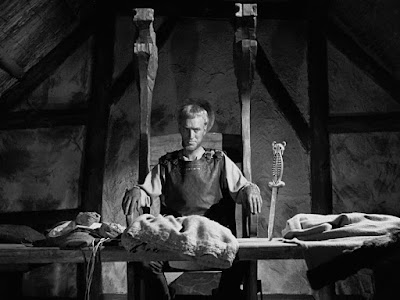
Ingmar Bergman—film fan—checking out "Bruce" the shark
on the set of Jaws.

Thursday, May 30, 2024

Vicky Christina Barcelona

Written at the time of the film's release...

"Juan is the Loneliest Number That You'll Ever Do"

or
"To Javier and Javier Not"


Vicky Christina Barcelona (Woody Allen, 2008) The latest film in what will, no doubt, be called Woody Allen's "Scarlett" period, Vicky Christina Barcelona was shot almost totally in Spain, and benefits from the change of location. It's a large part of what drives the plot and the two women who vacation in Spain for different purposes.

Vicky (Christina Hall) is studying Catalan architecture (particularly Gaudi), and spends the time in Spain as a prelude to getting married to staid, reliable Doug (Chris Messina). Christina (Scarlett Johansson) has just written and directed an 18 minute film starring herself, and broken up with the latest in a series of men in impetuous affairs. She has no business in Spain, but goes to spend time with Vicky and get away. Vicky values the safe and dependable. Christina is searching, "certain only of what she doesn't want," as explained by a ubiquitous Narrator (Christopher Welch), whose constant comments make the film feel less a visual experience than a story with pictures.
While in Spain, the two women are approached by darkly handsome artist Juan Antonio (
Javier Bardem) who offers to fly the women to the town of Oviedo for the weekend to view the Gaudi works, drink wine, and make love. Vicky thinks Juan is a creep. Christina is intrigued, but both women end up going, Vicky to protect her impetuous friend.
Juan is soulful, attentive, but it is obvious he is in love with his ex-wife Maria Elena (
Penelope Cruz), despite the fact a) they couldn't make it work, and b) she stabbed him in a rage. ("Oh, that..." she says dismissively when it's brought up).
Things get complicated, but never enough for the Narrator to be lost for words or explanations, and when Maria Elena shows up again in Juan Antonio's life, the movie turns, at equal turns poetic, and dangerous. Despite the mannered ways that Allen's films can frequently turn out, this group of actors is particularly well-suited to working outside of Allen's tic's and rhythms. The closest any of the characters come to the Allen neurotic persona (a staple in Allen's films, either played by Allen or a stand-in) is Vicky, but she's much more sure of herself, if not her situation.
Bardem is sadly relaxed in the film, but Penelope Cruz is a force of nature, this generation's
Sophia Loren. After being stuck in some unmemorable films with some straight-jacketed performances, the last few years and films have displayed a bravura presence, and she runs a gamut of emotions in this one to full effect. It's a tough role to pull off--she's held up as an icon until she appears, and when she shows up later in the film, arriving bedraggled from the hospital after a suicide attempt, Cruz more than fills the bill, with her extremes of behavior never seeming contrived or phony.
And Johansson has rarely been better represented on-screen—one close-up in particular of Christina listening to Juan Antonio explaining his love for his ex-wife fairly burns on the screen with resentment.
 
It may ultimately prove to be a minor Allen film, but as a change of pace and an expansion of style it couldn't be more successful.

Wednesday, April 12, 2023

A Very Long Engagement

Written at the time of the film's release in 2004. There have been a lot of movies about WWI since then. Now, you know what they were watching when preparing their movies.
 
A Very Long Engagement (aka "Un long dimanche de fiançailles") (Jean-Pierre Jeunet, 2004) Epic war film, reuniting Jeunut with his Amelie star Audrey Tautou, that tells the story of one woman's search for her lost lover who went to WWI and never came back. The film is full of story and incident (and Jeunet's wind-up mechanism way of telling a story) that it makes the 134 minute film feel a lot longer.The film starts as a story told in flash-back of five soldiers who were court-martialed for self-mutilation (shooting themselves in the hand by various means) in order to get themselves out of the war and the hellish existence in the trenches on the front line. One of them is the Manech (Gaspar Ulliel), lover of Mathilde (Tautou), whose fantasies and re-imaginings of the circumstances of the war make up the bulk of the film's realisation. By various means, she begins to piece together the story of her lover's court-martial and punishment (he and the others found guilty are thrown out of the trenches into "no-man's land" to fend for themselves), which are told "Rashoman"-like from different angles and perspectives.
The war-scenes are appropriately grisly, Jeunet displays his usual penchant for things grotesque--there's a murder of a rotund general by a prostitute that's particularly...interesting--that are part and parcel of his films, and there's the tendency to turn his films into little Rube Golberg-esque mechanisms, that can become tedious as much as they can delight (He always has to thrown in "the mechanism of sex" joke somewhere, too).*
Still, as distracting as his eye for the unusual shot can be, there are moments of "gee-whizzery" and CG-wizardry that are pretty wondrous, and stay in the head long after the details of the movie fade. Jeunet is a master of bending reality to meet his artistic goals, whether lighting and dressing an area to its maximum potential, or employing digital tricks to make it conform to his vision or the past's.

Examples of some of the amazing frames of A Very Long Engagement, some courtesy of Evan Richards and his wonderful blog "Cinematography, Etc.**
A make-shift field hospital set in a dirigible hangar is engulfed in flames
when a bomb sets off the contained hydrogen.
A sinister night meeting is made even more so in Jeuneut's composition
--as the one must come down to the other's level.
Going a long way for a visual pun-a farmer is met by gendarmes to join the war-effort,
and the wind from their car sweeps aside the tall grass leading to their wagon. "Draft," indeed.
Jeuneut makes incredible use of depth-of-field here, as Mathilde seeks out the wife of one of 
the condemned in a market-place (Yes, that is Jodie Foster, whose french is impeccable)
A Luhrmann-esque "post-card" shot told in lettered flash-back.
A CGI recreation of WWI-period Nice, France. Quite Nice, in fact
The crippled Mathilde must stand on her rickety wheelchair to reach for war records.
"MMM"--the initials "Manech's marrying Mathilde" --is a constant icon throughout the film. 
Here, Jeuneut cranes up from the carved initials to Mathilde's obvious bliss.
The shot will continue further up to include an albatross-symbol of tenacity.
The young Mathilde fantasizes that her new boy-friend will save her from falling from the lighthouse. 
The next scene will have them embracing as they gaze from the light in a mock-Hollywood shot.
Jeuneut makes the stair-way leading to the light-house lamp a literal "golden spiral".
From the impossibly soaring crane-move preceding it, it's obviously a set, 
but the breathtaking sun-set looks quite real, even if it is computer-enhanced.
Jeuneut makes Mathilde's family's home warm and earthy by accentuating the color palette of the scene.
The Fog of War--Jeuneut drains the color out of a stark battlefield to shades of gray.
A hospital is drained to a sepia tint, not unlike the jaundiced color of old medicine bottles.
The lighthouse stirs to life

Ultimately, it is such a polyglot of a movie that one can't help feel it might split any potential audience. Those wanting a purely romantic film will be put off by the war scenes and the occasional blunt sexuality, as well as the prolonged sense of hopelessness the film radiates. Those interested in the mystery aspect will be frustrated by the lack of momentum in the progress of acquiring facts and the diverging stories leading to blind alleys. What spurred me on was seeing the amazing scenes like the preceding ones, and seeing a new one around every splice.

It's an amazing film, if not everyone's cup of tea.

* It occurs to me that in the unlikely event Steven Spielberg ever wants to hand over the reins of the "Indiana Jones" films to another director Jeunet would be the perfect choice. ***
 
** Sadly, no longer a part of the Inter-webs. But, credit where it is due.
 
** Uh, yeah. He didn't.

Wednesday, August 3, 2022

Vantage Point (2008)

Vantage Point (Pete Travis, 2008) An American news crew sits in their van in Salamanca, Spain, technically coordinating coverage of a Presidential visit. No sooner does POTUS (William Hurt) take the podium when two shots ring out, sending him flying, to the horror of the news-people, the Secret Service, the crowded throng and the millions who are (probably not) watching at home. For a split-second, there is reaction all around, and then the confusion starts: where did the shots come from, who's that running guy, get the president to the hospital, foot-chase. At the end of it, a lot of people are dead, and the ramifications are huge, while the news channels try to play catch up...and one suspects never will.
   
This one's just plain crazy. The same 15 minutes, played out, rewound, clock started again, and POV switched. Technically, it's a daunting challenge, with all the shots of things that have gone before shifted into the background, and having to match what went before in the same time-frame that it did before, although one later incident seems to be fudged a little longer to allow some exposition in one segment (all the better to build suspense). The director, Pete Travis, mostly known for his British television work) does one thing that always drives me nuts in pot-boiler novels—he takes you to one pop-eye inducing moment...and then...stops and goes back. Next chapter. We'll get back to that...
That would make it "a relentless page-turner" if it had a spine, but you're stuck watching the movie, wondering, "Yeah, but what about..." Annoying. But, not enough to make you hit the "Eject" button.

Source Code
did this a little better this year, and had the decency to make all the populace in it more than innocent by-standers.  Most of the characters are there to serve a function in the plot, rather then being motivated, save for Dennis Quaid's Secret Service agent, who has just come back to active duty after taking a bullet for this President six months earlier. The speculation is that he might be a little gun-shy (if so, he wouldn't be put on active duty, now would he?)
 
This is the problem with the film. Good concept (even if it is Akira Kurosawa's), but the deeper we go into the movie and the more we find out about this 15 minutes, the situation becomes less and less likely, and more and more contrived. It has the kinetic feel of an episode of "24" compressed and spread out over a ninety minute running time. And, it isn't even "The Rashomon Effect," where (when it's done well) the differing perspectives are colored by the person telling the story. Here, facts are facts—it just happens from different angles, how the person feels about it doesn't enter into things. In that regard, Vantage Point is just a standard detective thriller, more about information dissemination in an electronic 24 hour news cycle, rather than saying anything about the human condition—besides the obvious jumping to conclusions. The film begins and ends in that van and the broadcast of events, making the point that there's a photon-filter between truth and knowledge. At the end, the news audience does not know, and may never know exactly what went down. But, given what we already know about the efficacy of reporting "while it happens," the endless speculation and rumor-airing and other apocrypha and opinion that's offered as journalism, it is a bit of a hollow exercise, a "gimmick" movie without that much to offer.
Is it a good movie? I don't know.

Wednesday, May 18, 2022

Venus

Roger Michell died last year at the age of 65, before his latest film The Duke was released. It is out now and I recommend seeing it, especially in a theater, where it will do the most good. Michell's most popular film is probably Notting Hill, but he also made The Mother and Enduring Love (for you Daniel Craig fans), Hyde Park on Hudson (with Bill Murray as Franklin Roosevelt), and Morning Glory (with Rachel McAdams, Harrison Ford and Diane Keaton)—which we'll be looking at tomorrow. To sum up, he made movies that are usually placed in "art-houses" where films of a limited budget and less than frivolus subject matter, unsullied by hyperbolic press and saturation campaigns go to die...and merit consideration during Awards Season, where sometimes their fortunes are favored, but mostly forgotten. And he was darned good at it. 
 
Here's a look at one of his films—featuring another amazing performance of Peter O'Toole. It was also the feature film debut of Jodie Whitaker, who made history as the 13th Doctor Who. This was written at the time of the film's release on DVD.
 
Venus (Roger Michell, 2006) Peter O'Toole, in an interview in the special features section of the Venus" DVD sums it up as a story between "a dirty old man and a slutty young woman." Exactly, and if it had been sold like that it would have made much more money at the box-office. As it is, the film has to stand on its own merits, which are considerable. Hanif Kureishi's script is literate but low-down, full of humanity in all its frailties, both young and old, well-played by a stellar cast. And that's where the elements of specialness occur:
1) O'Toole--he plays an elderly thespian who, these days, "specializies in corpses," who has lived an impulsive romantic life, and in the winter of his discontent, still does. O'Toole makes the most of the words, but, more than any other actor, knows what to do between the lines. O'Toole is frail, but not THIS frail, and his tremulousness is a stunning act of craft over pride. He's not alone.
2) Playing the ex-wife he abandoned with three kids ("under six," she reminds him) is Vanessa Redgrave, the greatest actress extant, who does the part sans make-up, unglamourously and brilliantly. To see O'Toole and Redgrave play a scene together for the first time is a great event, and should be required viewing for all aspiring actors. These two actors, once coltish and prancing, now old and playing broken down is heart-breaking, but exciting (I'm starting to sound like bloody James Lipton!)
3)
Jodie Whittaker, in a seemingly artless way, matches them. That is not an insignificant thing. Picked, no doubt, because she resembles the young Vanessa Redgrave, one waits for the scene where the two meet. The viewer is not disappointed.

4) A scene where O'Toole, humiliated, goes for a walk and finds himself at a small, humble proscenium--the benches covered and strewn with leaves and garbage, as the soundtrack becomes awash with O'Toole's voice from past performances of different eras and different fidelities that's as fine as any piece of film I've ever seen
5) A waitress at the old actor's favorite eating hole sees a picture of the young actor in the paper. "Gawd, he was GO-geous, wasn't he?" Someone should make another starrer for O'Toole and call it "Give The Man The Friggin' Oscar He So Richly Deserves, Already" and be done with it.
2022 Update: Peter O'Toole was nominated for 8 Best Actor Performances and received an "Honorary Award" in 2003.

Saturday, February 19, 2022

The Valley of Gwangi

This was written in tandem with my appearance on the Forgotten Filmcast podcast, which you can find by clicking here.

The Valley of Gwangi
(Jim O'Connelly, 1969) The idea for The Valley of Gwangi had been around since Willis O' Brien—the genius behind the stop-motion animation sequences in
King Kong—shopped it around the studios in 1939, with no takers for his cowboys-and-dinosaurs concept. RKO was more interested in a Kong sequel, the result of which was 1949's Mighty Joe Young, a cowboys-and-gorilla movie that O'Brien worked on with a young protege named Ray Harryhausen
 
It was not the most stable work to be a stop-motion animator. Special effects movies were no guarantee of box-office, the meticulous one-frame-at-a-time process usually played havoc on scheduling for release, and Hollywood was more interested in what they could do fast and cheap. Plus, special effects...if not done well...had a way of cheapening everything else. Special effects movies were a niche market, as well, even more risky to have a hit.
The Valley of Gwangi began production on a high—Harryhausen's work was featured in a box office success—the Hammer film
One Million Years B.C. (although one would argue that people were going to see Raquel Welch in an improbable fur bikini rather than Harryhausen's dinosaur fights). Harryhausen had partnered with Charles H. Schneer, with whom he'd made a few adventure films in the 1950's and early 60's. After One Million Years B.C.—which Schneer had nothing to do with—the two settled on a formula similar to their fantasy/adventure films of the earlier time...only they'd add a buxom female lead to the mix.
Gwangi begins with the discovery of a body in a remote corner of the Mexican desert. Carlos (
Gustavo Rojo) finds a member of his gypsy band unconscious clutching a burlap bag in which something is moving. Cut to the T.J. Breckinridge Wild West Show trudging into a small Mexican town, the latest stop in their tour. Watching is Tuck Kirby (James Franciscus), who's working for the competing Buffalo Bill show and wants to buy the Breckinridge outfit out. Two things will get in his way: Manager Champ Connors (Richard Carlson) doesn't like Kirby due to his past history; and T.J.Breckinridge (Gila Golan) who has taken over ownership of the show after her father's passing, and is the other party in Kirby's "past history."
T.J. won't sell—she has a secret attraction that will make the show's fortune. And who better to show it to than her competition/former lover? It's a tiny horse—the one found in the desert—and she's sure that the creature will be a sensation. Kirby thinks so, too, enough that he wants to find out where "My Little Pony" was found. A gypsy boy Lope (
Curtis Arden) thinks he knows the answer and in their search they come across a paleontologist (Laurence Naismith), who has a fossilized footprint of just such a small animal that he's also searching for.
The presence of the little horse, called El Diablo at the Wild West Show and eohippus by the paleontologist, is a source of conflict among the local gypsies who believe that removing the creature from its home in the Forbidden Valley will bring about a curse that will doom everyone forever, and the scientist conspires with them to steal the critter and return it home, ostensibly to ward off any evil, but from the prof's standpoint, he'll be able to discover where it originated. When the horse-napping is discovered, Kirby, Connors and Breckinridge all ride out in the desert, following the trail of the thieves.
They get more than they bargained for. The Forbidden Valley is the last vestige of a prehistoric kingdom, home to many sorts of dinosaurs, all ferociously ready to do a lot of biting. Of course, Carlson sees these things and goes into "Carl Denham"-mode* wanting to capture the most lethal of the beasts and make him a star attraction of the Wild West show. Surprisingly, T.J. thinks this is a grand idea. Kirby thinks they're all nuts—"the only thing I want to bring back alive is myself!"
Hubris being hubris and movie formula being movie formula, an allosaurus is brought back to the show...and chaos ensues...right at show-time (it just goes to show you what you miss if you arrive late!). How will a turn-of-the-century Mexican town get rid of a rampaging dinosaur? After all, there aren't any available major power lines nearby...they haven't been invented yet! And history doesn't help as the chances of a big asteroid hitting are a bit remote.
It's entertaining, but, golly, it is dumb. But give credit to the actors to playing their scenes with deadly earnest. The look of incredulity on Franciscus' face when he sees his first dinosaur is a nice study in less-is-more, not over-playing it, just a look of "how the heck am I going to break THAT?"** Franciscus was a small "a" actor who was impressive on the television screen but not so much in movies. His character stays refreshingly consistent as a slightly seedy roustabout, who could turn at any moment despite wearing the whitest of hats...and suits. The other actors are either troopers...or they're dubbed.
And one has to admit that a Blu-Ray presentation of this feature won't be an improvement unless they do some major tweaking of the special effects sequences, especially in the colorization. It's been pointed out that "Gwangi" (with a soft 'g") keeps changing hue without any mention of having camouflage ability. And in most of the stop-motion scenes, the dirt surrounding the creature is consistently a different shade than the dirt in the film-footage. It's as if Gwangi is being followed by a spot-light. Those details are heard to tweak when you're going one frame at a time...or the film-stock used in the process let them down. In whatever case, it's enough noticeable on video to slightly disappoint.
Still one can't do anything but marvel at what Harryhausen was able to do at the time, going frame per frame, with the film footage projected behind it. The subtle lip curls, the almost required animal behavior—before Franciscus notices Gwangi, there's a moment or two of waiting, so the dino scratches its head!—the intricacy, even given the jaded perspective of a CGI-niverse is a wonder to behold. 
 
King Kong was the 8th Wonder of the World. Harryhausen was the 9th.

 * Carl Denham is the relentlessly crass entrepreneur who insisted on bringing King Kong from Skull Island to New York, presenting it as "the 8th Wonder of the World."
 
**