This was written in tandem with my appearance on the Forgotten Filmcast podcast, which you can find by clicking here.
The Valley of Gwangi(Jim O'Connelly, 1969) The idea for The Valley of Gwangi had been around since Willis O' Brien—the genius behind the stop-motion animation sequences inKing Kong—shopped it around the studios in 1939, with no takers for his cowboys-and-dinosaurs concept. RKO was more interested in a Kong sequel, the result of which was 1949's Mighty Joe Young, a cowboys-and-gorilla movie that O'Brien worked on with a young protege named Ray Harryhausen.
It was not the most stable work to be a stop-motion animator. Special effects movies were no guarantee of box-office, the meticulous one-frame-at-a-time process usually played havoc on scheduling for release, and Hollywood was more interested in what they could do fast and cheap. Plus, special effects...if not done well...had a way of cheapening everything else. Special effects movies were a niche market, as well, even more risky to have a hit.
The Valley of Gwangi began production on a high—Harryhausen's work was featured in a box office success—the Hammer film One Million Years B.C. (although one would argue that people were going to see Raquel Welch in an improbable fur bikini rather than Harryhausen's dinosaur fights). Harryhausen had partnered with Charles H. Schneer, with whom he'd made a few adventure films in the 1950's and early 60's. After One Million Years B.C.—which Schneer had nothing to do with—the two settled on a formula similar to their fantasy/adventure films of the earlier time...only they'd add a buxom female lead to the mix.
Gwangi begins with the discovery of a body in a remote corner of the Mexican desert. Carlos (Gustavo Rojo) finds a member of his gypsy band unconscious clutching a burlap bag in which something is moving. Cut to the T.J. Breckinridge Wild West Show trudging into a small Mexican town, the latest stop in their tour. Watching is Tuck Kirby (James Franciscus), who's working for the competing Buffalo Bill show and wants to buy the Breckinridge outfit out. Two things will get in his way: Manager Champ Connors (Richard Carlson) doesn't like Kirby due to his past history; and T.J.Breckinridge (Gila Golan) who has taken over ownership of the show after her father's passing, and is the other party in Kirby's "past history."
T.J. won't sell—she has a secret attraction that will make the show's fortune. And who better to show it to than her competition/former lover? It's a tiny horse—the one found in the desert—and she's sure that the creature will be a sensation. Kirby thinks so, too, enough that he wants to find out where "My Little Pony" was found. A gypsy boy Lope (Curtis Arden) thinks he knows the answer and in their search they come across a paleontologist (Laurence Naismith), who has a fossilized footprint of just such a small animal that he's also searching for.
The presence of the little horse, called El Diablo at the Wild West Show and eohippus by the paleontologist, is a source of conflict among the local gypsies who believe that removing the creature from its home in the Forbidden Valley will bring about a curse that will doom everyone forever, and the scientist conspires with them to steal the critter and return it home, ostensibly to ward off any evil, but from the prof's standpoint, he'll be able to discover where it originated. When the horse-napping is discovered, Kirby, Connors and Breckinridge all ride out in the desert, following the trail of the thieves.
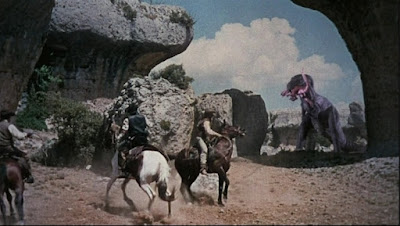
They get more than they bargained for. The Forbidden Valley is the last vestige of a prehistoric kingdom, home to many sorts of dinosaurs, all ferociously ready to do a lot of biting. Of course, Carlson sees these things and goes into "Carl Denham"-mode*wanting to capture the most lethal of the beasts and make him a star attraction of the Wild West show. Surprisingly, T.J. thinks this is a grand idea. Kirby thinks they're all nuts—"the only thing I want to bring back alive is myself!"
Hubris being hubris and movie formula being movie formula, an allosaurus is brought back to the show...and chaos ensues...right at show-time (it just goes to show you what you miss if you arrive late!). How will a turn-of-the-century Mexican town get rid of a rampaging dinosaur? After all, there aren't any available major power lines nearby...they haven't been invented yet! And history doesn't help as the chances of a big asteroid hitting are a bit remote.
It's entertaining, but, golly, it is dumb. But give credit to the actors to playing their scenes with deadly earnest. The look of incredulity on Franciscus' face when he sees his first dinosaur is a nice study in less-is-more, not over-playing it, just a look of "how the heck am I going to break THAT?"** Franciscus was a small "a" actor who was impressive on the television screen but not so much in movies. His character stays refreshingly consistent as a slightly seedy roustabout, who could turn at any moment despite wearing the whitest of hats...and suits. The other actors are either troopers...or they're dubbed.
And one has to admit that a Blu-Ray presentation of this feature won't be an improvement unless they do some major tweaking of the special effects sequences, especially in the colorization. It's been pointed out that "Gwangi" (with a soft 'g") keeps changing hue without any mention of having camouflage ability. And in most of the stop-motion scenes, the dirt surrounding the creature is consistently a different shade than the dirt in the film-footage. It's as if Gwangi is being followed by a spot-light. Those details are heard to tweak when you're going one frame at a time...or the film-stock used in the process let them down. In whatever case, it's enough noticeable on video to slightly disappoint.
Still one can't do anything but marvel at what Harryhausen was able to do at the time, going frame per frame, with the film footage projected behind it. The subtle lip curls, the almost required animal behavior—before Franciscus notices Gwangi, there's a moment or two of waiting, so the dino scratches its head!—the intricacy, even given the jaded perspective of a CGI-niverse is a wonder to behold.
King Kong was the 8th Wonder of the World. Harryhausen was the 9th.
* Carl Denham is the relentlessly crass entrepreneur who insisted on bringing King Kong from Skull Island to New York, presenting it as "the 8th Wonder of the World."
The Sound of Fury(akaTry and Get Me!, Cy Endfield, 1950) I was watching an old repeat of "British Antiques Roadshow," when Cy Endfield's name came up. Brought up for appraisal was an elegantly designed silver and gold portable chess-set to commemorate the Bobby Fisher-Boris Spassky match in 1972. Much ooh-ing and ahh-ing was made over the piece for its design characteristics and it was mentioned that the fellow responsible was Endfield, described as a "polymath," as magician, engineer, writer, director and inventor. His most famous (and successful) film was Zulu (1964), a genuine British classic, but he also made Mysterious Island (along with Ray Harryhausen)—his Hell Drivers has been posted here. Those films were made in Britain, but he started his career in America, working at RKO (where his magic legerdemain brought him into the orbit of Orson Welles), and where he directed B-movies like The Underworld Story, only to be black-listed for his political beliefs during the McCarthy era. The film we're talking about today (no matter which title you use) was particularly labeled by the House Un-American Activities Committee for being "un-American." Seeing as the film—and you could properly call it among the darkest of the film noir genre—is an indictment of capitalism, yellow journalism and mob violence, particularly lynching, one could see where this might cause a stir in '50's America. But, seeing as how it was based on an actual incident (which also inspired Fritz Lang's first American film, Fury), one might consider the source.
The film begins with a blind street-preacher haranguing passers-by that judgment day is coming and they should prepare to meet their lord (you know you're in for a rough time at the movies when that's the first thing you hear—evidently his appearance wasn't enough to assuage HUAC). The passersby ignore him, as does Howard Tyler (Frank Lovejoy), who's now out of work and prospects are thin. He's getting tired of it, especially when his wife (Kathleen Ryan) reminds him of his responsibilities and that they have a son to take care of...with another on the way.
Tyler moves the family to Santa Sierra, California to get a job in the mines, but is unsuccessful. To get away from his wife's nagging, he goes to the local bowling alley where he meets a sharp named Jerry Slocum (Lloyd Bridges, pushing his acting boundaries considerably). Jerry's a vain-glorious dandy who talks big but is a bit schizy and convinces Tyler that working in the mines is a sucker's game, one that'll kill him without much to show for it. Slocum knows of a guy who needs a good driver for some jobs that need a certain level of confidentiality and Tyler agrees.
Those jobs turn out to be knocking over gas stations, and, as much as he doesn't like his part in it, he is at least able to take care of his family...if only his wife didn't ask so many questions about what he does at night. Meanwhile, the robberies are starting to get the attention of a local reporter (Richard Carlson), who gets the assignment to pump up the story as an incipient crime wave to sell papers. Things are starting to get hot and the added attention makes Jerry want out, but that inspires Slocum to pull one last crime—a big score—kidnapping the son of one of the town's rich folk and holding him for ransom.
But, Jerry's not the best at the "long game," being so fidgety and all. When the kid tries to make a run for it, Slocum picks up a boulder and smashes his head in, then dumps him in the river—but not before taking a distinctive tie-pin for evidence. He's still trying to get the ransom for a dead man. The two head out of town, the better to mail a ransom note, and Slocum decides to make things a night on the town with women, so that there's no show of two strangers showing up in town. But, Tyler's in bad shape and starts to drink...and well...you know. Plus, with the added attention of a blood-thirsty press, the temperatures in Santa Sierra start to soar above the boiling point.
Between Bridges' histrionics and Endfield's off-kilter camera-view, The Sound of Fury has more than its share of amped-up energy that starts to explode near the film's end in a sequence of mob violence that still stiffens the hairs on the back of the neck to this day. It's a bit mitigated to off-screen action, but, really, is that something you want to see? Endfield's suggestiveness is enough to give nightmares and paint a grim picture of majority rule when it becomes a mob.
It's been tough to see The Sound of Fury, as it wasn't a hit, and there weren't many prints. One, however, was owned by Martin Scorsese (for whom it's a favorite film) and, with his permission and efforts, the film is back to its pristine, if begrimed, glory.
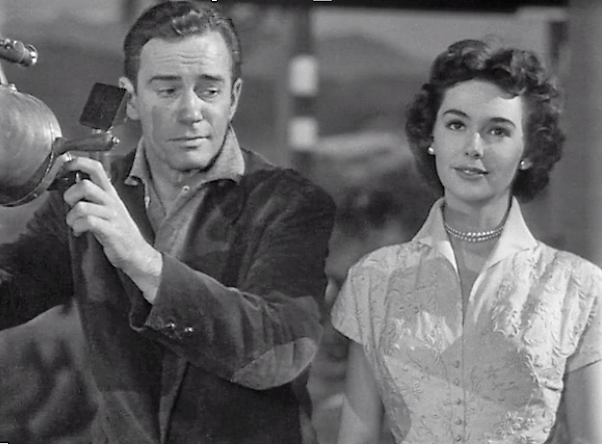
It Came From Outer Space(Jack Arnold, 1953) Before there was E.T., there was an un-abbreviated "IT." Writer and amateur astronomer John Putnam (Richard Carlson) is spending a quiet night in his desert home making lovey-dovey talk with his squeeze, teacher Ellen Fields (Barbara Rush)—frankly, she has the most earning power in this relationship—when he decides to take a look at the night sky. Well, he doesn't need a telescope to see what's coming our way. A big old flaming something-or-other comes streaking over the desert hills and crashes at the base of the desert foot-hills. Because he is so in love with his girlfriend, he decides to charter a helicopter from buddy Pete Davis (Dave Willock) to rush over to see what crashed. Hey, nothing to worry about! Little does he know that the thing is an alien space-craft, and one of its bug-eyed occupants (we'll call it "IT" for now) has exited the craft and started exploring the landing area, leaving a shimmering trail of...criminy, is that glitter? Do the "IT's" shop at Joann Fabrics?
You knows he's a 1950's writer because of the patches on his elbows. You know she's a 1950's teacher because she wears pearls.
No matter. John, Ellen, and Pete land by the crash-site at the old Excelsior mine (owned by Stan Lee, maybe?) and, interested as he is, he abandons his girl-friend and scrambles into the crater. There he finds a huge glowing orb that pulses with whatever energy or heat-waves are emanating from it. He sees what would appear to be a door at the front of it, figuring that, at that point, it's not a meteorite, but some sort of craft or device and, peering into it, he sees equipment. But, he doesn't see that he's being observed. As the door moves, it creates a small avalanche, and Putnam, no dummy, beats it out of there.
"Hmmph! Compensating for something?"
Putnam tells Ellen and Pete what he saw down there and they're a little skeptical—he should probably get used to that feeling, because over the course of the movie, nobody is going to believe what he says and they're going to think he's a kook. Doubling down on that begins almost immediately with the two most skeptical people anyone could find in a town—the sheriff (Charles Drake) and the local newspaper publisher (Alan Dexter). Putnam, still agog over what he saw, thinks nothing of telling them exactly what he saw, never once thinking "These guys could either lock me up or make me look like a loon in the paper." For a writer, he doesn't have much imagination. But, neither do police or newspapermen.
"Our town needs a soccer team..."
Of course, the sheriff is predisposed to think Putnam is a flake—he's had designs on Ellen for years (not that he'd let that get in the way of his job! *cough*) and things get a little uncomfortable between them...in front of the newspaper-guy, and so Putnam is persuaded to leave before things get worse and more people find out. But, on the way home, teacher Ellen gets a real education about maybe believing in what John saw down in the mine. But, now there's an IT blocking the road and they just avoid hitting it and trashing the car. When they get out to take a look—they get out and take a LOOK??!—the IT roadblock is gone, leaving only a trail of glitter like a "My Little Pony."
1950's prototype highway cameras...
After such a weird occurrence, Putnam and Ellen return to the Excelsior mine, where they find a circus of reporters, TV crews, police and scientists who are swarming all over the site. This might have been helped by that responsible newspaper publisher "fake-newsing" a front page headline that reads "Star Gazer Sees Martians." Way to vet, "Hearst." Putnam has microphones shoved in his face, but he and Ellen escape from the Press, but only after he is informed by one of the scientists that the craft is not radioactive. Good thing they're not in the Nevada desert in the '50's. They take a jaunt along the highway and scan the countryside with binoculars to see if they can see anything.
"I'm going to do a show called WHAT in the 60's?"
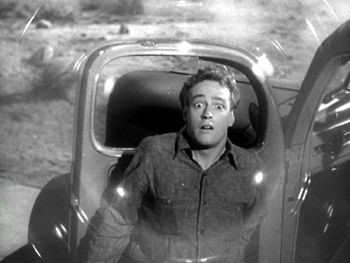
Along the way, they run into a couple of telephone linemen, Frank (Joe Sawyer) and George (Russell Johnson), who are working along the highway. Putnam stops and asks Frank if he's seen anything...ya know..."unusual." No, says Frank, but he's picking up weird signals over the wires. The two love-birds continue their searching while the two phone jockeys move down the line and have a close encounter—too close. George gets out of the close and while we get the IT's perspective through a "Jell-O" filter, he's enveloped by a noxious fog and collapses. Poor "Professor."
"John, why are all those people wearing red and blue glasses?" "I don't know, honey, but I'm glad I brought my pistol!"
Not finding anything up the road, Putnam and Ellen start worrying about the linemen they've left behind. They back-track and find the men's truck, abandoned, with some blood on the door. Putnam grabs his pistol (naturally) and the two start searching through the scrub, following the glitter to either find the ITs or Elton John. They don't get too far before they find George. But, George is, frankly, acting weird or—given that Russell Johnson is a pretty good thesp—acting badly. Speaking in a halting monotone, he has none of the personality of George and all of the personality of Al Gore. He is vague and unhelpful when asked about where Frank might be, but Putnam sees beyond a boulder an outstretched hand. Is it Frank? He doesn't intend to ask George or he'll probably get a lecture on carbon footprints, so they smile and act "normal" and get the Hell out of there.
Let me tell you about an Inconvenient Truth
Where do they go? The Sheriff's office. And why not? Just because he thinks you're a kook and has the hots for your girlfriend. What can go wrong? Putnam and Ellen convince Sheriff Matt to go with them because (gosh-darn it!) they have proof this time. And when they get there...the proof is gone. Even though it won't be invented for 15 years, someone has taken a Dust-Buster to the glitter. "But, we saw it, we tell you!" they argue, but the Sheriff just wants to get back to the office.
Too bad they weren't around 30 minutes earlier, when Frank woke up and saw two George's. The creature has taken on George's form, but reassures the two men that his kind would not take over their souls, their minds or their bodies. From now on in this post, we will refer to the ITs as "Xeroxians™." He tells them not to be afraid. It will only be necessary for a short time. We cut away before there are any questions about double Union wages for playing two parts.
Putnam and Ellen drive the Sheriff back to town, but they see Frank and George—or given their robotic walk and looks, their doubles. Putnam takes off after them and corners them, telling the Xeroxians that he wants to help, but asks where his friends are. He is reassured that they are alright, but to give the aliens time. "Give us time or terrible things will happen. Things you can only dream about." These guys sound like great Presidential candidates. Human beings must be like potato chips because the Xeroxians can't absorb just one. Pretty soon, they have a bunch of the township under wraps and unlike other alien probes, they're only violating their copyrights. Because he's a writer and amateur astronomer, Putnam decides to take the job of getting to the bottom of things rather than letting any professionals do it.
"Does this Jell-o filter make me look...?"
By any stretch of the imagination, It Came from Outer Space is not a great science fiction movie, although it does peg the ol' kitsch meter. So, it may come as a surprise that the story is an original treatment by Ray Bradbury, one the greatest lights in the night-sky of sci-fi. The screenplay is credited to Harry Essex, and the dialogue is sledgehammer subtle. But, the details are all Bradbury, most especially the concept that the Xeroxians are not invaders, but merely had to make an emergency landing on Earth, and are doing their best not to cause a distraction or garner attention to themselves. After all, they must think they've landed on the Planet of the Monkey-People and they're worried about being contaminated by our damn, dirty paws.
"Mischief Matters!"
Still, the psychology of the Xeroxians is a little contrived and very lucky for Earthlings. I mean, humans gets kidnapped and held hostage, sure, and their identities appropriated, but they're not exactly using their credit cards or something else heinous. However, on the Xeroxian side of the ledger, two of them get shot and immolated or dissolved, and they have no sense of regret or vengeance in any way displayed. Lucky Earthlings. Why, the Xeroxians don't even have a form a space small-pox that can cause lungs to explode to even the score.
"Who were those creatures?" "I don't know, but I wanted to thank them."
But, the Arizona Earthlings end up looking like doofi. There's not much tolerance displayed and a propensity to wave guns around, shoot first and investigate later. There's no sense of wonder but a prevailing sense of panic. And the Xeroxians? The worst you can say is they're dangerously middle-of-the-road—as in standing in it—and they have a lousy fashion sense. A black cocktail dress in the middle of the Arizona desert? Really? Still, that concept of non-hostile aliens is something of an anomaly in the science fiction firmament (although The Day the Earth Stood Still did it two years earlier), especially for a xenophobic time as the 1950's. Next week, same space, same time—another sci-fi movie with an equally reductive term for "the other."
Camera-saving VFX from the 1950's: evidently (you can tell from the left) that it was shot using a mirror.

 The Valley of Gwangi began production on a high—Harryhausen's work was featured in a box office success—the Hammer film One Million Years B.C. (although one would argue that people were going to see Raquel Welch in an improbable fur bikini rather than Harryhausen's dinosaur fights). Harryhausen had partnered with Charles H. Schneer, with whom he'd made a few adventure films in the 1950's and early 60's. After One Million Years B.C.—which Schneer had nothing to do with—the two settled on a formula similar to their fantasy/adventure films of the earlier time...only they'd add a buxom female lead to the mix.
 Gwangi begins with the discovery of a body in a remote corner of the Mexican desert. Carlos (Gustavo Rojo) finds a member of his gypsy band unconscious clutching a burlap bag in which something is moving. Cut to the T.J. Breckinridge Wild West Show trudging into a small Mexican town, the latest stop in their tour. Watching is Tuck Kirby (James Franciscus), who's working for the competing Buffalo Bill show and wants to buy the Breckinridge outfit out. Two things will get in his way: Manager Champ Connors (Richard Carlson) doesn't like Kirby due to his past history; and T.J.Breckinridge (Gila Golan) who has taken over ownership of the show after her father's passing, and is the other party in Kirby's "past history."