Showing posts with label Chloe Moretz. Show all posts

Tuesday, October 5, 2021

The Addams Family 2

Oh, *Snap* *Snap*
or
National Lampoon Addams Family Family Vacation Negation
 
I've made plain my life-long love of "The Addams Family" especially the TV-series based on the macabre New Yorker cartoons of Charles Addams (not the worst source for a TV show...), which, for its short two year run, did a running black satire of family sitcoms—credit to Nat Perrin, who'd worked with the Marx Brothers and who knew "funny."

Attempts to revive the characters have been monstrously uneven whether in film, TV revivals or cartoon series. The best result was Barry Sonenfeld's film Addams Family Values, which managed to combine satire—and not sitcom-satire, real satire—and clever writing to make a wicked little movie on many levels. 
 
The same could not be said for 2019's The Addams Family, a CGI-animation version that knew exactly what it was supposed to do...but couldn't make it funny. With that title, you could immediately guess that cleverness was not going to be the spark that animated the thing to life.
 
Well, now everybody's back with...The Addams Family 2. Its biggest joke might be the "Submitted for Your Consideration" ad come Oscar-time.
Oh, technically, it's all fine. CGI being what it is these days, something (like, say, a waterfall) has to be really dodgy for it to be noticed. It's just that there is a sense of rote-ness to this, a feeling that the ambitions are so slim, the characters so known, that any effort besides the obvious isn't attempted, and in fact is avoided, lest it fall out of a PG category and betray the lack of sophistication expected in animated films. There's no shock, no envelope-pushing, and no sense of the black humor emblematic of the original Addams work in The New Yorker.
This one, like the last, focuses on Wednesday Addams (ChloĆ« Grace Moretz), who is going through all sorts of growing pains. For her school's science project, she's developed a way to transfer tendencies from one being to another (ala Freaky Friday (both of them) and God knows how many other films and television shows)—in this case, she transfers her pet octopus' higher brain functions to her sweet but diminished Uncle Fester (Nick Kroll). Fester will, as the film progresses, take on more and more octo-tendencies, which the family doesn't really notice too much (which is odd but not funny). Wednesday's work is noticed by a mad scientist named Cyrus Strange (Bill Hader, surprisingly uneffective) who would like to know her methodology, which she refuses to divulge as "a family secret." 
This starts a plot where Strange sets up a plot to convince the Addams Family that Wednesday was switched at birth with another child (as the joke that Addams used for Wednesday was that she resembled her mother this makes little sense and they have to do extra work to get past DNA issues). As Wednesday is already feeling estranged from her family, this sets too well with her, but not the others, and Gomez suggests they go on a family road trip to see the worst of America (planned stops are Salem, Sleepy Hollow, Miami, San Antonio, The Grand Canyon, Death Valley, and...Sausalito). If one did a little more research—or just had the cajones to risk offending people—they could have found a LOT of places to go.
It's not a lot of fun—there were two lines that made me laugh: When the family sits down to dinner, Fester starts to dig in and Morticia chastises him: "Fester, wait for the children..." to which he replies "I thought we were having CHICKEN!" And at a detour to Niagara Falls, Morticia asks Wednesday "Having fun, dear?" To which she replies "I'm looking at Canada, if that answers your question..." (just the phrasing of that I liked). There's also a nice shot of Gomez being so depressed, he can't even cradle his head on his hands. "Thing" has to do it. It's at the bottom of the review, as it graphically encapsulates how I feel about the film.
The cast does a good job for all they're asked to do: Oscar Isaac is the proper amount of latin dash as Gomez, but Charlize Theron seems to be under the impression that Morticia went to Bryn Mawr. Chloƫ Grace Moretz has the largest role as Wednesday, but doesn't do much to sell the humor of her depressed daughter, and Nick Kroll does a fine imitation of Jackie Coogan's TV Uncle Fester, but with considerably more saliva. And why the producers thought the sonorous butler Lurch would, when he sings (!!!), have a high singing voice I have no idea, but they do it. He sings "I Will Survive" which isn't funny and makes little sense story-wise.
But, then, that passes for the best you can expect from this milquetoast Addams Family series, which is the wrong format for the wrong audience and betrays and negates the peculiar charms of Addams' original work. It should be staked, coffined, chained, and buried 12 feet deep in salted, sanctified Earth never to materialize in this incarnation again.

Friday, October 23, 2020

Dark Shadows (2012)

Written at the time of the film's bloody resurrection...

Camping Vamps and Risible Damp
or
"What Strange Terrain is This?"


"Dark Shadows" has been a cult favorite for Baby-Boomers for more than 40 years (ouch!), long before it was fashionable to have vampires as fodder for young adults. The ABC soap opera ran for several seasons of afternoons replacing the standard plot-lines of cheating spouses and long-lost family secrets with long-buried family relatives—that often didn't stay buried—and a full range of gothic ghoulery that plundered every horror story in the crypt-library, including vampires, werewolves, Frankenstein-ish monsters, time-travel, parallel dimensions and ghost stories. Why, they even robbed from "The Crucible" and "The Turn of the Screw" and got people interested in the I-Ching, for howling out loud. In fact, I kept expecting the fern in their front hallway to turn into Chthulu!
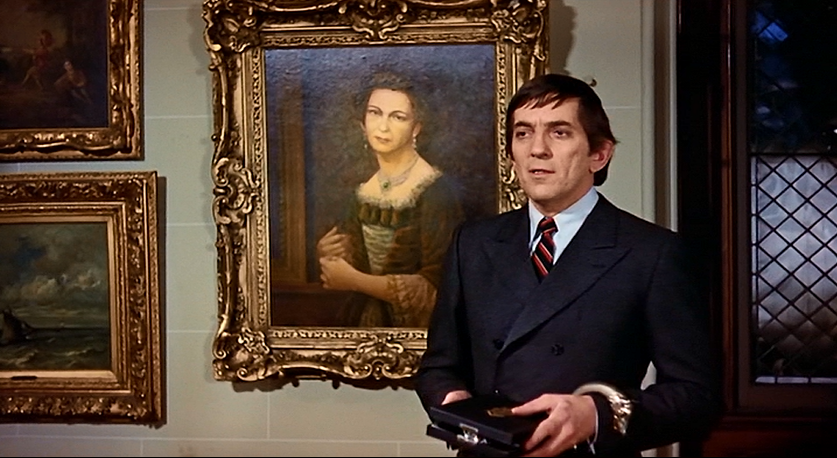
It was a TV habit of mine when I was a kid, timed perfectly to be the after-school tonic for a parochial school education, an occult chaser for the catechism, all those crucifixes I was surrounded by during the day being used for other purposes. It was also a fixation for Tim Burton and Johnny Depp, Burton digging the horror genre and Depp grooving on the character of Barnabas Collins (played by the late—or is he?—Jonathan Frid, who puts in a very brief cameo here along with a couple of other cast-mates), the reluctant vampire who pursued hearts, rather than the blood that pumped through them. The result of their dual obsessions is this version of
Dark Shadows, produced by Depp, directed by Burton.
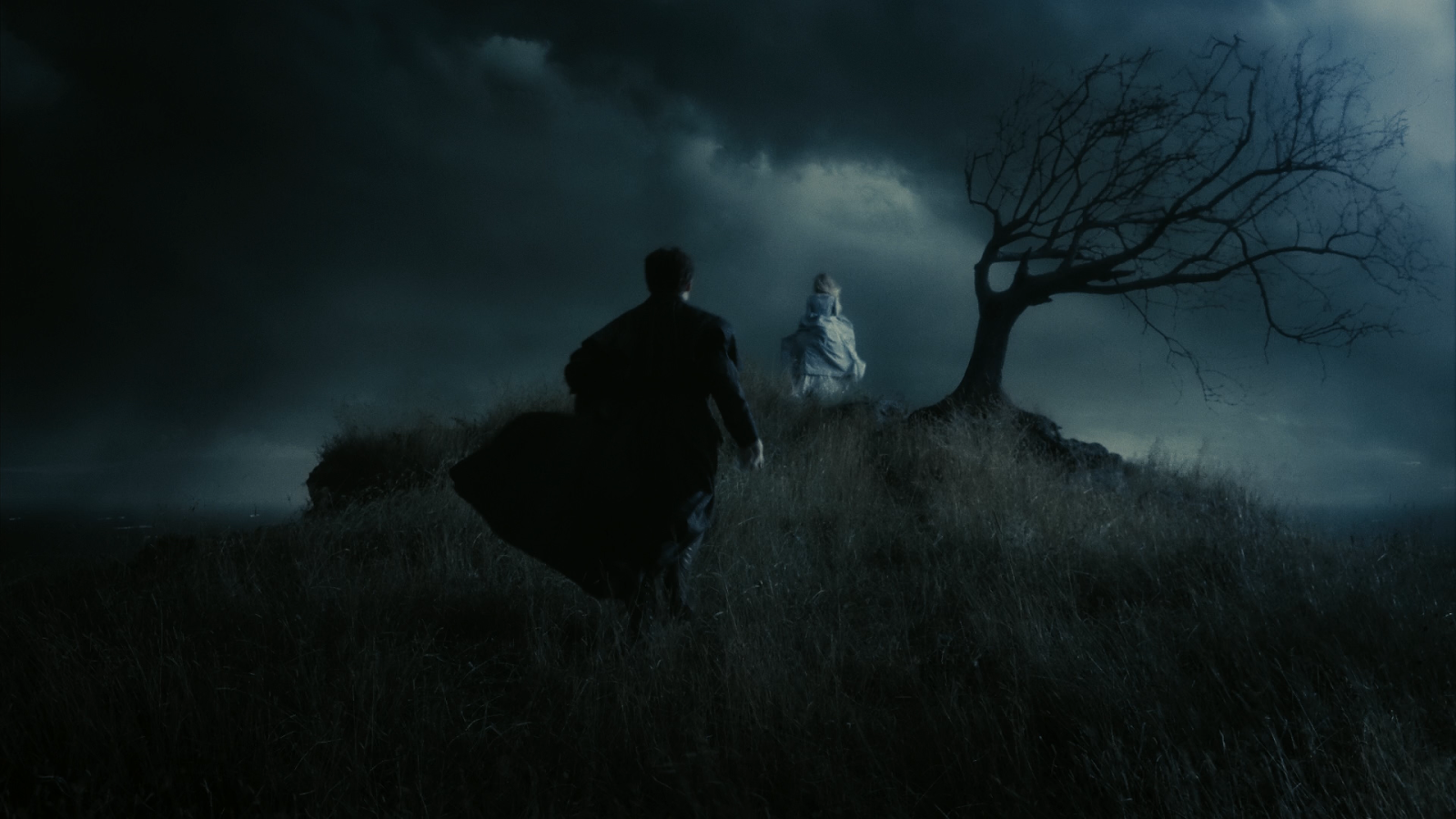
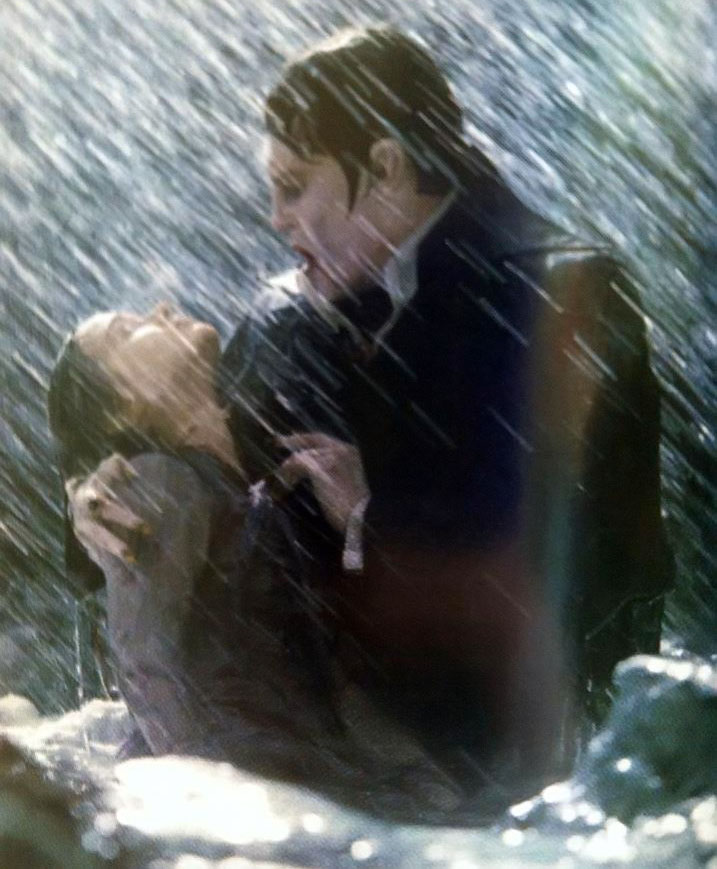
"It is said that blood is thicker than water," narrates Barnabas Collins (Depp), over the strains of Robert Colbert's alto flute-through-echoplex composition "The Secret Room" from the original series. "It binds us, confines us, curses us." For a moment, things are fairly serious as the 18th century story of young Collins scion Barnabas is unearthed, with his spurning of the witch Angelique Bouchard (Eva Green) and her subsequent dark revenge, killing the Collins elders, forcing the suicide of Barnabas' love Josette and turning him into an eternally cursed vampire. She subsequently sets the townsfolk on the monster who chain him into a coffin and bury him for all eternity.

Depp and Burton get it right at the beginning: Barnabas learns his fate.
The worst-laid plans of mages and men...Eternity is cut short around 1972 as the construction of a new McDonald's in Collinswood unearths Barnabas and he lays waste to a construction crew (who must have been getting overtime working at night!) with an explanatory "You have no idea how thirsty I am!" 
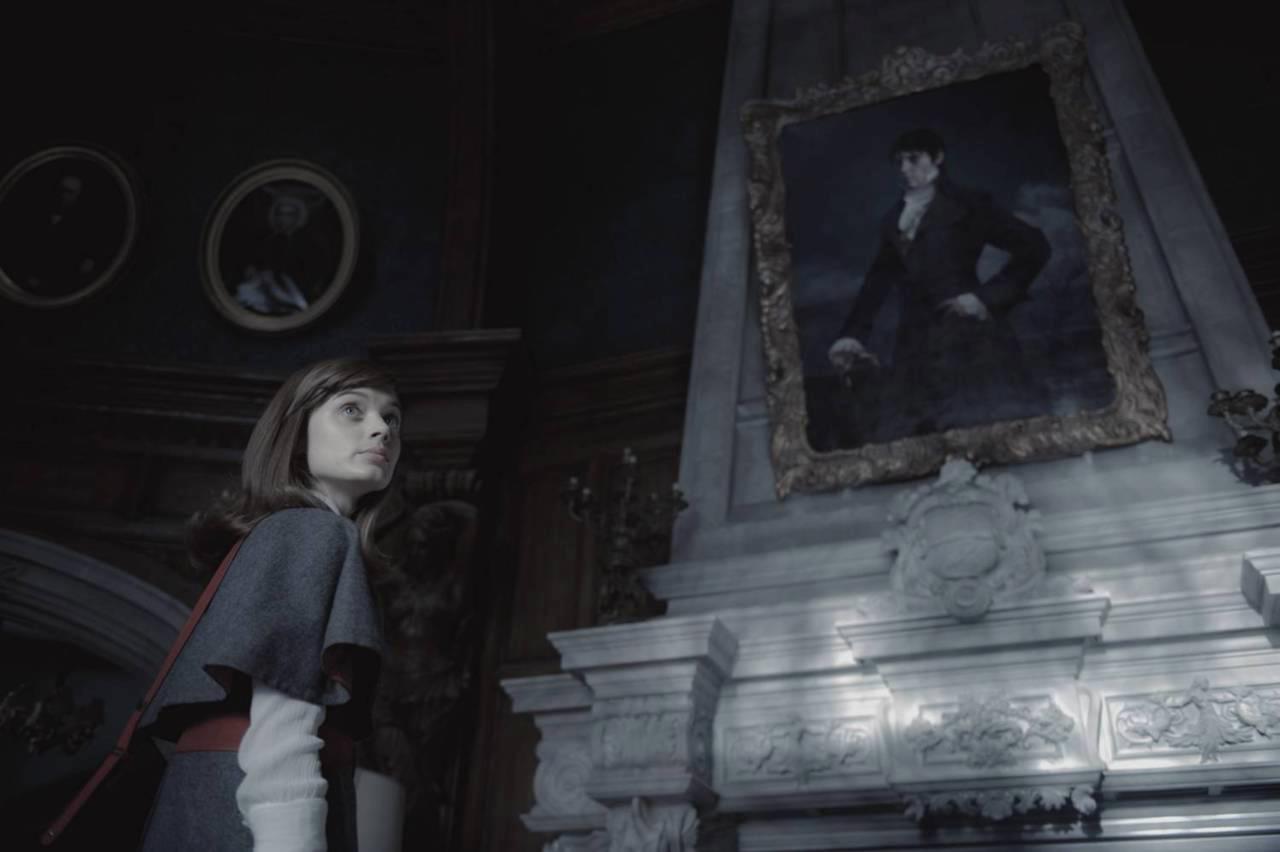
On a parallel course, Maggie Evans (Bella Heathcote, the latest in a long line of Burton ingenues with thin necks topped by big heads with huge eyes and "big" hair) is on a train to Collinswood where she has applied for a job as a governess to young David Collins (Gulliver McGrath), who is having psychological issues from the disappearance of his mother at sea. Abruptly, she decides to change her name to Victoria Winters, indicating a past she wants to run away from, as The Moody Blues tune "Knights in White Satin" burbles over the soundtrack. Hey, Burton may be onto something here. The combining of '70's kitsch and some of its more mordant songs with the gothic mood of "Dark Shadows" works well, setting the tone of the series and the morbid fascination my generation had with it. Can "Don't Fear the Reaper" be far behind?
Then, things get a little weird. She's picked up by a VW van of hippies, and there's some stoned comedy about how they're so wasted, and Vicky is cool, man, and it's easy laughs and you wish it was more clever. It becomes apparent quickly that Burton will be playing this for laughs, which is fine (he always does to a certain extent), but the original material is already so melodramatic and over-the-top that the humor undercuts the effectiveness of what drama there is that ekes through the dramatic stares and the vamping poses. "Dark Shadows" was always "camp" entertainment in the broad sense, but to broaden it even further nullifies whatever chills and thrills can be drained from it. This is why Frid's performance on the show was such an anchor for it—he played it absolutely straight, and in fact, ramrod-stiff; you didn't make fun of Barnabas for fear of his wrath—or his breaking down in tears.
Depp's Barnabas is tortured, of course, but risibly so (in a performance that's a combination of Frid's formality, some Max Schreck thrown in, and a bit of Ed Wood cast-mate Martin Landau's incarnation of Bela Lugosi). And there's the "otherness" factor that Depp brings to so many of his roles, as if he's in a different movie from everybody else—he walks through it, and everybody reacts, usually comedically and derisively. In part, that's the point: it ties in with Burton's feelings growing up as being an outsider-geek, looking on at the rest of the world that he found strange, while it found him odd (and there's a mirroring through-line of humor throughout the film of Barnabas, out of his time, observing to some horror the eccentricities of 1970's life, that reflects it).
*
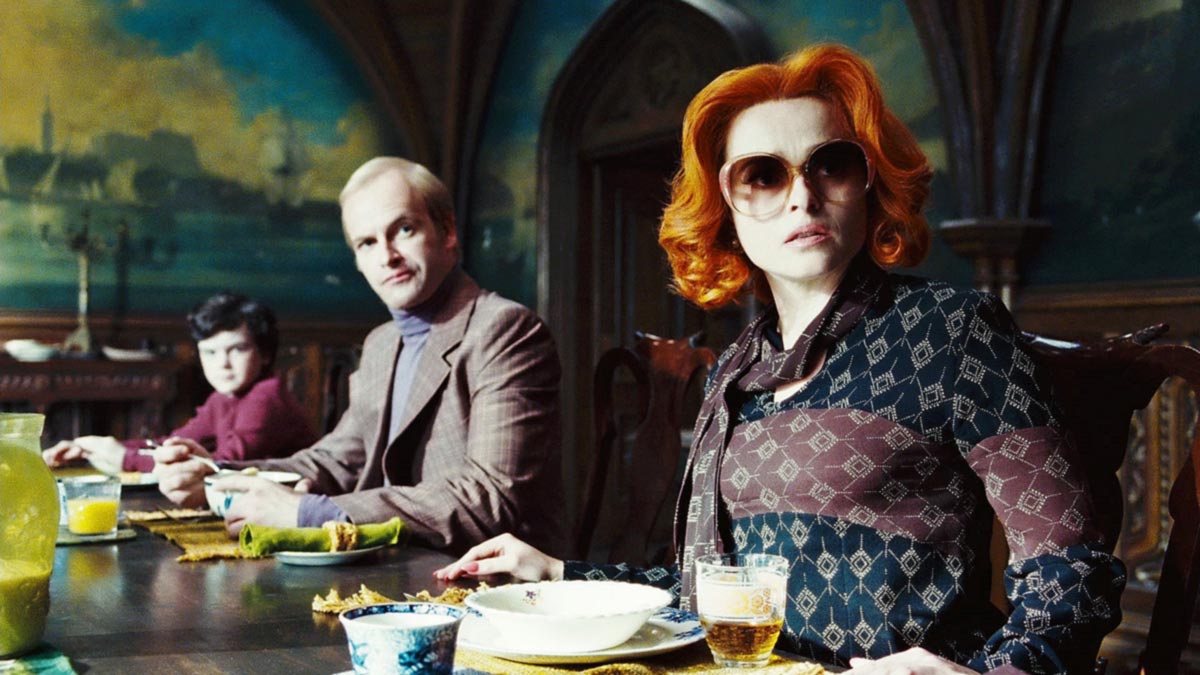
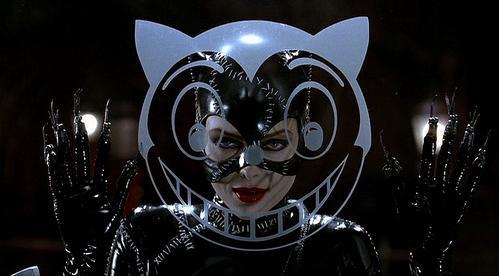
But Collinwood's odd family doesn't bat an eye when Victoria shows up and doesn't react to the disrepair of the gothic Collinwood mansion or to David's assertion that he speaks to his dead mother, and she follows quite readily when the ghost of Josette appears floating down the hallways, whispering "He's coming..." Barnabas' arrival, in Victorian array and the palest of skin, and the oddest of manners only brings up temporary suspicions, but the matriarch of the house (Michelle Pfeiffer, who played Burton's Catwoman) readily accepts him as family, even after revealing his vampirism. The cast is uniformly fine, gamely being archly camp throughout, but the one performer who's best at it is Green, who clearly relishes the villainess role and has fun with it, taking it in some very odd, even poignant places.
It looks great. Burton's films always do, with a superb design sense and his knack for picking terrific, seemingly impossible angles to shoot from. But, like a lot of Burton films, it tends to fall apart in story, snatching hasty explanations and Deus ex machina to get out of trouble, or to provide the director with a bizarre concept that may seem right in retrospective sub-context, but that comes out of nowhere, randomly and jarringly. One has to stop, back-track, only to realize that, no, this has never been mentioned before, and why now?
One suspects it's a whim, a passing "wouldn't-it-be-crazy-if" thought passed between Depp and Burton as they geek out, rocking in their corners, internal logic no longer mattering as much as a superficial entertaining notion. As such, Dark Shadows accomplished their goals. Yeah, it's entertaining, but highly insubstantial, a mere spirit of a movie.

"Yes, yes" I hear you cry. "But, don't you think it was better than the OLD "Dark Shadows"? I mean, have you seen it lately?"

In truth, I have.
My frustration with Burton is not that he desecrated the memory of a classic television show—even with the air fragrant with the nostalgic scent of Mom's Apple Pie, I'm not convinced that "Dark Shadows" was anything more than a quickly put-together variation of soap programming with elements of gothic romance/horror tossed onto it. No, my problem with Burton's version is that he didn't try to make it better, but chose to just mock the absurdity of it. Not much sticking your neck out there, even for a vampire movie. 

But, then, maybe he didn't try because he already saw what happened when somebody did try to do it semi-seriously. That someone being show creator Dan Curtis.

House of Dark Shadows
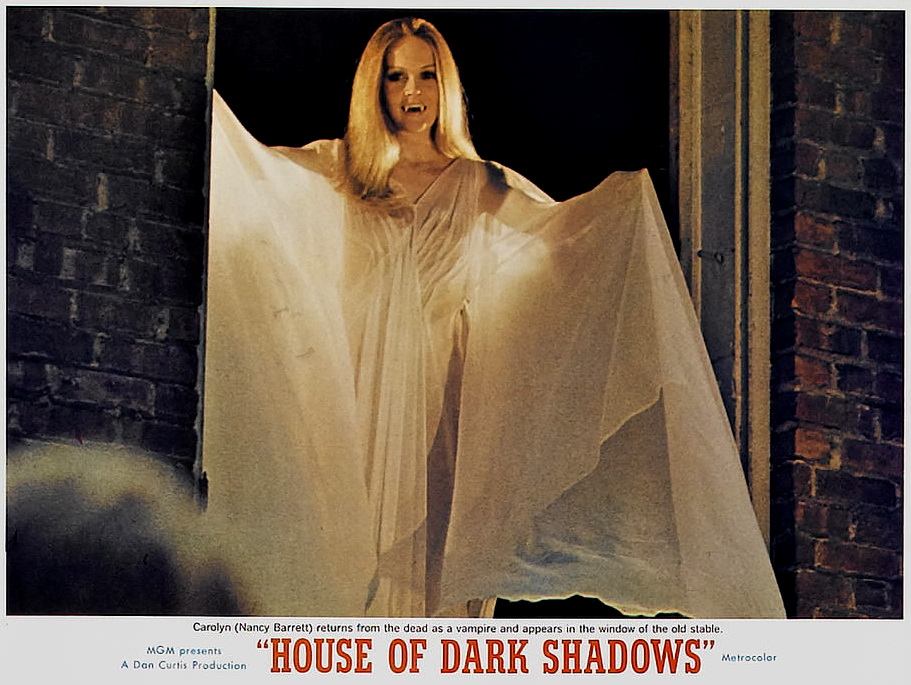
(Dan Curtis, 1970) Filmed while the soap-opera was still running (and so a lot of cast-members "disappeared" for 29 days from the taping). They dragged out the "big-guns" and did a 2 hour version of the "Barnabas Arrives at Collinwood" storyline with Jonathan Frid's character withheld from sight—except for his black onyx ringed hand—until he shows up as the "lost Collins cousin from England." He meets nanny Maggie Evans (Katheryn Leigh Scott), who bears an uncanny resemblance to his lost-love Josette, Dr. Julia Hoffman's (Grayson Hall) attempts at curing him, then, in a fit of jealousy, reneging, turning him into his aged 200 year old self (make-up by the amazing Dick Smith), and a vampire-hunt that ends in a lot of Collins-family vampires. The first is Carolyn Stoddard (Nancy Barrett) who's blond, pretty, and looks good in the Hammer label of diaphanous lingerie, so a lot of screen-time is given to her—poster-acreage, too—even though Barrett was not the most skilled of actresses. The soap languished through repeated exposition and lingering looks in its story-line Monday through Thursdays and put all the "good stuff" on cliffhanger Fridays, and so, compressing it all in one movie makes the movie feel camp and hysterical. Still, once the movie gets going, Curtis starts to be a bit more free with the camera and compositions—it's like half-way through he realized he wasn't dealing with the old studio RCA TK46's anymore and could do something beyond waist-level. Still, in such a quick time-frame, the story doesn't coagulate too well and makes you realize that long-form eased the mis-match of gothic romance and horror.

Night of Dark Shadows
(Dan Curtis 1971) House of Dark Shadows made money, enough to green-light a sequel and, as the television series had been canceled, a newly unencumbered Curtis started on a direct sequel to the earlier film. Jonathan Frid, worried about the curse of type-casting, bowed out of participating. But, the story of Angelique Bouchard, witch and  former lover of young Barnabas, had never been told, so Curtis and series writer Sam Hall cobbled together a story of a young couple (David Selby and Kate Jackson) who inherit the Collinwood estate, only for the man to be haunted, then possessed, by the spirit of his Collins ancestor, who had an affair with his brothers' wife, Angelique (Lara Parker), resulting in her being hung as a witch, and him entombed with her. A somewhat similar story had been used in the series involving Selby as Quentin Collins, but the Angelique angle was new. Returning were John Karlen and Nancy Barrett, as well as Grayson Hall (the writer's wife) and Thayer David.

Anyone who sees Night of Dark Shadows will understandably come away from it wondering what they just saw, and if they'd missed something. They had. The film, was originally 2 hours long, but M-G-M thought that was too long for a movie they'd planned to put as the B-movie in double-bills (No, really, they used to do that), and so they insisted that Curtis cut half-an-hour out of the film—and he had 24 hours to do it. With such hack-work, any slow build-up was excised, and so Night comes off as poorly as a U.S. released foreign film that only includes highlights...and a bit of a muddle. 

Oh...and studios still do that.

* This also sets up a series of sight-gags that are somewhat clever, as Barnabas never seems to be able to find appropriate sleeping arrangements at Collinwood.


Friday, November 1, 2019

Carrie On, My Wayward Daughter

King's Prom Queen


Carrie (Brian DePalma, 1976) Director Brian DePalma ratcheted up to the top tier of film directors—from his independent-gadfly status—with his adaptation of Stephen King's teen horror story. It was the first film based on one of King's novels, "Carrie" being only King's second published book. Screenwriter Lawrence D. Cohen did away with King's splintered narrative and made it more personal, treating it like some perverse After-school Special from Hell, showing the tortured existence of a repressed high school wall-flower—played at the time by 26 year-old Sissy Spacek—who, upon her late onset of puberty is given yet another curse—telekinesis, the ability to move objects with her mind...sometimes violently.

Sometimes very violently.

Some might consider it a gift as, after all, it levels the playing-field for this unpopular, shy girl when dealing with the teasing and bullying of her school-mates, a species of popularity that Carrie does not understand or even hope to attain.
The trouble is Carrie White (Spacek) is not mature enough to use it with any sort of tempered judgment. The very hormones coursing through her that have given her the power are also the ones that give her extremes of emotions that are only exacerbated by the social freedom and pressures that percolate and bubble and boil in the cauldron that is High School.
Carrie White, also, has a less-than-secure home-life. Her mother (played by Piper Laurie) is extremely religious to a near-demented degree. A single mother, her control over Carrie is close to a strangle-hold, and as tight a grip as she maintains, she cannot compete with her daughter's desire to fit in and her defiance, which completely unhinges her. Combine that with Carrie's newly-realized powers and her Mother begins to see her as a devil or witch. Certainly Godless.
Carrie's persecution by the more popular girls at Bates High School inspires Sue Snell (Amy Irving) to suggest to her boyfriend Tommy Ross (William Katt) that he take Carrie to the upcoming prom. He is VERY reluctant, but she manages to convince him On the other hand, if Sue has sympathy for Carrie, "Sosh" Chris Hargenson (Nancy Allen) has vengeful antipathy, for the way she's been punished over her bullying of Carrie. And rather than admit her role in it, doubles down on taking revenge on Carrie by sabotaging Sue's good intentions. Her actions, though, only guarantee that everything is going to go to hell, complete with the commensurate fire and brimstone, wiping out guilty and innocent alike.
De Palma had the advantage of some lucky casting—he conducted a joint casting call with George Lucas, who was looking for young actors for his upcoming "Star Wars" feature—and he also had the lucky break of getting Spacek (whom he knew as a set dresser for husband Jack Fisk, a production designer), as well as managing to coax Piper Laurie out of a self-imposed retirement (after winning an Oscar for The Hustler), as well as getting teen-heart-throb and cast-member of "Welcome Back Kotter", John Travolta. It's an amazing cast with large parts for Betty Buckley (who would win a "Tony" Award for "Cats") as well as newcomers Irving and Allen (both of whom would appear in other De Palma films).
By the time of filming, the iconoclastic De Palma had developed a huge respect for the cinema of Alfred Hitchcock (his previous films, Sisters and Obsession, being whole-sale tributes to the Master of Suspense) and his work on Carrie has echoes of Hitchcock's architectural film-work throughout, even borrowing Bernard Herrmann's murder music from Psycho for a sound-accompaniment to Carrie's use of her powers (Herrmann was even set to score Carrie before his death). Certainly, frustratingly domineering mothers and religious iconography were appropriated from Hitch's work, as well as his way of building suspense.
Carrie remains one of the strongest films in De Palma's filmography, with its combination of the macabre, the tragic, and the mordantly humorous, lying just on the precipice of hysteria, which is where one's memories of High School usually lie.

De Palma moves from slo-motion suspense to split-screen mayhem at Carrie's prom.
Written at the time of the film's release...

To Carrie Out the Lord's Vengeance
or 
"Mama, Don't Ruin it!"

I've been working on a review of Brian De Palma's film Passion the last couple of weeks years (still working out how I feel about it—on a superficial enjoyment level it doesn't succeed very well, but if you appreciate craft and detail there is a lot to digest, and it makes you realize that a lot of older directors go through that shift where the details are more important than the Big Picture) and was watching an interview with De Palma* about the film (which I'll include again when I get around to finishing it) and at one point the subject of Kimberly Pierce making a new version of Carrie was broached.  

"We're friends", he said of Pierce, who made Boys Don't Cry and Stop-Loss. "I've seen some stuff and it looks good." But the more telling comment from the talk is when someone brings up Piper Laurie (who played mother Margaret White in his version) and De Palma remarks: "Piper thought we were making a comedy."

As well she might have. Stephen King's "Carrie" is a hoot to read (you can do so—textually—here), but it isn't if you take it too seriously. Which is odd. King cackles and galumphs through his writing, something he also did when he took to acting and directing his films. Which is why the best King adaptations have a surreal sense of giddy humor about them—they have to be a little over-the-edge, dangling their feet in the muddy waters of madness to be really, really good. It's why George Romero made good King adaptations. And Kubrick (despite King's protestations). And Carpenter. And Reiner. And De Palma.  But, if you get all solemn and reverential about them, they fall flat as pancakes.
Pierce gets precipitously close to that edge, but doesn't tumble over it. She includes a couple of things that De Palma, and the screenwriter of both versions—and the musical version—Lawrence D. Cohen, left out of King's book, which are the opening scene of Carrie's birth (the harrowing circumstances alluded to in the first chapter) and a sub-plot involving Sue Snell. Quite a few things are better—the kids...look like kids, not twenty-somethings from television sit-com's posing as teens. The good of that is that the performances are more awkward and more vulnerable. The downside is that they are all dewy lumps that don't have a lot of distinctiveness to them, so one is caught for a second wondering "which one is this, again?" I mock the ages of the older Carrie cast-members, but they had the experience and chops (from those sit-coms, presumably) to make their characters known as soon as they entered a shot. The 2013 kids are...awkward...looking like they're ready for a direction-cue in the middle of a take. For example, as pretty and competent as Gabriella Wilde is (she plays this version's Sue Snell, the "remorseful" girl played first by Amy Irving), most of the time she's blandly waiting for her next line with a concerned furrow and not much else behind it
One essential thing (given the times, making this Carrie somewhat relevant) is the inclusion of the evil genie of new media into the mix. Every kid here has a cell-phone. Every kid is documenting their lives like would-be film-makers (and Pierce throws in random samples of such stuff for bridging sequences, showing "normal" high school activity). But, the most innovative use of it comes when Carrie has a "period" in school that isn't scheduled and the girls in her high school gym class viciously taunt her, there's the added inevitability that some goonish lout will whip out their I-phone (usually banned from bathrooms for this very reason) to record the event. At that point, the truly bad-bad girl of Kris Hargenson (a brunetted Portia Doubleday here, future Mrs. de Palma Nancy Allen then) decides to go one step further, post it on YouTube, and it's then that punishment is meted out to the class. For Kris, this is unfair—she doesn't want to be an out-cast as she sees Carrie is and lashes out, digging herself deeper and deeper into detention, punishment and malicious revenge—and that video is used to twist the knife during the horrific prom sequence. It raises the stink of public media being thrown into the mix of private bullying and how it has escalated the trauma of humiliation by bringing mob mentality into the pecking order, empowering the mean-spirited far beyond their reach, and narrowing the victim of options for safe zones that might bring light (and perspective) to their situation. At that point, humiliation becomes torture and isolation becomes impenetrable.
As I said, if you take this stuff too seriously, it becomes no fun at all. And while Pierce's heart is in the right place, standing up for the repressed outcast and removing the puerile nudity of De Palma's version, she also goes a bit too far, making things less horror-ific, and more disturbingly real. For example, taking the loony ecstasy that Laurie brought to her fundamentalist (no fun; all mental) mother—Julianne Moore's version is seriously deranged, scratching herself to bleeding at the slightest provocation—and making Moretz's Carrie a very active revenge-seeker (where Spacek's interpretation was all evil-eye and mannequin-stiff, Moretz directs the carnage like a magician), the changes make her much less sympathetic as a character. Even though both movies show Carrie "learning her craft" by checking out resources in the library (I thought schools were banning books right and left—heck, they even ban "Carrie!"), the new Carrie seems to have more control than Spacek's, whose bursts of revenge felt like an id monster that would combust things with a look. This one concocts tortures and lingers over them like a cat playing with a mouse. Hey, control is great, but at what point does the tortured become the torturer? At what point do we lose sympathy for her and see her as just another maniac terrorizing a school? At what point does that earnestness work against the intent?
So. Good attempt. Maybe even worth the effort. But, at some point, this new Carrie manages to undermine the reason it was generated in the first place—to give us a really good scare. Perhaps real life events have just caught up and overwhelmed the perspective of seeing entertainment in this, or, to make debating points, the filmmakers just eked out some of that entertainment value. But, I remember leaving the first Carrie feeling sympathy for the devil, seeing it as a tragedy. This time, it seemed everything was a natural consequence of tinkering with forces beyond one's control, especially if self-control is in short supply. There was no catharsis, and at that point, Carrie 2.0 just stands for nothing, a nihilistic bloody mess. 

*

Wednesday, October 16, 2019

The Addams Family (2019)

Altogether Ooky (And I Don't Even Know What That MEANS!!)
or
"Are You Unhappy, Darling?" "Oh, Yes, Yes! Completely"*

I've written about how much I loved "The Addams Family" (both as a 1960's TV show and as a concept from Charles Addams' series of macabre  New Yorker cartoons from 1932 to his apparent death in 1988), and the rather "iffy" attempts to continue the perverse charm in Barry Sonenfeld's feature films and TV spin-off's. There's been a Broadway musical (that I know nothing about) and there were rumors a few years ago that Tim Burton was working on a stop-motion version—which might have been interesting. Burton might not have been entirely faithful to it, but he would have captured the spirit and the schtick that made the old series so enjoyable (as opposed to the watered-down "Munsters" that appeared on CBS at roughly (very roughly) the same time.

Well, that would have been interesting. And probably far more enjoyable than the latest re-boot of The Addams Family, written by Conrad Vernon, Pamela Pettler, Matt Lieberman, Erica Rivinoja and directed by Vernon and Greg Tiernan.
Kudo's to them for designing it closer to Addams' original conceptions (although they don't always make compelling characters—their version of Addams daughter Wednesday is particularly bland) and there are some rare body-snatches of Addams original material—like the line (*) in this post's title. But, the whole thing is barely enjoyable, particularly because some of the voice-casting is underwhelming, with the exception of Oscar Isaac's "Gomez" and Nick Kroll's "Uncle Fester."
But, there's also less emphasis on the family dynamics and more on their "otherness" from somewhat ordinary citizenry. That tactic has always been dull—unless the "normals" were weirder than the Addamses—and usually the least intriguing part of any "Addams" story. How many gawping reactions can you get before it gets old and starts decaying before your eyes? And this version of "The Addams Family" has an awful lot of that.
The film begins with the wedding of Gomez (Isaac) and Morticia (Charlize Theron—she tries, although the role would be better suited to another cast-member, Allison Janney) attended by the Addams Extended Family, but it gets interrupted by locals with torches and pitchforks—ordinary people are turned murderously monstrous by what they fear (now where have we seen that before?)** Escaping with Fester (Kroll) and "Thing" (their literal hand-servant), the joyously gloomy newly-weds head for their honeymoon in New Jersey (State Motto: "What Are YOU Looking At?), where they run down an escapee from an asylum for the criminally insane, who turns out to be Lurch (muttered by director Vernon), who will become their beloved man...er...creature-servant. Trying to return him to the asylum, they find the facility closed (by police tape), abandoned, and haunted. But, for them, it's merely a lovely fixer-upper dream-home to raise a family—but not from the dead—and put down gnarled roots.
Morticia is mortified that Wednesday starts to show interest in bling
"But, darling, pink is a gateway color!"
Cut to thirteen years later. The Addamses have an older daughter Wednesday (Chloe Grace Moretz) and son Pugsley (Finn Wolfhard, busy young man). Wednesday, full of woe, has grown rebellious ("But, darling, you have all the horrors of home right here!") and Pugsley is approaching an Addams right of passage. No, it's not a Bat Mitzvah (but thanks for going there), it's a Mazurka, in which he must demonstrate his prowess as a warrior with the Addams Scimitar. That's not Pugsley's style—he's more of an expert in explosives—and Gomez fears that, despite his worst efforts, Pugsley will be an embarrassment to the Family coming to witness the momentous event. This sentiment seems un-Addamsish.
Meanwhile, gentrification also challenges The Addams Family. At the base of their escarpment their mausoleum is perched on, a development has cropped up, sponsored by the Home, Art, and Garden Network (HAG-TV) and its principal make-over star, Margaux Needler (Janney). As if to push the point a little too far, the name of the town is "Assimilation," and the movie is consumed with her efforts to get rid of the eye-sore that sits in the cross-hairs of Assimilation's picture-windows.
Margaux stops by to give the Addams House a make-over.
The hair may be a political point.
Oh, there are good lines—at one point Wednesday runs away from home, insisting on going to public school (rather than "cage-schooling") and she's asked if she wants to go to the Mall to which she replies "Sure, I haven't seen a good mauling in ages"—but, it's relatively simple to get laughs out of Addams contrariness. The very fact that they're a morbid bunch makes them a natural anathema to normalcy and rife with satirical possibilities aimed at white picket fences. But, this version is a little too desperate to find them. And bludgeons them like a wooden stake.
There's an awful lot of music humor—too much of it—Lurch plays "Green Onions" on the organ and, at one point, "Everybody Hurts." It's a little weak. And it has the annoying habit of going back to the well of the TV-show for dread-cred, rather than stake out new territory. The film-makers make too much of a big deal of the pet lion (in the TV series, did we see that twice?) Did we really need an animated version of the TV-show's theme song that matches the live version to the last detail? Can't this be its own "thing" (so to speak?) without cleaving so close to the source? Are we to reduce the Addams Family to being a horrid cliche, with the very first movie in a re-boot series?
I know it's a children's movie and all, but the group who made the "Hotel Transylvania" films had a better coffin-handle on the material than this weak effort has. 

Maybe I'm a little too close to the source, but, after watching this, I had a normal urge to go down to Lowe's and get a cart full of torches and pitch-forks.


*
** Short Answer: "Everywhere"
"That's 'It', Folks!"