Showing posts with label Piper Laurie. Show all posts

Thursday, May 14, 2020

Return to Oz (1985)

Return to Oz (Walter Murch, 1985) In 1980, when Walter Murch talked to Disney about working on a project, the subject of L. Frank Baum's "Oz" books came up. Disney had acquired the series in 1954 and some filming had been done on an adaptation of later stories, but it was never completed, and the company's rights to do anything with them were about to expire. Murch and writer Gill Dennis started work on a screenplay based on threads and characters from later books in the series. When filming began, things turned contentious with a change in executive producers (Gary Kurtz out and Paul Maslansky in), Murch being fired for a time—and rehired with the assurances of George Lucas, Francis Ford Coppola and Steven Spielberg, and a regime-change at Disney which lost any interest in promoting the film as something different from what an audience saturated with memories of the 1939 musical would expect.

The result was a fascinating film, truer to Baum, but far different in tone from M-G-M's The Wizard of Oz.

The thing is, the films' DNA are so similar, it's the presentation that's very different.

Six months after Dorothy Gale (Fairuza Balk—10 years old at the time) survived the terrible twister that decimated her family's farm, she is still having sleepless nights and talking incessantly about her friends visited in another land far away from the flat colorless expanse of Kansas, even prattling on that a key she has found with what she interprets as the word "Oz" in the bow fell with a shooting star to tell her that they're in trouble. For her folks, Aunt Em' (Piper Laurie) and Uncle Harry (Matt Clark), who have troubles of their own and are still re-building and trying to scratch together a farming existence, this is not only impractical, but troubling. Perhaps it's time to see a specialist. An advertisement in the local paper gives Em' a possible solution.
Dr. J. B. Worley (Nicol Williamson) runs a local asylum and boasts great success using electroshock therapy ("It's the 20th Century! The age of electricity!") and, after some condescending questions about "Oz" and how she got back from there ("Where are those ruby slippers now?" "I lost them!"), he is only too quick to prescribe strapping Dorothy down and zapping her fantasies away. But, before the procedure can be performed, an electrical storm causes a power black-out, and Dorothy is saved by another little girl who escapes with her until they stumble in the dark and Dorothy falls into the river, a chicken coop providing her only life-line.
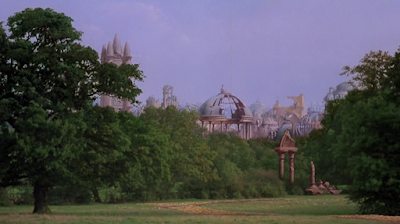
The next morning, she wakes up in Oz, but not the Oz she remembers—Munchkinland is in ruins, the yellow brick road is just rubble and everyone in the city of Oz, including the Cowardly Lion and the Tin Woodsman, has been turned to stone and King Scarecrow is missing! With the help of her favorite Kansas farm-chicken, Billina—who has followed her to Oz and can now talk—Dorothy manages to avoid capture by a roving pack of malicious "Wheelers" and uses her "Oz" key to open a door when she's trapped in a hallway to escape them.
She finds one of Oz's mechanical soldiers and reads the instructions how to start him up. Its name is "Tik-Tok" and with its help, Dorothy captures one of the Wheelers and they're told what has befallen the emerald city: Oz was attacked by the Nome King, who took the Scarecrow captive, turned all of the Ozians to stone and has plucked every last emerald from the city to his mountain-lair across the Deadly Desert, which will kill anyone who dares to walk across it. Dorothy is desperate to find the Scarecrow and the captured Wheeler tells her that Princess Mombi (played by three actresses—Jean Marsh, Sophie Ward, and Fiona Victory—for a reason), who lives now in Oz, can tell him what happened to the Straw-King.
The little party travels to the only part of Oz that hasn't fallen to ruin, where the Princess lives, and are informed that the Scarecrow has been taken captive by the Nome King. They also find out that Princess Mombi collects heads, and switches hers out whenever the fancy strikes her, bringing them to life with her Powder of Life (naturally...or unnaturally). Meeting Dorothy, she finds she has a good head on her shoulders, so she locks her up in her attic until Dorothy is old enough to be usable. Out the window attic, Dorothy can see the mountain of the Nome King, where the Scarecrow is held captive, enticingly in the distance across the Deadly Desert.
But, one finds all sorts of interesting things in attics—for example, there's Jack Pumpkinhead, who has been "powdered" into existence by Mombi, and together, he and Dorothy devise a plan to escape, using Jack's height and agility, a couch, a couple of plants and the mounted head of a Gump, but only if she can get downstairs and get the Princess's Powder of Life. Jack gets the door open, and starts to assemble their transport, while Dorothy sneaks down to Mombi's quarters while the headless princess sleeps. She is able to find the Powder, but not without waking up one of the heads, and while the Princess scrambles to find her head—or any head—Dorothy runs back up to attic, and just in the nick...she and her companions are able to hop on their Gump-plane and crash through their attic-prison window. It's off to the Nome King's mountain. 
More perils ensue, and Dorothy must play a game of wits with the Nome King if she wishes to save her friends, the Princess is after Dorothy after her escape, and there's also the matter of the mysterious girl who saved her back in Kansas. Dorothy must muddle through and save the day, before she can earn her reward to go back home, having made new friends and dispatched troubles and enemies.
Return to Oz did not perform well at the box office, perhaps due to the differences from the 1939 M-G-M musical with its dependence on sprightly songs and fantasy characters portrayed by heavily made-up (but easily recognized as) human actors with a distinctly vaudevillian approach to the material. There were also rumblings of the film being too scary for children, despite being given a "PG" rating (the more restrictive PG-13 rating had been available since Summer 1983), with its threatened electroshock therapy, scary characters like the Wheelers, a headless Princess Mombi, and decidedly evil Nome King (without the theatricality of, say, the Wicked Witch of the West).
This is is a bit disingenuous, as M-G-M's film also had a lot of traumatizing aspects, such as the flying monkeys, a liberal use of very real fire against the Scarecrow, and the intense hour-glass scene as Judy Garland's Dorothy is forced to watch her life run out.
To say nothing of a tornado that imperils Dorothy and crushes a character on its crash-landing in Oz; Baum's initial "Oz" books are rife with ingenious ways to traumatize Dorothy enough to get her back to her safe, if constantly jeopardized, fantasy-land. Let's be real about the fantasy—Oz is a sublimating dream-land caused by physical peril that helps Dorothy deal with the vagaries of real life (amplified in the movies, as in the original film, the Scarecrow, Woodsman and Lion all have Kansas counterparts as field-hands and the Wicked Witch is Kansas' worst-neighbor-in-the-world Elmira Gulch, and in Murch's follow-up, the Nome King is a manifestation of Dr. Worley and Mombi is his less-than-empathetic nurse).
Murch's cherry-picking of elements from Baum, particularly his sequels "The Marvelous Land of Oz" and "Ozma of Oz" is seamless, but complicated, and the added electroshock therapy peril is an ingenious way to threaten to "cure" Dorothy of her dreams, and a particularly cruel one, given their therapeutic value to the girl and, thus, the transposition of Worley with the Nome King is inspired (Baum used earthquakes and being swept off ocean liners as traumas in the books but the doctor intends to rob the girl of her "safe-place" making the cure worse than the disease).
Murch's presentation might also be somewhat disturbing, but in a very basic way: the 1939 "musical" was all done on sound-stages, even the Kansas scenes, giving the film a safer, artificial look, but in Return to Oz, things are filmed on location outside, giving a heightened sense of reality—even the ruined Oz is filmed with natural light, which might have had a subliminal effect on the reality of the movie, making it more menacing.
Perhaps that's an overreach, but the reaction to Murch's Oz film was more in its relationship to the musical version of Oz than to itself as its own adaptation of Baum (and one should remember that, although a critical success, The Wizard of Oz was not considered a box-office success that year, only making back its costs with a 1949 re-release). And, that is a big factor. M-G-M's version had traumatizing elements, sure, but sublimated it with a happy tune every 10 minutes in a constant bi-polar yin-yang of emotion—danger/release-danger/release.
Return to Oz didn't have that steady stream of emotional tonic to off-set the troubles, merely showing the resolution of those troubles in the story-line. Without the constant insulin-drip of song cluing audiences in to how people were feeling, The Wizard of Oz would be alarming, as well, inspiring folks to look for a soothing poppy-field somewhere.
I remember Roger Ebert's review of The Phantom Menace, where he wrote: "If it were the first 'Star Wars' movie, 'The Phantom Menace' would be hailed as a visionary breakthrough. But this is the fourth movie of the famous series, and we think we know the territory" By comparison to the earlier films (and, more importantly, our memories of them), The Phantom Menace came up short. But, taken on its own, it's still an amazing movie—it just didn't have all the inter-species hugging and celebrating of A New Hope.
And that may be the issue: Return to Oz is an amazing, smart intricate little film that actually does right by Baum, even improving on his spare style a bit. But its charms are ones of the intellect, rather than the Garland musical vehicle, wearing its heart on its sleeve.

It really should come as no surprise, really, that we would find more endearing the Tin Woodsman, always in danger of rusting from his own tears, than we would the Scarecrow, who only had a brain.

Oz help us all.

Friday, November 1, 2019

Carrie On, My Wayward Daughter

King's Prom Queen


Carrie (Brian DePalma, 1976) Director Brian DePalma ratcheted up to the top tier of film directors—from his independent-gadfly status—with his adaptation of Stephen King's teen horror story. It was the first film based on one of King's novels, "Carrie" being only King's second published book. Screenwriter Lawrence D. Cohen did away with King's splintered narrative and made it more personal, treating it like some perverse After-school Special from Hell, showing the tortured existence of a repressed high school wall-flower—played at the time by 26 year-old Sissy Spacek—who, upon her late onset of puberty is given yet another curse—telekinesis, the ability to move objects with her mind...sometimes violently.

Sometimes very violently.

Some might consider it a gift as, after all, it levels the playing-field for this unpopular, shy girl when dealing with the teasing and bullying of her school-mates, a species of popularity that Carrie does not understand or even hope to attain.
The trouble is Carrie White (Spacek) is not mature enough to use it with any sort of tempered judgment. The very hormones coursing through her that have given her the power are also the ones that give her extremes of emotions that are only exacerbated by the social freedom and pressures that percolate and bubble and boil in the cauldron that is High School.
Carrie White, also, has a less-than-secure home-life. Her mother (played by Piper Laurie) is extremely religious to a near-demented degree. A single mother, her control over Carrie is close to a strangle-hold, and as tight a grip as she maintains, she cannot compete with her daughter's desire to fit in and her defiance, which completely unhinges her. Combine that with Carrie's newly-realized powers and her Mother begins to see her as a devil or witch. Certainly Godless.
Carrie's persecution by the more popular girls at Bates High School inspires Sue Snell (Amy Irving) to suggest to her boyfriend Tommy Ross (William Katt) that he take Carrie to the upcoming prom. He is VERY reluctant, but she manages to convince him On the other hand, if Sue has sympathy for Carrie, "Sosh" Chris Hargenson (Nancy Allen) has vengeful antipathy, for the way she's been punished over her bullying of Carrie. And rather than admit her role in it, doubles down on taking revenge on Carrie by sabotaging Sue's good intentions. Her actions, though, only guarantee that everything is going to go to hell, complete with the commensurate fire and brimstone, wiping out guilty and innocent alike.
De Palma had the advantage of some lucky casting—he conducted a joint casting call with George Lucas, who was looking for young actors for his upcoming "Star Wars" feature—and he also had the lucky break of getting Spacek (whom he knew as a set dresser for husband Jack Fisk, a production designer), as well as managing to coax Piper Laurie out of a self-imposed retirement (after winning an Oscar for The Hustler), as well as getting teen-heart-throb and cast-member of "Welcome Back Kotter", John Travolta. It's an amazing cast with large parts for Betty Buckley (who would win a "Tony" Award for "Cats") as well as newcomers Irving and Allen (both of whom would appear in other De Palma films).
By the time of filming, the iconoclastic De Palma had developed a huge respect for the cinema of Alfred Hitchcock (his previous films, Sisters and Obsession, being whole-sale tributes to the Master of Suspense) and his work on Carrie has echoes of Hitchcock's architectural film-work throughout, even borrowing Bernard Herrmann's murder music from Psycho for a sound-accompaniment to Carrie's use of her powers (Herrmann was even set to score Carrie before his death). Certainly, frustratingly domineering mothers and religious iconography were appropriated from Hitch's work, as well as his way of building suspense.
Carrie remains one of the strongest films in De Palma's filmography, with its combination of the macabre, the tragic, and the mordantly humorous, lying just on the precipice of hysteria, which is where one's memories of High School usually lie.

De Palma moves from slo-motion suspense to split-screen mayhem at Carrie's prom.
Written at the time of the film's release...

To Carrie Out the Lord's Vengeance
or 
"Mama, Don't Ruin it!"

I've been working on a review of Brian De Palma's film Passion the last couple of weeks years (still working out how I feel about it—on a superficial enjoyment level it doesn't succeed very well, but if you appreciate craft and detail there is a lot to digest, and it makes you realize that a lot of older directors go through that shift where the details are more important than the Big Picture) and was watching an interview with De Palma* about the film (which I'll include again when I get around to finishing it) and at one point the subject of Kimberly Pierce making a new version of Carrie was broached.  

"We're friends", he said of Pierce, who made Boys Don't Cry and Stop-Loss. "I've seen some stuff and it looks good." But the more telling comment from the talk is when someone brings up Piper Laurie (who played mother Margaret White in his version) and De Palma remarks: "Piper thought we were making a comedy."

As well she might have. Stephen King's "Carrie" is a hoot to read (you can do so—textually—here), but it isn't if you take it too seriously. Which is odd. King cackles and galumphs through his writing, something he also did when he took to acting and directing his films. Which is why the best King adaptations have a surreal sense of giddy humor about them—they have to be a little over-the-edge, dangling their feet in the muddy waters of madness to be really, really good. It's why George Romero made good King adaptations. And Kubrick (despite King's protestations). And Carpenter. And Reiner. And De Palma.  But, if you get all solemn and reverential about them, they fall flat as pancakes.
Pierce gets precipitously close to that edge, but doesn't tumble over it. She includes a couple of things that De Palma, and the screenwriter of both versions—and the musical version—Lawrence D. Cohen, left out of King's book, which are the opening scene of Carrie's birth (the harrowing circumstances alluded to in the first chapter) and a sub-plot involving Sue Snell. Quite a few things are better—the kids...look like kids, not twenty-somethings from television sit-com's posing as teens. The good of that is that the performances are more awkward and more vulnerable. The downside is that they are all dewy lumps that don't have a lot of distinctiveness to them, so one is caught for a second wondering "which one is this, again?" I mock the ages of the older Carrie cast-members, but they had the experience and chops (from those sit-coms, presumably) to make their characters known as soon as they entered a shot. The 2013 kids are...awkward...looking like they're ready for a direction-cue in the middle of a take. For example, as pretty and competent as Gabriella Wilde is (she plays this version's Sue Snell, the "remorseful" girl played first by Amy Irving), most of the time she's blandly waiting for her next line with a concerned furrow and not much else behind it
One essential thing (given the times, making this Carrie somewhat relevant) is the inclusion of the evil genie of new media into the mix. Every kid here has a cell-phone. Every kid is documenting their lives like would-be film-makers (and Pierce throws in random samples of such stuff for bridging sequences, showing "normal" high school activity). But, the most innovative use of it comes when Carrie has a "period" in school that isn't scheduled and the girls in her high school gym class viciously taunt her, there's the added inevitability that some goonish lout will whip out their I-phone (usually banned from bathrooms for this very reason) to record the event. At that point, the truly bad-bad girl of Kris Hargenson (a brunetted Portia Doubleday here, future Mrs. de Palma Nancy Allen then) decides to go one step further, post it on YouTube, and it's then that punishment is meted out to the class. For Kris, this is unfair—she doesn't want to be an out-cast as she sees Carrie is and lashes out, digging herself deeper and deeper into detention, punishment and malicious revenge—and that video is used to twist the knife during the horrific prom sequence. It raises the stink of public media being thrown into the mix of private bullying and how it has escalated the trauma of humiliation by bringing mob mentality into the pecking order, empowering the mean-spirited far beyond their reach, and narrowing the victim of options for safe zones that might bring light (and perspective) to their situation. At that point, humiliation becomes torture and isolation becomes impenetrable.
As I said, if you take this stuff too seriously, it becomes no fun at all. And while Pierce's heart is in the right place, standing up for the repressed outcast and removing the puerile nudity of De Palma's version, she also goes a bit too far, making things less horror-ific, and more disturbingly real. For example, taking the loony ecstasy that Laurie brought to her fundamentalist (no fun; all mental) mother—Julianne Moore's version is seriously deranged, scratching herself to bleeding at the slightest provocation—and making Moretz's Carrie a very active revenge-seeker (where Spacek's interpretation was all evil-eye and mannequin-stiff, Moretz directs the carnage like a magician), the changes make her much less sympathetic as a character. Even though both movies show Carrie "learning her craft" by checking out resources in the library (I thought schools were banning books right and left—heck, they even ban "Carrie!"), the new Carrie seems to have more control than Spacek's, whose bursts of revenge felt like an id monster that would combust things with a look. This one concocts tortures and lingers over them like a cat playing with a mouse. Hey, control is great, but at what point does the tortured become the torturer? At what point do we lose sympathy for her and see her as just another maniac terrorizing a school? At what point does that earnestness work against the intent?
So. Good attempt. Maybe even worth the effort. But, at some point, this new Carrie manages to undermine the reason it was generated in the first place—to give us a really good scare. Perhaps real life events have just caught up and overwhelmed the perspective of seeing entertainment in this, or, to make debating points, the filmmakers just eked out some of that entertainment value. But, I remember leaving the first Carrie feeling sympathy for the devil, seeing it as a tragedy. This time, it seemed everything was a natural consequence of tinkering with forces beyond one's control, especially if self-control is in short supply. There was no catharsis, and at that point, Carrie 2.0 just stands for nothing, a nihilistic bloody mess. 

*