Showing posts with label Stephen King. Show all posts

Friday, May 22, 2020

Misery (1990)

Written at the time of the film's release...

  Misery (Rob Reiner, 1990) A return to Stephen King territory for Reiner after adapting King's novella "The Body" into Stand By Me. That one was an unexpected hit for Reiner, who'd only achieved a certain cult following with This is Spinal Tap and The Sure Thing. King's Stand By Me changed all that, and Reiner had his pick of projects. 

We're going to be looking at a bunch of Reiner films over the next week as part of the Large Association of Movie Blogs' "Directors Chair" series for next month. The main reason is: I haven't done a lot of comments on his films—Stand By Me is it. There are a couple in the can and a couple I should write up...because the films are important parts of his output. 

And part of the movie zeitgeist.
The story is every creator's worst nightmare: meeting critics and obsessed fans. As adapted by William Goldman, Writer Paul Sheldon (James Caan) goes to his mountain writing-retreat to put the finishing touches on his latest novel—a departure from the successful historical potboilers he has been churning out. 
Trouble starts when a traffic accident leaves him injured and in the care of nurse Annie Wilkes (Kathy Bates, who won a Best Actress Oscar for this), who declares herself his "number one fan." The care she gives him is fine—of course, he's helpless, bed-ridden, incapacitated with two broken legs, and there is the usual paranoia that comes from being in the care of a stranger. But his condition goes from "stable" to "critical" when Annie reads his manuscript, and doesn't like it as it's not the same thing he's been writing. But, he's down-graded from "critical" when she gets ahold of the latest book in Sheldon's "Misery" series and discovers her favorite character is killed in it. At this point, Annie down-grades from "stable" to "street-rat crazy." 
She restrains Sheldon to his recovery bed, burns his manuscript, then breaks his ankles—"hobbling" him—to keep him captive to write the next "Misery" novel bringing the character back to miraculous life.
Meanwhile, Sheldon's publisher (played by Lauren Bacall) reports him missing—he's missed his manuscript delivery date—and a search begins for Sheldon in the local area, spear-headed by Sheriff Buster (the late great Richard Farnsworth, aided by his dispatcher, Frances Sternhagen), circling around the area around the vicinity of Annie, who may have been responsible for some mysterious hospital deaths in the past.
King was writing in his basic fear wheelhouse with this one. A cult-figure for his contemporary horror novels, his fan-base must have been a little weird, inspiring nightmares of what they might do to him if they ever got ahold of him. Metaphorically, he was also writing about his own feelings of helplessness dealing with drug addiction—Annie keeps Paul addicted to painkillers throughout his stay, withholding them from him when he becomes "bad," in her estimation.
This might fall into the thriller category, but I find it a horror film, just as much as Psycho is a horror film.   
And the most interesting aspect, for me, is the aspect of the creator's view of the "fans"—not all of them, just the most dedicated, the ones who see every work as a love-letter to themselves. And an idea stuck in my head wondering if George Lucas ever had nightmares about fans dressed as storm-troopers, each one carrying a sledge-hammer, and their own ideas of what a "Star Wars" movie should look like. I wonder if he's ever seen this movie.

Thursday, December 5, 2019

Stand By Me

Stand By Me (Rob Reiner, 1986) Stand By Me just might be the best film ever adapted from a Stephen King story, in fine company with Stanley Kubrick's The ShiningBrian DePalma's CarrieFrank Darabont's The Shawshank Redempton and The Green Mile, David Cronenberg's The Dead Zone, and (of course) Children of the Corn V: Fields of Terror.** 

King's collection of novellas "Different Seasons" came at a particularly inspired point in King's early career; each story is a gem, sitting outside of his then-established genre of horror writing, but still full of incident and character that could produce goose-flesh, or laughter. And the writing is sublime. Of the four stories included, only the "tale told in passing"--"The Breathing Method"--has not been filmed. The others--"Apt Pupil" was an indifferent Bryan Singer sophomore effort, and the classic "Rita Hayworth and the Shawshank Redemption" was the sublime Darabont film. But "The Body"--the story of boys of summer--was filmed first, as Stand By Me. It's cast of young actors (River Phoenix, Jerry O'Connell, Wil Wheaton, and Corey Feldman, along with Keifer Sutherland, Casey Siemaszko, and John Cusack--who'd starred in Reiner's The Sure Thing) would become established film players, with Phoenix breaking out early before his death at the age of 23. His death gives the resolution of the story an extra pang it didn't have when it was first released.

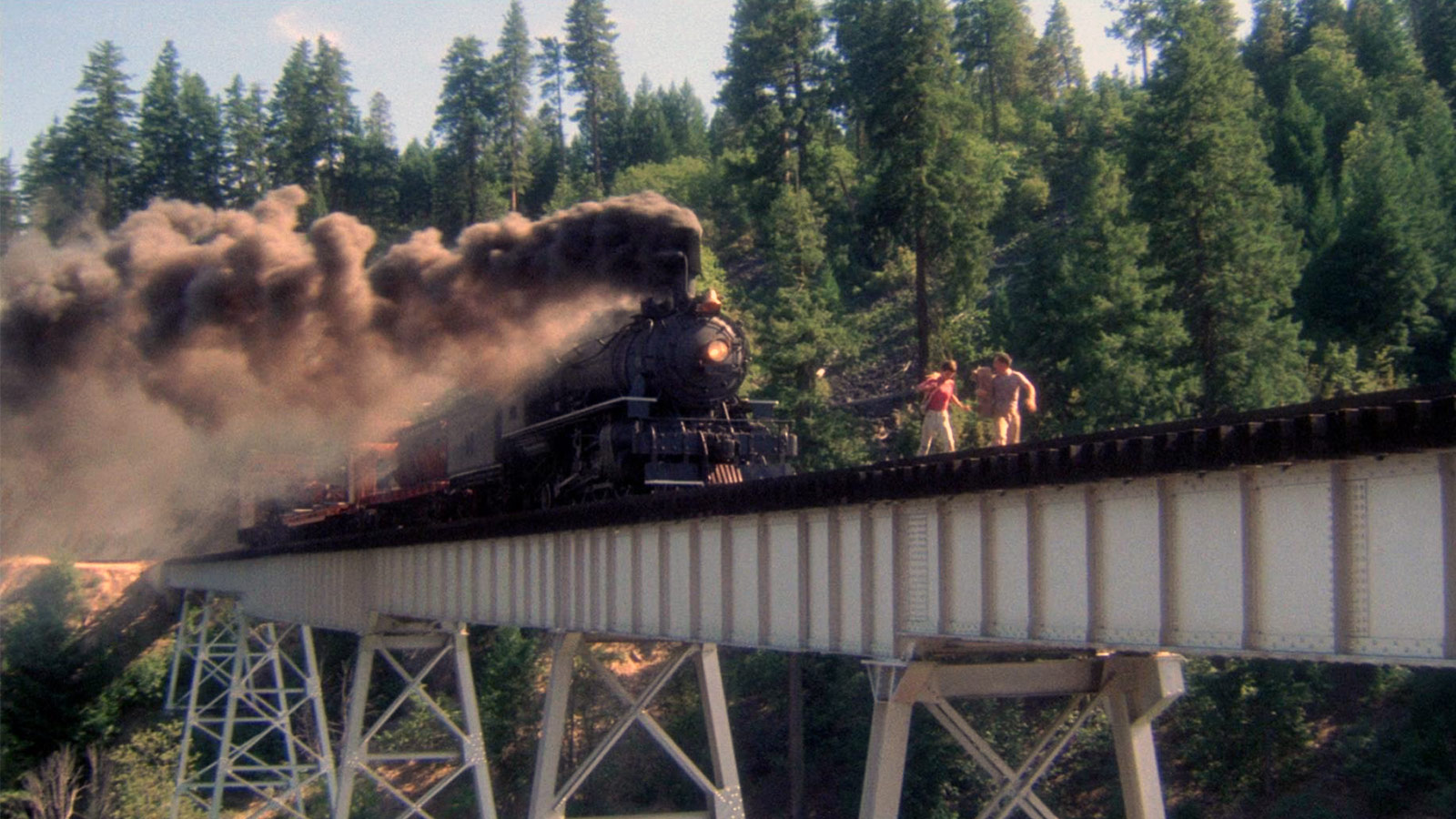
The story is of four 12 year old boys living in King's omnipresent town of Castle Rock (Maine in the story, Oregon in the film), who set out to find the body of Ray Brower--a kid who disappeared, and is gossiped to have been hit by a train--during an idyllic summer, made less so by the kids' circumstances at home, and their harassment by town bullies. Finding no real comfort anywhere, the outsiders set out to find the body in the wilderness for an adventure, and they are tested by Nature and their own natures.
Stand By Me is not so much a "coming-of-age" story as its been pigeon-holed, but a "coming-to-terms"...with one's lot in life, with those who threaten, and with the way life has a way of testing your mettle, and your sense of justice.
Rob Reiner has had a run of bad luck with his recent films clicking with the public. But Stand By Me was right in the middle of a superb run of well-done comedy films before his earnestness became a bit heavy-handed for most Americans' tastes.
There's an axiom in Hollywood that says, "You're only as good as your last film." But there's the "Billy Wilder corollary:" Really, you're only as good as your best film."

Given that, its only a matter of time before Reiner finds his audience again. Or they find him.


** Kidding, kidding... But, let's also include Andy Muscietti's It among them as well as Reiner's other King adaptation Misery.

Thursday, November 21, 2019

Doctor Sleep

Well, We All Shine On (Like Moon-light and The Stars, and You)
or
Wait'll the Talent Scouts Get Wind of Him

There was no reason for there to be a sequel to "The Shining," either the book or the 1980 film adaptation. It told its story and ended. Each told it differently, but there was no ambiguity to either one. King ended his story by having the Overlook blow up in a boiler-room conflagration. And Stanley Kubrick's movie kept the Overlook in one piece, but put the story to an end.

There ARE no reasons to make sequels of any of Kubrick's films—he ended his stories, having said all that needed to be said, even if the ending was ambiguous. There was no next chapter because there was no point. And if you did do a "sequel"—like the ill-considered 2010: The Year We Make Contact—you basically cheapen the story with considerations that are not central to the first conceit and the whole thing gets watered down. "Oh, yeah, and by the way, this could happen tangentially...only it's not as important as the first story, but...blah blah blah—people will have jobs so let's make a sequel."

And so..."Heeeere's...Danny!"

Danny Torrance (Ewan McGregor), of Jack (E.T.'s Henry Thomas) and Wendy Torrance (Alex Essoe), is not doing well. One could say he's following in the family tradition—a victim of PTSD from his experiences when his parents were caretakers at the haunted Overlook Hotel, he is drinking and drifting, short-time jobs, the money of which he'll squander on booze and start the cycle again to losing the work and moving on. But, Danny (as we know) has been gifted—or cursed—with "the shining," a psychic ability of some indeterminence, but which played a large part in saving the life of himself and his Mother when father Jack became swayed by the spirits haunting the Overlook. A "very willful boy," he has lost his will since his Mother's death and shines far less brightly these days, the booze having doused it, like water to flame.
For Danny has been plagued by nightmares. Not just nightmares, but the returning spirits of the Overlook, who have followed him and his Mother to Florida—they never wanted to see snow again—and beset Danny until one day he's given a coaching by Dick Halloran (Carl Lumbley), his friend "in shining" at the Overlook, who teaches him about what he used to do as a boy, a trick taught to him by his grandmother. If one of those old spooks comes back to haunt you, you think up a box and just lock them in it, and they'll never bother you again.
Now, for fans of the original Shining—book and/or film (and they're not exactly a group that like both), you know there's an issue: Halloran appears in the book of "Doctor Sleep" because he survived in the book of "The Shining." But, (can it be a SPOILER ALERT for a movie that's 39 years old?), in the movie, Halloran gets cleaved by an ax in an attempt to rescue Danny and Wendy from their predicament. And yet, he appears in Mike Flanagan's movie of Doctor Sleep, to give little Danny that advice about the mental boxes. Flanagan does a bit of finagling to do justice to both book and film, and satisfy the expectations of both (which is no small task) but he does a fairly good job of keeping his feet on both banks of the river simultaneously, but in the process, he kinda hasta change what "the shining" actually is—not that we knew in the first place.*
Problem solved, and if I remember correctly (and I probably don't because I couldn't get through King's novel), that happened in the first twenty pages. Now, Danny may be able to box those demons, but he can't box the ones inherited from his father. And so he spends most of his life wasted and drifting, until he comes to one town, Frazier New Hampshire, where under the stewardship of Billy Freeman (Cliff Curtis) he gets a job, a room of his own, and starts going to A-A where he meets Dr. John (Bruce Greenwood), who becomes impressed with Dan and offers him a job as an orderly at a hospice that seems to suit him.

That's where the cat comes in.

The hospice has a therapy cat, who has a strange ability. At night, when everything is quiet, the cat will wander the halls of the hospice and open a door and jump on the bed of one of the patients. The cat, named Azrael, has a reputation among the internees—when the cat visits you at night, it means you're about to die. Despite this, the cat seems to be popular and not kicked off beds right and left. Soon, Danny starts to follow the cat on its rounds, and comforting the about-to-die, giving them peace in their last moments.

And he gets a nickname—"Doctor Sleep." Roll credits.

All well and good, if that was all there was to it. Danny finds peace giving peace, his "shining" bringing comfort like a spooky version of Last Rites. But, there are other shiners who don't give comfort at all; they're The True Knot and over the years—and there have been many, many of them—the Knot led by its cult leader "Rose the Hat" (a particularly on-point Rebecca Ferguson) have been luring children with shining abilities and ritualistically killing them...slowly, so as to absorb their shining abilities like a life-force, that manifests itself as a mist, giving them rejuvenation and renewed life. They're like vampires, but for shining, not blood. This is a new wrinkle, that the "Shining" has a physicality, that—with an expanded range of abilities—makes it feel more like George Lucas' midichlorian-based "The Force."
The activities of The True Knot psychically alerts a shining adept teen, Abra Stone (Kyliegh Curran), who is traumatized by the murder of a child (the always amazing Jacob Tremblay) by the group. Abra has been in psychic contact with Danny, the way a HAM radio operator talks with other stations around the world. But the night of the boy's murder, Danny is blasted by Abra's terror and the blackboard the two have used to communicate is covered with the word "MURDER" which Danny first sees in a mirror as an all-too familiar word—"REDRUM"
The movie then turns into a three-way struggle between Danny and Abra and the Knot, and particularly its leader, Rose, a fight that escalates from merely invading each other's thoughts to more murderous physical contact. Pretty soon, everybody is tracking the movements of everybody else and Danny decides to take Abra and stage a last stand at the one place that might be suffused with enough evil energy to defeat Rose—the Overlook Hotel, containing all the ghosts and memories that have haunted Danny's past, including the restless spirit of his father. 
Director Flanagan has done a very creditable job of directing Doctor Sleep, making an intriguing film that stands on its own without depending on the very heavy shadow of Kubrick's film (although he does fall back on it a lot—which we'll talk about later). If there are gripes, they can be directed at King's novel, which gives far more substance (literally) to The Shining ability, which now allows astral projection, mind and body hijacking—"pushing" to use King's phrase from the book and from his novel "Firestarter"—and the capacity to get into people's heads, even those that shine, and messing around with their "files." 
That's a big jump from the psychological manipulation and thought-reading that had been the extent of the earlier versions. Think about it: if the shining ability was originally presented the way it now is, little Danny wouldn't have had to do what he did in the original to spare himself and his Mother. All he would have to have done is take over Daddy Jack's mind. Problem solved.
That aside, there is a bit of diffusion of the original story—the True Knot is too big a group that has lasted too long to not be noticed, even at the time of the first book. In a way, it overshadows the first story, even threatening to swamp it.
Flanagan ignores that, giving the Knot its due, and deftly combining both versions of The Shining, book and film. He takes a lot of tricks from the Kubrick film, not just in creating a near duplicate of the Overlook sets—that was probably a chore—using key images, like the swooping Main Title sequence, digitally altered for effect, recreating the "Here's Johnny" sequence that is so spot on, you will initially think they used the sequence with Shelley Duvall, but, no, that's Alex Essoe playing it perfectly. The film is also bracketed with the same music (Wendy Carlos' distortion of "Dies Irae" and the old tune "Midnight, the Stars and You") as well as the thumping heart-beat Kubrick used to underscore tension.
But, his best weapon is employing the same creepy technique Kubrick used in The Shining, which is purely cinematic—the framing. Kubrick imbued his film with his usual trope, the one-point perspective.** But, with The Shining, he gave it an extra element—nothing. For much of the film, Kubrick centers his one point on a negative space, giving the film a vertiginous depth despite its horizontal perspective.
Most of the time it works, but there are moments when it's jarring—like a shot of Greenwood's Dr. John in his office that is so influenced by Kubrick's shots of the Overlook's manager, Ullman, in his office—in the Overlook Hotel, mind you—that for a moment it took me right out of the movie. That seemed a bit slavish...and unnecessary—an irrelevant echo that is a complete mis-match, despite its adherence to the original.***
But, we can overlook that as maybe taking a good idea too far. For the most part, Flanagan has taken an old haunt and managed to bring it back to creepy life.

Maybe Kubrick was right—how could The Shining be a down-beat movie when it suggests there is life after death? Perhaps there's a corollary of that thought to sequels, as well.


* I suspect it has something to do with midichlorians, but I might be confused...

**


*** That's what I'm talking about


Friday, November 1, 2019

Carrie On, My Wayward Daughter

King's Prom Queen


Carrie (Brian DePalma, 1976) Director Brian DePalma ratcheted up to the top tier of film directors—from his independent-gadfly status—with his adaptation of Stephen King's teen horror story. It was the first film based on one of King's novels, "Carrie" being only King's second published book. Screenwriter Lawrence D. Cohen did away with King's splintered narrative and made it more personal, treating it like some perverse After-school Special from Hell, showing the tortured existence of a repressed high school wall-flower—played at the time by 26 year-old Sissy Spacek—who, upon her late onset of puberty is given yet another curse—telekinesis, the ability to move objects with her mind...sometimes violently.

Sometimes very violently.

Some might consider it a gift as, after all, it levels the playing-field for this unpopular, shy girl when dealing with the teasing and bullying of her school-mates, a species of popularity that Carrie does not understand or even hope to attain.
The trouble is Carrie White (Spacek) is not mature enough to use it with any sort of tempered judgment. The very hormones coursing through her that have given her the power are also the ones that give her extremes of emotions that are only exacerbated by the social freedom and pressures that percolate and bubble and boil in the cauldron that is High School.
Carrie White, also, has a less-than-secure home-life. Her mother (played by Piper Laurie) is extremely religious to a near-demented degree. A single mother, her control over Carrie is close to a strangle-hold, and as tight a grip as she maintains, she cannot compete with her daughter's desire to fit in and her defiance, which completely unhinges her. Combine that with Carrie's newly-realized powers and her Mother begins to see her as a devil or witch. Certainly Godless.
Carrie's persecution by the more popular girls at Bates High School inspires Sue Snell (Amy Irving) to suggest to her boyfriend Tommy Ross (William Katt) that he take Carrie to the upcoming prom. He is VERY reluctant, but she manages to convince him On the other hand, if Sue has sympathy for Carrie, "Sosh" Chris Hargenson (Nancy Allen) has vengeful antipathy, for the way she's been punished over her bullying of Carrie. And rather than admit her role in it, doubles down on taking revenge on Carrie by sabotaging Sue's good intentions. Her actions, though, only guarantee that everything is going to go to hell, complete with the commensurate fire and brimstone, wiping out guilty and innocent alike.
De Palma had the advantage of some lucky casting—he conducted a joint casting call with George Lucas, who was looking for young actors for his upcoming "Star Wars" feature—and he also had the lucky break of getting Spacek (whom he knew as a set dresser for husband Jack Fisk, a production designer), as well as managing to coax Piper Laurie out of a self-imposed retirement (after winning an Oscar for The Hustler), as well as getting teen-heart-throb and cast-member of "Welcome Back Kotter", John Travolta. It's an amazing cast with large parts for Betty Buckley (who would win a "Tony" Award for "Cats") as well as newcomers Irving and Allen (both of whom would appear in other De Palma films).
By the time of filming, the iconoclastic De Palma had developed a huge respect for the cinema of Alfred Hitchcock (his previous films, Sisters and Obsession, being whole-sale tributes to the Master of Suspense) and his work on Carrie has echoes of Hitchcock's architectural film-work throughout, even borrowing Bernard Herrmann's murder music from Psycho for a sound-accompaniment to Carrie's use of her powers (Herrmann was even set to score Carrie before his death). Certainly, frustratingly domineering mothers and religious iconography were appropriated from Hitch's work, as well as his way of building suspense.
Carrie remains one of the strongest films in De Palma's filmography, with its combination of the macabre, the tragic, and the mordantly humorous, lying just on the precipice of hysteria, which is where one's memories of High School usually lie.

De Palma moves from slo-motion suspense to split-screen mayhem at Carrie's prom.
Written at the time of the film's release...

To Carrie Out the Lord's Vengeance
or 
"Mama, Don't Ruin it!"

I've been working on a review of Brian De Palma's film Passion the last couple of weeks years (still working out how I feel about it—on a superficial enjoyment level it doesn't succeed very well, but if you appreciate craft and detail there is a lot to digest, and it makes you realize that a lot of older directors go through that shift where the details are more important than the Big Picture) and was watching an interview with De Palma* about the film (which I'll include again when I get around to finishing it) and at one point the subject of Kimberly Pierce making a new version of Carrie was broached.  

"We're friends", he said of Pierce, who made Boys Don't Cry and Stop-Loss. "I've seen some stuff and it looks good." But the more telling comment from the talk is when someone brings up Piper Laurie (who played mother Margaret White in his version) and De Palma remarks: "Piper thought we were making a comedy."

As well she might have. Stephen King's "Carrie" is a hoot to read (you can do so—textually—here), but it isn't if you take it too seriously. Which is odd. King cackles and galumphs through his writing, something he also did when he took to acting and directing his films. Which is why the best King adaptations have a surreal sense of giddy humor about them—they have to be a little over-the-edge, dangling their feet in the muddy waters of madness to be really, really good. It's why George Romero made good King adaptations. And Kubrick (despite King's protestations). And Carpenter. And Reiner. And De Palma.  But, if you get all solemn and reverential about them, they fall flat as pancakes.
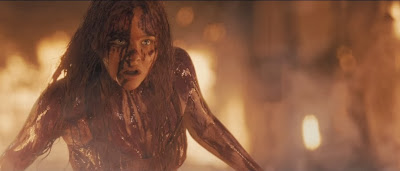
Pierce gets precipitously close to that edge, but doesn't tumble over it. She includes a couple of things that De Palma, and the screenwriter of both versions—and the musical version—Lawrence D. Cohen, left out of King's book, which are the opening scene of Carrie's birth (the harrowing circumstances alluded to in the first chapter) and a sub-plot involving Sue Snell. Quite a few things are better—the kids...look like kids, not twenty-somethings from television sit-com's posing as teens. The good of that is that the performances are more awkward and more vulnerable. The downside is that they are all dewy lumps that don't have a lot of distinctiveness to them, so one is caught for a second wondering "which one is this, again?" I mock the ages of the older Carrie cast-members, but they had the experience and chops (from those sit-coms, presumably) to make their characters known as soon as they entered a shot. The 2013 kids are...awkward...looking like they're ready for a direction-cue in the middle of a take. For example, as pretty and competent as Gabriella Wilde is (she plays this version's Sue Snell, the "remorseful" girl played first by Amy Irving), most of the time she's blandly waiting for her next line with a concerned furrow and not much else behind it
One essential thing (given the times, making this Carrie somewhat relevant) is the inclusion of the evil genie of new media into the mix. Every kid here has a cell-phone. Every kid is documenting their lives like would-be film-makers (and Pierce throws in random samples of such stuff for bridging sequences, showing "normal" high school activity). But, the most innovative use of it comes when Carrie has a "period" in school that isn't scheduled and the girls in her high school gym class viciously taunt her, there's the added inevitability that some goonish lout will whip out their I-phone (usually banned from bathrooms for this very reason) to record the event. At that point, the truly bad-bad girl of Kris Hargenson (a brunetted Portia Doubleday here, future Mrs. de Palma Nancy Allen then) decides to go one step further, post it on YouTube, and it's then that punishment is meted out to the class. For Kris, this is unfair—she doesn't want to be an out-cast as she sees Carrie is and lashes out, digging herself deeper and deeper into detention, punishment and malicious revenge—and that video is used to twist the knife during the horrific prom sequence. It raises the stink of public media being thrown into the mix of private bullying and how it has escalated the trauma of humiliation by bringing mob mentality into the pecking order, empowering the mean-spirited far beyond their reach, and narrowing the victim of options for safe zones that might bring light (and perspective) to their situation. At that point, humiliation becomes torture and isolation becomes impenetrable.
As I said, if you take this stuff too seriously, it becomes no fun at all. And while Pierce's heart is in the right place, standing up for the repressed outcast and removing the puerile nudity of De Palma's version, she also goes a bit too far, making things less horror-ific, and more disturbingly real. For example, taking the loony ecstasy that Laurie brought to her fundamentalist (no fun; all mental) mother—Julianne Moore's version is seriously deranged, scratching herself to bleeding at the slightest provocation—and making Moretz's Carrie a very active revenge-seeker (where Spacek's interpretation was all evil-eye and mannequin-stiff, Moretz directs the carnage like a magician), the changes make her much less sympathetic as a character. Even though both movies show Carrie "learning her craft" by checking out resources in the library (I thought schools were banning books right and left—heck, they even ban "Carrie!"), the new Carrie seems to have more control than Spacek's, whose bursts of revenge felt like an id monster that would combust things with a look. This one concocts tortures and lingers over them like a cat playing with a mouse. Hey, control is great, but at what point does the tortured become the torturer? At what point do we lose sympathy for her and see her as just another maniac terrorizing a school? At what point does that earnestness work against the intent?
So. Good attempt. Maybe even worth the effort. But, at some point, this new Carrie manages to undermine the reason it was generated in the first place—to give us a really good scare. Perhaps real life events have just caught up and overwhelmed the perspective of seeing entertainment in this, or, to make debating points, the filmmakers just eked out some of that entertainment value. But, I remember leaving the first Carrie feeling sympathy for the devil, seeing it as a tragedy. This time, it seemed everything was a natural consequence of tinkering with forces beyond one's control, especially if self-control is in short supply. There was no catharsis, and at that point, Carrie 2.0 just stands for nothing, a nihilistic bloody mess. 

*