Showing posts with label Finn Wolfhard. Show all posts

Saturday, December 17, 2022

Guillermo del Toro's Pinocchio

Re-Tooling Pinocchio
or
"All Good Things Require Patience"

Good Lord, we're certainly in a nostalgia craze right now, but then self-isolation will do that to you. Spielberg did Fabelmans, Mendes does Empire of Light, and now del Toro makes a film that was inspired by an early childhood movie memory of his youth, his own version of Pinocchio. I can't fault him; I loved that movie as a child—and was obsessed with it, too. But, that was Disney's Pinocchio made in 1940. It's of a different time and a different sensibility.
 
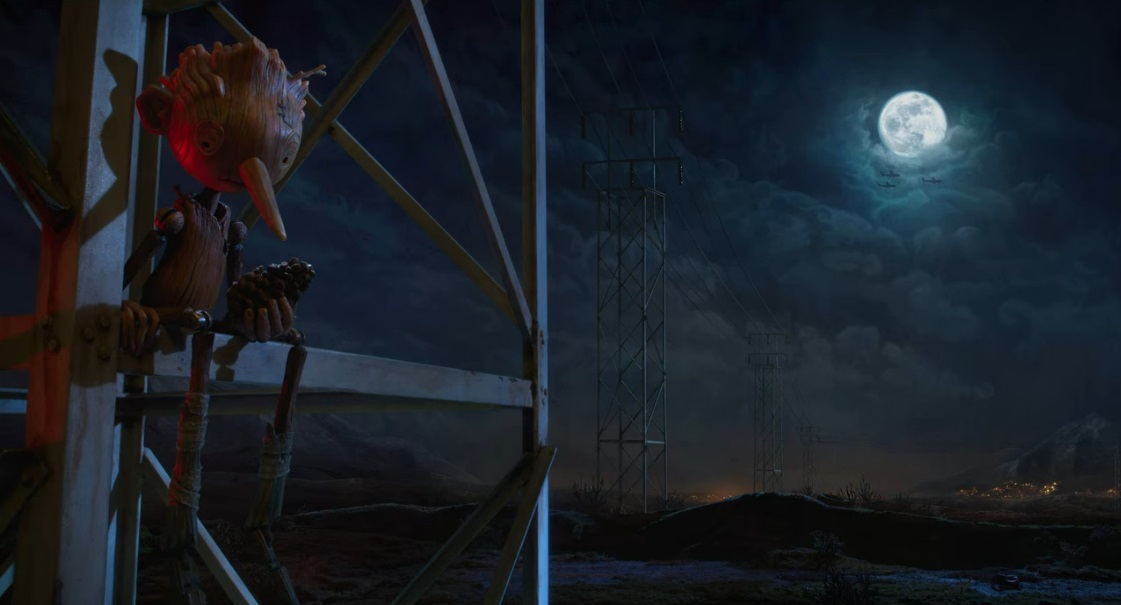
Guillermo Del Toro's Pinocchio is quite another creature entirely. For one thing, it's set in the fascist Italy of the 1930's. And the puppet is a puppet, never losing his bark (as it were) and without the embedded wish of being a real boy. He's real enough and high on, if not life, anthropomorphism. But, he's a block of wood, cut from a tree, without the benefit of paint or clothes as per the Disney version (and the recent Robert Zemeckis adaptation on Disney+). 

And this version isn't 2D animation or CGI as with those. This is stop-motion animation, that pain-staking movie-making done (as with most animation) frame by frame. I've always had a soft spot for this type of work, be it from its earliest days of King Kong, through the mesmerizing work of Ray Harryhausen to the improvements of "go-motion" developed by the wizards like Phil Tippett for the Star Wars films. To think of these guys, with their little play-sets, moving their figures inch by perceptible inch, bearing in mind the incremental differences in perceptible motion and speed!) to create the illusion of life on film reveals not only the imagination but the science and mechanics of making moving pictures. We won't even talking about the commitment of walking to a studio knowing you'll probably only get a minute of film done (if you're lucky) every day.
So, hats off to
Mark Gustafson, who co-directed this—while del Toro was off directing live features, promoting them, winning Oscars, getting married and supervising his vision of what "his" Pinocchio story should be. Gustafson's work is incredible...and convincing. You get lost in this world and its creatures, all with their individual quirks and personalities (they move differently—by design, Gustafson's design). Those are determined by del Toro, they are brought to life by Gustafson's steadfast and steady work.
You know the story. Simplified, the story goes like this; Gepetto is a wood-carver/toy-maker who makes a humanoid marionette with the wish that it might be a real boy. Supernatural powers animate the puppet and, after the usual chaos that an energized blunt instrument can inflict, Gepetto insists that the thing go to school to be socialized, forgetting that society sees Pinocchio as a puppet walking around without strings and thus, something exploitable. Pinocchio gets gathered like kindling and tied up in a traveling show. Much searching occurs until getting swallowed by a whale, at which point, Pinoke proves his worth saving everybody and is rewarded.
But, it's the details. Disney's version leaned on the "wants to be a 'real' boy" wish, starlet-pretty fairies, anthropomorphized animals, and an emphasis on good behavior (while, curiously, demonstrating smoking, drinking, gambling, and vandalism) tent-poled with a lot of classic songs that perpetually show up in modern culture as well as hawking trips to Disneyland. The lesson to it all is "Always Let Your Conscience Be Your Guide," which implies that the conscience leads to good behavior that is accepted by society, the church, and the family. And that "being a real boy" is the sine qua non of life.
 
As they say at "CinemaSins": "That's speciest!"
Del Toro tells a different story, while keeping the nuts and bolts holding the thing together. It's set in the 1930's during fascist Italy (as we've said), and Gepetto (
David Bradley) makes his figure after his beloved son, Carlo, is killed in a bombing. Despairing (and drinking) he builds it from the tree that has grown out of his son's grave. Wood spirits (in the form of a slightly angelic figure—voiced by Tilda Swinton) show up and grant life to the figure and appoint resident cricket Sebastian J. Cricket (Ewan McGregor playing Obi-Wan for Disney a-gain!) as his guide and tutor.
The sight of Pinocchio (Gregory Mann) gallivanting cluelessly and curiously around his work-shop filled with sharp objects understandably freaks out the hung-over Gepetto. And his instincts are to curb his enthusiasms or, failing that, lock him in the closet to minimize the damage he causes. It's easiest to do the latter, ironically when he's going to church) But, Pinocchio cannot be contained and he follows his "Papa" to the humble chapel adorned with a crucifix built by Gepetto.
But, the parishioners are aghast! What unholy thing has desecrated this House of God? It's an abomination and (not only that, says the town's fascist leader, Podesta-voiced by "del Toro regular" Ron Perlman) he's a "dissident. An independent thinker, I'd say." All because Pinocchio looks at the wooden Christ on the cross (also built by his "Papa") and wonder "How come they like him and not me?" Poor Pinocchio. He's a beginning student asking post-grad questions.
Time to send him to school, but he's easily distracted by an offer from the unscrupulous Count Volpe (
Christoph Waltz) to join his circus and become a performer in his traveling puppet act. Soon, Pinocchio is quite the attraction, attracting the attention of a desperate Gepetto and the fascist Podesta—who wants to gain favor with Il Duce, Benito Mussolino (Tom Kenny), who fancies puppets as much as he fancies being the ultimate puppeteer. Dictators always have that fantasy, whether they rule a puppet government or not.
This is all delightful, even if its satire is heavy-handed (fascists deserve no less) at times, and its humor is periodically ghastly (it is del Toro, after all), but it caroms along at a brisk pace, occasionally interrupted by songs (composed by the always inventive
Alexandre Desplat, with lyrics by del Toro and Roeban Katz) that are sometimes interrupted themselves by some boisterous activity that ends them in mid-note.
And it adheres to the "Always Let Your Conscience Be Your Guide" maxim in a way that works in a complicated way where Society may not always be in the right. I like that. Like the movie itself, its heart is is exactly the right place where it should be, even if there is no heart in evidence.
 
This is a Pinocchio I can admire, no strings attached.

Saturday, December 11, 2021

Ghostbusters: Afterlife

Ghostbuster Babies Wake The Dead
or
Who You Gonna Call? Ghost-WRITERS!

One walks into a movie with such hope. 
 
Take Ghostbusters: Afterlife (please). The director and co-writer is Jason Reitman, son of the original's director (the real-life sequel if you will). But, Jason has made some terrific movies in his own right—Thank You for Smoking, Juno, Up in the Air, Young Adult, Tully—that eclipsed the quality of his father's work and heralded an original and mature director whose film-making instincts would, at least, be interesting and, more often than not, thought-provoking and challenging.
 
What one does not expect is a work of desperation, of a studio in need of a tent-pole of a franchise, even one that has suffered in the past (except for the first one) from its own haphazardness and money grubbing, and of a director in need of a hit who doesn't want to wade in the world of mass-market spandex and not fall too far from the money-tree. I'm sure the Sony execs were crowing that they had the best of both worlds—a younger director with a track record who was close enough to the material (and its initial legacy) that he wouldn't try to re-invent their hit (as had been tried...with disastrous box-office results).
 
Is there life in Ghosbusters? Or after-life? Stay tuned.

Callie Spengler (Carrie Coon), divorced mother of two—that would be Trevor (Finn Wolfhard) and Phoebe (Mckenna Grace)—has just been evicted from her place and she and the kids pack up everything and move for the Summer to—Summerville, Oklahoma—as her only assets are the tumble-down dirt farm, where her father, Dr. Egon Spengler—former Ghostbuster—moved and ultimately died (under mysterious circumstances). Callie has nothing but vitriol for her father—science skipping a generation—for abandoning her and her family for something having to do with his work. The house itself is a disaster, with books stacked high ("symmetrical book-stacking..." Humans DO do that, evidently), and a secret laboratory in the basement (accessible by fire-pole), and an abandoned Ecto-1 in the back-broken barn.
While Trevor tries to make friends working at the local burger drive-in, Phoebe, the science-nerd takes Summer science classes from Mr. Grooberson (Paul Rudd), who plugs a horror movie into the VHS (funding...) while he investigates the strange seismological activity happening in Oklahoma. Fracking? "Fracking annoying!" responds Callie. The humor here is mostly visual, although verbal attempts are constant, usually consisting of some sort of cynical comment that hurts.*
Eventually, everyone becomes aware that Granddad was a Ghostbuster, and shows up at the house by inhabiting inanimate objects and moving them around—chess pieces, lights, desk-drawers. Trevor gets Ecto-1 going again, despite its age and rust and oxidating gas supply. And Phoebe wins this year's "Mary Sue" award for figuring out how Egon's "unlicensed nuclear accelerator" proton pack works without any sort of guidance. "Why worry?"
Why, indeed? She catches her first ghost on her first pursuit and traps it. It results in some substantial property damage around town and she, Trevor, and their buddy "Podcast" (because...he...does a...ah, forget it) wind up in jail, with their equipment confiscated and Mom being really pissed at them for interrupting her date with Mr. Grooberson.
Eventually, it's determined that Summerville is the epicenter for another emergence of Gozer the Gozarian (who'll appear as Olivia Wilde in an uncredited cameo) as Ivo Shandor (J. K. Simmons), the designer of the building that was ground zero for "The Great Manhattan Crossrip of '84") built the town just for that purpose. Mom Callie and Mr. Grooberson become the gate-keeper and key-master for the return.
Basically, the movie is "Goonies Meets Ghosbusters" while using the same strategy as The Force Awakens by bringing back most of the elements of the original (including SPOILER ALERT: the remaining Ghostbusters) in another locale and pulling a Carrie Fisher by having the late Harold Ramis appear as the spirit of Egon, complete with Obi-Wan Kenobi blue-shimmer. The devil-dogs appear, and so do possessed Stay-Puft marshmallow men. Everybody but Rick Moranis. But, it's the same story filled to busting with call-backs, heavily encrusted with nostalgia.
The kids are alright, though. Wolfhard is a good presence, and Mckenna Grace is a highlight as young Phoebe, using the same straight-faced strategy as "Young Sheldon"'s Iain Armitage, that somehow enhances the amusement factor as when told that as key-master and gate-keeper, her Mom and Mr. Grooberson have probably "done it": "
No, I just don't show my emotions like everyone else, on the inside I'm vomiting." It's not the line; it's the delivery—the singer, not the song.
One goes into these things with such hope. But, movies in a franchise need to grow not just regurgitate and please the fan-base or the investors. It's funny. They could really do some interesting things with the concept of an after-life** besides resurrecting "force-ghosts." But, "Ghostbusters" has always been a bit shallow in its intentions and this version does not intend to dig any deeper. But, then, it's not so much a movie, as it's a wake. For Ramis. And for the franchise.
 
* Phoebe wishes her Mother good night with : "Have a good night! Don't be yourself." Paul Rudd has a good line: "History is safe. Geometry is safe. Science is a safety-pin through the nipple of academia!"
 
** I had a friend who professed to be a psychic, and the most believable thing about it was he was so casual talking about it. A casual mention of ghosts and he blurted "Ah, ghosts are ASS-holes, man..."

Wednesday, October 16, 2019

The Addams Family (2019)

Altogether Ooky (And I Don't Even Know What That MEANS!!)
or
"Are You Unhappy, Darling?" "Oh, Yes, Yes! Completely"*

I've written about how much I loved "The Addams Family" (both as a 1960's TV show and as a concept from Charles Addams' series of macabre  New Yorker cartoons from 1932 to his apparent death in 1988), and the rather "iffy" attempts to continue the perverse charm in Barry Sonenfeld's feature films and TV spin-off's. There's been a Broadway musical (that I know nothing about) and there were rumors a few years ago that Tim Burton was working on a stop-motion version—which might have been interesting. Burton might not have been entirely faithful to it, but he would have captured the spirit and the schtick that made the old series so enjoyable (as opposed to the watered-down "Munsters" that appeared on CBS at roughly (very roughly) the same time.

Well, that would have been interesting. And probably far more enjoyable than the latest re-boot of The Addams Family, written by Conrad Vernon, Pamela Pettler, Matt Lieberman, Erica Rivinoja and directed by Vernon and Greg Tiernan.
Kudo's to them for designing it closer to Addams' original conceptions (although they don't always make compelling characters—their version of Addams daughter Wednesday is particularly bland) and there are some rare body-snatches of Addams original material—like the line (*) in this post's title. But, the whole thing is barely enjoyable, particularly because some of the voice-casting is underwhelming, with the exception of Oscar Isaac's "Gomez" and Nick Kroll's "Uncle Fester."
But, there's also less emphasis on the family dynamics and more on their "otherness" from somewhat ordinary citizenry. That tactic has always been dull—unless the "normals" were weirder than the Addamses—and usually the least intriguing part of any "Addams" story. How many gawping reactions can you get before it gets old and starts decaying before your eyes? And this version of "The Addams Family" has an awful lot of that.
The film begins with the wedding of Gomez (Isaac) and Morticia (Charlize Theron—she tries, although the role would be better suited to another cast-member, Allison Janney) attended by the Addams Extended Family, but it gets interrupted by locals with torches and pitchforks—ordinary people are turned murderously monstrous by what they fear (now where have we seen that before?)** Escaping with Fester (Kroll) and "Thing" (their literal hand-servant), the joyously gloomy newly-weds head for their honeymoon in New Jersey (State Motto: "What Are YOU Looking At?), where they run down an escapee from an asylum for the criminally insane, who turns out to be Lurch (muttered by director Vernon), who will become their beloved man...er...creature-servant. Trying to return him to the asylum, they find the facility closed (by police tape), abandoned, and haunted. But, for them, it's merely a lovely fixer-upper dream-home to raise a family—but not from the dead—and put down gnarled roots.
Morticia is mortified that Wednesday starts to show interest in bling
"But, darling, pink is a gateway color!"
Cut to thirteen years later. The Addamses have an older daughter Wednesday (Chloe Grace Moretz) and son Pugsley (Finn Wolfhard, busy young man). Wednesday, full of woe, has grown rebellious ("But, darling, you have all the horrors of home right here!") and Pugsley is approaching an Addams right of passage. No, it's not a Bat Mitzvah (but thanks for going there), it's a Mazurka, in which he must demonstrate his prowess as a warrior with the Addams Scimitar. That's not Pugsley's style—he's more of an expert in explosives—and Gomez fears that, despite his worst efforts, Pugsley will be an embarrassment to the Family coming to witness the momentous event. This sentiment seems un-Addamsish.
Meanwhile, gentrification also challenges The Addams Family. At the base of their escarpment their mausoleum is perched on, a development has cropped up, sponsored by the Home, Art, and Garden Network (HAG-TV) and its principal make-over star, Margaux Needler (Janney). As if to push the point a little too far, the name of the town is "Assimilation," and the movie is consumed with her efforts to get rid of the eye-sore that sits in the cross-hairs of Assimilation's picture-windows.
Margaux stops by to give the Addams House a make-over.
The hair may be a political point.
Oh, there are good lines—at one point Wednesday runs away from home, insisting on going to public school (rather than "cage-schooling") and she's asked if she wants to go to the Mall to which she replies "Sure, I haven't seen a good mauling in ages"—but, it's relatively simple to get laughs out of Addams contrariness. The very fact that they're a morbid bunch makes them a natural anathema to normalcy and rife with satirical possibilities aimed at white picket fences. But, this version is a little too desperate to find them. And bludgeons them like a wooden stake.
There's an awful lot of music humor—too much of it—Lurch plays "Green Onions" on the organ and, at one point, "Everybody Hurts." It's a little weak. And it has the annoying habit of going back to the well of the TV-show for dread-cred, rather than stake out new territory. The film-makers make too much of a big deal of the pet lion (in the TV series, did we see that twice?) Did we really need an animated version of the TV-show's theme song that matches the live version to the last detail? Can't this be its own "thing" (so to speak?) without cleaving so close to the source? Are we to reduce the Addams Family to being a horrid cliche, with the very first movie in a re-boot series?
I know it's a children's movie and all, but the group who made the "Hotel Transylvania" films had a better coffin-handle on the material than this weak effort has. 

Maybe I'm a little too close to the source, but, after watching this, I had a normal urge to go down to Lowe's and get a cart full of torches and pitch-forks.


*
** Short Answer: "Everywhere"
"That's 'It', Folks!"