Showing posts with label Christoph Waltz. Show all posts

Wednesday, January 25, 2023

Carnage (2011)

Written at the time of the film's release...

Get a Room!

or
Who's Afraid of Nibbles the Hamster?

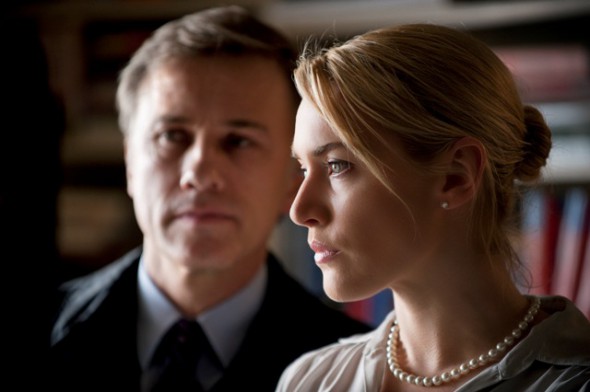
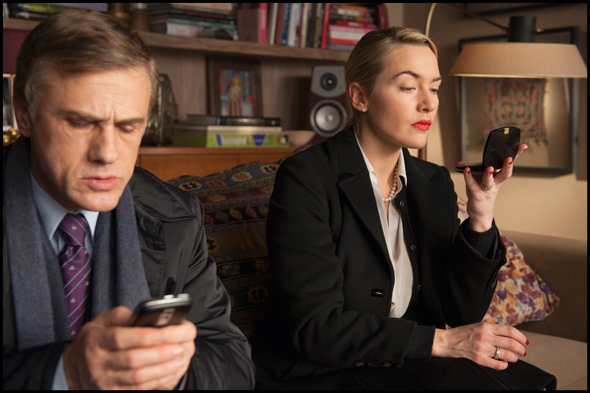
A schoolyard brawl between two kids escalates into a meeting between the parents that only proves the kids are amateurs at it in Roman Polanski's new film Carnage, based on the play by Yasmina Reza.  The meet-and-greet takes place at the New York apartment of Penelope and Michael Longstreet (Jodie Foster, John C. Reilly)— he's in hardware sales and she's an arts afficianado and rights activist, writing a book about African genocide—with Alan and Nancy Cowen (Christoph Waltz, Kate Winslet)—he's in lawyerly mode and she frets. It all starts well enough: cobbler is served and coffee offered, everyone's uncomfortable and on their best behavior.  But the niceties don't last any longer than the cobbler. Penelope starts getting self-righteous, Michael, overly conciliatory, while Alan loses his laser-like focus from a series of interrupting cell-calls that from a client with a wonder-drug for high blood pressure that may have all sorts of side effects.
Then, Nancy...
well, things go down-hill fast after Nancy...


It's basically a one-joke black-comedy that isn't remotely funny (the anti-punch-line comes at the end) turned up to 11 by an all-star cast and a director confined to a minimal set and probably going a little bit insane day by day. Bear in mind that Polanski was probably giggling and encouraging extremism all through shooting, but all these terrific actors have their moments of masonry mastication—Foster coming off the worst, and Winslet the best, with Reilly and Waltz being alternately obnoxious and snaky. Fairly soon, lines are drawn in tasteful carpets and there's a constant tying and untying of boundaries and bonds, that fall along lines of sex, politics and whatever the last subject talked about was. 
There are histrionics galore, and while there are no real baring of souls,
there are all sorts of baring of inhibitions and not in the fun way. These people seem to have absolutely no sense of decorum or restraint or any illusions that their opinions might not be the most pertinent to the proceedings. It's all out there, vomited at projectile force and with no dolby/no squelch. That would appear to be the comedy of it, but unfortunately it comes off a little forced and a little unrealistic. It doesn't matter how set in their ways and high-strung these people are, at some point there is going to be re-assessment and back-pedaling, even if the trajectory is straight down-hill.
Not in this self-contained universe
. There is no tentativeness here, no sticking the toes in to test the waters, everybody belly-flops into the pool from the high-minded-board. Even "Who's Afraid of Virginia Woolf?" is subtle by comparison, although there are some nice behavioral touches, like Penelope raising her level of discussion to an obviously uncomfortable volume to drown out Alan's phone-call.  Common sense is forgotten along with the kids argument and everything degenrates to a tag-team grudge match between and among the couples.

Ultimately, it's a bad night out that you want to forget about in the morning.

Saturday, December 17, 2022

Guillermo del Toro's Pinocchio

Re-Tooling Pinocchio
or
"All Good Things Require Patience"

Good Lord, we're certainly in a nostalgia craze right now, but then self-isolation will do that to you. Spielberg did Fabelmans, Mendes does Empire of Light, and now del Toro makes a film that was inspired by an early childhood movie memory of his youth, his own version of Pinocchio. I can't fault him; I loved that movie as a child—and was obsessed with it, too. But, that was Disney's Pinocchio made in 1940. It's of a different time and a different sensibility.
 
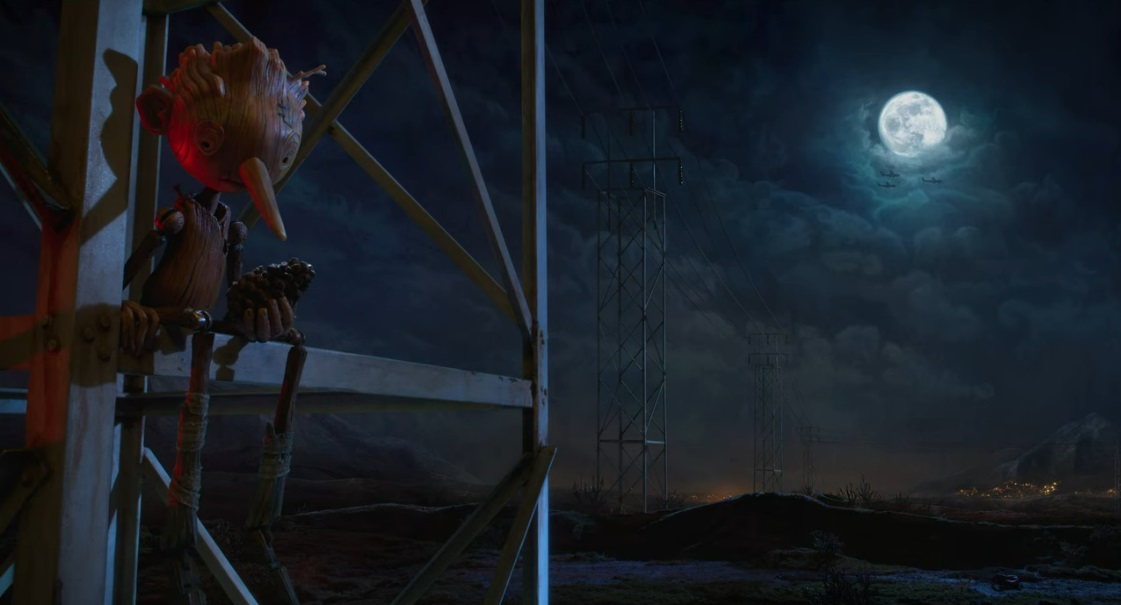
Guillermo Del Toro's Pinocchio is quite another creature entirely. For one thing, it's set in the fascist Italy of the 1930's. And the puppet is a puppet, never losing his bark (as it were) and without the embedded wish of being a real boy. He's real enough and high on, if not life, anthropomorphism. But, he's a block of wood, cut from a tree, without the benefit of paint or clothes as per the Disney version (and the recent Robert Zemeckis adaptation on Disney+). 

And this version isn't 2D animation or CGI as with those. This is stop-motion animation, that pain-staking movie-making done (as with most animation) frame by frame. I've always had a soft spot for this type of work, be it from its earliest days of King Kong, through the mesmerizing work of Ray Harryhausen to the improvements of "go-motion" developed by the wizards like Phil Tippett for the Star Wars films. To think of these guys, with their little play-sets, moving their figures inch by perceptible inch, bearing in mind the incremental differences in perceptible motion and speed!) to create the illusion of life on film reveals not only the imagination but the science and mechanics of making moving pictures. We won't even talking about the commitment of walking to a studio knowing you'll probably only get a minute of film done (if you're lucky) every day.
So, hats off to
Mark Gustafson, who co-directed this—while del Toro was off directing live features, promoting them, winning Oscars, getting married and supervising his vision of what "his" Pinocchio story should be. Gustafson's work is incredible...and convincing. You get lost in this world and its creatures, all with their individual quirks and personalities (they move differently—by design, Gustafson's design). Those are determined by del Toro, they are brought to life by Gustafson's steadfast and steady work.
You know the story. Simplified, the story goes like this; Gepetto is a wood-carver/toy-maker who makes a humanoid marionette with the wish that it might be a real boy. Supernatural powers animate the puppet and, after the usual chaos that an energized blunt instrument can inflict, Gepetto insists that the thing go to school to be socialized, forgetting that society sees Pinocchio as a puppet walking around without strings and thus, something exploitable. Pinocchio gets gathered like kindling and tied up in a traveling show. Much searching occurs until getting swallowed by a whale, at which point, Pinoke proves his worth saving everybody and is rewarded.
But, it's the details. Disney's version leaned on the "wants to be a 'real' boy" wish, starlet-pretty fairies, anthropomorphized animals, and an emphasis on good behavior (while, curiously, demonstrating smoking, drinking, gambling, and vandalism) tent-poled with a lot of classic songs that perpetually show up in modern culture as well as hawking trips to Disneyland. The lesson to it all is "Always Let Your Conscience Be Your Guide," which implies that the conscience leads to good behavior that is accepted by society, the church, and the family. And that "being a real boy" is the sine qua non of life.
 
As they say at "CinemaSins": "That's speciest!"
Del Toro tells a different story, while keeping the nuts and bolts holding the thing together. It's set in the 1930's during fascist Italy (as we've said), and Gepetto (
David Bradley) makes his figure after his beloved son, Carlo, is killed in a bombing. Despairing (and drinking) he builds it from the tree that has grown out of his son's grave. Wood spirits (in the form of a slightly angelic figure—voiced by Tilda Swinton) show up and grant life to the figure and appoint resident cricket Sebastian J. Cricket (Ewan McGregor playing Obi-Wan for Disney a-gain!) as his guide and tutor.
The sight of Pinocchio (Gregory Mann) gallivanting cluelessly and curiously around his work-shop filled with sharp objects understandably freaks out the hung-over Gepetto. And his instincts are to curb his enthusiasms or, failing that, lock him in the closet to minimize the damage he causes. It's easiest to do the latter, ironically when he's going to church) But, Pinocchio cannot be contained and he follows his "Papa" to the humble chapel adorned with a crucifix built by Gepetto.
But, the parishioners are aghast! What unholy thing has desecrated this House of God? It's an abomination and (not only that, says the town's fascist leader, Podesta-voiced by "del Toro regular" Ron Perlman) he's a "dissident. An independent thinker, I'd say." All because Pinocchio looks at the wooden Christ on the cross (also built by his "Papa") and wonder "How come they like him and not me?" Poor Pinocchio. He's a beginning student asking post-grad questions.
Time to send him to school, but he's easily distracted by an offer from the unscrupulous Count Volpe (
Christoph Waltz) to join his circus and become a performer in his traveling puppet act. Soon, Pinocchio is quite the attraction, attracting the attention of a desperate Gepetto and the fascist Podesta—who wants to gain favor with Il Duce, Benito Mussolino (Tom Kenny), who fancies puppets as much as he fancies being the ultimate puppeteer. Dictators always have that fantasy, whether they rule a puppet government or not.
This is all delightful, even if its satire is heavy-handed (fascists deserve no less) at times, and its humor is periodically ghastly (it is del Toro, after all), but it caroms along at a brisk pace, occasionally interrupted by songs (composed by the always inventive
Alexandre Desplat, with lyrics by del Toro and Roeban Katz) that are sometimes interrupted themselves by some boisterous activity that ends them in mid-note.
And it adheres to the "Always Let Your Conscience Be Your Guide" maxim in a way that works in a complicated way where Society may not always be in the right. I like that. Like the movie itself, its heart is is exactly the right place where it should be, even if there is no heart in evidence.
 
This is a Pinocchio I can admire, no strings attached.

Friday, October 8, 2021

No Time to Die

James Bond's Swann Song
or
In The War of Orphans, Winning is Who You Leave Behind
or
"Tell Mother I Died Game" ("Well, It Just Goes to Show No One's Indestructible")
 
The continuity-conscious Daniel Craig era of the James Bond series has had a through-line simmering throughout all of its previous four films—"Don't trust anyone." 

From Craig's first film, Casino Royale, when the newly designated "00" agent James Bond has a moment of romantic weakness with the wrong person, continuing to the next film when he finds that his service has been compromised, and that the allied CIA works to cross-purposes, through Skyfall, where his boss "M" (Dame Judi Dench) sacrifices agents (including himself) indiscriminately, to the last one, where he discovers he can't even trust his past, this version of Bond walks under a cloud of suspicion, never letting his armor down, lest he be betrayed...by anyone. 

By the time of Craig's fourth film, SPECTRE, he has tipped so far over the edge that he draws down on a random mouse to ask it "Who sent you? Who are you working for?"   

As the song (from Quantum of Solace) says: "...someone that you think that you can trust is just another way to die."

The official series' 25th entry*, No Time to Die, sees Craig's James Bond retired in Jamaica and recruited—by CIA pal Felix Leiter (Jeffrey Wright)—for an operation that eventually reunites him with the people he does trust to go after people he can't, something involving a missing scientist. Another one. Hey, the series has been going on for nearly 60 years, everything can't be original and nor would the many "James Bond" devotees not allow the "familiarity factor" to creep into the story ("Where's the Aston Martin?" "Where's the martini line?" "I didn't hear 'Bond...James Bond!" "Is he going 'rogue' again?"**).
Still, with all the Fleming novels having been filmed—in one form or another—and a good smattering of the short stories included, the filmmakers have been hard pressed to keep Bond current, the movie-plots being set "a few minutes from now" with call-backs from past novels and films spattered in, as well as acknowledgments from other sources that the producers use to know that they know they're being watched.*** And the films have for the most part been formulaic—Pre-Credit Sequence/Main Title/Meeting with M/Visit to Q/Two Women (at least) with one being of mixed loyalty/The Sacrificial Lamb/Meet the Villain/Big Finish (with Explosion)/Sting in the Tail With a Challenging Henchman/"James Bond Will Return in..."—so that there were things you could count on. Rules were played with, but some you just didn't violate.
 
No Time to Die up-ends them.
As I mentioned, the Craig films are continuity-conscious. When last we left James Bond (Daniel Craig, pushing it this time, in all aspects—age, acting, etc...), he had crushed the international crime league, S.P.E.C.T.R.E., and brought to ground (literally) its ring-leader, Ernst Stavro Blofeld (Christoph Waltz)—but didn't kill him—instead walking off into the London night with Dr. Madeleine Swann (Lea Seydoux), daughter of the mysterious SPECTRE middle-man Mr. White (seen in three of the Craig's). The last shot of SPECTRE had the two seated in Bond's recently re-constructed Aston Martin, sharing smug, self-satisfied smiles. They were meant for each other.
No Time to Die begins with an episode from the past (not involving Bond, but will), and the story of the two scar-crossed lovers on a European honeymoon of sorts that is ruined when Bond is attacked visiting the grave of...Vesper Lynd (the "other woman" from Casino Royale). Coincidence? Not much of one, and as Swann and Bond are high-tailing it out of there, it's revealed that Blofeld has engineered the whole thing from his prison and implicates Madeleine. Despite her protests, Bond puts her on a train and she's out of his life. Bond and his trust-issues again.
In the past, we'd gotten used to the disappearing Bond-girl act, where after the final clinch of each movie, she is never seen...or mentioned...again. "Who?" But, the fact that Seydoux is even there—and she's the only actress playing the same Bond-woman part over two movies—means that she's special. And that the producers have "borrowed" a piece of music from the series' past (written by John Barry!!) to serenade the Bond-Swann romance means she's more than special. More on that later—Madeleine Swann Will Return.
Five years later and Bond is retired in Jamaica and alone, spending his days fishing, cooking and (probably) drinking. One day, he comes back to his house and sees evidence that someone had been there—someone who smokes cigars. He goes into town, realizes he's being followed, and manages to catch the culprits in the act. It turns out to be Leiter and a State Department official Logan Ash (Billy Magnussen) who are trying to get Bond to help track down Valdo Obruchev (David Dencik), a biochemist who has recently been kidnapped by SPECTRE. Bond had a hand in bringing him in during his tenure, and under the agency's careful watch, the man had been working on something called the Heracles Project, a form of targeted weaponized virus. MI6 lost him and the CIA is trying to get him back.
But, they're not the only one. Also tracking him in Jamaica is a "00" agent from MI6, in fact, the new "007" ("I'll bet you thought they'd retired it"), Nomi (Lashana Lynch), who's also on the look-out for the chemist. Despite her warnings to back off, Bond travels to Cuba, where SPECTRE agents seem to be gathering. Nomi is there too, and with the help of a new CIA agent (Ana de Armas), Bond walks right into a viper's nest.
The Cuba sequence, with its fights, the jokey repartee of Bond and "Paloma," their pauses to drink, while Nomi is skulking in the background looking for opportunity is probably the highlight of the film. It works like a violent dance, with a Cuban jazz background (part of Hans Zimmer's functional score) that gives it verve and a sense of hysteria. That it follows one of the creepiest scenes in a Bond film probably helps to provide that sense of chaotic relief.
But, just because that's the giddy apex of the movie doesn't mean the rest of its bad. There's a hell-bent Aston Martin chase in an Italian villa, a spooky cross-country shoot-out through a foggy Norwegian forest that is terrific, and another example of those spectacular villain lair designs that have always set the series apart from its competitors. 
This is another of those Bond films that stun for how well done the practical effects are, the cinematography—by not one of the upper tier of photographers—is lush and colorful, the editing is crisp and tight (while giving you a sense of continuity and flow—something not apparent in Quantum of Solace), and the sheer kinetic verve of the action sequences goggle. Credit director Cary Joji Fukunaga for his precise direction and making a movie that never feels like it's 2 hours 46 minutes in length ("We Have All the Time in the World," indeed!). It's a bit of a miracle, really.
Fukunaga has also inspired Craig's most intense performance as Bond, part of which must also be credited to Phoebe Waller-Bridge's re-write of the original Purvis/Wade script. Fukunaga's practice of letting the actors "wing it" gives the film a richer, fuller life, much more than the standard Bond direction of "line (beat)/funny line (beat-beat)" that makes the viewing of the older films of the series seem awkward. Here the dialogue fairly scampers when Craig's present, and only slows to a crawl when Rami Malik's puppet-master Safin appears. "He's kinda creepy" is how he's described early and, indeed, he is, reminiscent of a trembling Peter Lorre, with a philosophy that's a bit hard to decipher, though natter on about it he does. The Bond villains have some motivation, whether it be greed, errant activism, or a power grab. Safin is simply crazy, but a self-important, rambling crazy.
Now, this is going to be a spoiler-free review, but, as mentioned, this one up-ends things, but not in a way that anyone who's read a book by Bond-creator Fleming wouldn't recognize. Because the Bond films have only flirted with a strict continuity lately means they can get away with it with no harm done. The older films had a strict "Bond is fresh with each adventure" edict, which the Craig films have ignored. Bond never got hurt in the old films, but now they keep track of the scars. This is Craig's last film—he's been doing it for 16 years, longer than anybody, and wife Rachel Weisz was getting annoyed he was coming home broken. There will be another Bond, but whether the series will be as continuity-conscious next go-'round hasn't been decided. 
Original Bond producer Cubby Broccoli always maintained that Bond should be "at the top of his game" and that nobody would be interested in an "early Bond" origin story. When his kids got control, they tried it with Craig and it's worked. But, now that they've done it, there's no need to do it again. Bond may go a different route, like going back to stand-alone movies. Maybe they'll do Cold War period pieces. Maybe they'll remake a couple of the bad ones. Who's to say? And who's to say who'll be the next Bond. Finding Craig was something of a miracle despite the initial nay-saying, so I'll trust their judgment on the matter.
 
One thing is certain and that is, as the credit says "James Bond will Return." As long as the British flag flies, and the box office receipts are healthy.


* "Official" refers to the films made by EON Productions (founded by Harry Saltzman and Albert R. Broccoli), starting with Dr. No in 1962, and featuring the Ian Fleming titles they had the film-rights to, which—at the time—excluded "Casino Royale" and (owing to an early '60's plagiarism suit) "Thunderball". "Casino Royale" appeared ("unofficially") as an episode of CBS-TV's "Climax" (starring Barry Nelson as "Jimmy" Bond, American) and a 1967 "spoof" film starring David Niven, Peter Sellers and Woody Allen, before EON got the rights to it for the first of Daniel Craig's films. Thunderball became an EON presentation when the fellow who won that lawsuit wanted to make his movie with Sean Connery and worked out a deal with EON to "present" the film—with Connery—thus avoiding any competition that might hurt box-office receipts. However, when that same guy wanted to remake Thunderball (which, contractually, he could do after ten years), things were so contentious between him and EON that both sides battled in court before that remake (called Never Say Never Again and starring Sean Connery) was released in 1983, the same year as EON's Octopussy starring Roger Moore. EON now owns the rights to both the books "Casino Royale" and "Thunderball" (even including those "un-official" movie versions). They've since been doing original stories for ages, (and over several agents), and it's a wonder when some morsel of the original Fleming writing sneaks undercover into the films.
 
** The series' Bond has "gone rogue" in On Her Majesty's Secret Service, Licence To Kill, Die Another Day, Casino Royale, Quantum of Solace, Skyfall, and SPECTRE. It's as if the producers have preferred Bond's role to be less a company man and more of a rebel.
 
*** Hmm. Live and Let Die was put in during the craze for "Blax-ploitation" films, The Man with the Golden Gun was taken out of its novel-locale of Cuba to be set in Hong Kong, Thailand, and Cambodia to catch the "Kung-Fu" craze, Moonraker timed to take advantage of the Star Wars-prepped audience, Octopussy threw in some Indiana Jones action, Goldeneye's Xenia Onatopp was a soul-sister to Never Say Never Again's Fatima Blush, the fight sequences of late owe much to the "Bourne" series, and the Austin Powers movies stole all of the series' leering jokes leaving the Craig films to be a bit more stoic—although the Bond screenwriters stole the "villain-is-a-relation-to-the-hero" bit from Goldmember...as either series might say "Tit for Tat" 
 

Wednesday, May 8, 2019

The Green Hornet

Superheroes come in all colors and stripes...and quality. We're all in the $2 billion glow of The Avengers: Endgame right now, but there have been some really lousy ones, too. Someone brought up Seth Rogen today, remembering him as "that funny guy." I brought up the name of Seth Rogen and when they said "yes" I mentioned snarkily that I got confused "when you mentioned that funny guy." Well, I remembered this movie. Wish I could forget...

"BUZZZZZZZZ.....zzzzzzzzzzzzzzzzzzzzzzz"
or
"Girls Are a Drag, Kato.  Thank God We've Got Each Other." 

"The Green Hornet" was a popular radio series in the 40's, and became a brief second tier in ABC-TV's "superhero" programming after the success of the Adam West "Batman" television show. Unlike the campy "Batman," "The Green Hornet" played it somewhat straight, albeit with the gleaming technology, out-there set decoration...and another fabulous George Barris car design. It also featured Bruce Lee, as Kato, Britt Reid's formidable kung-fu kicking house-boy, a couple of years before forsaking Hollywood for Hong Kong super-stardom.

When it was announced that Seth Rogen would be portraying "The Hornet" (as bad an idea, really, as when Jack Black was supposed to star in Green Lantern), I thought this could not come to any good. "The Green Hornet" was a distant lineage of "The Lone Ranger," in the continuity, and Rogen, known for playing ape-neck every-slobs, didn't seem to fit the bill (I couldn't even imagine Rogen throwing a punch!). Compounding the pre-release jitters, the movie was planned to be presented, rather unnecessarily, in 3-D, was delayed until after the Christmas crunch, and in the last couple months, the car has increasingly seemed to be the focus of the promotion. The Green Hornet appeared to be a victim of bad buzz, but cheerily trumpeted its excellence ("dude") at the top of its lungs—par-tay! The previews looked semi-amusing, so one walked in with a certain cock-eyed optimism.
It is abysmal. Starting out with a deadly serious "origin" episode  (de rigueur for all superhero movies, apparently*) where Daddy Reid (Tom Wilkinson) publisher of the "The Daily Sentinel" rips the head off young son Britt's superhero doll, traumatizing him,** the movie goes off-kilter fast. Directed by Michel Gondry (!!), the film soon settles into a un-comic romp with guns, gadgets, and all the cool things that will make the frat-boys spit out their beer in gawping appreciation: rock-themed fights, CSI-orifice-cams, gratuitous babes, "Matrix" slo-mo's, while generally following the "key-ingredient" rules of movie-making from Sweet Liberty.*** Ho-hum. But, the main problem is the lead character.  I like Rogen. I think he's very talented and, on occasion, very funny. Not here.  As played (and written with pal Evan Goldberg) by Rogen, Britt Reid's Green Hornet is a whining ADD cretin, with the slimmest, and dumbest, of character motivations. Rogen's Reid can't keep his mouth shut,**** no matter how inane his attitude or stupid his comment—he is entitlement-dumb, in marked contrast to the parade of millionaire-geniuses who inexplicably become "mystery men" in the genre. Indeed, he is so dependent on Kato (Jay Chou) for...everything...that you wonder why the kid from Shanghai***** doesn't insist on up-ending the billing (Kato with Hornet, the boy-doofus) and keep Reid corralled with a nunchuck leash.
The yin and yang of stupidity/competence continues throughout. Questions begin arising. Why does their super-slick, weapons-festooned car, "The Black Beauty" have rotating license plates, when it has "hornet" emblems all over it—even the gas-cap—making it hopelessly identifiable? Why does The Green Hornet hand out business cards at the scene of his bust-ups...with his internet address and e-mail account? Why does Reid talk about arming The Black Beauty out loud, sitting in a pool of accessory-chicks?
Why doesn't Kato just kick the green-snot out of Reid and be done with him?******

As with the series, Kato is the coolest character. Bruce Lee (who is given a brief homage) was the best thing about "The Green Hornet" show and one anticipated his fight scenes that rose, with considerable hang-time, above the common whiffed fisticuffs of television stunt-men. This Kato builds cars, seemingly from scratch, is an acrobatic master, martial artist, engineer and draughtsman...and...can make the perfect cup of coffee. Hmmm. Chou doesn't have much emotional range, but is loose enough that he can carry off the comedy, and still look like he knows business. However, the relationship between Reid and Kato is so skewed in the millionaire's favor (for no apparent reason) that the character comes off a bit as his "bitch," (which he calls him at one point—Kato is belittled constantly, short of racial slurs). And Rogen and Goldberg throw in a lot of unsubtle "bro-mance" references in case we miss the point.
And, the whole thing is a waste. The final set-piece is an exercise in over-the-top property destruction that reminds one of an unfunny version of the mall-destruction chase in The Blues Brothers. Good actors are squandered—not just Wilkinson, but also Christoph Waltz, who can't seen to decide if he's playing comedy or drama, Cameron Diaz in a "girlfriend" role, who tries to ad-lib with the big boys, but about the second line in a string says something inane, and Edward James Olmos, who looks dyspeptic every time he's on camera (his character is supposed to be frustrated, but I couldn't help but think he might be thinking about strangling his agent: "Hey, don't worry, Eddie, you thought "Battlestar Galactica" was a bad idea, too!")

The final segment begins with The Hornet saying "Everything we've done to this moment is complete and utter crap." Truer words...
What is most upsetting is to see a director like Michael Gondry, whose past efforts have included Eternal Sunshine of the Spotless Mind—a favorite of mine—and Be Kind Rewind—which isn't—continue a Shamalamyan decline in quality of work. This thing is a mess, and one can only wonder how cross-eyed it would make one in 3-D. I might actually worry about some form of brain-damage resulting from viewing this film.

Van Williams and Bruce Lee: In Memory, Still Green

* There was a preview of Thor in the promo-clusters before the show, and it appears to be the same story, but in Asgard—daddy issues are everywhere.

** .....o-kaaaay.

*** Those are: 1.) Rebellion against authority; 2.) Violence; 3.) Nudity.  I confess, of the venerable cliches, I didn't hear a "Wilhelm" scream, see a vegetable cart being overturned in a car-chase, but, "The Brother" does "Get It First."

**** There's a lot of post-production voice-over inserts to wedge in one...more...laugh-line, usually inane.  But, they're clumsy...and it feels like it's an attempt to go for a laugh so the audience doesn't think for very long.

***** Kato has always been, traditionally, Japanese...except for that time when he became Filipino after December 7th, 1941.

****** At one point in the film, he does.  But Rogen gets in enough licks, that it reminded me of the nadir of the "Green Hornet" series...in the cross-over with the "Batman" show, when Bruce Lee (Kato) was fought to a stand-still with Burt Ward (Robin, the Boy Wonder).  As if...  Supposedly, Lee was a bit miffed at that scenario.  And, for some reason, Kato is given a weakness that's condescending, not unlike how Jet Li was treated in The Expendables.

Friday, March 22, 2019

Alita: Battle Angel

Spare Parts
or
Little Orphan Gally (Sappiness is a Warm Gunnm)

It is the year 2563 and the separation between the have's and have-not's is evident at all times. Floating above "Iron City" is the pleasure-dome of Zalem, and the city in disrepair below it is, literally, its dumping ground. It is where Dr. Dyson Ido (Christoph Waltz), a brilliant cyber-surgeon of limited means, finds an angel...or part of one, anyway. 

Doc has been living in a self-imposed exile in Iron City, repairing its citizens, providing them with replacement parts for whatever has been ripped from them in the rough world of Iron City. Money is not a concern—he will take a bag or oranges for fixing a busted cyber-arm, if it will do the most good. He could have made good money creating freaks and cyber-monsters for the Moneyball tournaments that serve as bread and circuses for the disadvantaged to take their minds off being disadvantaged ("better football than revolution, right?")
Hunting for spare parts to use in his work, he finds the head and torso of an android female and looks at it and takes it home. using the discarded android body he had designed for his paralyzed daughter—murdered when a cyber-ruffian burst into his lab looking for drugs—Ido puts the little android together and calls her "Alita,"(Rosa Salazar, motion capped) his daughter's name. He doesn't know her background, doesn't know her history or function. But, he takes on the role of father-mentor and protector in a world where "people do terrible things."
Alita: Battle Angel went through "development hell" for many years, acquired by James Cameron after being introduced to the manga and its video by Guillermo del Toro, some time after he'd made Titanic. Cameron tinkered with a script, developed technologies, and ultimately used them to make Avatar and its (how many are anticipated?) sequels. Alita was put on a very back-burner until Cameron approached Robert Rodriguez, a director with a great sense of economy, but often not the vision to try and make something out of the property, or at least get it back on track. Rodriguez's first job was to try and fashion a script out of the many begun by Cameron that never seemed to gel. But, Rodriguez managed to squeeze into his script the first four books to the satisfaction of Cameron and producer Jon Landau, and the movie got made to the tune of 170 million dollars, Rodriguez's biggest budget by many factors.
The film that is cobbled together from the first four "Gunnm"/"Gally" books has the establishment of the Zalem-Iron city dichotomy, the murder of some women "Jack the Ripper"-style (which briefly makes Ido himself a suspect-perp), Alita's relationship with a street-punk named "Yugo" ("Hugo" in the film, played by Keean Johnson), and her emergence as a star-participant in a vicious roller derby game thoroughly based on the one in Rollerball; it's called "Moneyball" because...lawyers.
Frankly, they could have done without the "Ripper" sub-plot, even though it establishes a strata of Iron-ites as "hunter-warriors"—vigilante/bounty hunters who dis-assemble the most predatory of the cyber-human hybrids, who all seem to be associated with the Moneyball games, if only tangentially, through the person of one of the many bad-guys, Vector (Mahershala Ali*), who seems to be the Iron City mega-promoter of the games and its chief supplier of cyber-enhancements to keep the games...interesting.
There wasn't a need to make a third version of Rollerball. The movie wasn't a success in 1975 (nor was its 2002 re-boot), either financially or artistically, when Norman Jewison made it, and its same point about distracting an oppressed populace can be made, far more directly and relevantly, by making a football film. There is virtually no difference between Alita's "Moneyball" games and the "rollerball" concept right through to the no-holds-barred playing strategies or the "jam-the-ball-in-the-hole" concept of what constitutes a goal. Rollerball had motorcycles involved, but that's about it.
Alita rivets together Rollerball with "Tinocchio" and "Chromeo and Screwliet" with some seams showing through the solder, as they try to crunch four of the "Gally" stories into one movie. It gives short-shrift to Ido's development (which may be why Waltz gives one of his "uncommitted" performances) as there's never a point where he changes attitude from paternalistic protectiveness to his eventual "show 'em what you're made of" boosterism when she decides to enter a rigged Moneyball championship.
Rodriguez gets the spectacle down cold, but some of his futurism is a bit weird—the one wheeled motorcycles that pop up seem ludicrously stabilized for their design. Alita—the character—has big Disney-princess-eyes (the only one who does, curiously) to reflect its manga origins, but the movie is very Anglicized, with touches of Rodriguez's latino roots thrown in, more than its Japanese origins. Some of the editing is very rough with those continuity flaws "they" love to throw in IMDB's "Goofs" sections, and I'm still trying to figure out how Alita got her feet back after Ido replaces them with some nifty plug-in skates for the tournament. I'm sure some of it can be explained that it messed up the pacing, but given the other things, I think it was done "because they had to." "It's only a movie, Ingrid."
However, some of the work is stellar, especially when Rodriguez and his technicians stop reaching for photo-realism and make the thing move with an almost Chuck Jones-cartoon precision. As, below:
Now...let's wade hip-deep into Alita: Battle Angel and its place in the current political climate. Of course, it doesn't need to be and is a false flag in any political discussion because Alita is hardly political, making its point in sociological terms, merely. 
But...a certain sub-strata of internet commentators have chosen to make it political by bitching that Alita is a better representation of a female character than a "woke" "social warrior" movie (in their view) than say, Captain Marvel. This is not true. That sub-set just "feels" that way because Alita—to them—is a better representation of women, with her big eyes and her doll-like proportions (would that be more structurally sound for a robot rather than being heftier?) because it adheres more to the concept they prefer, which can be described as "the kind men like." Even if Alita wasn't petite and reminded one of a emaciated gymnast, she is also emotionally naive...in the way men like.
The second Alita story-line involves her becoming emotionally drawn to a street-tough named Hugo, whose dream is to live in Zalem, is working for Vector, makes his livelihood by dismembering hybrids for their spare parts and even sets up Alita for being demolished in the Moneyball tournament. Alita knows nothing of this—save for his Zalem upward-mobility—but even when she learns that he has worked against her, she loves him so much, she still forgives him and wants to be with him, despite it all.
What jerk wouldn't be attracted to that concept? Alita's devotion is unconditional, while his is based purely for his benefit. It doesn't matter that he's a scumbag, she Capital-♥ loves him, no matter what crap—or cyber spine—he pulls. This does not compute, and makes sense only in a male fantasy of uneven relationships and warped power dynamics.
At one point (and I started giggling uproariously while watching this, upsetting some in the theater) Alita offers Hugo her heart—her mechanical heart, pulling it right out of her chest and holds it out to him. One wonders how seriously this was taken by the film-makers: is it "on the nose" what they meant to represent, or was it meant to be a satirical joke because, hey, she's a robot. I chose to think of it a third way...as ridiculous. 
Personally, I would have liked her to grab him by his mullet and say, "Ya wanna get to Zalem, meat-monkey? Let's see how far I can THROW ya!" I think that would have been far more cathartic than Alita playing weak and deferential to her inferior-in-all-ways man-child.

But, I'm sure it played well for the boys still playing with girl-toys.

"It's only a movie, Ingrid"


* This is the first performance by this wonderful actor (two Oscars?) where he seems a bit lost and so, takes the role slowly, while still managing to differentiate between the character when normal and when "possessed"—never actually explained how (or why he doesn't do it to everybody) by the Big Heavy "Mabuse"-like Zalem kingpin named Nova (played by Edward Norton—and where has he been outside of Wes Anderson movies?) who runs the games like an overlord.