Shadows and Fog(Woody Allen, 1991) When Woody Allen makes a film in the style of Ingmar Bergman (Interiors), it's done in deadly earnest. But, when he takes on German Expressionism, entering the angular world of Lang, Murnau, with a para-nod towards Kafka, it's a comedy. Not quite sure why; maybe he has an affinity towards one stylization and the other he just finds phony, but the different approaches are like, well, day and night. Allen explored that theme—taking the same story and interpreting it as either comedy or tragedy—in Melinda and Melinda, a bit of a mis-fire—but one suspects that the Nordic tradition he buys completely, and completely dismisses the German (God knows why). Here, the visual is pure dread, but the subject matter is a mixed bag of precision and vagueness, comedy and darkness. Allen plays Kleinman, a passive-aggressive bookkeeper, who is recruited in the middle of the night by a vigilante mob (including David Ogden Stiers and James Rebhorn) to roam the streets looking for a serial strangler. Being a professional coward, and only dealing well with facts and figures in black-and-white, Kleinman is ill-suited for the activity and begs off, inviting suspicion from the group. When there is speculation that maybe he won't do his duty as a citizen because he might be the strangler, Kleinman caves.
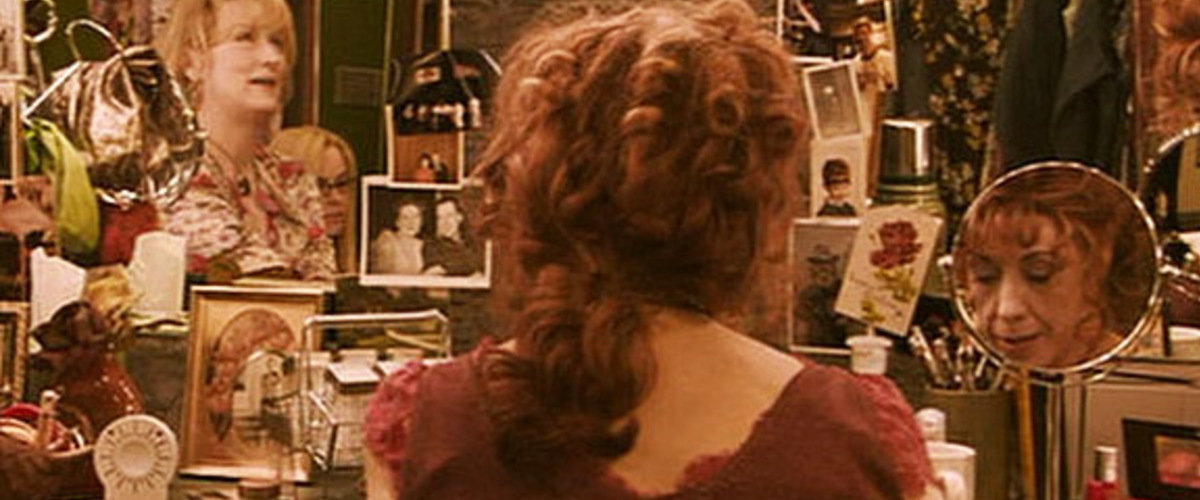
On his dark journey through the city streets (the largest set ever built in New York's Kaufman-Astoria Studios, making this Allen's most expensive film), he runs across an all-star cavalcade of slothful potential victims: a philosophy student (John Cusack) with a weakness for prostitutes (among them Lily Tomlin and Jodie Foster, madamed by Kathy Bates), a circus love-triangle tangentially related (with John Malkovich, Mia Farrow and Madonna) and the town coroner (Donald Pleasence), who has a purely scientific interest in the killer.*
Kleinman soon realizes that life simply doesn't add up, that a little slippage occurs, especially when it comes to illusion and reality (in the form of a very handy and practical magician named Armstead, played by Kenneth Mars). The film struggles with the dichotomy throughout, as highly contrasted as the black and white photography, never truly meshing, and finally ends, as many of Allen's weaker films—and one of Allen's strongest ones (Hannah and Her Sisters)—do, with a Deus ex Machina**that buttons everything up inexplicably, leaving no questions but a lot of raised eyebrows.
Which is fine for the purposes of the film, but it's hardly what you'd find in an example of German Expressionism, where the punishment fits the crime...and where things really are in black and white.
* Yes, the film is top-heavy with fine actors (and Madonna), but if you look in the darkened nooks and crannies of the film you'll also find Fred Gwynne, William H. Macy, John C. Reilly, Josef Sommer, Wallace Shawn, Kate Nelligan, Kurtwood Smith and Philip Bosco. Was this film cast or filmed at a SAG convention?
** Here's a question: It's a Woody Allen film; Can there be a Deus Ex Machina if there's no Deus?
Then, Nancy...well, things go down-hill fast after Nancy...
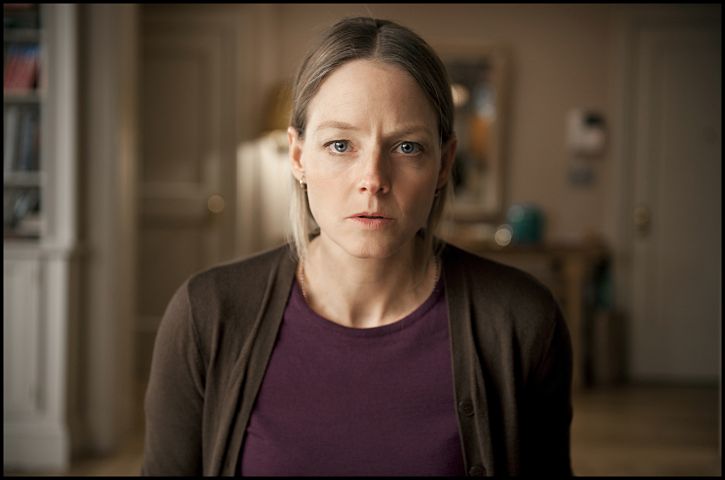
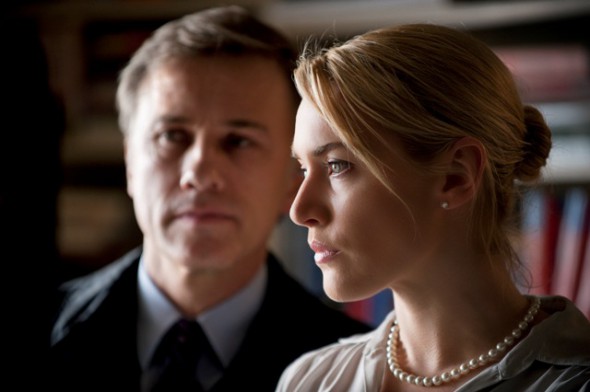
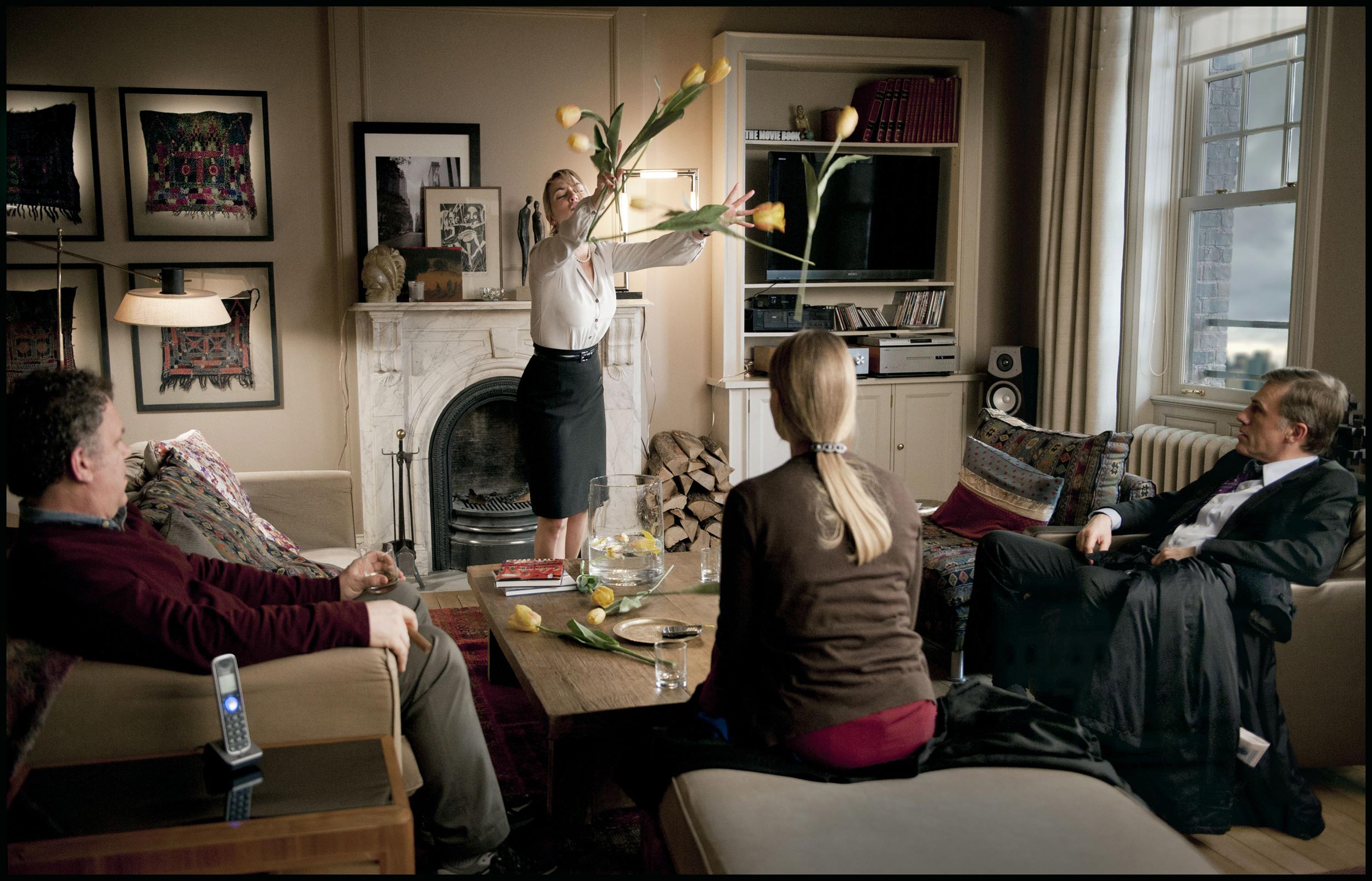
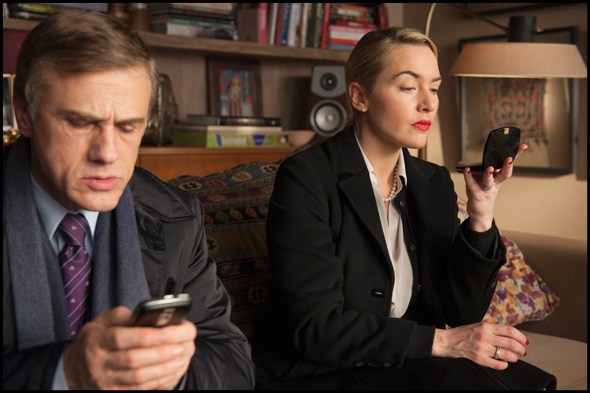
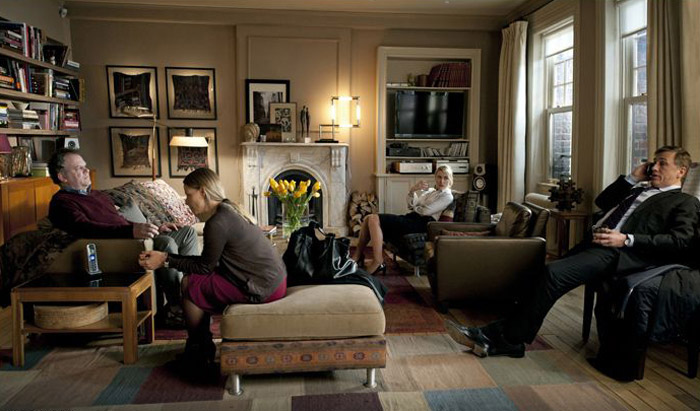
It's basically a one-joke black-comedy that isn't remotely funny (the anti-punch-line comes at the end) turned up to 11 by an all-star cast and a director confined to a minimal set and probably going a little bit insane day by day. Bear in mind that Polanski was probably giggling and encouraging extremism all through shooting, but all these terrific actors have their moments of masonry mastication—Foster coming off the worst, and Winslet the best, with Reilly and Waltz being alternately obnoxious and snaky. Fairly soon, lines are drawn in tasteful carpets and there's a constant tying and untying of boundaries and bonds, that fall along lines of sex, politics and whatever the last subject talked about was.
There are histrionics galore, and while there are no real baring of souls, there are all sorts of baring of inhibitions and not in the fun way. These people seem to have absolutely no sense of decorum or restraint or any illusions that their opinions might not be the most pertinent to the proceedings. It's all out there, vomited at projectile force and with no dolby/no squelch. That would appear to be the comedy of it, but unfortunately it comes off a little forced and a little unrealistic. It doesn't matter how set in their ways and high-strung these people are, at some point there is going to be re-assessment and back-pedaling, even if the trajectory is straight down-hill.
Not in this self-contained universe. There is no tentativeness here, no sticking the toes in to test the waters, everybody belly-flops into the pool from the high-minded-board. Even "Who's Afraid of Virginia Woolf?" is subtle by comparison, although there are some nice behavioral touches, like Penelope raising her level of discussion to an obviously uncomfortable volume to drown out Alan's phone-call. Common sense is forgotten along with the kids argument and everything degenrates to a tag-team grudge match between and among the couples.
Ultimately, it's a bad night out that you want to forget about in the morning.
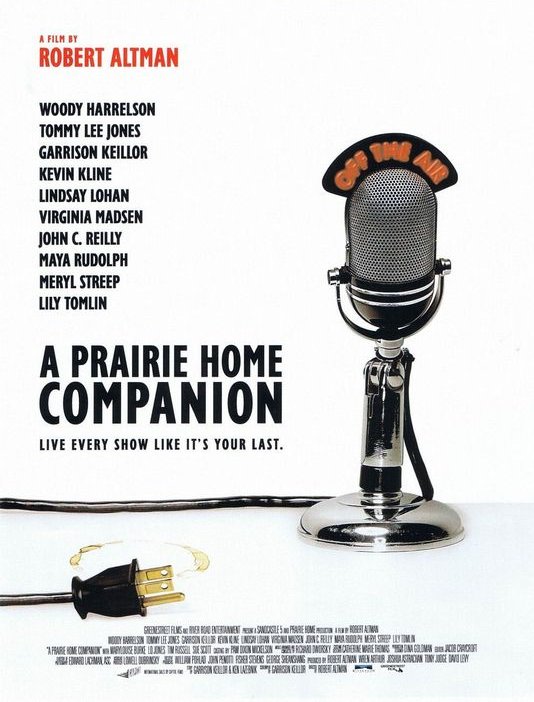
"A Prairie Home Companion" is one of the best shows on the radio (the best being "This American Life," but we'll save that for later...or better yet, check it out for yourself
on the link). Over the course of its 30 year run, this less-than-"Grand Ol' Opry"-wanna-be has
presented home-spun music of all genres--from Gospel to Grand Opera (and has
seemingly unearthed every folk-artist extant in the country) and combined
spiritual optimism (albeit Lutheran, which takes the joy out of it) with a
cynical farm-land realism, all reflecting the philosophy and upbringing of
its host Garrison Keillor, whose low story-telling voice is as lulling as cattle moaning in the
pasture at night. Keillor
writes it all, performs in most of it and serves as ringmaster, finally
capping it off with his stool-talk reverie, The News from Lake Wobegon,
land of low expectations ("Where all the women are strong, all the men,
good-looking and all the children are above-average"). Old time radio
techniques and phony commercials--for "Powder-Milk Biscuits" ("Heavens, they're tasty and
expeditious!") or for "The Ketchup Advisory Board" wind their way through
everything, with just enough toothsome satire to leaven the bitter with the
sweet.
It's Community-Theater of the Mind, a staple of Public Radio, and manages to
embrace and cherish both red and blue states in it's musty woolen blanket of
nostalgia.
In the long string of Saturdays that I've listened I've heard moments of
great beauty that I'll never forget,**while, on the other hand, I've wondered more than once why Keillor needs
to sing so damned much. It's been a comforting friend on lonely
cross-country drives, and it's been known to make a car load of rowdies
quiet in contemplation.
But anyone going into
Robert Altman's
A Prarie Home Companion or "PHC" is due for a bit of a shock. Written by Keillor (from a story by him and Ken LeZebnik), it incorporates familiar bits and pieces from the broadcasts
throughout. Characters come to life in the form of show-stalwarts cowboys
Dusty and Lefty (played in the film by Woody Harrelson and John C. Reilly) and private eye Guy Noir (played by Kevin Kline
as not hard-boiled, so much as hard-up), as well as the subjects of one of
Keillor's Wobegon yarns-the Johnson Sisters (Lily Tomlin and Meryl Streep). There's an old country music type named Chuck Akers (played by L. Q. Jones), who stands in for the PHC perennial guest,
Chet Atkins. Why, I even remember the episode the Penguin joke came from. But the
radio show itself is used as backdrop to the intertwining stories of the
participants on the last night of the show, which overwhelms the conceit
of using the show in the first place.
And then...it's about death, primarily.
Which must make every blue-haired old lady in the audience go, "What'd
they do that for? It's supposed to be 'A Prairie Home
Companion!!"
A little back-story: Keillor had written a screenplay for Altman called
"Lake Wobegon Days," about a local boy coming home to bury his father (it
sounds alarmingly like
Elizabethtown!)
Altman rejected it, saying: 1) "The death of an old man is not a tragedy" and 2) "I want to make a movie of 'A Prairie Home Companion,' instead!" I can just see the sour-lemon look on Keillor's face when Altman said that! "What does he wanna make a movie of that for?" he no doubt grumbled. "I've been doing that for years! And it's RADIO!"
Yup. But it's also live, which means chaos, and Altman always loved chaos. And it has music, which to Altman means
community, and PHC ends, as the show usually does, with a group-sing of an
old gospel standard--kinda shaky and maybe a little off-key, but still,
it's everyone putting aside their differences and pulling together to make
something nice, a trope that goes back to the films of Howard Hawks. And it ends with a grace note—an
impromptu final bow from the wings.***Altman's been making that kind of film for years, and death has always
been a player, in
M*A*S*H (whose so-familiar theme song is entitled "Suicide is Painless"), McCabe and Mrs. Miller, Nashville, The Player, Short Cuts, and Gosford Park. And The Long Goodbye.
And the reaction is usually "What'd he do that for?" Amidst the songs by long-time PHC participants, the bits and skits, the
players**** hook up and separate and
talk over each other in a life-like muddle, Keillor's self-initialed
character is constantly correcting the details of the various versions of
History that he's concocted, and Death (in the form of Virginia Madsen)
wanders the theater. Madsen's a wonderful actress—she deserved her Oscar
nomination for Sideways and to win it, as well—but she's not terribly convincing in
the
part. Not entirely her fault. It's written as clueless and all-knowing,
deeply philosophical and
naive--Streep would have had difficulty with it.
Plus, it's a little unclear just how she operates. Some people who see
her, die. Some don't. Some folks who are unaware of her die. It's
inconsistent. You'd want Death to have some kind of definite procedure,
but I guess that's asking too much of a Grim Reaper. Death doesn't have
rules.
But it's significant that before the final song, Death makes one final
appearance and she heads our way until she obscures the camera in
white. A Prairie Home Companion was Robert Altman's last film. He died at
age 81 on November 20th, 2006.
And as he said, "The death of an old man is no tragedy." Especially one who
could still challenge an audience right up to the end. "Live Every Show Like It's Your Last." The last bow's yours, Bob.
* The German Title of "Once Upon a Time in the West," translated, means "Play me a Song of Death" ** a college chorus group solemnly singing John Lennon's "Julia" will
haunt me for the rest of my life, and even a sing-along with a crowd in
Buffalo
last week, made me dab my eyes and smile at the cleverness with which it was
done (It's "Angels Watching Over Me" in Segment 2 of the link) *** Courtesy of the always-wonderful John C. Reilly. But before that, one of the joys of the film is an impromptu bit by
Meryl Streep, where she runs from the stage, grabs Keillor, who's already
shambled off, drags him, surprised, back for a short, sweet
dance--then turns around and leaves him, his arms holding her memory,
as he watches--not sure what to do next. Then he turns and shuffles
off-stage again. It feels spontaneous, and it feels perfect for both
characters...and for Keillor in real life.
Two Peas in a Pod
or "I'm Going To Miss Us When We're Gone"
I wasn't the biggest fan of Laurel and Hardy when I was a kid—they weren't as funny as The Three Stooges, whose short films were more readily available on local television stations...and generally shorter in length. The Stooges were more antic (and more violent), but I appreciated L&H more as an adult for the relationship comedy and their contrasts in style...Hardy for his grace under weighty pressure and his slow-burns, Laurel for his ability to make anything funny in his visual comedy. But, I always preferred the films of Buster Keaton from the golden age of comedy...more inventive and I always preferred his "fine messes" for their scope and inventiveness. I by-passed Laurel and Hardy for the "hard-fall" stuff. But, there was the undeniable—shall I say sweetness?—to the antics of Stan and Ollie that endearing, no matter how cruel the comedy could be at times.
The team is celebrated—in that sweet but somewhat melancholy way—with the new film by Philomena's co-writer Jeff Pope and Pope's collaborator and the film's star, Steve Coogan,Stan & Ollie(directed by Jon S. Baird), which starts out in 1937, when the comedy duo are at the peak of their fame. The two are working for Hal Roach (Danny Huston), who first teamed the two of them up. Laurel's contract is up and is negotiating for more money from Roach or he'll walk. Hardy (played by John C. Reilly and many pounds of prosthetics) has a little further to go on his service contract and urges Stan not to make waves. Roach won't budge, so Laurel walks out to go to Fox Studios, fully expecting Hardy to join him. He doesn't, making another film for Roach, this time with another partner—Harry Langdon—leaving Laurel to sign along, and Fox only to get half of what they were hoping for.
It's 16 years later, and the duo are older and a bit out of fashion and not working much, although Laurel is writing a feature for them based on Robin Hood. To cement the deal and keep working until the Robin Hood deal comes together, the two embark on a stage tour throughout England, Scotland and Ireland. Laurel fully expects to sign the movie deal once they get to their dates in London, where they'll be met by their wives (played by Shirley Henderson and Nina Arianda) and continue the tour.
Well, the shows start inauspiciously, with the promoter (Rufus Jones) making vague promises—when he's able to be reached—and the venues are small and the audiences thin. Laurel maintains his enthusiasm in the face of disappointment, maintaining that things will get better, but Hardy is doubtful, keeping up his demeanor for the sake of the act, despite some tiredness with a grueling schedule.
They play to smallish crowds at the beginning, but once they start promoting themselves at public appearance and photo opportunities, the crowds start to grow and become more enthusiastic. Things are looking up. Then, Stan gets the word (after some persistent badgering) that there won't be a film, the funds are not there. But, he keeps the news from Hardy and keeps working out ideas and bits for the film—you never know, something might come of it.
They're joined by their wives in London, but their presence doesn't do anything to ease tensions—if anything, they increase them as each wife looks out for her man to the detriment of the other. Finally, this leads to a row in London, where old slights re-surface, threatening to cancel the tour and splitting the comedy team forever.
In review, first off, Coogan and Reilly are superb, recreating Laurel and Hardy routines and making you believe that this might have been the way the two acted in their non-professional lives. The film is breezy and moves at such a brisk pace that—before you know it—it's over, leaving you wanting more, and wondering why movies with much more action—and budget—can't be entertaining, minute by minute.
The film does play fast and loose with the facts (one should always be skeptical of the tag "Based on a true story"): the tour wasn't an act of desperation, but only the last of many tours Laurel and Hardy played in the area—Laurel being born in Ulverston; one major medical incident is invented to keep the drama for both men heightened and to reinforce many of the issues throughout the film, pushing the stakes up a couple years from what actually happened. And one wonders how fair the movies happens to be to Laurel and to hardy, but more especially to the supporting characters in the film, who come off looking like god-diggers or gold-bricks.
Still, the film is very entertaining and, again, feels much shorter than its running time would suggest. That's a rarity these days and should acknowledged and applauded.
Pulling the Ol' Plugola
or Life Among the Block-Heads
It's surprising how you can not want something until you need it. For instance, "Lounge Seating." My first experience of it was at an early proponent of it, and the layout was haphazard and piece-meal—a flat floor with a bunch of barcaloungers underneath the screen. I found it uncomfortable and distracting...(or maybe it was because I was watching Baz Luhrmann's version of The Great Gatsby). Not even the new experience of being able to raise my feet —without interfering with the seat of the audience-member in front of me—into a semi-reclining position could dissuade me that this was not a step forward in the movie-going experience. Anyway, it was my first introduction to the trend and I found it lacking. But, then my thinking is that you go to the movies to see movies, not to eat popcorn (how can you eat popcorn when you're scribbling notes?). Ever since, I've curled my lip at the idea of "luxury seating" the way a dog curls its lip when it considers a raccoon.
But, I've now come around the other side of the debate after having watchedRalph Breaks the Internet, Disney's sequel to Wreck-It Ralph. "Lounge Seating" was a god-send, and a salvation. I knew I was in for it, when the super-quad-surround sound of the theater was prominently scrunched to the left side of the hall (to the point where the dialog out of the front speakers could be legible only if you stuck your finger...or a Milk-Dud, raisinet, rolled up Red Vine?...in your left ear) to the point where the dust from the vibrating plaster walls on that side were covering up the "row letters" on the aisle carpet.
There are Pop-Up's, Pop-Up's everywhere...
From what I was able to discern, Ralph and Venellope (voiced, as before, by John C. Reilly and Sarah Silverman) have become inseparable pals when they're not at the day-jobs as video-game characters in the copies of "Fix-It Felix" and "Sugar Crush" inhabiting the video arcade of the "Family Fun Center" of Mr. Litwak (voiced by Ed O'Neill). Ralph couldn't be happier, but Venellope is starting to get tired of the routine, the same-old, same-old of the three tracks that "Sugar Crush" provides—ya know, sort of like watching a lot of Tom Cruise movies (is this the one where he rides a motorcycle?...oh, right, he does that in ALL of them).
Then, disaster strikes. The steering wheel used by players to drive the "Sugar Crush" cars breaks—Ralph is indirectly involved this time—leaving Venellope "gameless." What to do, what to do. Well, as Litwak has installed a wi-fi router into Fun Center, it's only a matter of time before Ralph and Venellope travel to the Land of the Internet to see if they can find a replacement steering-wheel and get things going again. How they get to the Internet is a tortured path-way that made me think that somebody just applied the pop-psych landscapes of Inside Out and just applied it to dial-up.
The opportunities for satire are as seemingly endless as a YouTube conspiracy video, but given permission and copyright issues inherent in using those company names, the satire is as tough as a NERF™-ball. Ebay, YouTube, Amazon are all mentioned, but Google is confined to a character named Mr. KnowsMore (voiced by Alan Tudyk) who does searches around the Internet, like a kiosk lady at a mall—why they didn't just call him "BING™"*would take enough lawyer's briefs to create its own cease and desist order.
Through the search process, Ralph and Venellope find that they can bid on one of these "Sugar Crush" steering-wheels over at Ebay, but when they get there, they find themselves bidding against another user—all the avatars of real-world users are represented by bi-ped's with block-heads, which gives you an idea of how YOU rate in this movie—which they out-bid with a winning sum of $27,001. Their brief joy at getting it is extinguished when they go to check-out, and find that they don't have any of these dollar-things (being as they're just video-game characters who don't get out much) and are told they have to come up with the cash in 24 hours or they will lose the item.
They go about securing the funds in two ways: from one of the annoying pop-up sellers that zap in everywhere—this one named J.P. Spamley (voiced by Bill Hader), Ralph and Venellope learn they can earn money by playing video-games (imagine!), and their assignment for more than enough to claim the steering wheel is finding an easter-egg in the form of the top prize of a GTA video-clone called "Slaughter Race," the car belonging to the character Shank (voiced by Gal Gadot). Their efforts to get the car has unintended consequences—Shank hooks them up with a viral video channel called BuzzTube...and Venellope develops an interest in wanting to be one of the Fast and Furious in "Slaughter Race."
Ralph's appearance on BuzzTube brings him to the attention of Yesss (voiced by Taraji P. Henson) who uses him to increase traffic to the site, while he gets a pay-out for the number of "like's." Venellope helps out by doing her own pop-up selling, which lands her in...wait.
Let's stop there.
Sooooo...the barcaloungers, back to them. Why my obsession with them? It was around this point in the movie where I found myself sliding down my seat as if I was being pummeled into the very naugahyde fabric of it, from my upright position until I was practically prone. Not sure why; it could have been a number of things. Maybe it was that Venellope ends up at the Disney web-site, and I started to feel like I was being sucked into a corporate version of a black hole where mergered properties start to fold in on themselves, creating a sickening disorientation, like a meta-coma (I laughed when I saw the Disney site being called "Oh My Disney™," thinking it might be a satirical jab of "OMG" where "God"="Disney." But, no, the Disney website is—in reality—"Oh My Disney"). When its acquisitions are trotted out—Pixar, Marvel, Star Wars, Muppets, but not Fox (too soon for product to be produced, it seems), I sank a little further by the sheer heavy gravity that was being displayed.
And then, a bit of salvation—Venellope meets the Disney princesses™ (and the filmmakers put up the funds for the original voice-artists—the extant ones) and it is as funny and bitchy and irreverent as one would want and the movie gets a nice shot of counter-marketing to off-set the rest of the film's celebration of its own acquisitiveness. The film will, of course, continue on with its life-lessons, its action packed resolution (complete with a creature that seemed like a nightmare out of World War Z) that is the de rigueur denouement of these things, but the highlight of the film is the left-field Princess placement.
And one knows—one just knows—that Disney is thinking of how they can capitalize on it with their own stand-alone movie. Yeah, spoil it, why doncha?
* As Stephen Colbert once said: "Bing—what you use when you want to 'Google' something."
Who Framed Wreck-It Ralph?
or Being Two-Bit in an 8-Bit World It's not that I didn't "like"Wreck-it Ralph. I did. I just wasn't moved by it, nor did I care one bit about any of it—not the movie, not the characters—any of it. Oh, there's a lot to admire: the animation is amazing, albeit to a limited world inside a video game (it can't be too complicated in its design as it's supposed to reflect the limited world-view of a flat 8-bit world refracted in 3-dimensions); the expansions and contractions of those worlds are quite cleverly done—the expansions of those environments being of the commingling of those worlds before the lights turn on in the video arcade, the characters commuting in a Grand Central Station hub to their various scenarios, and the contractions being in the limited animation movements of some of the characters. The voice-acting is fine, headed by John C. Reilly, Sarah Silverman, Jane Lynch, Alan Tudyk, and Jack McBrayer (of "30Rock"). The cameos by various amusement game characters are amusing—the Pac-man ghosts, Sonic, Qbert—which gives the whole thing a tinge of Who Framed Roger Rabbit,* Disney Animation has done a great job of it under the tutelage of Pixar's Jon Lasseter.
But, as great as it is, it's hardly inspired, the central conceit being all those video game characters have lives and concerns when no one's looking, which is the idea behind the "Toy Story" franchise. But, instead of that series forming a concept of the toys banding together to get along in The Big Toy-Box, the issues of the segregated video game characters are decidedly trivial and territorial. They inhabit an 8-bit world, but their concerns are decidedly two-bit, as in the story's central story-line. "Wreck-it Ralph" is the villain of the game "Fix-it Felix"—inspired by "Donkey Kong" but not (Mario, remember?) and he's dissatisfied with his life as a villain. He wants to be a hero, but is never given a chance and his intended role keeps him ostracized in the "Felix" community. He's shunned, gets no respect, and isn't even invited to parties. His "villain support group" provides no comfort. So, Ralph decides to expand his horizons (if video games have horizons) and starts visiting other games, like a WOW game with a butch commander in curvy leather (Lynch, of course), then navigates to another game "Sugar Rush" (no doubt coming to a Game Stop near you) where perky princesses race in a candyland world (and one of the racers is voiced by Silverman, not of course).
There are some wonderful things that could be done here as far as the migration of traditional characters in non-traditional environments, but what's here doesn't have a lot of imagination as far as plot, the complications or the resolution. Ultimately, it's a bright, pretty snooze-fest (I felt the need to feed myself quarters to keep from nodding off). But ultimately I just wanted to move on, feeling like I was losing a life—the only one I have!—just waiting for the blessed relief of "Game Over."
* ...although you wonder where some other characters are, like Prince of Persia, Mario, Halo, and then you remember"Oh, yeah, they have their own movie franchises" (mostly inactive) and their places are "suggested" by other characters.
 Shadows and Fog (Woody Allen, 1991) When Woody Allen makes a film in the style of Ingmar Bergman (Interiors), it's done in deadly earnest. But, when he takes on German Expressionism, entering the angular world of Lang, Murnau, with a para-nod towards Kafka, it's a comedy. Not quite sure why; maybe he has an affinity towards one stylization and the other he just finds phony, but the different approaches are like, well, day and night. Allen explored that theme—taking the same story and interpreting it as either comedy or tragedy—in Melinda and Melinda, a bit of a mis-fire—but one suspects that the Nordic tradition he buys completely, and completely dismisses the German (God knows why).


.jpg)