Showing posts with label Donald Pleasence. Show all posts

Thursday, August 31, 2023

Shadows and Fog

Shadows and Fog (Woody Allen, 1991) When Woody Allen makes a film in the style of Ingmar Bergman (Interiors), it's done in deadly earnest. But, when he takes on German Expressionism, entering the angular world of Lang, Murnau, with a para-nod towards Kafka, it's a comedy. Not quite sure why; maybe he has an affinity towards one stylization and the other he just finds phony, but the different approaches are like, well, day and night. Allen explored that theme—taking the same story and interpreting it as either comedy or tragedy—in Melinda and Melinda, a bit of a mis-fire—but one suspects that the Nordic tradition he buys completely, and completely dismisses the German (God knows why).

Here, the visual is pure dread, but the subject matter is a mixed bag of precision and vagueness, comedy and darkness. Allen plays Kleinman, a passive-aggressive bookkeeper, who is recruited in the middle of the night by a vigilante mob (including David Ogden Stiers and James Rebhorn) to roam the streets looking for a serial strangler.  Being a professional coward, and only dealing well with facts and figures in black-and-white, Kleinman is ill-suited for the activity and begs off, inviting suspicion from the group. When there is speculation that maybe he won't do his duty as a citizen because he might be the strangler, Kleinman caves.
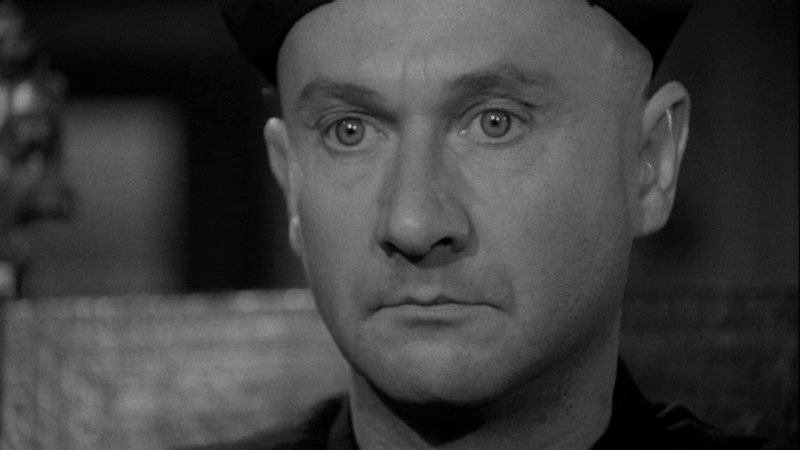
On his dark journey through the city streets (the largest set ever built in New York's Kaufman-Astoria Studios, making this Allen's most expensive film), he runs across an all-star cavalcade of slothful potential victims: a philosophy student (John Cusack) with a weakness for prostitutes (among them Lily Tomlin and Jodie Foster, madamed by Kathy Bates), a circus love-triangle tangentially related (with John Malkovich, Mia Farrow and Madonna) and the town coroner (Donald Pleasence), who has a purely scientific interest in the killer.
*

Kleinman soon realizes that life simply doesn't add up, that a little slippage occurs, especially when it comes to illusion and reality (in the form of a very handy and practical magician named Armstead, played by Kenneth Mars). The film struggles with the dichotomy throughout, as highly contrasted as the black and white photography, never truly meshing, and finally ends, as many of Allen's weaker films—and one of Allen's strongest ones (Hannah and Her Sisters)—do, with a Deus ex Machina
** that buttons everything up inexplicably, leaving no questions but a lot of raised eyebrows.

Which is fine for the purposes of the film, but it's hardly what you'd find in an example of German Expressionism, where the punishment fits the crime...and where things really are in black and white.

* Yes, the film is top-heavy with fine actors (and Madonna), but if you look in the darkened nooks and crannies of the film you'll also find Fred Gwynne, William H. Macy, John C. Reilly, Josef Sommer, Wallace Shawn, Kate Nelligan, Kurtwood Smith and Philip Bosco. Was this film cast or filmed at a SAG convention?

** Here's a question:  It's a Woody Allen film; Can there be a Deus Ex Machina if there's no Deus?

Thursday, March 21, 2019

Hearts of the West

Written at the time of the film'e release...

Caution: there is spoilerage ahead!

Hearts of the West (Howard Zieff, 1975) You've gotta have some kinda admiration for a movie that starts out with dialog you always think of yelling when a movie starts in a jabbering theater: "Allright, people, settle down, please, please!" And then, when we're all settled we are given a screen-test--the illusion (it's all acted, after all) of a reality (screen-tests are "real" world versions of movie illusion) of an illusion (the movie-world that we see on screen).

Through it all stumbles Lewis Tater (
Jeff Bridges), but he does it both in 16mm black and white for the screen-test, but also through the 35mm color for the movie-movie that we, the audience, see. Lewis keeps plunging himself through reality and illusion and multiple layers of the two. Lewis is shown to be a writer writing illusions (his western stories), acts them out (which is also an illusion/delusion, but a reality that they are acted out, but that's also an illusion). He is sent a letter from a Nevada correspondence college (reality) to which he goes to attend classes and hang around campus. His brothers are yokking it up as he tells of his plan because they can't adjust so easily as Lewis to crossing between reality and illusion (if they call the college a "ranch" and use all sorts of western jargon, then it has to be able to teach western writing--it's gotta be for real--but the western jargon is idiotic and hype to the brothers).

So Lewis goes to college. It ain't there. The college is an illusion, but not really, it's there in the form of the real post office boxes ticket agent Dub Taylor points at. The college is an illusion, but it's there in the reality of the boxes. And Taylor talks about it as though it were really there. Tater is thrown out of his funk by a landlady who sets him up for the night. There he can start professing his abilities ("I'm a writer!--also an illusion if you take the words of Howard Pike (Andy Griffith), "You're not a writer 'til somebody tells ya are," for reality--but still Tater writes--he is a writer, whatever his talent) and acting out his illusions of battling desperadoes with an imaginary whip. Then, suddenly illusion becomes reality as he must fight and flee flea-bag desperadoes. He "wanders through the desert, parched and thirsty" turning the reality of his situation into the fantasy of his novels. Who should he wander upon, or who should wander upon him? Real cowboys.
But not real cowboys--movie cowboys. They are, but they are not. Lewis becomes one himself, living out his fantasies on a movie set in an illusion of the West, while (in reality) he is being stalked by the two con-men he has inadvertently robbed. The conflict of reality and illusions abound: Lewis, overcome by his fantasies, going berserk, charging the leading man, extending a "bullet-tearin'-his-gut" death, generally screwing up a scene; the improbably scene where Lewis must pose as a young businessman to get some cash from the bank-notes of the two swindlers at the bank (improbable, but...what is a more interesting situation where a young actor must act a role to gain something, ala Hitchcock's Stage-Fright); Howard pike's "in-the-nick" entrance as he shoots one of the swindlers full of lead--he only shoots imaginary bullets--blanks--which are enough to convince the crook, and us, that he has been shot, especially after Lewis really has been shot (his disbelief that such a thing could really happen exemplified in his "there's a hole in my leg...a round little hole" My God! It isn't pointing your finger and whistling air through your mouth, it's real!), and the final confusion as Tater, led into the ambulance, tells Pike, "What a story this'll be...independent wealth." Reality turned into Fantasy. A complete turn-around from the beginning of the film when Lewis' fantasies became true. Now, the truth will become a story--a fantasy. Lewis' life is now enough to fulfill his need of fantasy and illusion.
Howard Zieff directed Hearts of the West very simply and economically, a habit handed over from his commercial-making days. His Slither, to me, was a vacancy--I can't remember much of it, except that it was paired* with Scarecrow, which at least has Gene Hackman, Al Pacino and Vilmos Zsigmond going for it. And if I've dwelled too long on Rob Thompson's script a bitt too much (a bit?), it is because I found Zieff's direction of this story a trifle pedestrian. Zieff can direct a fine picture for writers, for he doesn't let his direction get too flashy and hurt the story. That's good if ya got a good story like Hearts..., but it you've got an "El Goose-egg" like Slither his direction can't help.

Written December 1, 1975

I had to re-read this several times (and again, even as I was typing this out), and had trouble following it each time. So rather than re-review the movie, I feel like using this space to review the review. It's all too much "theme-paper" analysis assuming that the reader has already seen the film (and that's not a safe assumption, given this particular film) as opposed to being a good summation/review of the particulars for people who, it is assumed, have not seen it, and are making a decision to do so. For example, I give away far too much of the plot, and, again, as this film is not often seen, or even known about (undeservedly so, I think) that's not a good thing. Not a very good review, and not very well-written. An "off" day.
So, perhaps a little summary is in order. Hearts of the West was a fairly-low budget film written by Seattle-based writer Rob Thompson, who, after a long time seeing B-westerns, wrote a screen-play about the early days of film-making--not too long after the time of the cowboy era, really--and of an aspiring writer who lived and dreamed the Old West, or rather the Old West portrayed in pulp-novels and the silent westerns. It was light-hearted, with some dark spots, and a unique voice that set it apart from most other movies being made at the time.
What I remember of Hearts of the West are the performances of Jeff Bridges and Blythe Danner, but especially Andy Griffith (playing a morally ambiguously character after years of squeaky-clean "Mayberry" television work) and more especially Alan Arkin**--all riding-cropped egomania as the director. And I remember the bits of dialog--those sited in the review, like "a ROUND little hole," and "You're not a writer 'til someone says you are" (a favorite of mine), but also his screen-test line "This ain't a ca-tillion!" Rob Thompson the script-writer moved from films to television, and from writing to directing, and his quirky brand of each breathed that atypical freshness to such quirky shows as "Northern Exposure," "Ed," "Monk," and "The Book of Daniel."
It's nice to find entertainment outside of the cookie-cutter.


* This was in the day of double-bills (R.I.P.)

** I love Alan Arkin and his work (and his son's, for that matter). And I came across an interview with Dick Cavett, where he talks about playing this director and he did it in such a way that, in every scene, he was doing the attitude of every director he hated--but a different director in each scene. The characterization is the same ("That would have been a DISASTER!" he says in the interview), but the attitude of each director is different. Alan Arkin amazes me.

Wednesday, October 26, 2016

Eye of the Devil

Eye of the Devil (aka 13, J. Lee Thompson et al., 1966)
Going in cold to Eye of the Devil—its end-credits say that "13" is presented by M-G-M and that was the name of it when released in Europe—you wonder what were the filmmakers trying to achieve. 

The film sports a great cast, and is a middling occult story (although the dialogue is a bit "highfalutin'"), presents a rather amazing location in the Chateau de Hautefort, but undercut by direction that one can only describe as "odd" and off-kilter, and editing that follows a particular beat for no apparent reason, then when it comes to shock moments, cuts away just too soon, so that one can't register what they're seeing. Eye of the Devil is frustrating on very many levels

But probably more for the producer.  More on that later. First, the film.

You start off watching the film by asking the question "why does Deborah Kerr have two children under the age of six?"  It was physically possible, of course (she was 45 at the time of filming), it's just that...well, in movie terms* it doesn't quite skew.  Then, the editing has an odd rhythm, allowing you to hear all the words people are saying, of course, but the natural beats are slightly "off." The camera glides along, cat-like, and BOOM there's an edit that feels uncomfortable or unnecessary given what's transpiring on-screen.

Things unravel as the mysteries deepen and people start to do "movie-logic" things.  For example, David Niven's marquis Phillipe de Montfaucon is called away at a dinner party; it seems the vineyards at his estate are dying and he must make one of his infrequent trips to the old stomping grounds of Bellenac. He explicitly tells his wife Catherine (Kerr) to keep the home fires burning while he goes to tend to things. Trusting him implicitly, she bundles up the kids and drives all the way out there, where she is greeted with all the welcome you'd give to a burning bag of poop at the front door.
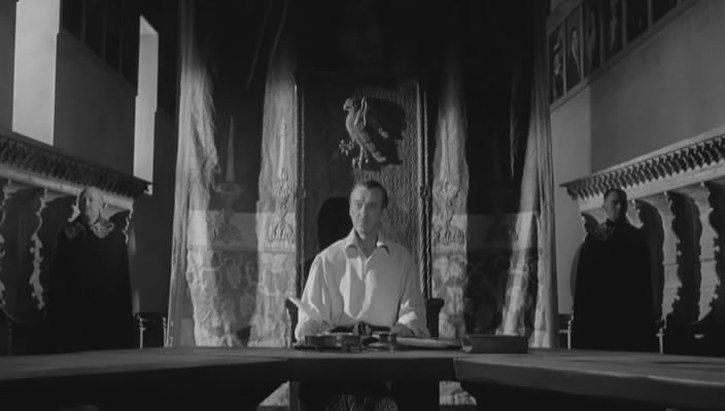
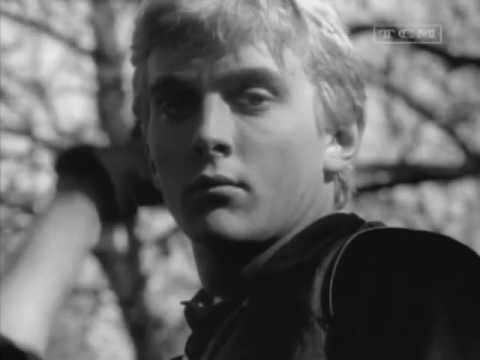
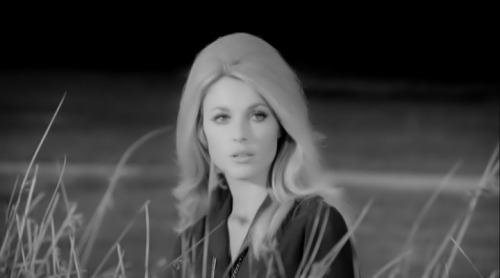
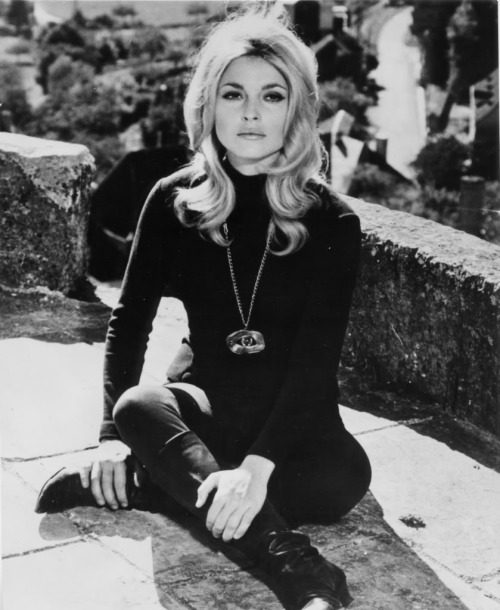
Phillipe's Aunt Estell (the wonderful Flora Robson) is outward-smiles, but suggests that all things are fine (dear), why don't you go home? Then, there are the strange kids hanging around, Christian and Odille de Caray (David Hemmings and "introducing" Sharon Tate, dubbed). Christian thinks nothing of bow-skewing a dove in front of the wife and kids and Odile is all heavily-made-up blond-thing-in-a-black-catsuit (Were they able to watch "The Avengers" in Bellenac?). Then, there's the unwelcome presence of Father Dominic (Donald Pleasence, whose name rhymes with "unwelcome presence," especially in the 1960's), who has the gaze of a psycho and looks like if he ran out of wine, he'd skip a step in the Mass and just serve blood to the parishioners, instead. Plus, Mrs. de Montfaucon has creeping "Rebecca" disease, where the uneasy mistress of the house can't stop poking around all the dark corners and shuttered rooms of the castle. One night, she finds a conclave of robed visitors surrounding her husband in a circle, and frightened, she runs into a mysterious man who tells her to go far, far from here.
Does she?  Nope. Not even when the kids are encouraged to play near the edge of the castle's high parapets by Odile, not when she is nearly sent over the edge herself, and not when she decides to take an impromptu trip to the family mausoleum and finds herself surrounded by those 12 hooded...who-evers. She doesn't get a clue when she finds the word "DEMON" chiseled into the mausoleum's wall.
It's a mess of a film, trying to emulate the Hammer style of occultish films—long entrance to the story, heavy atmospherics, and heaving starlets—and it probably would have been this messy even with the original players. The first director attached was Michael Anderson, then Sidney J. Furie (probably where a lot of the confusion came in, even though it worked well with The Ipcress File), then, briefly Arthur Hiller, then J. Lee Thompson came in to pick up the pieces. When filming started, the cast was in place, but Kim Novak was playing the role of Niven's suspicious wife, and left the production weeks into filming.** Kerr was quickly hired and any frame involving Novak had to be re-shot. There's only so much work-around you can do, and that's why Eye of the Devil looks so odd in presentation. It's a patch-work affair with a good cast and good intentions, but a Frankenstein monster of a script and a completion cut. 

Maybe it belongs in the "Horror" category, after all.

No, really, honey, what was your first clue?


* And when I say "movie terms" I mean the ageist and sexist tropes that go along with film entertainment (and not just Hollywood, folks)—that an older woman can't have younger children, or that older men can't have wives that are older than, say, 20.  Or that older film stars can have mothers who are two years older (or younger) than they are

** "Creative differences." Let's call it that. It was explained away as a back injury from a horse riding scene (Novak is an excellent equestrian and lives with her vet-husband on a horse ranch these days) for insurance purposes. These things are always "he said/she said." Kim Novak is an extremely talented actor, who manages to make the most of material, good, bad and indifferent. She was particular in how she wanted to come across on-camera for the character and that could rankle the front office. But, it is also tough to negotiate the "boy's club" of the picture making industry, and if you want to take control at all, you're considered "difficult."  I'm sure that leaving the production was a difficult decision.  I found this interesting web-site that tells the changing story.