Shadows and Fog(Woody Allen, 1991) When Woody Allen makes a film in the style of Ingmar Bergman (Interiors), it's done in deadly earnest. But, when he takes on German Expressionism, entering the angular world of Lang, Murnau, with a para-nod towards Kafka, it's a comedy. Not quite sure why; maybe he has an affinity towards one stylization and the other he just finds phony, but the different approaches are like, well, day and night. Allen explored that theme—taking the same story and interpreting it as either comedy or tragedy—in Melinda and Melinda, a bit of a mis-fire—but one suspects that the Nordic tradition he buys completely, and completely dismisses the German (God knows why). Here, the visual is pure dread, but the subject matter is a mixed bag of precision and vagueness, comedy and darkness. Allen plays Kleinman, a passive-aggressive bookkeeper, who is recruited in the middle of the night by a vigilante mob (including David Ogden Stiers and James Rebhorn) to roam the streets looking for a serial strangler. Being a professional coward, and only dealing well with facts and figures in black-and-white, Kleinman is ill-suited for the activity and begs off, inviting suspicion from the group. When there is speculation that maybe he won't do his duty as a citizen because he might be the strangler, Kleinman caves.
On his dark journey through the city streets (the largest set ever built in New York's Kaufman-Astoria Studios, making this Allen's most expensive film), he runs across an all-star cavalcade of slothful potential victims: a philosophy student (John Cusack) with a weakness for prostitutes (among them Lily Tomlin and Jodie Foster, madamed by Kathy Bates), a circus love-triangle tangentially related (with John Malkovich, Mia Farrow and Madonna) and the town coroner (Donald Pleasence), who has a purely scientific interest in the killer.*
Kleinman soon realizes that life simply doesn't add up, that a little slippage occurs, especially when it comes to illusion and reality (in the form of a very handy and practical magician named Armstead, played by Kenneth Mars). The film struggles with the dichotomy throughout, as highly contrasted as the black and white photography, never truly meshing, and finally ends, as many of Allen's weaker films—and one of Allen's strongest ones (Hannah and Her Sisters)—do, with a Deus ex Machina**that buttons everything up inexplicably, leaving no questions but a lot of raised eyebrows.
Which is fine for the purposes of the film, but it's hardly what you'd find in an example of German Expressionism, where the punishment fits the crime...and where things really are in black and white.
* Yes, the film is top-heavy with fine actors (and Madonna), but if you look in the darkened nooks and crannies of the film you'll also find Fred Gwynne, William H. Macy, John C. Reilly, Josef Sommer, Wallace Shawn, Kate Nelligan, Kurtwood Smith and Philip Bosco. Was this film cast or filmed at a SAG convention?
** Here's a question: It's a Woody Allen film; Can there be a Deus Ex Machina if there's no Deus?
Written at the time of the film's release. Saturday is traditionally "Take Out the Trash" Day....
"What...Again?!"
These things go in cycles, but every so often someone has to do the "If I Knew Then What I Know Now..." movie. Let's tick off a few, shall we? Big, Freaky Friday, Vice Versa, Like Father Like Son, Peggy Sue Got Married, 18 Again! (with Charlie Schlatter), 17 Again (with Zac Efron), they (and I'm sure I've left one or a dozen out) tell the story of a bitter adult who yearns to go back to the time when they were happy...before all "THAT" happened, and they learn...what, that life wasn't as good as they thought, or they'd probably do the same thing all over again...whatever, their eyes are opened to some basic truths about themselves or their times and that "there's no time like the present." It's the future, get used to it.
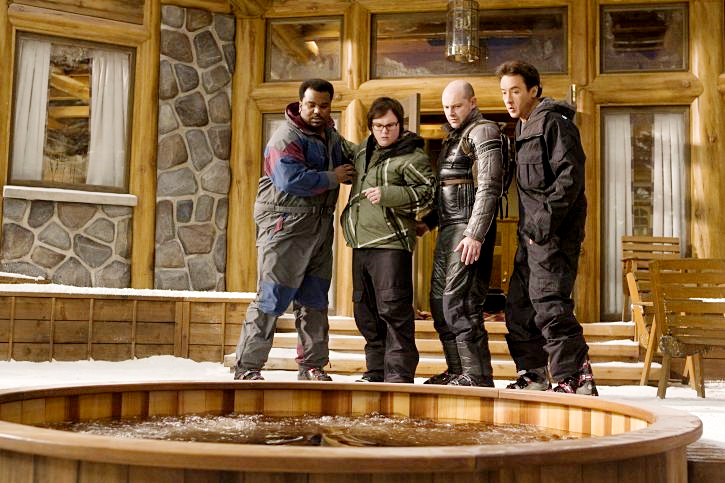
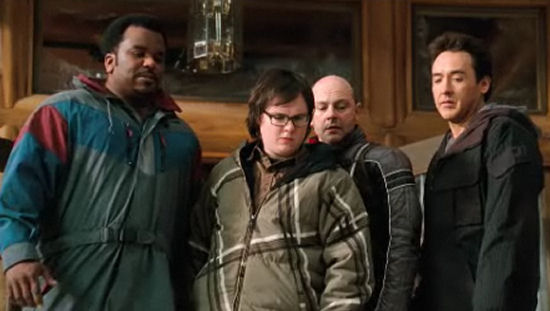
After so many variations (or are they parallel universes) on the theme, we should be used to it by now. Sadly,Hot Tub Time Machineis a roll-back to those films without significantly supplanting that feeling of Déjà vu while seeing it. It actually feels like a been there/done that version of Back to the Future (very much so*) in the process, with only an an upsurge in smut to recommend it. Even the era the quartet goes to (Reagan's 80's) is a recall of the period where these "do-over" films occurred with alarming frequency...again and again.
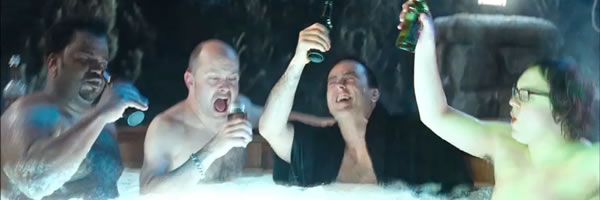
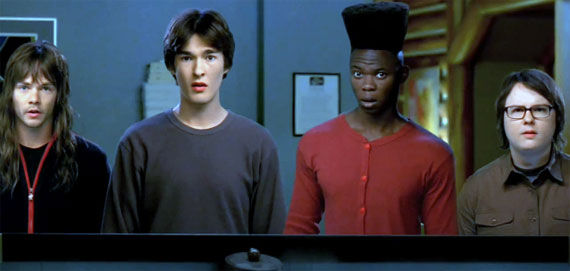
At least the room still has a hot-tub. But a drunken slob-party knocks vodka and an illegal Russian energy drink, Chernoblé, into the hot tub's controls sending the four back to 1986 and that one eventful week-end they'd celebrated before. After that, everything went down-hill for them, so it's conveeeeenient that the HTTM takes them to that one point in time. From then on, it's Big Hair, poofy parkas and leg-warmers, some minor time-goofs, and 80's references around every corner.
Corddry's character comes out strongest,**an anarchic spirit dispirited, a man so debauched that anything and everything can and should be tried if only to feel something, anything from the torpor he suffers from. For him, life is a gateway drug. He learns the valuable lesson: events in time are not fixed, they can be changed. He discovers this, first, to his pain, and then, to his delight, and its his very go-for-broke spirit that "makes things happen," to everybody's advantage. And for a movie guided by John Cusack and directed by Steve Pink (who co-produced the superior Grosse Pointe Blank starring Cusack), the movie adheres to a fairly conservative conclusion, where the entrepreneurial spirit (and a bit of insider-trading prescience) can conquer your inner slacker. W. would be proud.
I wonder if that's what they intended.
From a technical stand-point, the movie's sort of a mess. Oh, it keeps its concurrent time-lines properly creased, but it has the look and feel of an 80's B-movie, not unlike Better Off Dead (also starring Cusack), which felt like it was hurried through (despite a good first half) and then it became a matter of knuckling down and finishing the thing within time and budget...but not inspiration. It has the feel of a low-end TV-movie that could never be shown on TV due to its raunchiness.
It's okay to waste a couple hours on, but, really, don't you have better things to do with YOUR time? You just might want to experiment with your own hot tub to get those hours back.
* Okay, instead of a Delorean Time Machine, this one is another 80's icon, a hot tub. The boys—it is SUCH a boy's movie—must recreate the disastrous weekend they'd experienced: Cusack's character suffers a nasty break-up, while being stabbed with a fork, Cusack's nephew keeps zapping away—rather than fading—if his conception doesn't happen, Richardson's character introduces a song that hasn't happened yet—"but you'll love it" he says—Corddry's character must suffer the same fight-humiliation he originally did, and uses his knowledge of the future to alter events. Crispin Glover's in both films, and Chevy Chase's character could be Doc Bown in disguise. Sure, it could be an "homage," but it plays like a set-piece by set-piece remake—and that was done in Back to the Future, Part II. In fact, the more I think about it, Zemeckis and Gale have a potentially lucrative law-suit brewing. But then it's released through United Artists, so maybe "lucrative" doesn't apply).
** Who comes off the worst is Chevy Chase in an ill-conceived half-idea of an Alternate Reality Hot Tub Maintenance Man. Maybe they thought Chase would add something to the proceedings with some choice ad-libs, but if he did, the part was a real dud to begin with. I kept hoping that he'd be revealed to be Clark Griswold thrown out of the time-space continuum by a Christmas lighting disaster.
Despite what "The Last Word" blurb—at the bottom of the page—says, I don't like writing reviews of bad movies. I just don't. (I don't even like WATCHING bad movies!)
But, I have to admit: I enjoyed writing this one.
Saturday is traditionally "Take Out the Trash" Day.
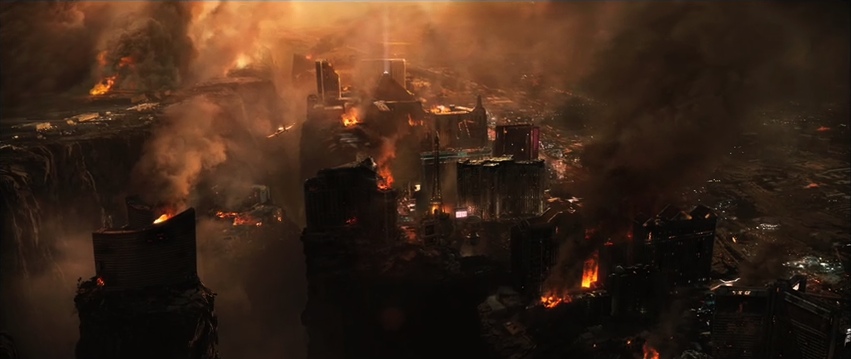
Seventeen special effects companies, including Sony and Digital Domain (two heavy-weights and they're not even the first ones listed) were employed to create the global carnage on display in this flick, and there's still a recession going on. The attention to detail and dedication to photo-realism is the only evidence of professionalism in the enterprise. That's entirely appropriate as the only reason to see this monstrosity is to witness things blow up "real good." That they do.
Los Angeles develops wrinkles and cracks that even Joan Rivers' supply of Retin-A can't erase and schlumpfs into the Pacific. Yellowstone faithfully incinerates in a verrry slow pyroclastic flow that the hero can out-run. Las Vegas becomes the new Grander Canyon (they were going to knock those buildings down anyway!). Hawaii's a volcano (but the surfing's great!). Washington D.C. becomes more chaotic than it already is.
I'll admit it. There is a giddy, monstrous 2-year old's glee in seeing the White House (which Emmerich imploded with a shiny blue destructa-beam in Independence Day) being destroyed again—this time by the aircraft carrier John F. Kennedy, propelled on a Potomac tidal wave (That's about as "high concept" as this film gets). And St. Peter's. Tibet.*All the hots spots become much hotter. The fly-over-and-through of Los Angeles over the splintering clover-leafs and under collapsing buildings is a thrilling roller-coaster ride through Hell with digi-people clinging to collapsing floors, all manner of auto-mayhem and even violence by Rolling Donut sign. But if you were to take out all the countdowns to disaster in 2012 ("We've got five minutes before everything blows!!") and just include the disasters, you'd have a 20 minute highlights reel, rather than a 158 minute poorly written series of contrivances and coincidences.
Now, in this world-wide scenario, everybody in the cast has only one degree of separation to everybody else, so that they can look with surprise at their monitors and intone "Wait! I know that man/woman/dog!" Coincidences are the order of the doomsday, and little dialog goes unmatched without the appropriate chunk of irony whistling through the air and squishing the speakers with a thud. It's the kind of movie where hubby says to wife "I feel like there's something pulling us apart" right before a fissure opens up between them. When St. Peter's Basilica starts to collapse, the cracks split down the Sistine Chapel right between Man and God's fingers. Roland Emmerich is not a subtle director. No man whose ambition is to make a better "Godzilla" movie can be.
And what Emmerich is re-making here is When Worlds Collide,** a 1950's sci-fi flick that imagined Earth hit by another planet, and its treasures, two-by-two's of animals and a lottery-chosen clutch of humans are rocketed off to the convenient companion planet that precedes it. Here, the art is rounded up, libraries accumulated, animals airlifted, and although a lottery is mentioned, the folks who go in the arks are world leaders (naturally), the folks who can afford to pay 1 billion euros per seat, and anyone conniving enough to smuggle themselves on-board. The Best and the Brightest, The Cream of Humanity. Everybody else becomes part of the new petroleum deposits the survivors will profit from in the future.Talk about your disasters. Imagine a world where among the survivors are Dick Cheney, Mahmoud Ahmadinejad, Hugo Chavez, Rod Blagojevich, Paris Hilton, Mike Tyson and Pat Robertson, but no research scientists—not even the guys who invented Post-it Notes! That's a version of Hell even Milton wouldn't have conjured.***
It was at this point, I would have been happy to see everybody die, but no such luck. The last few minutes of the film are disaster heaped upon disaster, with survival dependent on the actions of one man—guess who? But, my concern was what exercises I could find to relieve the pain in my eyes from rolling them so much. They don't sell aspirins at the concession stand. Not even chocolate-covered ones.
Truth be told I don't enjoy writing reviews for bad movies, as there's more inspiration in good ones. But I'll leave it with this quote from the director (in a New York Times profile by Tyler Gray) complaining about people's reactions to his making a film like 2012 in a "post-9/11 environment."
Our world is fine, Rollie, no thanks to you. But it says your priorities are really shitty.
And the only way to make it good to us is to make all your digital models of people caught in wholesale slaughter based on your likeness.
Verstehen sie?
Verstehen sie nicht.
****
"thoughts and prayers..."
* But not Mecca. Fatwa's need not apply. Kinda lily-livered of Emmerich to not risk personal destruction when destroying the world for his art. Don't they have "sins of omission" in Islam?
** And just our luck, that master of the cinematic form Stephen Sommers (The Mummy, Van Helsing, G.I. Joe: The Rise of Cobra) is making his own direct re-make of "When Worlds Collide" to be released in 2010. Oh, the joy. (As of 2023, IMDB lists it as still "In Develpment").
*** Not to politicize too much (or think, God help me) but given the Ark scenario envisioned by the movie, with the whole "two-by-two" concept, I'm imagining the passenger list is restricted to "breeders," meaning there are no gays and lesbians on the boats. Emmerich is gay. What is he thinking?
**** Part of the mission of these reviews is to promote the theatrical experience when it is deemed important to the presentation of the story. It is tempting to say that "The Big Screen" is the only way to watch 2012, because there are so many little demons in the details. But, no. The story is so lunk-headed and gleefully clap-happy nihilistic that the best presentation is merely putting a bow on a cess-pool.
Rock Me, Amadeus or Bravo Vibrato (Good and Bad, Heroes and Villains)
The other night I was casting around looking for something—anything—on television and landed on a PBS fund-raising version of "SoundStage" featuring "Brain Wilson and Friends," in conjunction with the release of his new album "No Pier Pressure" (heh...the promo is below) and the opening vocal harmony ("Our Prayer" from "Smile") raised the hairs on the back of my neck. It had the "Beach Boys" sound of blended harmonies, but had a melancholy, respectful air that moves the soul, a heady miasma of nostalgia and renewal. It's a revelation. Wilson, back in the time of "The Beach Boys," had far more "reach" than his fellow band-mates, who might have been content with surfing and car songs. But, while they were out on tour protecting the brand, recycling their hits over and over, Wilson moved beyond singer-songwriter and became what he was unofficially, anyway: producer. It was Wilson who came up with those "pet" sounds, odd combinations of instruments and timbres with their bizarre harmonics...that worked. It was revolutionary stuff, but had a childhood relatability that invited you in and imprinted themselves in your mind. His songs never go away...from the mind, from the heart, leavened with a look backwards, of nostalgia, upbeat still, but with grace-notes of regret.
Wilson is our Mozart—if Mozart had written about California beaches, girls and bikinis (which I'm sure he would have if he was ever made aware of them). Wilson's music was always several cuts above the standard "Beach Boys" fare, as his songs were fueled by serotonin, as opposed to testosterone. There was ambition in his songs, in the conception and production of them, ambitions that might not have been accepted in the pop marketplace of the '60's. But that is speculation. After the disappointing sales of his produced "Pet Sounds" album, (rebounded by the #1 hit status of the first release ("Good Vibrations") from their in-production album "Smile," band dissension, nervous record exec's and Wilson's own building insecurities scuttled what was to be the band's (and Wilson's) most ambitious album. For Brian Wilson, it led to creative roadblocks and a deep-ended wipe-out into a depression that he would not emerge from for years.
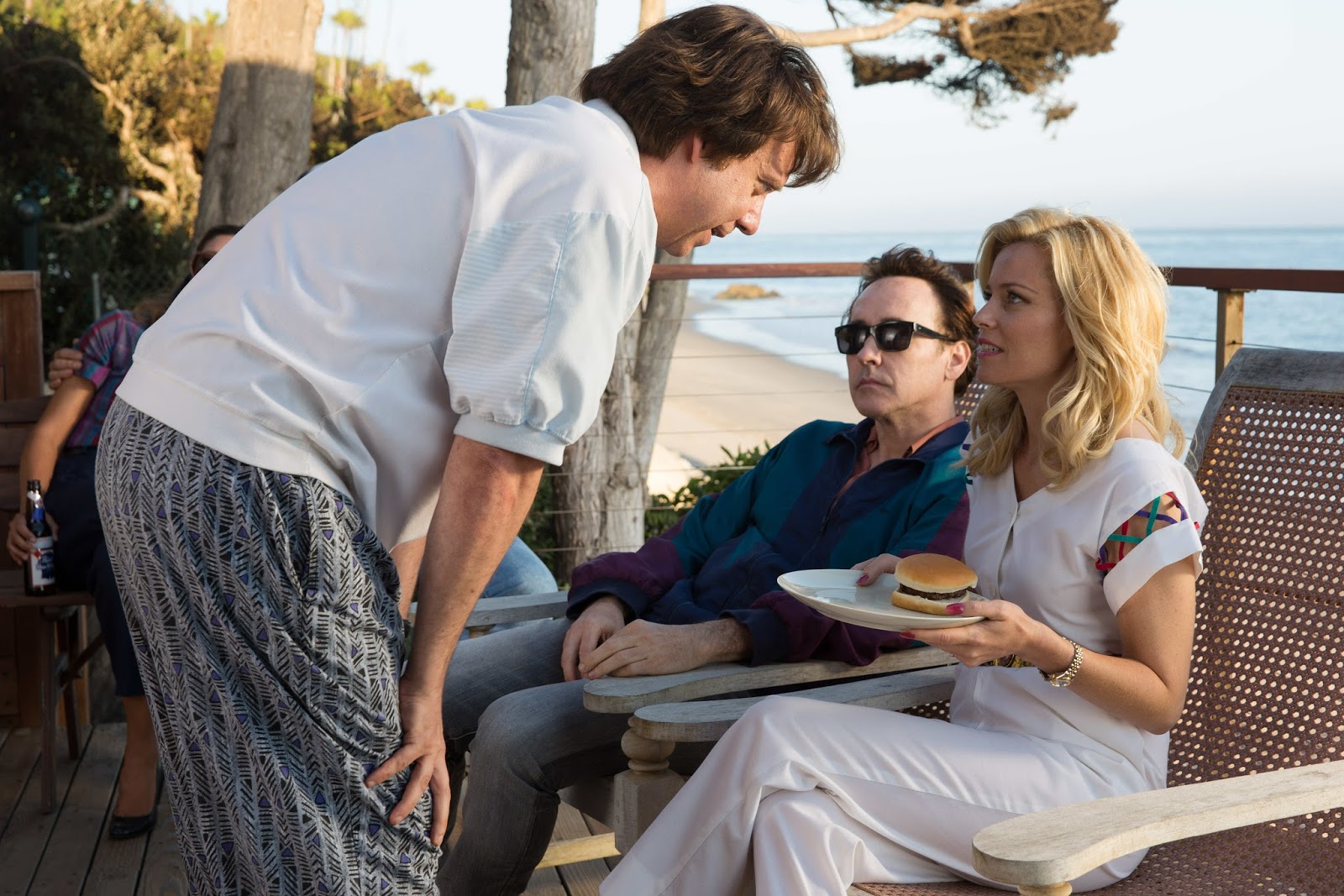
Wilson's story of his fall into and rise out of that depression is the make-up ofLove & Mercy, directed by Bill Pohlad (he's only directed one other feature) and written by Oren Moverman, who also wrote I'm Not There, the episodic Todd Haynes film "about" Bob Dylan, where different actors played aspects of the singer. A simplified version of the same approach is done in Love & Mercy, where Paul Dano plays Wilson pre-breakdown and John Cusack plays him post-breakdown. The results are mixed. But, one thing that is for certain is the eerie way Dano nails Brian Wilson in the heady days of The Beach Boys' success in the 1960's and his subsequent troubles. Dano resembles Wilson, he sounds like him, and captures the puppy-dog optimism of Wilson that percolated through his early songs and melodies, that could easily be shattered in a family crisis, which was inevitable as most of his band-mates were brothers or cousins, his father was their manager and estranged from the boys' mother.
Director Pohlad changes his style in the two movie sections, as well. The Dano segments switch from drama then zip to home-movie vignettes, like a Richard Lester movie. Cusack's segments are much more straight-forward and have far less energy, except from the fireworks provided by the actors—except Cusack. His Brian Wilson is a bit like a sad-eyed automaton, not entirely the actor's fault as Wilson at the time was being heavily medicated (more about that later), but it creates a fissure in the film that ultimately works against it—the segments post-"Smile" with Cusack just aren't as successful as the parts with Dano.
Evidently, there was a conscious decision between Dano and Cusack to not compare notes after their meetings with Wilson and their impressions of him; the actors playing Dylan in I'm Not There didn't confer, either, but the kaleidoscopic Dylan segments in that film aren't connected in any way—not in time, space, or (for that matter) dimension. Love & Mercy no matter its editing dynamic (in this case, going back and forth in time) is still a linear story—the artist went from here to there—so the two actors, so distinctive in look and style, make for an emotional disconnect. That they are two different stories in the same life—Brian's falling into depression, pre-"Smile"—and his rise out of it, offers no balm in that discomfort, it only enhances it. Having a different actor resolve the conflicts of the other leaves a feeling of a story only half-finished.
Cusack's part of the story is the one that is the most heroic, despite that Cusack is passive throughout (and you don't believe he could play, let alone compose, a lick of music). The purchase of a new car puts him in the orbit of car-dealer Melinda Ledbetter (Elizabeth Banks) who doesn't know he's "Brian Wilson of the Beach Boys" (as he will later be introduced)—of course not, he doesn't look a thing like Paul Dano. He's just a guy buying a car, albeit one who leaves a note on her business card saying "Lonely. Scared. Frightened." Before Banks can express her surprise by opening her mouth and blinking twice, into the showroom walks Brian's "minders," as well as Dr. Eugene Landy (played with a glowering malice by Paul Giamatti, acting on all thrusters), who smiles balefully through a tight smile, as he grills Melinda and Brian about what's going on, at the same time his eyes dart back and forth looking for signs of betrayal, his head lowered as if towering above people despite his small stature.
Giamatti's Landy is malevolent piece of work. Festooned in a toupee, he usually starts a conversation by apologizing for his previous behavior, like a bad father trying to retain your good side (and puts him in parallel with Brian's father Murry—played by Bill Camp—both self-important men who end up exploiting and resenting their meal ticket) Landy is Wilson's psychiatrist, life-coach, nutritionist, guru, and disciplinarian, as well as being the current tenant of his house (Brian's in another one and reveals his perpetual silver lining-search by saying "I got to pick my own room.") Landy sees the bond between Melinda and Brian and, in a requested meeting (by him), offers her "unprecedented access—but you've got to work with me." Landy's hold on Wilson is total, controlling what he eats and when, and hectoring Wilson into working at a piano (and taking co-writing credit). He's abusive, humiliating, while keeping his charge dosed on "allergy medications" that leave Wilson nearly catatonic. Landy has had him diagnosed a "paranoid schizophrenic" and while the singer-songwriter does hear voices in his head (usually in harmony), it's a wonder he's not paranoid what with the whole world against him, while lionizing him at the same time.
Except Melinda. For whatever reason, she decides to take on Landy—even when she is banned by him from seeing Wilson. For Brian, it's the end of a long line of using, usery authority figures, and, left alone, he is finally able to think for himself...and what he sees isn't too bad.
It's a great story and truly inspirational for anybody who has suffered clinical depression, as Wilson is an extreme case, crippled by his own need to achieve beyond his limitations and stalemated from being able to reach it, by forces without and within. Yet, there he is, now, in concert before thousands of enraptured fans, mixing old hits and new works (which are great, by the way—check out below) with a band of artists who manage to play his most complicated stuff...and do it live. Wilson finally cracked and completed "Smile" and performed it in concert before committing it to recording and posterity. Amazing. Heroic. He survived his second act and emerged triumphant for a third. His life, itself, is worth a standing ovation, and if Love & Mercy simplifies and homogenizes the depths of his despair for public consumption (as was done with A Beautiful Mind), at least it manages to capture some of the nuances that made the music so memorable the instant it went from Wilson's mind...to ours.
Boo-ray for Hell-y-weird! or They Should Have Called the Town "Phoenix," instead.
Los Angeles is a suitable case for Xanaxing it's water supply in the way they used to fluoridate the waters for tooth decay; the Xanax is for the psychic decay of a town whose whose compass in mainly bi-polar. A town built on incoming heights of hope and the gravely-crushed dreams of the downwardly spiraling, L.A. and its tarty step-sister Hollywood have inspired many a cautionary tale since...well, since they started making movies there. Every decade sees at least one or two poison pen letters to Tinsel-town, be it A Star is Born (three versions), The Day of the Locust, Mulholland Drive,The Oscar,The Player,Barton Fink,S.O.B.,Postcards From the Edge,The Big Knife,Whatever Happened to Baby Jane?(those by Robert Aldrich), and the most revered and stylish,Sunset Boulevard. Those are the most successful, but there have been others by lesser lights, hoping their screeds to the industry would get them noticed—it's that kind of thinking that might be at the root of their discontent. David Cronenberg is the latest to poke the wasp's nest inMaps to the Stars(written by Bruce Wagner, who wrote a Nightmare on Elm Street episode, Scenes from the Class Struggle in Beverly Hills and the TV series "Wild Palms"), which is less about the movie business and what it creates and tears down, and more about the culture (or lack of it) swarming around the business. It's more of a self-contained soap opera that exposes the selfishness, egotism, neuroses, incestuousness, and just plain venality that provides the background stink to the town.*
"How's that therapy working out for ya, hun'?"
Like a soap, it's convoluted. There are two spheres of influence, one is Havana Segrand (Julianne Moore, in the performance that should have won her the Oscar), child-star of a famous movie-star Mom (played by Sarah Gadon as a 20 year old ghost), who is starting to fade and is such a mess of conflicts she can't seem to get them straight—she's vying for a role in a remake of a film her mother starred in, despite the fact that she seems to have invented a past abusive relationship, when the abuse she seems to inhabit are of her own conjuring. Moore plays her with a valley-girl voice and a wild-animal stare that unnerves—one keeps thinking of Lindsey Lohan while watching her, which seems intentional, as the movie is steeped in name-dropping and gossipy in-jokes. She has visions of her mother that appear, only to break her down and throw her into an emotional melt-down.
Her therapist is a self-help guru of enormous ego named Dr. Stafford Weiss (John Cusack), who specializes in what mathematician-comedian Tom Lehrer used to call "diseases of the rich." He's very touchy-feely (especially with stars) and keeps up a running dialogue with them during his sessions—as opposed to them doing the talking—that encourages the wildest surface instincts. Weiss is married to Christina (Olivia Williams), a chain-smoker and manager of the career of their son Benjie (Evan Bird), a child-star with a franchise to keep up and a drug habit to keep down. Negotiations for him to star in the latest of the "Bad Babysitter" series of movies is going well, but things aren't going well for him—he's being haunted by a patient with Hodgkins that he visited in the hospital and subsequently died. Is she a vision of a flash-back—it's hard to differentiate.
And then (speaking of flashbacks) there's daughter Agatha (Mia Wasikowska), who's just come back to L.A. after "being" in Florida for many years. Why she was living there and not with the family is one of the many suspicions that get revealed eventually in the film (but not really revealed, and even then, circumspectly) but there might be some clue given the burns that she hides with her distinctive haircut and the black gloves that she constantly sports. Agatha meets up with a screenwriter/limo-driver—that's his order of importance, anyway, fantasy/reality—(Robert Pattinson) and lands a job as Havana's personal assistant (convenient!), while planning out how she will individually re-unite with her family, none of whom know that she has returned, as she is one of those many subjects the family avoids.
There's a lot of back-story, some of which may be interconnected, but maybe not, but all of which explains why the people populating this movie might be crazy...now. All kinds of crazy, starting with the merely deluded to the criminally insane. Illusion is the normal—in fact, in L.A., it's business as usual—it's reality that no one has a grasp on, by choice or circumstance.
So, what are we to make of this cloistered, desolate finger-trap of a movie that has little to do with the illusion of movie-making, and more to do with the illusions of our own making. Movie-making is an art, even if it's the art of making a deal, but Maps to the Stars is all about lying to ourselves to get by. Just like movie-making, it takes imagination and a lot of work, but that's the extent of it. It is wasted effort. There's no art to kidding ourselves. All it takes is a bubble-world with no perspective other than our own. Movie-making is designed to leave a legacy. The tragedy of Maps to the Stars is that no one gets out alive, without any marker to show their existence
* I've done some work in L.A. and have mostly stayed in the safety of the studios and hotels, rather than do any sight-seeing. The last time I walked down Hollywood Boulevard ("The Walk of the Stars"), I was so appalled, I couldn't get out of there fast enough. Between the hustlers, screwballs, and weirdo's, the place gave off a vibe of cheapness that I've never been able to shake.
 Shadows and Fog (Woody Allen, 1991) When Woody Allen makes a film in the style of Ingmar Bergman (Interiors), it's done in deadly earnest. But, when he takes on German Expressionism, entering the angular world of Lang, Murnau, with a para-nod towards Kafka, it's a comedy. Not quite sure why; maybe he has an affinity towards one stylization and the other he just finds phony, but the different approaches are like, well, day and night. Allen explored that theme—taking the same story and interpreting it as either comedy or tragedy—in Melinda and Melinda, a bit of a mis-fire—but one suspects that the Nordic tradition he buys completely, and completely dismisses the German (God knows why).




.jpg)


.jpg)